Program design and
analysis
mr.C.KARTHIKEYAN
AP/ECE/RMKCET
Program design and
analysis
Program-level performance analysis.
Optimizing for:
Execution time.
Energy/power.
Program size.
Program validation and testing.
Program-level performance
analysis
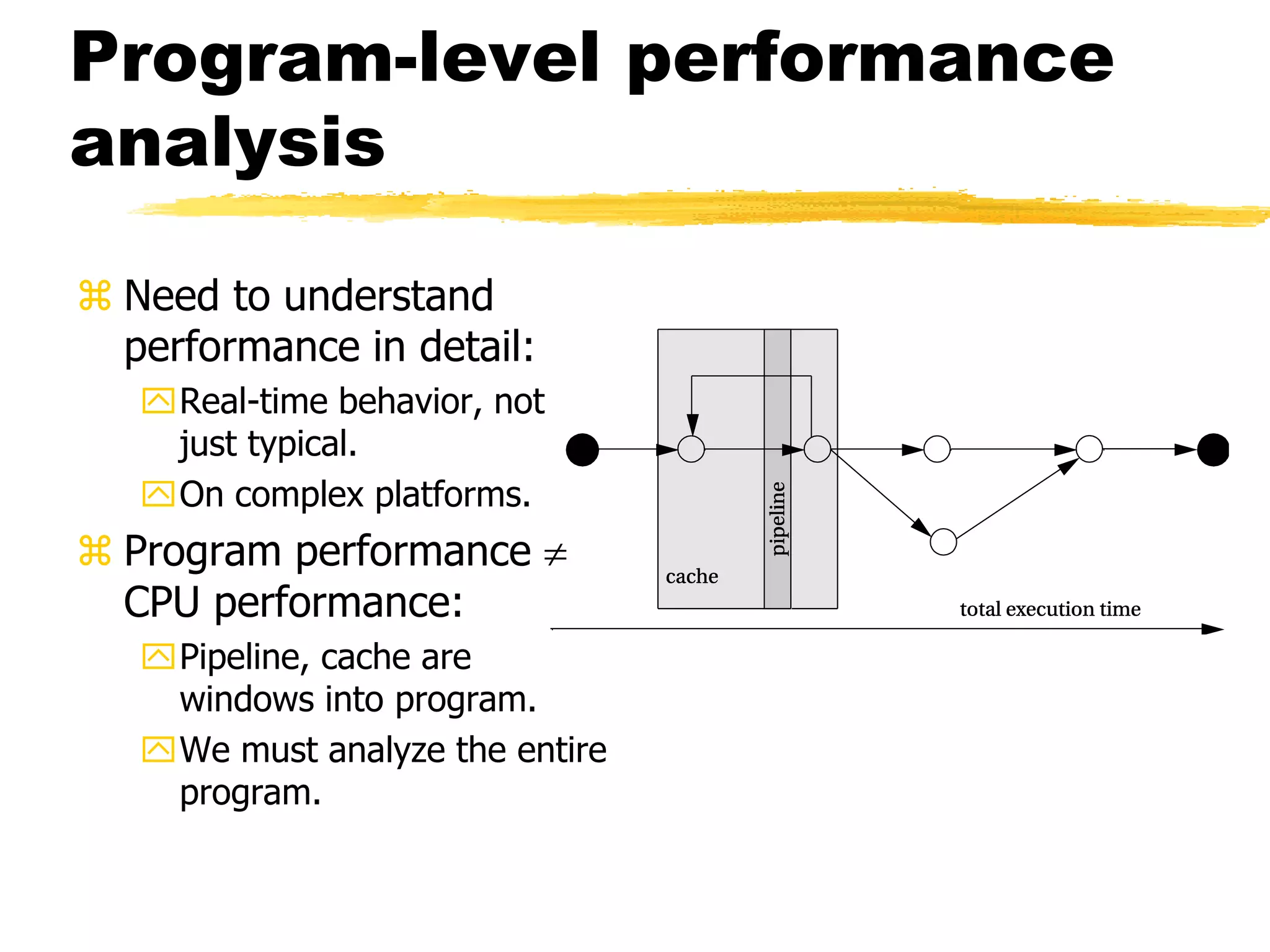
 Need to understand
performance in detail:
Real-time behavior, not
just typical.
On complex platforms.
 Program performance 
CPU performance:
Pipeline, cache are
windows into program.
We must analyze the entire
program.
Complexities of program
performance
Varies with input data:
Different-length paths.
Cache effects.
Instruction-level performance variations:
Pipeline interlocks.
Fetch times.
How to measure program
performance
Simulate execution of the CPU.
Makes CPU state visible.
Measure on real CPU using timer.
Requires modifying the program to control
the timer.
Measure on real CPU using logic analyzer.
Requires events visible on the pins.
Program performance
metrics
Average-case execution time.
Typically used in application programming.
Worst-case execution time.
A component in deadline satisfaction.
Best-case execution time.
Task-level interactions can cause best-case
program behavior to result in worst-case
system behavior.
Elements of program
performance
Basic program execution time formula:
execution time = program path + instruction timing
Solving these problems independently helps
simplify analysis.
Easier to separate on simpler CPUs.
Accurate performance analysis requires:
Assembly/binary code.
Execution platform.
Data-dependent paths in
an if statement
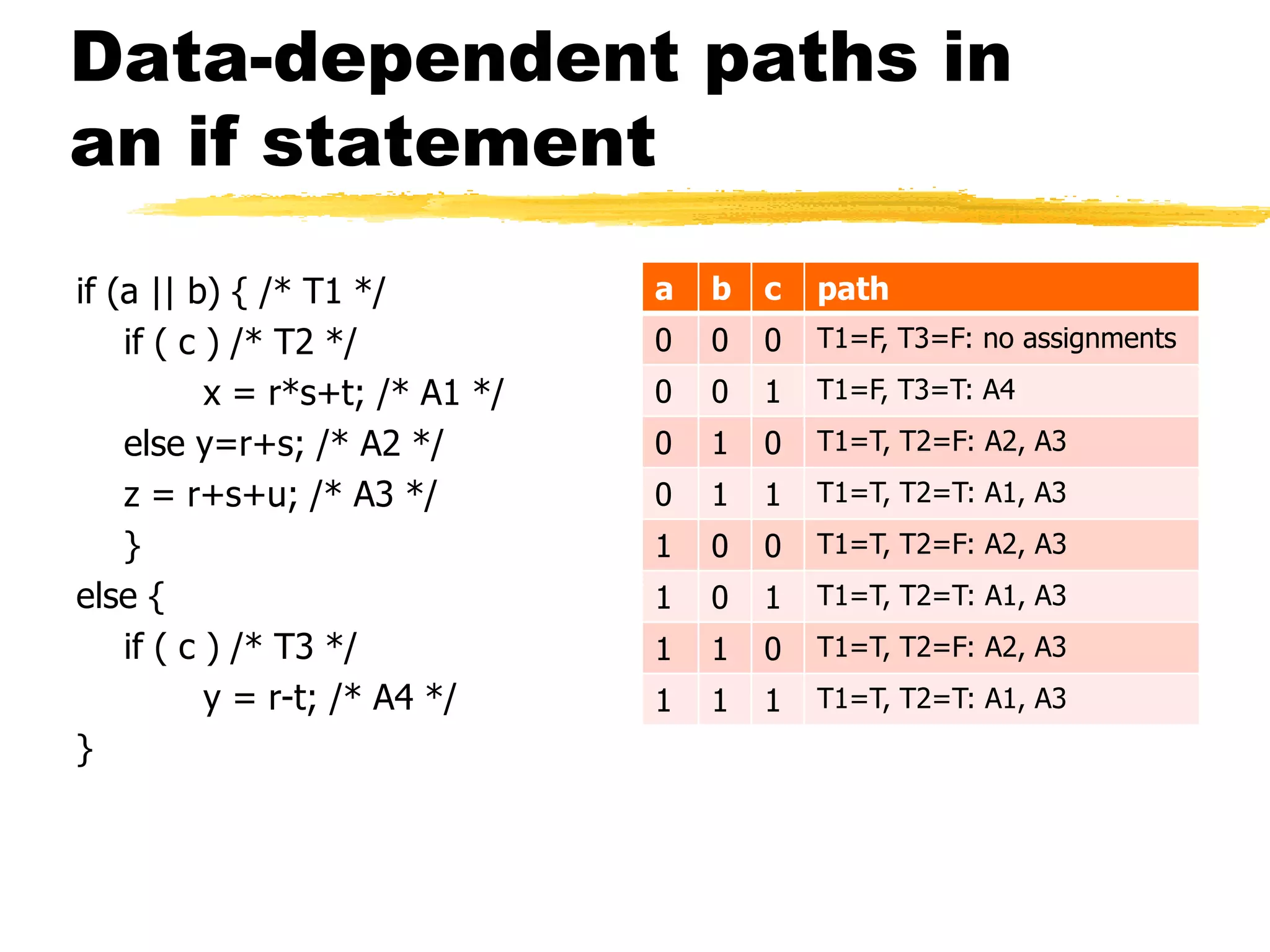
if (a || b) { /* T1 */
if ( c ) /* T2 */
x = r*s+t; /* A1 */
else y=r+s; /* A2 */
z = r+s+u; /* A3 */
}
else {
if ( c ) /* T3 */
y = r-t; /* A4 */
}
a b c path
0 0 0 T1=F, T3=F: no assignments
0 0 1 T1=F, T3=T: A4
0 1 0 T1=T, T2=F: A2, A3
0 1 1 T1=T, T2=T: A1, A3
1 0 0 T1=T, T2=F: A2, A3
1 0 1 T1=T, T2=T: A1, A3
1 1 0 T1=T, T2=F: A2, A3
1 1 1 T1=T, T2=T: A1, A3
Paths in a loop
for (i=0, f=0; i<N; i++)
f = f + c[i] * x[i];
i=0
f=0
i=N
f = f + c[i] * x[i]
i = i + 1
N
Y
Instruction timing
 Not all instructions take the same amount of time.
Multi-cycle instructions.
Fetches.
 Execution times of instructions are not independent.
Pipeline interlocks.
Cache effects.
 Execution times may vary with operand value.
Floating-point operations.
Mesaurement-driven
performance analysis
Program trace
Simulator
H/S
Profiling-it counts the no. of times that
procedures or basic blocks I the program
are executed
Physical measurement
In-circuit emulator allows tracing.
Affects execution timing.
Logic analyzer can measure behavior at pins.
Address bus can be analyzed to look for events.
Code can be modified to make events visible.
Particularly important for real-world input
streams.
CPU simulation
Some simulators are less accurate.
Cycle-accurate simulator provides
accurate clock-cycle timing.
Simulator models CPU internals.
Simulator writer must know how CPU works.
Performance optimization
motivation
Embedded systems must often meet
deadlines.
Faster may not be fast enough.
Need to be able to analyze execution
time.
Worst-case, not typical.
Need techniques for reliably improving
execution time.
Programs and performance
analysis
Best results come from analyzing
optimized instructions, not high-level
language code:
non-obvious translations of HLL statements
into instructions;
code may move;
cache effects are hard to predict.
SOFTWARE PERFORMNACE OPTIMIZATION
Loop optimizations
Loops are good targets for optimization.
Basic loop optimizations:
code motion;
induction-variable elimination;
strength reduction (x*2 -> x<<1).
Code motion
BEFORE OPTIMIZATION
for (i=0, f=0; i<N; i++)
{
x=y+z;
a[i]=6*i;
}
AFTER OPTIMIZATION
x=y+z;
for (i=0, f=0; i<N; i++)
{
a[i]=6*I;
}
Induction variable
elimination (nested loop)
BEFORE OPTIMIZATION
for (i=0; i<N; i++)
{
for (j=0; j<M; j++)
{
z[i] [j]= b[i] [j];
}
}
AFTER OPTIMIZATION
for (i=0; i<N; i++)
for (j=0; j<M; j++)
{
Zbinduct = i*M+j;
*(Zptr+Zbinduct)=*(bptr+
Z binduct);
}
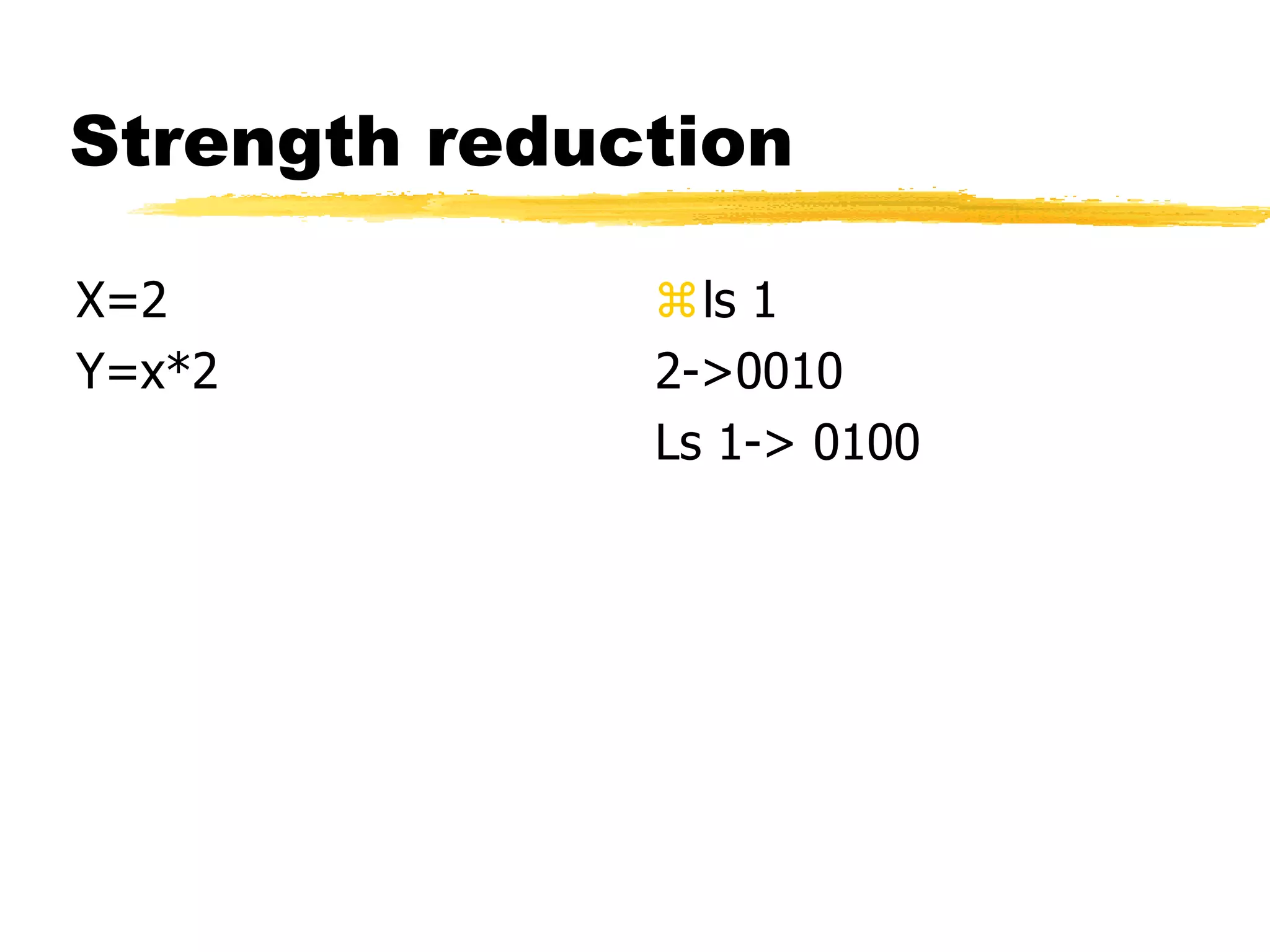
Strength reduction
X=2
Y=x*2
ls 1
2->0010
Ls 1-> 0100
Cache analysis
Loop nest: set of loops, one inside other.
Perfect loop nest: no conditionals in nest.
Because loops use large quantities of
data, cache conflicts are common.
Array conflicts in cache
a[0,0]
b[0,0]
main memory cache
1024 4099
...
1024
4099
Array conflicts, cont’d.
Array elements conflict because they are
in the same line, even if not mapped to
same location.
Solutions:
move one array;
pad array.
Performance optimization
hints
Use registers efficiently.
Use page mode memory accesses.
Analyze cache behavior:
instruction conflicts can be handled by
rewriting code, rescheudling;
conflicting array data can be moved, padded.
PROGRAM LEVEL ENERGY AND POWER
ANALYSIS OPTIMIZATION
Energy/power optimization
Energy: ability to do work.
Most important in battery-powered systems.
Power: energy per unit time.
Important even in wall-plug systems---power
becomes heat.
Measuring energy
consumption
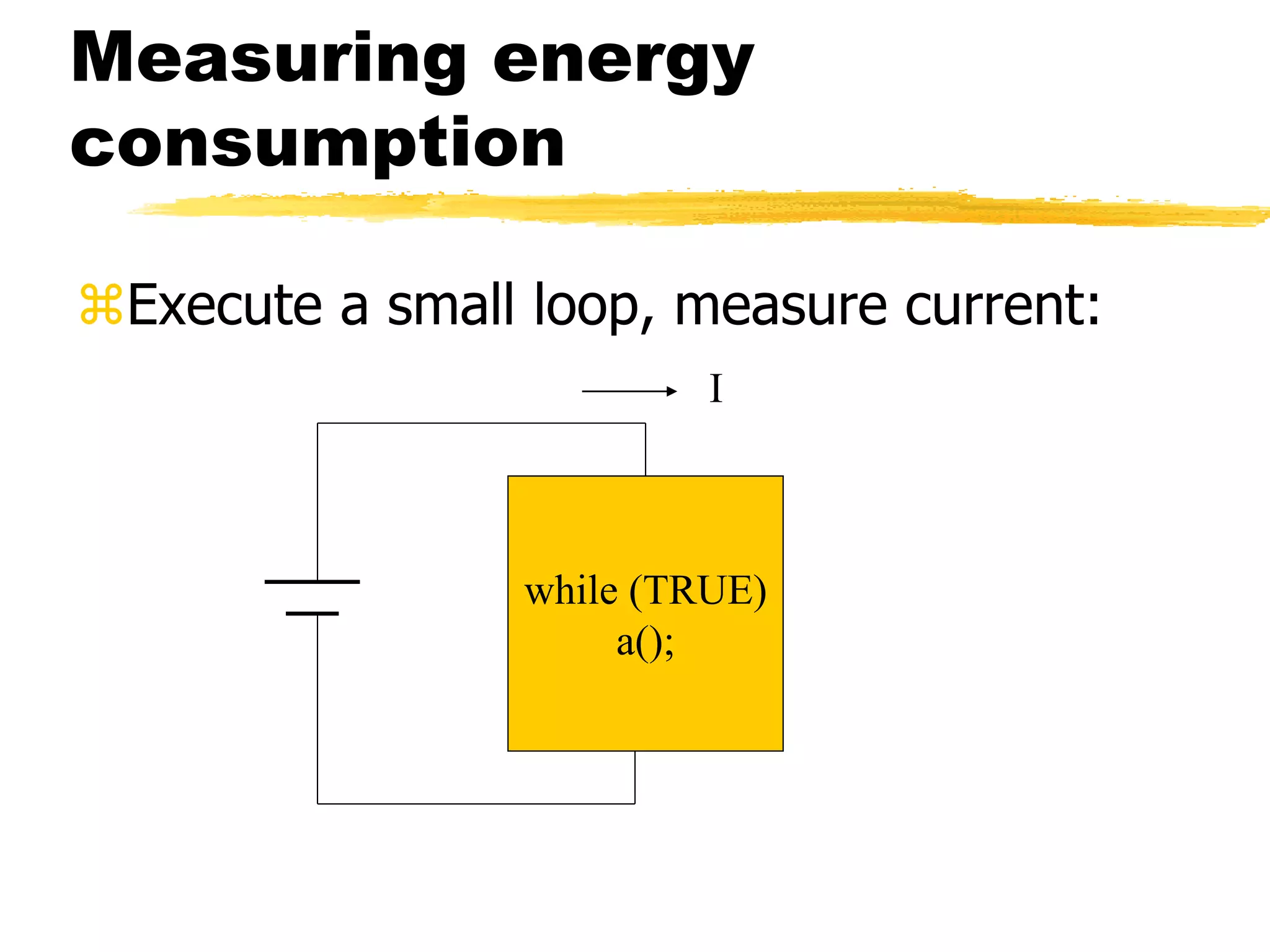
Execute a small loop, measure current:
while (TRUE)
a();
I
Cache behavior is
important
Energy consumption has a sweet spot as
cache size changes:
cache too small: program thrashes, burning
energy on external memory accesses;
cache too large: cache itself burns too much
power.
Optimizing for energy
First-order optimization:
high performance = low energy.
Not many instructions trade speed for
energy.
Optimizing for energy,
cont’d.
Use registers efficiently.
Identify and eliminate cache conflicts.
Moderate loop unrolling eliminates some
loop overhead instructions.
Eliminate pipeline stalls.
Inlining procedures may help: reduces
linkage, but may increase cache
thrashing.
ANALYSIS AND OPTIMIZATION OF
PROGRAM SIZE
Optimizing for program
size
Goal:
reduce hardware cost of memory;
reduce power consumption of memory units.
Two opportunities:
data;
instructions.
Data size minimization
Reuse constants, variables, data buffers in
different parts of code.
Requires careful verification of correctness.
Encapsulating functions in subroutines when
done carefully can reduce program size
PROGRAM VALIDATION AND
TESTING
Program validation and
testing
Concentrate here on functional verification.
Major testing strategies:
Black box doesn’t look at the source code.
Clear box (white box) does look at the
source code.
Clear-box testing
Examine the source code to determine whether
it works:
Can you actually exercise a path?
Do you get the value you expect along a path?
Testing procedure:
Controllability: rovide program with inputs.
Execute.
Observability: examine outputs.
Execution paths and
testing
Paths are important in functional testing
as well as performance analysis.
In general, an exponential number of
paths through the program.
Show that some paths dominate others.
Heuristically limit paths.
Choosing the paths to test
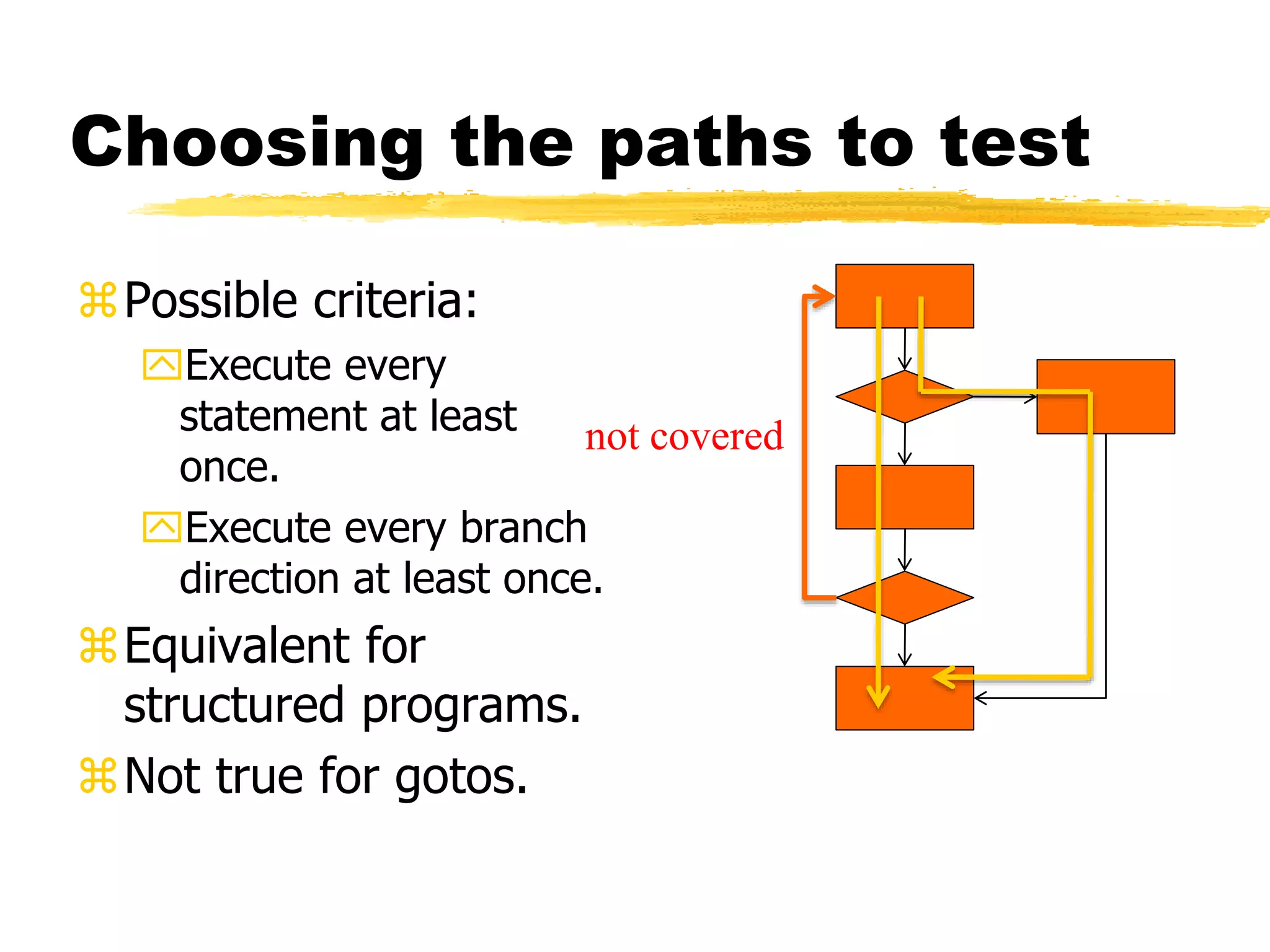
Possible criteria:
Execute every
statement at least
once.
Execute every branch
direction at least once.
Equivalent for
structured programs.
Not true for gotos.
not covered
Basis paths
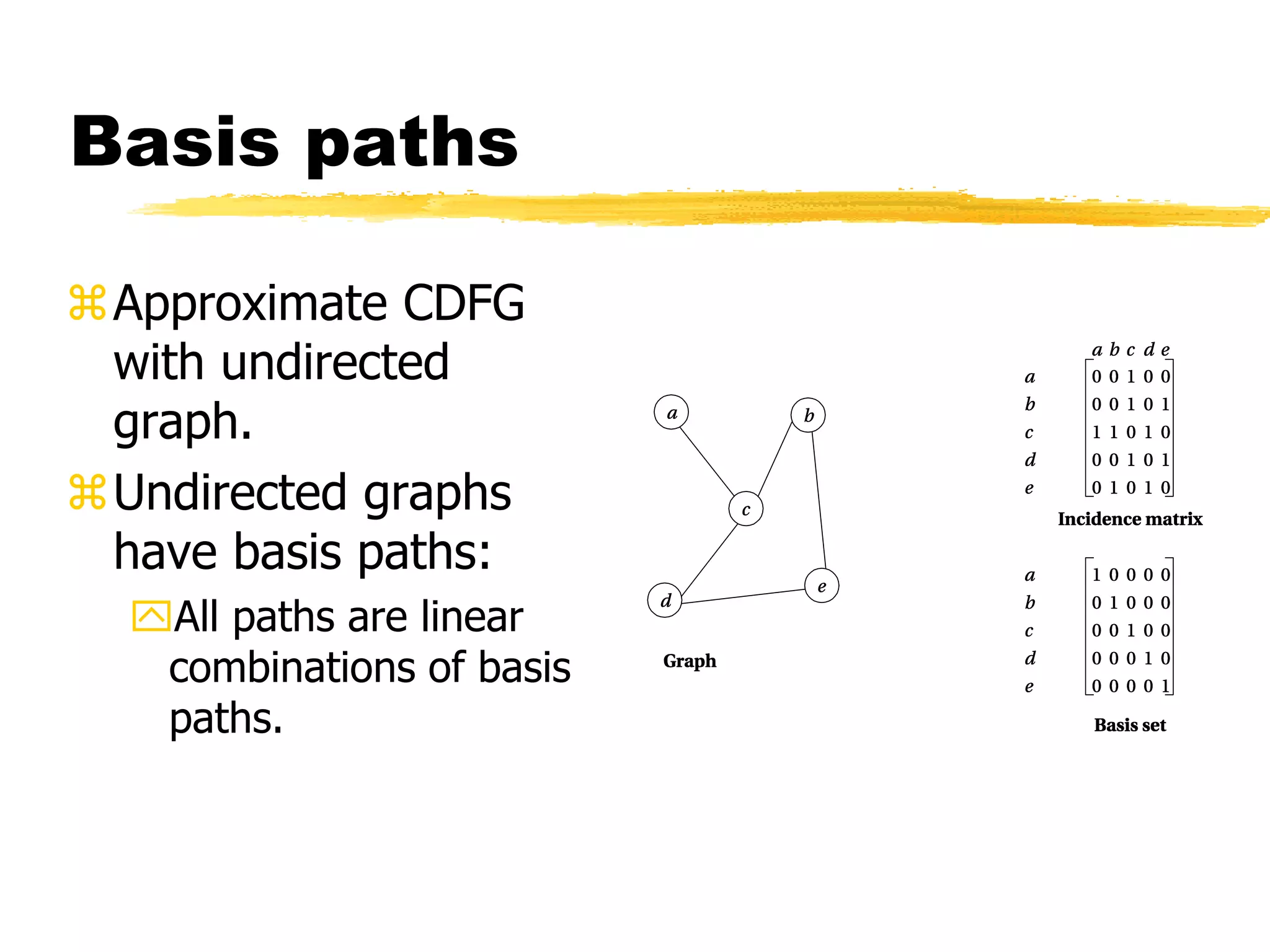
Approximate CDFG
with undirected
graph.
Undirected graphs
have basis paths:
All paths are linear
combinations of basis
paths.
Cyclomatic complexity
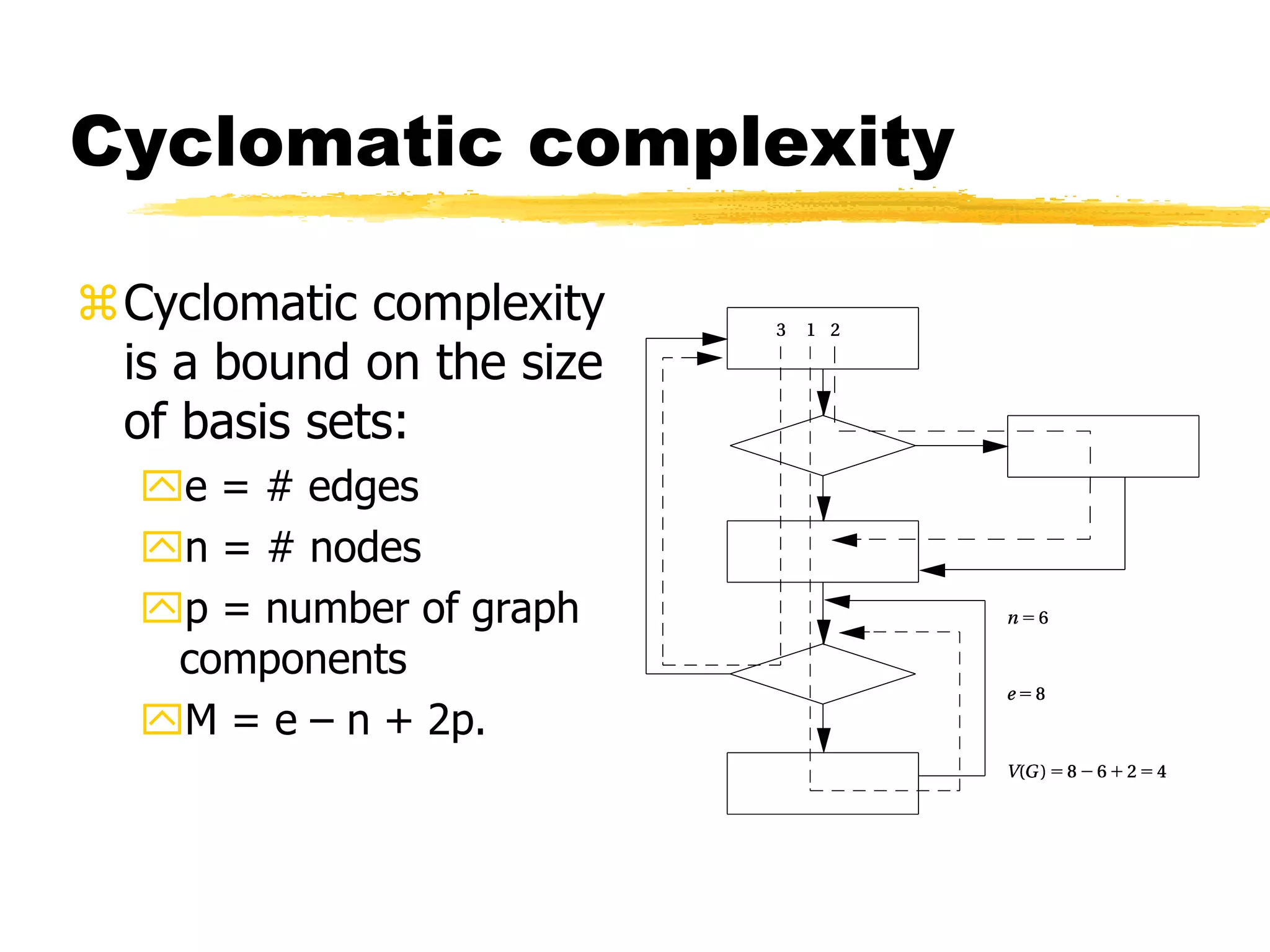
Cyclomatic complexity
is a bound on the size
of basis sets:
e = # edges
n = # nodes
p = number of graph
components
M = e – n + 2p.
Branch testing
Heuristic for testing branches.
Exercise true and false branches of
conditional.
Exercise every simple condition at least once.
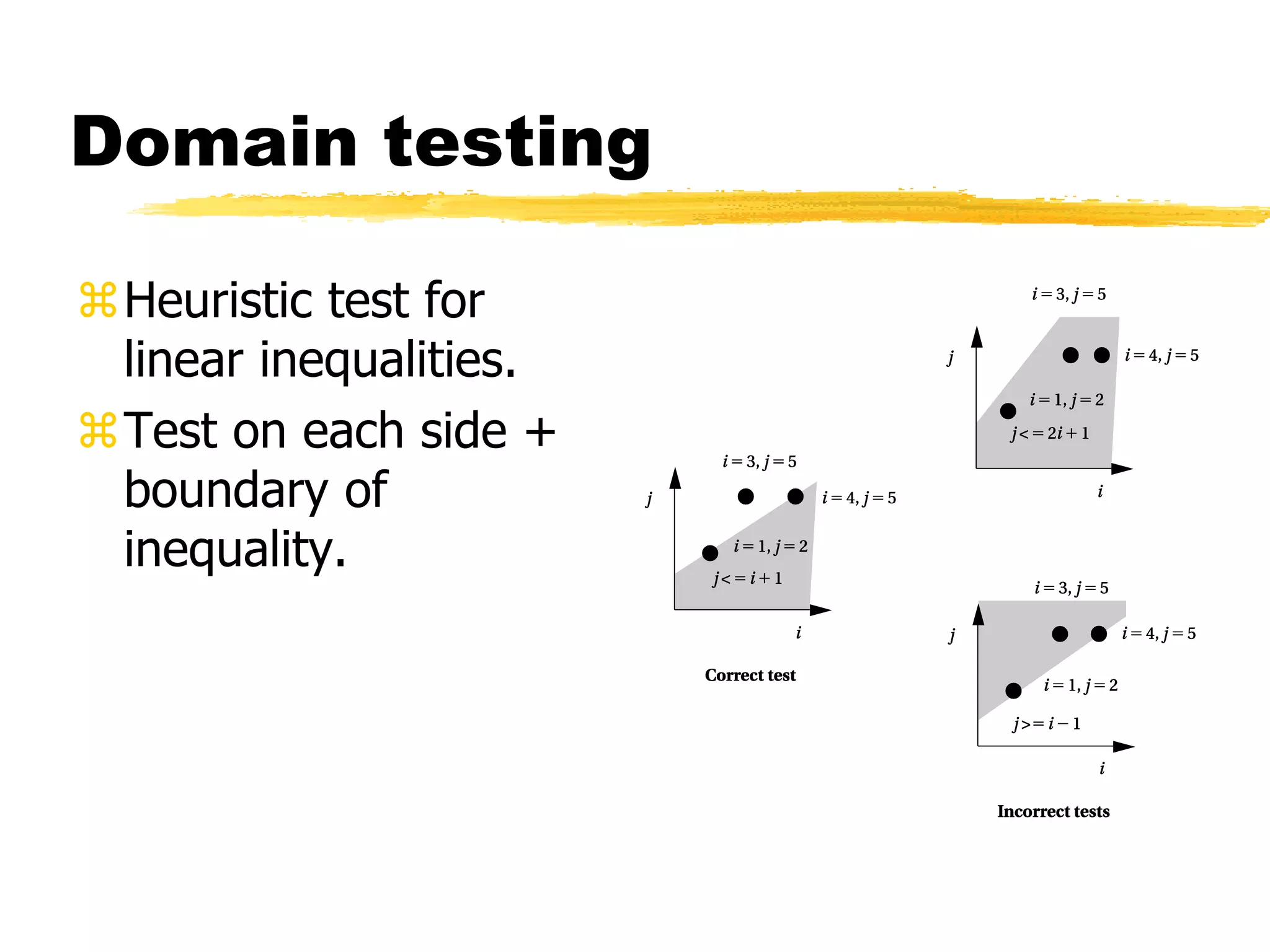
Domain testing
Heuristic test for
linear inequalities.
Test on each side +
boundary of
inequality.
Def-use pairs
Variable def-use:
Def when value is
assigned (defined).
Exercise each def-use
pair.
Loop testing
Loops need specialized tests to be tested
efficiently.
Heuristic testing strategy:
Skip loop entirely.
One loop iteration.
Two loop iterations.
# iterations much below max.
n-1, n, n+1 iterations where n is max.
Black-box testing
Complements clear-box testing.
May require a large number of tests.
Tests software in different ways.
Black-box test vectors
Random tests.
May weight distribution based on software
specification.
Regression tests.
Tests of previous versions, bugs, etc.
May be clear-box tests of previous versions.
What atlast?
 Must have the knowledge of compiler opt.
 Well worse in Embedded C
 To interpret the data structures whenever needed
 Must know the DFG and CDFG
 Wide knowledge on processor (target)
 Techniques in prog optimization
 Develop the code which occupies less memory space
with much features
 Smart usage of loops in the code

Unit 3 part2

  • 1.
  • 2.
    Program design and analysis Program-levelperformance analysis. Optimizing for: Execution time. Energy/power. Program size. Program validation and testing.
  • 3.
    Program-level performance analysis  Needto understand performance in detail: Real-time behavior, not just typical. On complex platforms.  Program performance  CPU performance: Pipeline, cache are windows into program. We must analyze the entire program.
  • 4.
    Complexities of program performance Varieswith input data: Different-length paths. Cache effects. Instruction-level performance variations: Pipeline interlocks. Fetch times.
  • 5.
    How to measureprogram performance Simulate execution of the CPU. Makes CPU state visible. Measure on real CPU using timer. Requires modifying the program to control the timer. Measure on real CPU using logic analyzer. Requires events visible on the pins.
  • 6.
    Program performance metrics Average-case executiontime. Typically used in application programming. Worst-case execution time. A component in deadline satisfaction. Best-case execution time. Task-level interactions can cause best-case program behavior to result in worst-case system behavior.
  • 7.
    Elements of program performance Basicprogram execution time formula: execution time = program path + instruction timing Solving these problems independently helps simplify analysis. Easier to separate on simpler CPUs. Accurate performance analysis requires: Assembly/binary code. Execution platform.
  • 8.
    Data-dependent paths in anif statement if (a || b) { /* T1 */ if ( c ) /* T2 */ x = r*s+t; /* A1 */ else y=r+s; /* A2 */ z = r+s+u; /* A3 */ } else { if ( c ) /* T3 */ y = r-t; /* A4 */ } a b c path 0 0 0 T1=F, T3=F: no assignments 0 0 1 T1=F, T3=T: A4 0 1 0 T1=T, T2=F: A2, A3 0 1 1 T1=T, T2=T: A1, A3 1 0 0 T1=T, T2=F: A2, A3 1 0 1 T1=T, T2=T: A1, A3 1 1 0 T1=T, T2=F: A2, A3 1 1 1 T1=T, T2=T: A1, A3
  • 9.
    Paths in aloop for (i=0, f=0; i<N; i++) f = f + c[i] * x[i]; i=0 f=0 i=N f = f + c[i] * x[i] i = i + 1 N Y
  • 10.
    Instruction timing  Notall instructions take the same amount of time. Multi-cycle instructions. Fetches.  Execution times of instructions are not independent. Pipeline interlocks. Cache effects.  Execution times may vary with operand value. Floating-point operations.
  • 11.
    Mesaurement-driven performance analysis Program trace Simulator H/S Profiling-itcounts the no. of times that procedures or basic blocks I the program are executed
  • 12.
    Physical measurement In-circuit emulatorallows tracing. Affects execution timing. Logic analyzer can measure behavior at pins. Address bus can be analyzed to look for events. Code can be modified to make events visible. Particularly important for real-world input streams.
  • 13.
    CPU simulation Some simulatorsare less accurate. Cycle-accurate simulator provides accurate clock-cycle timing. Simulator models CPU internals. Simulator writer must know how CPU works.
  • 14.
    Performance optimization motivation Embedded systemsmust often meet deadlines. Faster may not be fast enough. Need to be able to analyze execution time. Worst-case, not typical. Need techniques for reliably improving execution time.
  • 15.
    Programs and performance analysis Bestresults come from analyzing optimized instructions, not high-level language code: non-obvious translations of HLL statements into instructions; code may move; cache effects are hard to predict.
  • 16.
  • 17.
    Loop optimizations Loops aregood targets for optimization. Basic loop optimizations: code motion; induction-variable elimination; strength reduction (x*2 -> x<<1).
  • 18.
    Code motion BEFORE OPTIMIZATION for(i=0, f=0; i<N; i++) { x=y+z; a[i]=6*i; } AFTER OPTIMIZATION x=y+z; for (i=0, f=0; i<N; i++) { a[i]=6*I; }
  • 19.
    Induction variable elimination (nestedloop) BEFORE OPTIMIZATION for (i=0; i<N; i++) { for (j=0; j<M; j++) { z[i] [j]= b[i] [j]; } } AFTER OPTIMIZATION for (i=0; i<N; i++) for (j=0; j<M; j++) { Zbinduct = i*M+j; *(Zptr+Zbinduct)=*(bptr+ Z binduct); }
  • 20.
  • 21.
    Cache analysis Loop nest:set of loops, one inside other. Perfect loop nest: no conditionals in nest. Because loops use large quantities of data, cache conflicts are common.
  • 22.
    Array conflicts incache a[0,0] b[0,0] main memory cache 1024 4099 ... 1024 4099
  • 23.
    Array conflicts, cont’d. Arrayelements conflict because they are in the same line, even if not mapped to same location. Solutions: move one array; pad array.
  • 24.
    Performance optimization hints Use registersefficiently. Use page mode memory accesses. Analyze cache behavior: instruction conflicts can be handled by rewriting code, rescheudling; conflicting array data can be moved, padded.
  • 25.
    PROGRAM LEVEL ENERGYAND POWER ANALYSIS OPTIMIZATION
  • 26.
    Energy/power optimization Energy: abilityto do work. Most important in battery-powered systems. Power: energy per unit time. Important even in wall-plug systems---power becomes heat.
  • 27.
    Measuring energy consumption Execute asmall loop, measure current: while (TRUE) a(); I
  • 28.
    Cache behavior is important Energyconsumption has a sweet spot as cache size changes: cache too small: program thrashes, burning energy on external memory accesses; cache too large: cache itself burns too much power.
  • 29.
    Optimizing for energy First-orderoptimization: high performance = low energy. Not many instructions trade speed for energy.
  • 30.
    Optimizing for energy, cont’d. Useregisters efficiently. Identify and eliminate cache conflicts. Moderate loop unrolling eliminates some loop overhead instructions. Eliminate pipeline stalls. Inlining procedures may help: reduces linkage, but may increase cache thrashing.
  • 31.
  • 32.
    Optimizing for program size Goal: reducehardware cost of memory; reduce power consumption of memory units. Two opportunities: data; instructions.
  • 33.
    Data size minimization Reuseconstants, variables, data buffers in different parts of code. Requires careful verification of correctness. Encapsulating functions in subroutines when done carefully can reduce program size
  • 34.
  • 35.
    Program validation and testing Concentratehere on functional verification. Major testing strategies: Black box doesn’t look at the source code. Clear box (white box) does look at the source code.
  • 36.
    Clear-box testing Examine thesource code to determine whether it works: Can you actually exercise a path? Do you get the value you expect along a path? Testing procedure: Controllability: rovide program with inputs. Execute. Observability: examine outputs.
  • 37.
    Execution paths and testing Pathsare important in functional testing as well as performance analysis. In general, an exponential number of paths through the program. Show that some paths dominate others. Heuristically limit paths.
  • 38.
    Choosing the pathsto test Possible criteria: Execute every statement at least once. Execute every branch direction at least once. Equivalent for structured programs. Not true for gotos. not covered
  • 39.
    Basis paths Approximate CDFG withundirected graph. Undirected graphs have basis paths: All paths are linear combinations of basis paths.
  • 40.
    Cyclomatic complexity Cyclomatic complexity isa bound on the size of basis sets: e = # edges n = # nodes p = number of graph components M = e – n + 2p.
  • 41.
    Branch testing Heuristic fortesting branches. Exercise true and false branches of conditional. Exercise every simple condition at least once.
  • 42.
    Domain testing Heuristic testfor linear inequalities. Test on each side + boundary of inequality.
  • 43.
    Def-use pairs Variable def-use: Defwhen value is assigned (defined). Exercise each def-use pair.
  • 44.
    Loop testing Loops needspecialized tests to be tested efficiently. Heuristic testing strategy: Skip loop entirely. One loop iteration. Two loop iterations. # iterations much below max. n-1, n, n+1 iterations where n is max.
  • 45.
    Black-box testing Complements clear-boxtesting. May require a large number of tests. Tests software in different ways.
  • 46.
    Black-box test vectors Randomtests. May weight distribution based on software specification. Regression tests. Tests of previous versions, bugs, etc. May be clear-box tests of previous versions.
  • 47.
    What atlast?  Musthave the knowledge of compiler opt.  Well worse in Embedded C  To interpret the data structures whenever needed  Must know the DFG and CDFG  Wide knowledge on processor (target)  Techniques in prog optimization  Develop the code which occupies less memory space with much features  Smart usage of loops in the code