• Preparation
for Disaster
Values in First
Aid Training
• Safety
Awareness
Prepared by:
BLESSLY GRACE R. ROSERO
BSED 3-U, BUCE
What is disaster
management ???
 “A disaster can be defined as any occurrence
that cause damage, ecological disruption, loss of
human life, deterioration of health and health
services on a scale, sufficient to warrant an
extraordinary response from outside the affected
community or area”.
(W.H.O.)
 “A disaster can be defined as an occurrence
either nature or manmade that causes human
suffering and creates human needs that victims
cannot alleviate without assistance”.
American Red Cross
(ARC) ’
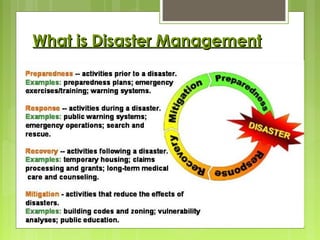
What is Disaster ManagementWhat is Disaster Management
What it involves ??
 Dealing with and avoiding both natural
and man made disasters. 
 Preparedness before disaster.
 Rebuilding and supporting society after
natural disasters.
BACKGROUNDBACKGROUND
 Enormous population pressures and
urbanization
 A flood, a drought or an earthquake millions
of peoples are affected each time a disaster
occurs
 Large-scale displacement and the loss of
life, loss of property and agricultural crops
 The reasons for this are varied including:
 an increasing population pressures in urban
areas
 an increase in the extent of encroachment
into lands, e.g., river beds or drainage
courses, low lying areas etc.
 poor or ignored zoning laws and policies
 lack of proper risk management (insurance)
BACKGROUNDBACKGROUND
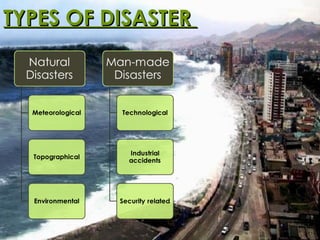
TYPES OF DISASTERTYPES OF DISASTER
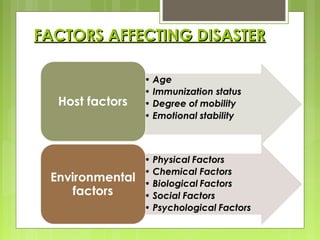
FACTORS AFFECTING DISASTERFACTORS AFFECTING DISASTER
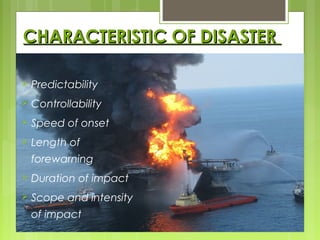
CHARACTERISTIC OF DISASTERCHARACTERISTIC OF DISASTER
 Predictability
 Controllability
 Speed of onset
 Length of
forewarning
 Duration of impact
 Scope and intensity
of impact
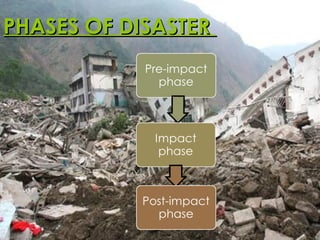
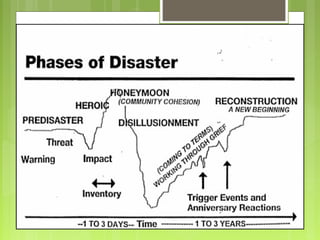
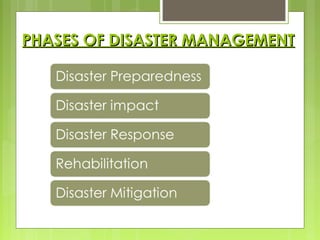
PHASES OF DISASTERPHASES OF DISASTER
PRINCIPLES OF DISASTER MANAGEMENTPRINCIPLES OF DISASTER MANAGEMENT
 Disaster management is the responsibility of all
spheres of government
 Disaster management should use resources that
exist for a day-to-day purpose.
 Organizations should function as an extension of
their core business
 Individuals are responsible for their own safety.
 Disaster management planning should focus on
large-scale events.
Contd….Contd….
 DM planning should recognize the difference
between incidents and disasters.
 DM planning must take account of the type of
physical environment and the structure of the
population.
 DM arrangements must recognise the
involvement and potential role of non-
government agencies.
PHASES OF DISASTER MANAGEMENTPHASES OF DISASTER MANAGEMENT
Disaster preparednessDisaster preparedness
Preparedness should be in the form of
money, manpower and materials
 Evaluation from past experiences about risk
 Location of disaster prone areas
 Organization of communication, information
and warning system
 Ensuring co-ordination and response
mechanisms
 Development of public education
programme
 Co-ordination with media
 National & international relations
 Keeping stock of foods, drug and other
essential commodities.
Contd….Contd….
E.g.: Indian Meteorological department (IMD) plays a key role
in forewarning the disaster of cyclone-storms by detection tracing. It has
5 centres in Kolkata, Bhubaneswar, Vishakapatanam, Chennai &
Mumbai. In addition there are 31 special observation posts setup a long
the east coast of India.
The International Agencies which provides humanitarian assistance to the
disaster strike areas are United Nation agencies.
 Office for the co-ordination of Humanitarian Affair (OCHA)
 World Health Organization (WHO)
 UNICEF
 World Food Programme (WFP)
 Food & Agricultural Organisation (FAD)
E.g.: Non Governmental Organizations
 Co-Operative American Relief Every where (CARE)
 International committee of Red cross
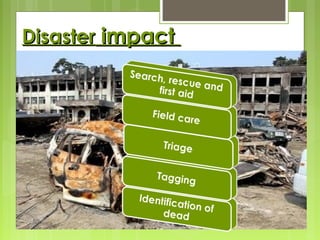
DisasterDisaster impactimpact
Disaster responseDisaster response
 Epidemiologic surveillance and disease
control
 Vaccination
 Nutrition
Rehabilitation phaseRehabilitation phase
 Water supply
 Food safety
 Basic sanitation and personal hygiene
 Vector control
Disaster mitigationDisaster mitigation
 This involves lessening the likely effects of emergencies.
 These include depending upon the disaster, protection of
vulnerable population and structure.
Eg. improving structural qualities of schools, houses and such other
buildings so that medical causalities can be minimized.
 Similarly ensuring the safety of health facilities and public health
services including water supply and sewerage system to reduce the
cost of rehabilitation and reconstruction.
This mitigation compliments the disaster preparedness and disaster
response activities.
 
DISASTER-EFFECTSDISASTER-EFFECTS
 Deaths
 Disability
 Increase in communicable disease
 Psychological problems
 Food shortage
 Socioeconomic losses
 Shortage of drugs and medical supplies.
 Environmental disruption
DISASTER RECOVERYDISASTER RECOVERY
 Successful Recovery Preparation
 Be vigilant in Health teaching
 Psychological support
 Referrals to hospital as needed
 Remain alert for environmental health
 Nurse must be attentive to the danger
Areas of Concern
 Activating an Early Warning System network and its
close monitoring
 Mechanisms for integrating the scientific,
technological and administrative agencies for
effective disaster management
 Terrestrial communication links which collapse in the
event of a rapid onset disaster
 Vulnerability of critical infrastructures (power supply,
communication, water supply, transport, etc.) to
disaster events
Contd…
 Funding : Primacy of relief as disaster response.
 Preparedness and Mitigation very often ignored.
 Lack of integrated efforts to collect and compile data,
information and local knowledge on disaster history and
traditional response patterns.
 Need for standardized efforts in compiling and interpreting
geo-spatial data, satellite imagery and early warning signals.
 Weak areas continue to be forecasting, modeling, risk
prediction, simulation and scenario analysis, etc.
Contd…
 Absence of a national level, state level, and district level
directory of experts and inventory of resources.
 Absence of a National Disaster Management Plan, and
State level and district level disaster management plans.
 Sustainability of efforts
 Effective Inter Agency Co-ordination and Standard
Operating Procedures for stakeholder groups, especially
critical first responder agencies.
 Emergency medicine, critical care medicine, triage, first
aid
Dynamics of Disasters
 There is a high probability or a low probability for an
event happening somewhere sometime soon…
 The unpredictability of disaster events and the high
risk and vulnerability profiles make it imperative to
strengthen disaster preparedness, mitigation and
enforcement of guidelines, building codes and
restrictions on construction of buildings in flood-prone
areas and storm surge prone coastal areas.
Lessons Learnt
 Be Prepared : Preparedness and Mitigation is
bound to yield more effective returns than
distributing relief after a disaster.
 Create a Culture of Preparedness and
Prevention.
 Evolve a code of conduct for all stake-holders
Future Directions
 Encourage and consolidate knowledge networks
 Mobilise and train disaster volunteers for more
effective preparedness, mitigation and response
(NSS, NCC, Scouts and Guides, NYK, Civil Defence,
Homeguards)
 Increased capacity building leads to faster
vulnerability reduction.
 Learn from best practices in disaster preparedness,
mitigation and disaster response
Future Directions
 Mobilising stakeholder participation of Self Help
Groups, Women’s Groups, Youth Groups, Panchayati
Raj Institutions
 Anticipatory Governance: Simulation exercises, Mock
drills and Scenario Analysis
 Indigenous knowledge systems and coping practices
 Living with Risk: Community Based Disaster Risk
Management
Invest in Preparedness
 Investments in Preparedness and Prevention
(Mitigation) will yield sustainable results, rather than
spending money on relief after a disaster.
 Most disasters are predictable, especially in their
seasonality and the disaster-prone areas which are
vulnerable.
 Communities must be involved in disaster
preparedness.
 Inclusive, participatory, gender sensitive, child
friendly, eco-friendly and disabled friendly
disaster management
 Technology driven but people owned
 Knowledge Management: Documentation and
dissemination of good practices
 Public Private Partnership
Future Directions
DISASTER NURSINGDISASTER NURSING
 It can be defined as the adaptation of
professional nursing skills in recognizing
and meeting the nursing, physical and
emotional needs resulting from a
disaster.
Any QuestionsAny Questions ????
Safety Awareness
Health and Safety
Health and safety is intended to bring
about condition free from risk of injury
or threat to our health and well-being.
This objective is not a natural state of
affairs.
Workplace accidents, illness and incidents
are preventable
provided that
Health and
Safety
is Managed
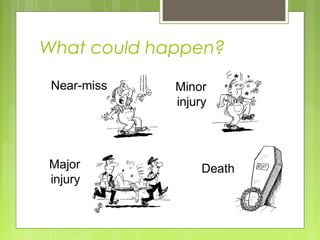
What could happen?
Near-miss Minor
injury
Major
injury
Death
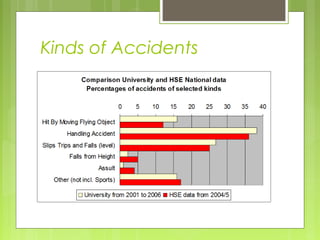
Kinds of Accidents
Why Report Accidents?
Accidents should be reported because:
• The law requires some specific types of
accidents to be reported to the Enforcing
Authorities.
• The University Safety Policy requires all
accidents and near misses to be reported
to the USO.
• It enables investigations so as to prevent
further accidents.
Safety Management
This begins with Policy
and uses tools such as Local Rules
and Risk Assessment to establish
control of the hazards and risks of
work.
It is a specific legal duty to manage
safety so that all risks are suitably
and sufficiently controlled.
Identifying the main hazards
Examples which affect safety and/or health:
• Biological hazards
• Chemicals
• Fire
• Radiation
• Waste
• Electricity
• Noise and Vibration
• Lifting and carrying
• Repetitive movements
Biohazards
Classification of organisms
Control of Pathogens
(inc. inoculations)
Control of spread of organisms
Control of GM work
Chemicals
 COSHH – Control of Substances Hazardous to
Health.
 This applies to all chemicals and substances
(including cultures) used in labs and elsewhere.
 There are specific additional measures for very
high risk chemicals and substances – in
particular
Cyanides Pathogens Asthmagens
 This is dealt with in more detail in the
Risk Assessment Training provided by the USO.
Fire
All Fire Alarms must be treated as
genuine
Evacuate immediately
Close doors and windows as you leave
Go to the assembly point
Actions to take to prevent Fire
Keep smoke doors closed
Do not obstruct escape
corridors
Store fire risk materials correctly
Control wastes.
Radiation
Very heavily controlled by the HSE and the
Environment Agency. Specific laws relating to
the use, storage and disposal of radioactive
materials.
 Use is restricted to controlled areas.
 Only authorised persons permitted to use
radiation.
 All use must be recorded, and all wastes
controlled.
 Very specific Local Rules are in force.
 Good technique main protection against
contamination.
Waste
Many accidents are caused by
incorrect disposal of wastes.
Wastes must be segregated by
law.
University has strict rules.
Errors put others at risk.
Legal Duties
COMMON LAW
duty of one individual to another -
“Duty of Care”
STATUTE LAW
Criminal Law
duty between individual and the
state
The costs of failure
 Health and safety law is Criminal Law
 Failure to manage health and safety can result in:
• prosecution,
fines and imprisonment
• compensation claims
• loss of output or service
• replacement costs
• loss of reputation

Disaster management and safety awareness

  • 1.
    • Preparation for Disaster Valuesin First Aid Training • Safety Awareness Prepared by: BLESSLY GRACE R. ROSERO BSED 3-U, BUCE
  • 2.
    What is disaster management???  “A disaster can be defined as any occurrence that cause damage, ecological disruption, loss of human life, deterioration of health and health services on a scale, sufficient to warrant an extraordinary response from outside the affected community or area”. (W.H.O.)  “A disaster can be defined as an occurrence either nature or manmade that causes human suffering and creates human needs that victims cannot alleviate without assistance”. American Red Cross (ARC) ’
  • 3.
    What is DisasterManagementWhat is Disaster Management
  • 4.
    What it involves??  Dealing with and avoiding both natural and man made disasters.   Preparedness before disaster.  Rebuilding and supporting society after natural disasters.
  • 5.
    BACKGROUNDBACKGROUND  Enormous populationpressures and urbanization  A flood, a drought or an earthquake millions of peoples are affected each time a disaster occurs  Large-scale displacement and the loss of life, loss of property and agricultural crops
  • 6.
     The reasonsfor this are varied including:  an increasing population pressures in urban areas  an increase in the extent of encroachment into lands, e.g., river beds or drainage courses, low lying areas etc.  poor or ignored zoning laws and policies  lack of proper risk management (insurance) BACKGROUNDBACKGROUND
  • 7.
  • 8.
  • 9.
    CHARACTERISTIC OF DISASTERCHARACTERISTICOF DISASTER  Predictability  Controllability  Speed of onset  Length of forewarning  Duration of impact  Scope and intensity of impact
  • 10.
  • 12.
    PRINCIPLES OF DISASTERMANAGEMENTPRINCIPLES OF DISASTER MANAGEMENT  Disaster management is the responsibility of all spheres of government  Disaster management should use resources that exist for a day-to-day purpose.  Organizations should function as an extension of their core business  Individuals are responsible for their own safety.  Disaster management planning should focus on large-scale events.
  • 13.
    Contd….Contd….  DM planningshould recognize the difference between incidents and disasters.  DM planning must take account of the type of physical environment and the structure of the population.  DM arrangements must recognise the involvement and potential role of non- government agencies.
  • 14.
    PHASES OF DISASTERMANAGEMENTPHASES OF DISASTER MANAGEMENT
  • 15.
    Disaster preparednessDisaster preparedness Preparednessshould be in the form of money, manpower and materials  Evaluation from past experiences about risk  Location of disaster prone areas  Organization of communication, information and warning system  Ensuring co-ordination and response mechanisms
  • 16.
     Development ofpublic education programme  Co-ordination with media  National & international relations  Keeping stock of foods, drug and other essential commodities. Contd….Contd….
  • 17.
    E.g.: Indian Meteorologicaldepartment (IMD) plays a key role in forewarning the disaster of cyclone-storms by detection tracing. It has 5 centres in Kolkata, Bhubaneswar, Vishakapatanam, Chennai & Mumbai. In addition there are 31 special observation posts setup a long the east coast of India. The International Agencies which provides humanitarian assistance to the disaster strike areas are United Nation agencies.  Office for the co-ordination of Humanitarian Affair (OCHA)  World Health Organization (WHO)  UNICEF  World Food Programme (WFP)  Food & Agricultural Organisation (FAD) E.g.: Non Governmental Organizations  Co-Operative American Relief Every where (CARE)  International committee of Red cross  International committee of Red cross
  • 18.
  • 19.
    Disaster responseDisaster response Epidemiologic surveillance and disease control  Vaccination  Nutrition
  • 20.
    Rehabilitation phaseRehabilitation phase Water supply  Food safety  Basic sanitation and personal hygiene  Vector control
  • 21.
    Disaster mitigationDisaster mitigation This involves lessening the likely effects of emergencies.  These include depending upon the disaster, protection of vulnerable population and structure. Eg. improving structural qualities of schools, houses and such other buildings so that medical causalities can be minimized.  Similarly ensuring the safety of health facilities and public health services including water supply and sewerage system to reduce the cost of rehabilitation and reconstruction. This mitigation compliments the disaster preparedness and disaster response activities.  
  • 22.
    DISASTER-EFFECTSDISASTER-EFFECTS  Deaths  Disability Increase in communicable disease  Psychological problems  Food shortage  Socioeconomic losses  Shortage of drugs and medical supplies.  Environmental disruption
  • 23.
    DISASTER RECOVERYDISASTER RECOVERY Successful Recovery Preparation  Be vigilant in Health teaching  Psychological support  Referrals to hospital as needed  Remain alert for environmental health  Nurse must be attentive to the danger
  • 24.
    Areas of Concern Activating an Early Warning System network and its close monitoring  Mechanisms for integrating the scientific, technological and administrative agencies for effective disaster management  Terrestrial communication links which collapse in the event of a rapid onset disaster  Vulnerability of critical infrastructures (power supply, communication, water supply, transport, etc.) to disaster events
  • 25.
    Contd…  Funding :Primacy of relief as disaster response.  Preparedness and Mitigation very often ignored.  Lack of integrated efforts to collect and compile data, information and local knowledge on disaster history and traditional response patterns.  Need for standardized efforts in compiling and interpreting geo-spatial data, satellite imagery and early warning signals.  Weak areas continue to be forecasting, modeling, risk prediction, simulation and scenario analysis, etc.
  • 26.
    Contd…  Absence ofa national level, state level, and district level directory of experts and inventory of resources.  Absence of a National Disaster Management Plan, and State level and district level disaster management plans.  Sustainability of efforts  Effective Inter Agency Co-ordination and Standard Operating Procedures for stakeholder groups, especially critical first responder agencies.  Emergency medicine, critical care medicine, triage, first aid
  • 27.
    Dynamics of Disasters There is a high probability or a low probability for an event happening somewhere sometime soon…  The unpredictability of disaster events and the high risk and vulnerability profiles make it imperative to strengthen disaster preparedness, mitigation and enforcement of guidelines, building codes and restrictions on construction of buildings in flood-prone areas and storm surge prone coastal areas.
  • 28.
    Lessons Learnt  BePrepared : Preparedness and Mitigation is bound to yield more effective returns than distributing relief after a disaster.  Create a Culture of Preparedness and Prevention.  Evolve a code of conduct for all stake-holders
  • 29.
    Future Directions  Encourageand consolidate knowledge networks  Mobilise and train disaster volunteers for more effective preparedness, mitigation and response (NSS, NCC, Scouts and Guides, NYK, Civil Defence, Homeguards)  Increased capacity building leads to faster vulnerability reduction.  Learn from best practices in disaster preparedness, mitigation and disaster response
  • 30.
    Future Directions  Mobilisingstakeholder participation of Self Help Groups, Women’s Groups, Youth Groups, Panchayati Raj Institutions  Anticipatory Governance: Simulation exercises, Mock drills and Scenario Analysis  Indigenous knowledge systems and coping practices  Living with Risk: Community Based Disaster Risk Management
  • 31.
    Invest in Preparedness Investments in Preparedness and Prevention (Mitigation) will yield sustainable results, rather than spending money on relief after a disaster.  Most disasters are predictable, especially in their seasonality and the disaster-prone areas which are vulnerable.  Communities must be involved in disaster preparedness.
  • 32.
     Inclusive, participatory,gender sensitive, child friendly, eco-friendly and disabled friendly disaster management  Technology driven but people owned  Knowledge Management: Documentation and dissemination of good practices  Public Private Partnership Future Directions
  • 33.
    DISASTER NURSINGDISASTER NURSING It can be defined as the adaptation of professional nursing skills in recognizing and meeting the nursing, physical and emotional needs resulting from a disaster.
  • 34.
  • 35.
    Safety Awareness Health andSafety Health and safety is intended to bring about condition free from risk of injury or threat to our health and well-being. This objective is not a natural state of affairs.
  • 36.
    Workplace accidents, illnessand incidents are preventable provided that Health and Safety is Managed
  • 37.
    What could happen? Near-missMinor injury Major injury Death
  • 38.
  • 39.
    Why Report Accidents? Accidentsshould be reported because: • The law requires some specific types of accidents to be reported to the Enforcing Authorities. • The University Safety Policy requires all accidents and near misses to be reported to the USO. • It enables investigations so as to prevent further accidents.
  • 40.
    Safety Management This beginswith Policy and uses tools such as Local Rules and Risk Assessment to establish control of the hazards and risks of work. It is a specific legal duty to manage safety so that all risks are suitably and sufficiently controlled.
  • 41.
    Identifying the mainhazards Examples which affect safety and/or health: • Biological hazards • Chemicals • Fire • Radiation • Waste • Electricity • Noise and Vibration • Lifting and carrying • Repetitive movements
  • 42.
    Biohazards Classification of organisms Controlof Pathogens (inc. inoculations) Control of spread of organisms Control of GM work
  • 43.
    Chemicals  COSHH –Control of Substances Hazardous to Health.  This applies to all chemicals and substances (including cultures) used in labs and elsewhere.  There are specific additional measures for very high risk chemicals and substances – in particular Cyanides Pathogens Asthmagens  This is dealt with in more detail in the Risk Assessment Training provided by the USO.
  • 44.
    Fire All Fire Alarmsmust be treated as genuine Evacuate immediately Close doors and windows as you leave Go to the assembly point
  • 45.
    Actions to taketo prevent Fire Keep smoke doors closed Do not obstruct escape corridors Store fire risk materials correctly Control wastes.
  • 46.
    Radiation Very heavily controlledby the HSE and the Environment Agency. Specific laws relating to the use, storage and disposal of radioactive materials.  Use is restricted to controlled areas.  Only authorised persons permitted to use radiation.  All use must be recorded, and all wastes controlled.  Very specific Local Rules are in force.  Good technique main protection against contamination.
  • 47.
    Waste Many accidents arecaused by incorrect disposal of wastes. Wastes must be segregated by law. University has strict rules. Errors put others at risk.
  • 48.
    Legal Duties COMMON LAW dutyof one individual to another - “Duty of Care” STATUTE LAW Criminal Law duty between individual and the state
  • 49.
    The costs offailure  Health and safety law is Criminal Law  Failure to manage health and safety can result in: • prosecution, fines and imprisonment • compensation claims • loss of output or service • replacement costs • loss of reputation

Editor's Notes

  • #6 1.India is a country highly vulnerable to natural disasters. 2.Enormous population pressures and urbanization have forced people to live on marginal lands or in cities where they are at greater risk to disasters. 3.Whether it is a flood, a drought or an earthquake, millions of peoples are affected each time a disaster occurs. In addition to large-scale displacement and the loss of life, these events result in the loss of property and agricultural crops worth thousand of Crores of rupees annually.
  • #7 The reasons for this are varied including: an increasing population pressures in urban areas an increase in the extent of encroachment into lands, e.g., river beds or drainage courses, low lying areas etc. poor or ignored zoning laws and policies lack of proper risk management (insurance) In India the primary responsibility for responding to disasters lies at the State level. Many states have yet to prepare Disaster Management Plans. Section 11 of DM Act provides that “There shall be drawn up a plan for Disaster Management for the whole of the Country to be called National Plan.” The National Response Plan to be prepared by an Inter Ministerial Central Team formed by the NEC in the MHA Spanning all the Central Ministries/Departments. The Mitigation and Preparedness Plans The National Human Resource and Capacity Building Plan To be prepared by National Institute of Disaster Management,