NHS  Calderdale   Equality & Diversity for commissioners   Mole (Laura) Chapman
Mindscapes to Landscapes We would be foolish to assume that it’s easy to achieve a fairer society.  If it was easy we would have cracked it, and we would all live in an equitable world.  It is not. We have not. We do not. Think!  EQuality training 2010
The Equalities Act Public Duty Eliminate discrimination, harassment and victimisation Advance equality of opportunity for different groups of people  Foster good relations between groups  EQuality training 2010
What is in the Act? A new duty to consider socio-economic status The Bill introduces a new requirement on strategic public authorities to have due regard to how their decisions might help to reduce inequalities associated with socio-economic status.   EQuality training 2010
What is in the act? Positive Action Dual Discrimination  Equal Pay Impact - strategic, policy and service delivery  EQuality training 2010
Equality: Every human being has an absolute and equal right to common dignity and parity of esteem and entitlement to access the benefits of society on equal terms. Equal treatment for all:  The availability of the same rights, position, and status to all people, irrespective of gender, sexual preference, age, race, ethnicity, ability or religion.   EQuality training 2010
Equity  The principle of equality has to be reinforced and extended by the practice of equity.  Three broad principles about the nature of social justice: Equity: every human being has a right to benefit from the outcomes of society on the basis of fairness and according to need. Leadership activity require ethical practice: deliberate and specific intervention to secure equality and equity.    (West-Burnham & Chapman 2009)  EQuality training 2010
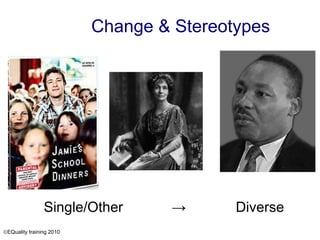
Single/Other -> Diverse Change & Stereotypes   EQuality training 2010
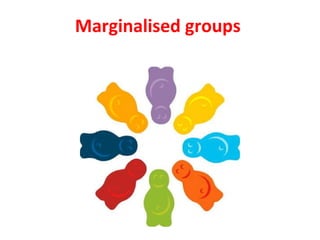
Marginalised groups
“ Vision without action is merely a dream Action without vision just passes the time Vision with action can change the world” Joel Barker
Inclusive practice: ‘ All INDIVIDUALS belonging to the organisations they would if they were not different.  AND  Support provided to individuals, families, and colleagues so that all can be successful.’ (Carol Tashie) “ Is an ongoing process of reviewing and developing practice in order to adjust and celebrate diversity.  It is the journey not the destination!” (EQuality Training 2006)  EQuality training 2010
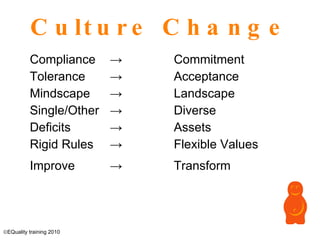
Culture Change Compliance -> Commitment  Tolerance -> Acceptance Mindscape -> Landscape Single/Other -> Diverse Deficits -> Assets Rigid Rules  -> Flexible Values Improve -> Transform    EQuality training 2010
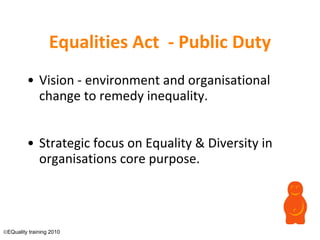
Equalities Act  - Public Duty Vision - environment and organisational change to remedy inequality. Strategic focus on Equality & Diversity in organisations core purpose.  EQuality training 2010
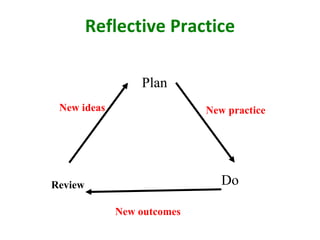
Reflective Practice Plan   Do Review New ideas New practice New outcomes
What is disability?
Stereotypes  VULNERABLE PEOPLE ?
Behaviour Feeling Action:
Tackling social oppression Racism and sexism  Internalised oppression Lack of participation Individualism v individuality Abuse and violence
The Facts Visually impaired people are four times more likely to be verbally and physically abused than sighted people  People with mental health issues are 11 times more likely to be victimised  90% of adults with a learning difficulty report being 'bullied'.  Scope 2008
Compared with non-disabled people, disabled people are: more likely to be  economically inactive  – only one in two disabled people of working age are currently in employment, compared with four out of five non-disabled people; more likely to experience problems with  hate crime or harassment  – a quarter of all disabled people say that they have experienced hate crime or  harassment, and this number rises to 47% of people with mental  health conditions;
"on the experience of disability, history is largely silent, and when it is discussed at all, it is within the context of the history of medical advances. Just as women and black people have discovered that they must write their own histories, so too with disabled people."
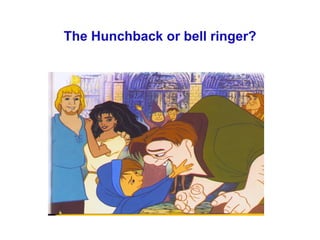
The Hunchback or bell ringer?
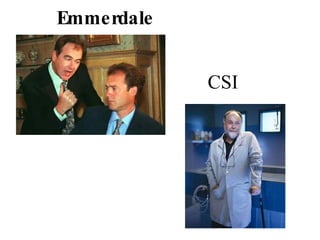
Emmerdale   CSI
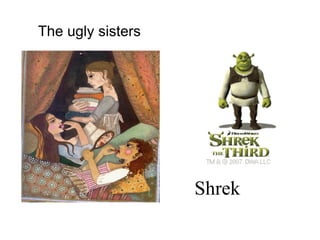
The ugly sisters Shrek
The Medical Model of disability Medical approach to the problem.  Defined by non-disabled professionals Equated to illness in terms of research and findings.  Care and benefits have been awarded  to compensate for personal tragedy.
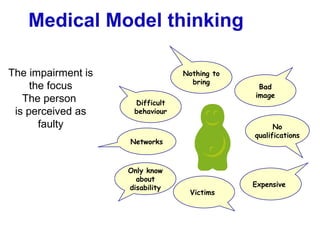
Medical Model thinking Bad image No qualifications Expensive  Nothing to bring Victims  Only know about disability Networks Difficult behaviour The impairment is the focus The person  is perceived as faulty
The Social Model of disability The problem owned by the whole community.  It defines disability in terms barriers, attitudinal, structural and systemic. Acknowledges the oppression, and need for action. It recognises disabled people’s leadership in finding a solution.
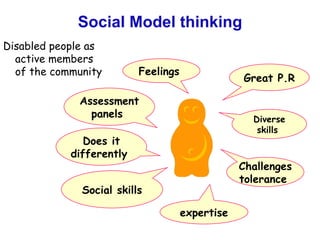
Social Model thinking Disabled people as active members of the community  Great P.R expertise Challenges tolerance  Diverse skills  Social skills Does it differently  Feelings  Assessment panels
Barriers
Respectful language The  person —their name.   Impairment =  Functioning   Disability =  barriers  in society
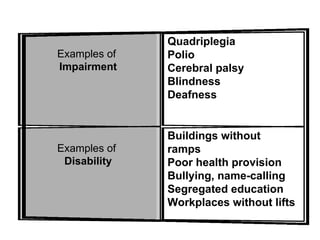
  Examples of  Impairment Quadriplegia Polio Cerebral palsy Blindness Deafness   Examples of  Disability Buildings without ramps Poor health provision Bullying, name-calling Segregated education Workplaces without lifts
Respectful language Impairment , disabled people use this term to talk about their medical condition or diagnosis or description of their functioning—if there is nothing more formal.
Respectful language Fred Brown (the  person ) is a man with cerebral palsy (the  impairment ). When the barriers and discrimination (the  oppression ) that restrict Fred have been removed from society, Fred will no longer be disabled, but he will still have cerebral palsy and be called Fred.
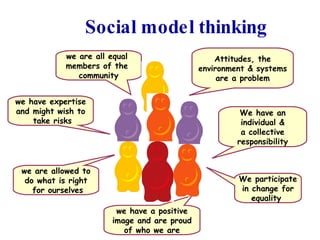
Social model thinking Attitudes, the environment & systems are a problem We participate in change for equality  We have an individual & a collective responsibility we are allowed to do what is right for ourselves we have a positive image and are proud of who we are we have expertise and might wish to take risks we are all equal  members of the  community
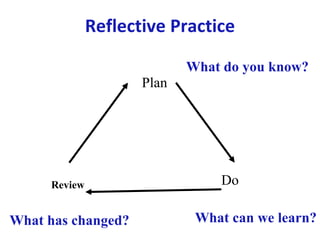
Reflective Practice Plan   Do Review What do you know? What can we learn? What has changed?
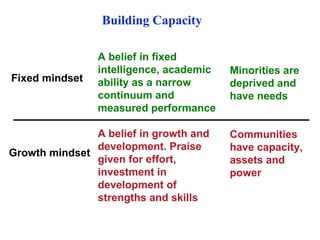
Building   Capacity Minorities are deprived and  have needs Communities have capacity, assets and power Fixed mindset Growth mindset A belief in fixed intelligence, academic ability as a narrow continuum and measured performance  A belief in growth and development. Praise given for effort, investment in development of strengths and skills
Respectful language
Inequality and Wellbeing  Inequality affects all of society Affluenza - Treadmill culture Individualism - materialism culture  Education Hierarchy - target culture Wilkinson, Layard and Oliver
Wellbeing Wellbeing … is indirectly but powerfully part of the educational and societal goal of dealing with the emotional and social consequences of failing and being of low status.  ( Fullan 2007) Wellbeing is more than absence of pain Wellbeing recognises happiness, pleasure and health Systems which identify material success as the only outcome of work are potentially very damaging Prioritising wellbeing is fundamental to achieving a culture of equality, because of the part wellbeing plays in flourishing. Humiliation can be a trigger for powerful defensive behaviours, involving anger and disaffection
Seeking Congruence  Head  Theory, vision, understanding Heart  Feeling, reflection, response Hand  Action, practice, learning
Reflective Practice Enlightenment   ( understanding ) Understanding why things have come to be as they are in terms of frustrating self’s realisation of desirable practice. Empowerment  Creating the necessary conditions within self whereby action to realize desirable practice can be undertaken. Emancipation  ( transformation ) A stable shift in practice congruent with the realisation of desirable practice
Equalities Bill - Public Duty Vision - environment and organisational change to remedy inequality. Strategic focus on Equality & Diversity in organisations core purpose.
From Compliance to Commitment: the implications of ethical practice How far do policies translate the aspirations of vision into inclusive practice? To what extent do strategies for monitoring, reviewing and evaluating practice focus on a commitment to equity? How might the wider community be involved in the UOB vision?
©  EQuality Training  81 New Laithe Hill, Huddersfield HD4 6RF [email_address] Tel: 01484 530 321 www.equalitytraining.co.uk

Equalities NHS Calderdale

  • 1.
    NHS Calderdale Equality & Diversity for commissioners Mole (Laura) Chapman
  • 2.
    Mindscapes to LandscapesWe would be foolish to assume that it’s easy to achieve a fairer society. If it was easy we would have cracked it, and we would all live in an equitable world. It is not. We have not. We do not. Think!  EQuality training 2010
  • 3.
    The Equalities ActPublic Duty Eliminate discrimination, harassment and victimisation Advance equality of opportunity for different groups of people Foster good relations between groups  EQuality training 2010
  • 4.
    What is inthe Act? A new duty to consider socio-economic status The Bill introduces a new requirement on strategic public authorities to have due regard to how their decisions might help to reduce inequalities associated with socio-economic status.  EQuality training 2010
  • 5.
    What is inthe act? Positive Action Dual Discrimination Equal Pay Impact - strategic, policy and service delivery  EQuality training 2010
  • 6.
    Equality: Every humanbeing has an absolute and equal right to common dignity and parity of esteem and entitlement to access the benefits of society on equal terms. Equal treatment for all: The availability of the same rights, position, and status to all people, irrespective of gender, sexual preference, age, race, ethnicity, ability or religion.  EQuality training 2010
  • 7.
    Equity Theprinciple of equality has to be reinforced and extended by the practice of equity. Three broad principles about the nature of social justice: Equity: every human being has a right to benefit from the outcomes of society on the basis of fairness and according to need. Leadership activity require ethical practice: deliberate and specific intervention to secure equality and equity. (West-Burnham & Chapman 2009)  EQuality training 2010
  • 8.
    Single/Other -> DiverseChange & Stereotypes  EQuality training 2010
  • 9.
  • 10.
    “ Vision withoutaction is merely a dream Action without vision just passes the time Vision with action can change the world” Joel Barker
  • 11.
    Inclusive practice: ‘All INDIVIDUALS belonging to the organisations they would if they were not different. AND Support provided to individuals, families, and colleagues so that all can be successful.’ (Carol Tashie) “ Is an ongoing process of reviewing and developing practice in order to adjust and celebrate diversity. It is the journey not the destination!” (EQuality Training 2006)  EQuality training 2010
  • 12.
    Culture Change Compliance-> Commitment Tolerance -> Acceptance Mindscape -> Landscape Single/Other -> Diverse Deficits -> Assets Rigid Rules -> Flexible Values Improve -> Transform  EQuality training 2010
  • 13.
    Equalities Act - Public Duty Vision - environment and organisational change to remedy inequality. Strategic focus on Equality & Diversity in organisations core purpose.  EQuality training 2010
  • 14.
    Reflective Practice Plan Do Review New ideas New practice New outcomes
  • 15.
  • 16.
  • 17.
  • 18.
    Tackling social oppressionRacism and sexism Internalised oppression Lack of participation Individualism v individuality Abuse and violence
  • 19.
    The Facts Visuallyimpaired people are four times more likely to be verbally and physically abused than sighted people People with mental health issues are 11 times more likely to be victimised 90% of adults with a learning difficulty report being 'bullied'. Scope 2008
  • 20.
    Compared with non-disabledpeople, disabled people are: more likely to be economically inactive – only one in two disabled people of working age are currently in employment, compared with four out of five non-disabled people; more likely to experience problems with hate crime or harassment – a quarter of all disabled people say that they have experienced hate crime or harassment, and this number rises to 47% of people with mental health conditions;
  • 21.
    "on the experienceof disability, history is largely silent, and when it is discussed at all, it is within the context of the history of medical advances. Just as women and black people have discovered that they must write their own histories, so too with disabled people."
  • 22.
    The Hunchback orbell ringer?
  • 23.
  • 24.
  • 25.
    The Medical Modelof disability Medical approach to the problem. Defined by non-disabled professionals Equated to illness in terms of research and findings. Care and benefits have been awarded to compensate for personal tragedy.
  • 26.
    Medical Model thinkingBad image No qualifications Expensive Nothing to bring Victims Only know about disability Networks Difficult behaviour The impairment is the focus The person is perceived as faulty
  • 27.
    The Social Modelof disability The problem owned by the whole community. It defines disability in terms barriers, attitudinal, structural and systemic. Acknowledges the oppression, and need for action. It recognises disabled people’s leadership in finding a solution.
  • 28.
    Social Model thinkingDisabled people as active members of the community Great P.R expertise Challenges tolerance Diverse skills Social skills Does it differently Feelings Assessment panels
  • 29.
  • 30.
    Respectful language The person —their name. Impairment = Functioning Disability = barriers in society
  • 31.
      Examples of Impairment Quadriplegia Polio Cerebral palsy Blindness Deafness   Examples of Disability Buildings without ramps Poor health provision Bullying, name-calling Segregated education Workplaces without lifts
  • 32.
    Respectful language Impairment, disabled people use this term to talk about their medical condition or diagnosis or description of their functioning—if there is nothing more formal.
  • 33.
    Respectful language FredBrown (the person ) is a man with cerebral palsy (the impairment ). When the barriers and discrimination (the oppression ) that restrict Fred have been removed from society, Fred will no longer be disabled, but he will still have cerebral palsy and be called Fred.
  • 34.
    Social model thinkingAttitudes, the environment & systems are a problem We participate in change for equality We have an individual & a collective responsibility we are allowed to do what is right for ourselves we have a positive image and are proud of who we are we have expertise and might wish to take risks we are all equal members of the community
  • 35.
    Reflective Practice Plan Do Review What do you know? What can we learn? What has changed?
  • 36.
    Building Capacity Minorities are deprived and have needs Communities have capacity, assets and power Fixed mindset Growth mindset A belief in fixed intelligence, academic ability as a narrow continuum and measured performance A belief in growth and development. Praise given for effort, investment in development of strengths and skills
  • 37.
  • 38.
    Inequality and Wellbeing Inequality affects all of society Affluenza - Treadmill culture Individualism - materialism culture Education Hierarchy - target culture Wilkinson, Layard and Oliver
  • 39.
    Wellbeing Wellbeing …is indirectly but powerfully part of the educational and societal goal of dealing with the emotional and social consequences of failing and being of low status. ( Fullan 2007) Wellbeing is more than absence of pain Wellbeing recognises happiness, pleasure and health Systems which identify material success as the only outcome of work are potentially very damaging Prioritising wellbeing is fundamental to achieving a culture of equality, because of the part wellbeing plays in flourishing. Humiliation can be a trigger for powerful defensive behaviours, involving anger and disaffection
  • 40.
    Seeking Congruence Head Theory, vision, understanding Heart Feeling, reflection, response Hand Action, practice, learning
  • 41.
    Reflective Practice Enlightenment ( understanding ) Understanding why things have come to be as they are in terms of frustrating self’s realisation of desirable practice. Empowerment Creating the necessary conditions within self whereby action to realize desirable practice can be undertaken. Emancipation ( transformation ) A stable shift in practice congruent with the realisation of desirable practice
  • 42.
    Equalities Bill -Public Duty Vision - environment and organisational change to remedy inequality. Strategic focus on Equality & Diversity in organisations core purpose.
  • 43.
    From Compliance toCommitment: the implications of ethical practice How far do policies translate the aspirations of vision into inclusive practice? To what extent do strategies for monitoring, reviewing and evaluating practice focus on a commitment to equity? How might the wider community be involved in the UOB vision?
  • 44.
    © EQualityTraining 81 New Laithe Hill, Huddersfield HD4 6RF [email_address] Tel: 01484 530 321 www.equalitytraining.co.uk