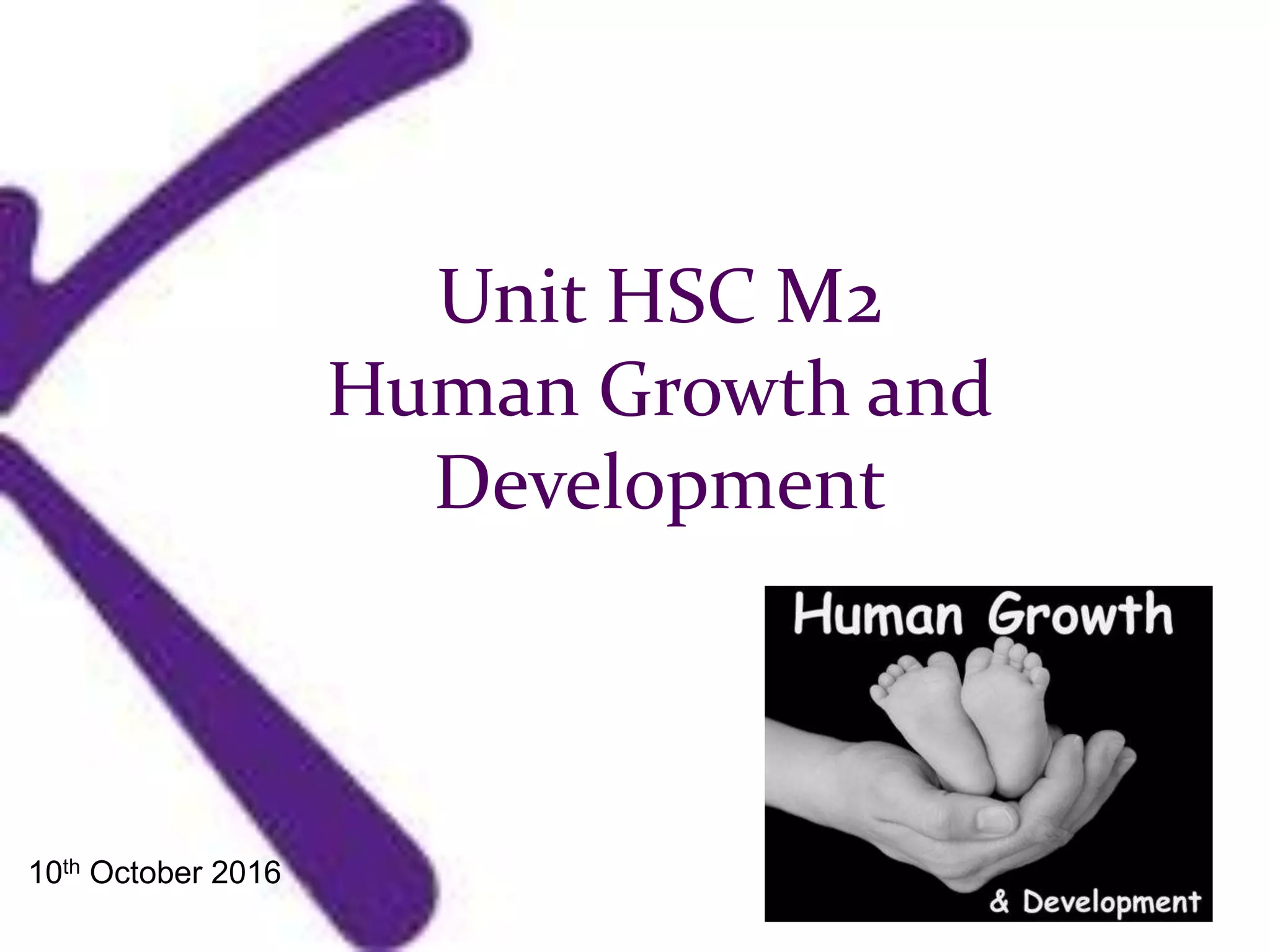
Unit HSC M2
Human Growth and
Development
10th October 2016
Time to Think………….

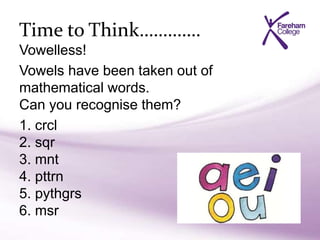
Vowelless!
Vowels have been taken out of
mathematical words.
Can you recognise them?
1. crcl
2. sqr
3. mnt
4. pttrn
5. pythgrs
6. msr
Learning Outcomes
• Identify the meaning of human growth
and development.
• Outline the six life stages of human
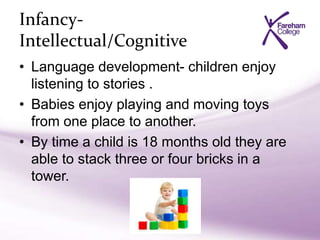
growth and development.
• Outline PIES development within the
infancy life stage.
• Explain the process of attachment in
babies and young children and the role of
the key person
Key Terminology
• Growth is the physical changes in the
body. This is measurable. Height, weight
and head circumference.
• Development is holistic including
physical, intellectual, emotional and social
aspects.
• People move through different stages of
growth and development.
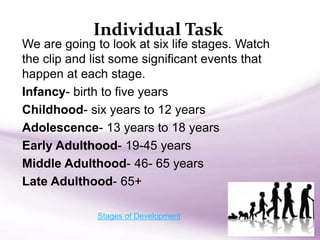
Individual Task
We are going to look at six life stages. Watch
the clip and list some significant events that
happen at each stage.
Infancy- birth to five years
Childhood- six years to 12 years
Adolescence- 13 years to 18 years
Early Adulthood- 19-45 years
Middle Adulthood- 46- 65 years
Late Adulthood- 65+
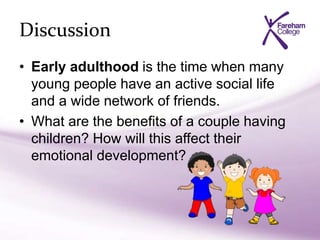
Stages of Development
Have you met your
objectives?
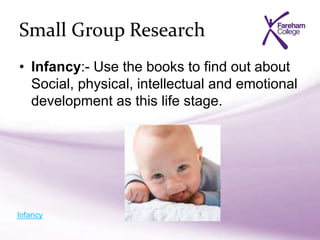
Small Group Research
• Infancy:- Use the books to find out about
Social, physical, intellectual and emotional
development as this life stage.
Infancy
Feedback from Task
• What have YOU learnt?
Infancy- Physical Development
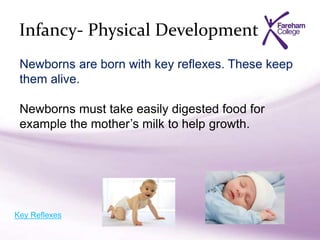
Newborns are born with key reflexes. These keep
them alive.
Newborns must take easily digested food for
example the mother’s milk to help growth.
Key Reflexes
Let’s watch a clip
What did Bowlby say children were seeking other than
to be fed?
What type of attachment do parents and babies need
to make?
What did the parent say impacted on her building
attachment to her child?
Bowlby
Infancy- Emotional
• Children’s emotional development and well-being
are closely linked to both social and behavioural
development.
• Emotional and social development strengthen a
child’s happiness and well-being. The first
relationships that they form will have an impact on
the rest of their lives.
• Secure attachments provide emotional resources
needed to cope with uncertainty.
• The senses are important in developing a
relationship with a baby through touch, eye contact
and use of voice.
Have you met your
objectives?
Reflect
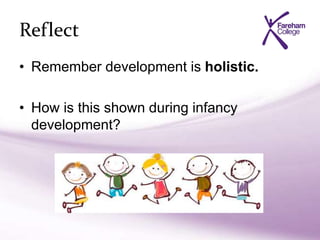
• Remember development is holistic.
• How is this shown during infancy
development?
Unit HSC M2
Human Growth and
Development
11th October 2016
Time to think…………
• Words from the letters in :-
• intellectual
Learning Outcomes
• Summarise PIES development at the
childhood stage
• Discuss the importance of promoting
independence in childhood
• Explain intellectual and social
development
• Design a development wheel showing life
stages
Recap-Board Blast
• Name a physical development at the
infancy life stage.
ICT Task
• Childhood 6 years to 12 years.
• During the ICT session find out about
PIES relating to childhood development
and add to our class Padlet.
Infancy-
Intellectual/Cognitive
• Language development- children enjoy
listening to stories .
• Babies enjoy playing and moving toys
from one place to another.
• By time a child is 18 months old they are
able to stack three or four bricks in a
tower.
Infancy - Social
Interaction with carers
– 2 mths – smile at human faces
– 3 mths – respond to adult talk
Solitary Play- Babies and under 2’s mostly play
alone.
Parallel Play- Age 2 years children may play
side by side but do not interact very much. The
are more interested in their own activities.
Cooperative Play- 3 to 4 years of age children
begin to play with each other spontaneously.
Have you met your
objectives?
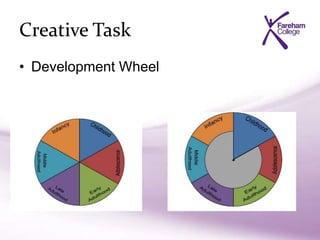
Creative Task
• Development Wheel
• Let’s look at what we learnt this morning.
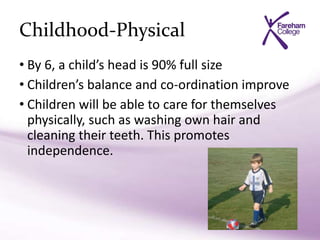
Childhood-Physical
• By 6, a child’s head is 90% full size
• Children’s balance and co-ordination improve
• Children will be able to care for themselves
physically, such as washing own hair and
cleaning their teeth. This promotes
independence.
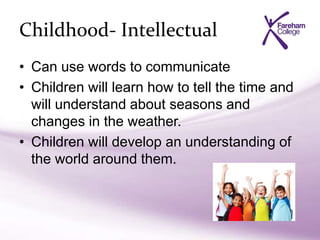
Childhood- Intellectual
• Can use words to communicate
• Children will learn how to tell the time and
will understand about seasons and
changes in the weather.
• Children will develop an understanding of
the world around them.
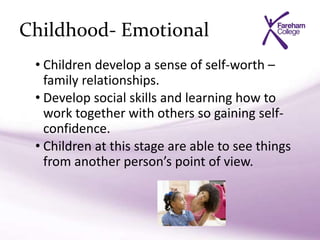
Childhood- Emotional
• Children develop a sense of self-worth –
family relationships.
• Develop social skills and learning how to
work together with others so gaining self-
confidence.
• Children at this stage are able to see things
from another person’s point of view.
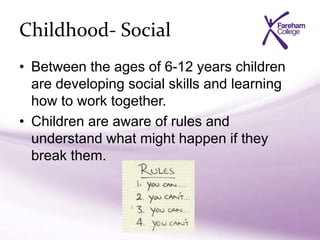
Childhood- Social
• Between the ages of 6-12 years children
are developing social skills and learning
how to work together.
• Children are aware of rules and
understand what might happen if they
break them.
Have you met your
objectives?
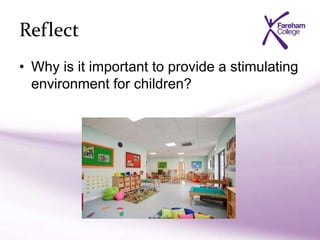
Reflect
• Why is it important to provide a stimulating
environment for children?
Unit HSC M2
Human Growth and
Development
12th October 2016
Time to think………..
• Word square- All that you have to do is
make dictionary words of any length from
the letters in the grid – the bigger the
better! The only restriction is that the word
must contain the central letter.
Y
C
AC
Learning Outcomes
• Demonstrate how to measure head
circumference
• Describe the importance of self-image
and confidence during adolescence
• Explain the impact of PIES development
during a key life stage
• Evaluate factors that affect human growth
and development and how they are
interrelated
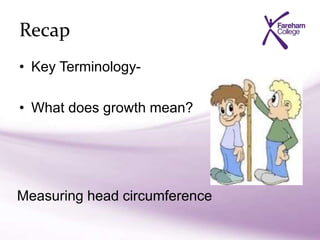
Recap
• Key Terminology-
• What does growth mean?
Measuring head circumference
Self-image
• Watch the clip and consider how important
self-image and confidence are to
teenagers.
• Why is the support of our peers important
during adolescence?
Mushy
Have you met your
objectives?
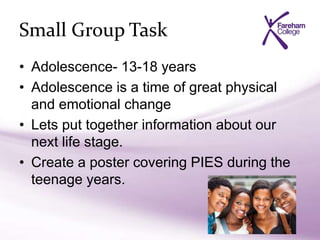
Small Group Task
• Adolescence- 13-18 years
• Adolescence is a time of great physical
and emotional change
• Lets put together information about our
next life stage.
• Create a poster covering PIES during the
teenage years.
Feedback from Task
• What have YOU learnt?
Review
Have you met your
objectives?
Unit HSC M2
Human Growth and
Development
12th October 2016
Time to Think…………
• Times Table Bingo
Learning Outcomes
• Describe three life stages in adulthood
• Outline emotional development in early
adulthood in relation to parenthood
• Explain how intellectual development can
be affected by dementia in later adulthood
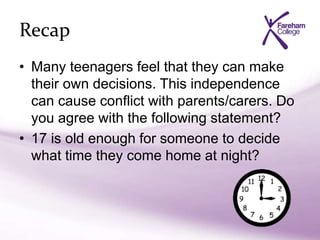
Recap
• Many teenagers feel that they can make
their own decisions. This independence
can cause conflict with parents/carers. Do
you agree with the following statement?
• 17 is old enough for someone to decide
what time they come home at night?
Discussion
• Early adulthood is the time when many
young people have an active social life
and a wide network of friends.
• What are the benefits of a couple having
children? How will this affect their
emotional development?
Graffiti Boards
• Early Adulthood 19-45 years
• Middle Adulthood 45-65 years
• Later Adulthood 65+
PIES
Have you met your
objectives?
Home Learning Task
• Read through the case study and consider
the factors affecting Mariah growth and
development.

Human growth week 1

  • 1.
    Unit HSC M2 HumanGrowth and Development 10th October 2016
  • 2.
    Time to Think…………. Vowelless! Vowelshave been taken out of mathematical words. Can you recognise them? 1. crcl 2. sqr 3. mnt 4. pttrn 5. pythgrs 6. msr
  • 3.
    Learning Outcomes • Identifythe meaning of human growth and development. • Outline the six life stages of human growth and development. • Outline PIES development within the infancy life stage. • Explain the process of attachment in babies and young children and the role of the key person
  • 4.
    Key Terminology • Growthis the physical changes in the body. This is measurable. Height, weight and head circumference. • Development is holistic including physical, intellectual, emotional and social aspects. • People move through different stages of growth and development.
  • 5.
    Individual Task We aregoing to look at six life stages. Watch the clip and list some significant events that happen at each stage. Infancy- birth to five years Childhood- six years to 12 years Adolescence- 13 years to 18 years Early Adulthood- 19-45 years Middle Adulthood- 46- 65 years Late Adulthood- 65+ Stages of Development
  • 6.
    Have you metyour objectives?
  • 7.
    Small Group Research •Infancy:- Use the books to find out about Social, physical, intellectual and emotional development as this life stage. Infancy
  • 8.
    Feedback from Task •What have YOU learnt?
  • 9.
    Infancy- Physical Development Newbornsare born with key reflexes. These keep them alive. Newborns must take easily digested food for example the mother’s milk to help growth. Key Reflexes
  • 10.
    Let’s watch aclip What did Bowlby say children were seeking other than to be fed? What type of attachment do parents and babies need to make? What did the parent say impacted on her building attachment to her child? Bowlby
  • 11.
    Infancy- Emotional • Children’semotional development and well-being are closely linked to both social and behavioural development. • Emotional and social development strengthen a child’s happiness and well-being. The first relationships that they form will have an impact on the rest of their lives. • Secure attachments provide emotional resources needed to cope with uncertainty. • The senses are important in developing a relationship with a baby through touch, eye contact and use of voice.
  • 12.
    Have you metyour objectives?
  • 13.
    Reflect • Remember developmentis holistic. • How is this shown during infancy development?
  • 14.
    Unit HSC M2 HumanGrowth and Development 11th October 2016
  • 15.
    Time to think………… •Words from the letters in :- • intellectual
  • 16.
    Learning Outcomes • SummarisePIES development at the childhood stage • Discuss the importance of promoting independence in childhood • Explain intellectual and social development • Design a development wheel showing life stages
  • 17.
    Recap-Board Blast • Namea physical development at the infancy life stage.
  • 18.
    ICT Task • Childhood6 years to 12 years. • During the ICT session find out about PIES relating to childhood development and add to our class Padlet.
  • 19.
    Infancy- Intellectual/Cognitive • Language development-children enjoy listening to stories . • Babies enjoy playing and moving toys from one place to another. • By time a child is 18 months old they are able to stack three or four bricks in a tower.
  • 20.
    Infancy - Social Interactionwith carers – 2 mths – smile at human faces – 3 mths – respond to adult talk Solitary Play- Babies and under 2’s mostly play alone. Parallel Play- Age 2 years children may play side by side but do not interact very much. The are more interested in their own activities. Cooperative Play- 3 to 4 years of age children begin to play with each other spontaneously.
  • 21.
    Have you metyour objectives?
  • 22.
  • 23.
    • Let’s lookat what we learnt this morning.
  • 24.
    Childhood-Physical • By 6,a child’s head is 90% full size • Children’s balance and co-ordination improve • Children will be able to care for themselves physically, such as washing own hair and cleaning their teeth. This promotes independence.
  • 25.
    Childhood- Intellectual • Canuse words to communicate • Children will learn how to tell the time and will understand about seasons and changes in the weather. • Children will develop an understanding of the world around them.
  • 26.
    Childhood- Emotional • Childrendevelop a sense of self-worth – family relationships. • Develop social skills and learning how to work together with others so gaining self- confidence. • Children at this stage are able to see things from another person’s point of view.
  • 27.
    Childhood- Social • Betweenthe ages of 6-12 years children are developing social skills and learning how to work together. • Children are aware of rules and understand what might happen if they break them.
  • 28.
    Have you metyour objectives?
  • 29.
    Reflect • Why isit important to provide a stimulating environment for children?
  • 30.
    Unit HSC M2 HumanGrowth and Development 12th October 2016
  • 31.
    Time to think……….. •Word square- All that you have to do is make dictionary words of any length from the letters in the grid – the bigger the better! The only restriction is that the word must contain the central letter. Y C AC
  • 32.
    Learning Outcomes • Demonstratehow to measure head circumference • Describe the importance of self-image and confidence during adolescence • Explain the impact of PIES development during a key life stage • Evaluate factors that affect human growth and development and how they are interrelated
  • 33.
    Recap • Key Terminology- •What does growth mean? Measuring head circumference
  • 34.
    Self-image • Watch theclip and consider how important self-image and confidence are to teenagers. • Why is the support of our peers important during adolescence? Mushy
  • 35.
    Have you metyour objectives?
  • 36.
    Small Group Task •Adolescence- 13-18 years • Adolescence is a time of great physical and emotional change • Lets put together information about our next life stage. • Create a poster covering PIES during the teenage years.
  • 37.
    Feedback from Task •What have YOU learnt?
  • 38.
  • 39.
    Have you metyour objectives?
  • 40.
    Unit HSC M2 HumanGrowth and Development 12th October 2016
  • 41.
  • 42.
    Learning Outcomes • Describethree life stages in adulthood • Outline emotional development in early adulthood in relation to parenthood • Explain how intellectual development can be affected by dementia in later adulthood
  • 43.
    Recap • Many teenagersfeel that they can make their own decisions. This independence can cause conflict with parents/carers. Do you agree with the following statement? • 17 is old enough for someone to decide what time they come home at night?
  • 44.
    Discussion • Early adulthoodis the time when many young people have an active social life and a wide network of friends. • What are the benefits of a couple having children? How will this affect their emotional development?
  • 45.
    Graffiti Boards • EarlyAdulthood 19-45 years • Middle Adulthood 45-65 years • Later Adulthood 65+ PIES
  • 47.
    Have you metyour objectives?
  • 48.
    Home Learning Task •Read through the case study and consider the factors affecting Mariah growth and development.