CACHE Level 2 Intro to Early Years EducationŠ Hodder & Stoughton Limited
CACHE LEVEL 2
INTRODUCTION TO
EARLY YEARS EDUCATION
AND CARE
Unit 7 Support children’s play in early years
Session 5
CACHE Level 2 Intro to Early Years EducationŠ Hodder & Stoughton Limited
Starter activity
4. Be able to support different types of play for children (4.1, 4.2)
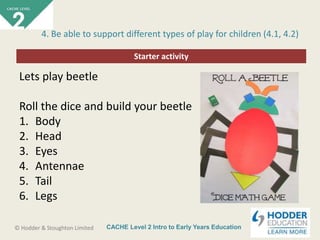
Lets play beetle
Roll the dice and build your beetle
1. Body
2. Head
3. Eyes
4. Antennae
5. Tail
6. Legs
CACHE Level 2 Intro to Early Years EducationŠ Hodder & Stoughton Limited
LO4 Be able to support different types of play for children.
AC 4.1 Describe benefits of:
• Physical play
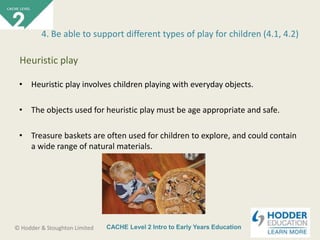
• Creative play
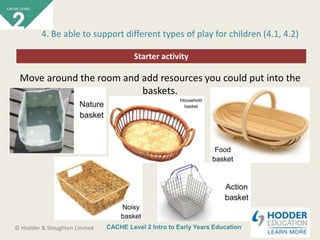
• Imaginative play
AC 4.2 Implement activities which support children’s:
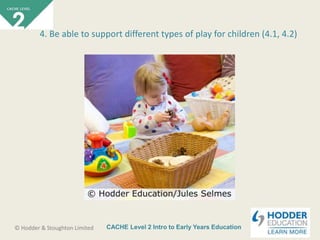
• Physical play
• Creative play
• Imaginative play
Learning Outcomes
CACHE Level 2 Intro to Early Years EducationŠ Hodder & Stoughton Limited
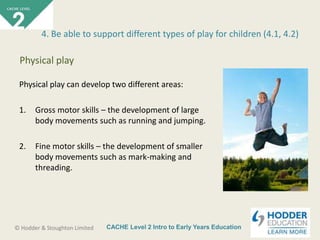
Physical play can develop two different areas:
1. Gross motor skills – the development of large
body movements such as running and jumping.
2. Fine motor skills – the development of smaller
body movements such as mark-making and
threading.
4. Be able to support different types of play for children (4.1, 4.2)
Physical play
CACHE Level 2 Intro to Early Years EducationŠ Hodder & Stoughton Limited
Pairs activity
In pair’s describe two physical activities available at your settings.
Consider:
• One gross motor activity
• One fine motor activity
How does each activity supported children’s learning and development?
Which activity do you think children prefer? Why?
4. Be able to support different types of play for children (4.1, 4.2)
CACHE Level 2 Intro to Early Years EducationŠ Hodder & Stoughton Limited
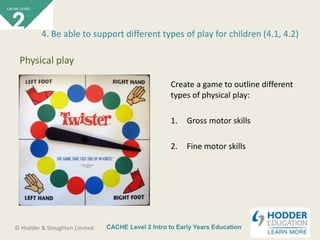
Create a game to outline different
types of physical play:
1. Gross motor skills
2. Fine motor skills
4. Be able to support different types of play for children (4.1, 4.2)
Physical play
CACHE Level 2 Intro to Early Years EducationŠ Hodder & Stoughton Limited
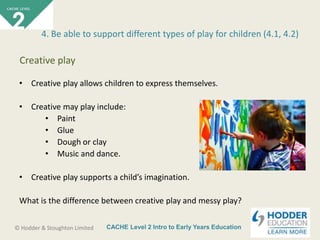
• Creative play allows children to express themselves.
• Creative may play include:
• Paint
• Glue
• Dough or clay
• Music and dance.
• Creative play supports a child’s imagination.
What is the difference between creative play and messy play?
4. Be able to support different types of play for children (4.1, 4.2)
Creative play
CACHE Level 2 Intro to Early Years EducationŠ Hodder & Stoughton Limited
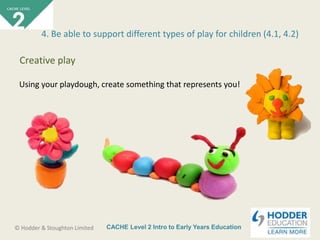
Using your playdough, create something that represents you!
4. Be able to support different types of play for children (4.1, 4.2)
Creative play
CACHE Level 2 Intro to Early Years EducationŠ Hodder & Stoughton Limited
• Role play allows children to use their imagination and be someone else.
• Children sometimes use their imagination to create or deal with a
situation.
• They might be their favourite superhero or character, or they might be in
the home corner re-enacting something that happened at home.
https://www.youtube.com/watch?v=6ahRp-LhXC8
4. Be able to support different types of play for children (4.1, 4.2)
Imaginative play
CACHE Level 2 Intro to Early Years EducationŠ Hodder & Stoughton Limited
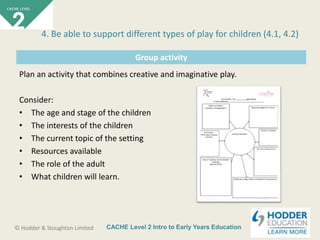
Group activity
Plan an activity that combines creative and imaginative play.
Consider:
• The age and stage of the children
• The interests of the children
• The current topic of the setting
• Resources available
• The role of the adult
• What children will learn.
4. Be able to support different types of play for children (4.1, 4.2)
CACHE Level 2 Intro to Early Years EducationŠ Hodder & Stoughton Limited
LO4 Be able to support different types of play for children.
AC 4.1 Describe benefits of:
• Physical play
• Creative play
• Imaginative play
AC 4.2 Implement activities which support children’s:
• Physical play
• Creative play
• Imaginative play
Learning Outcomes
CACHE Level 2 Intro to Early Years EducationŠ Hodder & Stoughton Limited
CACHE LEVEL 2
INTRODUCTION TO
EARLY YEARS EDUCATION
AND CARE
Unit 7 Support children’s play in early years
Session 6
CACHE Level 2 Intro to Early Years EducationŠ Hodder & Stoughton Limited
Starter activity
4. Be able to support different types of play for children (4.1, 4.2)
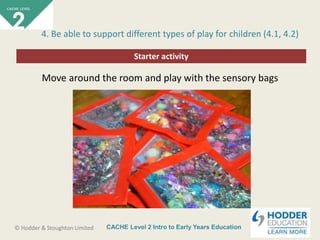
Move around the room and play with the sensory bags
CACHE Level 2 Intro to Early Years EducationŠ Hodder & Stoughton Limited
LO4 Be able to support different types of play for children.
AC 4.1 Describe benefits of:
• Sensory play
AC 4.2 Implement activities which support children’s:
• Sensory play
Learning Outcomes
CACHE Level 2 Intro to Early Years EducationŠ Hodder & Stoughton Limited
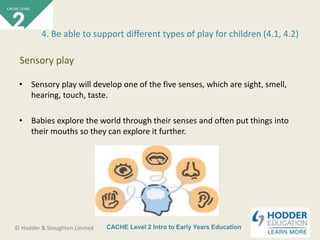
• Sensory play will develop one of the five senses, which are sight, smell,
hearing, touch, taste.
• Babies explore the world through their senses and often put things into
their mouths so they can explore it further.
4. Be able to support different types of play for children (4.1, 4.2)
Sensory play
CACHE Level 2 Intro to Early Years EducationŠ Hodder & Stoughton Limited
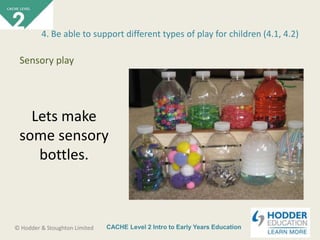
Lets make
some sensory
bottles.
4. Be able to support different types of play for children (4.1, 4.2)
Sensory play
CACHE Level 2 Intro to Early Years EducationŠ Hodder & Stoughton Limited
Fold an A4 piece of paper in half
Create an information poster on one side of your A4 sheet to display on a
setting’s parents/carer’s information board, outlining the benefits of sensory
toys.
Use the Nabi’s and the EYE books to aid you complete some supporting
research. Remember to add in a quote.
4. Be able to support different types of play for children (4.1, 4.2)
Sensory play
CACHE Level 2 Intro to Early Years EducationŠ Hodder & Stoughton Limited
LO4 Be able to support different types of play for children.
AC 4.1 Describe benefits of:
• Sensory play
AC 4.2 Implement activities which support children’s:
• Sensory play
Learning Outcomes
CACHE Level 2 Intro to Early Years EducationŠ Hodder & Stoughton Limited
CACHE LEVEL 2
INTRODUCTION TO
EARLY YEARS EDUCATION
AND CARE
Unit 7 Support children’s play in early years
Session 7
CACHE Level 2 Intro to Early Years EducationŠ Hodder & Stoughton Limited
Starter activity
4. Be able to support different types of play for children (4.1, 4.2)
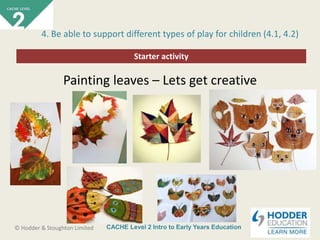
Painting leaves – Lets get creative
CACHE Level 2 Intro to Early Years EducationŠ Hodder & Stoughton Limited
LO4 Be able to support different types of play for children.
AC 4.1 Describe benefits of:
• Heuristic play.
AC 4.2 Implement activities which support children’s:
• Heuristic play.
Learning Outcomes
CACHE Level 2 Intro to Early Years EducationŠ Hodder & Stoughton Limited
• Heuristic play involves children playing with everyday objects.
• The objects used for heuristic play must be age appropriate and safe.
• Treasure baskets are often used for children to explore, and could contain
a wide range of natural materials.
4. Be able to support different types of play for children (4.1, 4.2)
Heuristic play
CACHE Level 2 Intro to Early Years EducationŠ Hodder & Stoughton Limited
Starter activity
4. Be able to support different types of play for children (4.1, 4.2)
Move around the room and add resources you could put into the
baskets.
CACHE Level 2 Intro to Early Years EducationŠ Hodder & Stoughton Limited
4. Be able to support different types of play for children (4.1, 4.2)
CACHE Level 2 Intro to Early Years EducationŠ Hodder & Stoughton Limited
Pairs activity
Time: 15 mins
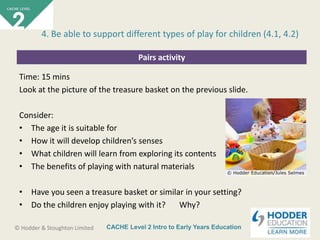
Look at the picture of the treasure basket on the previous slide.
Consider:
• The age it is suitable for
• How it will develop children’s senses
• What children will learn from exploring its contents
• The benefits of playing with natural materials
• Have you seen a treasure basket or similar in your setting?
• Do the children enjoy playing with it? Why?
4. Be able to support different types of play for children (4.1, 4.2)
CACHE Level 2 Intro to Early Years EducationŠ Hodder & Stoughton Limited
• You are required to carry out activities in each of the areas discussed and
to describe the benefits of each type of play.
• You can combine two or more areas when planning, but you must clearly
identify each area and its specific benefits to children’s learning and
development.
Revisit any completed activity plans to check the details
4. Be able to support different types of play for children (4.1, 4.2)
Different types of play
CACHE Level 2 Intro to Early Years EducationŠ Hodder & Stoughton Limited
Reflection activity
Time: 15 mins
Is there an area of play within the setting that you do not like taking part in?
Consider:
• Outdoor play
• Messy play
• Role play
• Tactile play
How might this impact on the children?
How can you overcome your dislike for this area of play?
4. Be able to support different types of play for children (4.1, 4.2)
CACHE Level 2 Intro to Early Years EducationŠ Hodder & Stoughton Limited
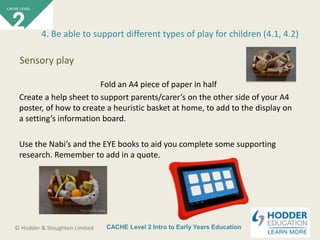
Fold an A4 piece of paper in half
Create a help sheet to support parents/carer’s on the other side of your A4
poster, of how to create a heuristic basket at home, to add to the display on
a setting’s information board.
Use the Nabi’s and the EYE books to aid you complete some supporting
research. Remember to add in a quote.
4. Be able to support different types of play for children (4.1, 4.2)
Sensory play
CACHE Level 2 Intro to Early Years EducationŠ Hodder & Stoughton Limited
LO4 Be able to support different types of play for children.
AC 4.1 Describe benefits of:
• Heuristic play.
AC 4.2 Implement activities which support children’s:
• Heuristic play.
Learning Outcomes
CACHE Level 2 Intro to Early Years EducationŠ Hodder & Stoughton Limited
Extension activity
Time: 15 mins
Elinor Goldschmied developed the idea of babies learning through exploring
treasure baskets. How would you explain the benefits to a new parent/carer?
Consider:
• Creating an age-appropriate treasure basket using items from around the
home
• How it will support all areas of development
• The value of learning through exploring
• The benefits of heuristic play.
4. Be able to support different types of play for children (4.1, 4.2)
CACHE Level 2 Intro to Early Years EducationŠ Hodder & Stoughton Limited
Summary
• Children will learn and develop through a well-planned variety of play
activities.
• Some children will prefer one type of play, but all types of play should
be offered.
• Different types of play can be combined in one activity to support even
more learning and development.
CACHE Level 2 Intro to Early Years EducationŠ Hodder & Stoughton Limited
1. What are the two types of physical play called?
2. Describe three activities that can be planned for creative
play.
3. List 10 things you could put in a treasure basket that would
be suitable for an 18-month-old child.
Plenary

Unit 7 pp 5, 6 and 7

  • 1.
    CACHE Level 2Intro to Early Years Education© Hodder & Stoughton Limited CACHE LEVEL 2 INTRODUCTION TO EARLY YEARS EDUCATION AND CARE Unit 7 Support children’s play in early years Session 5
  • 2.
    CACHE Level 2Intro to Early Years EducationŠ Hodder & Stoughton Limited Starter activity 4. Be able to support different types of play for children (4.1, 4.2) Lets play beetle Roll the dice and build your beetle 1. Body 2. Head 3. Eyes 4. Antennae 5. Tail 6. Legs
  • 3.
    CACHE Level 2Intro to Early Years Education© Hodder & Stoughton Limited LO4 Be able to support different types of play for children. AC 4.1 Describe benefits of: • Physical play • Creative play • Imaginative play AC 4.2 Implement activities which support children’s: • Physical play • Creative play • Imaginative play Learning Outcomes
  • 4.
    CACHE Level 2Intro to Early Years Education© Hodder & Stoughton Limited Physical play can develop two different areas: 1. Gross motor skills – the development of large body movements such as running and jumping. 2. Fine motor skills – the development of smaller body movements such as mark-making and threading. 4. Be able to support different types of play for children (4.1, 4.2) Physical play
  • 5.
    CACHE Level 2Intro to Early Years Education© Hodder & Stoughton Limited Pairs activity In pair’s describe two physical activities available at your settings. Consider: • One gross motor activity • One fine motor activity How does each activity supported children’s learning and development? Which activity do you think children prefer? Why? 4. Be able to support different types of play for children (4.1, 4.2)
  • 6.
    CACHE Level 2Intro to Early Years EducationŠ Hodder & Stoughton Limited Create a game to outline different types of physical play: 1. Gross motor skills 2. Fine motor skills 4. Be able to support different types of play for children (4.1, 4.2) Physical play
  • 7.
    CACHE Level 2Intro to Early Years Education© Hodder & Stoughton Limited • Creative play allows children to express themselves. • Creative may play include: • Paint • Glue • Dough or clay • Music and dance. • Creative play supports a child’s imagination. What is the difference between creative play and messy play? 4. Be able to support different types of play for children (4.1, 4.2) Creative play
  • 8.
    CACHE Level 2Intro to Early Years EducationŠ Hodder & Stoughton Limited Using your playdough, create something that represents you! 4. Be able to support different types of play for children (4.1, 4.2) Creative play
  • 9.
    CACHE Level 2Intro to Early Years Education© Hodder & Stoughton Limited • Role play allows children to use their imagination and be someone else. • Children sometimes use their imagination to create or deal with a situation. • They might be their favourite superhero or character, or they might be in the home corner re-enacting something that happened at home. https://www.youtube.com/watch?v=6ahRp-LhXC8 4. Be able to support different types of play for children (4.1, 4.2) Imaginative play
  • 10.
    CACHE Level 2Intro to Early Years Education© Hodder & Stoughton Limited Group activity Plan an activity that combines creative and imaginative play. Consider: • The age and stage of the children • The interests of the children • The current topic of the setting • Resources available • The role of the adult • What children will learn. 4. Be able to support different types of play for children (4.1, 4.2)
  • 11.
    CACHE Level 2Intro to Early Years Education© Hodder & Stoughton Limited LO4 Be able to support different types of play for children. AC 4.1 Describe benefits of: • Physical play • Creative play • Imaginative play AC 4.2 Implement activities which support children’s: • Physical play • Creative play • Imaginative play Learning Outcomes
  • 12.
    CACHE Level 2Intro to Early Years Education© Hodder & Stoughton Limited CACHE LEVEL 2 INTRODUCTION TO EARLY YEARS EDUCATION AND CARE Unit 7 Support children’s play in early years Session 6
  • 13.
    CACHE Level 2Intro to Early Years EducationŠ Hodder & Stoughton Limited Starter activity 4. Be able to support different types of play for children (4.1, 4.2) Move around the room and play with the sensory bags
  • 14.
    CACHE Level 2Intro to Early Years Education© Hodder & Stoughton Limited LO4 Be able to support different types of play for children. AC 4.1 Describe benefits of: • Sensory play AC 4.2 Implement activities which support children’s: • Sensory play Learning Outcomes
  • 15.
    CACHE Level 2Intro to Early Years Education© Hodder & Stoughton Limited • Sensory play will develop one of the five senses, which are sight, smell, hearing, touch, taste. • Babies explore the world through their senses and often put things into their mouths so they can explore it further. 4. Be able to support different types of play for children (4.1, 4.2) Sensory play
  • 16.
    CACHE Level 2Intro to Early Years EducationŠ Hodder & Stoughton Limited Lets make some sensory bottles. 4. Be able to support different types of play for children (4.1, 4.2) Sensory play
  • 17.
    CACHE Level 2Intro to Early Years Education© Hodder & Stoughton Limited Fold an A4 piece of paper in half Create an information poster on one side of your A4 sheet to display on a setting’s parents/carer’s information board, outlining the benefits of sensory toys. Use the Nabi’s and the EYE books to aid you complete some supporting research. Remember to add in a quote. 4. Be able to support different types of play for children (4.1, 4.2) Sensory play
  • 18.
    CACHE Level 2Intro to Early Years Education© Hodder & Stoughton Limited LO4 Be able to support different types of play for children. AC 4.1 Describe benefits of: • Sensory play AC 4.2 Implement activities which support children’s: • Sensory play Learning Outcomes
  • 19.
    CACHE Level 2Intro to Early Years Education© Hodder & Stoughton Limited CACHE LEVEL 2 INTRODUCTION TO EARLY YEARS EDUCATION AND CARE Unit 7 Support children’s play in early years Session 7
  • 20.
    CACHE Level 2Intro to Early Years Education© Hodder & Stoughton Limited Starter activity 4. Be able to support different types of play for children (4.1, 4.2) Painting leaves – Lets get creative
  • 21.
    CACHE Level 2Intro to Early Years Education© Hodder & Stoughton Limited LO4 Be able to support different types of play for children. AC 4.1 Describe benefits of: • Heuristic play. AC 4.2 Implement activities which support children’s: • Heuristic play. Learning Outcomes
  • 22.
    CACHE Level 2Intro to Early Years Education© Hodder & Stoughton Limited • Heuristic play involves children playing with everyday objects. • The objects used for heuristic play must be age appropriate and safe. • Treasure baskets are often used for children to explore, and could contain a wide range of natural materials. 4. Be able to support different types of play for children (4.1, 4.2) Heuristic play
  • 23.
    CACHE Level 2Intro to Early Years EducationŠ Hodder & Stoughton Limited Starter activity 4. Be able to support different types of play for children (4.1, 4.2) Move around the room and add resources you could put into the baskets.
  • 24.
    CACHE Level 2Intro to Early Years EducationŠ Hodder & Stoughton Limited 4. Be able to support different types of play for children (4.1, 4.2)
  • 25.
    CACHE Level 2Intro to Early Years Education© Hodder & Stoughton Limited Pairs activity Time: 15 mins Look at the picture of the treasure basket on the previous slide. Consider: • The age it is suitable for • How it will develop children’s senses • What children will learn from exploring its contents • The benefits of playing with natural materials • Have you seen a treasure basket or similar in your setting? • Do the children enjoy playing with it? Why? 4. Be able to support different types of play for children (4.1, 4.2)
  • 26.
    CACHE Level 2Intro to Early Years Education© Hodder & Stoughton Limited • You are required to carry out activities in each of the areas discussed and to describe the benefits of each type of play. • You can combine two or more areas when planning, but you must clearly identify each area and its specific benefits to children’s learning and development. Revisit any completed activity plans to check the details 4. Be able to support different types of play for children (4.1, 4.2) Different types of play
  • 27.
    CACHE Level 2Intro to Early Years Education© Hodder & Stoughton Limited Reflection activity Time: 15 mins Is there an area of play within the setting that you do not like taking part in? Consider: • Outdoor play • Messy play • Role play • Tactile play How might this impact on the children? How can you overcome your dislike for this area of play? 4. Be able to support different types of play for children (4.1, 4.2)
  • 28.
    CACHE Level 2Intro to Early Years Education© Hodder & Stoughton Limited Fold an A4 piece of paper in half Create a help sheet to support parents/carer’s on the other side of your A4 poster, of how to create a heuristic basket at home, to add to the display on a setting’s information board. Use the Nabi’s and the EYE books to aid you complete some supporting research. Remember to add in a quote. 4. Be able to support different types of play for children (4.1, 4.2) Sensory play
  • 29.
    CACHE Level 2Intro to Early Years Education© Hodder & Stoughton Limited LO4 Be able to support different types of play for children. AC 4.1 Describe benefits of: • Heuristic play. AC 4.2 Implement activities which support children’s: • Heuristic play. Learning Outcomes
  • 30.
    CACHE Level 2Intro to Early Years Education© Hodder & Stoughton Limited Extension activity Time: 15 mins Elinor Goldschmied developed the idea of babies learning through exploring treasure baskets. How would you explain the benefits to a new parent/carer? Consider: • Creating an age-appropriate treasure basket using items from around the home • How it will support all areas of development • The value of learning through exploring • The benefits of heuristic play. 4. Be able to support different types of play for children (4.1, 4.2)
  • 31.
    CACHE Level 2Intro to Early Years Education© Hodder & Stoughton Limited Summary • Children will learn and develop through a well-planned variety of play activities. • Some children will prefer one type of play, but all types of play should be offered. • Different types of play can be combined in one activity to support even more learning and development.
  • 32.
    CACHE Level 2Intro to Early Years EducationŠ Hodder & Stoughton Limited 1. What are the two types of physical play called? 2. Describe three activities that can be planned for creative play. 3. List 10 things you could put in a treasure basket that would be suitable for an 18-month-old child. Plenary

Editor's Notes

  • #6 Learners should identify the difference between the two, with specific activities. These activities can support: Gross motor skills – exercise, co-ordination, balance, team work Fine motor skills – pincer control, palmer grasp, concentration. Learners should discuss that some children prefer to run around, while others like to sit and play.
  • #11 Learners should discuss how the two types of play work well together. For example: Creating a painted brick wall to make the home corner a castle Decorating cloaks for the role-play area A dance activity where children pretend to be creatures.
  • #26 Learners should link two further types of play, and identify the benefits of both. Discussion of treasure baskets in the setting could lead to learners planning to create one if it is not available in their setting.
  • #28 Learners should reflect on the impact of their views on play. For example: If a learner shows a real dislike for getting messy, then children may be reluctant to join in. If a learner does not want to go outside because it is cold, then children will copy this thought. If a learner finds a treasure basket boring, then it will not stimulate children to explore.
  • #31 Learners should describe both the benefits and possible contents of a homemade treasure basket. Learners could carry out further research on Goldschmied, and include some of her findings in their answer.