Designing and Conducting Training Program
Learning Objectives
5-2
• Be able to choose and prepare a training site based on how trainees will be involved and interact
with the content and each other in the course
• Prepare for instruction using a curriculum road map, lesson plan, design document, and
concept map
• Explain how trainees’ age, generational differences, and personality might influence how
programs are designed
 Prepare a request for proposal (RFP) and a list of questions to evaluate training consultants
and suppliers
 Explain the program design elements that should be included to ensure near and far transfer of
training
 Develop a self-management module for a training program
 Design application assignments and action plans to enhance learning and transfer of training
 Make recommendations about what managers can do before, during, and after training to
facilitate learning and transfer
Program Design
5-3
Organization and coordination of the training program
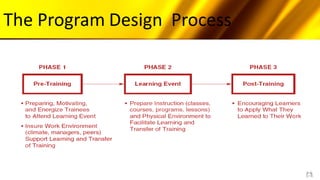
The Program Design Process
5-4
Selecting and Preparing
Training Site
5-5
Training site: Room where training will be
conducted
Characteristics of good training room
Comfortable and accessible
Quiet private and free from interruptions
Sufficient space for trainees to move around easily
Enough room for trainees to have adequate work space
Good visibility for trainees to see each other, the trainer and any
visual displays
Details to Consider When Evaluating a
Training Room
5-6
Noise and colors
Room structure and lighting
Wall and floor covering
Meeting room chairs
Glare
Ceiling
Electrical outlets
Acoustics
Technology
Examples of Seating Arrangements
5-7
Making Training Site and
Instruction Conducive to learning
5-8
Creating learning setting- Determine the extent to which
trainees decide
When, where, and how they will learn (self-direction)
Whether learning will occur by interaction with others (collaboration)
Preparation of materials
Know the audience
Pretraining
Provide overview of the course
Making Training Site and Instruction
Conducive to learning
5-9
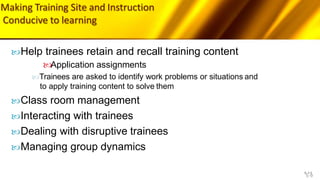
Help trainees retain and recall training content
Application assignments
Trainees are asked to identify work problems or situations and
to apply training content to solve them
Class room management
Interacting with trainees
Dealing with disruptive trainees
Managing group dynamics
Examples of How to Get
Trainees Involved
5-
10
Curriculum Course and Lesson Design
5-
11
Curriculum
Organized program of study designed to meet a complex
learning objective
Includes several courses
Learning objectives- Broader and less measurable than course or
lesson
Course or Program
Covers specific learning objectives
Addresses limited number of competencies
Curriculum Road Map
5-
12
 Shows
 All of the courses in a curriculum
 Paths that learners can take through it
 Sequences in which courses have to be completed
 Includes
 Brief statement of the course purpose
 Prerequisite skills needed for the course
 Learning objectives or competencies covered by the course
 Format of the content and course expectations
 Delivery method for the content
 Design document
 Outlines scope of project, delivery methods, and objectives
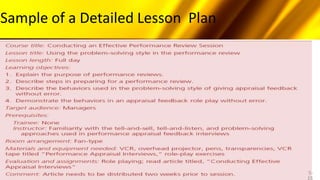
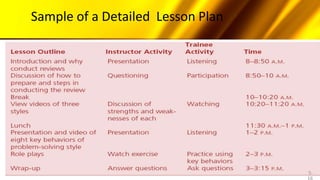
 Detailed lesson plan
 Translates the content and sequence of training activities into a trainer guide
 Lesson plan overview
 Matches major activities of the training program and specific times
Design Document Template
5-
13
Design Document
5-
14
Sample of a Detailed Lesson Plan
5-
15
Sample of a Detailed Lesson Plan
5-
16
Features of an Effective Lesson Plan
5-
17
Choosing Vendor or Consultant For
Training Services
5-
18
 Request for proposal (RFP)
 Used for potential vendors and consultants
 Outlines:
 Type of service the company is seeking
 Type and number of references needed
 Number of employees who need to be trained
 Funding for the project
 Follow-up process used to determined level of satisfaction and service
 Expected date of completion of project, and the date when proposals
must be received by the company
Questions to Ask Vendors and Consultants
5-
19
Transfer of Training
5-
20
 Encourage trainees to self-manage the use of learned skills
 Provide trainees with opportunities to use training content
 Near transfer
 Applying learned capabilities exactly in a work situation
 Training tasks involve responding to predictable
Situations
 In Programs with emphasis on near transfer, trainees
 Need to follow standardized procedures, processes,and checklists
 Should be encouraged to focus only on importantdifferences between training tasks and
work tasks
 Should be provided with an explanation of why and howthe procedure should be
performed
 Learn behaviors or skills that contribute to effectiveperformance
Transfer of Training
5-
21
 Far transfer
 Involves using learned capabilities to novel situations involving original
thinking
 Training tasks require variable interactions and unpredictable
responses
 Programs with emphasis on far transfer should:
 Teach general concepts, broad principles, or key behaviors
 Provide a list of prompts or questions to help trigger thoughts and question
sets
Encourage Manager
Support for Training
5-
22
 Manager support: Degree to which managers
 Emphasize the importance of attending training programs
 Stress the application of training content to job
 Provide opportunities for trainees to use what they have learned on the job
 Action plan
 Document that includes the steps required to ensure that training transfers to
the job
 Includes
 A goal identifying what training content will be used and how it will be used
 Strategies for reaching the goal
 Strategies for receiving feedback
 Expected results
Checklist for Determining a
Manager’s Level of Support for Training
5-
23
Opportunity to Use Learned
Capabilities
5-
24
 Opportunity to perform
 Extent to which the trainee is provided with or actively seeks experiences that
allow:
 Application of the newly learned knowledge, skill, and behavior from the
training program
 Determined by:
 Breadth- Number of trained tasks performed
 Activity level- Number of times with which trained tasks are performed
 Task type- Difficulty of the trained tasks that are actually performed
 Can be measured by asking former trainees indicate:
 Whether they perform a task
 How many times they perform the task
 The extent to which they perform difficult and challengingtasks
Designing and Conducting Training Program.pptx

Designing and Conducting Training Program.pptx

  • 1.
    Designing and ConductingTraining Program
  • 2.
    Learning Objectives 5-2 • Beable to choose and prepare a training site based on how trainees will be involved and interact with the content and each other in the course • Prepare for instruction using a curriculum road map, lesson plan, design document, and concept map • Explain how trainees’ age, generational differences, and personality might influence how programs are designed  Prepare a request for proposal (RFP) and a list of questions to evaluate training consultants and suppliers  Explain the program design elements that should be included to ensure near and far transfer of training  Develop a self-management module for a training program  Design application assignments and action plans to enhance learning and transfer of training  Make recommendations about what managers can do before, during, and after training to facilitate learning and transfer
  • 3.
    Program Design 5-3 Organization andcoordination of the training program
  • 4.
    The Program DesignProcess 5-4
  • 5.
    Selecting and Preparing TrainingSite 5-5 Training site: Room where training will be conducted Characteristics of good training room Comfortable and accessible Quiet private and free from interruptions Sufficient space for trainees to move around easily Enough room for trainees to have adequate work space Good visibility for trainees to see each other, the trainer and any visual displays
  • 6.
    Details to ConsiderWhen Evaluating a Training Room 5-6 Noise and colors Room structure and lighting Wall and floor covering Meeting room chairs Glare Ceiling Electrical outlets Acoustics Technology
  • 7.
    Examples of SeatingArrangements 5-7
  • 8.
    Making Training Siteand Instruction Conducive to learning 5-8 Creating learning setting- Determine the extent to which trainees decide When, where, and how they will learn (self-direction) Whether learning will occur by interaction with others (collaboration) Preparation of materials Know the audience Pretraining Provide overview of the course
  • 9.
    Making Training Siteand Instruction Conducive to learning 5-9 Help trainees retain and recall training content Application assignments Trainees are asked to identify work problems or situations and to apply training content to solve them Class room management Interacting with trainees Dealing with disruptive trainees Managing group dynamics
  • 10.
    Examples of Howto Get Trainees Involved 5- 10
  • 11.
    Curriculum Course andLesson Design 5- 11 Curriculum Organized program of study designed to meet a complex learning objective Includes several courses Learning objectives- Broader and less measurable than course or lesson Course or Program Covers specific learning objectives Addresses limited number of competencies
  • 12.
    Curriculum Road Map 5- 12 Shows  All of the courses in a curriculum  Paths that learners can take through it  Sequences in which courses have to be completed  Includes  Brief statement of the course purpose  Prerequisite skills needed for the course  Learning objectives or competencies covered by the course  Format of the content and course expectations  Delivery method for the content  Design document  Outlines scope of project, delivery methods, and objectives  Detailed lesson plan  Translates the content and sequence of training activities into a trainer guide  Lesson plan overview  Matches major activities of the training program and specific times
  • 13.
  • 14.
  • 15.
    Sample of aDetailed Lesson Plan 5- 15
  • 16.
    Sample of aDetailed Lesson Plan 5- 16
  • 17.
    Features of anEffective Lesson Plan 5- 17
  • 18.
    Choosing Vendor orConsultant For Training Services 5- 18  Request for proposal (RFP)  Used for potential vendors and consultants  Outlines:  Type of service the company is seeking  Type and number of references needed  Number of employees who need to be trained  Funding for the project  Follow-up process used to determined level of satisfaction and service  Expected date of completion of project, and the date when proposals must be received by the company
  • 19.
    Questions to AskVendors and Consultants 5- 19
  • 20.
    Transfer of Training 5- 20 Encourage trainees to self-manage the use of learned skills  Provide trainees with opportunities to use training content  Near transfer  Applying learned capabilities exactly in a work situation  Training tasks involve responding to predictable Situations  In Programs with emphasis on near transfer, trainees  Need to follow standardized procedures, processes,and checklists  Should be encouraged to focus only on importantdifferences between training tasks and work tasks  Should be provided with an explanation of why and howthe procedure should be performed  Learn behaviors or skills that contribute to effectiveperformance
  • 21.
    Transfer of Training 5- 21 Far transfer  Involves using learned capabilities to novel situations involving original thinking  Training tasks require variable interactions and unpredictable responses  Programs with emphasis on far transfer should:  Teach general concepts, broad principles, or key behaviors  Provide a list of prompts or questions to help trigger thoughts and question sets
  • 22.
    Encourage Manager Support forTraining 5- 22  Manager support: Degree to which managers  Emphasize the importance of attending training programs  Stress the application of training content to job  Provide opportunities for trainees to use what they have learned on the job  Action plan  Document that includes the steps required to ensure that training transfers to the job  Includes  A goal identifying what training content will be used and how it will be used  Strategies for reaching the goal  Strategies for receiving feedback  Expected results
  • 23.
    Checklist for Determininga Manager’s Level of Support for Training 5- 23
  • 24.
    Opportunity to UseLearned Capabilities 5- 24  Opportunity to perform  Extent to which the trainee is provided with or actively seeks experiences that allow:  Application of the newly learned knowledge, skill, and behavior from the training program  Determined by:  Breadth- Number of trained tasks performed  Activity level- Number of times with which trained tasks are performed  Task type- Difficulty of the trained tasks that are actually performed  Can be measured by asking former trainees indicate:  Whether they perform a task  How many times they perform the task  The extent to which they perform difficult and challengingtasks