1
CONTROLLING
2
Controlling
 The process of evaluating and
regulating ongoing activities to
ensure that goals are achieved.
3
The Nature of Control
The regulation of organizational activities so
that some targeted element of
performance remains within acceptable
limits.
 Provides organizations with indications of how
well they are performing in relation to their
goals.
 Provides a mechanism for adjusting
performance to keep organizations moving in
the right direction.
4
Why To Control?
Managing people performance
Coping with uncertainty
Detecting Irregularities
Identifying opportunities
Handling complex situations
Delegation
Minimizing Costs
Basis for planning
5
AREAS OF CONTROL
 Physical resources—inventory management,
quality control, and equipment control.
 Human resources—selection and placement,
training and development, performance appraisal,
and compensation.
 Information resources—sales and marketing
forecasts, environmental analysis, public
relations, production scheduling, and economic
forecasting.
 Financial resources—managing capital funds
and cash flow, collection and payment of debts.
Goals and
Objectives
Organizational
Divisional
Departmental
Individual
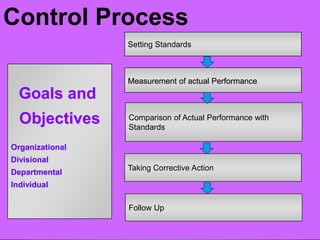
Setting Standards
Measurement of actual Performance
Taking Corrective Action
Control Process
Comparison of Actual Performance with
Standards
Follow Up
7
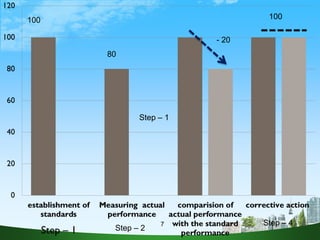
100
80
- 20
100
Step – 1
Step – 2
Step – 4
Establish Objectives and Standards
• Standards are the plans or the targets which
have to be achieved in the course of business
function
• They can also be called as the criterions for
judging the performance
8
Cont.…
Standards generally are classified into two-:
• Measurable or tangible - Those standards which can be
measured and expressed are called as measurable
standards. They can be in form of cost, output, expenditure,
time, profit, etc.
• Non-measurable or intangible- There are standards which
cannot be measured monetarily. For example- performance
of a manager, deviation of workers, their attitudes towards
a concern. These are called as in tangible standards.
9
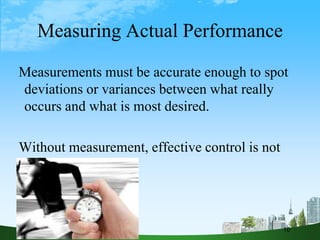
Measuring Actual Performance
Measurements must be accurate enough to spot
deviations or variances between what really
occurs and what is most desired.
Without measurement, effective control is not
possible.
10
Comparing Results with
Objectives and Standards
• Comparison of actual
performance with the planned
targets is very important.
• Deviation can be defined as the
gap between actual performance
and the planned targets.
• The manager has to find out two
things here- extent of deviation 11
For example, if stationery charges increase by a
minor 5 to 10%, it can be called as a minor
deviation.
On the other hand, if monthly production
decreases continuously, it is called as major
deviation.
12
Cont…
Once the deviation is identified, a manager has to
think about various cause which has led to
deviation. The causes can be-
• Erroneous planning,
• Co-ordination loosens,
• Implementation of plans is defective, and
• Supervision and communication is ineffective,
etc.
13
Taking Corrective Action
Once the causes and extent of deviations are known, the manager has to detect
those errors and take remedial measures for it. There are two alternatives
here-
1. Taking corrective measures for deviations which have occurred;
2. After taking the corrective measures, if the actual performance is not in
conformity with plans, the manager can revise the targets. It is here the
controlling process comes to an end.
Follow up is an important step because it is only
through taking corrective measures, a manager
can exercise controlling.
14
15
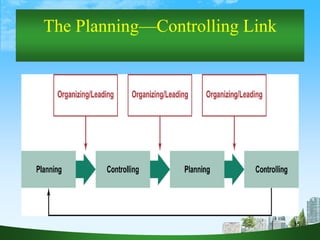
The Planning—Controlling Link
Relationship between planning
and controlling
Planning and controlling are two separate
functions of management, yet they are closely
related.
Without the basis of planning, controlling
activities becomes baseless and without
controlling, planning becomes a meaningless
exercise.
In absence of controlling, no purpose can be
served by. Therefore, planning and controlling
reinforce each other 16
Cont.
According to Billy Goetz, " Relationship between the two can be summarized in
the following points:
•Planning precedes controlling and controlling succeeds planning.
•Planning and controlling are inseparable functions of management.
•Activities are put on rails by planning and they are kept at right place through
controlling.
•The process of planning and controlling works on Systems Approach which is
as follows
:Planning → Results → Corrective Action
•Planning and controlling are integral parts of an organization as both are
important for smooth running of an enterprise.
•Planning and controlling reinforce each other. Each drives the other function of
management.
18
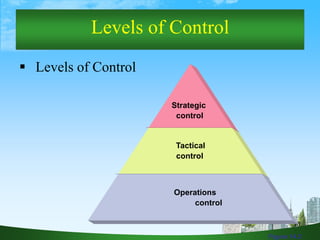
Levels of Control
 Levels of Control
Strategic
control
Tactical
control
Operations
control
Figure 14.2
19
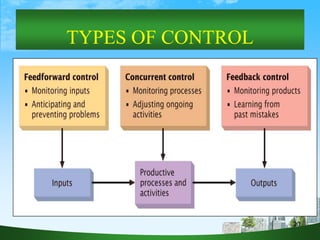
Feedforward Control
The active anticipation and prevention of
problems, rather than passive reaction.
Concurrent Control
Monitoring and adjusting ongoing activities and
processes.
Feedback Control
Checking a completed activity and learning from
mistakes.
TYPES OF CONTROL
20
TYPES OF CONTROL
21
Characteristics of Effective Control
 Integration with Planning
 the more control is linked to planning, the more
effective the control system.
 Flexibility
 the control system must be flexible enough to
accommodate change.
 Accuracy
 Inaccurate information results in bad decision making
and inappropriate managerial actions.
 Timeliness
 A control system should provide information as often
as necessary.
 Objectivity
 A control system must be free from bias
and distortion
22
CONTROL TECHNIQUES
23
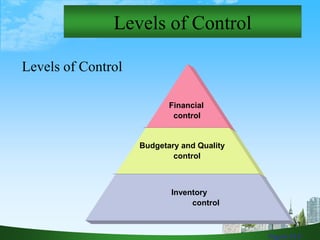
Levels of Control
Levels of Control
Financial
control
Budgetary and Quality
control
Inventory
control
Figure 14.2
24
Financial Control
Financial Statements
A financial statement is a profile of some aspect of an organization’s
financial circumstances.
Balance sheet
A listing of assets (current and fixed), liabilities
(short- and long-term), and stockholders’ equity at a
specific point in time (typically year-ending) that
summarizes the financial condition of the
organization.
Income statement
Summary of financial performance—revenues less
25
Financial Control (cont’d)
Ratio Analysis
The calculation of of one or more financial ratios to assess some
aspect of the organization’s financial health
Liquidity Ratio (e.g. Current Ratio –
current assets/current liabilities)
Activity Ratio (e.g. Inventory Turnover Ratio –
Cost of goods sold/Inventory)
Debt Management Ratio (e.g. Debt Ratio –
Total Liabilities / Total Assets)
Profitability Ratio (e.g. Net Profit Margin –
26
Budgetary Control
Budgets may be established at any organizational level.
Budgets are typically for one year or less.
Budgets may be expressed in financial
terms, units of output, or
other quantifiable factors.
27
Budgetary Control (cont’d)
Budgets serve four purposes:
Help managers coordinate resources and
projects.
Help define the established standards for
control.
Provide guidelines about the
organization’s resources
and expectations.
Enable the organization
to evaluate the
28
Responsibility Centers
Standard Cost Centers
Production Unit
Discretionary Expense Centers
R&D
Revenue Centers
Sales Department
Profit Centers
Business Unit
Investment Centers
Project
29
Strengths and Weaknesses of Budgeting
Strengths
Budgets facilitate effective
operational controls.
Budgets facilitate coordination
and communication between
departments.
Budgets establish records of
organizational performance,
which can enhance planning.
Weaknesses
Budgets can hamper
operations if applied too
rigidly.
Budgets can be time
consuming to develop.
Budgets can limit innovation
and change.
30
Structural Control
Bureaucratic Control
A form of organizational control characterized by formal and
mechanistic structural arrangements.
Clan Control
An approach to organizational
control characterized by
informal and organic
structural arrangements.

controlling.ppt

  • 1.
  • 2.
    2 Controlling  The processof evaluating and regulating ongoing activities to ensure that goals are achieved.
  • 3.
    3 The Nature ofControl The regulation of organizational activities so that some targeted element of performance remains within acceptable limits.  Provides organizations with indications of how well they are performing in relation to their goals.  Provides a mechanism for adjusting performance to keep organizations moving in the right direction.
  • 4.
    4 Why To Control? Managingpeople performance Coping with uncertainty Detecting Irregularities Identifying opportunities Handling complex situations Delegation Minimizing Costs Basis for planning
  • 5.
    5 AREAS OF CONTROL Physical resources—inventory management, quality control, and equipment control.  Human resources—selection and placement, training and development, performance appraisal, and compensation.  Information resources—sales and marketing forecasts, environmental analysis, public relations, production scheduling, and economic forecasting.  Financial resources—managing capital funds and cash flow, collection and payment of debts.
  • 6.
    Goals and Objectives Organizational Divisional Departmental Individual Setting Standards Measurementof actual Performance Taking Corrective Action Control Process Comparison of Actual Performance with Standards Follow Up
  • 7.
    7 100 80 - 20 100 Step –1 Step – 2 Step – 4
  • 8.
    Establish Objectives andStandards • Standards are the plans or the targets which have to be achieved in the course of business function • They can also be called as the criterions for judging the performance 8
  • 9.
    Cont.… Standards generally areclassified into two-: • Measurable or tangible - Those standards which can be measured and expressed are called as measurable standards. They can be in form of cost, output, expenditure, time, profit, etc. • Non-measurable or intangible- There are standards which cannot be measured monetarily. For example- performance of a manager, deviation of workers, their attitudes towards a concern. These are called as in tangible standards. 9
  • 10.
    Measuring Actual Performance Measurementsmust be accurate enough to spot deviations or variances between what really occurs and what is most desired. Without measurement, effective control is not possible. 10
  • 11.
    Comparing Results with Objectivesand Standards • Comparison of actual performance with the planned targets is very important. • Deviation can be defined as the gap between actual performance and the planned targets. • The manager has to find out two things here- extent of deviation 11
  • 12.
    For example, ifstationery charges increase by a minor 5 to 10%, it can be called as a minor deviation. On the other hand, if monthly production decreases continuously, it is called as major deviation. 12
  • 13.
    Cont… Once the deviationis identified, a manager has to think about various cause which has led to deviation. The causes can be- • Erroneous planning, • Co-ordination loosens, • Implementation of plans is defective, and • Supervision and communication is ineffective, etc. 13
  • 14.
    Taking Corrective Action Oncethe causes and extent of deviations are known, the manager has to detect those errors and take remedial measures for it. There are two alternatives here- 1. Taking corrective measures for deviations which have occurred; 2. After taking the corrective measures, if the actual performance is not in conformity with plans, the manager can revise the targets. It is here the controlling process comes to an end. Follow up is an important step because it is only through taking corrective measures, a manager can exercise controlling. 14
  • 15.
  • 16.
    Relationship between planning andcontrolling Planning and controlling are two separate functions of management, yet they are closely related. Without the basis of planning, controlling activities becomes baseless and without controlling, planning becomes a meaningless exercise. In absence of controlling, no purpose can be served by. Therefore, planning and controlling reinforce each other 16
  • 17.
    Cont. According to BillyGoetz, " Relationship between the two can be summarized in the following points: •Planning precedes controlling and controlling succeeds planning. •Planning and controlling are inseparable functions of management. •Activities are put on rails by planning and they are kept at right place through controlling. •The process of planning and controlling works on Systems Approach which is as follows :Planning → Results → Corrective Action •Planning and controlling are integral parts of an organization as both are important for smooth running of an enterprise. •Planning and controlling reinforce each other. Each drives the other function of management.
  • 18.
    18 Levels of Control Levels of Control Strategic control Tactical control Operations control Figure 14.2
  • 19.
    19 Feedforward Control The activeanticipation and prevention of problems, rather than passive reaction. Concurrent Control Monitoring and adjusting ongoing activities and processes. Feedback Control Checking a completed activity and learning from mistakes. TYPES OF CONTROL
  • 20.
  • 21.
    21 Characteristics of EffectiveControl  Integration with Planning  the more control is linked to planning, the more effective the control system.  Flexibility  the control system must be flexible enough to accommodate change.  Accuracy  Inaccurate information results in bad decision making and inappropriate managerial actions.  Timeliness  A control system should provide information as often as necessary.  Objectivity  A control system must be free from bias and distortion
  • 22.
  • 23.
    23 Levels of Control Levelsof Control Financial control Budgetary and Quality control Inventory control Figure 14.2
  • 24.
    24 Financial Control Financial Statements Afinancial statement is a profile of some aspect of an organization’s financial circumstances. Balance sheet A listing of assets (current and fixed), liabilities (short- and long-term), and stockholders’ equity at a specific point in time (typically year-ending) that summarizes the financial condition of the organization. Income statement Summary of financial performance—revenues less
  • 25.
    25 Financial Control (cont’d) RatioAnalysis The calculation of of one or more financial ratios to assess some aspect of the organization’s financial health Liquidity Ratio (e.g. Current Ratio – current assets/current liabilities) Activity Ratio (e.g. Inventory Turnover Ratio – Cost of goods sold/Inventory) Debt Management Ratio (e.g. Debt Ratio – Total Liabilities / Total Assets) Profitability Ratio (e.g. Net Profit Margin –
  • 26.
    26 Budgetary Control Budgets maybe established at any organizational level. Budgets are typically for one year or less. Budgets may be expressed in financial terms, units of output, or other quantifiable factors.
  • 27.
    27 Budgetary Control (cont’d) Budgetsserve four purposes: Help managers coordinate resources and projects. Help define the established standards for control. Provide guidelines about the organization’s resources and expectations. Enable the organization to evaluate the
  • 28.
    28 Responsibility Centers Standard CostCenters Production Unit Discretionary Expense Centers R&D Revenue Centers Sales Department Profit Centers Business Unit Investment Centers Project
  • 29.
    29 Strengths and Weaknessesof Budgeting Strengths Budgets facilitate effective operational controls. Budgets facilitate coordination and communication between departments. Budgets establish records of organizational performance, which can enhance planning. Weaknesses Budgets can hamper operations if applied too rigidly. Budgets can be time consuming to develop. Budgets can limit innovation and change.
  • 30.
    30 Structural Control Bureaucratic Control Aform of organizational control characterized by formal and mechanistic structural arrangements. Clan Control An approach to organizational control characterized by informal and organic structural arrangements.

Editor's Notes