


Human capital management
Dr. Preeti Bhaskar
Content
Introduction
Constituents of human capital
Importance of human capital management
Human capital management drivers
Human capital theory
Human capital measurement
Approaches to human capital measurement
Human capital reporting
Introduction
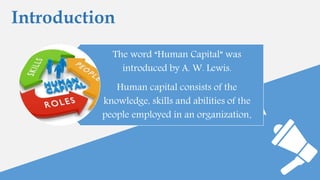
The word “Human Capital” was
introduced by A. W. Lewis.
Human capital consists of the
knowledge, skills and abilities of the
people employed in an organization.
According to Lawrence Bossidy
an American author and former
CEO of Allied Signal,
later Homewell.
“I am convinced that nothing we do
is more important than hiring and
developing people. At the end of the
day, you bet on people, not on
strategies.”
Definition
Human capital represents the human factor in the
organization; the combined intelligence, skills and
expertise that gives the organization its distinctive
character. The human elements of the organization are
those that are capable of learning, changing, innovating
and providing the creative thrust which if properly
motivated can ensure the long-term survival of the
organization.
Bontis et al (1999)
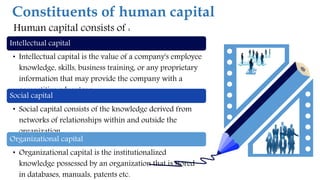
Constituents of human capital
Intellectual capital
• Intellectual capital is the value of a company's employee
knowledge, skills, business training, or any proprietary
information that may provide the company with a
competitive advantage.
Social capital
• Social capital consists of the knowledge derived from
networks of relationships within and outside the
organization
Organizational capital
• Organizational capital is the institutionalized
knowledge possessed by an organization that is stored
in databases, manuals, patents etc.
Human capital consists of :
Human capital management
(HCM) transforms the traditional
administrative functions of
human resources (HR)
departments—recruiting,
training, payroll, compensation,
and performance management—
into opportunities to drive
engagement, productivity, and
business value.
Meaning: Human
capital management
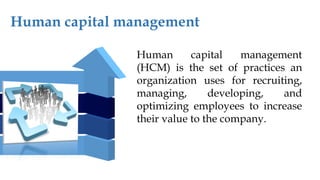
Human capital management
(HCM) is the set of practices an
organization uses for recruiting,
managing, developing, and
optimizing employees to increase
their value to the company.
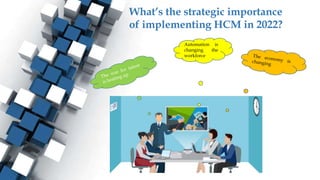
What’s the strategic importance
of implementing HCM in 2022?
Automation is
changing the
workforce
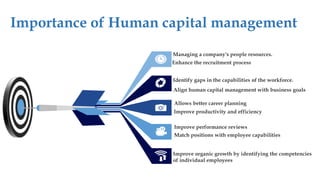
Importance of Human capital management
Improve organic growth by identifying the competencies
of individual employees
Managing a company's people resources.
Identify gaps in the capabilities of the workforce.
Align human capital management with business goals
Improve productivity and efficiency
Enhance the recruitment process
Improve performance reviews
Match positions with employee capabilities
Allows better career planning
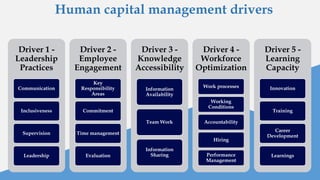
Driver 1 -
Leadership
Practices
Communication
Inclusiveness
Supervision
Leadership
Driver 2 -
Employee
Engagement
Key
Responsibility
Areas
Commitment
Time management
Evaluation
Driver 3 -
Knowledge
Accessibility
Information
Availability
Team Work
Information
Sharing
Driver 4 -
Workforce
Optimization
Work processes
Working
Conditions
Accountability
Hiring
Performance
Management
Driver 5 -
Learning
Capacity
Innovation
Training
Career
Development
Learnings
Human capital management drivers
START
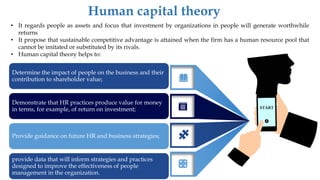
Human capital theory
Determine the impact of people on the business and their
contribution to shareholder value;
Demonstrate that HR practices produce value for money
in terms, for example, of return on investment;
Provide guidance on future HR and business strategies;
provide data that will inform strategies and practices
designed to improve the effectiveness of people
management in the organization.
• It regards people as assets and focus that investment by organizations in people will generate worthwhile
returns
• It propose that sustainable competitive advantage is attained when the firm has a human resource pool that
cannot be imitated or substituted by its rivals.
• Human capital theory helps to:
Human capital measurement has been
defined by IDS (2004) as being ‘about
finding links, correlations and, ideally,
causation, between different sets of
(HR) data, using
statistical techniques’.
The primary aim of HCM is to assess
the impact of human resource
management practices
and the contribution made by people
to organizational performance.
Human capital measurement
Reasons for interest in human
capital measurement
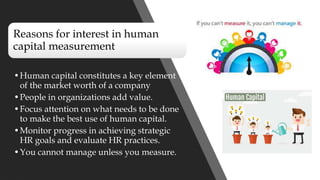
•Human capital constitutes a key element
of the market worth of a company
•People in organizations add value.
•Focus attention on what needs to be done
to make the best use of human capital.
•Monitor progress in achieving strategic
HR goals and evaluate HR practices.
•You cannot manage unless you measure.
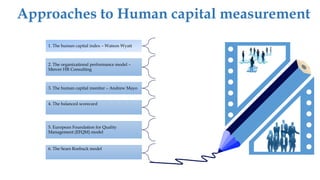
Approaches to Human capital measurement
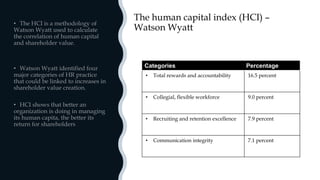
1. The human capital index – Watson Wyatt
2. The organizational performance model –
Mercer HR Consulting
3. The human capital monitor – Andrew Mayo
4. The balanced scorecard
5. European Foundation for Quality
Management (EFQM) model
6. The Sears Roebuck model
The human capital index (HCI) –
Watson Wyatt
• Total rewards and accountability 16.5 percent
• Collegial, flexible workforce 9.0 percent
• Recruiting and retention excellence 7.9 percent
• Communication integrity 7.1 percent
Categories Percentage
The organizational performance model –
Mercer HR Consulting
Organizational performance model developed by Mercer HR Consulting is based on the
following elements:
People
Work
processes
Management Structure
Information
and
knowledge
Decision
making
Rewards
• Each elements plays out differently within the context of the organization, creating a unique DNA.
• The statistical tool, ‘Internal Labour Market Analysis’ used by Mercer scrutinize the record of employee and labour
market data to analyse the actual experience of employees rather than stated HR programmes and policies
• Thus gaps can be identified between what is required in the workforce to support business goals and what is actually
being delivered.
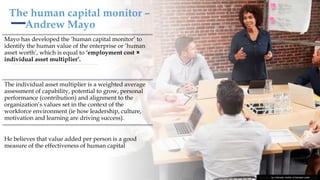
The human capital monitor –
Andrew Mayo
Mayo has developed the ‘human capital monitor’ to
identify the human value of the enterprise or ‘human
asset worth’, which is equal to ‘employment cost ×
individual asset multiplier’.
The individual asset multiplier is a weighted average
assessment of capability, potential to grow, personal
performance (contribution) and alignment to the
organization’s values set in the context of the
workforce environment (ie how leadership, culture,
motivation and learning are driving success).
He believes that value added per person is a good
measure of the effectiveness of human capital
This Photo by Unknown Author is licensed under CC BY
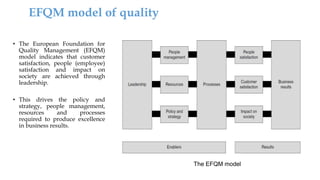
The EFQM model
• The European Foundation for
Quality Management (EFQM)
model indicates that customer
satisfaction, people (employee)
satisfaction and impact on
society are achieved through
leadership.
• This drives the policy and
strategy, people management,
resources and processes
required to produce excellence
in business results.
EFQM model of quality
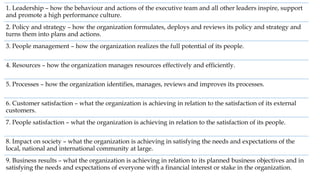
1. Leadership – how the behaviour and actions of the executive team and all other leaders inspire, support
and promote a high performance culture.
2. Policy and strategy – how the organization formulates, deploys and reviews its policy and strategy and
turns them into plans and actions.
3. People management – how the organization realizes the full potential of its people.
4. Resources – how the organization manages resources effectively and efficiently.
5. Processes – how the organization identifies, manages, reviews and improves its processes.
6. Customer satisfaction – what the organization is achieving in relation to the satisfaction of its external
customers.
7. People satisfaction – what the organization is achieving in relation to the satisfaction of its people.
8. Impact on society – what the organization is achieving in satisfying the needs and expectations of the
local, national and international community at large.
9. Business results – what the organization is achieving in relation to its planned business objectives and in
satisfying the needs and expectations of everyone with a financial interest or stake in the organization.
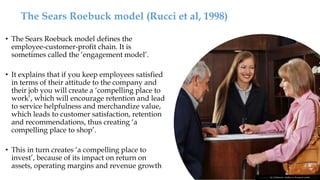
The Sears Roebuck model (Rucci et al, 1998)
• The Sears Roebuck model defines the
employee-customer-profit chain. It is
sometimes called the ‘engagement model’.
• It explains that if you keep employees satisfied
in terms of their attitude to the company and
their job you will create a ‘compelling place to
work’, which will encourage retention and lead
to service helpfulness and merchandize value,
which leads to customer satisfaction, retention
and recommendations, thus creating ‘a
compelling place to shop’.
• This in turn creates ‘a compelling place to
invest’, because of its impact on return on
assets, operating margins and revenue growth
This Photo by Unknown Author is licensed under CC BY
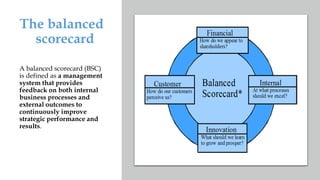
The balanced
scorecard
A balanced scorecard (BSC)
is defined as a management
system that provides
feedback on both internal
business processes and
external outcomes to
continuously improve
strategic performance and
results.
The financial perspective
• Focuses on financial performances of an organization. It normally covers the revenue and profit targets of commercial
companies as well as the budget and cost-saving targets of not-for-profit organisations. The financial health of an
organisation is a critical perspective for managers to track. It is important to note that financial performance is usually the
result of good performance in the other three scorecard perspectives.
The customer perspective
• Focuses on performance targets as they relate to customers and the market. It usually covers customer growth and service
targets as well as market share and branding objectives. Typical measures and KPIs in this perspective include customer
satisfaction, service levels, net promoter scores, market share and brand awareness.
The internal process perspective
• Focuses on internal operational goals and covers objectives as they relate to the key processes necessary to deliver the
customer objectives. Here, companies outline the internal business processes goals and the things the organization has to do
really well internally in order to push performance. Typical example measures and KPIs include process improvements,
quality optimization and capacity utilization.
The learning and growth perspective
• Focuses on the intangible drivers of future and is often broken down into the following components:
• Human Capital (skills, talent, and knowledge)
• Information Capital (databases, information systems, networks, and technology infrastructure)
• Organization Capital (culture, leadership, employee alignment, teamwork and knowledge management).
• Typical example measures and KPIs include staff engagement, skills assessment, performance management scores and
corporate culture audits.
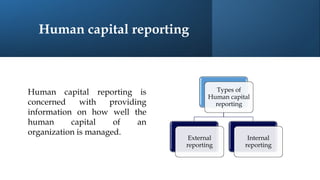
Human capital reporting
Human capital reporting is
concerned with providing
information on how well the
human capital of an
organization is managed.
Types of
Human capital
reporting
External
reporting
Internal
reporting
Human
capital
internal
reporting
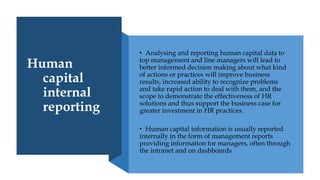
• Analysing and reporting human capital data to
top management and line managers will lead to
better informed decision making about what kind
of actions or practices will improve business
results, increased ability to recognize problems
and take rapid action to deal with them, and the
scope to demonstrate the effectiveness of HR
solutions and thus support the business case for
greater investment in HR practices.
• Human capital information is usually reported
internally in the form of management reports
providing information for managers, often through
the intranet and on dashboards
Human
capital
external
reporting
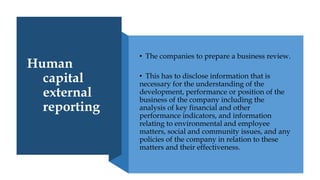
• The companies to prepare a business review.
• This has to disclose information that is
necessary for the understanding of the
development, performance or position of the
business of the company including the
analysis of key financial and other
performance indicators, and information
relating to environmental and employee
matters, social and community issues, and any
policies of the company in relation to these
matters and their effectiveness.
human capital management.pptx

human capital management.pptx

  • 1.
  • 2.
    Content Introduction Constituents of humancapital Importance of human capital management Human capital management drivers Human capital theory Human capital measurement Approaches to human capital measurement Human capital reporting
  • 3.
    Introduction The word “HumanCapital” was introduced by A. W. Lewis. Human capital consists of the knowledge, skills and abilities of the people employed in an organization.
  • 4.
    According to LawrenceBossidy an American author and former CEO of Allied Signal, later Homewell. “I am convinced that nothing we do is more important than hiring and developing people. At the end of the day, you bet on people, not on strategies.”
  • 5.
    Definition Human capital representsthe human factor in the organization; the combined intelligence, skills and expertise that gives the organization its distinctive character. The human elements of the organization are those that are capable of learning, changing, innovating and providing the creative thrust which if properly motivated can ensure the long-term survival of the organization. Bontis et al (1999)
  • 6.
    Constituents of humancapital Intellectual capital • Intellectual capital is the value of a company's employee knowledge, skills, business training, or any proprietary information that may provide the company with a competitive advantage. Social capital • Social capital consists of the knowledge derived from networks of relationships within and outside the organization Organizational capital • Organizational capital is the institutionalized knowledge possessed by an organization that is stored in databases, manuals, patents etc. Human capital consists of :
  • 7.
    Human capital management (HCM)transforms the traditional administrative functions of human resources (HR) departments—recruiting, training, payroll, compensation, and performance management— into opportunities to drive engagement, productivity, and business value. Meaning: Human capital management
  • 8.
    Human capital management Humancapital management (HCM) is the set of practices an organization uses for recruiting, managing, developing, and optimizing employees to increase their value to the company.
  • 9.
    What’s the strategicimportance of implementing HCM in 2022? Automation is changing the workforce
  • 10.
    Importance of Humancapital management Improve organic growth by identifying the competencies of individual employees Managing a company's people resources. Identify gaps in the capabilities of the workforce. Align human capital management with business goals Improve productivity and efficiency Enhance the recruitment process Improve performance reviews Match positions with employee capabilities Allows better career planning
  • 11.
    Driver 1 - Leadership Practices Communication Inclusiveness Supervision Leadership Driver2 - Employee Engagement Key Responsibility Areas Commitment Time management Evaluation Driver 3 - Knowledge Accessibility Information Availability Team Work Information Sharing Driver 4 - Workforce Optimization Work processes Working Conditions Accountability Hiring Performance Management Driver 5 - Learning Capacity Innovation Training Career Development Learnings Human capital management drivers
  • 12.
    START Human capital theory Determinethe impact of people on the business and their contribution to shareholder value; Demonstrate that HR practices produce value for money in terms, for example, of return on investment; Provide guidance on future HR and business strategies; provide data that will inform strategies and practices designed to improve the effectiveness of people management in the organization. • It regards people as assets and focus that investment by organizations in people will generate worthwhile returns • It propose that sustainable competitive advantage is attained when the firm has a human resource pool that cannot be imitated or substituted by its rivals. • Human capital theory helps to:
  • 13.
    Human capital measurementhas been defined by IDS (2004) as being ‘about finding links, correlations and, ideally, causation, between different sets of (HR) data, using statistical techniques’. The primary aim of HCM is to assess the impact of human resource management practices and the contribution made by people to organizational performance. Human capital measurement
  • 14.
    Reasons for interestin human capital measurement •Human capital constitutes a key element of the market worth of a company •People in organizations add value. •Focus attention on what needs to be done to make the best use of human capital. •Monitor progress in achieving strategic HR goals and evaluate HR practices. •You cannot manage unless you measure.
  • 15.
    Approaches to Humancapital measurement 1. The human capital index – Watson Wyatt 2. The organizational performance model – Mercer HR Consulting 3. The human capital monitor – Andrew Mayo 4. The balanced scorecard 5. European Foundation for Quality Management (EFQM) model 6. The Sears Roebuck model
  • 16.
    The human capitalindex (HCI) – Watson Wyatt • Total rewards and accountability 16.5 percent • Collegial, flexible workforce 9.0 percent • Recruiting and retention excellence 7.9 percent • Communication integrity 7.1 percent Categories Percentage
  • 17.
    The organizational performancemodel – Mercer HR Consulting Organizational performance model developed by Mercer HR Consulting is based on the following elements: People Work processes Management Structure Information and knowledge Decision making Rewards • Each elements plays out differently within the context of the organization, creating a unique DNA. • The statistical tool, ‘Internal Labour Market Analysis’ used by Mercer scrutinize the record of employee and labour market data to analyse the actual experience of employees rather than stated HR programmes and policies • Thus gaps can be identified between what is required in the workforce to support business goals and what is actually being delivered.
  • 18.
    The human capitalmonitor – Andrew Mayo Mayo has developed the ‘human capital monitor’ to identify the human value of the enterprise or ‘human asset worth’, which is equal to ‘employment cost × individual asset multiplier’. The individual asset multiplier is a weighted average assessment of capability, potential to grow, personal performance (contribution) and alignment to the organization’s values set in the context of the workforce environment (ie how leadership, culture, motivation and learning are driving success). He believes that value added per person is a good measure of the effectiveness of human capital This Photo by Unknown Author is licensed under CC BY
  • 19.
    The EFQM model •The European Foundation for Quality Management (EFQM) model indicates that customer satisfaction, people (employee) satisfaction and impact on society are achieved through leadership. • This drives the policy and strategy, people management, resources and processes required to produce excellence in business results. EFQM model of quality
  • 20.
    1. Leadership –how the behaviour and actions of the executive team and all other leaders inspire, support and promote a high performance culture. 2. Policy and strategy – how the organization formulates, deploys and reviews its policy and strategy and turns them into plans and actions. 3. People management – how the organization realizes the full potential of its people. 4. Resources – how the organization manages resources effectively and efficiently. 5. Processes – how the organization identifies, manages, reviews and improves its processes. 6. Customer satisfaction – what the organization is achieving in relation to the satisfaction of its external customers. 7. People satisfaction – what the organization is achieving in relation to the satisfaction of its people. 8. Impact on society – what the organization is achieving in satisfying the needs and expectations of the local, national and international community at large. 9. Business results – what the organization is achieving in relation to its planned business objectives and in satisfying the needs and expectations of everyone with a financial interest or stake in the organization.
  • 21.
    The Sears Roebuckmodel (Rucci et al, 1998) • The Sears Roebuck model defines the employee-customer-profit chain. It is sometimes called the ‘engagement model’. • It explains that if you keep employees satisfied in terms of their attitude to the company and their job you will create a ‘compelling place to work’, which will encourage retention and lead to service helpfulness and merchandize value, which leads to customer satisfaction, retention and recommendations, thus creating ‘a compelling place to shop’. • This in turn creates ‘a compelling place to invest’, because of its impact on return on assets, operating margins and revenue growth This Photo by Unknown Author is licensed under CC BY
  • 22.
    The balanced scorecard A balancedscorecard (BSC) is defined as a management system that provides feedback on both internal business processes and external outcomes to continuously improve strategic performance and results.
  • 23.
    The financial perspective •Focuses on financial performances of an organization. It normally covers the revenue and profit targets of commercial companies as well as the budget and cost-saving targets of not-for-profit organisations. The financial health of an organisation is a critical perspective for managers to track. It is important to note that financial performance is usually the result of good performance in the other three scorecard perspectives. The customer perspective • Focuses on performance targets as they relate to customers and the market. It usually covers customer growth and service targets as well as market share and branding objectives. Typical measures and KPIs in this perspective include customer satisfaction, service levels, net promoter scores, market share and brand awareness. The internal process perspective • Focuses on internal operational goals and covers objectives as they relate to the key processes necessary to deliver the customer objectives. Here, companies outline the internal business processes goals and the things the organization has to do really well internally in order to push performance. Typical example measures and KPIs include process improvements, quality optimization and capacity utilization. The learning and growth perspective • Focuses on the intangible drivers of future and is often broken down into the following components: • Human Capital (skills, talent, and knowledge) • Information Capital (databases, information systems, networks, and technology infrastructure) • Organization Capital (culture, leadership, employee alignment, teamwork and knowledge management). • Typical example measures and KPIs include staff engagement, skills assessment, performance management scores and corporate culture audits.
  • 24.
    Human capital reporting Humancapital reporting is concerned with providing information on how well the human capital of an organization is managed. Types of Human capital reporting External reporting Internal reporting
  • 25.
    Human capital internal reporting • Analysing andreporting human capital data to top management and line managers will lead to better informed decision making about what kind of actions or practices will improve business results, increased ability to recognize problems and take rapid action to deal with them, and the scope to demonstrate the effectiveness of HR solutions and thus support the business case for greater investment in HR practices. • Human capital information is usually reported internally in the form of management reports providing information for managers, often through the intranet and on dashboards
  • 26.
    Human capital external reporting • The companiesto prepare a business review. • This has to disclose information that is necessary for the understanding of the development, performance or position of the business of the company including the analysis of key financial and other performance indicators, and information relating to environmental and employee matters, social and community issues, and any policies of the company in relation to these matters and their effectiveness.

Editor's Notes

  • #10 https://day.io/blog/strategic-importance-of-human-capital-management-2022/
  • #11 https://www.indeed.com/career-advice/career-development/what-is-human-capital-management https://www.linkedin.com/pulse/importance-human-capital-advancement-organisations-aljarallah-mba/?trk=articles_directory
  • #12 https://www.managementstudyguide.com/human-capital-management-drivers.htm