UNIT V-APPLICATION OF RS AND GIS
CROPACREAGE ESTIMATION
• Crop acreage estimation involves determining the total area of land devoted to different
crops within a specific region. Remote Sensing (RS) and Geographic Information
Systems (GIS) play a crucial role in this process, offering accurate and timely data.
• Methods and Techniques
Satellite Imagery Analysis
• Multi-spectral Imaging.
• Temporal Analysis.
Image Classification
• Supervised Classification
• Unsupervised Classification
• Object-based Image Analysis (OBIA)
Normalized Difference Vegetation Index (NDVI)
• NDVI is a widely used vegetation index derived from red and near-infrared
spectral bands. It helps in identifying vegetation health and estimating crop
acreage by distinguishing crops from bare soil and other land covers.
Field Surveys and Ground Truthing
Ground truth data are collected through field surveys to validate and calibrate the
satellite image classification. This data helps in improving the accuracy of crop
acreage estimates.
Geographic Information Systems (GIS) Integration
GIS is used to store, analyze, and visualize the spatial data obtained from RS. It
helps in integrating satellite imagery with other spatial datasets (e.g., soil maps,
climate data) for more comprehensive analysis.
Spatial analysis tools in GIS allow for the calculation of crop acreage, mapping of
crop distribution, and assessment of spatial patterns and trends.
Applications and Benefits
• Agricultural Planning and Policy Making
• Market Forecasting
• Disaster Management
• Sustainable Agriculture
• Research and Development
CROP WATER REQUIREMENTS
• Estimating crop water requirements (CWR) using Geographic Information Systems (GIS) involves
integrating spatial data, environmental variables, and crop-specific parameters to create detailed
maps and analyses of water needs across different agricultural regions.
Steps to Estimate Crop Water Requirement Using GIS
Data Collection
• Satellite Imagery
• Climate Data
• Soil Data
• Crop Data
Reference Evapotranspiration (ETo) Calculation
Crop Coefficient (Kc) Application
Soil Moisture and Irrigation Requirement Analysis
Remote Sensing for Monitoring and Validation
Spatial Analysis and Visualization
Applications and Benefits
• Precision Irrigation Management
• Water Resource Planning
• Drought and Water Scarcity Management
• Sustainable Agriculture
• Using GIS to estimate crop water requirements provides a comprehensive,
spatially explicit method for managing agricultural water use efficiently. By
integrating climatic data, crop characteristics, soil properties, and remote
sensing observations, GIS enables precise irrigation management, supporting
sustainable agriculture and water conservation efforts.
• The visualization and analytical capabilities of GIS also facilitate better
decision-making and resource planning, making it an invaluable tool for
modern agriculture.
CROP CONDITIONS
• Using Geographic Information Systems (GIS) to monitor and assess crop
conditions involves integrating various spatial data sources and analytical
techniques to evaluate the health and performance of crops over time and across
different regions.
• Data Sources for Monitoring Crop Conditions
Satellite Imagery
• Multi-spectral Imagery
• Thermal Infrared Imagery
• Aerial Imagery
• Weather Data
• Soil Data
• Ground Truth Data
Techniques for Monitoring Crop Conditions
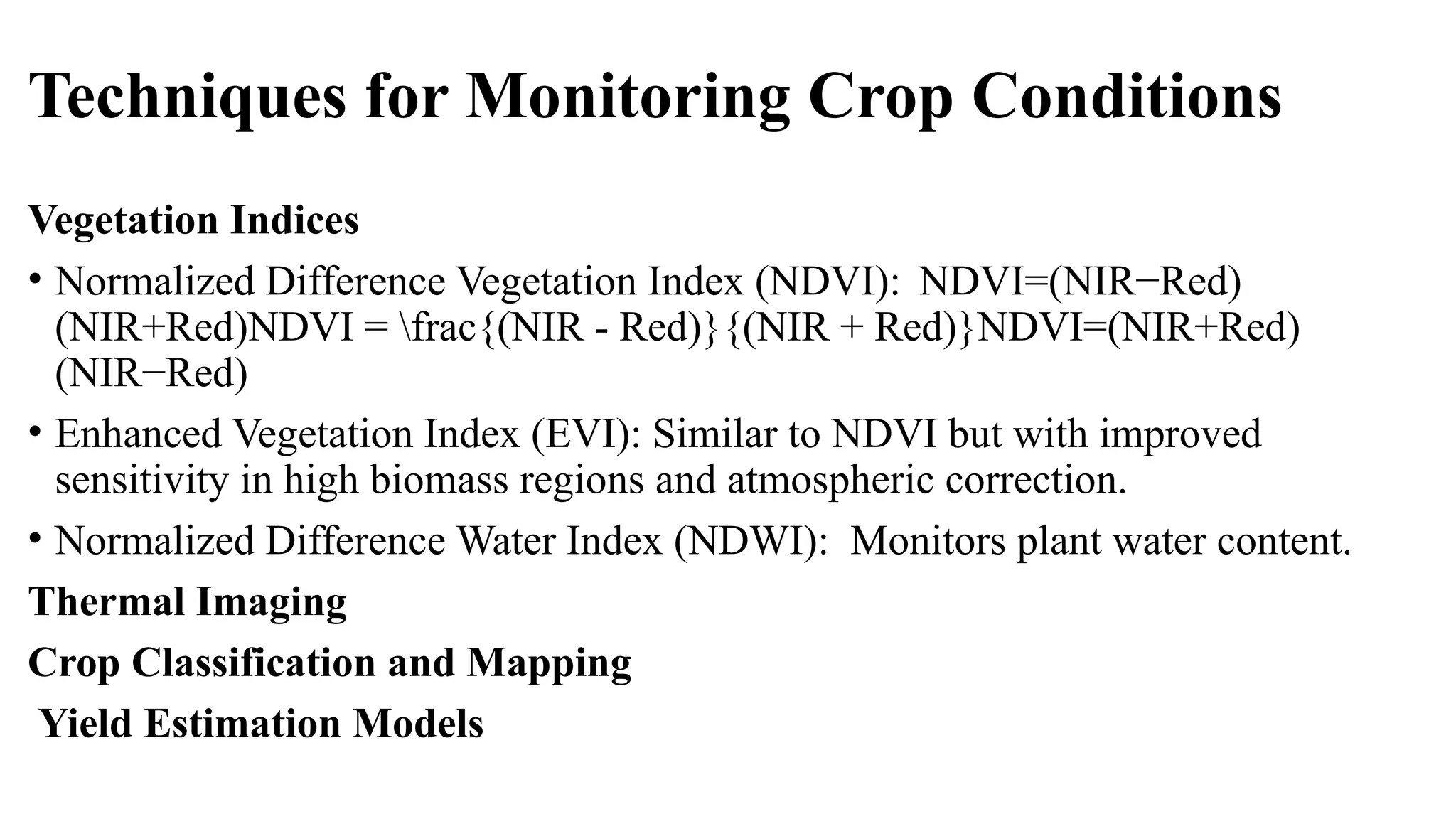
Vegetation Indices
• Normalized Difference Vegetation Index (NDVI): NDVI=(NIR−Red)
(NIR+Red)NDVI = frac{(NIR - Red)}{(NIR + Red)}NDVI=(NIR+Red)
(NIR−Red)
• Enhanced Vegetation Index (EVI): Similar to NDVI but with improved
sensitivity in high biomass regions and atmospheric correction.
• Normalized Difference Water Index (NDWI): Monitors plant water content.
Thermal Imaging
Crop Classification and Mapping
Yield Estimation Models
Applications and Benefits
• Early Warning Systems GIS-based monitoring can provide early warnings of
pest infestations, disease outbreaks, and water stress, allowing for timely
interventions.
• Precision Agriculture Supports precision agriculture by identifying variability
within fields and enabling targeted application of water, fertilizers, and
pesticides.
• Resource Management Helps in optimizing the use of resources such as water
and fertilizers by monitoring crop conditions and adjusting inputs accordingly.
• Policy and Decision Support
Steps to Monitor Crop Conditions Using GIS
• Data Acquisition and Preprocessing.
• Vegetation Index Calculation
• Crop Classification and Mapping
• Analysis and Interpretation
• Visualization and Reporting
GIS-based monitoring of crop conditions offers a comprehensive approach to
understanding and managing agricultural production. By integrating remote
sensing data with climatic, soil, and crop information, GIS provides valuable
insights into crop health, stress, and productivity, supporting more effective and
sustainable agricultural practices. The ability to visualize and analyze spatial
data helps farmers, researchers, and policymakers make informed decisions,
enhancing food security and resource management.
Soil mapping
• Soil mapping using Geographic Information Systems (GIS) involves the
collection, analysis, and visualization of soil data to create detailed maps that
represent various soil properties and their spatial distribution. These maps are
crucial for agricultural planning, environmental management, and land use
decision-making.
• Steps to Soil Mapping Using GIS
• Data Collection
• Data Preparation
• Soil Classification
• GIS Analysis
• Visualization
• Validation and Calibration
Applications and Benefits
• Agricultural Planning
• Environmental Management
• Land Use Planning
• Climate Change Studies
Classifying soil using digital numbers
• Classifying soil using digital numbers involves interpreting data derived from
remote sensing techniques. Digital numbers (DNs) represent the radiometric
values recorded by sensors on satellites or aerial platforms.
Data Collection
• Remote Sensing Data
• Ground Truth Data
Preprocessing
• Radiometric Correction
• Geometric Correction
• Normalization
Feature Extraction
• Spectral Indices
• Principal Component Analysis (PCA)
Classification
• Supervised Classification
• Unsupervised Classification: Techniques like K-means clustering or ISODATA
clustering can group pixels with similar spectral characteristics without prior
knowledge of soil types. This can be useful for preliminary analysis.
Post-Processing
• Accuracy Assessment
• Filtering and Smoothing
Interpretation and Analysis
• Soil Property Mapping
• Change Detection
Soil erosion mapping
• Soil erosion mapping involves assessing and visualizing the extent and severity
of soil erosion in a particular area.
• Data Collection: Gathering relevant data such as topography, land use, soil
types, rainfall patterns, and vegetation cover.
• Erosion Modeling: Using various models (such as USLE - Universal Soil Loss
Equation or RUSLE - Revised Universal Soil Loss Equation)
• GIS Analysis: GIS tools help in creating erosion risk maps by combining and
analyzing various layers of information.
• Mapping: Producing maps that depict erosion-prone areas, erosion rates, and
vulnerable landscapes.
• Monitoring and Validation: Continuously monitoring soil erosion rates
through remote sensing and field observations to validate the accuracy of
erosion models and maps.
Reservoir sedimentation
• Reservoir sedimentation refers to the process where sediment carried by rivers,
streams, or surface runoff accumulates in a reservoir over time. This
accumulation can reduce the reservoir's storage capacity, affect water quality,
and impact the efficiency of hydropower generation and other water uses.
• Image processing can play a crucial role in monitoring and managing reservoir
sedimentation.
Remote Sensing
Drones
Estimating Sediment Volume:
• Once sedimentation patterns are identified in images, algorithms can be used to
estimate the volume of sediment deposited in different parts of the reservoir.
This information is crucial for planning sediment removal operations to
maintain reservoir capacity.
Modeling Sediment Transport:
• Image processing can assist in developing models that simulate sediment
transport within the reservoir. By analyzing historical data and current
images, these models can predict future sedimentation trends and guide
reservoir management strategies.
Early Warning Systems
Environmental Impact Assessment
Integration with GIS
Overall, image processing techniques provide valuable tools for studying
reservoir sedimentation, enabling efficient monitoring, accurate estimation,
and effective management strategies to maintain reservoir functionality and
environmental sustainability.
Inventory water resources
Inventorying water resources using GIS (Geographical Information Systems) is a
powerful approach that integrates spatial data with various attributes of water
resources.
Data Collection and Integration
Spatial Data
Hydrological Data: Include stream networks, watershed boundaries, flow direction,
and elevation data (DEM - Digital Elevation Model).
Infrastructure
Quantifying Water Availability
Flow and Volume Estimation: Use GIS to calculate drainage areas, flow
accumulation, and discharge using hydrological models.
Groundwater
Rainfall
Assessing Water Quality
• Water Quality Monitoring Stations: Map locations and attributes of monitoring
stations measuring parameters like pH, dissolved oxygen, nutrients, and
pollutants.
• Pollution Sources: Identify and map point and non-point sources of pollution
affecting water bodies.
• Spatial Analysis
Infrastructure and Accessibility
• Mapping Infrastructure
• Accessibility Analysis
Climate and Environmental Factors
Climate Data Integration
Ecological Mapping
Decision Support and Planning
• Modeling and Simulation
• Scenario Planning
Public Engagement and Communication
• Visualization: Create maps, charts, and dashboards to communicate water resource
information effectively to stakeholders and the public.
• Participatory GIS
Monitoring and Management
• Real-Time Monitoring
Data Management and Collaboration
• Database Integration
• Collaborative Platforms
By leveraging GIS for inventorying water resources, organizations can enhance their
understanding of water availability, quality, and infrastructure, leading to more informed
decision-making and sustainable management practices.
Water quality assessment
• Water quality assessment using GIS (Geographical Information Systems) combines
spatial data with water quality parameters to analyze, visualize, and manage water
resources effectively.
Data Integration and Visualization
• Spatial Data
• Water Quality Parameters: Include data points from monitoring stations measuring pH,
dissolved oxygen, nutrients (nitrogen, phosphorus), heavy metals, and other
contaminants.
• Meteorological Data: Integrate rainfall patterns, temperature, and other climate variables
affecting water quality.
Spatial Analysis and Modeling
• Interpolation Techniques
• Hotspot Analysis
• Buffer Analysis
Monitoring and Trend Analysis
• Temporal Analysis: Track changes in water quality parameters over time using
GIS to detect trends and seasonal variations.
• Event Mapping
Risk Assessment and Decision Support
• Risk Mapping
• Scenario Modeling
• Multi-Criteria Decision Analysis (MCDA)
Public Outreach and Communication
• Visualization Tools
• Public Participation
Application of Remote sensing and GIS
• Crop Health Monitoring
• Yield Prediction and Monitoring
• Soil Mapping and Management
• Precision Irrigation Management
• Crop Type Mapping and Rotation Planning
• Pest and Disease Management
• Farm Management and Decision Support
• Environmental Impact Assessment
Management Decision Support System
• Management Decision Support System (DSS) is a computer-based information
system that supports decision-making activities within an organization or
business. It combines data analysis, modeling, and visualization tools to assist
managers and executives in making informed and effective decisions.
Components of a Management Decision Support System:
• Database Management System (DBMS): Stores and manages data collected
from various sources within the organization. Provides a centralized repository
for structured and sometimes unstructured data.
• Model Base: Includes mathematical models, statistical analysis tools, and
algorithms used to analyze data and predict outcomes.
User Interface:
• Provides a graphical or command-driven interface for users to interact with the
DSS.
• Enables users to input data, specify parameters for analysis, and view results
through reports, dashboards, or visualizations.
Knowledge Base:
• Stores rules, policies, and guidelines that guide decision-making within the
organization.
• Helps users interpret results and make decisions consistent with organizational
goals and strategies.
Decision Support Software:
• Includes specialized software applications designed for specific decision-
making tasks, such as financial analysis, resource allocation, or risk assessment.
Data Collection and Integration:
• Collects data from internal sources (e.g., operational databases, ERP
systems) and external sources (e.g., market data, industry reports).
• Integrates data from multiple sources to provide a comprehensive view for
analysis.
Data Analysis and Modeling:
• Performs data mining, statistical analysis, and modeling to uncover patterns,
trends, and relationships within the data.
Decision Support Tools:
• Provides tools for "what-if" analysis, sensitivity analysis, and scenario
planning to simulate different outcomes based on varying assumptions.
• Helps users evaluate alternatives and understand the potential impacts of
different decisions.
Visualization and Reporting:
• Presents analysis results through interactive dashboards, charts, graphs, and
reports.
• Facilitates data visualization to enhance understanding and communication of
complex information.
Collaboration and Communication:
• Supports collaboration among decision-makers, allowing them to share data,
analysis results, and insights.
• Enables discussions, annotations, and decision documentation within the
system.
Monitoring and Feedback:
• Monitors the implementation of decisions and their outcomes over time.
• Provides feedback mechanisms to evaluate decision effectiveness and adjust
strategies as needed.
Benefits of a Management Decision Support System
• Improved Decision-Making: Enables faster, more informed decisions based on
comprehensive data analysis and modeling.
• Efficiency
• Accuracy.
• Strategic Alignment
• Competitive Advantage
A Management Decision Support System integrates technology, data, and
decision-making processes to enhance organizational effectiveness and
competitive advantage. It supports managers at all levels by providing timely,
relevant information and analytical tools to make optimal decisions in dynamic
and complex environments.

Unit - 5 Application of RS and GIS

  • 1.
    UNIT V-APPLICATION OFRS AND GIS CROPACREAGE ESTIMATION • Crop acreage estimation involves determining the total area of land devoted to different crops within a specific region. Remote Sensing (RS) and Geographic Information Systems (GIS) play a crucial role in this process, offering accurate and timely data. • Methods and Techniques Satellite Imagery Analysis • Multi-spectral Imaging. • Temporal Analysis. Image Classification • Supervised Classification • Unsupervised Classification • Object-based Image Analysis (OBIA)
  • 2.
    Normalized Difference VegetationIndex (NDVI) • NDVI is a widely used vegetation index derived from red and near-infrared spectral bands. It helps in identifying vegetation health and estimating crop acreage by distinguishing crops from bare soil and other land covers. Field Surveys and Ground Truthing Ground truth data are collected through field surveys to validate and calibrate the satellite image classification. This data helps in improving the accuracy of crop acreage estimates. Geographic Information Systems (GIS) Integration GIS is used to store, analyze, and visualize the spatial data obtained from RS. It helps in integrating satellite imagery with other spatial datasets (e.g., soil maps, climate data) for more comprehensive analysis. Spatial analysis tools in GIS allow for the calculation of crop acreage, mapping of crop distribution, and assessment of spatial patterns and trends.
  • 3.
    Applications and Benefits •Agricultural Planning and Policy Making • Market Forecasting • Disaster Management • Sustainable Agriculture • Research and Development
  • 4.
    CROP WATER REQUIREMENTS •Estimating crop water requirements (CWR) using Geographic Information Systems (GIS) involves integrating spatial data, environmental variables, and crop-specific parameters to create detailed maps and analyses of water needs across different agricultural regions. Steps to Estimate Crop Water Requirement Using GIS Data Collection • Satellite Imagery • Climate Data • Soil Data • Crop Data Reference Evapotranspiration (ETo) Calculation Crop Coefficient (Kc) Application Soil Moisture and Irrigation Requirement Analysis Remote Sensing for Monitoring and Validation Spatial Analysis and Visualization
  • 5.
    Applications and Benefits •Precision Irrigation Management • Water Resource Planning • Drought and Water Scarcity Management • Sustainable Agriculture • Using GIS to estimate crop water requirements provides a comprehensive, spatially explicit method for managing agricultural water use efficiently. By integrating climatic data, crop characteristics, soil properties, and remote sensing observations, GIS enables precise irrigation management, supporting sustainable agriculture and water conservation efforts. • The visualization and analytical capabilities of GIS also facilitate better decision-making and resource planning, making it an invaluable tool for modern agriculture.
  • 6.
    CROP CONDITIONS • UsingGeographic Information Systems (GIS) to monitor and assess crop conditions involves integrating various spatial data sources and analytical techniques to evaluate the health and performance of crops over time and across different regions. • Data Sources for Monitoring Crop Conditions Satellite Imagery • Multi-spectral Imagery • Thermal Infrared Imagery • Aerial Imagery • Weather Data • Soil Data • Ground Truth Data
  • 7.
    Techniques for MonitoringCrop Conditions Vegetation Indices • Normalized Difference Vegetation Index (NDVI): NDVI=(NIR−Red) (NIR+Red)NDVI = frac{(NIR - Red)}{(NIR + Red)}NDVI=(NIR+Red) (NIR−Red) • Enhanced Vegetation Index (EVI): Similar to NDVI but with improved sensitivity in high biomass regions and atmospheric correction. • Normalized Difference Water Index (NDWI): Monitors plant water content. Thermal Imaging Crop Classification and Mapping Yield Estimation Models
  • 8.
    Applications and Benefits •Early Warning Systems GIS-based monitoring can provide early warnings of pest infestations, disease outbreaks, and water stress, allowing for timely interventions. • Precision Agriculture Supports precision agriculture by identifying variability within fields and enabling targeted application of water, fertilizers, and pesticides. • Resource Management Helps in optimizing the use of resources such as water and fertilizers by monitoring crop conditions and adjusting inputs accordingly. • Policy and Decision Support
  • 9.
    Steps to MonitorCrop Conditions Using GIS • Data Acquisition and Preprocessing. • Vegetation Index Calculation • Crop Classification and Mapping • Analysis and Interpretation • Visualization and Reporting GIS-based monitoring of crop conditions offers a comprehensive approach to understanding and managing agricultural production. By integrating remote sensing data with climatic, soil, and crop information, GIS provides valuable insights into crop health, stress, and productivity, supporting more effective and sustainable agricultural practices. The ability to visualize and analyze spatial data helps farmers, researchers, and policymakers make informed decisions, enhancing food security and resource management.
  • 10.
    Soil mapping • Soilmapping using Geographic Information Systems (GIS) involves the collection, analysis, and visualization of soil data to create detailed maps that represent various soil properties and their spatial distribution. These maps are crucial for agricultural planning, environmental management, and land use decision-making. • Steps to Soil Mapping Using GIS • Data Collection • Data Preparation • Soil Classification • GIS Analysis • Visualization • Validation and Calibration
  • 11.
    Applications and Benefits •Agricultural Planning • Environmental Management • Land Use Planning • Climate Change Studies
  • 12.
    Classifying soil usingdigital numbers • Classifying soil using digital numbers involves interpreting data derived from remote sensing techniques. Digital numbers (DNs) represent the radiometric values recorded by sensors on satellites or aerial platforms. Data Collection • Remote Sensing Data • Ground Truth Data Preprocessing • Radiometric Correction • Geometric Correction • Normalization
  • 13.
    Feature Extraction • SpectralIndices • Principal Component Analysis (PCA) Classification • Supervised Classification • Unsupervised Classification: Techniques like K-means clustering or ISODATA clustering can group pixels with similar spectral characteristics without prior knowledge of soil types. This can be useful for preliminary analysis. Post-Processing • Accuracy Assessment • Filtering and Smoothing Interpretation and Analysis • Soil Property Mapping • Change Detection
  • 14.
    Soil erosion mapping •Soil erosion mapping involves assessing and visualizing the extent and severity of soil erosion in a particular area. • Data Collection: Gathering relevant data such as topography, land use, soil types, rainfall patterns, and vegetation cover. • Erosion Modeling: Using various models (such as USLE - Universal Soil Loss Equation or RUSLE - Revised Universal Soil Loss Equation) • GIS Analysis: GIS tools help in creating erosion risk maps by combining and analyzing various layers of information. • Mapping: Producing maps that depict erosion-prone areas, erosion rates, and vulnerable landscapes. • Monitoring and Validation: Continuously monitoring soil erosion rates through remote sensing and field observations to validate the accuracy of erosion models and maps.
  • 15.
    Reservoir sedimentation • Reservoirsedimentation refers to the process where sediment carried by rivers, streams, or surface runoff accumulates in a reservoir over time. This accumulation can reduce the reservoir's storage capacity, affect water quality, and impact the efficiency of hydropower generation and other water uses. • Image processing can play a crucial role in monitoring and managing reservoir sedimentation. Remote Sensing Drones Estimating Sediment Volume: • Once sedimentation patterns are identified in images, algorithms can be used to estimate the volume of sediment deposited in different parts of the reservoir. This information is crucial for planning sediment removal operations to maintain reservoir capacity.
  • 16.
    Modeling Sediment Transport: •Image processing can assist in developing models that simulate sediment transport within the reservoir. By analyzing historical data and current images, these models can predict future sedimentation trends and guide reservoir management strategies. Early Warning Systems Environmental Impact Assessment Integration with GIS Overall, image processing techniques provide valuable tools for studying reservoir sedimentation, enabling efficient monitoring, accurate estimation, and effective management strategies to maintain reservoir functionality and environmental sustainability.
  • 17.
    Inventory water resources Inventoryingwater resources using GIS (Geographical Information Systems) is a powerful approach that integrates spatial data with various attributes of water resources. Data Collection and Integration Spatial Data Hydrological Data: Include stream networks, watershed boundaries, flow direction, and elevation data (DEM - Digital Elevation Model). Infrastructure Quantifying Water Availability Flow and Volume Estimation: Use GIS to calculate drainage areas, flow accumulation, and discharge using hydrological models. Groundwater Rainfall
  • 18.
    Assessing Water Quality •Water Quality Monitoring Stations: Map locations and attributes of monitoring stations measuring parameters like pH, dissolved oxygen, nutrients, and pollutants. • Pollution Sources: Identify and map point and non-point sources of pollution affecting water bodies. • Spatial Analysis Infrastructure and Accessibility • Mapping Infrastructure • Accessibility Analysis Climate and Environmental Factors Climate Data Integration Ecological Mapping
  • 19.
    Decision Support andPlanning • Modeling and Simulation • Scenario Planning Public Engagement and Communication • Visualization: Create maps, charts, and dashboards to communicate water resource information effectively to stakeholders and the public. • Participatory GIS Monitoring and Management • Real-Time Monitoring Data Management and Collaboration • Database Integration • Collaborative Platforms By leveraging GIS for inventorying water resources, organizations can enhance their understanding of water availability, quality, and infrastructure, leading to more informed decision-making and sustainable management practices.
  • 20.
    Water quality assessment •Water quality assessment using GIS (Geographical Information Systems) combines spatial data with water quality parameters to analyze, visualize, and manage water resources effectively. Data Integration and Visualization • Spatial Data • Water Quality Parameters: Include data points from monitoring stations measuring pH, dissolved oxygen, nutrients (nitrogen, phosphorus), heavy metals, and other contaminants. • Meteorological Data: Integrate rainfall patterns, temperature, and other climate variables affecting water quality. Spatial Analysis and Modeling • Interpolation Techniques • Hotspot Analysis • Buffer Analysis
  • 21.
    Monitoring and TrendAnalysis • Temporal Analysis: Track changes in water quality parameters over time using GIS to detect trends and seasonal variations. • Event Mapping Risk Assessment and Decision Support • Risk Mapping • Scenario Modeling • Multi-Criteria Decision Analysis (MCDA) Public Outreach and Communication • Visualization Tools • Public Participation
  • 22.
    Application of Remotesensing and GIS • Crop Health Monitoring • Yield Prediction and Monitoring • Soil Mapping and Management • Precision Irrigation Management • Crop Type Mapping and Rotation Planning • Pest and Disease Management • Farm Management and Decision Support • Environmental Impact Assessment
  • 23.
    Management Decision SupportSystem • Management Decision Support System (DSS) is a computer-based information system that supports decision-making activities within an organization or business. It combines data analysis, modeling, and visualization tools to assist managers and executives in making informed and effective decisions. Components of a Management Decision Support System: • Database Management System (DBMS): Stores and manages data collected from various sources within the organization. Provides a centralized repository for structured and sometimes unstructured data. • Model Base: Includes mathematical models, statistical analysis tools, and algorithms used to analyze data and predict outcomes.
  • 24.
    User Interface: • Providesa graphical or command-driven interface for users to interact with the DSS. • Enables users to input data, specify parameters for analysis, and view results through reports, dashboards, or visualizations. Knowledge Base: • Stores rules, policies, and guidelines that guide decision-making within the organization. • Helps users interpret results and make decisions consistent with organizational goals and strategies. Decision Support Software: • Includes specialized software applications designed for specific decision- making tasks, such as financial analysis, resource allocation, or risk assessment.
  • 25.
    Data Collection andIntegration: • Collects data from internal sources (e.g., operational databases, ERP systems) and external sources (e.g., market data, industry reports). • Integrates data from multiple sources to provide a comprehensive view for analysis. Data Analysis and Modeling: • Performs data mining, statistical analysis, and modeling to uncover patterns, trends, and relationships within the data. Decision Support Tools: • Provides tools for "what-if" analysis, sensitivity analysis, and scenario planning to simulate different outcomes based on varying assumptions. • Helps users evaluate alternatives and understand the potential impacts of different decisions.
  • 26.
    Visualization and Reporting: •Presents analysis results through interactive dashboards, charts, graphs, and reports. • Facilitates data visualization to enhance understanding and communication of complex information. Collaboration and Communication: • Supports collaboration among decision-makers, allowing them to share data, analysis results, and insights. • Enables discussions, annotations, and decision documentation within the system. Monitoring and Feedback: • Monitors the implementation of decisions and their outcomes over time. • Provides feedback mechanisms to evaluate decision effectiveness and adjust strategies as needed.
  • 27.
    Benefits of aManagement Decision Support System • Improved Decision-Making: Enables faster, more informed decisions based on comprehensive data analysis and modeling. • Efficiency • Accuracy. • Strategic Alignment • Competitive Advantage A Management Decision Support System integrates technology, data, and decision-making processes to enhance organizational effectiveness and competitive advantage. It supports managers at all levels by providing timely, relevant information and analytical tools to make optimal decisions in dynamic and complex environments.