GIS and it’s Applications
Name of Supervisors:
Dr. Bholanath Roy
Asst. Prof. ,Department of CSE
MANIT, Bhopal
Presented By:
Rahul Singh
Ph. D Scholar,
Department of CSE, MANIT
Outline
• Motivation
• Goal
• What is GIS
• Remote Sensing
• Data in GIS
• Raster Data vs Vector Data
• Types of Vector Data
• Spatial Resolution
• Normalised Difference Vegetation index (NDVI)
• Recent works in Natural Calamities
2
Motivation
• According to the FAO(Food and Agriculture Organization of the United Nations),
agriculture is the largest source of livelihoods in India. 70 percent of its rural
households still depend primarily on agriculture for their livelihood[6].
• The agriculture sector is one of the most important industries in the Indian
economy, which means it is also a huge employer.
• Approximately 60 percent of the Indian population works in this industry,
contributing about 18 percent to India's GDP [5].
• CMIE(Centre for Monitoring Indian Economy) data from the consumer pyramid
household survey shows the share of agriculture in total employment has gone
up from 35.3% in 2017-18 to 36.1% in 2018-19 and then to 38% in 2019-20.
• Currently most of the monitoring of crops damage due to natural calamities are
manual. If modern agriculture is applied widely in the near future, millions of
farmers will be able to benefit from the acquisition of real-time farm information.3
Goal
• Automatic monitoring of crop damage using satellite images and IoT
sensors inputs.
• Farmers need not spend significant amount of time on acquiring farm
data and will have access to disaster warnings and weather
information when a disaster event occurs.
• Even government spends a lot of money for manual monitoring of
crops damage for compensation. and there may be some possibilities
that right persons are not getting benefit due to corruption.
4
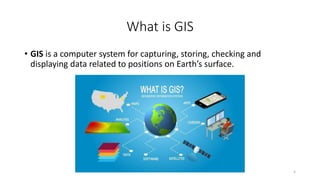
What is GIS
• GIS is a computer system for capturing, storing, checking and
displaying data related to positions on Earth’s surface.
5
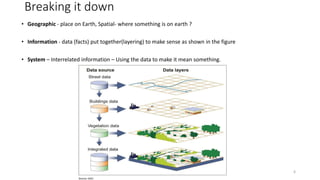
Breaking it down
• Geographic - place on Earth, Spatial- where something is on earth ?
• Information - data (facts) put together(layering) to make sense as shown in the figure
• System – Interrelated information – Using the data to make it mean something.
6
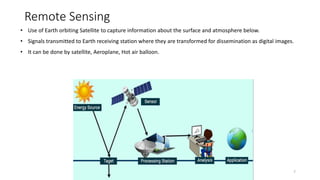
Remote Sensing
• Use of Earth orbiting Satellite to capture information about the surface and atmosphere below.
• Signals transmitted to Earth receiving station where they are transformed for dissemination as digital images.
• It can be done by satellite, Aeroplane, Hot air balloon.
7
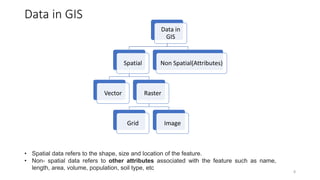
Data in GIS
Data in
GIS
Spatial
Vector Raster
Grid Image
Non Spatial(Attributes)
8
• Spatial data refers to the shape, size and location of the feature.
• Non- spatial data refers to other attributes associated with the feature such as name,
length, area, volume, population, soil type, etc
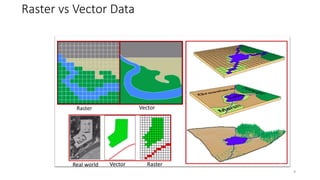
Raster vs Vector Data
Raster Vector
Vector Raster
Real world
9
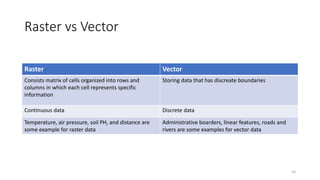
Raster vs Vector
Raster Vector
Consists matrix of cells organized into rows and
columns in which each cell represents specific
information
Storing data that has discreate boundaries
Continuous data Discrete data
Temperature, air pressure, soil PH, and distance are
some example for raster data
Administrative boarders, linear features, roads and
rivers are some examples for vector data
10
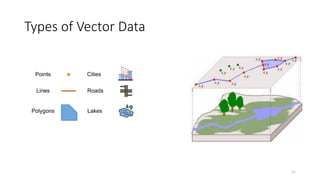
Types of Vector Data
11
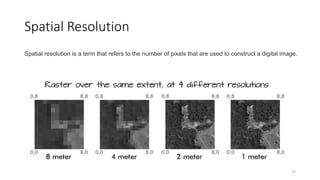
Spatial Resolution
12
Spatial resolution is a term that refers to the number of pixels that are used to construct a digital image.
Normalised Difference Vegetation index (NDVI)
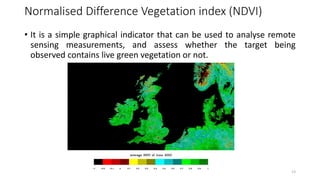
• It is a simple graphical indicator that can be used to analyse remote
sensing measurements, and assess whether the target being
observed contains live green vegetation or not.
13
Normalised Difference Vegetation index (NDVI)
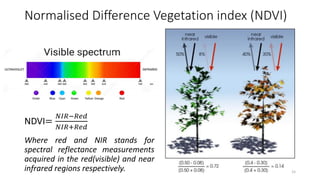
• Chlorophyll, which gives plants their green color, absorbs visible light.
• Leaves reflect near-infrared light(NIR); this makes sense
evolutionarily-speaking because plants use only visible light for
photosynthesis.
• This means that a healthy plant with good photosynthesis activity can
be analyzed by comparing NIR with visible red light.
14
Normalised Difference Vegetation index (NDVI)
NDVI=
𝑁𝐼𝑅−𝑅𝑒𝑑
𝑁𝐼𝑅+𝑅𝑒𝑑
Where red and NIR stands for
spectral reflectance measurements
acquired in the red(visible) and near
infrared regions respectively. 15
Normalised Difference Vegetation index (NDVI)
• NDVI values range between -1 and 1 (due to the normalization
procedure).
• Very low values of NDVI (<0.1) correspond to barren areas of rock,
sand or snow.
• Free standing water tend to be in the very low positive to negative
values
• Soils tend to generate rather small NDVI values(0.1-0.2).
• Sparse vegetation such as shrubs and grasslands may result in
moderate NDVI values (0.2-0.5)
• These are ideal values, but it may vary season to season and location
to location.
16
Normalised Difference Vegetation index (NDVI)
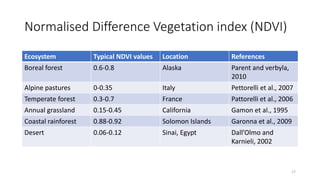
Ecosystem Typical NDVI values Location References
Boreal forest 0.6-0.8 Alaska Parent and verbyla,
2010
Alpine pastures 0-0.35 Italy Pettorelli et al., 2007
Temperate forest 0.3-0.7 France Pattorelli et al., 2006
Annual grassland 0.15-0.45 California Gamon et al., 1995
Coastal rainforest 0.88-0.92 Solomon Islands Garonna et al., 2009
Desert 0.06-0.12 Sinai, Egypt Dall’Olmo and
Karnieli, 2002
17
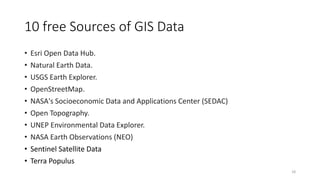
10 free Sources of GIS Data
• Esri Open Data Hub.
• Natural Earth Data.
• USGS Earth Explorer.
• OpenStreetMap.
• NASA's Socioeconomic Data and Applications Center (SEDAC)
• Open Topography.
• UNEP Environmental Data Explorer.
• NASA Earth Observations (NEO)
• Sentinel Satellite Data
• Terra Populus
18
Recent works in hailstone
• Title: Evaluation of Approaches to Identifying Hail Damage to
Crop Vegetation Using Satellite Imagery [1]
• examines an automated approach to detecting areas of hail damage in
satellite imagery and Remove the manual examination of normalized
difference vegetation index (NDVI)
• Two techniques are evaluated:
• (i) use of an NDVI change threshold and
• (ii) detection of anomalies that occur in both daily NDVI and land
surface temperature imagery.
• The NDVI threshold performed well in the two August case studies
with a final probability of detection (POD) ranging from 0.497 to 0.647,
whereas the anomaly detection for these two case studies had a lower
POD of 0.317 to 0.587.
19
Recent works in hailstone
• Title: Mapping hailstorm damaged crop area using multispectral
satellite data [2]
• Using NDVI difference of pre and post-hailstorm events.
• Crop classification within hail streak was performed using a high resolution
LISSIV satellite data from IRS-Resourcesat-2.
• Changes in NDVI profile of different crops in the study area was recorded, and a
model was developed for estimating changes in NDVI due to hail damage.
• Inputs from remote sensing platforms in the event of weather extremes will not
only help in improving yield loss estimations, but also aid settlement of claims for
crop insurance.
• Data Source: LISSIV satellite data from IRS-Resourcesat-2
20
Recent works in hailstone
• Title: GIS-based multicriteria approach for flood risk assessment
in Sigus city, east Algeria[3].
• The proposed methodology is based on the combination of geographical
information systems (GIS) and the analytical hierarchy process (AHP).
• The results show that the major part of the city is located in low-risk zones,
which are far from the main stream.
• Using ArcGIS software, the criteria weights were transformed into maps
and overlaid to produce a final map which is scaled by 05 levels of flood
vulnerability.
• Data source: large data for Sigus city, east Algeria were collected.
21
Recent works in hailstone
• Title: Flood disaster risk assessment based on random forest
algorithm[4]
• used ArcGIS10.1 to analyze and integrate each hazard factor into the flood
disaster report index model.
• random forest algorithm is used as the weight of each parameter of the flood
disaster index model.
• In the experimental part, this research uses layer overlay to determine the
number and types of affected areas.
• The research results show that the combination of random forest algorithm and
GIS technology is convenient for analyzing the spatial pattern and internal laws of
flood risk, and has good applicability
• Data Source: Remote sensing data mainly includes land use data, which is
obtained by unsupervised classification and interpretation of Landsat remote
sensing images in 2000 using EDRAS software
22
References
• [1] Bell, J. R., and A. L. Molthan, 2016: Evaluation of approaches to identifying hail damage to crop
vegetation using satellite imagery. J. Operational Meteor., 4 (11), 142 159
• [2] Mathyam Prabhakar, K.A. Gopinath , A.G.K. Reddy , M. Thirupathi , Ch. Srinivasa Rao, 2019:
“Mapping hailstorm damaged crop area using multispectral satellite data”, The Egyptian Journal of
Remote Sensing and Space Sciences.
• [3] Wail Faregh & Abdelkader Benkhaled, 2021:“GIS-based multicriteria approach for flood risk
assessment in Sigus city, east Algeria”, Arabian Journal of Geosciences.
• [4] Zijiang Zhu, Yu Zhang, 2021: “Flood disaster risk assessment based on random forest
algorithm”, Neural Computing and Applications.
• [5] https://www.statista.com/topics/4868/agricultural-sector-in-india/
• [6] https://www.fao.org/india/fao-in-india/india-at-a-glance/en/
23
Thank You
24

Rahul seminar1 for_slideshare

  • 1.
    GIS and it’sApplications Name of Supervisors: Dr. Bholanath Roy Asst. Prof. ,Department of CSE MANIT, Bhopal Presented By: Rahul Singh Ph. D Scholar, Department of CSE, MANIT
  • 2.
    Outline • Motivation • Goal •What is GIS • Remote Sensing • Data in GIS • Raster Data vs Vector Data • Types of Vector Data • Spatial Resolution • Normalised Difference Vegetation index (NDVI) • Recent works in Natural Calamities 2
  • 3.
    Motivation • According tothe FAO(Food and Agriculture Organization of the United Nations), agriculture is the largest source of livelihoods in India. 70 percent of its rural households still depend primarily on agriculture for their livelihood[6]. • The agriculture sector is one of the most important industries in the Indian economy, which means it is also a huge employer. • Approximately 60 percent of the Indian population works in this industry, contributing about 18 percent to India's GDP [5]. • CMIE(Centre for Monitoring Indian Economy) data from the consumer pyramid household survey shows the share of agriculture in total employment has gone up from 35.3% in 2017-18 to 36.1% in 2018-19 and then to 38% in 2019-20. • Currently most of the monitoring of crops damage due to natural calamities are manual. If modern agriculture is applied widely in the near future, millions of farmers will be able to benefit from the acquisition of real-time farm information.3
  • 4.
    Goal • Automatic monitoringof crop damage using satellite images and IoT sensors inputs. • Farmers need not spend significant amount of time on acquiring farm data and will have access to disaster warnings and weather information when a disaster event occurs. • Even government spends a lot of money for manual monitoring of crops damage for compensation. and there may be some possibilities that right persons are not getting benefit due to corruption. 4
  • 5.
    What is GIS •GIS is a computer system for capturing, storing, checking and displaying data related to positions on Earth’s surface. 5
  • 6.
    Breaking it down •Geographic - place on Earth, Spatial- where something is on earth ? • Information - data (facts) put together(layering) to make sense as shown in the figure • System – Interrelated information – Using the data to make it mean something. 6
  • 7.
    Remote Sensing • Useof Earth orbiting Satellite to capture information about the surface and atmosphere below. • Signals transmitted to Earth receiving station where they are transformed for dissemination as digital images. • It can be done by satellite, Aeroplane, Hot air balloon. 7
  • 8.
    Data in GIS Datain GIS Spatial Vector Raster Grid Image Non Spatial(Attributes) 8 • Spatial data refers to the shape, size and location of the feature. • Non- spatial data refers to other attributes associated with the feature such as name, length, area, volume, population, soil type, etc
  • 9.
    Raster vs VectorData Raster Vector Vector Raster Real world 9
  • 10.
    Raster vs Vector RasterVector Consists matrix of cells organized into rows and columns in which each cell represents specific information Storing data that has discreate boundaries Continuous data Discrete data Temperature, air pressure, soil PH, and distance are some example for raster data Administrative boarders, linear features, roads and rivers are some examples for vector data 10
  • 11.
  • 12.
    Spatial Resolution 12 Spatial resolutionis a term that refers to the number of pixels that are used to construct a digital image.
  • 13.
    Normalised Difference Vegetationindex (NDVI) • It is a simple graphical indicator that can be used to analyse remote sensing measurements, and assess whether the target being observed contains live green vegetation or not. 13
  • 14.
    Normalised Difference Vegetationindex (NDVI) • Chlorophyll, which gives plants their green color, absorbs visible light. • Leaves reflect near-infrared light(NIR); this makes sense evolutionarily-speaking because plants use only visible light for photosynthesis. • This means that a healthy plant with good photosynthesis activity can be analyzed by comparing NIR with visible red light. 14
  • 15.
    Normalised Difference Vegetationindex (NDVI) NDVI= 𝑁𝐼𝑅−𝑅𝑒𝑑 𝑁𝐼𝑅+𝑅𝑒𝑑 Where red and NIR stands for spectral reflectance measurements acquired in the red(visible) and near infrared regions respectively. 15
  • 16.
    Normalised Difference Vegetationindex (NDVI) • NDVI values range between -1 and 1 (due to the normalization procedure). • Very low values of NDVI (<0.1) correspond to barren areas of rock, sand or snow. • Free standing water tend to be in the very low positive to negative values • Soils tend to generate rather small NDVI values(0.1-0.2). • Sparse vegetation such as shrubs and grasslands may result in moderate NDVI values (0.2-0.5) • These are ideal values, but it may vary season to season and location to location. 16
  • 17.
    Normalised Difference Vegetationindex (NDVI) Ecosystem Typical NDVI values Location References Boreal forest 0.6-0.8 Alaska Parent and verbyla, 2010 Alpine pastures 0-0.35 Italy Pettorelli et al., 2007 Temperate forest 0.3-0.7 France Pattorelli et al., 2006 Annual grassland 0.15-0.45 California Gamon et al., 1995 Coastal rainforest 0.88-0.92 Solomon Islands Garonna et al., 2009 Desert 0.06-0.12 Sinai, Egypt Dall’Olmo and Karnieli, 2002 17
  • 18.
    10 free Sourcesof GIS Data • Esri Open Data Hub. • Natural Earth Data. • USGS Earth Explorer. • OpenStreetMap. • NASA's Socioeconomic Data and Applications Center (SEDAC) • Open Topography. • UNEP Environmental Data Explorer. • NASA Earth Observations (NEO) • Sentinel Satellite Data • Terra Populus 18
  • 19.
    Recent works inhailstone • Title: Evaluation of Approaches to Identifying Hail Damage to Crop Vegetation Using Satellite Imagery [1] • examines an automated approach to detecting areas of hail damage in satellite imagery and Remove the manual examination of normalized difference vegetation index (NDVI) • Two techniques are evaluated: • (i) use of an NDVI change threshold and • (ii) detection of anomalies that occur in both daily NDVI and land surface temperature imagery. • The NDVI threshold performed well in the two August case studies with a final probability of detection (POD) ranging from 0.497 to 0.647, whereas the anomaly detection for these two case studies had a lower POD of 0.317 to 0.587. 19
  • 20.
    Recent works inhailstone • Title: Mapping hailstorm damaged crop area using multispectral satellite data [2] • Using NDVI difference of pre and post-hailstorm events. • Crop classification within hail streak was performed using a high resolution LISSIV satellite data from IRS-Resourcesat-2. • Changes in NDVI profile of different crops in the study area was recorded, and a model was developed for estimating changes in NDVI due to hail damage. • Inputs from remote sensing platforms in the event of weather extremes will not only help in improving yield loss estimations, but also aid settlement of claims for crop insurance. • Data Source: LISSIV satellite data from IRS-Resourcesat-2 20
  • 21.
    Recent works inhailstone • Title: GIS-based multicriteria approach for flood risk assessment in Sigus city, east Algeria[3]. • The proposed methodology is based on the combination of geographical information systems (GIS) and the analytical hierarchy process (AHP). • The results show that the major part of the city is located in low-risk zones, which are far from the main stream. • Using ArcGIS software, the criteria weights were transformed into maps and overlaid to produce a final map which is scaled by 05 levels of flood vulnerability. • Data source: large data for Sigus city, east Algeria were collected. 21
  • 22.
    Recent works inhailstone • Title: Flood disaster risk assessment based on random forest algorithm[4] • used ArcGIS10.1 to analyze and integrate each hazard factor into the flood disaster report index model. • random forest algorithm is used as the weight of each parameter of the flood disaster index model. • In the experimental part, this research uses layer overlay to determine the number and types of affected areas. • The research results show that the combination of random forest algorithm and GIS technology is convenient for analyzing the spatial pattern and internal laws of flood risk, and has good applicability • Data Source: Remote sensing data mainly includes land use data, which is obtained by unsupervised classification and interpretation of Landsat remote sensing images in 2000 using EDRAS software 22
  • 23.
    References • [1] Bell,J. R., and A. L. Molthan, 2016: Evaluation of approaches to identifying hail damage to crop vegetation using satellite imagery. J. Operational Meteor., 4 (11), 142 159 • [2] Mathyam Prabhakar, K.A. Gopinath , A.G.K. Reddy , M. Thirupathi , Ch. Srinivasa Rao, 2019: “Mapping hailstorm damaged crop area using multispectral satellite data”, The Egyptian Journal of Remote Sensing and Space Sciences. • [3] Wail Faregh & Abdelkader Benkhaled, 2021:“GIS-based multicriteria approach for flood risk assessment in Sigus city, east Algeria”, Arabian Journal of Geosciences. • [4] Zijiang Zhu, Yu Zhang, 2021: “Flood disaster risk assessment based on random forest algorithm”, Neural Computing and Applications. • [5] https://www.statista.com/topics/4868/agricultural-sector-in-india/ • [6] https://www.fao.org/india/fao-in-india/india-at-a-glance/en/ 23
  • 24.