Clauses and Conditionals
What is a ‘conditional sentence’? 
 A sentence discussing factual implications or 
hypothetical situations and their 
consequences. 
 Full conditional sentences contain two 
clauses: the condition and the result. 
 Eg.) If I go to the mall (condition), I will buy a 
pair of jeans (result).
Conditional Sentence 
 The ‘result’ is the main clause and the ‘condition’ is a 
subordinate (dependant) clause. 
 The properties of the conditional clause (tense, 
degree of probability) determine the properties of the 
entire sentence. 
 Conditional clauses usually begin with “if” or “unless” 
– If you study, you will pass the exam. 
– You won’t pass the exam unless you study.
Three types of “IF” clauses in 
conditional sentences: 
 Type 1: if + Simple Present, will-future 
– Expresses something that is likely to happen 
 Type 2: if + Simple Past, would +infinitive 
– Expresses something that is not likely to happen 
 Type 3: if + Past Perfect 
– Expresses something that is impossible.
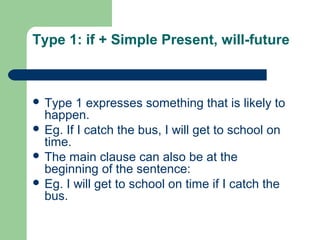
Type 1: if + Simple Present, will-future 
 Type 1 expresses something that is likely to 
happen. 
 Eg. If I catch the bus, I will get to school on 
time. 
 The main clause can also be at the 
beginning of the sentence: 
 Eg. I will get to school on time if I catch the 
bus.
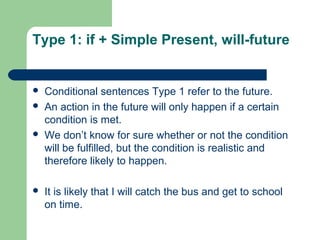
Type 1: if + Simple Present, will-future 
 Conditional sentences Type 1 refer to the future. 
 An action in the future will only happen if a certain 
condition is met. 
 We don’t know for sure whether or not the condition 
will be fulfilled, but the condition is realistic and 
therefore likely to happen. 
 It is likely that I will catch the bus and get to school 
on time.
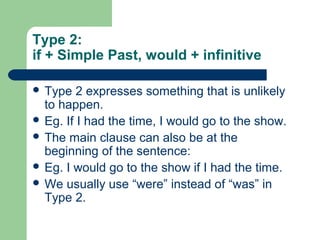
Type 2: 
if + Simple Past, would + infinitive 
 Type 2 expresses something that is unlikely 
to happen. 
 Eg. If I had the time, I would go to the show. 
 The main clause can also be at the 
beginning of the sentence: 
 Eg. I would go to the show if I had the time. 
 We usually use “were” instead of “was” in 
Type 2.
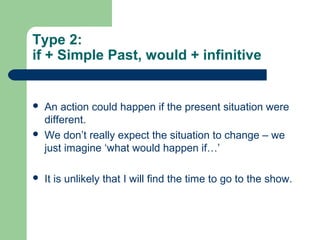
Type 2: 
if + Simple Past, would + infinitive 
 An action could happen if the present situation were 
different. 
 We don’t really expect the situation to change – we 
just imagine ‘what would happen if…’ 
 It is unlikely that I will find the time to go to the show.
Type 3: if + Past Perfect 
 Type 3 expresses something that is 
impossible. 
 Eg. If I had finished my homework, I would 
have gone to the party. 
 The main clause can also be at the 
beginning of the sentence: 
 Eg. I would have gone to the party if I had 
finished my homework.
Type 3: if + Past Perfect 
 Type 3 conditional sentences refer to situations in 
the past. 
 An action could have happened in the past if a 
certain condition had been fulfilled. 
 We just imagine what would have happened if the 
condition had been met. 
 I wanted to go to the party but I wasn’t able to go to 
the party because I hadn’t finished my homework.
Type “0” 
 The “0” conditional is formed with both clauses in the 
present tense. 
 It is used to express a certainty, a universal 
statement, a law of science, etc. 
 Eg. If you heat water to 100 degrees celsius, it boils. 
If you don’t eat for a long time, you become hungry. 
If the sea is stormy, the waves are high. 
 The “0” conditional is different from true conditionals 
because the introductory ‘if’ can be replaced by 
‘when’ or ‘whenever’.

Unit 4 (presentation conditinals)

  • 1.
  • 2.
    What is a‘conditional sentence’?  A sentence discussing factual implications or hypothetical situations and their consequences.  Full conditional sentences contain two clauses: the condition and the result.  Eg.) If I go to the mall (condition), I will buy a pair of jeans (result).
  • 3.
    Conditional Sentence The ‘result’ is the main clause and the ‘condition’ is a subordinate (dependant) clause.  The properties of the conditional clause (tense, degree of probability) determine the properties of the entire sentence.  Conditional clauses usually begin with “if” or “unless” – If you study, you will pass the exam. – You won’t pass the exam unless you study.
  • 4.
    Three types of“IF” clauses in conditional sentences:  Type 1: if + Simple Present, will-future – Expresses something that is likely to happen  Type 2: if + Simple Past, would +infinitive – Expresses something that is not likely to happen  Type 3: if + Past Perfect – Expresses something that is impossible.
  • 5.
    Type 1: if+ Simple Present, will-future  Type 1 expresses something that is likely to happen.  Eg. If I catch the bus, I will get to school on time.  The main clause can also be at the beginning of the sentence:  Eg. I will get to school on time if I catch the bus.
  • 6.
    Type 1: if+ Simple Present, will-future  Conditional sentences Type 1 refer to the future.  An action in the future will only happen if a certain condition is met.  We don’t know for sure whether or not the condition will be fulfilled, but the condition is realistic and therefore likely to happen.  It is likely that I will catch the bus and get to school on time.
  • 7.
    Type 2: if+ Simple Past, would + infinitive  Type 2 expresses something that is unlikely to happen.  Eg. If I had the time, I would go to the show.  The main clause can also be at the beginning of the sentence:  Eg. I would go to the show if I had the time.  We usually use “were” instead of “was” in Type 2.
  • 8.
    Type 2: if+ Simple Past, would + infinitive  An action could happen if the present situation were different.  We don’t really expect the situation to change – we just imagine ‘what would happen if…’  It is unlikely that I will find the time to go to the show.
  • 9.
    Type 3: if+ Past Perfect  Type 3 expresses something that is impossible.  Eg. If I had finished my homework, I would have gone to the party.  The main clause can also be at the beginning of the sentence:  Eg. I would have gone to the party if I had finished my homework.
  • 10.
    Type 3: if+ Past Perfect  Type 3 conditional sentences refer to situations in the past.  An action could have happened in the past if a certain condition had been fulfilled.  We just imagine what would have happened if the condition had been met.  I wanted to go to the party but I wasn’t able to go to the party because I hadn’t finished my homework.
  • 11.
    Type “0” The “0” conditional is formed with both clauses in the present tense.  It is used to express a certainty, a universal statement, a law of science, etc.  Eg. If you heat water to 100 degrees celsius, it boils. If you don’t eat for a long time, you become hungry. If the sea is stormy, the waves are high.  The “0” conditional is different from true conditionals because the introductory ‘if’ can be replaced by ‘when’ or ‘whenever’.