Conditional sentences
English presentation
Definition
“A conditional sentence is a type of sentence that
states a condition and outcome of that condition.”
➢ They are statements discussing known factors
and their consequences. They contain a
conditional clause and the consequence.
➢ A full conditional thus contains two clauses :
i.The dependent clause, expressing the condition called
the antecedent.
ii. Main clause expressing the consequence called the
consequent.
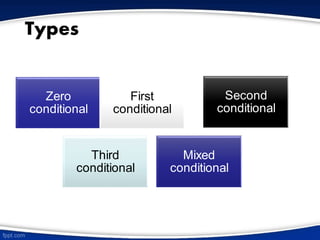
Types
Zero
conditional
First
conditional
Second
conditional
Third
conditional
Mixed
conditional
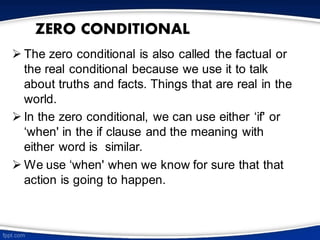
ZERO CONDITIONAL
➢ The zero conditional is also called the factual or
the real conditional because we use it to talk
about truths and facts. Things that are real in the
world.
➢ In the zero conditional, we can use either ‘if' or
‘when' in the if clause and the meaning with
either word is similar.
➢ We use ‘when' when we know for sure that that
action is going to happen.
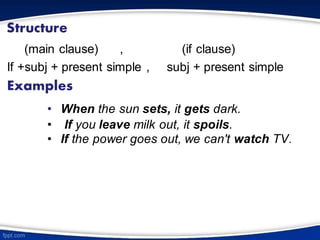
Structure
(main clause) , (if clause)
If +subj + present simple , subj + present simple
Examples
• When the sun sets, it gets dark.
• If you leave milk out, it spoils.
• If the power goes out, we can't watch TV.
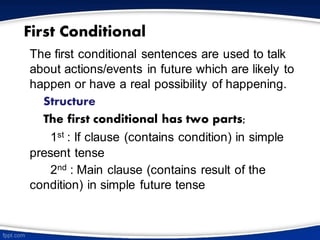
First Conditional
The first conditional sentences are used to talk
about actions/events in future which are likely to
happen or have a real possibility of happening.
Structure
The first conditional has two parts;
1st : If clause (contains condition) in simple
present tense
2nd : Main clause (contains result of the
condition) in simple future tense
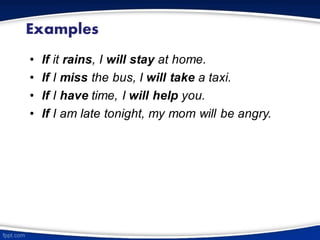
Examples
• If it rains, I will stay at home.
• If I miss the bus, I will take a taxi.
• If I have time, I will help you.
• If I am late tonight, my mom will be angry.
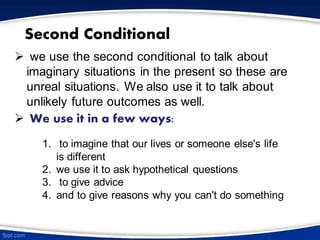
Second Conditional
➢ we use the second conditional to talk about
imaginary situations in the present so these are
unreal situations. We also use it to talk about
unlikely future outcomes as well.
➢ We use it in a few ways:
1. to imagine that our lives or someone else's life
is different
2. we use it to ask hypothetical questions
3. to give advice
4. and to give reasons why you can't do something
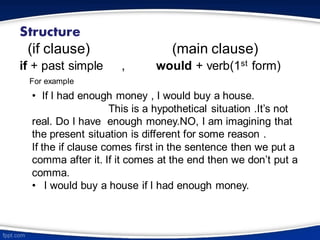
Structure
(if clause) (main clause)
if + past simple , would + verb(1st form)
For example
• If I had enough money , I would buy a house.
This is a hypothetical situation .It’s not
real. Do I have enough money.NO, I am imagining that
the present situation is different for some reason .
If the if clause comes first in the sentence then we put a
comma after it. If it comes at the end then we don’t put a
comma.
• I would buy a house if I had enough money.
Examples
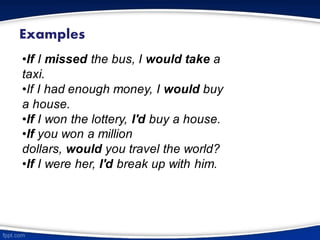
•If I missed the bus, I would take a
taxi.
•If I had enough money, I would buy
a house.
•If I won the lottery, I'd buy a house.
•If you won a million
dollars, would you travel the world?
•If I were her, I'd break up with him.
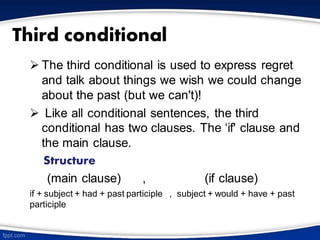
Third conditional
➢ The third conditional is used to express regret
and talk about things we wish we could change
about the past (but we can't)!
➢ Like all conditional sentences, the third
conditional has two clauses. The ‘if' clause and
the main clause.
Structure
(main clause) , (if clause)
if + subject + had + past participle , subject + would + have + past
participle
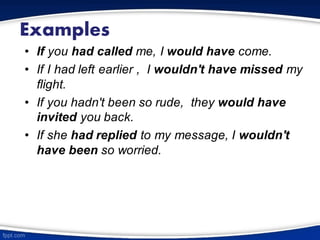
Examples
• If you had called me, I would have come.
• If I had left earlier , I wouldn't have missed my
flight.
• If you hadn't been so rude, they would have
invited you back.
• If she had replied to my message, I wouldn't
have been so worried.
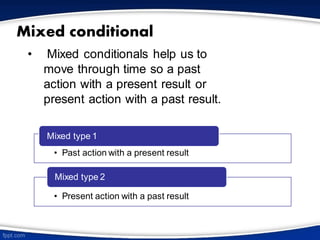
Mixed conditional
• Past action with a present result
Mixed type 1
• Present action with a past result
Mixed type 2
• Mixed conditionals help us to
move through time so a past
action with a present result or
present action with a past result.
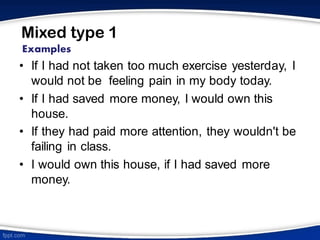
Mixed type 1
• If I had not taken too much exercise yesterday, I
would not be feeling pain in my body today.
• If I had saved more money, I would own this
house.
• If they had paid more attention, they wouldn't be
failing in class.
• I would own this house, if I had saved more
money.
Examples
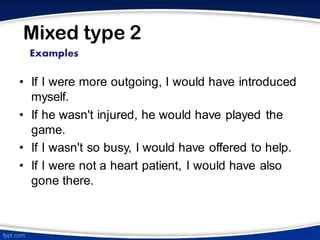
Mixed type 2
• If I were more outgoing, I would have introduced
myself.
• If he wasn't injured, he would have played the
game.
• If I wasn't so busy, I would have offered to help.
• If I were not a heart patient, I would have also
gone there.
Examples
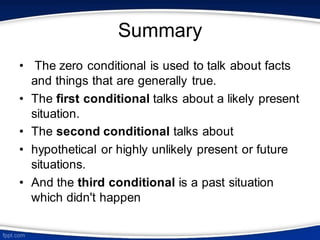
Summary
• The zero conditional is used to talk about facts
and things that are generally true.
• The first conditional talks about a likely present
situation.
• The second conditional talks about
• hypothetical or highly unlikely present or future
situations.
• And the third conditional is a past situation
which didn't happen

English conditional sentances

  • 1.
  • 2.
    Definition “A conditional sentenceis a type of sentence that states a condition and outcome of that condition.” ➢ They are statements discussing known factors and their consequences. They contain a conditional clause and the consequence. ➢ A full conditional thus contains two clauses : i.The dependent clause, expressing the condition called the antecedent. ii. Main clause expressing the consequence called the consequent.
  • 3.
  • 4.
    ZERO CONDITIONAL ➢ Thezero conditional is also called the factual or the real conditional because we use it to talk about truths and facts. Things that are real in the world. ➢ In the zero conditional, we can use either ‘if' or ‘when' in the if clause and the meaning with either word is similar. ➢ We use ‘when' when we know for sure that that action is going to happen.
  • 5.
    Structure (main clause) ,(if clause) If +subj + present simple , subj + present simple Examples • When the sun sets, it gets dark. • If you leave milk out, it spoils. • If the power goes out, we can't watch TV.
  • 6.
    First Conditional The firstconditional sentences are used to talk about actions/events in future which are likely to happen or have a real possibility of happening. Structure The first conditional has two parts; 1st : If clause (contains condition) in simple present tense 2nd : Main clause (contains result of the condition) in simple future tense
  • 7.
    Examples • If itrains, I will stay at home. • If I miss the bus, I will take a taxi. • If I have time, I will help you. • If I am late tonight, my mom will be angry.
  • 8.
    Second Conditional ➢ weuse the second conditional to talk about imaginary situations in the present so these are unreal situations. We also use it to talk about unlikely future outcomes as well. ➢ We use it in a few ways: 1. to imagine that our lives or someone else's life is different 2. we use it to ask hypothetical questions 3. to give advice 4. and to give reasons why you can't do something
  • 9.
    Structure (if clause) (mainclause) if + past simple , would + verb(1st form) For example • If I had enough money , I would buy a house. This is a hypothetical situation .It’s not real. Do I have enough money.NO, I am imagining that the present situation is different for some reason . If the if clause comes first in the sentence then we put a comma after it. If it comes at the end then we don’t put a comma. • I would buy a house if I had enough money.
  • 10.
    Examples •If I missedthe bus, I would take a taxi. •If I had enough money, I would buy a house. •If I won the lottery, I'd buy a house. •If you won a million dollars, would you travel the world? •If I were her, I'd break up with him.
  • 11.
    Third conditional ➢ Thethird conditional is used to express regret and talk about things we wish we could change about the past (but we can't)! ➢ Like all conditional sentences, the third conditional has two clauses. The ‘if' clause and the main clause. Structure (main clause) , (if clause) if + subject + had + past participle , subject + would + have + past participle
  • 12.
    Examples • If youhad called me, I would have come. • If I had left earlier , I wouldn't have missed my flight. • If you hadn't been so rude, they would have invited you back. • If she had replied to my message, I wouldn't have been so worried.
  • 13.
    Mixed conditional • Pastaction with a present result Mixed type 1 • Present action with a past result Mixed type 2 • Mixed conditionals help us to move through time so a past action with a present result or present action with a past result.
  • 14.
    Mixed type 1 •If I had not taken too much exercise yesterday, I would not be feeling pain in my body today. • If I had saved more money, I would own this house. • If they had paid more attention, they wouldn't be failing in class. • I would own this house, if I had saved more money. Examples
  • 15.
    Mixed type 2 •If I were more outgoing, I would have introduced myself. • If he wasn't injured, he would have played the game. • If I wasn't so busy, I would have offered to help. • If I were not a heart patient, I would have also gone there. Examples
  • 16.
    Summary • The zeroconditional is used to talk about facts and things that are generally true. • The first conditional talks about a likely present situation. • The second conditional talks about • hypothetical or highly unlikely present or future situations. • And the third conditional is a past situation which didn't happen