Conditional Sentences
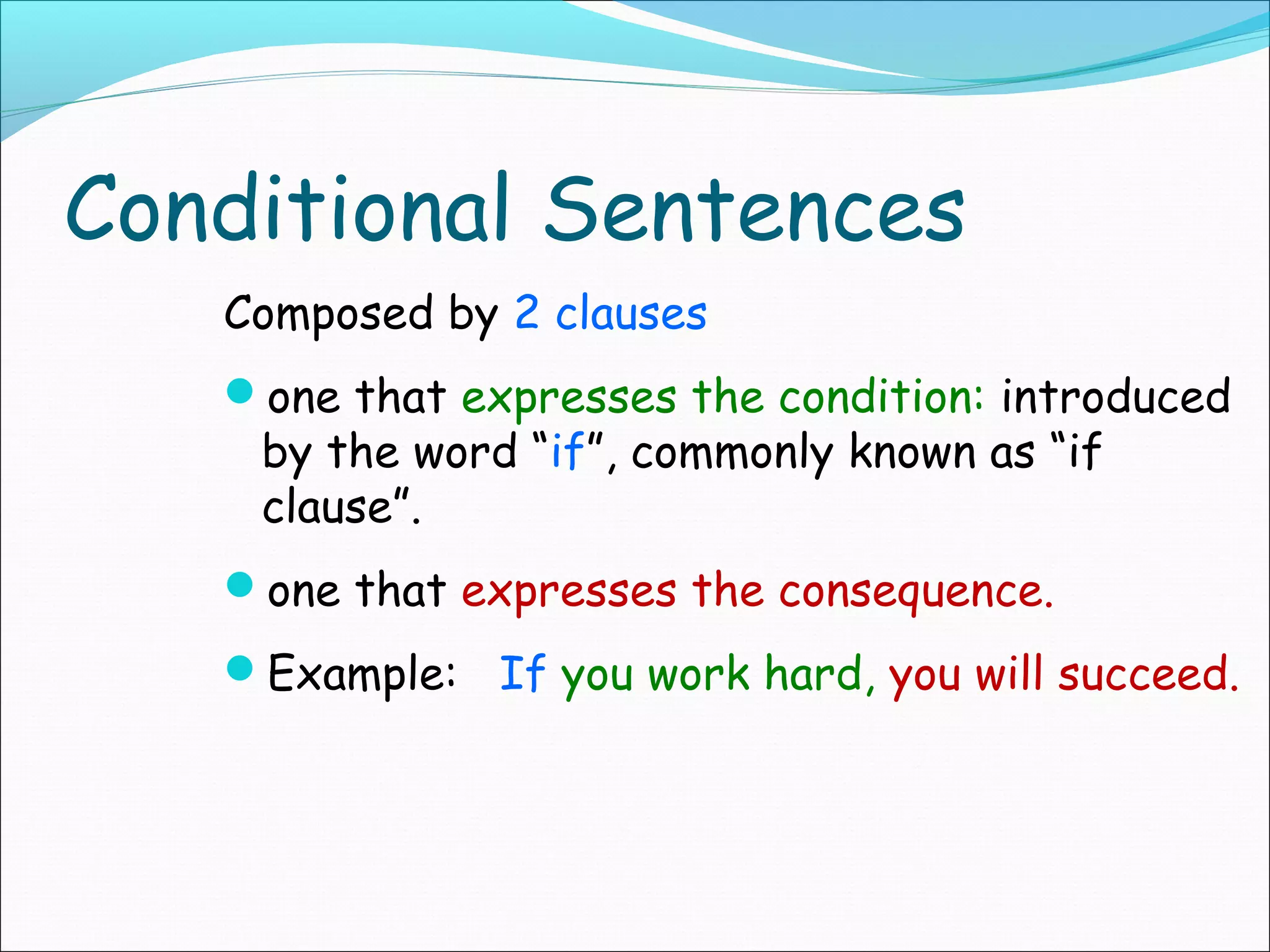
Composed by 2 clauses
one that expresses the condition: introduced
by the word “if”, commonly known as “if
clause”.
one that expresses the consequence.
Example: If you work hard, you will succeed.
Conditional Sentences
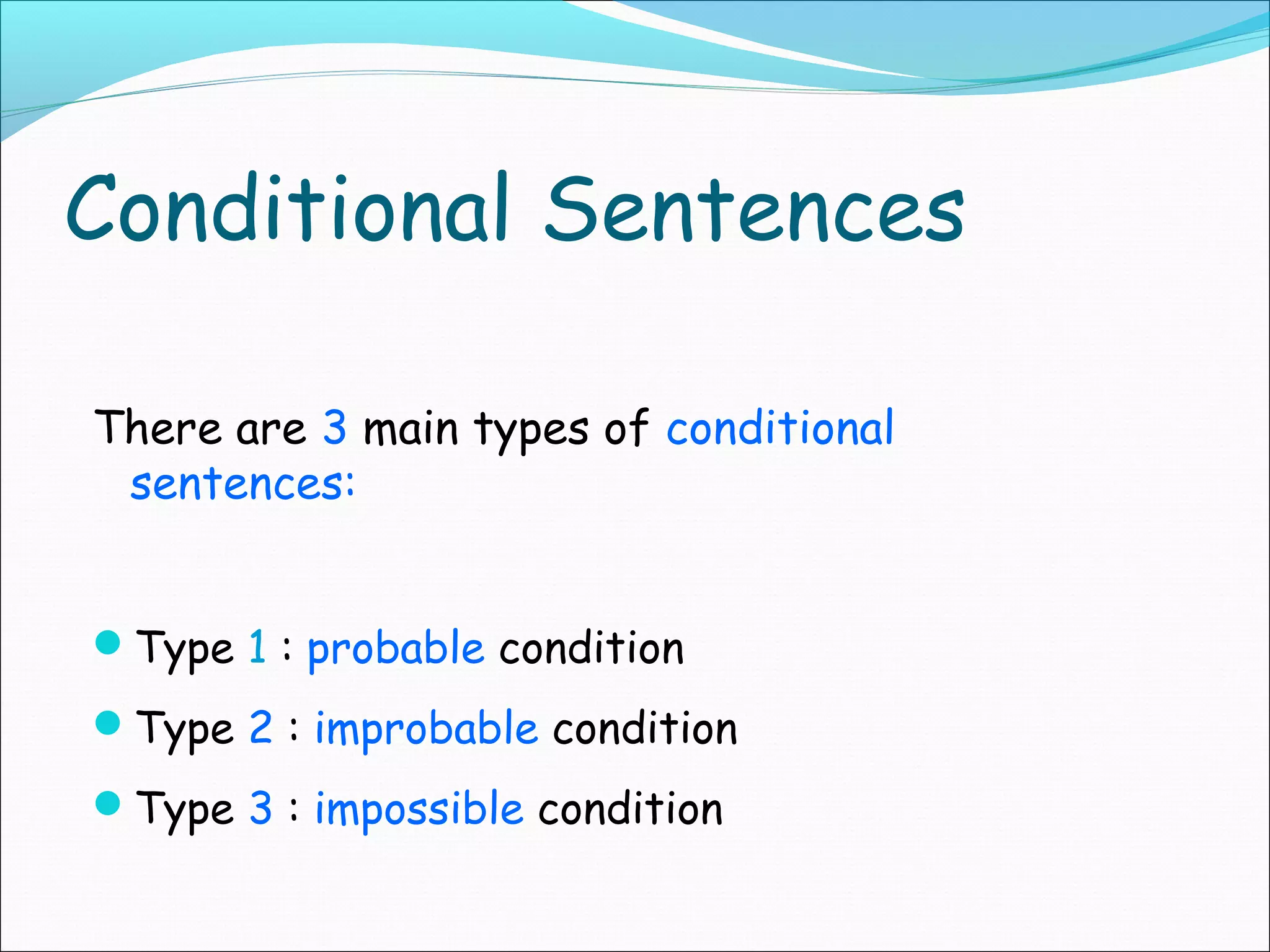
There are 3 main types of conditional
sentences:
Type 1 : probable condition
Type 2 : improbable condition
Type 3 : impossible condition
Type 1 : Probable Condition
Used for actions which are true or likely to happen
Examples:
If it rains tomorrow, we shall cancel the picnic.
You will be tired if you do a lot of exercises.
• Note on type 1:
If + present tense, future tense
Type 2 : Improbable Condition
Used for present or future activities which are
improbable or unlikely to happen
Examples:
If it rained tomorrow, we should stay at home.
You could start dinner if it were ready.
• Note on type 2:
if + past tense, would/should/might + infinitive
Type 3 : Impossible Condition
Used for impossible activities which could NOT
be true or performed
Examples:
If it had rained yesterday, I would have stayed at
home.
What would you have done if you had been
attacked by a monster?
• Note on type 3:
if + past perfect, would/should/might + perfect
infinitive
Variations
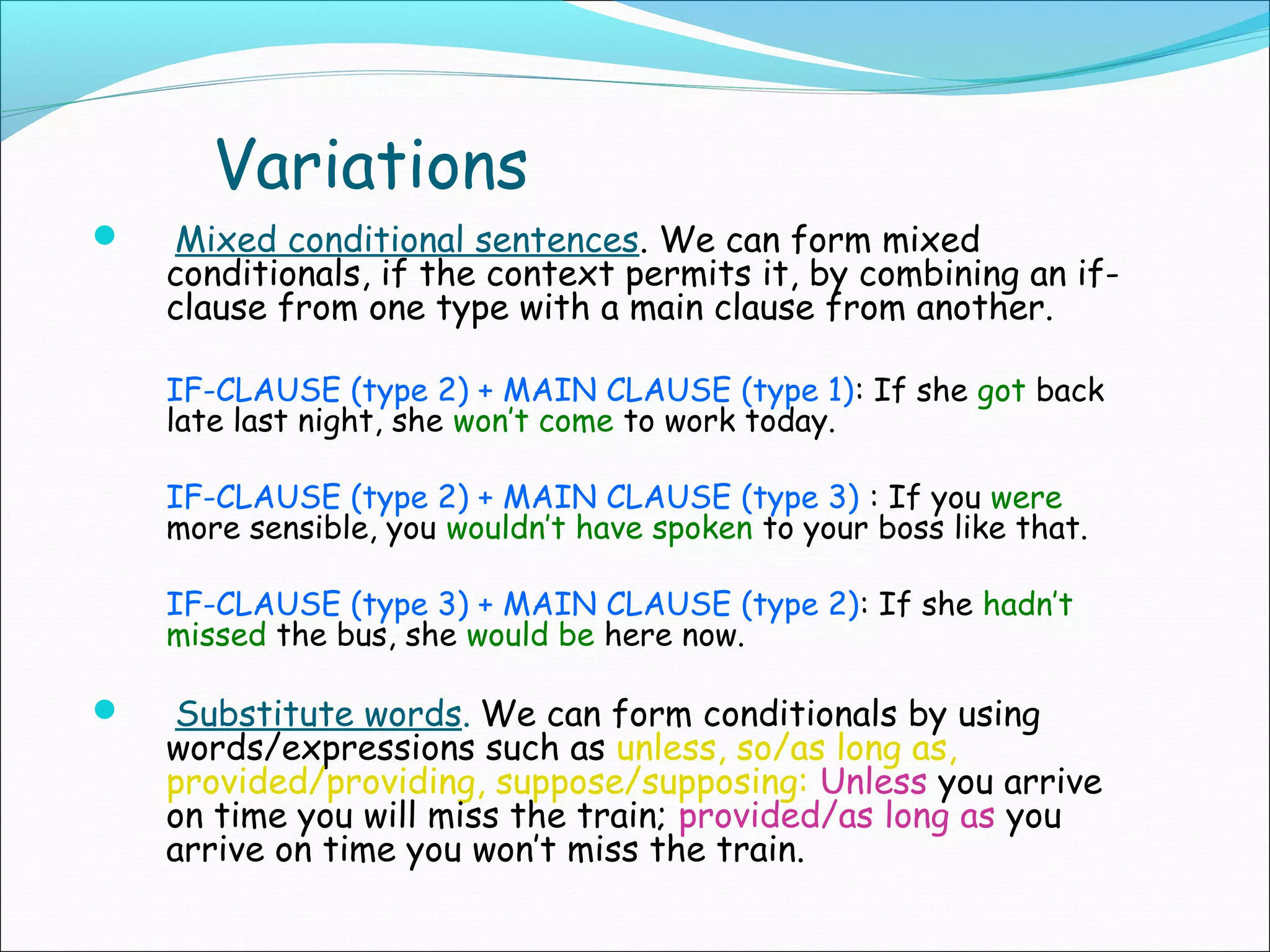
 Mixed conditional sentences. We can form mixed
conditionals, if the context permits it, by combining an if-
clause from one type with a main clause from another.
IF-CLAUSE (type 2) + MAIN CLAUSE (type 1): If she got back
late last night, she won’t come to work today.
IF-CLAUSE (type 2) + MAIN CLAUSE (type 3) : If you were
more sensible, you wouldn’t have spoken to your boss like that.
IF-CLAUSE (type 3) + MAIN CLAUSE (type 2): If she hadn’t
missed the bus, she would be here now.
 Substitute words. We can form conditionals by using
words/expressions such as unless, so/as long as,
provided/providing, suppose/supposing: Unless you arrive
on time you will miss the train; provided/as long as you
arrive on time you won’t miss the train.
Summary
Conditional sentences are composed by 2 clauses
 one that expresses the condition
 one that expresses the consequence
3 main types of conditional sentences.
 Type 1 : Probable Condition
 Type 2 : Improbable Condition
 Type 3 : Impossible Condition
Variations
- Mixed conditionals
- Substitute words: unless, so/as long as, provided/providing,
suppose/supposing.

Conditional sentences

  • 2.
    Conditional Sentences Composed by2 clauses one that expresses the condition: introduced by the word “if”, commonly known as “if clause”. one that expresses the consequence. Example: If you work hard, you will succeed.
  • 3.
    Conditional Sentences There are3 main types of conditional sentences: Type 1 : probable condition Type 2 : improbable condition Type 3 : impossible condition
  • 4.
    Type 1 :Probable Condition Used for actions which are true or likely to happen Examples: If it rains tomorrow, we shall cancel the picnic. You will be tired if you do a lot of exercises. • Note on type 1: If + present tense, future tense
  • 5.
    Type 2 :Improbable Condition Used for present or future activities which are improbable or unlikely to happen Examples: If it rained tomorrow, we should stay at home. You could start dinner if it were ready. • Note on type 2: if + past tense, would/should/might + infinitive
  • 6.
    Type 3 :Impossible Condition Used for impossible activities which could NOT be true or performed Examples: If it had rained yesterday, I would have stayed at home. What would you have done if you had been attacked by a monster? • Note on type 3: if + past perfect, would/should/might + perfect infinitive
  • 7.
    Variations  Mixed conditionalsentences. We can form mixed conditionals, if the context permits it, by combining an if- clause from one type with a main clause from another. IF-CLAUSE (type 2) + MAIN CLAUSE (type 1): If she got back late last night, she won’t come to work today. IF-CLAUSE (type 2) + MAIN CLAUSE (type 3) : If you were more sensible, you wouldn’t have spoken to your boss like that. IF-CLAUSE (type 3) + MAIN CLAUSE (type 2): If she hadn’t missed the bus, she would be here now.  Substitute words. We can form conditionals by using words/expressions such as unless, so/as long as, provided/providing, suppose/supposing: Unless you arrive on time you will miss the train; provided/as long as you arrive on time you won’t miss the train.
  • 8.
    Summary Conditional sentences arecomposed by 2 clauses  one that expresses the condition  one that expresses the consequence 3 main types of conditional sentences.  Type 1 : Probable Condition  Type 2 : Improbable Condition  Type 3 : Impossible Condition Variations - Mixed conditionals - Substitute words: unless, so/as long as, provided/providing, suppose/supposing.