Part 2:
MIXED CONDITIONALS
*
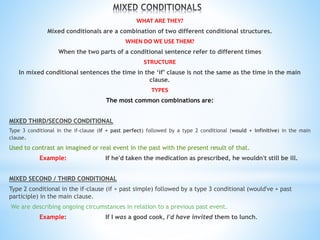
WHAT ARE THEY?
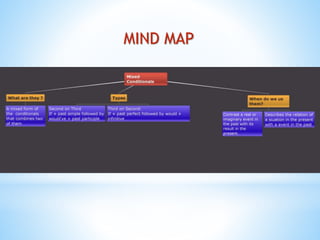
Mixed conditionals are a combination of two different conditional structures.
WHEN DO WE USE THEM?
When the two parts of a conditional sentence refer to different times
STRUCTURE
In mixed conditional sentences the time in the ‘if’ clause is not the same as the time in the main
clause.
TYPES
The most common combinations are:
MIXED THIRD/SECOND CONDITIONAL
Type 3 conditional in the if-clause (if + past perfect) followed by a type 2 conditional (would + infinitive) in the main
clause.
Used to contrast an imagined or real event in the past with the present result of that.
Example: If he'd taken the medication as prescribed, he wouldn't still be ill.
MIXED SECOND / THIRD CONDITIONAL
Type 2 conditional in the if-clause (if + past simple) followed by a type 3 conditional (would've + past
participle) in the main clause.
We are describing ongoing circumstances in relation to a previous past event.
Example: If I was a good cook, I'd have invited them to lunch.
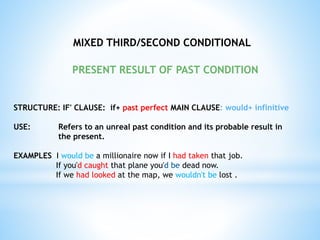
MIXED THIRD/SECOND CONDITIONAL
PRESENT RESULT OF PAST CONDITION
STRUCTURE: IF' CLAUSE: if+ past perfect MAIN CLAUSE: would+ infinitive
USE: Refers to an unreal past condition and its probable result in
the present.
EXAMPLES I would be a millionaire now if I had taken that job.
If you'd caught that plane you'd be dead now.
If we had looked at the map, we wouldn't be lost .
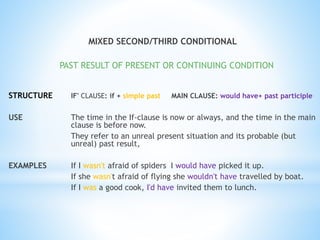
MIXED SECOND/THIRD CONDITIONAL
PAST RESULT OF PRESENT OR CONTINUING CONDITION
STRUCTURE IF' CLAUSE: if + simple past MAIN CLAUSE: would have+ past participle
USE The time in the If-clause is now or always, and the time in the main
clause is before now.
They refer to an unreal present situation and its probable (but
unreal) past result,
EXAMPLES If I wasn't afraid of spiders I would have picked it up.
If she wasn't afraid of flying she wouldn't have travelled by boat.
If I was a good cook, I'd have invited them to lunch.
MIND MAP
THE END

Mixed conditionals

  • 1.
  • 2.
    WHAT ARE THEY? Mixedconditionals are a combination of two different conditional structures. WHEN DO WE USE THEM? When the two parts of a conditional sentence refer to different times STRUCTURE In mixed conditional sentences the time in the ‘if’ clause is not the same as the time in the main clause. TYPES The most common combinations are: MIXED THIRD/SECOND CONDITIONAL Type 3 conditional in the if-clause (if + past perfect) followed by a type 2 conditional (would + infinitive) in the main clause. Used to contrast an imagined or real event in the past with the present result of that. Example: If he'd taken the medication as prescribed, he wouldn't still be ill. MIXED SECOND / THIRD CONDITIONAL Type 2 conditional in the if-clause (if + past simple) followed by a type 3 conditional (would've + past participle) in the main clause. We are describing ongoing circumstances in relation to a previous past event. Example: If I was a good cook, I'd have invited them to lunch.
  • 3.
    MIXED THIRD/SECOND CONDITIONAL PRESENTRESULT OF PAST CONDITION STRUCTURE: IF' CLAUSE: if+ past perfect MAIN CLAUSE: would+ infinitive USE: Refers to an unreal past condition and its probable result in the present. EXAMPLES I would be a millionaire now if I had taken that job. If you'd caught that plane you'd be dead now. If we had looked at the map, we wouldn't be lost .
  • 4.
    MIXED SECOND/THIRD CONDITIONAL PASTRESULT OF PRESENT OR CONTINUING CONDITION STRUCTURE IF' CLAUSE: if + simple past MAIN CLAUSE: would have+ past participle USE The time in the If-clause is now or always, and the time in the main clause is before now. They refer to an unreal present situation and its probable (but unreal) past result, EXAMPLES If I wasn't afraid of spiders I would have picked it up. If she wasn't afraid of flying she wouldn't have travelled by boat. If I was a good cook, I'd have invited them to lunch.
  • 5.
  • 6.