CONDITIONAL
  CLAUSES
Conditionals
 always have two parts:
    the Main Clause
          and
     the IF Clause
(When the If Clause goes first, it is followed by a
 comma, but you can also put the Main Clause
   first without using a comma between the
                    clauses.)
Conditional Conjunctions:
   IF is the most common one.

           Others are:

           As long as
    Provided/ Providing (that)

      UNLESS = If not
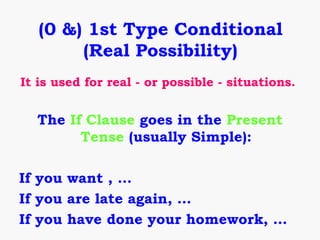
(0 &) 1st Type Conditional
        (Real Possibility)
It is used for real - or possible - situations.


  The If Clause goes in the Present
        Tense (usually Simple):

If you want , …
If you are late again, …
If you have done your homework, …
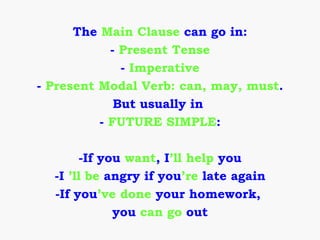
The Main Clause can go in:
            - Present Tense
              - Imperative
- Present Modal Verb: can, may, must.
             But usually in
          - FUTURE SIMPLE:

       -If you want, I’ll help you
  -I ’ll be angry if you’re late again
  -If you’ve done your homework,
             you can go out
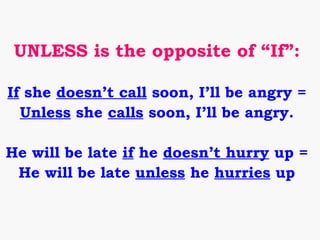
UNLESS is the opposite of “If”:

If she doesn’t call soon, I’ll be angry =
  Unless she calls soon, I’ll be angry.

He will be late if he doesn’t hurry up =
 He will be late unless he hurries up
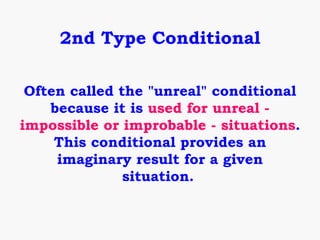
2nd Type Conditional

 Often called the "unreal" conditional
    because it is used for unreal -
impossible or improbable - situations.
     This conditional provides an
     imaginary result for a given
               situation.
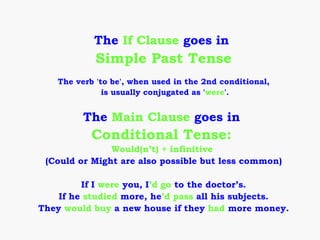
The If Clause goes in
            Simple Past Tense
   The verb 'to be', when used in the 2nd conditional,
              is usually conjugated as 'were'.


         The Main Clause goes in
           Conditional Tense:
               Would(n’t) + infinitive
 (Could or Might are also possible but less common)

         If I were you, I’d go to the doctor’s.
    If he studied more, he’d pass all his subjects.
They would buy a new house if they had more money.
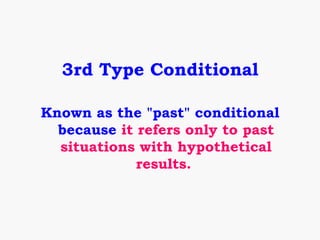
3rd Type Conditional

Known as the "past" conditional
  because it refers only to past
  situations with hypothetical
             results.
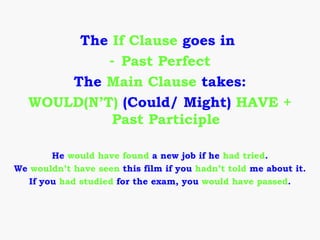
The If Clause goes in
            - Past Perfect
       The Main Clause takes:
   WOULD(N’T) (Could/ Might) HAVE +
             Past Participle

        He would have found a new job if he had tried.
We wouldn’t have seen this film if you hadn’t told me about it.
   If you had studied for the exam, you would have passed.
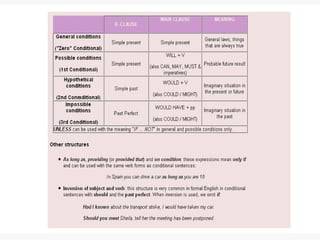
To sum up:

                        (Taken from
http://www.xtec.es/~ogodoy/sac/rephrasing/conditionals.htm)
Conditional Clauses

Conditional Clauses

  • 1.
  • 2.
    Conditionals always havetwo parts: the Main Clause and the IF Clause (When the If Clause goes first, it is followed by a comma, but you can also put the Main Clause first without using a comma between the clauses.)
  • 3.
    Conditional Conjunctions: IF is the most common one. Others are: As long as Provided/ Providing (that) UNLESS = If not
  • 4.
    (0 &) 1stType Conditional (Real Possibility) It is used for real - or possible - situations. The If Clause goes in the Present Tense (usually Simple): If you want , … If you are late again, … If you have done your homework, …
  • 5.
    The Main Clausecan go in: - Present Tense - Imperative - Present Modal Verb: can, may, must. But usually in - FUTURE SIMPLE: -If you want, I’ll help you -I ’ll be angry if you’re late again -If you’ve done your homework, you can go out
  • 6.
    UNLESS is theopposite of “If”: If she doesn’t call soon, I’ll be angry = Unless she calls soon, I’ll be angry. He will be late if he doesn’t hurry up = He will be late unless he hurries up
  • 7.
    2nd Type Conditional Often called the "unreal" conditional because it is used for unreal - impossible or improbable - situations. This conditional provides an imaginary result for a given situation.
  • 8.
    The If Clausegoes in Simple Past Tense The verb 'to be', when used in the 2nd conditional, is usually conjugated as 'were'. The Main Clause goes in Conditional Tense: Would(n’t) + infinitive (Could or Might are also possible but less common) If I were you, I’d go to the doctor’s. If he studied more, he’d pass all his subjects. They would buy a new house if they had more money.
  • 9.
    3rd Type Conditional Knownas the "past" conditional because it refers only to past situations with hypothetical results.
  • 10.
    The If Clausegoes in - Past Perfect The Main Clause takes: WOULD(N’T) (Could/ Might) HAVE + Past Participle He would have found a new job if he had tried. We wouldn’t have seen this film if you hadn’t told me about it. If you had studied for the exam, you would have passed.
  • 11.
    To sum up: (Taken from http://www.xtec.es/~ogodoy/sac/rephrasing/conditionals.htm)