Conditional
Sentences
De Guzman, Mia Milagros T.
II-17 BSE ENGLISH
STRUCTURES OF ENGLISH
What are Conditions?
• "Conditions deal with imagined situations:
some are possible, some are unlikely, some
are impossible. The speaker/writer imagines
that something can or cannot happen or have
happened, and then compares that situation
with possible consequences or outcomes, or
offers further logical conclusions about the
situation."
(R. Carter, Cambridge Grammar of English.
Cambridge Univ. Press, 2006)
Then…

WHAT ARE CONDITIONAL
SENTENCES/IF-CLAUSES?
What are Conditional Sentences?
• Definition
– A type of adverbial clause that states a
hypothesis or condition, real or imagined.
– A conditional clause may be introduced by
the subordinating conjunction if or another
conjunction, such as unless, provided that,
or in case of.
– Like other adverbial clauses, a conditional
clause can come either before or after
the clause on which it states a condition
• The conditional sentences are
sometimes confusing for learners of
English.
–Watch out:
• 1) Which type of the conditional
sentences is used?
• 2) Where is the if-clause (e.g. at the
beginning or at the end of the conditional
sentence)?
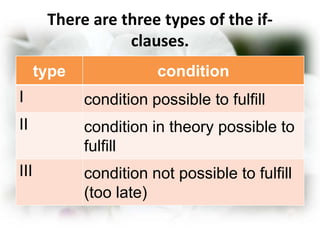
There are three types of the ifclauses.
type

condition

I

condition possible to fulfill

II

condition in theory possible to
fulfill

III

condition not possible to fulfill
(too late)
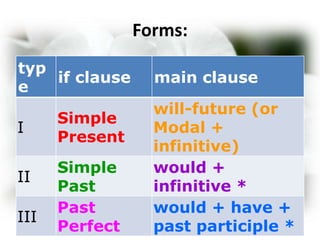
Forms:
typ
if clause
e
I
II
III

Simple
Present
Simple
Past
Past
Perfect

main clause
will-future (or
Modal +
infinitive)
would +
infinitive *
would + have +
past participle *
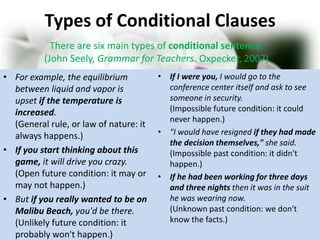
Types of Conditional Clauses
There are six main types of conditional sentence:
(John Seely, Grammar for Teachers. Oxpecker, 2007)
• For example, the equilibrium
between liquid and vapor is
upset if the temperature is
increased.
(General rule, or law of nature: it
always happens.)
• If you start thinking about this
game, it will drive you crazy.
(Open future condition: it may or
may not happen.)
• But if you really wanted to be on
Malibu Beach, you'd be there.
(Unlikely future condition: it
probably won't happen.)

• If I were you, I would go to the
conference center itself and ask to see
someone in security.
(Impossible future condition: it could
never happen.)
• "I would have resigned if they had made
the decision themselves," she said.
(Impossible past condition: it didn't
happen.)
• If he had been working for three days
and three nights then it was in the suit
he was wearing now.
(Unknown past condition: we don't
know the facts.)
Type I
Use
It is possible to fulfill a condition which is
given in the if-clause.
if clause

main clause

Simple Present

will-future
or
infinitive
or
Modal + infinitive
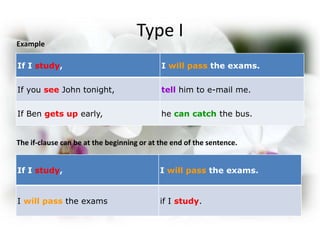
Example

Type I

If I study,

I will pass the exams.

If you see John tonight,

tell him to e-mail me.

If Ben gets up early,

he can catch the bus.

The if-clause can be at the beginning or at the end of the sentence.
If I study,

I will pass the exams.

I will pass the exams

if I study.
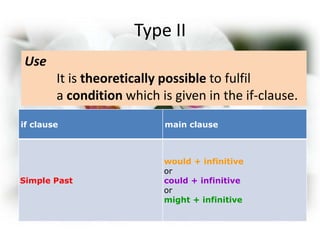
Type II
Use

It is theoretically possible to fulfil
a condition which is given in the if-clause.
if clause

main clause

Simple Past

would + infinitive
or
could + infinitive
or
might + infinitive
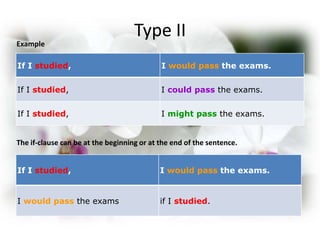
Example

Type II

If I studied,

I would pass the exams.

If I studied,

I could pass the exams.

If I studied,

I might pass the exams.

The if-clause can be at the beginning or at the end of the sentence.
If I studied,

I would pass the exams.

I would pass the exams

if I studied.
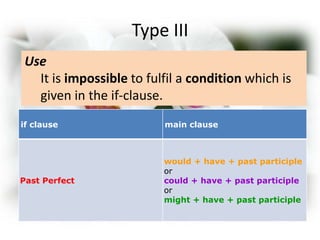
Type III
Use
It is impossible to fulfil a condition which is
given in the if-clause.
if clause

main clause

Past Perfect

would + have + past participle
or
could + have + past participle
or
might + have + past participle
Example

Type III

If I had studied,

I would have passed the
exams.

If I had studied,

I could have passed the exams.

If I had studied,

I might have passed the exams.

The if-clause can be at the beginning or at the end of the sentence.
If I had studied,

I would have passed the
exams.

I would have passed the exams

if I had studied.
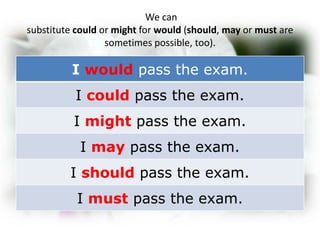
We can
substitute could or might for would (should, may or must are
sometimes possible, too).

I would pass the exam.
I could pass the exam.
I might pass the exam.
I may pass the exam.
I should pass the exam.
I must pass the exam.
Your Test
A) Finish the sentences. Use the
correct phrases.

1) You would have slept much
better
2) If we had seen the film,
3) If you drove from Paris to
Lisbon,
4) I would go to the party
5) If you wait a minute,

6) If he studied the new words,
7) The teacher will not be
happy
8) My uncle would stay longer
in York
9) If Amy does the washing up,

10) If I were you,
Possible Answers:
• 1) You would have slept much better if you had taken your
medicine.
2) If we had seen the film, we would not have bought the DVD.
3) If you drove from Paris to Lisbon, which way would you go?
4) I would go to the party if you came with me.
5) If you wait a minute, I'll go with you.
6) If he studied the new words, he could get a good mark in the
test.
7) The teacher will not be happy if we forget our homework
again.
8) My uncle would stay longer in York if he had more time.
9) If Amy does the washing up, her brother will clear the table.
10) If I were you, I would not play hockey.
References:
Englisch-Hilfen.de. Retrived on March 09, 2014 from
http://www.englisch-hilfen.de/en/grammar/if.htm
About.com. Grammar and Composition. Retrieved
on March 09, 2014 from
http://grammar.about.com/od/c/g/conditionalclauset
erm.htm
The End…
Thanks for listening!!! 

Conditional sentences

  • 1.
    Conditional Sentences De Guzman, MiaMilagros T. II-17 BSE ENGLISH STRUCTURES OF ENGLISH
  • 2.
    What are Conditions? •"Conditions deal with imagined situations: some are possible, some are unlikely, some are impossible. The speaker/writer imagines that something can or cannot happen or have happened, and then compares that situation with possible consequences or outcomes, or offers further logical conclusions about the situation." (R. Carter, Cambridge Grammar of English. Cambridge Univ. Press, 2006)
  • 3.
  • 4.
    What are ConditionalSentences? • Definition – A type of adverbial clause that states a hypothesis or condition, real or imagined. – A conditional clause may be introduced by the subordinating conjunction if or another conjunction, such as unless, provided that, or in case of. – Like other adverbial clauses, a conditional clause can come either before or after the clause on which it states a condition
  • 5.
    • The conditionalsentences are sometimes confusing for learners of English. –Watch out: • 1) Which type of the conditional sentences is used? • 2) Where is the if-clause (e.g. at the beginning or at the end of the conditional sentence)?
  • 6.
    There are threetypes of the ifclauses. type condition I condition possible to fulfill II condition in theory possible to fulfill III condition not possible to fulfill (too late)
  • 7.
    Forms: typ if clause e I II III Simple Present Simple Past Past Perfect main clause will-future(or Modal + infinitive) would + infinitive * would + have + past participle *
  • 8.
    Types of ConditionalClauses There are six main types of conditional sentence: (John Seely, Grammar for Teachers. Oxpecker, 2007) • For example, the equilibrium between liquid and vapor is upset if the temperature is increased. (General rule, or law of nature: it always happens.) • If you start thinking about this game, it will drive you crazy. (Open future condition: it may or may not happen.) • But if you really wanted to be on Malibu Beach, you'd be there. (Unlikely future condition: it probably won't happen.) • If I were you, I would go to the conference center itself and ask to see someone in security. (Impossible future condition: it could never happen.) • "I would have resigned if they had made the decision themselves," she said. (Impossible past condition: it didn't happen.) • If he had been working for three days and three nights then it was in the suit he was wearing now. (Unknown past condition: we don't know the facts.)
  • 9.
    Type I Use It ispossible to fulfill a condition which is given in the if-clause. if clause main clause Simple Present will-future or infinitive or Modal + infinitive
  • 10.
    Example Type I If Istudy, I will pass the exams. If you see John tonight, tell him to e-mail me. If Ben gets up early, he can catch the bus. The if-clause can be at the beginning or at the end of the sentence. If I study, I will pass the exams. I will pass the exams if I study.
  • 11.
    Type II Use It istheoretically possible to fulfil a condition which is given in the if-clause. if clause main clause Simple Past would + infinitive or could + infinitive or might + infinitive
  • 12.
    Example Type II If Istudied, I would pass the exams. If I studied, I could pass the exams. If I studied, I might pass the exams. The if-clause can be at the beginning or at the end of the sentence. If I studied, I would pass the exams. I would pass the exams if I studied.
  • 13.
    Type III Use It isimpossible to fulfil a condition which is given in the if-clause. if clause main clause Past Perfect would + have + past participle or could + have + past participle or might + have + past participle
  • 14.
    Example Type III If Ihad studied, I would have passed the exams. If I had studied, I could have passed the exams. If I had studied, I might have passed the exams. The if-clause can be at the beginning or at the end of the sentence. If I had studied, I would have passed the exams. I would have passed the exams if I had studied.
  • 15.
    We can substitute couldor might for would (should, may or must are sometimes possible, too). I would pass the exam. I could pass the exam. I might pass the exam. I may pass the exam. I should pass the exam. I must pass the exam.
  • 16.
    Your Test A) Finishthe sentences. Use the correct phrases. 1) You would have slept much better 2) If we had seen the film, 3) If you drove from Paris to Lisbon, 4) I would go to the party 5) If you wait a minute, 6) If he studied the new words, 7) The teacher will not be happy 8) My uncle would stay longer in York 9) If Amy does the washing up, 10) If I were you,
  • 17.
    Possible Answers: • 1)You would have slept much better if you had taken your medicine. 2) If we had seen the film, we would not have bought the DVD. 3) If you drove from Paris to Lisbon, which way would you go? 4) I would go to the party if you came with me. 5) If you wait a minute, I'll go with you. 6) If he studied the new words, he could get a good mark in the test. 7) The teacher will not be happy if we forget our homework again. 8) My uncle would stay longer in York if he had more time. 9) If Amy does the washing up, her brother will clear the table. 10) If I were you, I would not play hockey.
  • 18.
    References: Englisch-Hilfen.de. Retrived onMarch 09, 2014 from http://www.englisch-hilfen.de/en/grammar/if.htm About.com. Grammar and Composition. Retrieved on March 09, 2014 from http://grammar.about.com/od/c/g/conditionalclauset erm.htm
  • 19.
    The End… Thanks forlistening!!! 