Noun, Adjective, and Adverb Clauses:
 Also Known as Dependent Clauses!

                    Grammar
        Eleventh Grade American Literature
                   Ms. Pennell
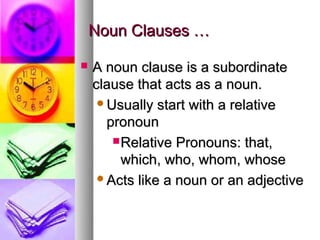
Noun Clauses …

   A noun clause is a subordinate
    clause that acts as a noun.
     Usually start with a relative
      pronoun
        Relative Pronouns: that,
         which, who, whom, whose
     Acts like a noun or an adjective
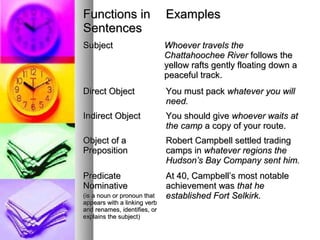
Functions in                  Examples
Sentences
Subject                       Whoever travels the
                              Chattahoochee River follows the
                              yellow rafts gently floating down a
                              peaceful track.
Direct Object                 You must pack whatever you will
                              need.
Indirect Object               You should give whoever waits at
                              the camp a copy of your route.
Object of a                   Robert Campbell settled trading
Preposition                   camps in whatever regions the
                              Hudson’s Bay Company sent him.
Predicate                     At 40, Campbell’s most notable
Nominative                    achievement was that he
(is a noun or pronoun that    established Fort Selkirk.
appears with a linking verb
and renames, identifies, or
explains the subject)
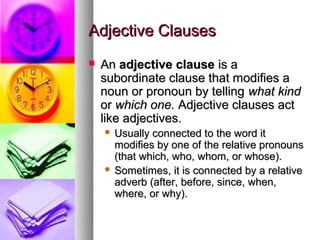
Adjective Clauses
   An adjective clause is a
    subordinate clause that modifies a
    noun or pronoun by telling what kind
    or which one. Adjective clauses act
    like adjectives.
     Usually connected to the word it
      modifies by one of the relative pronouns
      (that which, who, whom, or whose).
     Sometimes, it is connected by a relative
      adverb (after, before, since, when,
      where, or why).
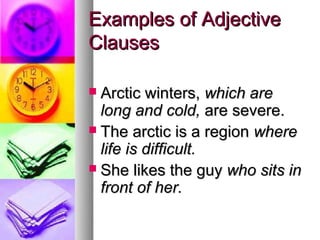
Examples of Adjective
Clauses

 Arctic winters, which are
  long and cold, are severe.
 The arctic is a region where
  life is difficult.
 She likes the guy who sits in
  front of her.
Essential and Nonessential
Adjective Clauses
   An adjective clause that is
    nonessential to the basic
    meaning of a sentence is set off
    by commas.
     The ship, which was a nuclear
      submarine, became the first
      vessel to pass beneath the North
      Pole.
Example of an Essential
Adjective Clause

   Essential adjective clauses are
    not set off by commas.

     The first vessel that passed
      beneath the North Pole was a
      nuclear submarine.
Practical Use of Adjective
Clauses
   By using either a nonessential or an
    essential adjective clause, you can
    often combine the ideas from two
    sentences into one.
    The Arktika was the first surface ship to
     crack through the Arctic icepack. It was
     a Soviet ice breaker.
    Combine the above two sentences using
     an essential or nonessential adjective
     clause.
Solution …

   The Arktika, which was a Soviet
    icebreaker, was the first surface
    ship to crack the Arctic ice pack.
Adjective Clauses Continued

   Relative pronouns and relative
    adverbs not only introduce
    adjective clauses, but also
    function within the subordinate
    clause.
Adjective Clauses Continued

   A relative pronoun or relative
    adverb:
     Connects   the adjective clause to
      the modified word
     Acts within the clause as a
      subject, direct object, or other
      sentence part.
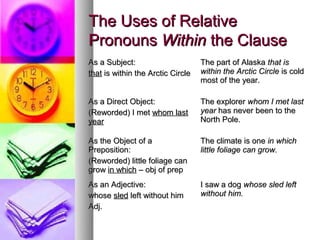
The Uses of Relative
Pronouns Within the Clause
As a Subject:                      The part of Alaska that is
that is within the Arctic Circle   within the Arctic Circle is cold
                                   most of the year.

As a Direct Object:                The explorer whom I met last
(Reworded) I met whom last         year has never been to the
year                               North Pole.

As the Object of a                 The climate is one in which
Preposition:                       little foliage can grow.
(Reworded) little foliage can
grow in which – obj of prep
As an Adjective:                   I saw a dog whose sled left
whose sled left without him        without him.
Adj.
Adverb Clauses
   Adverb clauses modify verbs,
    adjectives, adverbs, or verbals
    by telling where, when, in what
    way, to what extent, under what
    condition, or why.
   An example of an adverb clause
    is as follows:
     The   Yukon entered Canada’s
      confederation after a gold rush
      brought 100,000 people to the
      territory.
Adverb Clauses Continued …
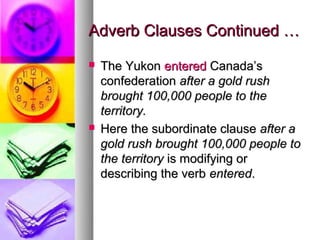
   The Yukon entered Canada’s
    confederation after a gold rush
    brought 100,000 people to the
    territory.
   Here the subordinate clause after a
    gold rush brought 100,000 people to
    the territory is modifying or
    describing the verb entered.
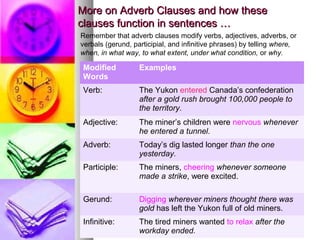
More on Adverb Clauses and how these
clauses function in sentences …
Remember that adverb clauses modify verbs, adjectives, adverbs, or
verbals (gerund, participial, and infinitive phrases) by telling where,
when, in what way, to what extent, under what condition, or why.

 Modified          Examples
 Words
 Verb:             The Yukon entered Canada’s confederation
                   after a gold rush brought 100,000 people to
                   the territory.
 Adjective:        The miner’s children were nervous whenever
                   he entered a tunnel.
 Adverb:           Today’s dig lasted longer than the one
                   yesterday.
 Participle:       The miners, cheering whenever someone
                   made a strike, were excited.

 Gerund:           Digging wherever miners thought there was
                   gold has left the Yukon full of old miners.
 Infinitive:       The tired miners wanted to relax after the
                   workday ended.
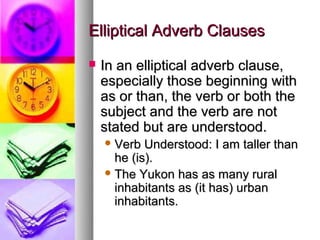
Elliptical Adverb Clauses
   In an elliptical adverb clause,
    especially those beginning with
    as or than, the verb or both the
    subject and the verb are not
    stated but are understood.
     Verb  Understood: I am taller than
      he (is).
     The Yukon has as many rural
      inhabitants as (it has) urban
      inhabitants.

Noun, adjective, and adverb clauses

  • 1.
    Noun, Adjective, andAdverb Clauses: Also Known as Dependent Clauses! Grammar Eleventh Grade American Literature Ms. Pennell
  • 2.
    Noun Clauses …  A noun clause is a subordinate clause that acts as a noun. Usually start with a relative pronoun  Relative Pronouns: that, which, who, whom, whose Acts like a noun or an adjective
  • 3.
    Functions in Examples Sentences Subject Whoever travels the Chattahoochee River follows the yellow rafts gently floating down a peaceful track. Direct Object You must pack whatever you will need. Indirect Object You should give whoever waits at the camp a copy of your route. Object of a Robert Campbell settled trading Preposition camps in whatever regions the Hudson’s Bay Company sent him. Predicate At 40, Campbell’s most notable Nominative achievement was that he (is a noun or pronoun that established Fort Selkirk. appears with a linking verb and renames, identifies, or explains the subject)
  • 4.
    Adjective Clauses  An adjective clause is a subordinate clause that modifies a noun or pronoun by telling what kind or which one. Adjective clauses act like adjectives.  Usually connected to the word it modifies by one of the relative pronouns (that which, who, whom, or whose).  Sometimes, it is connected by a relative adverb (after, before, since, when, where, or why).
  • 5.
    Examples of Adjective Clauses Arctic winters, which are long and cold, are severe.  The arctic is a region where life is difficult.  She likes the guy who sits in front of her.
  • 6.
    Essential and Nonessential AdjectiveClauses  An adjective clause that is nonessential to the basic meaning of a sentence is set off by commas.  The ship, which was a nuclear submarine, became the first vessel to pass beneath the North Pole.
  • 7.
    Example of anEssential Adjective Clause  Essential adjective clauses are not set off by commas.  The first vessel that passed beneath the North Pole was a nuclear submarine.
  • 8.
    Practical Use ofAdjective Clauses  By using either a nonessential or an essential adjective clause, you can often combine the ideas from two sentences into one. The Arktika was the first surface ship to crack through the Arctic icepack. It was a Soviet ice breaker. Combine the above two sentences using an essential or nonessential adjective clause.
  • 9.
    Solution …  The Arktika, which was a Soviet icebreaker, was the first surface ship to crack the Arctic ice pack.
  • 10.
    Adjective Clauses Continued  Relative pronouns and relative adverbs not only introduce adjective clauses, but also function within the subordinate clause.
  • 11.
    Adjective Clauses Continued  A relative pronoun or relative adverb:  Connects the adjective clause to the modified word  Acts within the clause as a subject, direct object, or other sentence part.
  • 12.
    The Uses ofRelative Pronouns Within the Clause As a Subject: The part of Alaska that is that is within the Arctic Circle within the Arctic Circle is cold most of the year. As a Direct Object: The explorer whom I met last (Reworded) I met whom last year has never been to the year North Pole. As the Object of a The climate is one in which Preposition: little foliage can grow. (Reworded) little foliage can grow in which – obj of prep As an Adjective: I saw a dog whose sled left whose sled left without him without him. Adj.
  • 13.
    Adverb Clauses  Adverb clauses modify verbs, adjectives, adverbs, or verbals by telling where, when, in what way, to what extent, under what condition, or why.  An example of an adverb clause is as follows:  The Yukon entered Canada’s confederation after a gold rush brought 100,000 people to the territory.
  • 14.
    Adverb Clauses Continued…  The Yukon entered Canada’s confederation after a gold rush brought 100,000 people to the territory.  Here the subordinate clause after a gold rush brought 100,000 people to the territory is modifying or describing the verb entered.
  • 15.
    More on AdverbClauses and how these clauses function in sentences … Remember that adverb clauses modify verbs, adjectives, adverbs, or verbals (gerund, participial, and infinitive phrases) by telling where, when, in what way, to what extent, under what condition, or why. Modified Examples Words Verb: The Yukon entered Canada’s confederation after a gold rush brought 100,000 people to the territory. Adjective: The miner’s children were nervous whenever he entered a tunnel. Adverb: Today’s dig lasted longer than the one yesterday. Participle: The miners, cheering whenever someone made a strike, were excited. Gerund: Digging wherever miners thought there was gold has left the Yukon full of old miners. Infinitive: The tired miners wanted to relax after the workday ended.
  • 16.
    Elliptical Adverb Clauses  In an elliptical adverb clause, especially those beginning with as or than, the verb or both the subject and the verb are not stated but are understood.  Verb Understood: I am taller than he (is).  The Yukon has as many rural inhabitants as (it has) urban inhabitants.