CONDITIONALS
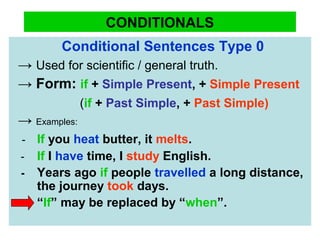
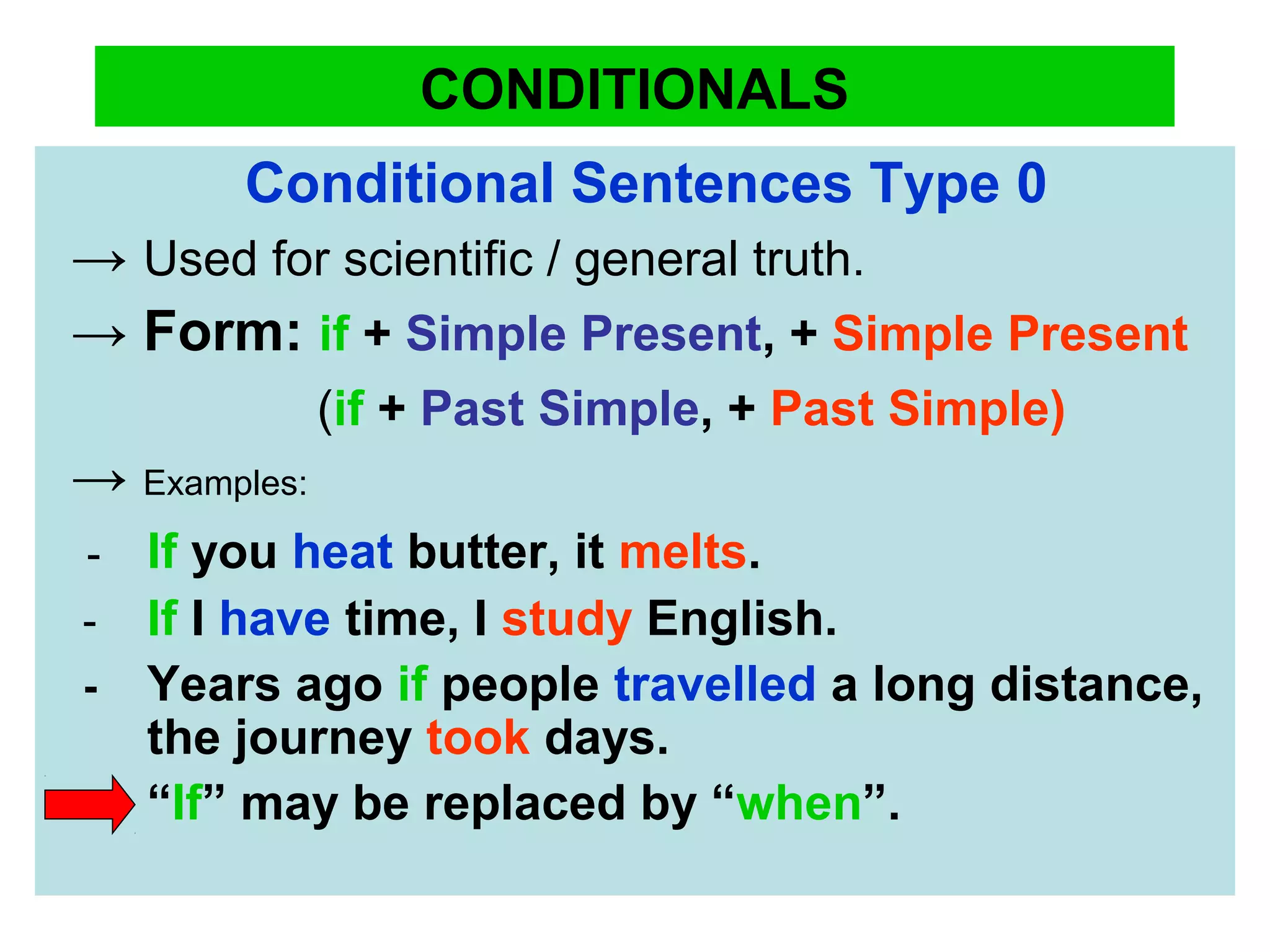
Conditional Sentences Type 0
→ Used for scientific / general truth.
→ Form: if + Simple Present, + Simple Present
(if + Past Simple, + Past Simple)
→ Examples:
- If you heat butter, it melts.
- If I have time, I study English.
- Years ago if people travelled a long distance,
the journey took days.
“If” may be replaced by “when”.
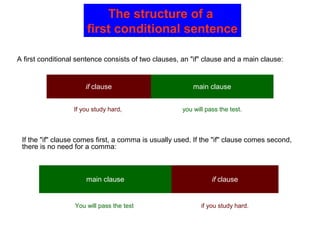
The structure of a
first conditional sentence
A first conditional sentence consists of two clauses, an "if" clause and a main clause:
if clause main clause
If you study hard, you will pass the test.
If the "if" clause comes first, a comma is usually used. If the "if" clause comes second,
there is no need for a comma:
main clause if clause
You will pass the test if you study hard.
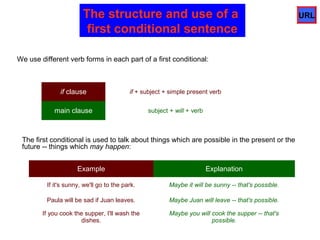
The structure and use of a
first conditional sentence
We use different verb forms in each part of a first conditional:
The first conditional is used to talk about things which are possible in the present or the
future -- things which may happen:
if clause if + subject + simple present verb
main clause subject + will + verb
Example Explanation
If it's sunny, we'll go to the park. Maybe it will be sunny -- that's possible.
Paula will be sad if Juan leaves. Maybe Juan will leave -- that's possible.
If you cook the supper, I'll wash the
dishes.
Maybe you will cook the supper -- that's
possible.
URL
CONDITIONALS
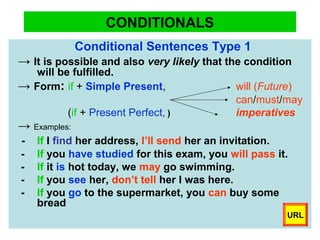
Conditional Sentences Type 1
→ It is possible and also very likely that the condition
will be fulfilled.
→ Form: if + Simple Present, will (Future)
can/must/may
(if + Present Perfect, ) imperatives
→ Examples:
- If I find her address, I’ll send her an invitation.
- If you have studied for this exam, you will pass it.
- If it is hot today, we may go swimming.
- If you see her, don’t tell her I was here.
- If you go to the supermarket, you can buy some
bread
URL
CONDITIONALS
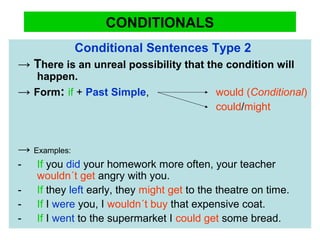
Conditional Sentences Type 2
→ There is an unreal possibility that the condition will
happen.
→ Form: if + Past Simple, would (Conditional)
could/might
→ Examples:
- If you did your homework more often, your teacher
wouldn´t get angry with you.
- If they left early, they might get to the theatre on time.
- If I were you, I wouldn´t buy that expensive coat.
- If I went to the supermarket I could get some bread.
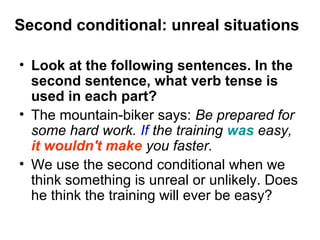
Second conditional: unreal situations
• Look at the following sentences. In the
second sentence, what verb tense is
used in each part?
• The mountain-biker says: Be prepared for
some hard work. If the training was easy,
it wouldn't make you faster.
• We use the second conditional when we
think something is unreal or unlikely. Does
he think the training will ever be easy?
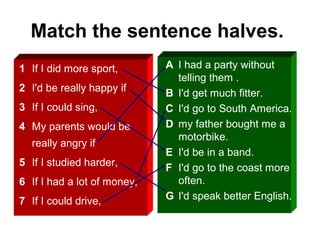
Match the sentence halves.
1 If I did more sport,
2 I'd be really happy if
3 If I could sing,
4 My parents would be
really angry if
5 If I studied harder,
6 If I had a lot of money,
7 If I could drive,
A I had a party without
telling them .
B I'd get much fitter.
C I'd go to South America.
D my father bought me a
motorbike.
E I'd be in a band.
F I'd go to the coast more
often.
G I'd speak better English.
CONDITIONALS
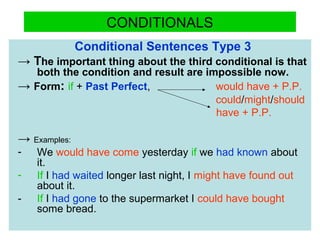
Conditional Sentences Type 3
→ The important thing about the third conditional is that
both the condition and result are impossible now.
→ Form: if + Past Perfect, would have + P.P.
could/might/should
have + P.P.
→ Examples:
- We would have come yesterday if we had known about
it.
- If I had waited longer last night, I might have found out
about it.
- If I had gone to the supermarket I could have bought
some bread.
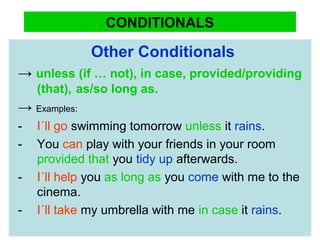
CONDITIONALS
Other Conditionals
→ unless (if … not), in case, provided/providing
(that), as/so long as.
→ Examples:
- I´ll go swimming tomorrow unless it rains.
- You can play with your friends in your room
provided that you tidy up afterwards.
- I´ll help you as long as you come with me to the
cinema.
- I´ll take my umbrella with me in case it rains.
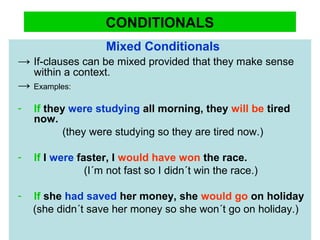
CONDITIONALS
Mixed Conditionals
→ If-clauses can be mixed provided that they make sense
within a context.
→ Examples:
- If they were studying all morning, they will be tired
now.
(they were studying so they are tired now.)
- If I were faster, I would have won the race.
(I´m not fast so I didn´t win the race.)
- If she had saved her money, she would go on holiday
(she didn´t save her money so she won´t go on holiday.)

Conditionals--grammar

  • 1.
    CONDITIONALS Conditional Sentences Type0 → Used for scientific / general truth. → Form: if + Simple Present, + Simple Present (if + Past Simple, + Past Simple) → Examples: - If you heat butter, it melts. - If I have time, I study English. - Years ago if people travelled a long distance, the journey took days. “If” may be replaced by “when”.
  • 2.
    The structure ofa first conditional sentence A first conditional sentence consists of two clauses, an "if" clause and a main clause: if clause main clause If you study hard, you will pass the test. If the "if" clause comes first, a comma is usually used. If the "if" clause comes second, there is no need for a comma: main clause if clause You will pass the test if you study hard.
  • 3.
    The structure anduse of a first conditional sentence We use different verb forms in each part of a first conditional: The first conditional is used to talk about things which are possible in the present or the future -- things which may happen: if clause if + subject + simple present verb main clause subject + will + verb Example Explanation If it's sunny, we'll go to the park. Maybe it will be sunny -- that's possible. Paula will be sad if Juan leaves. Maybe Juan will leave -- that's possible. If you cook the supper, I'll wash the dishes. Maybe you will cook the supper -- that's possible. URL
  • 4.
    CONDITIONALS Conditional Sentences Type1 → It is possible and also very likely that the condition will be fulfilled. → Form: if + Simple Present, will (Future) can/must/may (if + Present Perfect, ) imperatives → Examples: - If I find her address, I’ll send her an invitation. - If you have studied for this exam, you will pass it. - If it is hot today, we may go swimming. - If you see her, don’t tell her I was here. - If you go to the supermarket, you can buy some bread URL
  • 5.
    CONDITIONALS Conditional Sentences Type2 → There is an unreal possibility that the condition will happen. → Form: if + Past Simple, would (Conditional) could/might → Examples: - If you did your homework more often, your teacher wouldn´t get angry with you. - If they left early, they might get to the theatre on time. - If I were you, I wouldn´t buy that expensive coat. - If I went to the supermarket I could get some bread.
  • 6.
    Second conditional: unrealsituations • Look at the following sentences. In the second sentence, what verb tense is used in each part? • The mountain-biker says: Be prepared for some hard work. If the training was easy, it wouldn't make you faster. • We use the second conditional when we think something is unreal or unlikely. Does he think the training will ever be easy?
  • 7.
    Match the sentencehalves. 1 If I did more sport, 2 I'd be really happy if 3 If I could sing, 4 My parents would be really angry if 5 If I studied harder, 6 If I had a lot of money, 7 If I could drive, A I had a party without telling them . B I'd get much fitter. C I'd go to South America. D my father bought me a motorbike. E I'd be in a band. F I'd go to the coast more often. G I'd speak better English.
  • 8.
    CONDITIONALS Conditional Sentences Type3 → The important thing about the third conditional is that both the condition and result are impossible now. → Form: if + Past Perfect, would have + P.P. could/might/should have + P.P. → Examples: - We would have come yesterday if we had known about it. - If I had waited longer last night, I might have found out about it. - If I had gone to the supermarket I could have bought some bread.
  • 9.
    CONDITIONALS Other Conditionals → unless(if … not), in case, provided/providing (that), as/so long as. → Examples: - I´ll go swimming tomorrow unless it rains. - You can play with your friends in your room provided that you tidy up afterwards. - I´ll help you as long as you come with me to the cinema. - I´ll take my umbrella with me in case it rains.
  • 10.
    CONDITIONALS Mixed Conditionals → If-clausescan be mixed provided that they make sense within a context. → Examples: - If they were studying all morning, they will be tired now. (they were studying so they are tired now.) - If I were faster, I would have won the race. (I´m not fast so I didn´t win the race.) - If she had saved her money, she would go on holiday (she didn´t save her money so she won´t go on holiday.)

Editor's Notes

  • #5 http://www.englishgrammarsecrets.com/firstconditional/menu.php