CONDITIONAL
SENTENCES
Conditional sentences are complex
sentences that have two clauses: If-clause

(which gives the condition) and main clause
(which gives the result).
The condition

The result

Conditional sentences or Conditional clauses or IF-Clauses are
used to express that the action in the main clause can only take
place if a certain condition is fulfilled.
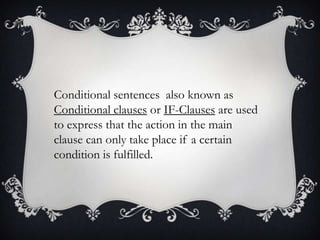
Conditional sentences also known as
Conditional clauses or IF-Clauses are used
to express that the action in the main
clause can only take place if a certain
condition is fulfilled.
There are more four (4) types of conditional sentences:
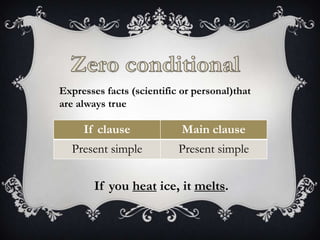
Expresses facts (scientific or personal)that
are always true

If clause

Main clause

Present simple

Present simple

If you heat ice, it melts.
Expresses prediction about the future that
will possibly happen.

If clause
Present simple

Main clause
will/won’t + V

If I find her address, I will send her an invitation.
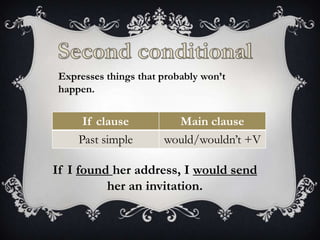
Expresses things that probably won’t
happen.

If clause
Past simple

Main clause
would/wouldn’t +V

If I found her address, I would send
her an invitation.
Expresses a condition that is impossible to
be fulfilled because it refers to the past

If clause
Past perfect

Main clause
Would have + past
participle

If I had found her address, I would
have sent her an invitation.
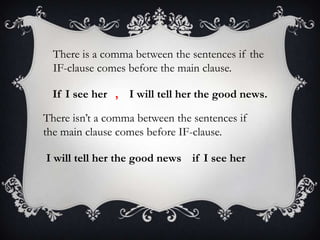
There is a comma between the sentences if the
IF-clause comes before the main clause.
If I see her , I will tell her the good news.

There isn’t a comma between the sentences if
the main clause comes before IF-clause.
I will tell her the good news if I see her
Thank you for your attention.


Teacher: Magdalena

Conditional sentences

  • 1.
  • 2.
    Conditional sentences arecomplex sentences that have two clauses: If-clause (which gives the condition) and main clause (which gives the result).
  • 3.
    The condition The result Conditionalsentences or Conditional clauses or IF-Clauses are used to express that the action in the main clause can only take place if a certain condition is fulfilled.
  • 4.
    Conditional sentences alsoknown as Conditional clauses or IF-Clauses are used to express that the action in the main clause can only take place if a certain condition is fulfilled.
  • 5.
    There are morefour (4) types of conditional sentences:
  • 6.
    Expresses facts (scientificor personal)that are always true If clause Main clause Present simple Present simple If you heat ice, it melts.
  • 7.
    Expresses prediction aboutthe future that will possibly happen. If clause Present simple Main clause will/won’t + V If I find her address, I will send her an invitation.
  • 8.
    Expresses things thatprobably won’t happen. If clause Past simple Main clause would/wouldn’t +V If I found her address, I would send her an invitation.
  • 9.
    Expresses a conditionthat is impossible to be fulfilled because it refers to the past If clause Past perfect Main clause Would have + past participle If I had found her address, I would have sent her an invitation.
  • 10.
    There is acomma between the sentences if the IF-clause comes before the main clause. If I see her , I will tell her the good news. There isn’t a comma between the sentences if the main clause comes before IF-clause. I will tell her the good news if I see her
  • 11.
    Thank you foryour attention.  Teacher: Magdalena