UNIT 3.8 SLOPES OOFF PPAARRAALLLLEELL AANNDD 
PPEERRPPEENNDDIICCUULLAARR LLIINNEESS
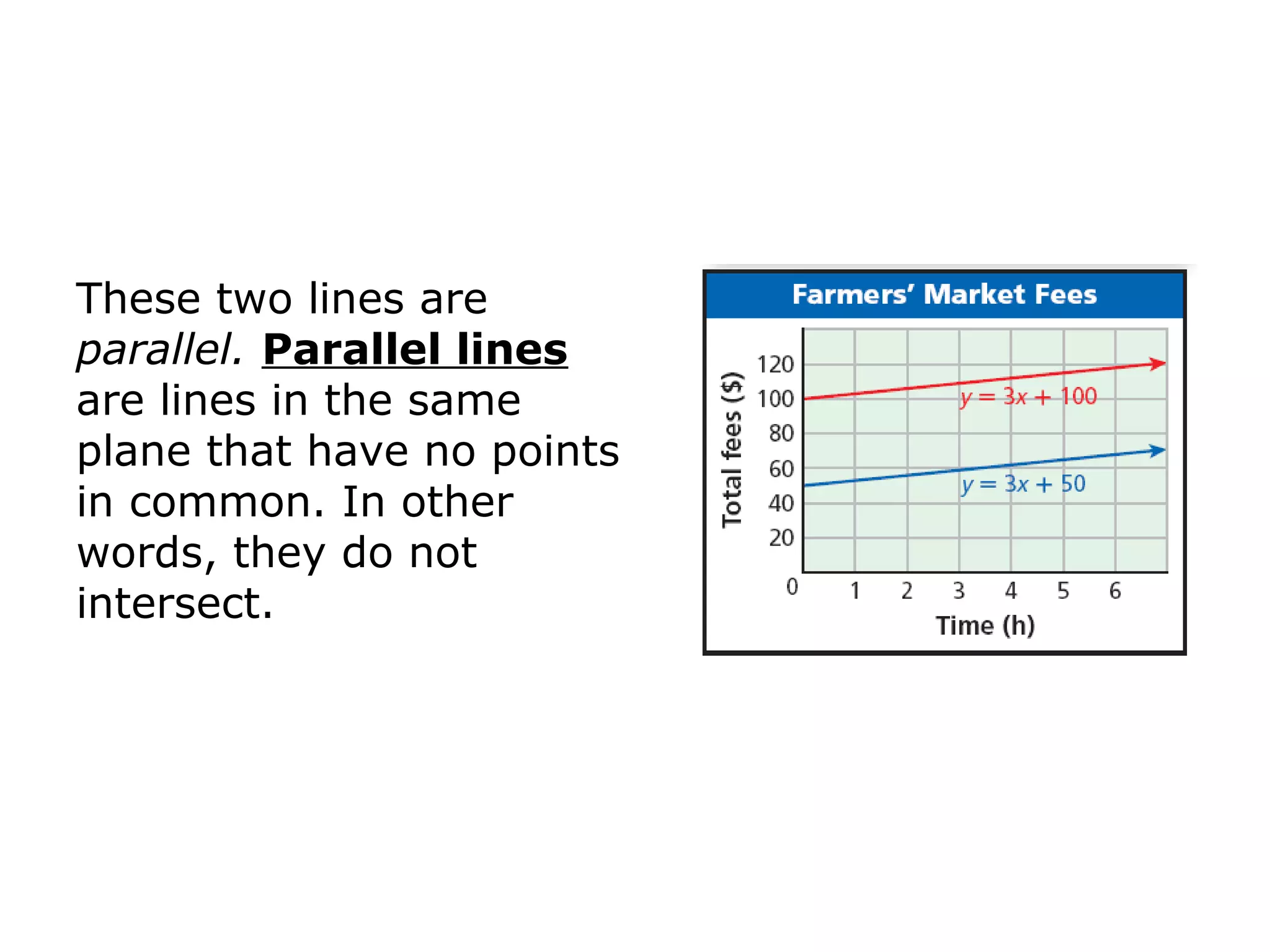
To sell at a particular farmers’ market for a year, 
there is a $100 membership fee. Then you pay $3 
for each hour that you sell at the market. However, 
if you were a member the previous year, the 
membership fee is reduced to $50. 
• The red line shows the 
total cost if you are a 
new member. 
• The blue line shows the 
total cost if you are a 
returning member.
These two lines are 
parallel. Parallel lines 
are lines in the same 
plane that have no points 
in common. In other 
words, they do not 
intersect.
Additional Example 1A: Identifying Parallel Lines 
Identify which lines are parallel. 
The lines described by 
and both have slope . 
These lines are parallel. The lines 
described by y = x and y = x + 1 
both have slope 1. These lines 
are parallel.
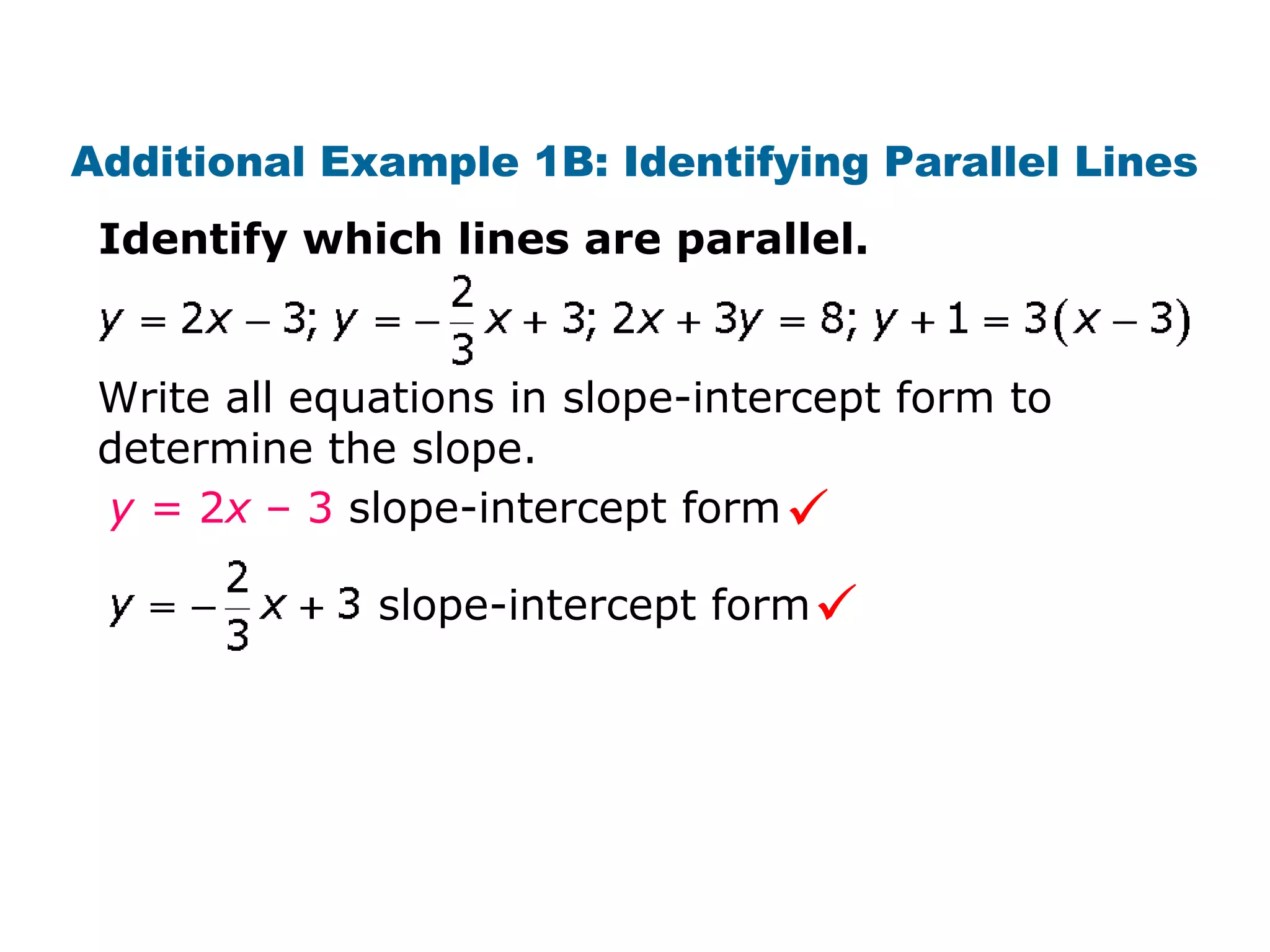
Additional Example 1B: Identifying Parallel Lines 
Identify which lines are parallel. 
Write all equations in slope-intercept form to 
determine the slope. 
y = 2x – 3 slope-intercept form 
slope-intercept form
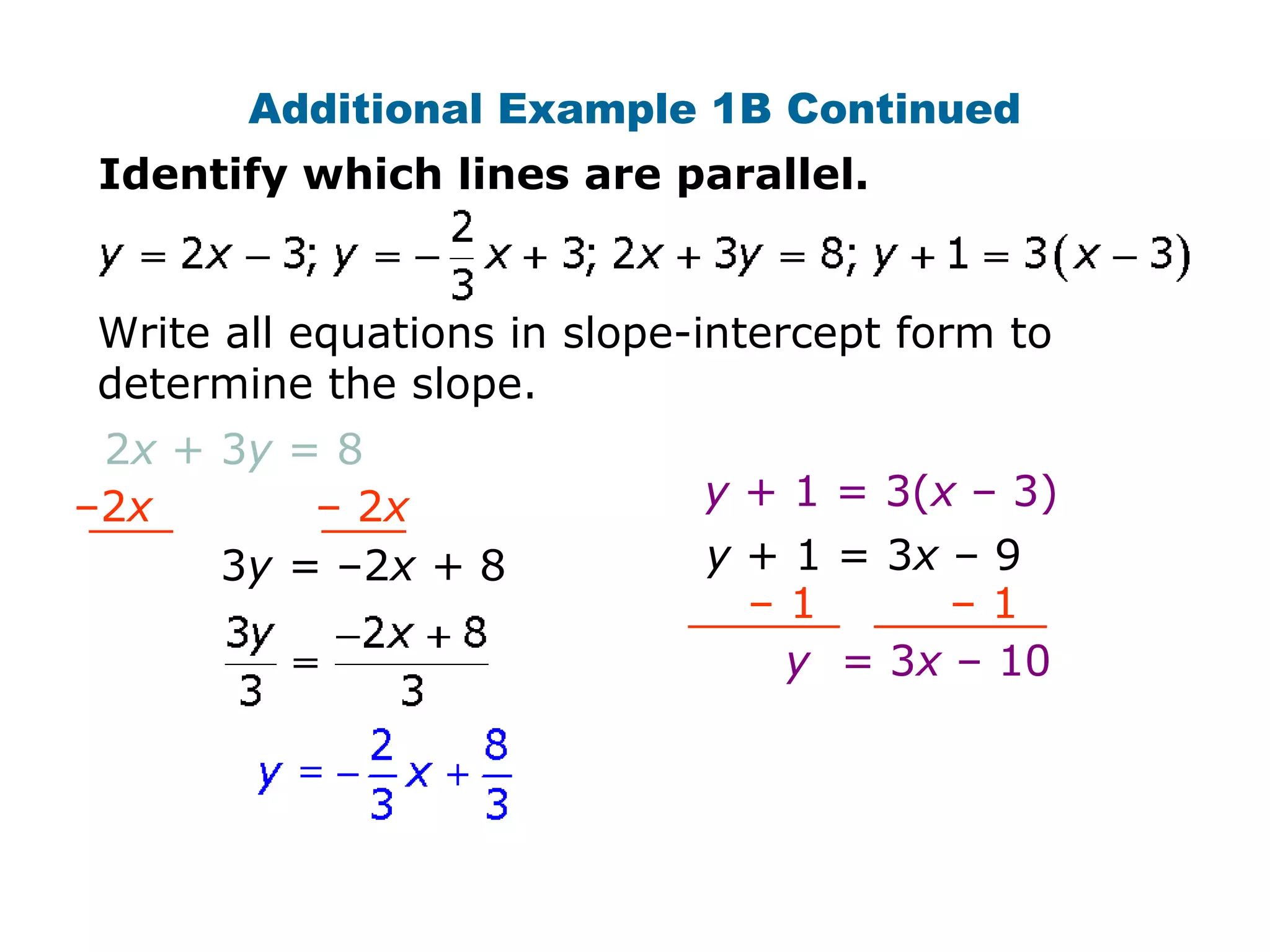
Additional Example 1B Continued 
Identify which lines are parallel. 
Write all equations in slope-intercept form to 
determine the slope. 
2x + 3y = 8 
–2x – 2x 
3y = –2x + 8 
y + 1 = 3(x – 3) 
y + 1 = 3x – 9 
– 1 – 1 
y = 3x – 10
Additional Example 1B Continued 
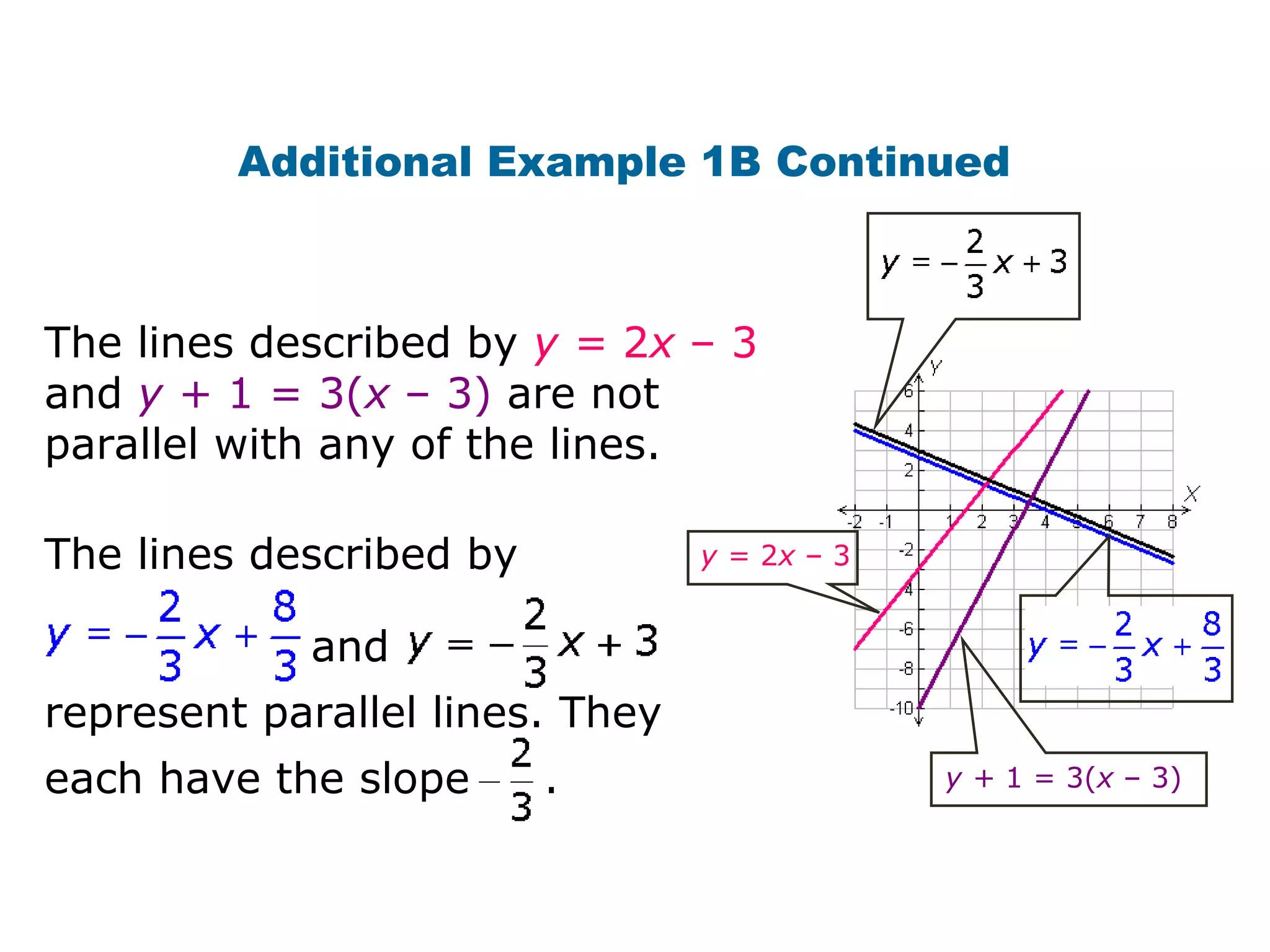
The lines described by y = 2x – 3 
and y + 1 = 3(x – 3) are not 
parallel with any of the lines. 
y = 2x – 3 
y + 1 = 3(x – 3) 
The lines described by 
and 
represent parallel lines. They 
each have the slope .
Check It Out! Example 1a 
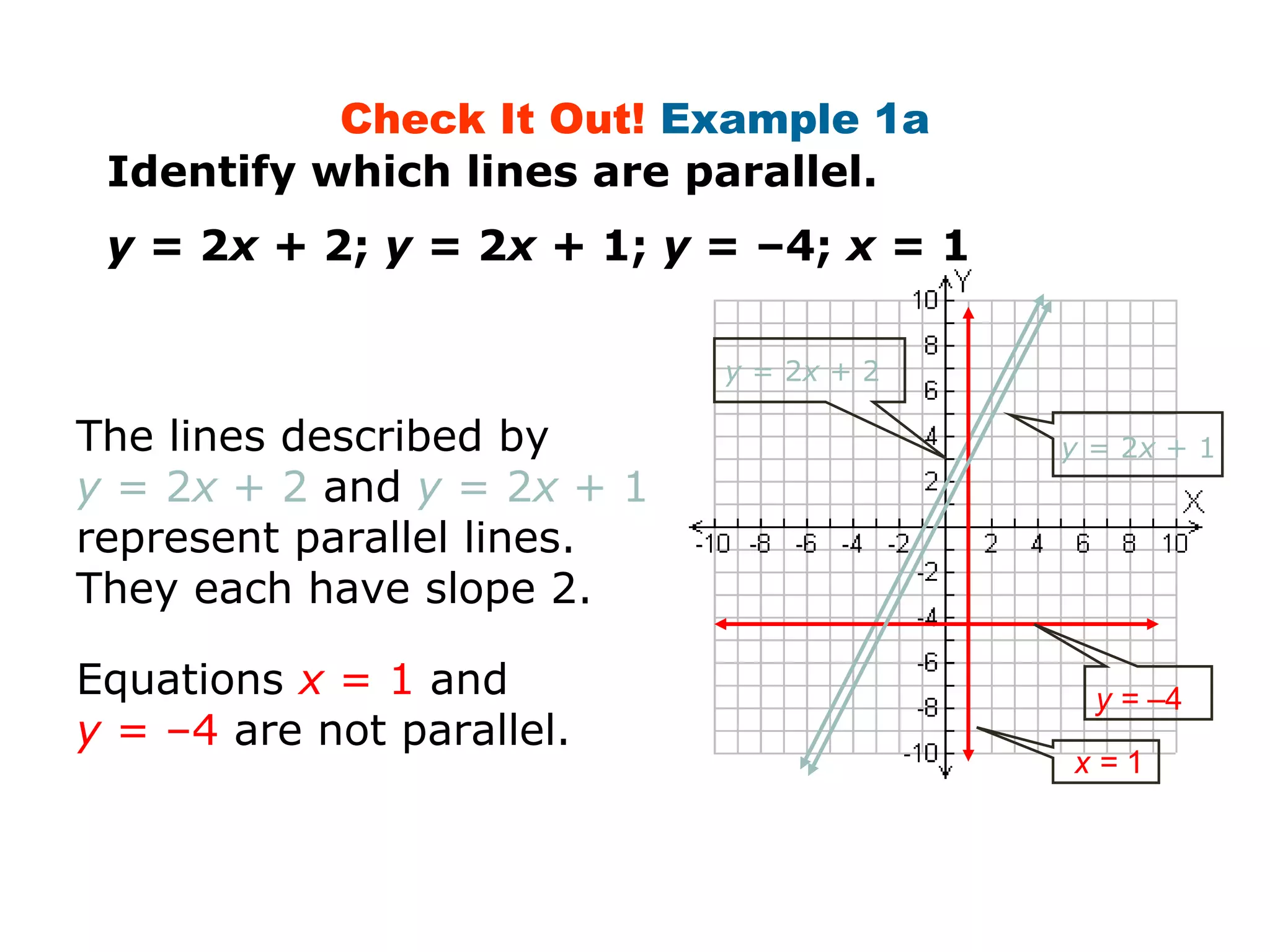
The lines described by 
y = 2x + 2 and y = 2x + 1 
represent parallel lines. 
They each have slope 2. 
Equations x = 1 and 
y = –4 are not parallel. 
y = 2x + 1 
y = 2x + 2 
y = –4 
x = 1 
Identify which lines are parallel. 
y = 2x + 2; y = 2x + 1; y = –4; x = 1
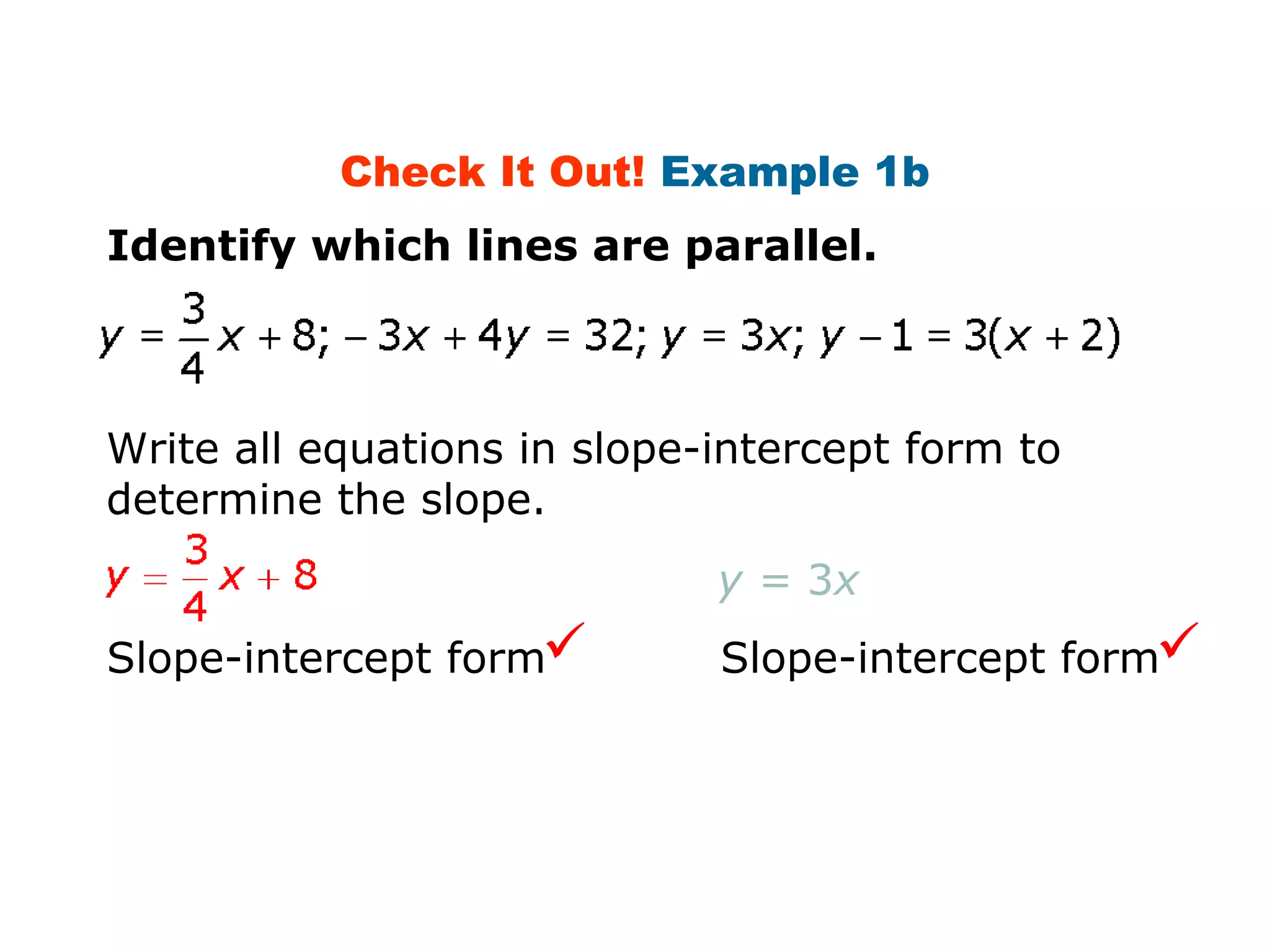
Check It Out! Example 1b 
Identify which lines are parallel. 
Write all equations in slope-intercept form to 
determine the slope. 
Slope-intercept form 
y = 3x 
Slope-intercept form
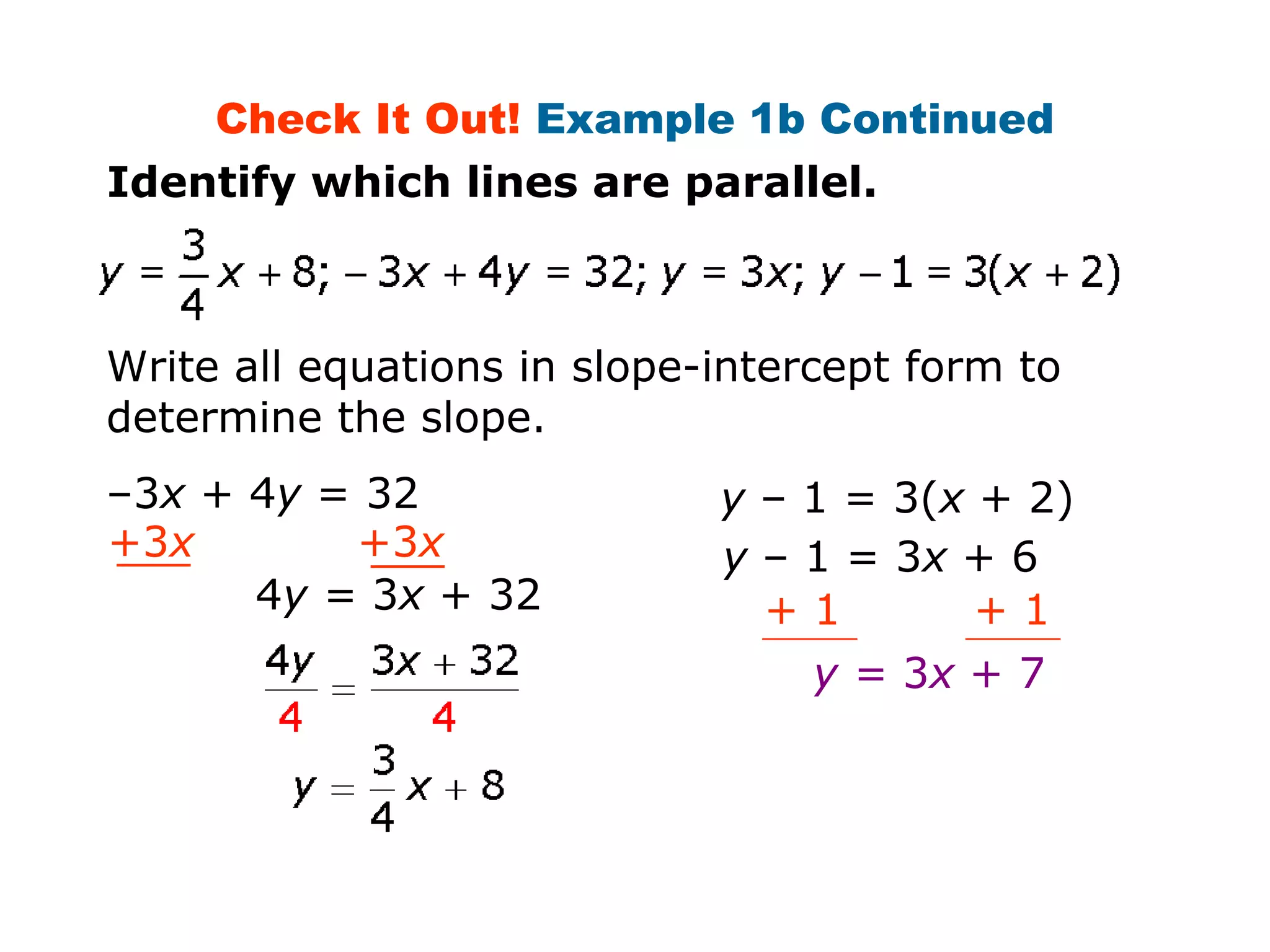
Check It Out! Example 1b Continued 
Identify which lines are parallel. 
Write all equations in slope-intercept form to 
determine the slope. 
–3x + 4y = 32 
+3x +3x 
4y = 3x + 32 
y – 1 = 3(x + 2) 
y – 1 = 3x + 6 
+ 1 + 1 
y = 3x + 7
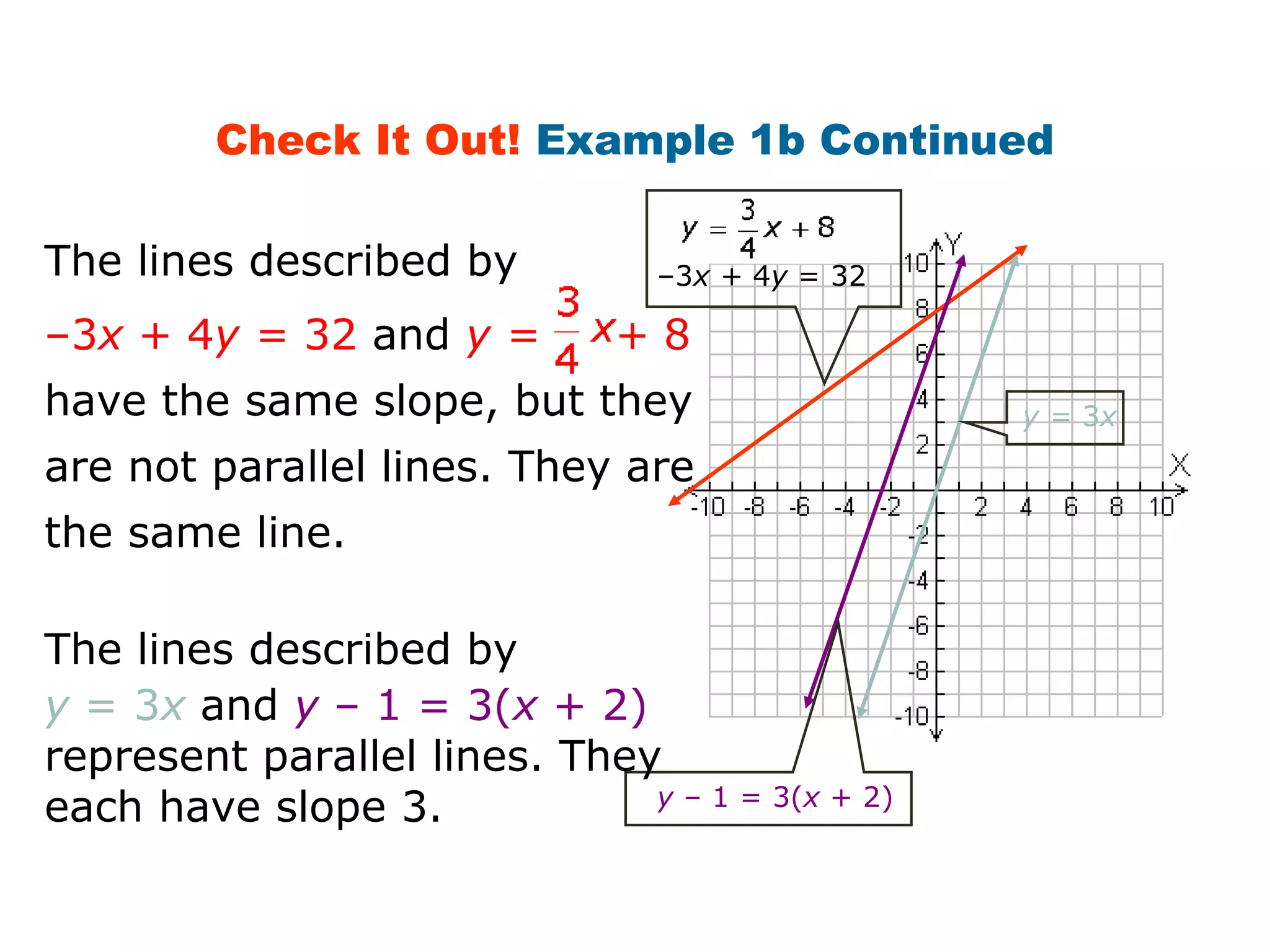
Check It Out! Example 1b Continued 
The lines described by 
–3x + 4y = 32 and y = + 8 
have the same slope, but they 
are not parallel lines. They are 
the same line. 
–3x + 4y = 32 
y – 1 = 3(x + 2) 
y = 3x 
The lines described by 
y = 3x and y – 1 = 3(x + 2) 
represent parallel lines. They 
each have slope 3.
Remember! 
In a parallelogram, opposite sides are parallel.
Additional Example 2: Geometry Application 
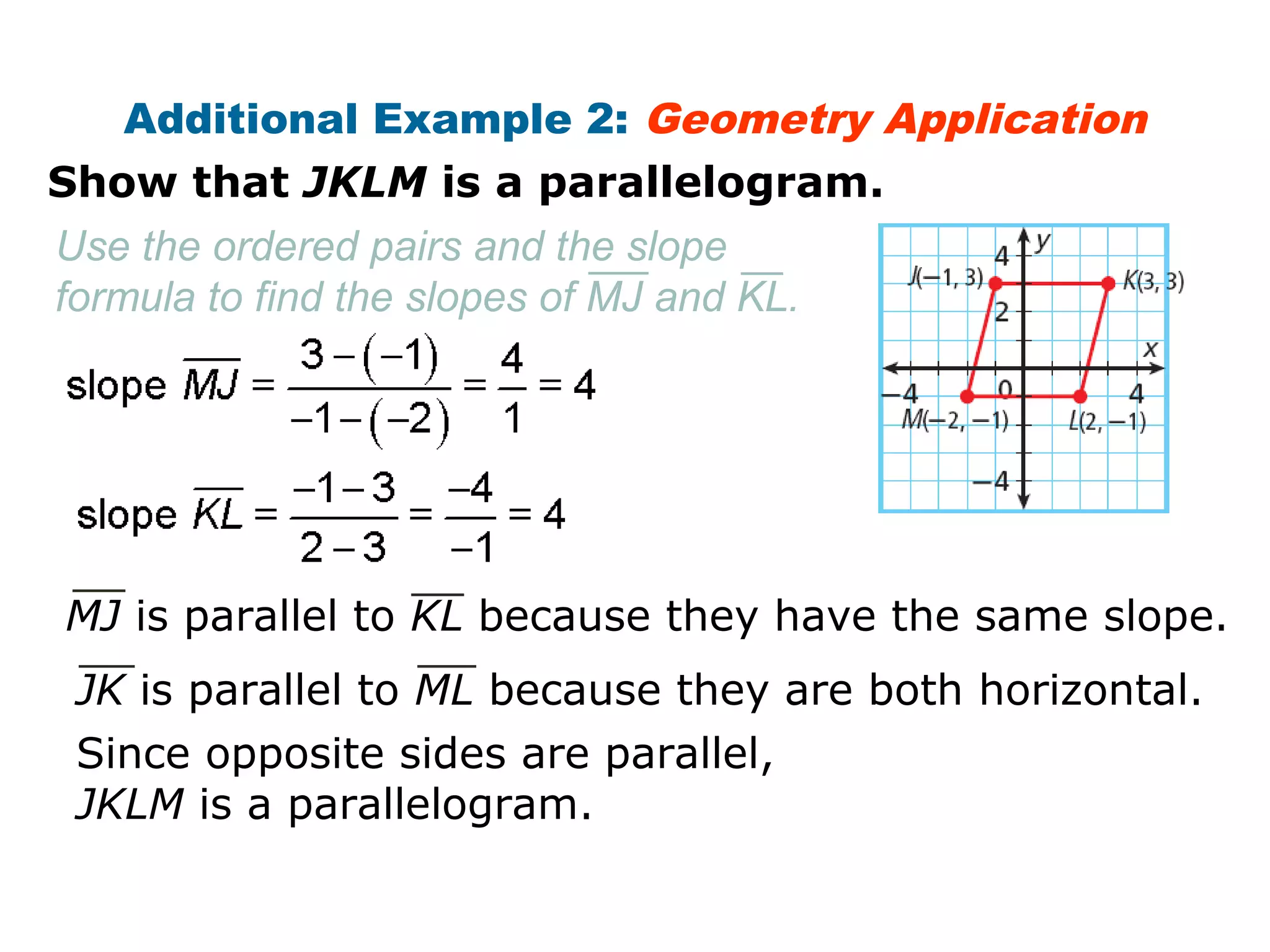
Show that JKLM is a parallelogram. 
Use the ordered pairs and the slope 
formula to find the slopes of MJ and KL. 
MJ is parallel to KL because they have the same slope. 
JK is parallel to ML because they are both horizontal. 
Since opposite sides are parallel, 
JKLM is a parallelogram.
Check It Out! Example 2 
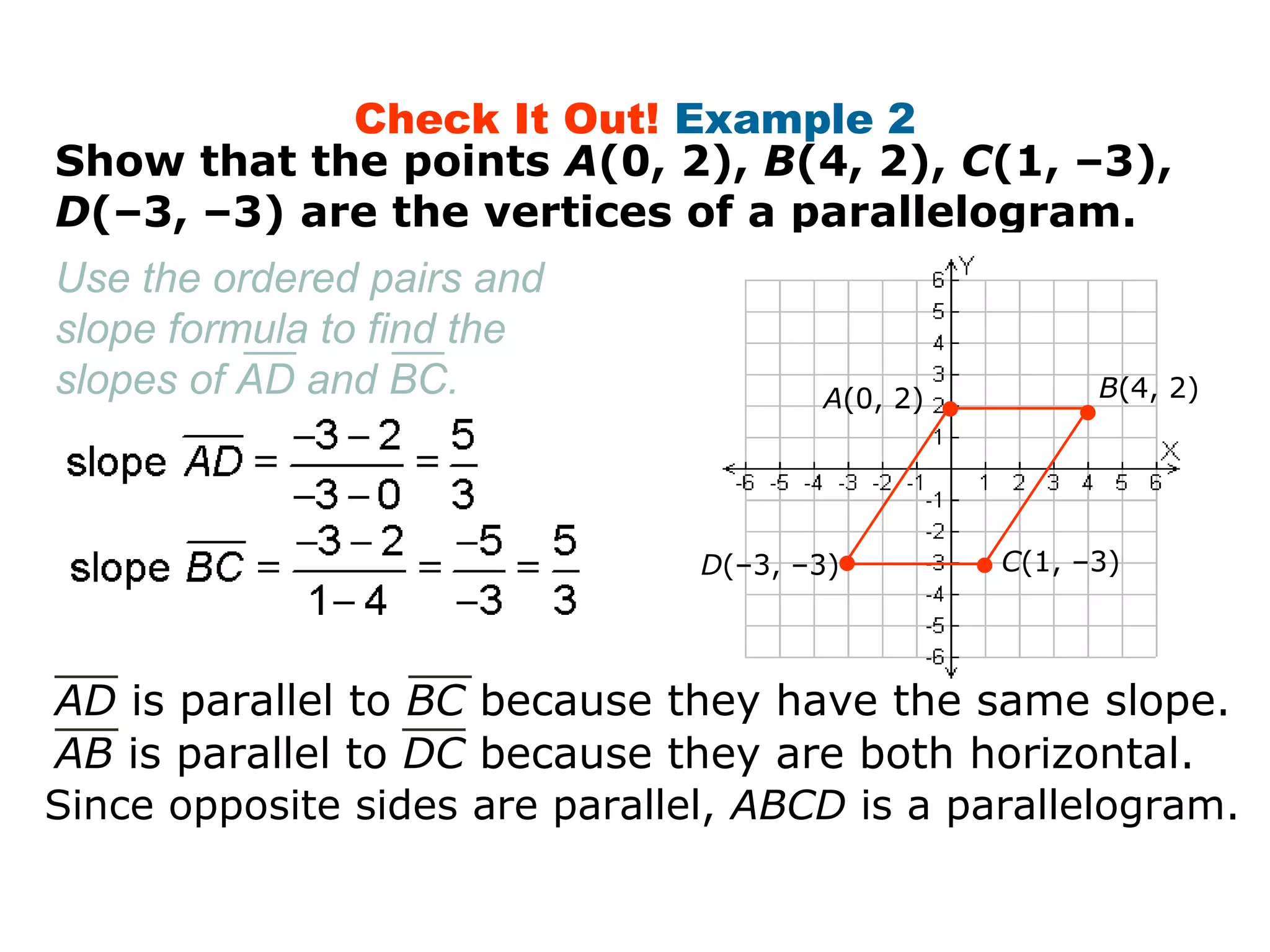
Show that the points A(0, 2), B(4, 2), C(1, –3), 
D(–3, –3) are the vertices of a parallelogram. 
A(0, 2) • •B(4, 2) 
• • 
D(–3, –3) C(1, –3) 
Use the ordered pairs and 
slope formula to find the 
slopes of AD and BC. 
AD is parallel to BC because they have the same slope. 
AB is parallel to DC because they are both horizontal. 
Since opposite sides are parallel, ABCD is a parallelogram.
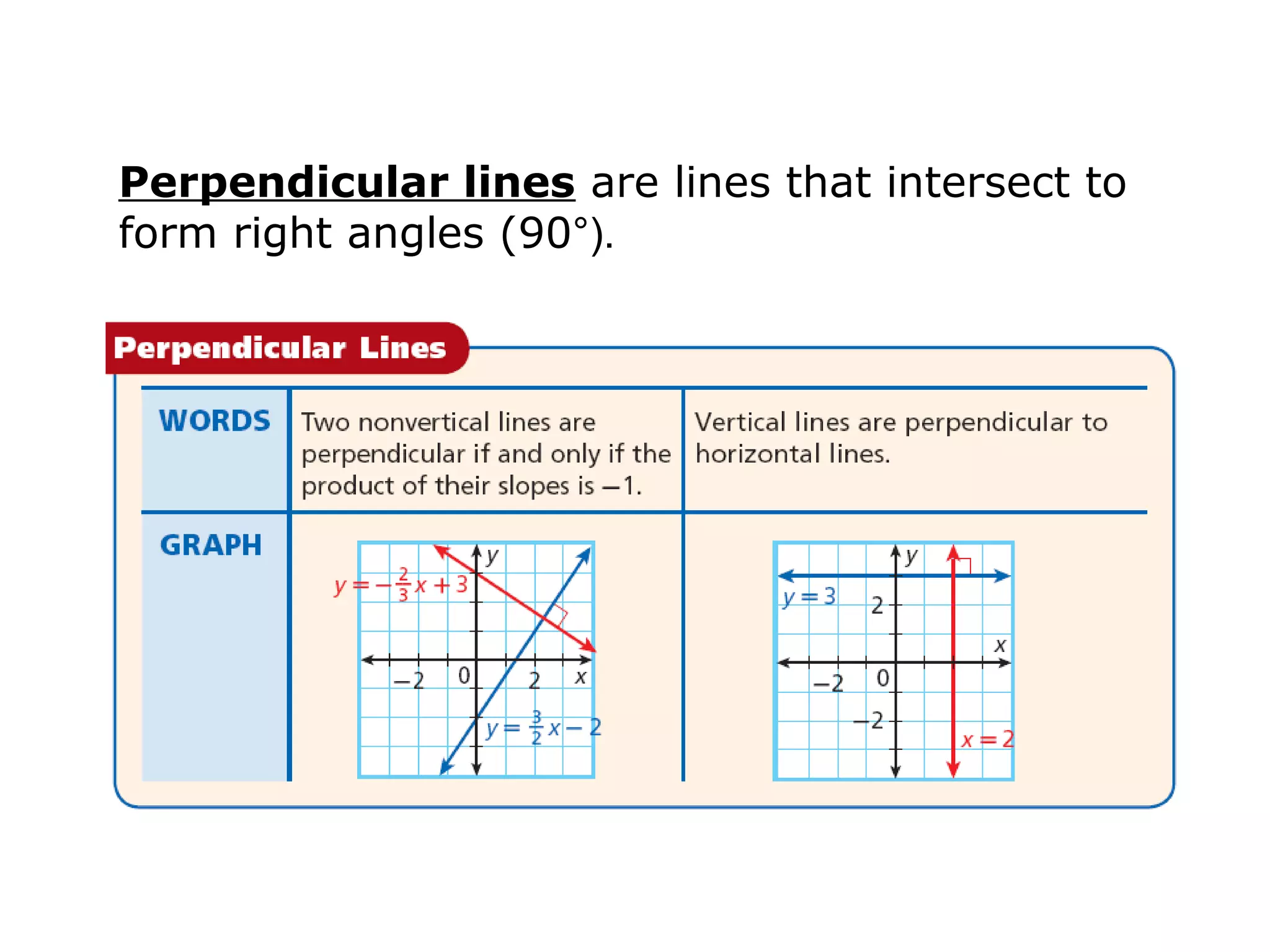
Perpendicular lines are lines that intersect to 
form right angles (90°).
Additional Example 3: Identifying Perpendicular Lines 
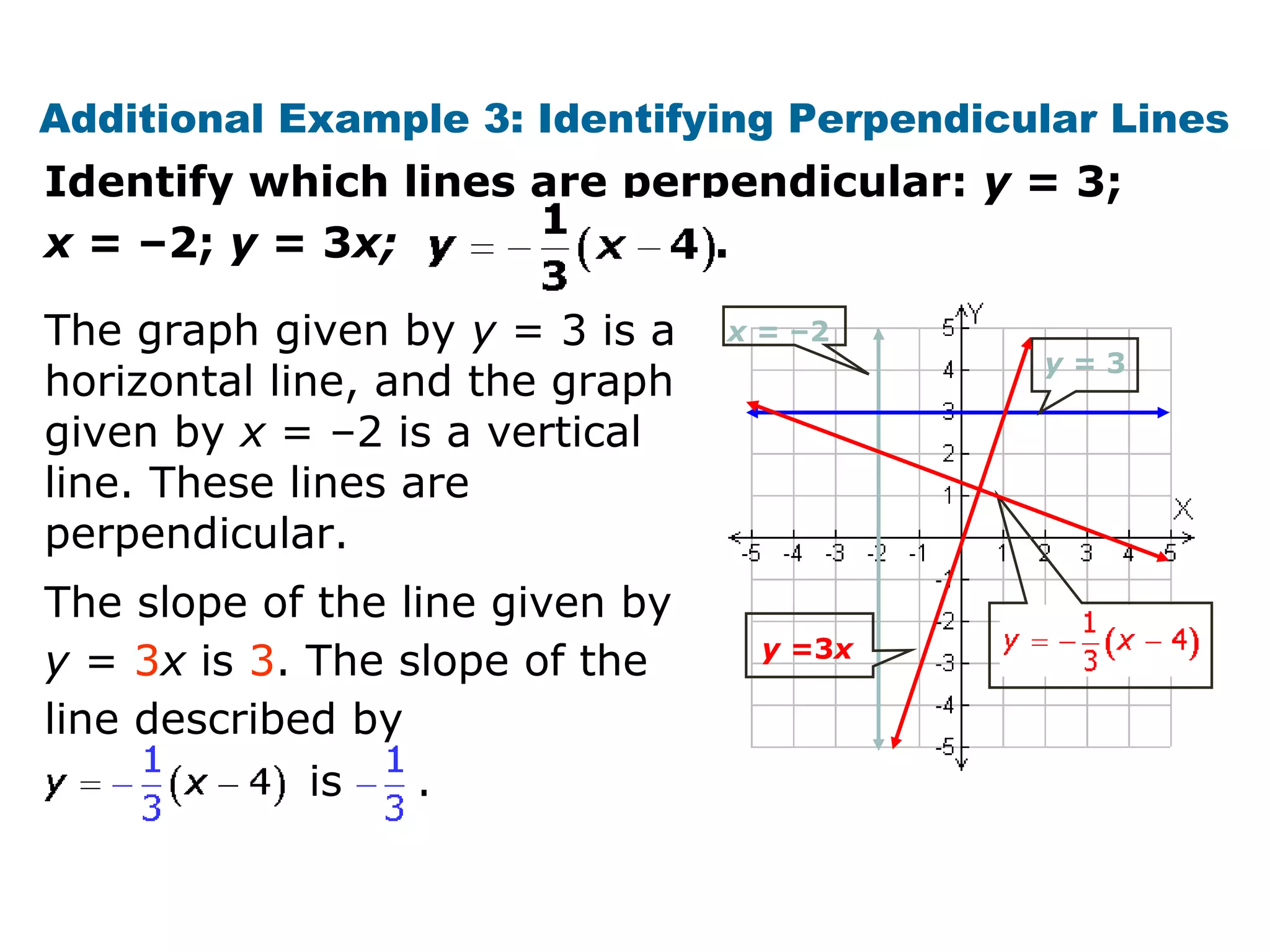
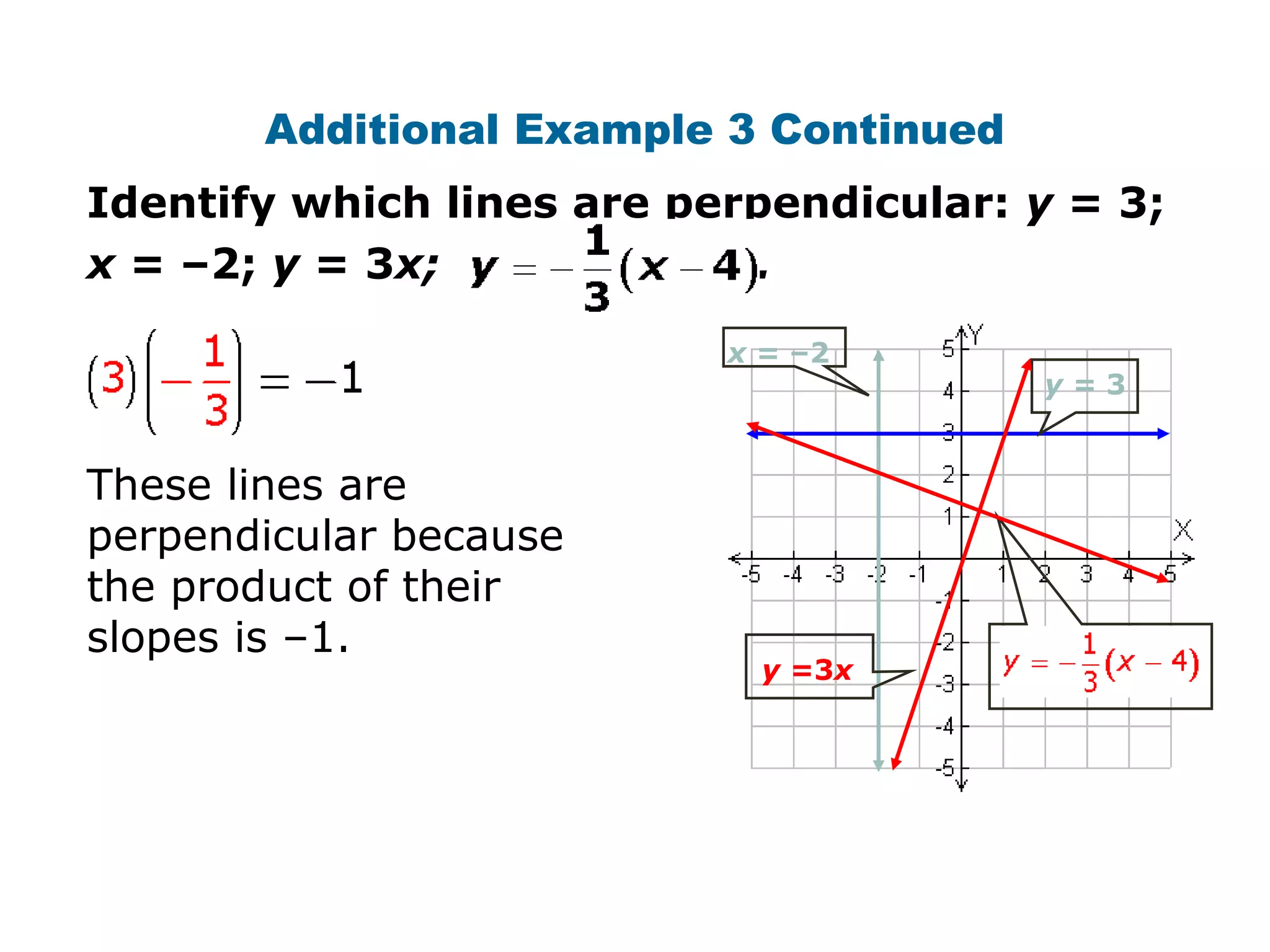
Identify which lines are perpendicular: y = 3; 
x = –2; y = 3x; . 
The graph given by y = 3 is a 
horizontal line, and the graph 
given by x = –2 is a vertical 
line. These lines are 
perpendicular. 
y = 3 
x = –2 
y =3x 
The slope of the line given by 
y = 3x is 3. The slope of the 
line described by 
is .
Additional Example 3 Continued 
Identify which lines are perpendicular: y = 3; 
x = –2; y = 3x; . 
y = 3 
x = –2 
y =3x 
These lines are 
perpendicular because 
the product of their 
slopes is –1.
Check It Out! Example 3 
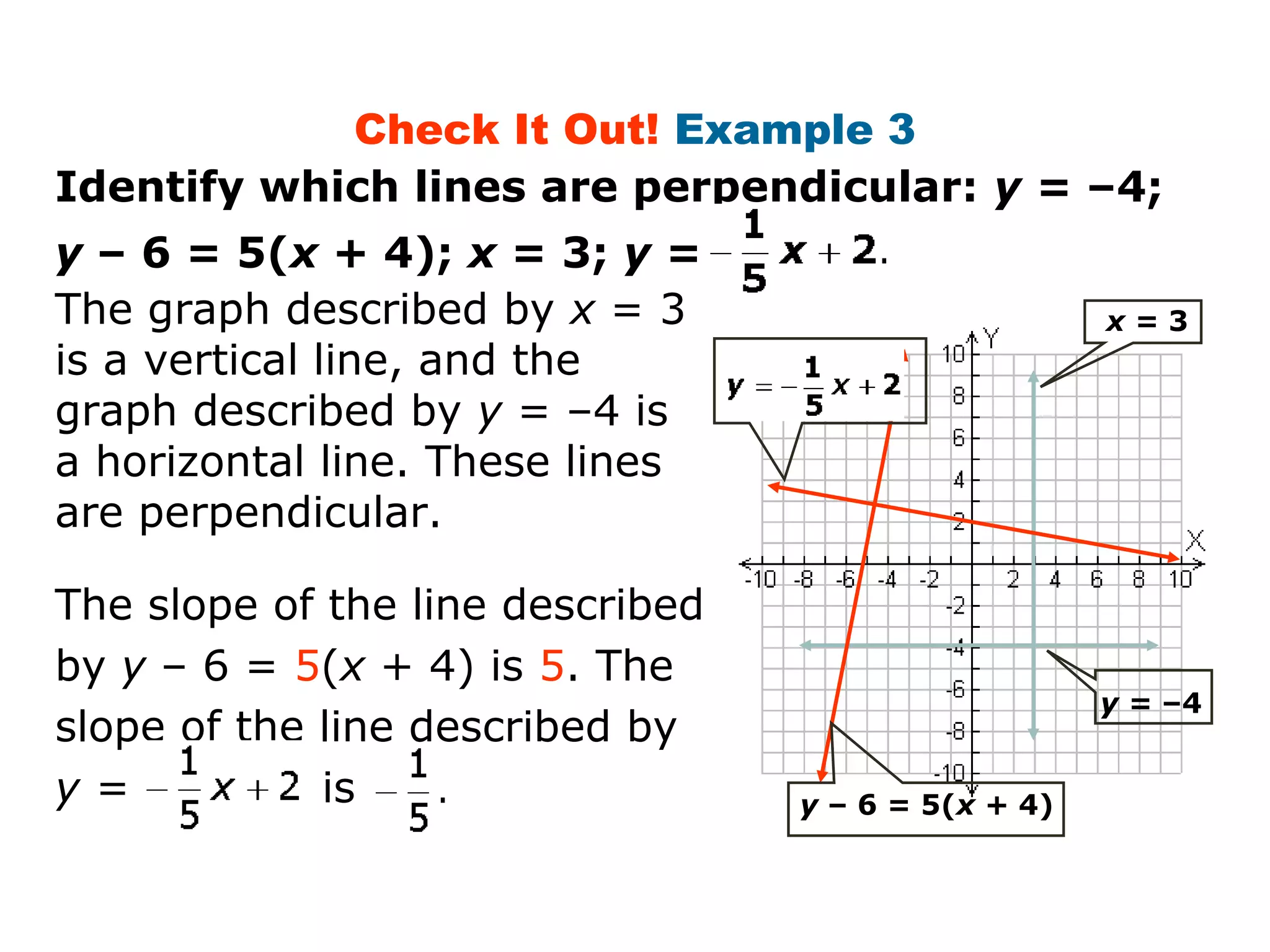
Identify which lines are perpendicular: y = –4; 
y – 6 = 5(x + 4); x = 3; y = 
The graph described by x = 3 
is a vertical line, and the 
graph described by y = –4 is 
a horizontal line. These lines 
are perpendicular. 
The slope of the line described 
by y – 6 = 5(x + 4) is 5. The 
slope of the line described by 
y = is 
x = 3 
y = –4 
y – 6 = 5(x + 4)
Check It Out! Example 3 Continued 
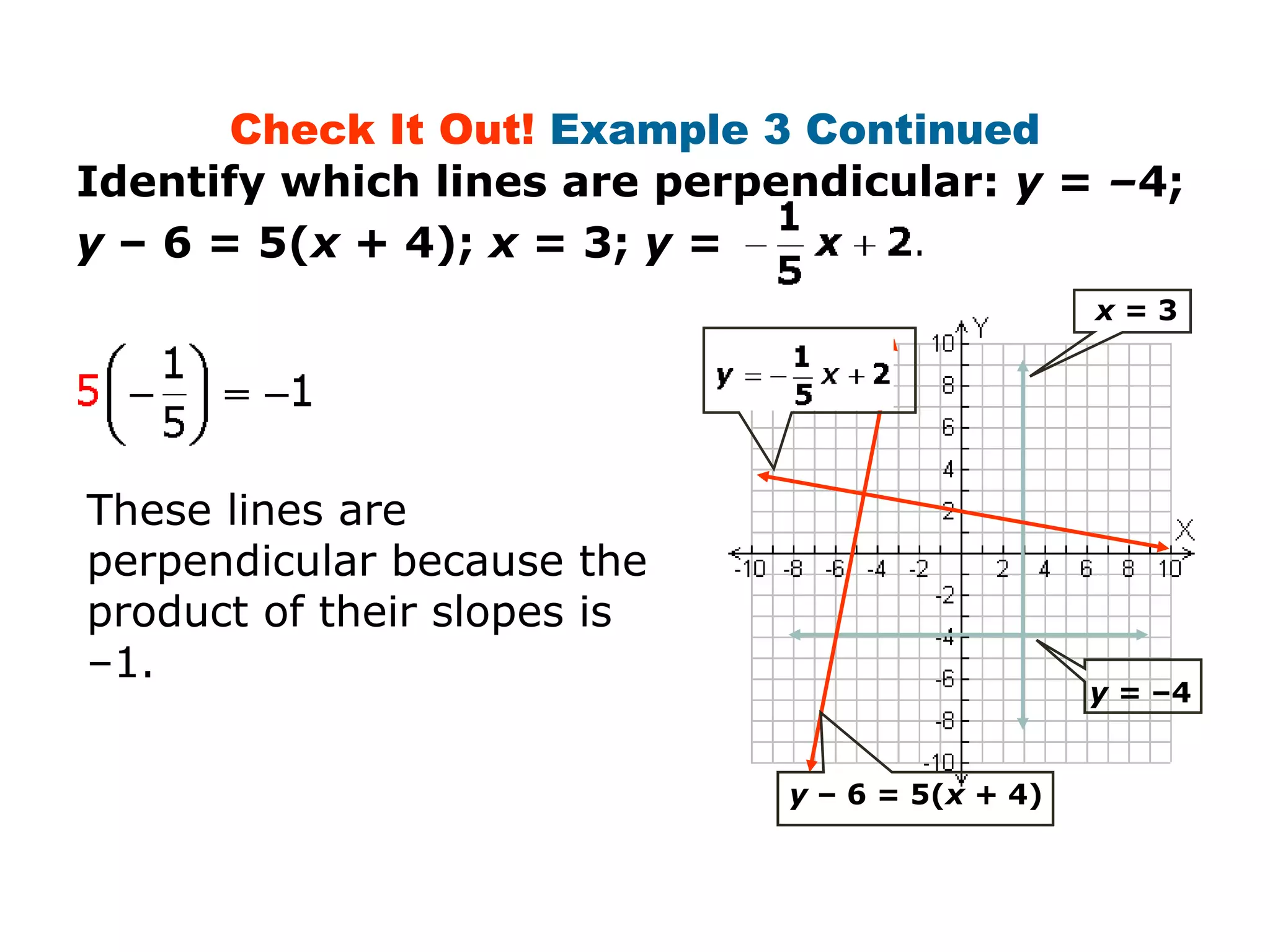
Identify which lines are perpendicular: y = –4; 
y – 6 = 5(x + 4); x = 3; y = 
These lines are 
perpendicular because the 
product of their slopes is 
–1. 
x = 3 
y = –4 
y – 6 = 5(x + 4)
Additional Example 4: Geometry Application 
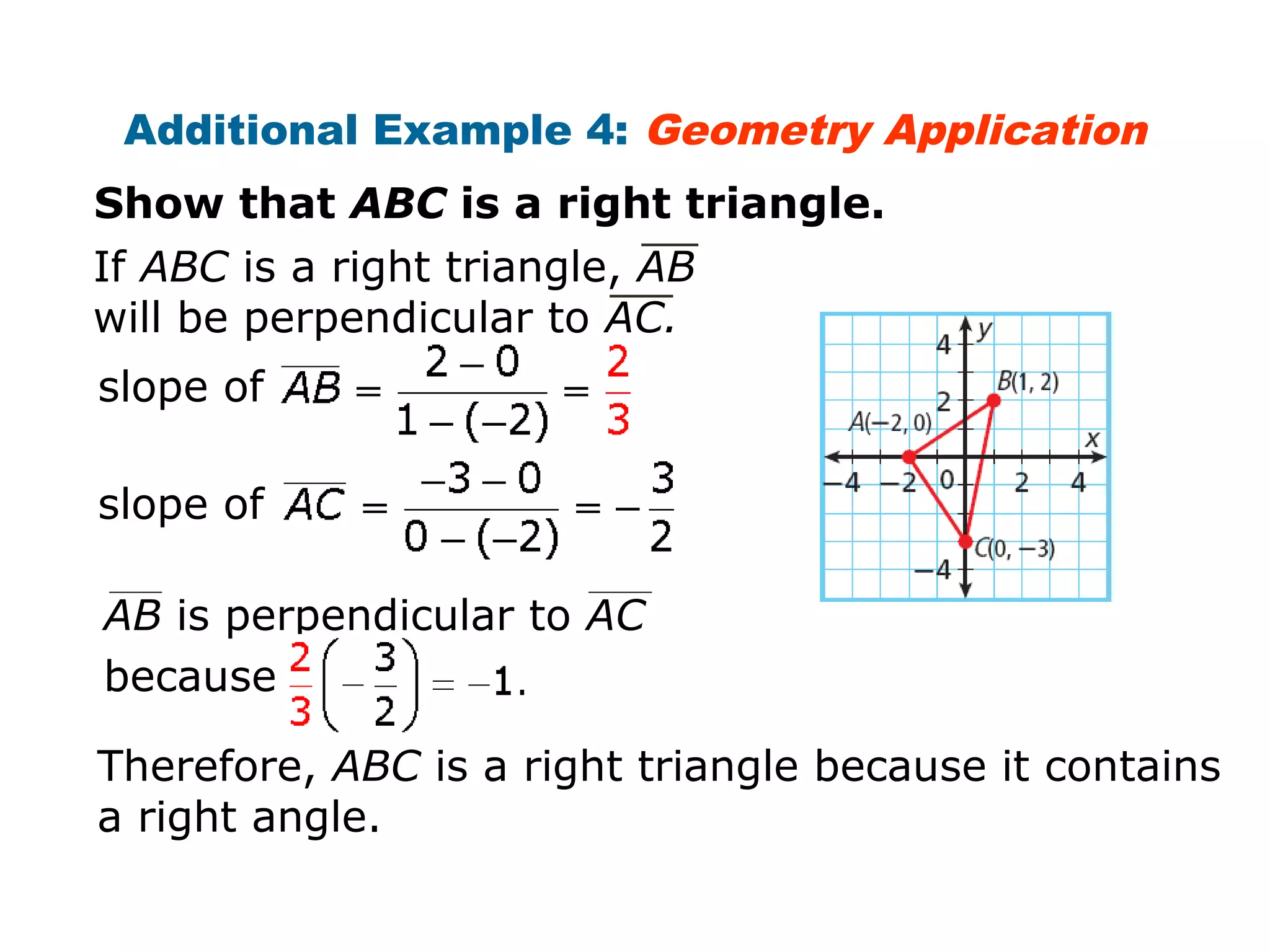
Show that ABC is a right triangle. 
If ABC is a right triangle, AB 
will be perpendicular to AC. 
slope of 
slope of 
AB is perpendicular to AC 
because 
Therefore, ABC is a right triangle because it contains 
a right angle.
Check It Out! Example 4 
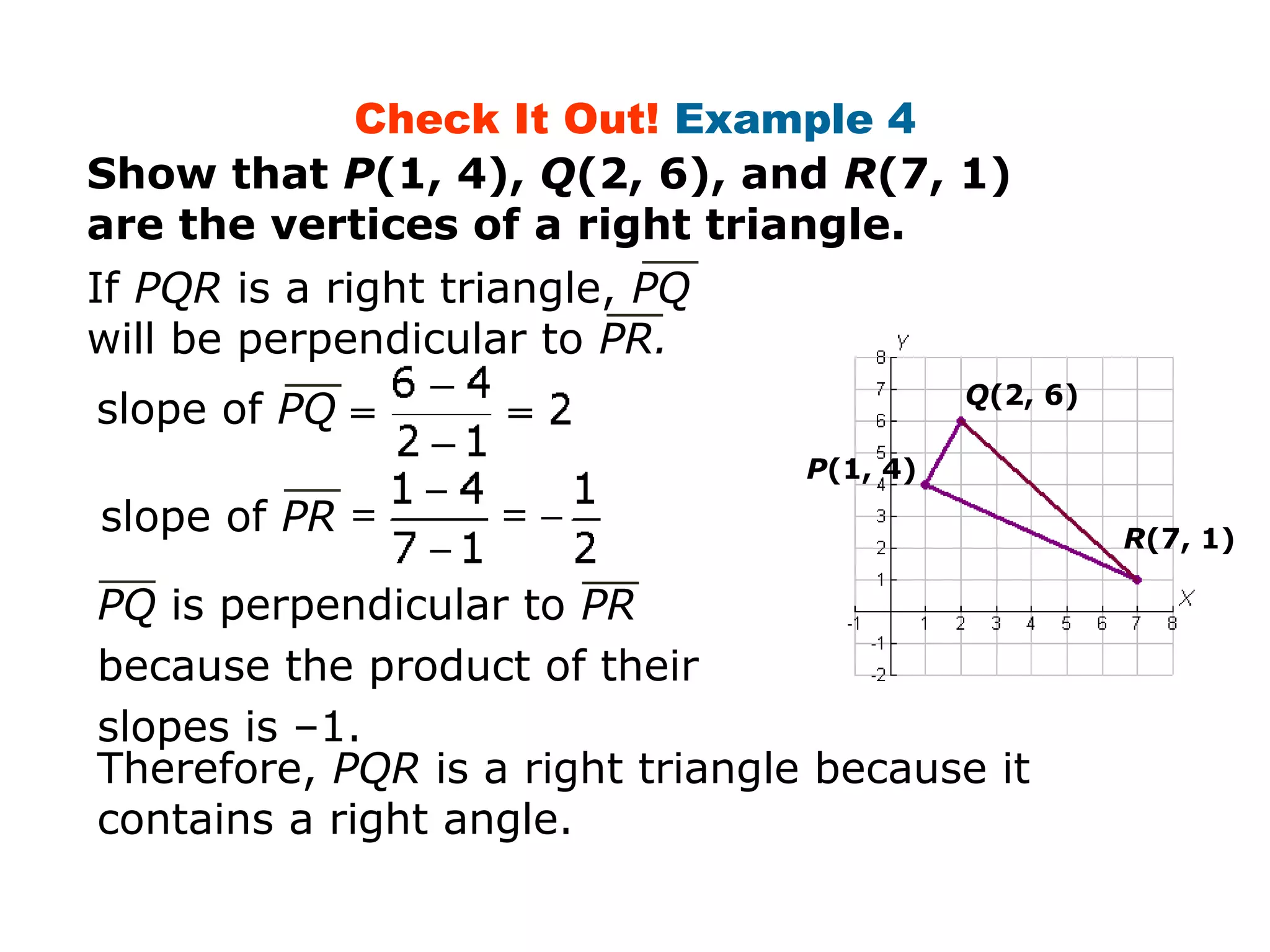
Show that P(1, 4), Q(2, 6), and R(7, 1) 
are the vertices of a right triangle. 
If PQR is a right triangle, PQ 
will be perpendicular to PR. 
slope of PQ 
R(7, 1) slope of PR 
PQ is perpendicular to PR 
because the product of their 
slopes is –1. 
P(1, 4) 
Q(2, 6) 
Therefore, PQR is a right triangle because it 
contains a right angle.
Additional Example 5A: Writing Equations of 
Parallel and Perpendicular Lines 
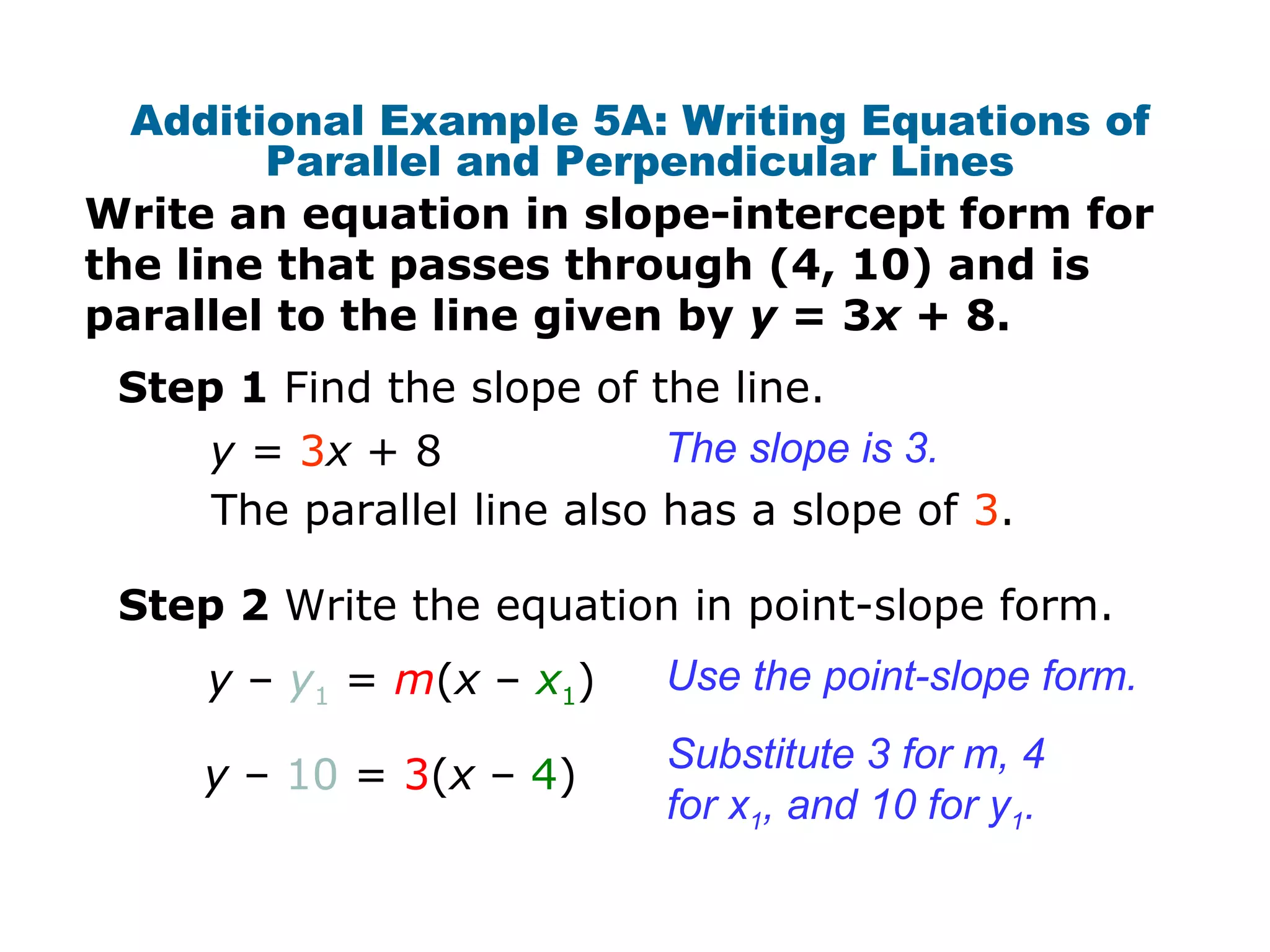
Write an equation in slope-intercept form for 
the line that passes through (4, 10) and is 
parallel to the line given by y = 3x + 8. 
Step 1 Find the slope of the line. 
y = 3x + 8 The slope is 3. 
The parallel line also has a slope of 3. 
Step 2 Write the equation in point-slope form. 
Use y – y the point-slope form. 1 = m(x – x1) 
y – 10 = 3(x – 4) Substitute 3 for m, 4 
for x1, and 10 for y1.
Additional Example 5A Continued 
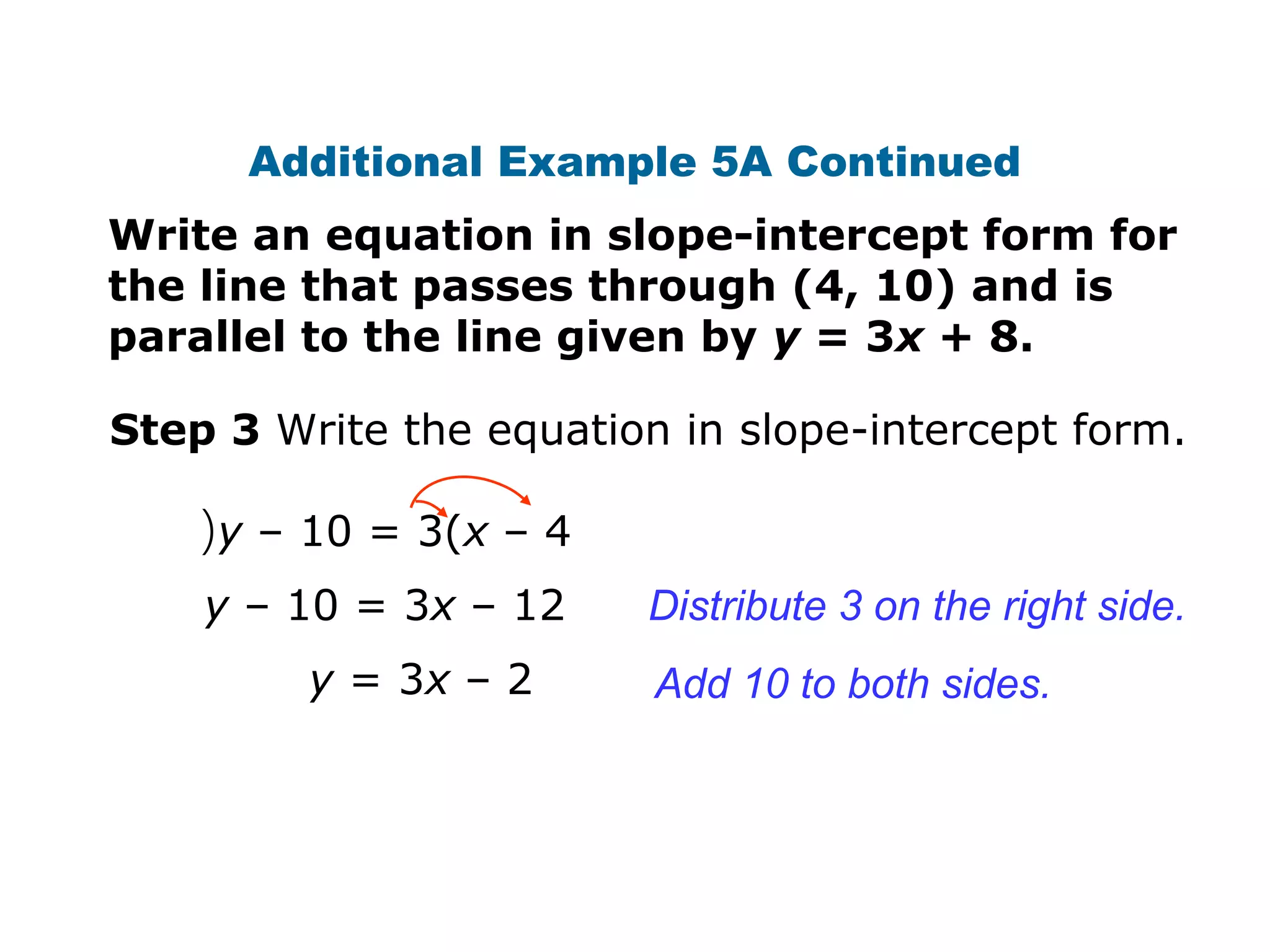
Write an equation in slope-intercept form for 
the line that passes through (4, 10) and is 
parallel to the line given by y = 3x + 8. 
Step 3 Write the equation in slope-intercept form. 
(y – 10 = 3(x – 4 
y – 10 = 3x – 12 
y = 3x – 2 
Distribute 3 on the right side. 
Add 10 to both sides.
Additional Example 5B: Writing Equations of 
Parallel and Perpendicular Lines 
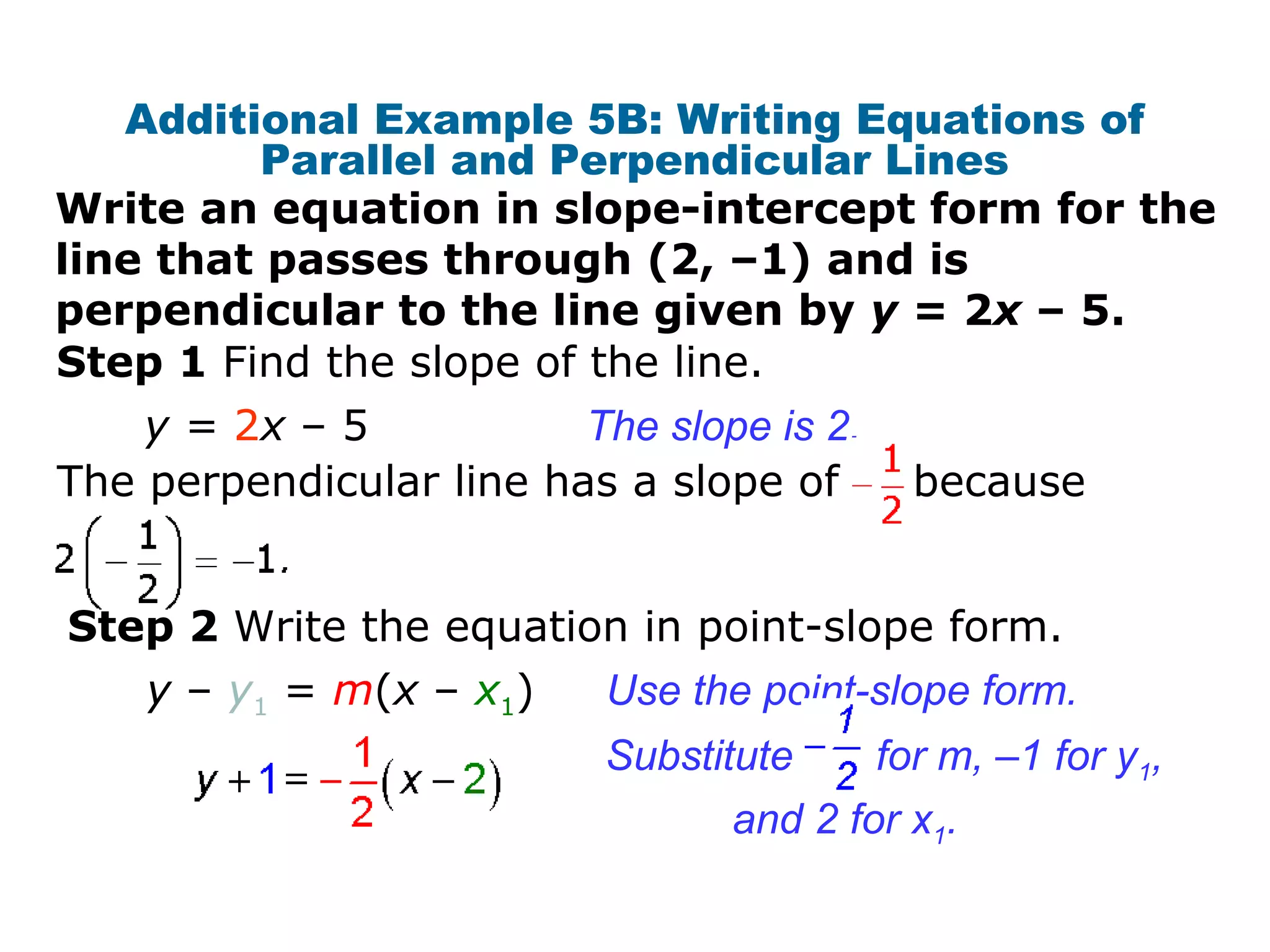
Write an equation in slope-intercept form for the 
line that passes through (2, –1) and is 
perpendicular to the line given by y = 2x – 5. 
Step 1 Find the slope of the line. 
y = 2x – 5 The slope is 2. 
The perpendicular line has a slope of because 
Step 2 Write the equation in point-slope form. 
Use y – y the point-slope form. 1 = m(x – x1) 
Substitute for m, –1 for y1, 
and 2 for x1.
Additional Example 5B Continued 
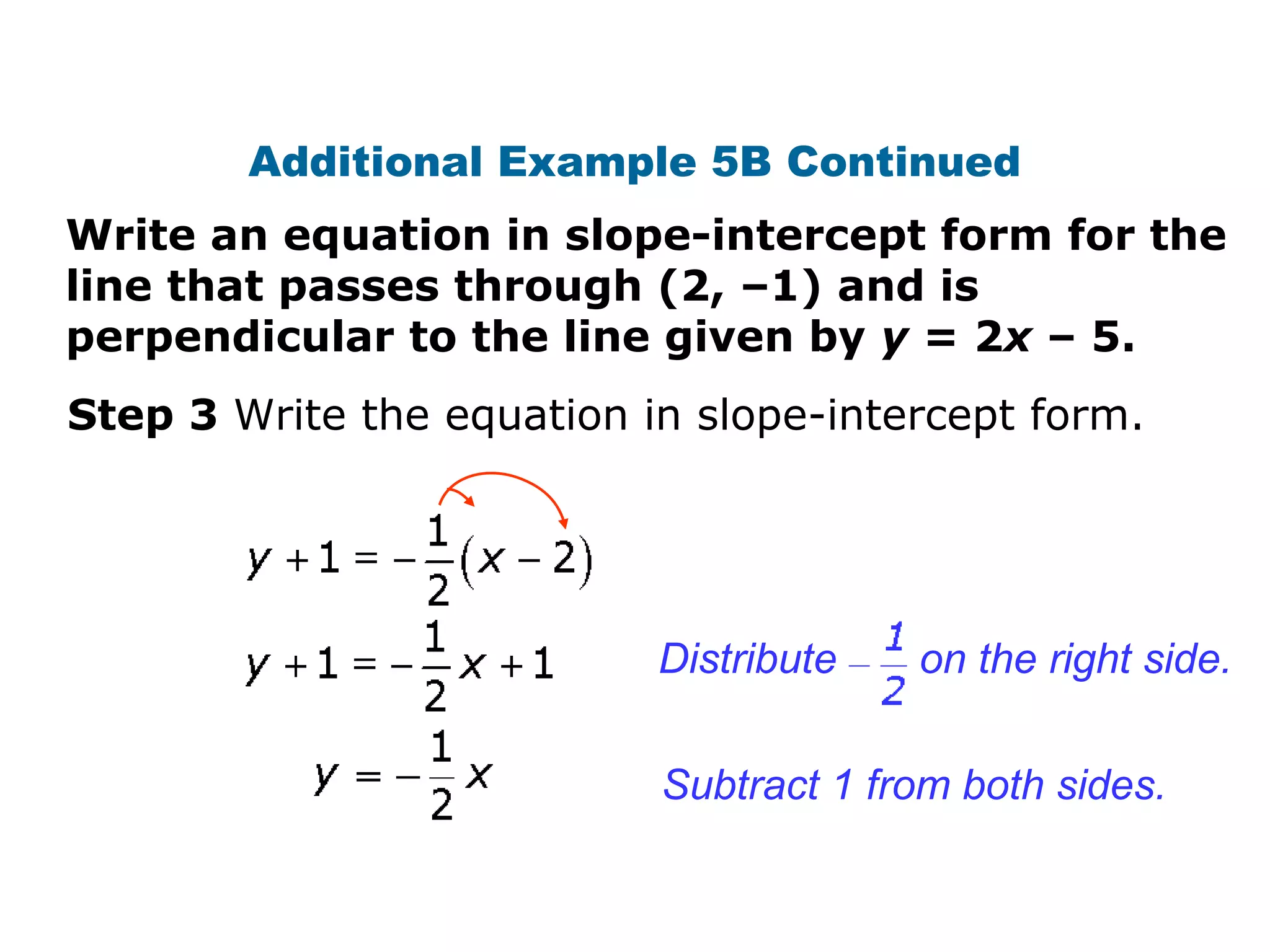
Write an equation in slope-intercept form for the 
line that passes through (2, –1) and is 
perpendicular to the line given by y = 2x – 5. 
Step 3 Write the equation in slope-intercept form. 
Distribute on the right side. 
Subtract 1 from both sides.
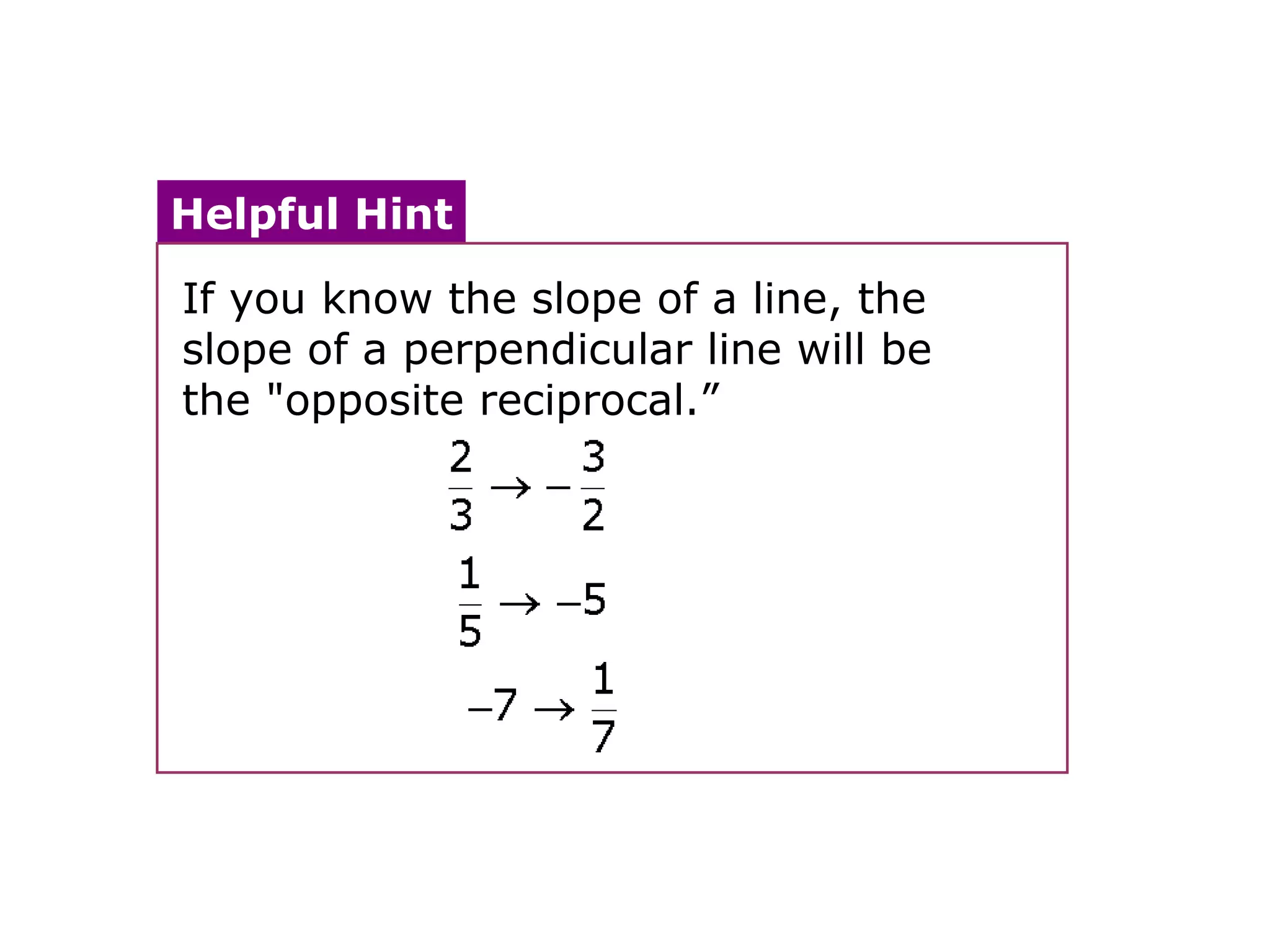
Helpful Hint 
If you know the slope of a line, the 
slope of a perpendicular line will be 
the "opposite reciprocal.”
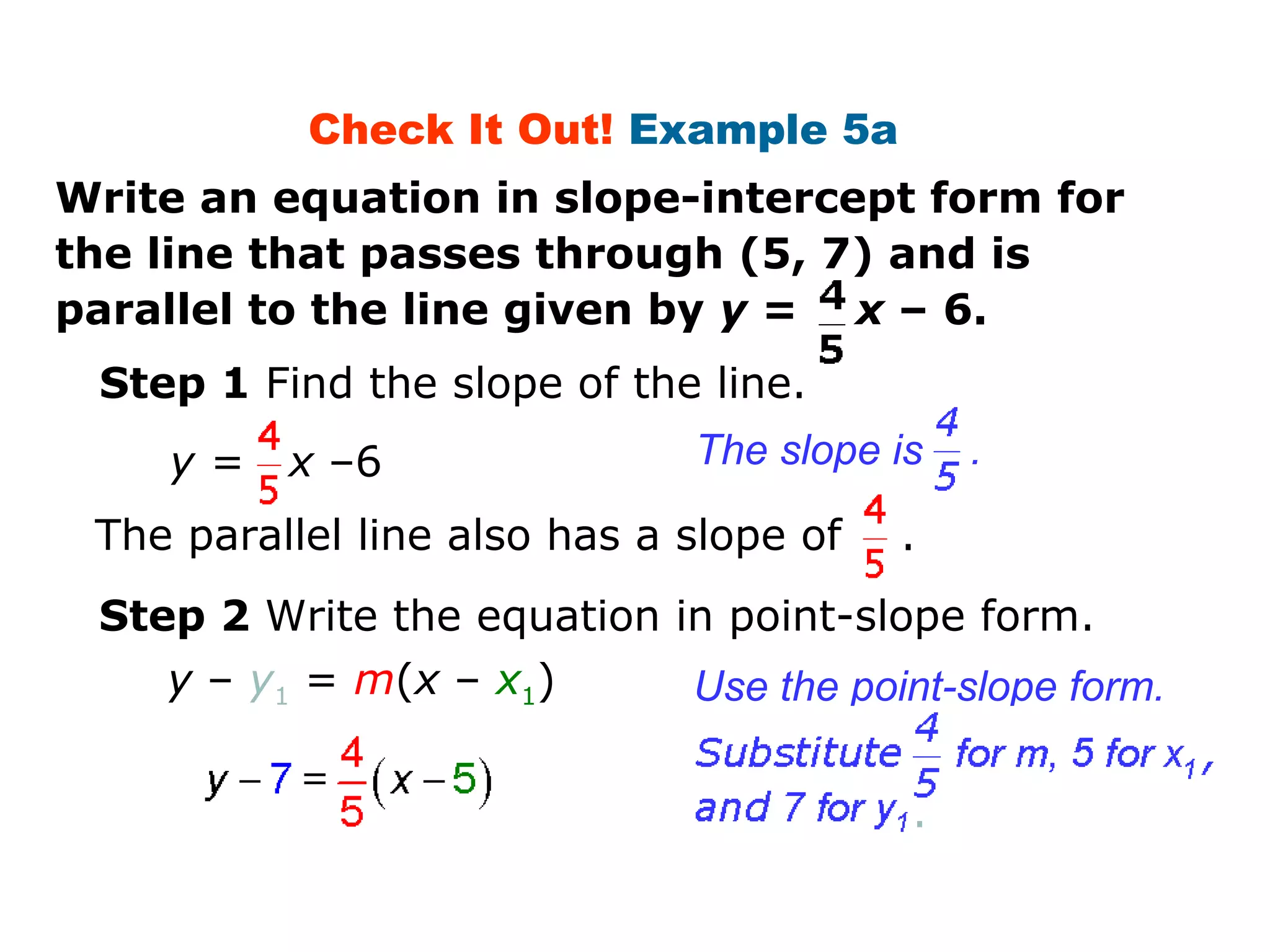
Check It Out! Example 5a 
Write an equation in slope-intercept form for 
the line that passes through (5, 7) and is 
parallel to the line given by y = x – 6. 
Step 1 Find the slope of the line. 
y = x –6 The slope is . 
The parallel line also has a slope of . 
Step 2 Write the equation in point-slope form. 
Use the point-slope form. 
y – y1 = m(x – x1) 
.
Check It Out! Example 5a Continued 
Write an equation in slope-intercept form for 
the line that passes through (5, 7) and is 
parallel to the line given by y = x – 6. 
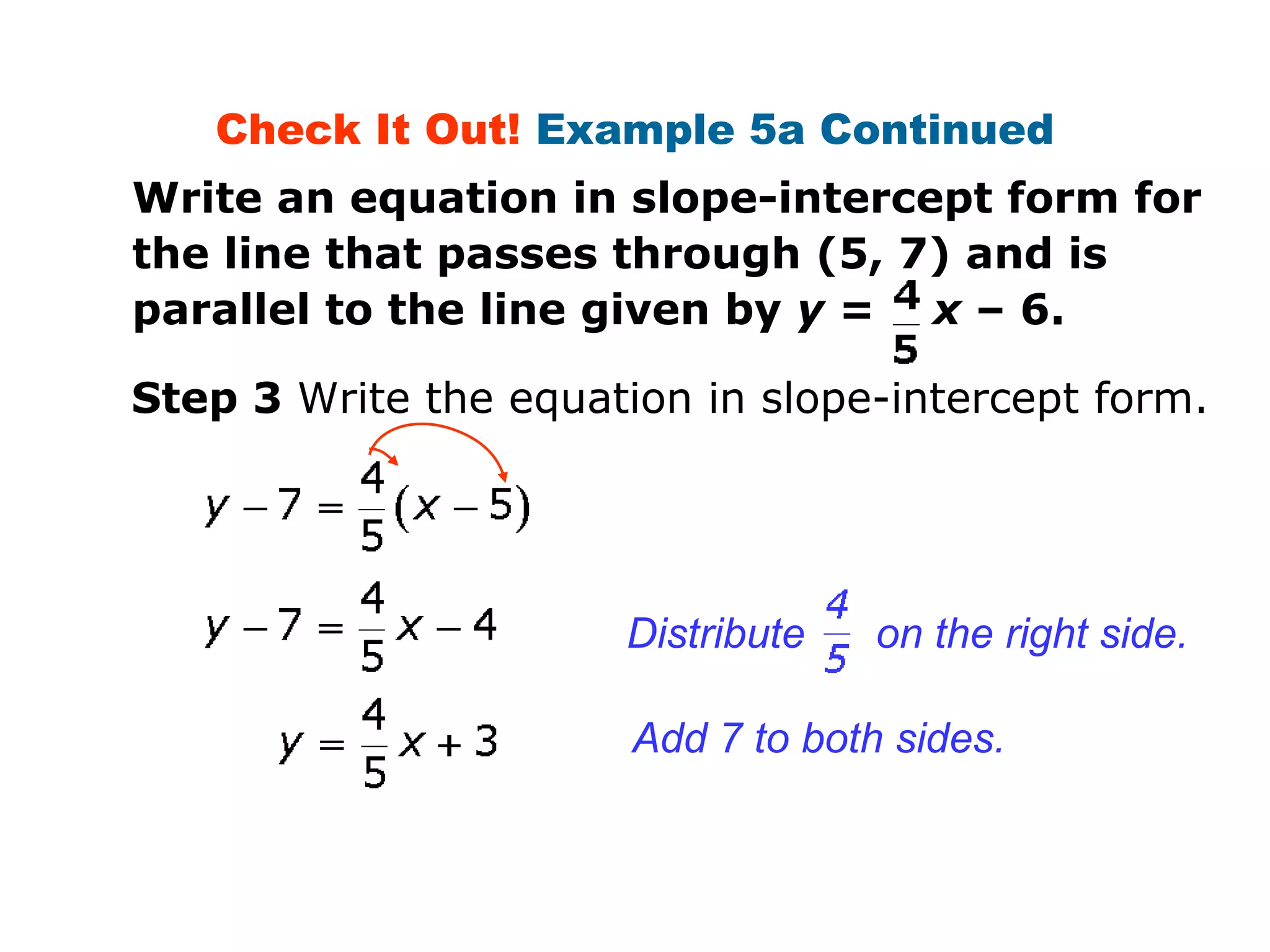
Step 3 Write the equation in slope-intercept form. 
Distribute on the right side. 
Add 7 to both sides.
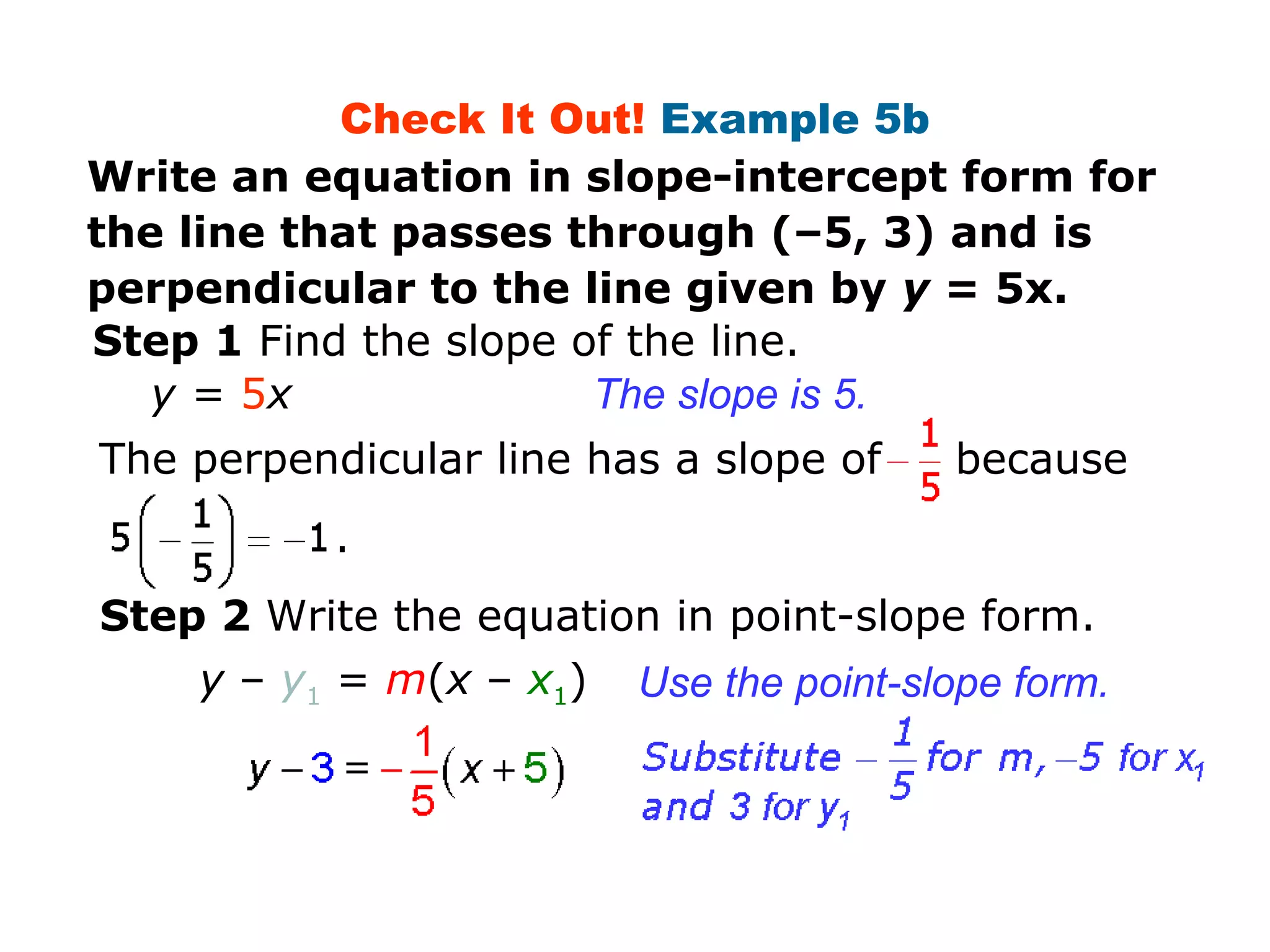
Check It Out! Example 5b 
Write an equation in slope-intercept form for 
the line that passes through (–5, 3) and is 
perpendicular to the line given by y = 5x. 
Step 1 Find the slope of the line. 
y = 5x The slope is 5. 
The perpendicular line has a slope of because 
Step 2 Write the equation in point-slope form. 
Use the point-slope form. 
. 
y – y1 = m(x – x1)
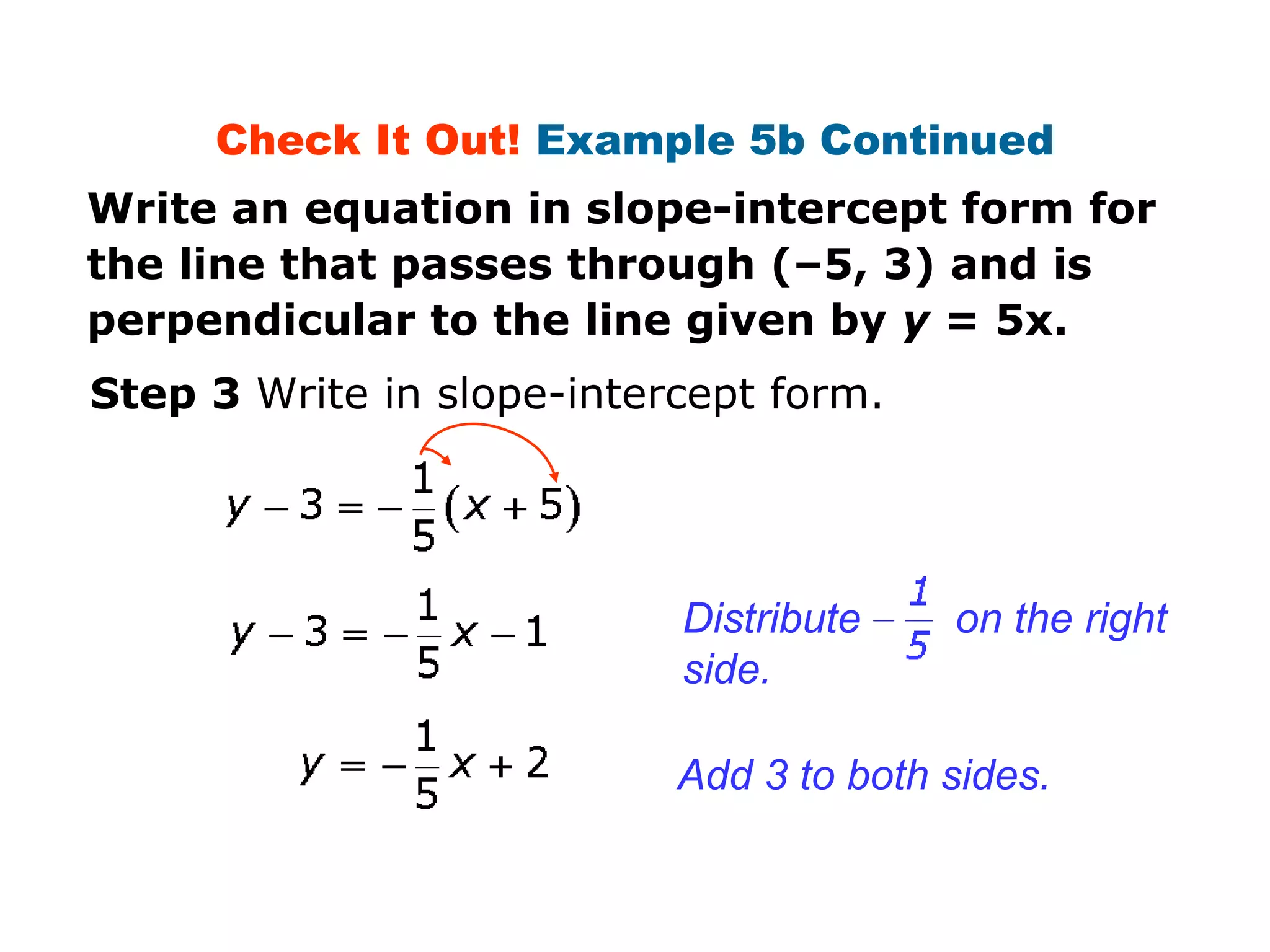
Check It Out! Example 5b Continued 
Write an equation in slope-intercept form for 
the line that passes through (–5, 3) and is 
perpendicular to the line given by y = 5x. 
Step 3 Write in slope-intercept form. 
Distribute on the right 
side. 
Add 3 to both sides.
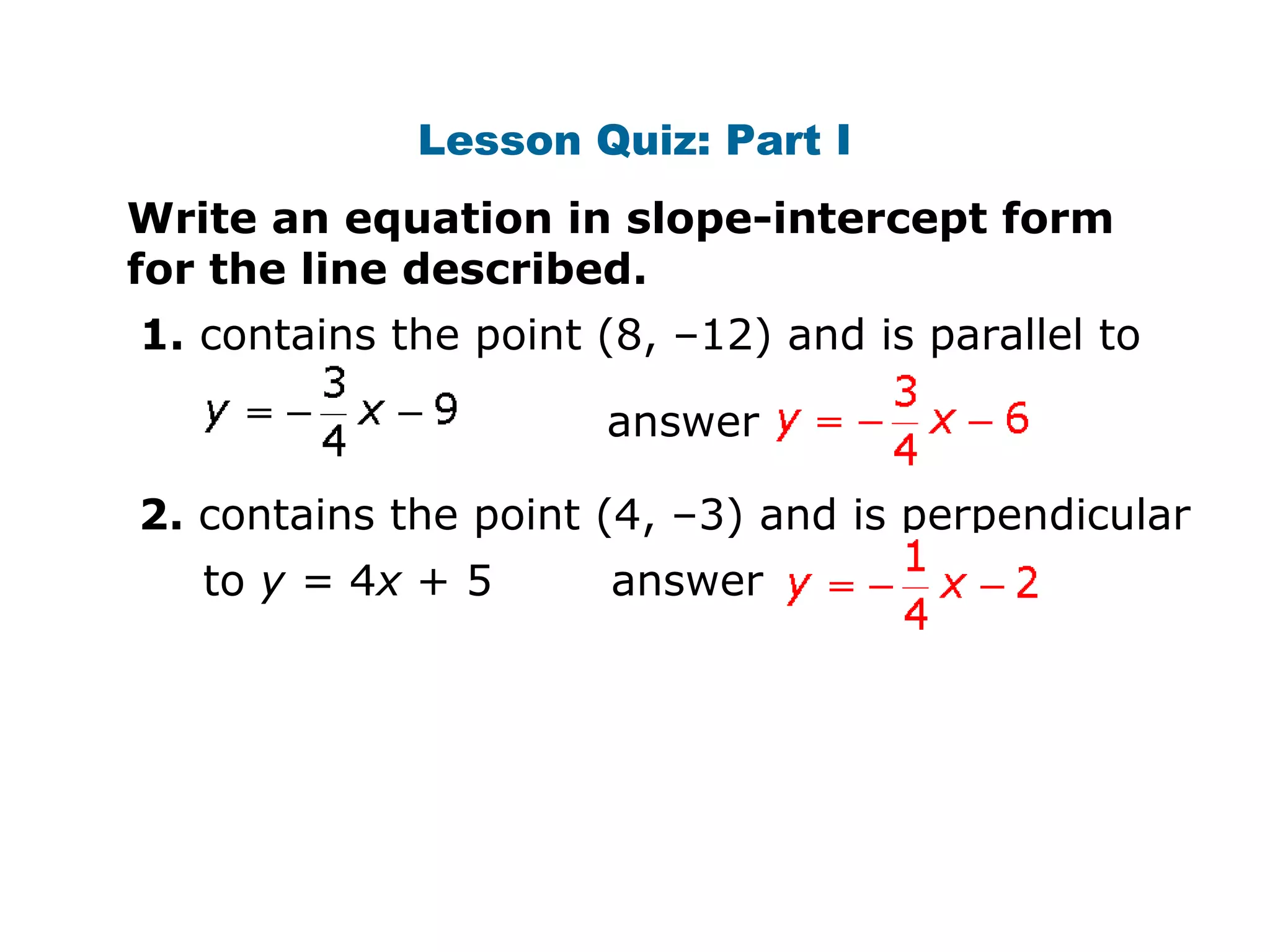
Lesson Quiz: Part I 
Write an equation in slope-intercept form 
for the line described. 
1. contains the point (8, –12) and is parallel to 
answer 
2. contains the point (4, –3) and is perpendicular 
to y = 4x + 5 answer
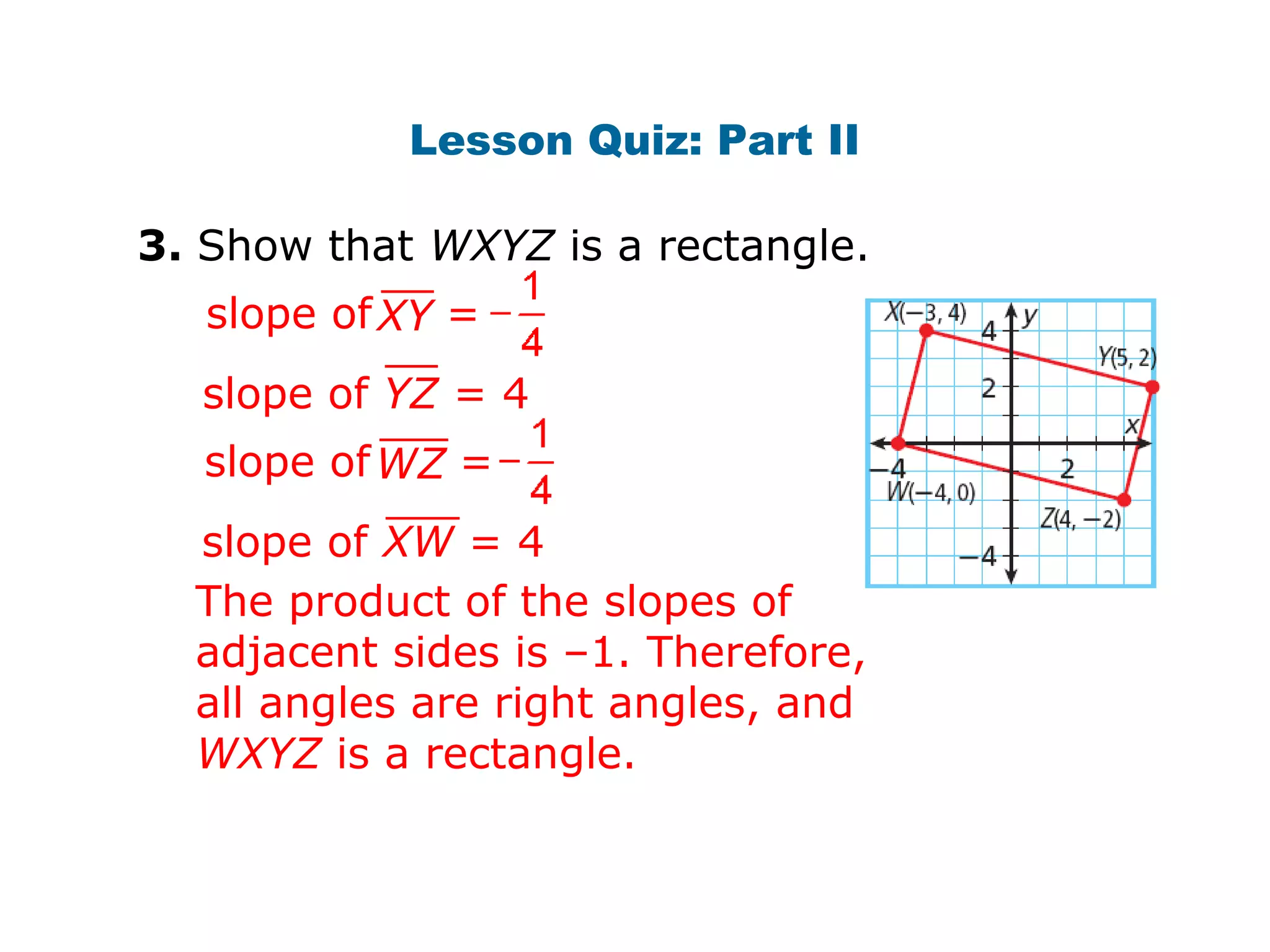
Lesson Quiz: Part II 
3. Show that WXYZ is a rectangle. 
slope of X Y = 
slope of YZ = 4 
slope of W Z = 
slope of XW = 4 
The product of the slopes of 
adjacent sides is –1. Therefore, 
all angles are right angles, and 
WXYZ is a rectangle.
All rights belong to their respective owners. 
Copyright Disclaimer Under Section 107 of 
the Copyright Act 1976, allowance is made 
for "fair use" for purposes such as criticism, 
comment, news reporting, TEACHING, 
scholarship, and research. 
Fair use is a use permitted by copyright 
statute that might otherwise be infringing. 
Non-profit, EDUCATIONAL or personal use 
tips the balance in favor of fair use.

Geometry unit 3.8

  • 1.
    UNIT 3.8 SLOPESOOFF PPAARRAALLLLEELL AANNDD PPEERRPPEENNDDIICCUULLAARR LLIINNEESS
  • 2.
    To sell ata particular farmers’ market for a year, there is a $100 membership fee. Then you pay $3 for each hour that you sell at the market. However, if you were a member the previous year, the membership fee is reduced to $50. • The red line shows the total cost if you are a new member. • The blue line shows the total cost if you are a returning member.
  • 3.
    These two linesare parallel. Parallel lines are lines in the same plane that have no points in common. In other words, they do not intersect.
  • 5.
    Additional Example 1A:Identifying Parallel Lines Identify which lines are parallel. The lines described by and both have slope . These lines are parallel. The lines described by y = x and y = x + 1 both have slope 1. These lines are parallel.
  • 6.
    Additional Example 1B:Identifying Parallel Lines Identify which lines are parallel. Write all equations in slope-intercept form to determine the slope. y = 2x – 3 slope-intercept form slope-intercept form
  • 7.
    Additional Example 1BContinued Identify which lines are parallel. Write all equations in slope-intercept form to determine the slope. 2x + 3y = 8 –2x – 2x 3y = –2x + 8 y + 1 = 3(x – 3) y + 1 = 3x – 9 – 1 – 1 y = 3x – 10
  • 8.
    Additional Example 1BContinued The lines described by y = 2x – 3 and y + 1 = 3(x – 3) are not parallel with any of the lines. y = 2x – 3 y + 1 = 3(x – 3) The lines described by and represent parallel lines. They each have the slope .
  • 9.
    Check It Out!Example 1a The lines described by y = 2x + 2 and y = 2x + 1 represent parallel lines. They each have slope 2. Equations x = 1 and y = –4 are not parallel. y = 2x + 1 y = 2x + 2 y = –4 x = 1 Identify which lines are parallel. y = 2x + 2; y = 2x + 1; y = –4; x = 1
  • 10.
    Check It Out!Example 1b Identify which lines are parallel. Write all equations in slope-intercept form to determine the slope. Slope-intercept form y = 3x Slope-intercept form
  • 11.
    Check It Out!Example 1b Continued Identify which lines are parallel. Write all equations in slope-intercept form to determine the slope. –3x + 4y = 32 +3x +3x 4y = 3x + 32 y – 1 = 3(x + 2) y – 1 = 3x + 6 + 1 + 1 y = 3x + 7
  • 12.
    Check It Out!Example 1b Continued The lines described by –3x + 4y = 32 and y = + 8 have the same slope, but they are not parallel lines. They are the same line. –3x + 4y = 32 y – 1 = 3(x + 2) y = 3x The lines described by y = 3x and y – 1 = 3(x + 2) represent parallel lines. They each have slope 3.
  • 13.
    Remember! In aparallelogram, opposite sides are parallel.
  • 14.
    Additional Example 2:Geometry Application Show that JKLM is a parallelogram. Use the ordered pairs and the slope formula to find the slopes of MJ and KL. MJ is parallel to KL because they have the same slope. JK is parallel to ML because they are both horizontal. Since opposite sides are parallel, JKLM is a parallelogram.
  • 15.
    Check It Out!Example 2 Show that the points A(0, 2), B(4, 2), C(1, –3), D(–3, –3) are the vertices of a parallelogram. A(0, 2) • •B(4, 2) • • D(–3, –3) C(1, –3) Use the ordered pairs and slope formula to find the slopes of AD and BC. AD is parallel to BC because they have the same slope. AB is parallel to DC because they are both horizontal. Since opposite sides are parallel, ABCD is a parallelogram.
  • 16.
    Perpendicular lines arelines that intersect to form right angles (90°).
  • 17.
    Additional Example 3:Identifying Perpendicular Lines Identify which lines are perpendicular: y = 3; x = –2; y = 3x; . The graph given by y = 3 is a horizontal line, and the graph given by x = –2 is a vertical line. These lines are perpendicular. y = 3 x = –2 y =3x The slope of the line given by y = 3x is 3. The slope of the line described by is .
  • 18.
    Additional Example 3Continued Identify which lines are perpendicular: y = 3; x = –2; y = 3x; . y = 3 x = –2 y =3x These lines are perpendicular because the product of their slopes is –1.
  • 19.
    Check It Out!Example 3 Identify which lines are perpendicular: y = –4; y – 6 = 5(x + 4); x = 3; y = The graph described by x = 3 is a vertical line, and the graph described by y = –4 is a horizontal line. These lines are perpendicular. The slope of the line described by y – 6 = 5(x + 4) is 5. The slope of the line described by y = is x = 3 y = –4 y – 6 = 5(x + 4)
  • 20.
    Check It Out!Example 3 Continued Identify which lines are perpendicular: y = –4; y – 6 = 5(x + 4); x = 3; y = These lines are perpendicular because the product of their slopes is –1. x = 3 y = –4 y – 6 = 5(x + 4)
  • 21.
    Additional Example 4:Geometry Application Show that ABC is a right triangle. If ABC is a right triangle, AB will be perpendicular to AC. slope of slope of AB is perpendicular to AC because Therefore, ABC is a right triangle because it contains a right angle.
  • 22.
    Check It Out!Example 4 Show that P(1, 4), Q(2, 6), and R(7, 1) are the vertices of a right triangle. If PQR is a right triangle, PQ will be perpendicular to PR. slope of PQ R(7, 1) slope of PR PQ is perpendicular to PR because the product of their slopes is –1. P(1, 4) Q(2, 6) Therefore, PQR is a right triangle because it contains a right angle.
  • 23.
    Additional Example 5A:Writing Equations of Parallel and Perpendicular Lines Write an equation in slope-intercept form for the line that passes through (4, 10) and is parallel to the line given by y = 3x + 8. Step 1 Find the slope of the line. y = 3x + 8 The slope is 3. The parallel line also has a slope of 3. Step 2 Write the equation in point-slope form. Use y – y the point-slope form. 1 = m(x – x1) y – 10 = 3(x – 4) Substitute 3 for m, 4 for x1, and 10 for y1.
  • 24.
    Additional Example 5AContinued Write an equation in slope-intercept form for the line that passes through (4, 10) and is parallel to the line given by y = 3x + 8. Step 3 Write the equation in slope-intercept form. (y – 10 = 3(x – 4 y – 10 = 3x – 12 y = 3x – 2 Distribute 3 on the right side. Add 10 to both sides.
  • 25.
    Additional Example 5B:Writing Equations of Parallel and Perpendicular Lines Write an equation in slope-intercept form for the line that passes through (2, –1) and is perpendicular to the line given by y = 2x – 5. Step 1 Find the slope of the line. y = 2x – 5 The slope is 2. The perpendicular line has a slope of because Step 2 Write the equation in point-slope form. Use y – y the point-slope form. 1 = m(x – x1) Substitute for m, –1 for y1, and 2 for x1.
  • 26.
    Additional Example 5BContinued Write an equation in slope-intercept form for the line that passes through (2, –1) and is perpendicular to the line given by y = 2x – 5. Step 3 Write the equation in slope-intercept form. Distribute on the right side. Subtract 1 from both sides.
  • 27.
    Helpful Hint Ifyou know the slope of a line, the slope of a perpendicular line will be the "opposite reciprocal.”
  • 28.
    Check It Out!Example 5a Write an equation in slope-intercept form for the line that passes through (5, 7) and is parallel to the line given by y = x – 6. Step 1 Find the slope of the line. y = x –6 The slope is . The parallel line also has a slope of . Step 2 Write the equation in point-slope form. Use the point-slope form. y – y1 = m(x – x1) .
  • 29.
    Check It Out!Example 5a Continued Write an equation in slope-intercept form for the line that passes through (5, 7) and is parallel to the line given by y = x – 6. Step 3 Write the equation in slope-intercept form. Distribute on the right side. Add 7 to both sides.
  • 30.
    Check It Out!Example 5b Write an equation in slope-intercept form for the line that passes through (–5, 3) and is perpendicular to the line given by y = 5x. Step 1 Find the slope of the line. y = 5x The slope is 5. The perpendicular line has a slope of because Step 2 Write the equation in point-slope form. Use the point-slope form. . y – y1 = m(x – x1)
  • 31.
    Check It Out!Example 5b Continued Write an equation in slope-intercept form for the line that passes through (–5, 3) and is perpendicular to the line given by y = 5x. Step 3 Write in slope-intercept form. Distribute on the right side. Add 3 to both sides.
  • 32.
    Lesson Quiz: PartI Write an equation in slope-intercept form for the line described. 1. contains the point (8, –12) and is parallel to answer 2. contains the point (4, –3) and is perpendicular to y = 4x + 5 answer
  • 33.
    Lesson Quiz: PartII 3. Show that WXYZ is a rectangle. slope of X Y = slope of YZ = 4 slope of W Z = slope of XW = 4 The product of the slopes of adjacent sides is –1. Therefore, all angles are right angles, and WXYZ is a rectangle.
  • 34.
    All rights belongto their respective owners. Copyright Disclaimer Under Section 107 of the Copyright Act 1976, allowance is made for "fair use" for purposes such as criticism, comment, news reporting, TEACHING, scholarship, and research. Fair use is a use permitted by copyright statute that might otherwise be infringing. Non-profit, EDUCATIONAL or personal use tips the balance in favor of fair use.