The document discusses various transformations of graphs including:
1. Vertical translations which move a graph up or down by adding or subtracting a constant c.
2. Vertical stretches and compressions which multiply the y-values of a graph by a constant factor c.
3. Horizontal translations which shift a graph left or right by adding or subtracting a constant c to the x-values.
4. Horizontal stretches and compressions which multiply the x-values of a graph by a constant factor c.
Examples are provided to demonstrate how to graph functions resulting from different combinations of these transformations.
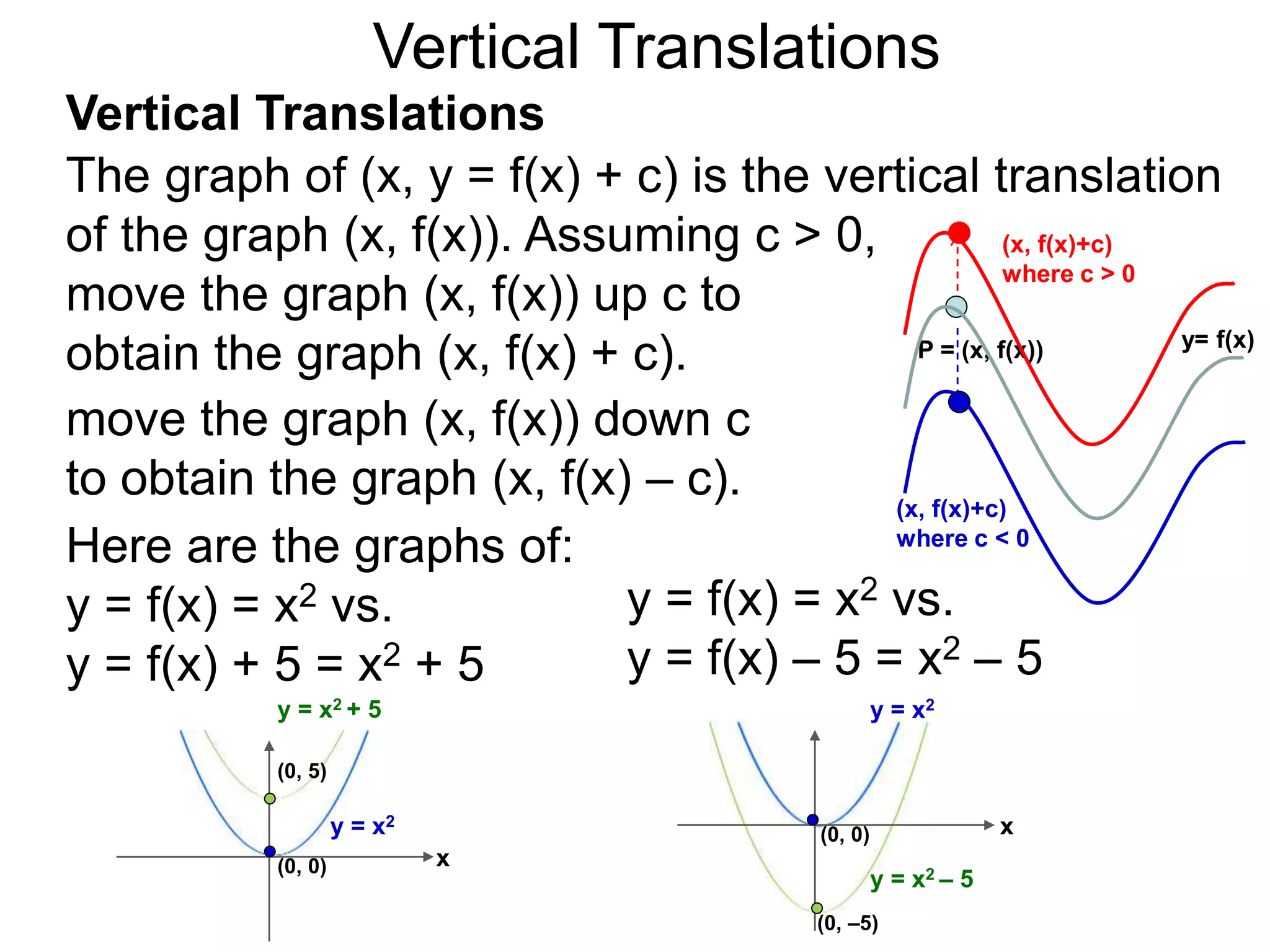
The graph of(x, y = f(x) + c) is the vertical translation
of the graph (x, f(x)). Assuming c > 0,
move the graph (x, f(x)) up c to
obtain the graph (x, f(x) + c).
Vertical Translations
move the graph (x, f(x)) down c
to obtain the graph (x, f(x) – c).
P = (x, f(x)) y= f(x)
(x, f(x)+c)
where c > 0
(x, f(x)+c)
where c < 0
Here are the graphs of:
y = f(x) = x2 vs.
y = f(x) + 5 = x2 + 5
y = f(x) = x2 vs.
y = f(x) – 5 = x2 – 5
y = x2
y = x2 + 5
y = x2 – 5
y = x2
(0, 0)
(0, 5)
(0, 0)
(0, –5)
x
x
Vertical Translations
2.
Vertical Stretches andCompressions
Assuming c > 0, the graph of y = cf(x) is the
vertical-stretch or compression of y = f(x).
If c > 1, it is a vertical stretch by a factor of c.
If 0 < c < 1, it is a vertical compression by a factor of c.
Here are the graphs of:
y = f(x) = 4 – x2 vs.
y = 3f(x) = 3(4 – x2)
y = f(x) = 4 – x2 vs.
y = f(x)/2 = (4 – x2)/2
y = 4 – x2
y = 3(4 – x2)
y = 4 – x2
y = (4 – x2)/2
(0, 4)
(0, 12)
(0, 4)
(0, 2)
(–2, 0) (2, 0)
(–2, 0) (2, 0)
c = 3 c = 1/2
x
x
Vertical Stretches and Compressions
3.
Example A.
a. Giventhe graph of y = f(x),
graph y = g(x) = –2f(x) + 3
(–3, 1)
(–1, –1)
(1, 1) (2, 1)
“–2f(x)" corresponds stretching the graph by a factor
of 2, then reflecting the entire graph across the x axis.
Afterwards move the graph vertically up by 3.
To draw the graph, track the “important points” on the
graph. Plug in their x–values to find the corresponding
y–values, then plot their destinations.
(–3, 1) (–3, –2f(–3) + 3 = 1)
(–1, –1) (–1, –2f(–1) + 3 = 5)
(1, 1) (1, –2f(1) + 3 = 1)
(2, 1) (2, –2f(2) + 3 = 1)
(–3, 1)
(–1, 5)
(1, 1)
(2, 1)
x
x
Vertical Stretches and Compressions
y = g(x) = –2f(x) + 3y = f(x) Graph of
y = g(x)
4.
Horizontal Translations
The graphsof y = f(x + c) are the horizontal shifts
(or translations) of y = f(x) by c units, assuming c > 0:
y=(x + 2)2 y=(x – 2)2
Horizontal Translations
moves y = f(x) to the left for y = f(x + c).
moves y = f(x) to the right for y = f(x – c).
Example B. Graph the following functions by shifting
the graph of y = f(x) = x2. Label their vertices.
a. g(x) = (x + 2)2 = f(x + 2)
Shift of the graph of y = x2
left 2 units. The vertex of
g(x) = (x + 2)2 is (–2, 0).
x
y=x 2
b. h(x) = (x – 2)2 = f(x – 2)
Shift the graph of y = x2 right
2 units. The vertex of h(x) is (2, 0). Horizontal Shifts
(–2, 0) (2, 0)
5.
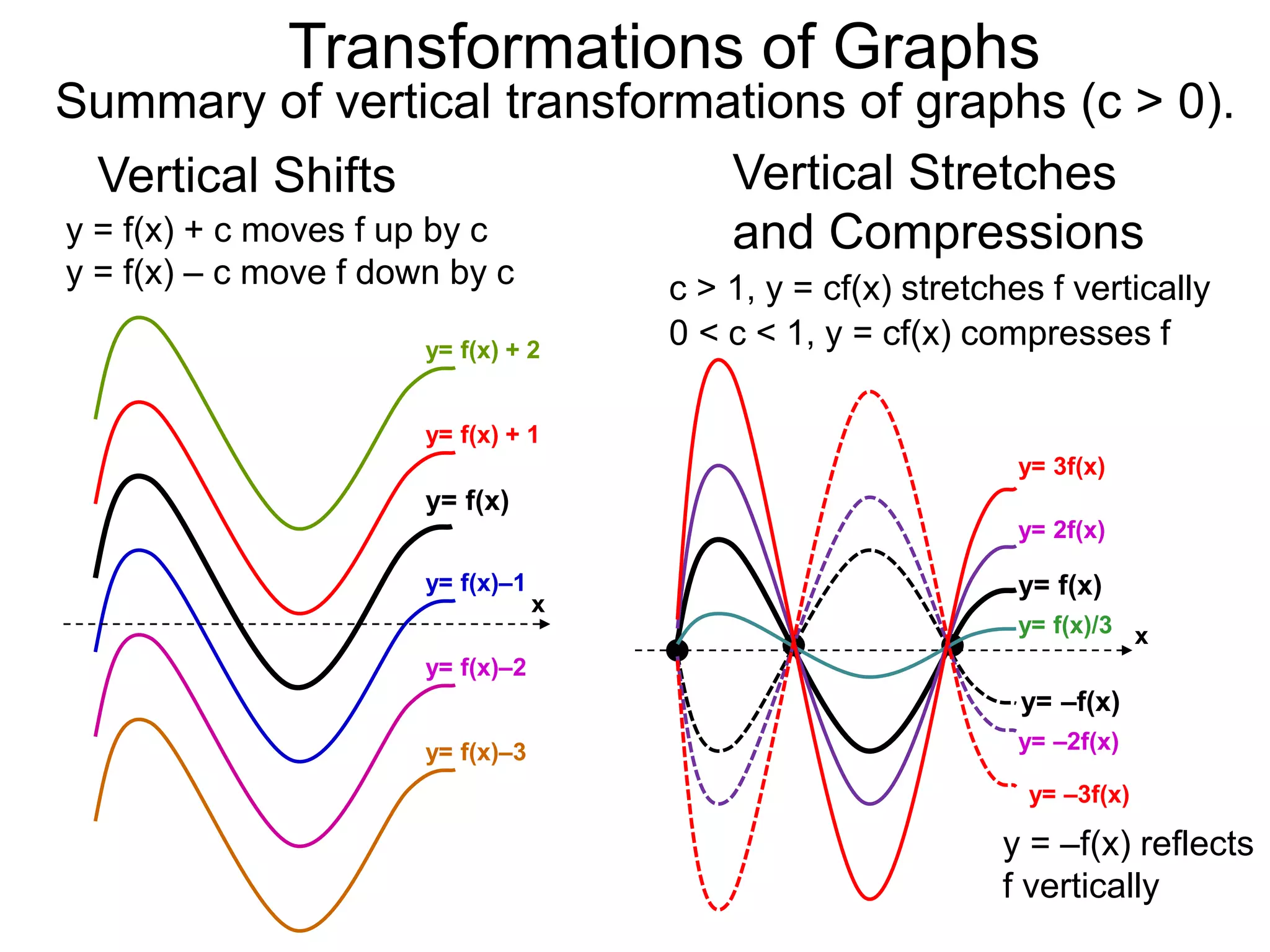
Summary of verticaltransformations of graphs (c > 0).
Transformations of Graphs
Vertical Shifts Vertical Stretches
and Compressions
y= f(x)–1
y= f(x) + 1
x
y= f(x) + 2
y= f(x)–2
y= f(x)–3
y= f(x)
y= 3f(x)
y= f(x)/3
y= 2f(x)
y= –f(x)
y= –2f(x)
y= –3f(x)
y= f(x)
y = f(x) + c moves f up by c
y = f(x) – c move f down by c c > 1, y = cf(x) stretches f vertically
y = –f(x) reflects
f vertically
0 < c < 1, y = cf(x) compresses f
x
6.
x
–1
Transformations of Graphs
HorizontalShifts
y=f(x)
y=f(x+2)
y=f(x+1)
y=f(x–2)
y=f(x–1)
y=f(x)y=f(x/2)y=f(x/3) y=f(2x)
–2–3
y=f(3x)
y
Horizontal Stretches
and Compressions
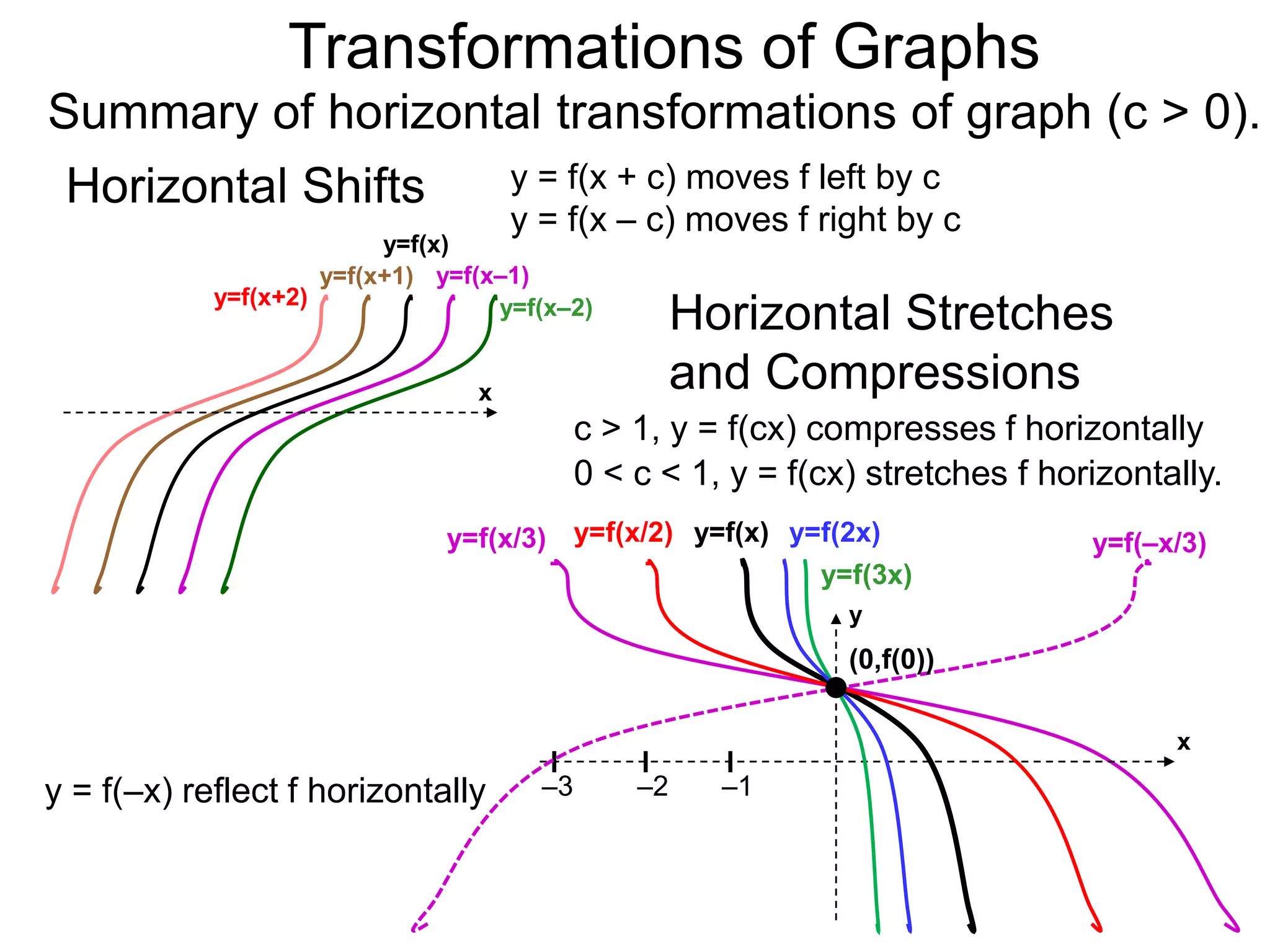
y = f(–x) reflect f horizontally
y=f(–x/3)
(0,f(0))
y = f(x + c) moves f left by c
y = f(x – c) moves f right by c
c > 1, y = f(cx) compresses f horizontally
0 < c < 1, y = f(cx) stretches f horizontally.
Summary of horizontal transformations of graph (c > 0).
x
7.
Horizontal Translations
y
y =f(x)
1
x
2 3
y=g(x)=f(½ * x)
The Domain of y = f(cx), c > 0
If the domain of
y = f(x) is [0, a],
then the domain of
y = f(cx) is [0, a/c].
y = f(2x)
½
y = f(x/3)y = f(3x)
Transformations of Graphs
FunctionCalisthenics
(Unknown Artist )
Exercise A.
Use the graphs shown on the list
for sketching the following graphs.
1. y = 3x2 2. y = –2x2
3. y = –0.5x2 4. y = x2 – 1
5. y = 2x2 – 1
8. y = –x3 – 2
6. y = (x+1)2
7. y = 2(x – 3)2
10. y = –(x – 2)3 – 29. y = –(x – 2)3
11. y = l x – 2 l + 1
12. y = –2l x + 2 l + 3
13. y = 14. y =
x
–1
+ 1 x + 1
1 – 1
15. y = 16. y =x
–1
+ 1 x + 1
1
– 1l l l l
10.
Transformations of Graphs
B.The following problems assumes the knowledge of
graphs of trig-functions. Graph at least two periods of each
function. Label the high and low points.
1. y = sin(x – π/2) 2. y = cos(x + π/4)
3. y = cos(x – 3π/4) 4. y = –3sin(x – π/2)
8. y = cos(2x)
9. y = 3sin(4x) 10. y = cos(x/3)
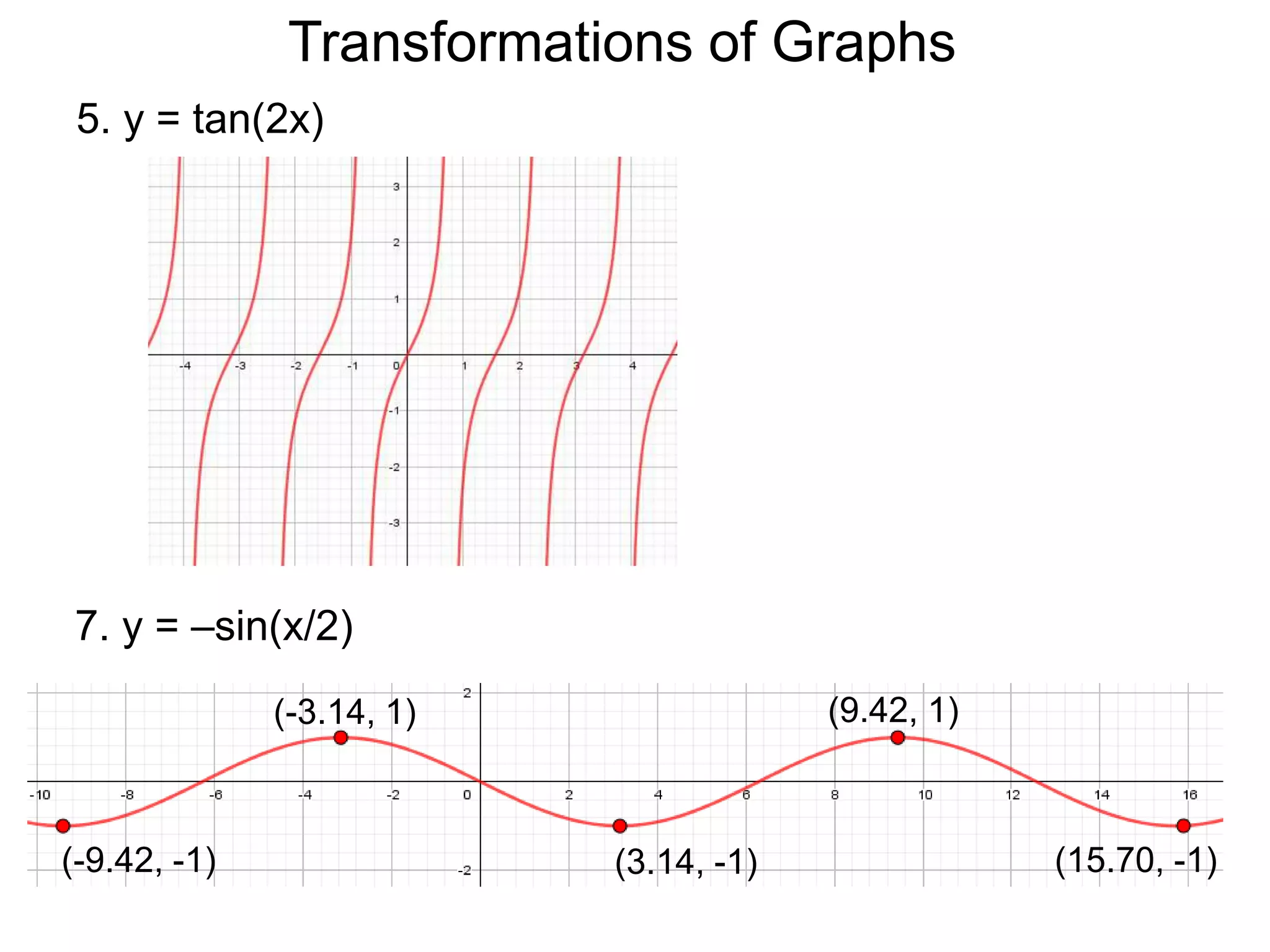
7. y = –sin(x/2)
11. y = –2cos(3x)
5. y = tan(2x) 6. y = –cot(x/2)
12. y = 3cos(x + π/4) – 2
13. y = –3sin(x – 3π/4) + 1 14. y = 4cos(x/2) – 2
15. y = –2sin(2x) + 1
11.
C. Given thegraphs of the following functions,
draw the graphs of the following functions.
Transformations of Graphs
(1,0)
(0,1)
(2,0)
(3,2)y = f(x): y = g(x):
(0,0)
(–1,1) (1,1)
(2, –1)
1. y = 2f(x – 4) 2. y = –f(x – 2)
3. y = –3g(x + 4) 4. y = –1/2 g(x – 2)
5. y = 2g(x + 2) – 1 6. y = –3f(x – 1) + 1
7. y = –4f(x + 4) + 3 8. y = –1/2 g(x – 3/2) – 4
9. What’s the domain of f(x)? What is the domain of f(–x)?
a. Draw f(–x). b. Draw –f(–x).
10. What’s the domain of g(x)? What is the domain of g(–x)?
a. Draw g(–x). b. Draw –g(–x).
12.
Transformations of Graphs
(Answersto odd problems) Exercise A.
1. y = 3x2 3. y = –0.5x2 5. y = 2x2 – 1
7. y = 2(x – 3)2 9. y = –(x – 2)3 11. y = l x – 2 l + 1
Exercise C.
Transformations ofGraphs
(5,0)
(4,2)
(6,0)
(7,4)
(-4,0)
(–5,-3) (-3,-3)
(-2, 3)
1. y = 2f(x – 4) 3. y = –3g(x + 4)
5. y = 2g(x + 2) – 1 7. y = –4f(x + 4) + 3
(-2,-1)
(–3,1) (-1,1)
(0, –3)
(-3,0)
(-4,-4)
(-2,0)
(-1,-8)
21.
Transformations of Graphs
9.domain of f(x): [0, 3]
domain of f(–x): [-3, 0]
10. domain of g(x): [-1, 2]
domain of g(–x): [-2, 1]
a. y = f(–x): b. y = –f(–x):
a. y = g(–x): b. y = –g(–x):
(-3,2)
(-3,-2)
(-2,0)
(-2,0)
(-1,0)
(-1,0)
(0,1)
(0,-1)
(-2,-1)
(-1,1)
(0,0)
(0,0)
(1,1)
(1,-1)(-1,-1)
(-2,1)


![Horizontal Translations
y
y = f(x)
1
x
2 3
y=g(x)=f(½ * x)
The Domain of y = f(cx), c > 0
If the domain of
y = f(x) is [0, a],
then the domain of
y = f(cx) is [0, a/c].
y = f(2x)
½
y = f(x/3)y = f(3x)](https://image.slidesharecdn.com/2-190616052554/75/2-10-translations-of-graphs-t-7-2048.jpg)




![Transformations of Graphs
9. domain of f(x): [0, 3]
domain of f(–x): [-3, 0]
10. domain of g(x): [-1, 2]
domain of g(–x): [-2, 1]
a. y = f(–x): b. y = –f(–x):
a. y = g(–x): b. y = –g(–x):
(-3,2)
(-3,-2)
(-2,0)
(-2,0)
(-1,0)
(-1,0)
(0,1)
(0,-1)
(-2,-1)
(-1,1)
(0,0)
(0,0)
(1,1)
(1,-1)(-1,-1)
(-2,1)](https://image.slidesharecdn.com/2-190616052554/75/2-10-translations-of-graphs-t-21-2048.jpg)


