Slopes of Lines
Slopes of Lines
The steepness of a street
is measured in “grade”.
Slopes of Lines
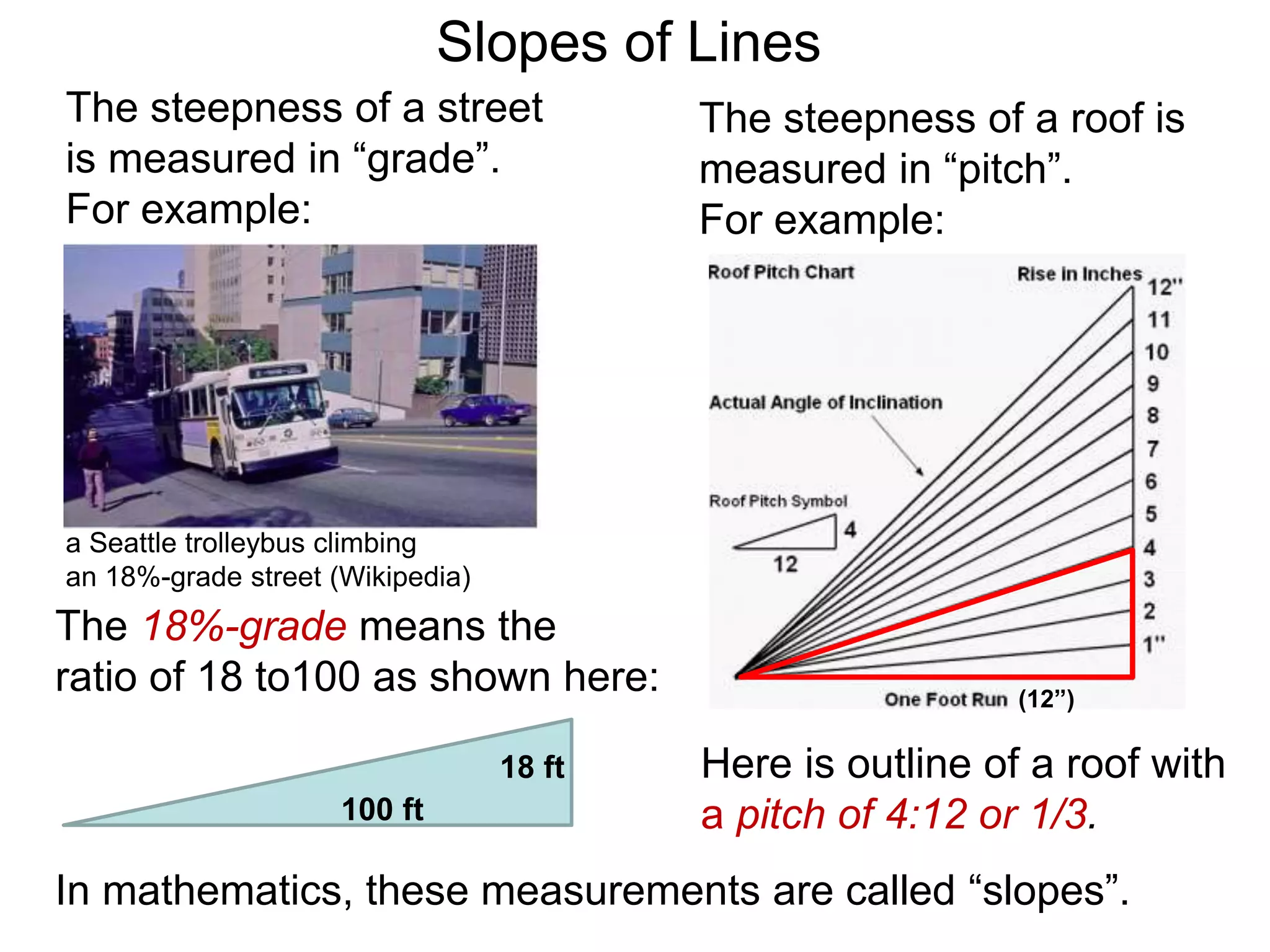
a Seattle trolleybus climbing
an 18%-grade street (Wikipedia)
The steepness of a street
is measured in “grade”.
For example:
Slopes of Lines
a Seattle trolleybus climbing
an 18%-grade street (Wikipedia)
The steepness of a street
is measured in “grade”.
For example:
The 18%-grade means the
ratio of 18 to100 as shown here:
18 ft
100 ft
Slopes of Lines
a Seattle trolleybus climbing
an 18%-grade street (Wikipedia)
The steepness of a street
is measured in “grade”.
For example:
The 18%-grade means the
ratio of 18 to100 as shown here:
18 ft
100 ft
The steepness of a roof is
measured in “pitch”.
Slopes of Lines
a Seattle trolleybus climbing
an 18%-grade street (Wikipedia)
The steepness of a street
is measured in “grade”.
For example:
The 18%-grade means the
ratio of 18 to100 as shown here:
18 ft
100 ft
The steepness of a roof is
measured in “pitch”.
For example:
(12”)
Slopes of Lines
a Seattle trolleybus climbing
an 18%-grade street (Wikipedia)
The steepness of a street
is measured in “grade”.
For example:
The 18%-grade means the
ratio of 18 to100 as shown here:
18 ft
100 ft
Here is outline of a roof with
a pitch of 4:12 or 1/3.
(12”)
The steepness of a roof is
measured in “pitch”.
For example:
Slopes of Lines
a Seattle trolleybus climbing
an 18%-grade street (Wikipedia)
The steepness of a street
is measured in “grade”.
For example:
The 18%-grade means the
ratio of 18 to100 as shown here:
18 ft
100 ft
Here is outline of a roof with
a pitch of 4:12 or 1/3.
(12”)
The steepness of a roof is
measured in “pitch”.
For example:
In mathematics, these measurements are called “slopes”.
Slopes of Lines
The slope of a line is a number.
Slopes of Lines
The slope of a line is a number. The slope of a line
measures the amount of tilt, (inclination, steepness) of the
line against the x-axis.
Slopes of Lines
The slope of a line is a number. The slope of a line
measures the amount of tilt, (inclination, steepness) of the
line against the x-axis.
Steep lines have slopes with large absolute value.
Gradual lines have slopes with small absolute value
Slopes of Lines
The slope of a line is a number. The slope of a line
measures the amount of tilt, (inclination, steepness) of the
line against the x-axis.
Steep lines have slopes with large absolute value.
Gradual lines have slopes with small absolute value
Definition of Slope
Slopes of Lines
Definition of Slope
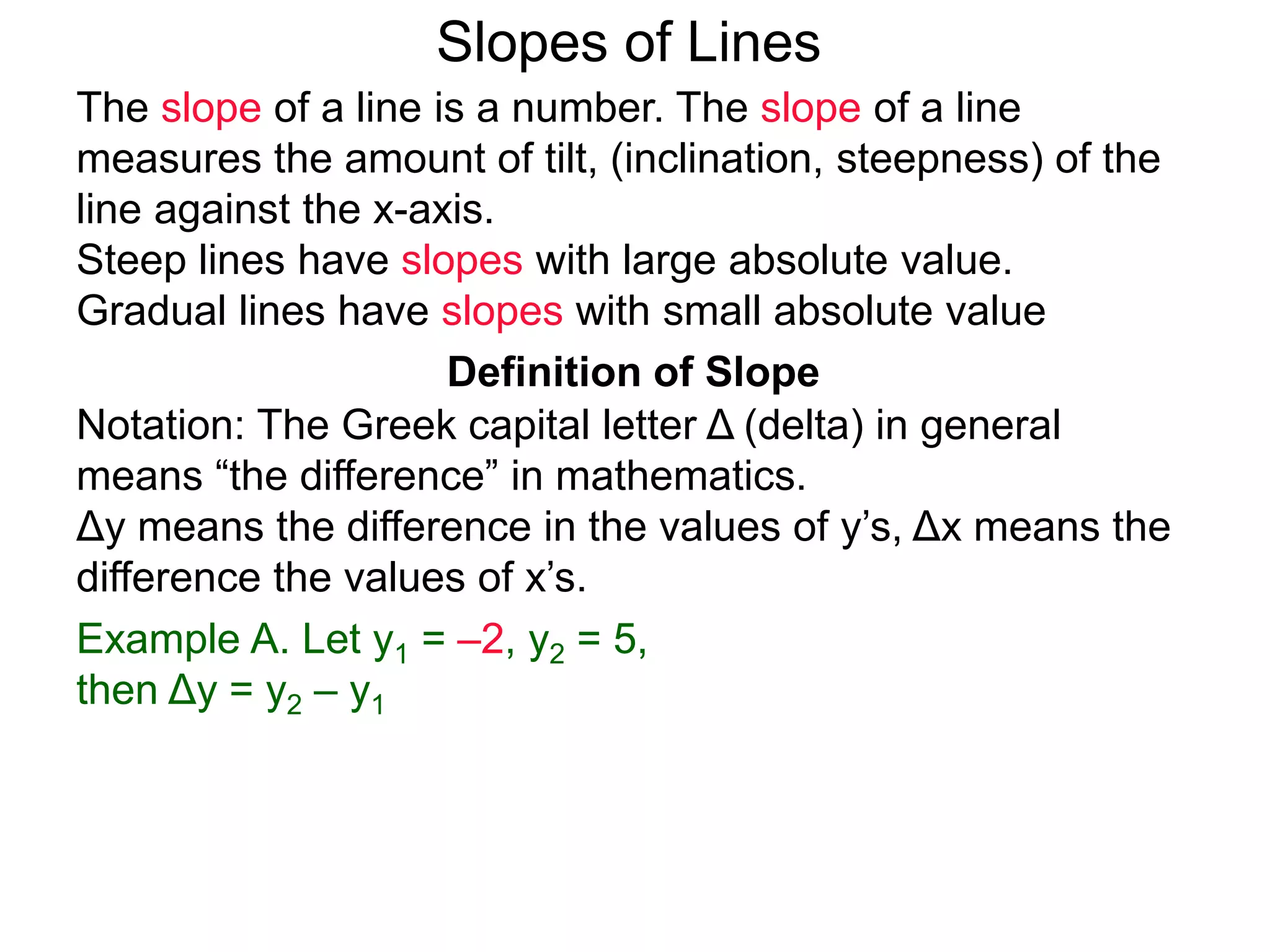
Notation: The Greek capital letter Δ (delta) in general
means “the difference” in mathematics.
The slope of a line is a number. The slope of a line
measures the amount of tilt, (inclination, steepness) of the
line against the x-axis.
Steep lines have slopes with large absolute value.
Gradual lines have slopes with small absolute value
Slopes of Lines
Definition of Slope
Notation: The Greek capital letter Δ (delta) in general
means “the difference” in mathematics.
Δy means the difference in the values of y’s, Δx means the
difference the values of x’s.
The slope of a line is a number. The slope of a line
measures the amount of tilt, (inclination, steepness) of the
line against the x-axis.
Steep lines have slopes with large absolute value.
Gradual lines have slopes with small absolute value
Slopes of Lines
Definition of Slope
Notation: The Greek capital letter Δ (delta) in general
means “the difference” in mathematics.
Δy means the difference in the values of y’s, Δx means the
difference the values of x’s.
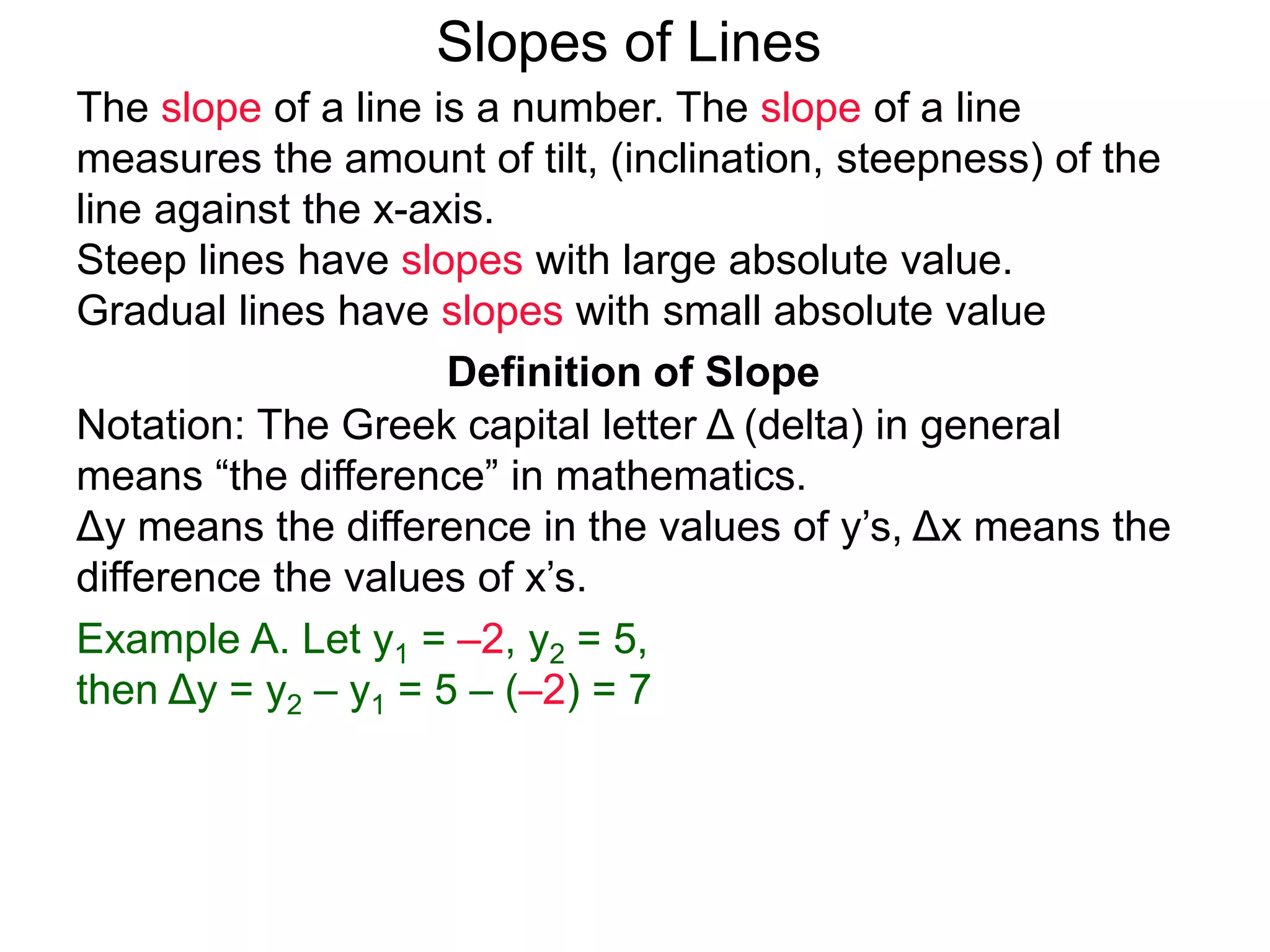
Example A. Let y1 = –2, y2 = 5,
The slope of a line is a number. The slope of a line
measures the amount of tilt, (inclination, steepness) of the
line against the x-axis.
Steep lines have slopes with large absolute value.
Gradual lines have slopes with small absolute value
Slopes of Lines
Definition of Slope
Notation: The Greek capital letter Δ (delta) in general
means “the difference” in mathematics.
Δy means the difference in the values of y’s, Δx means the
difference the values of x’s.
Example A. Let y1 = –2, y2 = 5,
then Δy = y2 – y1
The slope of a line is a number. The slope of a line
measures the amount of tilt, (inclination, steepness) of the
line against the x-axis.
Steep lines have slopes with large absolute value.
Gradual lines have slopes with small absolute value
Slopes of Lines
Definition of Slope
Notation: The Greek capital letter Δ (delta) in general
means “the difference” in mathematics.
Δy means the difference in the values of y’s, Δx means the
difference the values of x’s.
Example A. Let y1 = –2, y2 = 5,
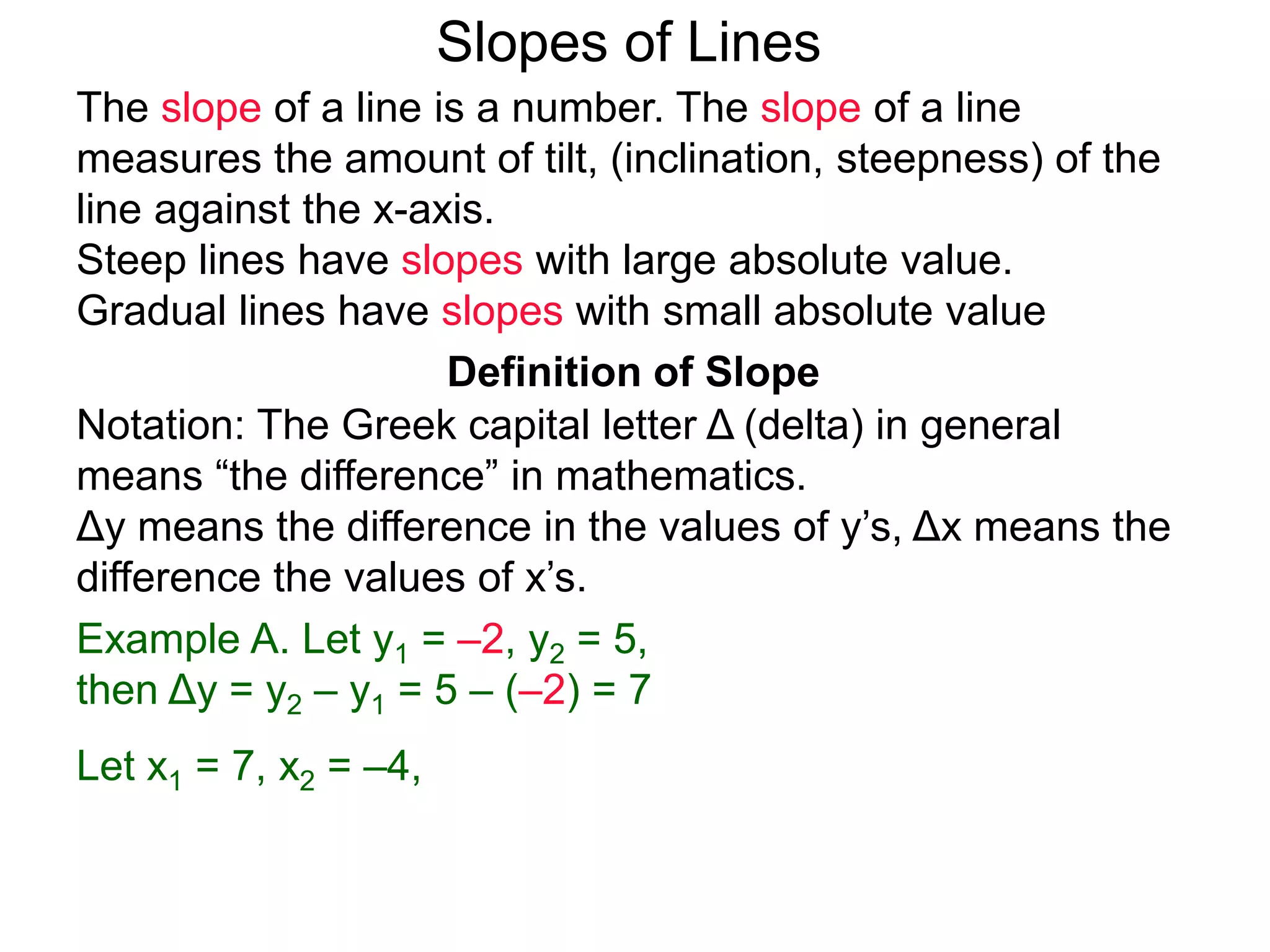
then Δy = y2 – y1 = 5 – (–2) = 7
The slope of a line is a number. The slope of a line
measures the amount of tilt, (inclination, steepness) of the
line against the x-axis.
Steep lines have slopes with large absolute value.
Gradual lines have slopes with small absolute value
Slopes of Lines
Definition of Slope
Notation: The Greek capital letter Δ (delta) in general
means “the difference” in mathematics.
Δy means the difference in the values of y’s, Δx means the
difference the values of x’s.
Example A. Let y1 = –2, y2 = 5,
then Δy = y2 – y1 = 5 – (–2) = 7
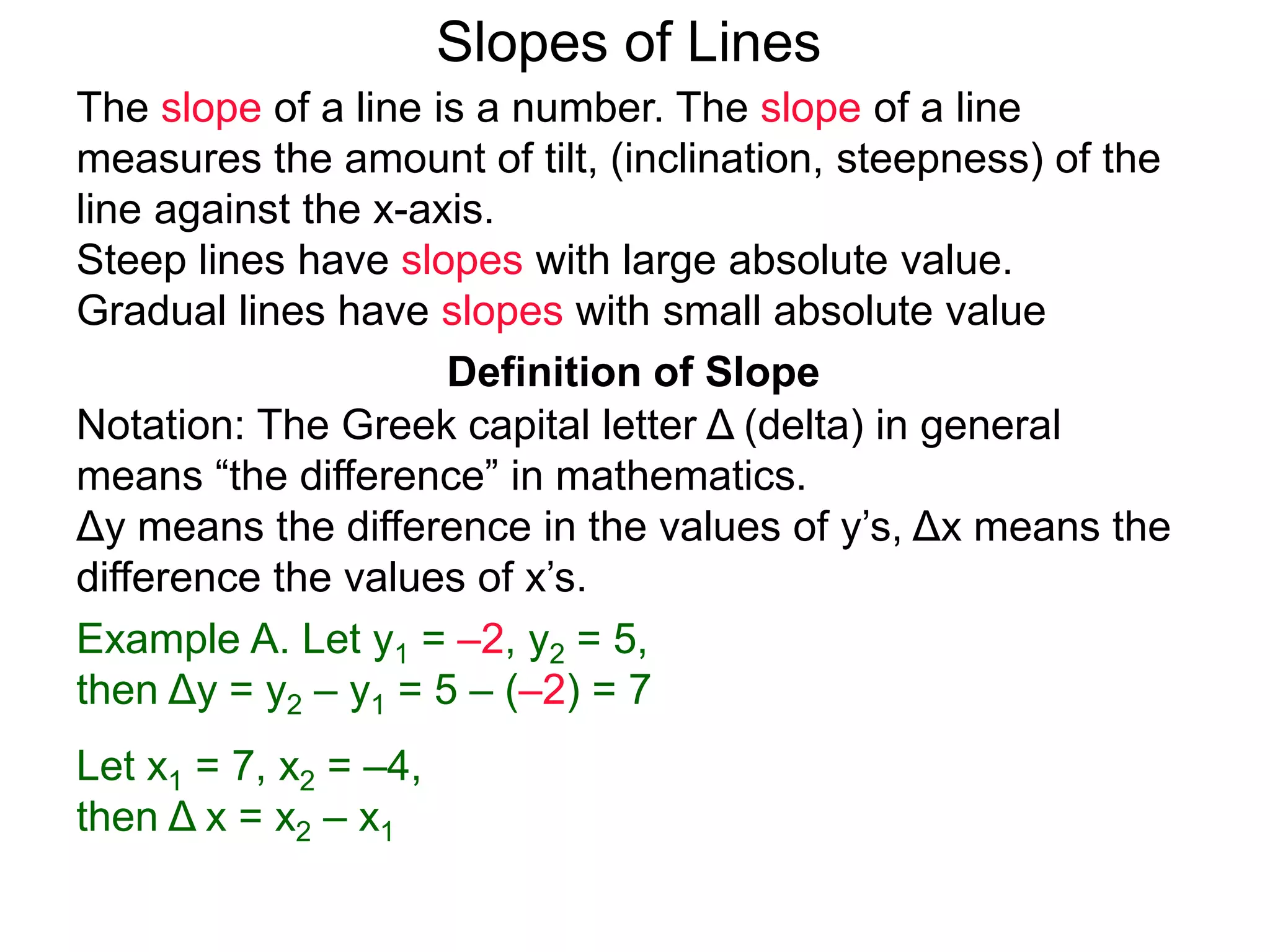
Let x1 = 7, x2 = –4,
The slope of a line is a number. The slope of a line
measures the amount of tilt, (inclination, steepness) of the
line against the x-axis.
Steep lines have slopes with large absolute value.
Gradual lines have slopes with small absolute value
Slopes of Lines
Definition of Slope
Notation: The Greek capital letter Δ (delta) in general
means “the difference” in mathematics.
Δy means the difference in the values of y’s, Δx means the
difference the values of x’s.
Example A. Let y1 = –2, y2 = 5,
then Δy = y2 – y1 = 5 – (–2) = 7
Let x1 = 7, x2 = –4,
then Δ x = x2 – x1
The slope of a line is a number. The slope of a line
measures the amount of tilt, (inclination, steepness) of the
line against the x-axis.
Steep lines have slopes with large absolute value.
Gradual lines have slopes with small absolute value
Slopes of Lines
Definition of Slope
Notation: The Greek capital letter Δ (delta) in general
means “the difference” in mathematics.
Δy means the difference in the values of y’s, Δx means the
difference the values of x’s.
Example A. Let y1 = –2, y2 = 5,
then Δy = y2 – y1 = 5 – (–2) = 7
Let x1 = 7, x2 = –4,
then Δ x = x2 – x1 = –4 – 7 = –11
The slope of a line is a number. The slope of a line
measures the amount of tilt, (inclination, steepness) of the
line against the x-axis.
Steep lines have slopes with large absolute value.
Gradual lines have slopes with small absolute value
Definition of Slope
Slopes of Lines
Definition of Slope
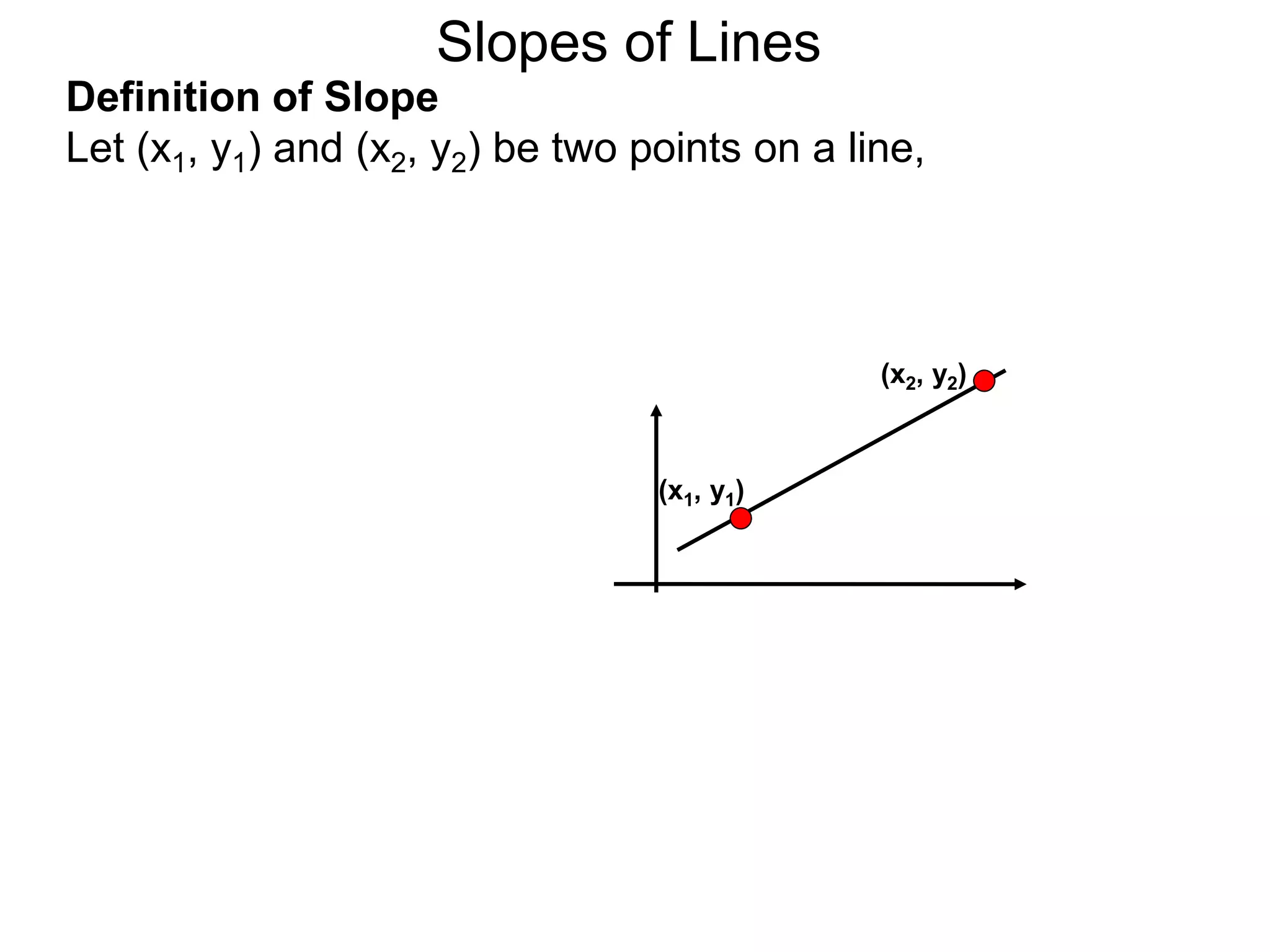
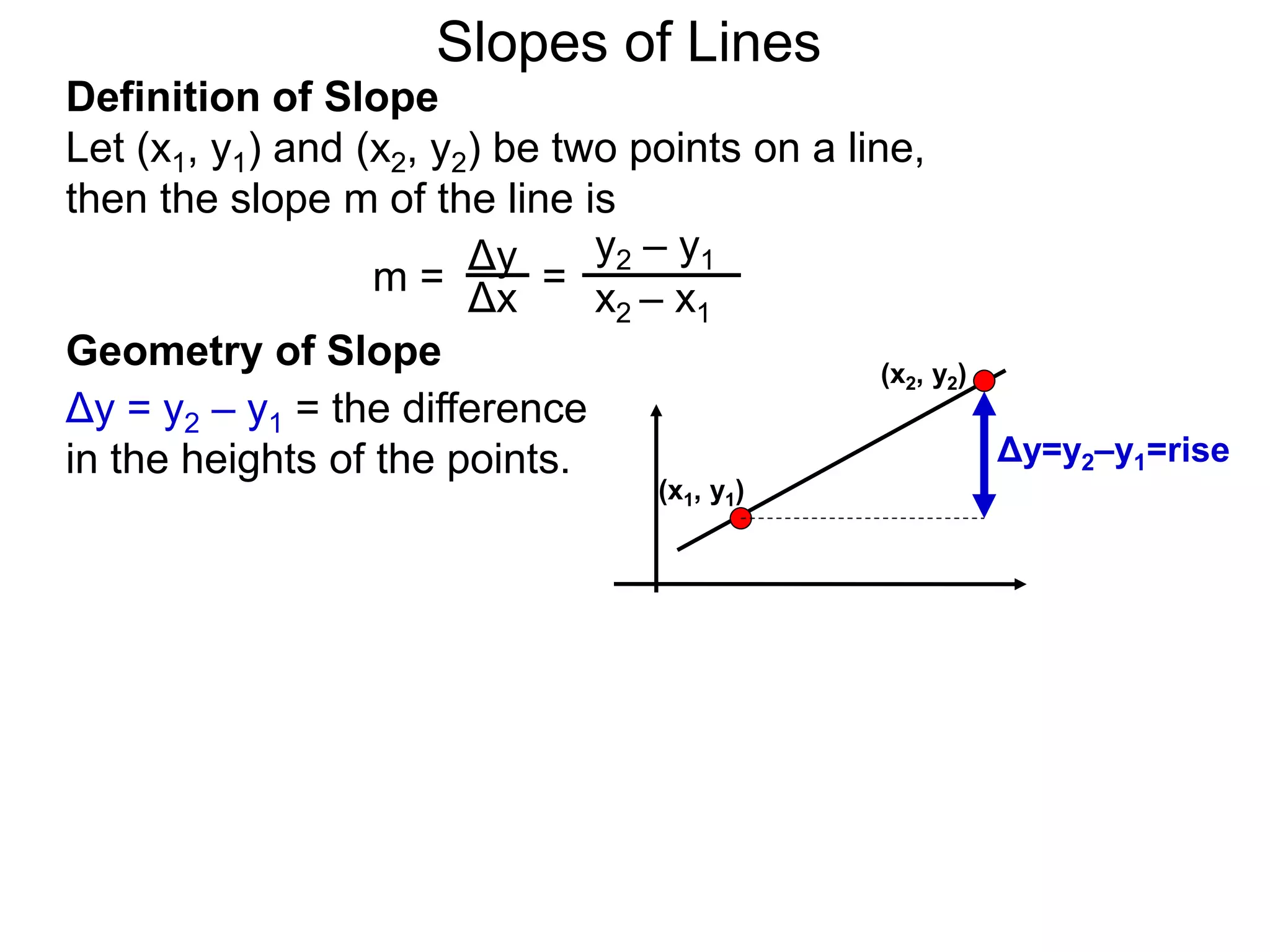
Let (x1, y1) and (x2, y2) be two points on a line,
Slopes of Lines
(x1, y1)
(x2, y2)
Definition of Slope
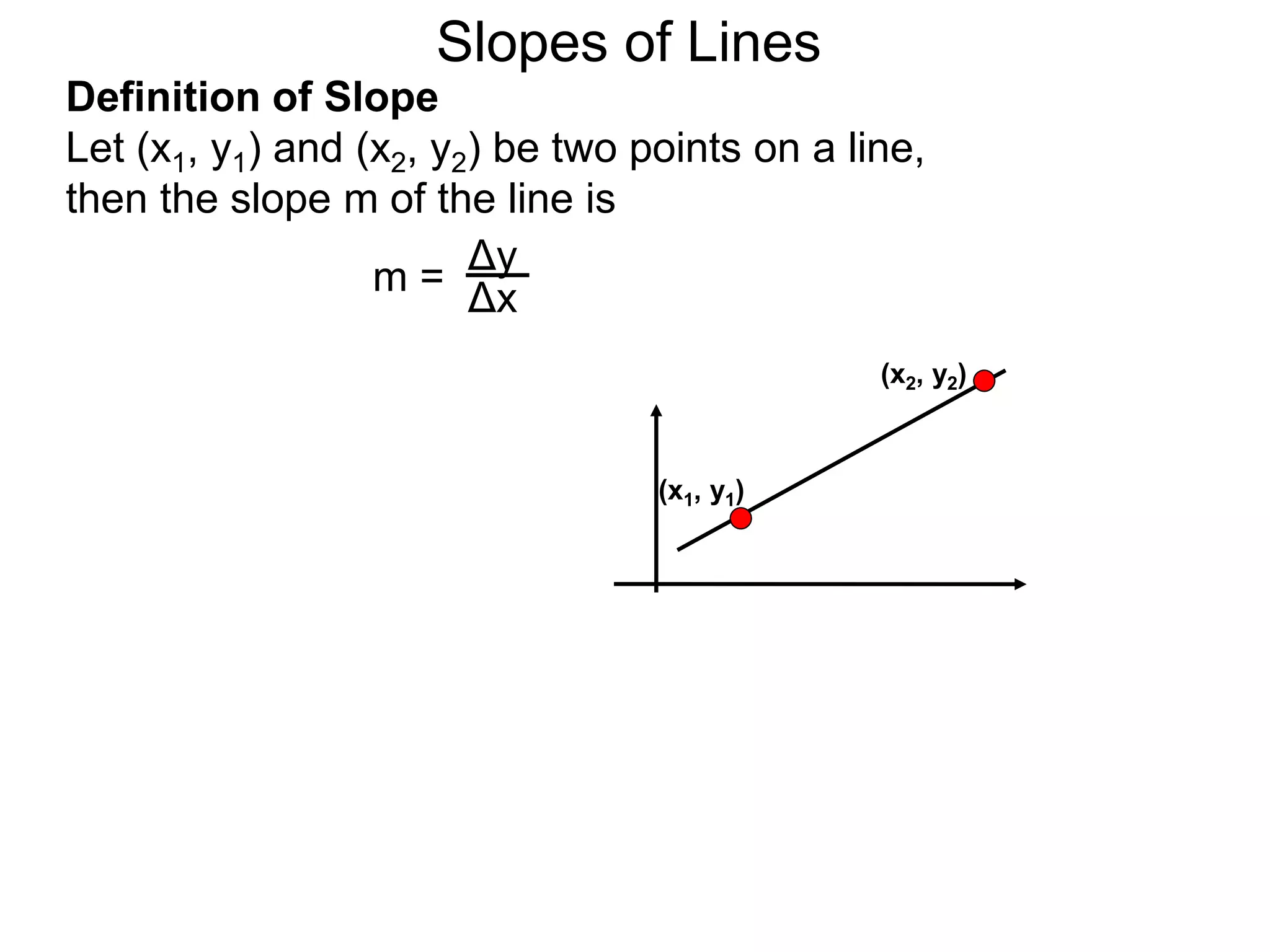
Let (x1, y1) and (x2, y2) be two points on a line,
then the slope m of the line is
Δy
Δxm =
Slopes of Lines
(x1, y1)
(x2, y2)
Definition of Slope
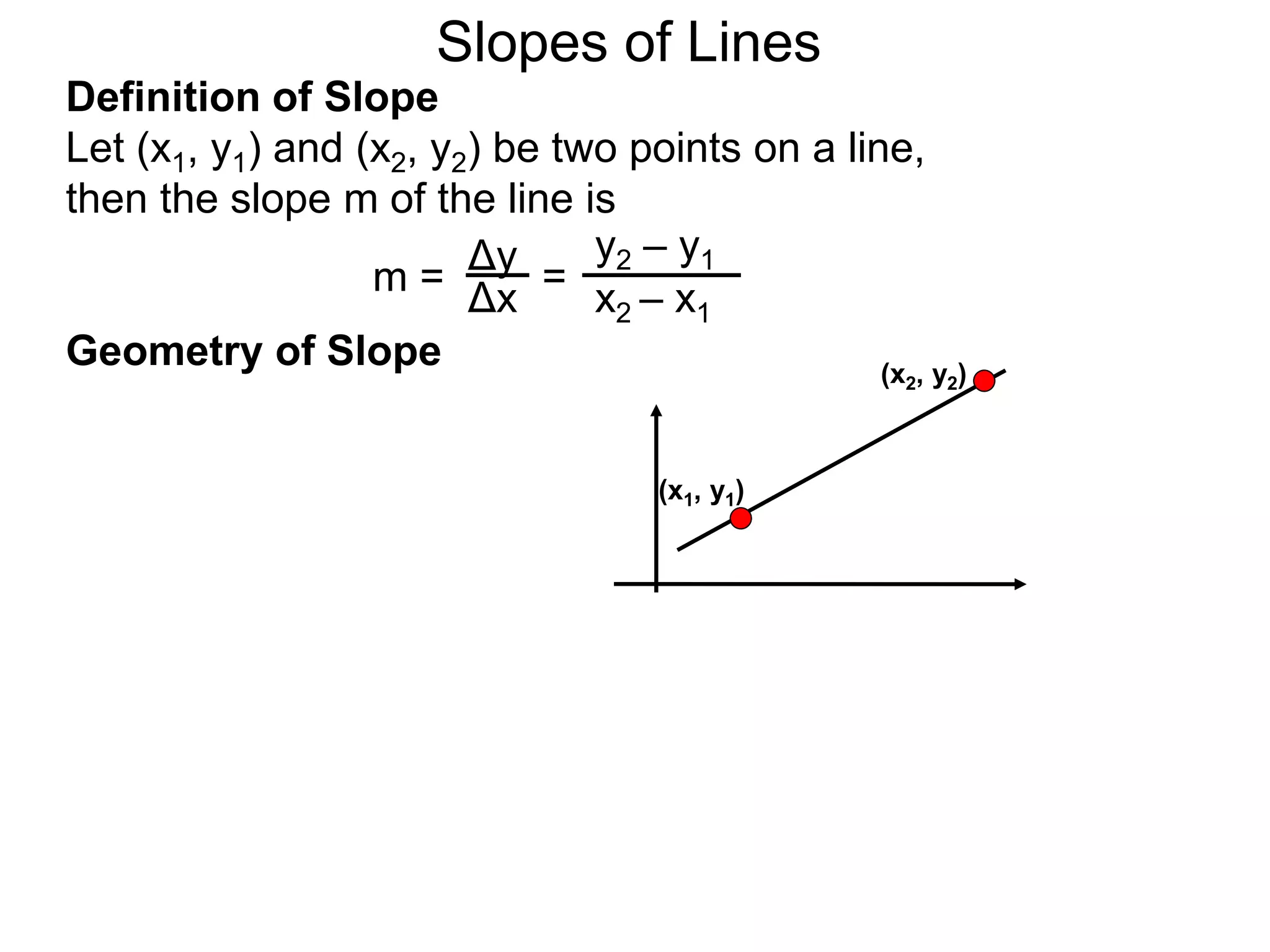
Let (x1, y1) and (x2, y2) be two points on a line,
then the slope m of the line is
Δy
Δx
y2 – y1
x2 – x1
m = =
Slopes of Lines
(x1, y1)
(x2, y2)
Definition of Slope
Let (x1, y1) and (x2, y2) be two points on a line,
then the slope m of the line is
Δy
Δx
y2 – y1
x2 – x1
m = =
Slopes of Lines
Geometry of Slope
(x1, y1)
(x2, y2)
Definition of Slope
Let (x1, y1) and (x2, y2) be two points on a line,
then the slope m of the line is
Δy
Δx
y2 – y1
x2 – x1
m = =
Slopes of Lines
(x1, y1)
(x2, y2)
Δy=y2–y1=rise
Geometry of Slope
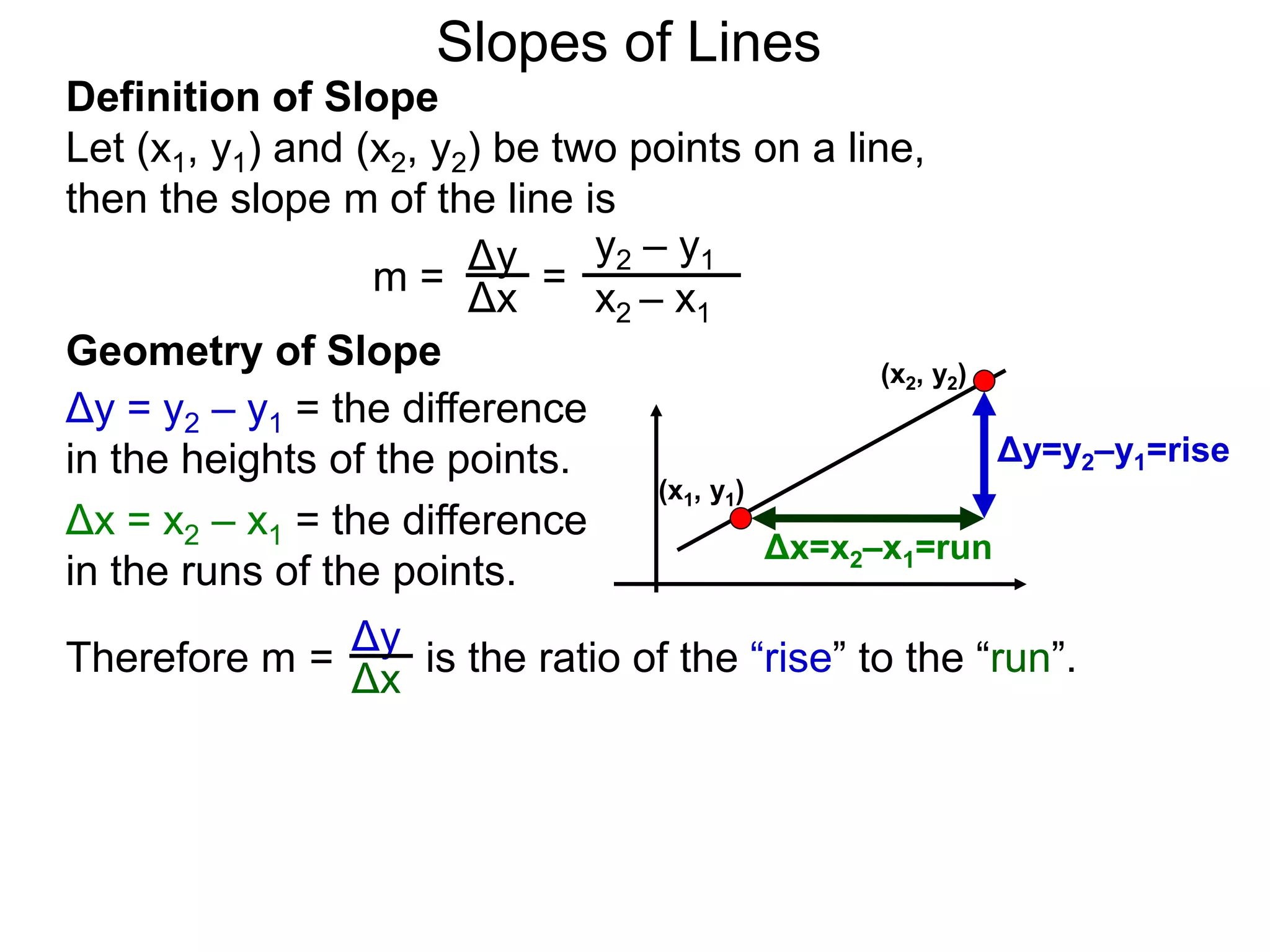
Δy = y2 – y1 = the difference
in the heights of the points.
Definition of Slope
Let (x1, y1) and (x2, y2) be two points on a line,
then the slope m of the line is
Δy
Δx
y2 – y1
x2 – x1
m = =
Slopes of Lines
(x1, y1)
(x2, y2)
Δy=y2–y1=rise
Δx=x2–x1=run
Geometry of Slope
Δy = y2 – y1 = the difference
in the heights of the points.
Δx = x2 – x1 = the difference
in the runs of the points.
Definition of Slope
Let (x1, y1) and (x2, y2) be two points on a line,
then the slope m of the line is
Δy
Δx
y2 – y1
x2 – x1
m = =
Slopes of Lines
(x1, y1)
(x2, y2)
Δy=y2–y1=rise
Δx=x2–x1=run
Geometry of Slope
Δy = y2 – y1 = the difference
in the heights of the points.
Δx = x2 – x1 = the difference
in the runs of the points.
Δy
Δx
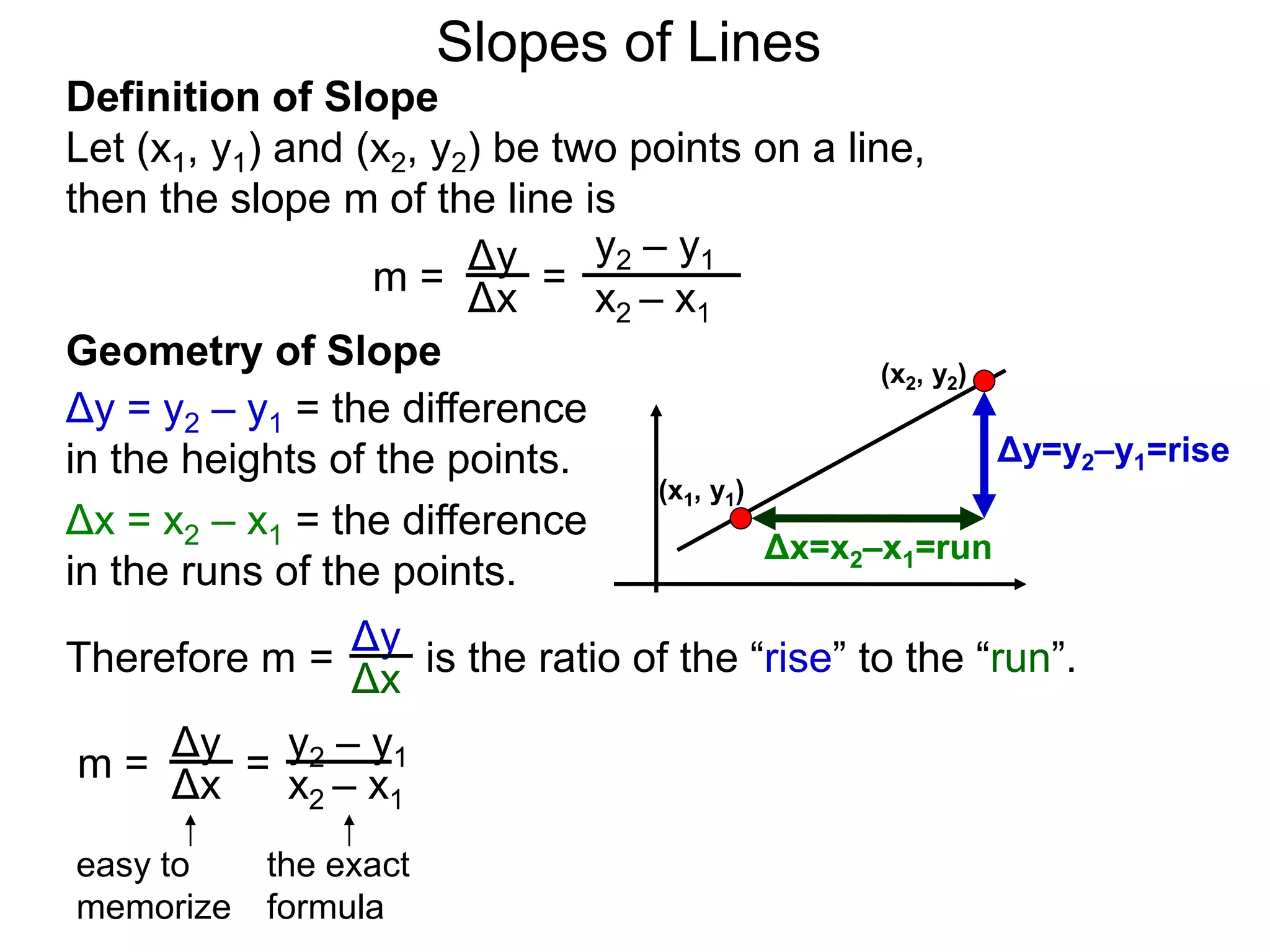
=Therefore m is the ratio of the “rise” to the “run”.
Definition of Slope
Let (x1, y1) and (x2, y2) be two points on a line,
then the slope m of the line is
Δy
Δx
y2 – y1
x2 – x1
m = =
Slopes of Lines
(x1, y1)
(x2, y2)
Δy=y2–y1=rise
Δx=x2–x1=run
Geometry of Slope
Δy = y2 – y1 = the difference
in the heights of the points.
Δx = x2 – x1 = the difference
in the runs of the points.
Δy
Δx
=Therefore m is the ratio of the “rise” to the “run”.
m = Δy
Δx
easy to
memorize
Definition of Slope
Let (x1, y1) and (x2, y2) be two points on a line,
then the slope m of the line is
Δy
Δx
y2 – y1
x2 – x1
m = =
Slopes of Lines
(x1, y1)
(x2, y2)
Δy=y2–y1=rise
Δx=x2–x1=run
Geometry of Slope
Δy = y2 – y1 = the difference
in the heights of the points.
Δx = x2 – x1 = the difference
in the runs of the points.
Δy
Δx
=Therefore m is the ratio of the “rise” to the “run”.
m = Δy
Δx
y2 – y1
x2 – x1
=
easy to
memorize
the exact
formula
Definition of Slope
Let (x1, y1) and (x2, y2) be two points on a line,
then the slope m of the line is
Δy
Δx
y2 – y1
x2 – x1
m = =
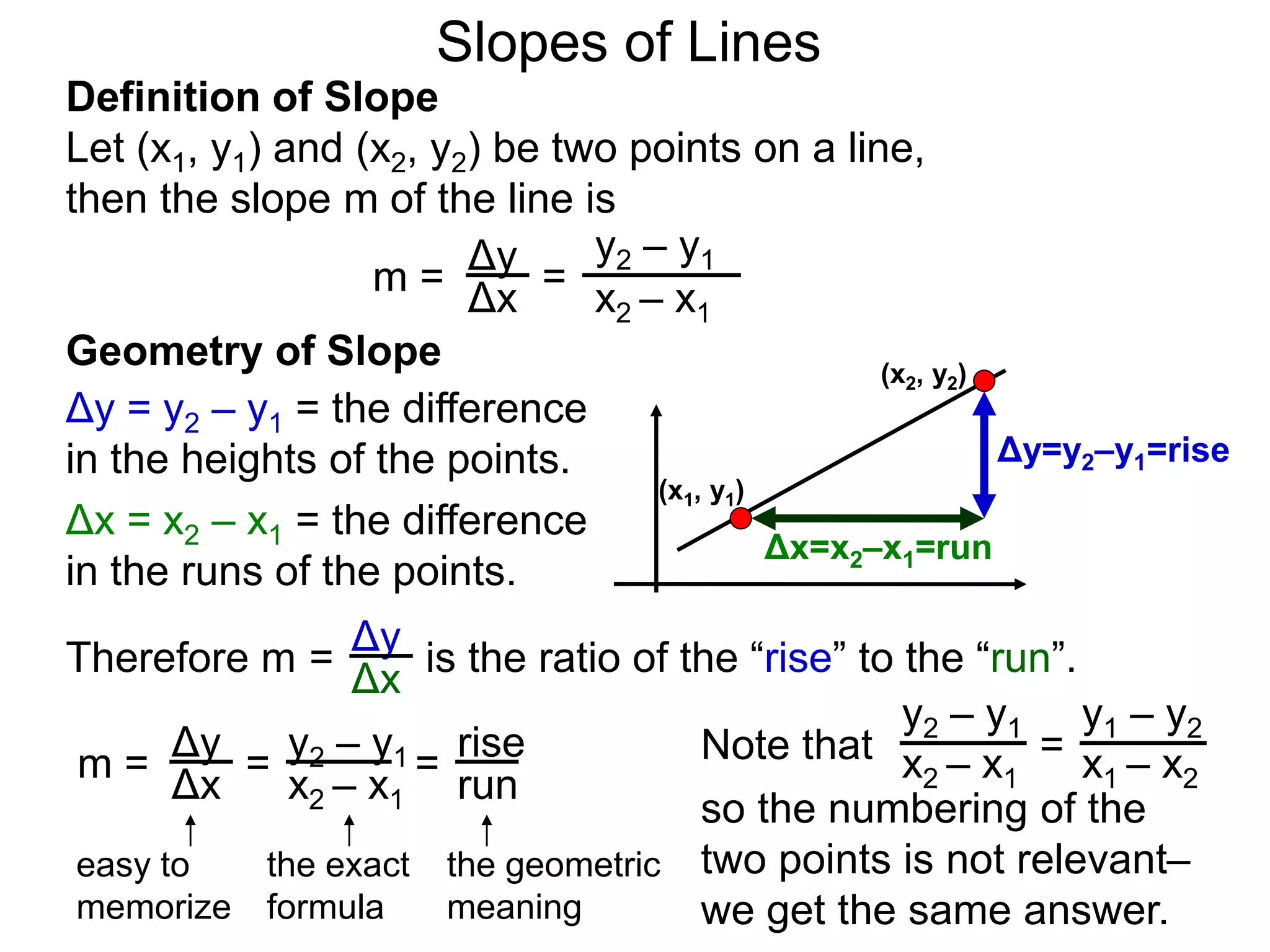
rise
run
=
Slopes of Lines
(x1, y1)
(x2, y2)
Δy=y2–y1=rise
Δx=x2–x1=run
Geometry of Slope
Δy = y2 – y1 = the difference
in the heights of the points.
Δx = x2 – x1 = the difference
in the runs of the points.
Δy
Δx
=Therefore m is the ratio of the “rise” to the “run”.
m = Δy
Δx
y2 – y1
x2 – x1
=
easy to
memorize
the exact
formula
the geometric
meaning
Definition of Slope
Let (x1, y1) and (x2, y2) be two points on a line,
then the slope m of the line is
Δy
Δx
y2 – y1
x2 – x1
m = =
rise
run
=
Slopes of Lines
(x1, y1)
(x2, y2)
Δy=y2–y1=rise
Δx=x2–x1=run
Geometry of Slope
Δy = y2 – y1 = the difference
in the heights of the points.
Δx = x2 – x1 = the difference
in the runs of the points.
Δy
Δx
=Therefore m is the ratio of the “rise” to the “run”.
m = Δy
Δx
y2 – y1
x2 – x1
=
easy to
memorize
the exact
formula
the geometric
meaning
Note that
y2 – y1
x2 – x1
y1 – y2
x1 – x2
=
so the numbering of the
two points is not relevant–
we get the same answer.
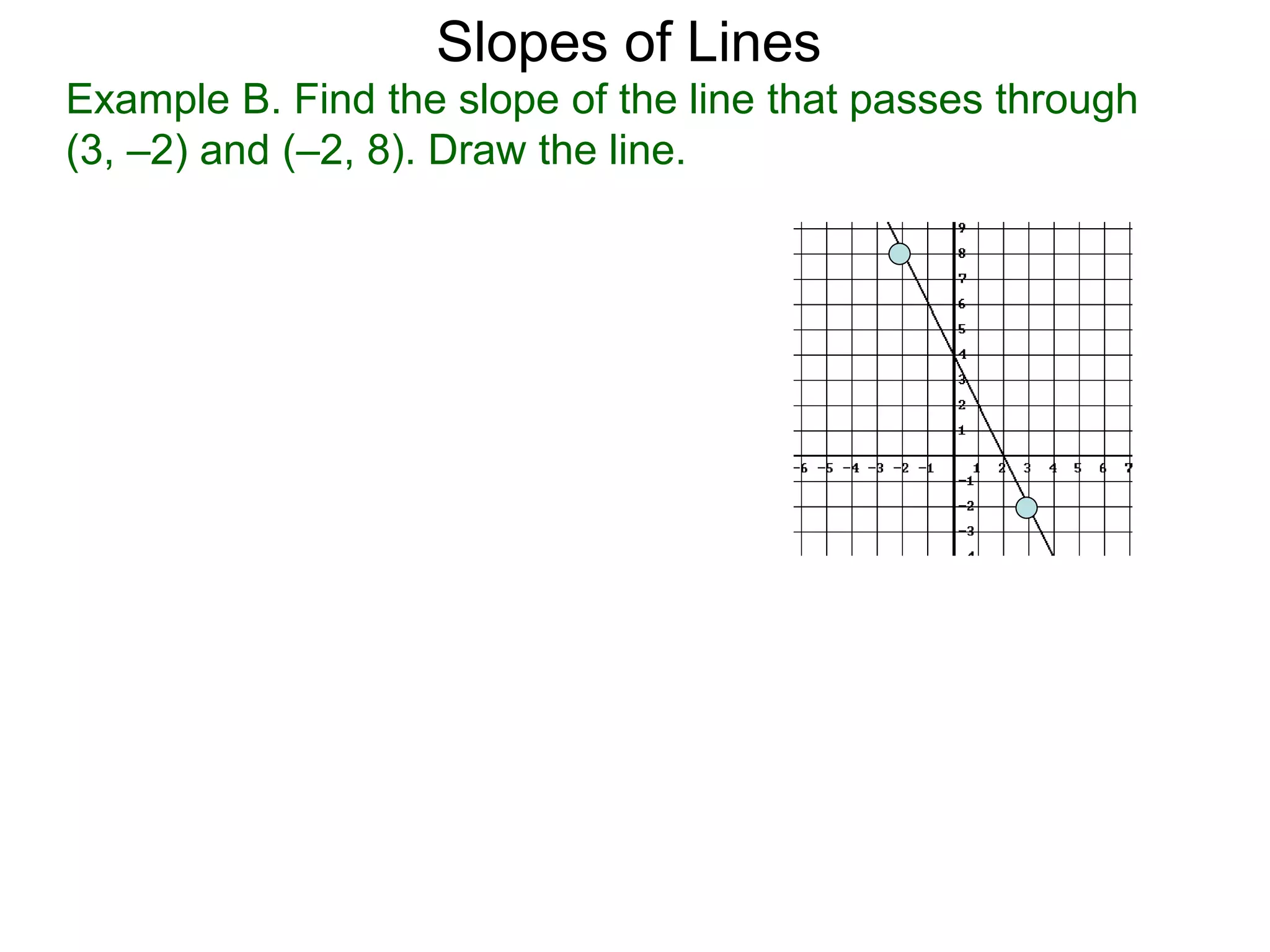
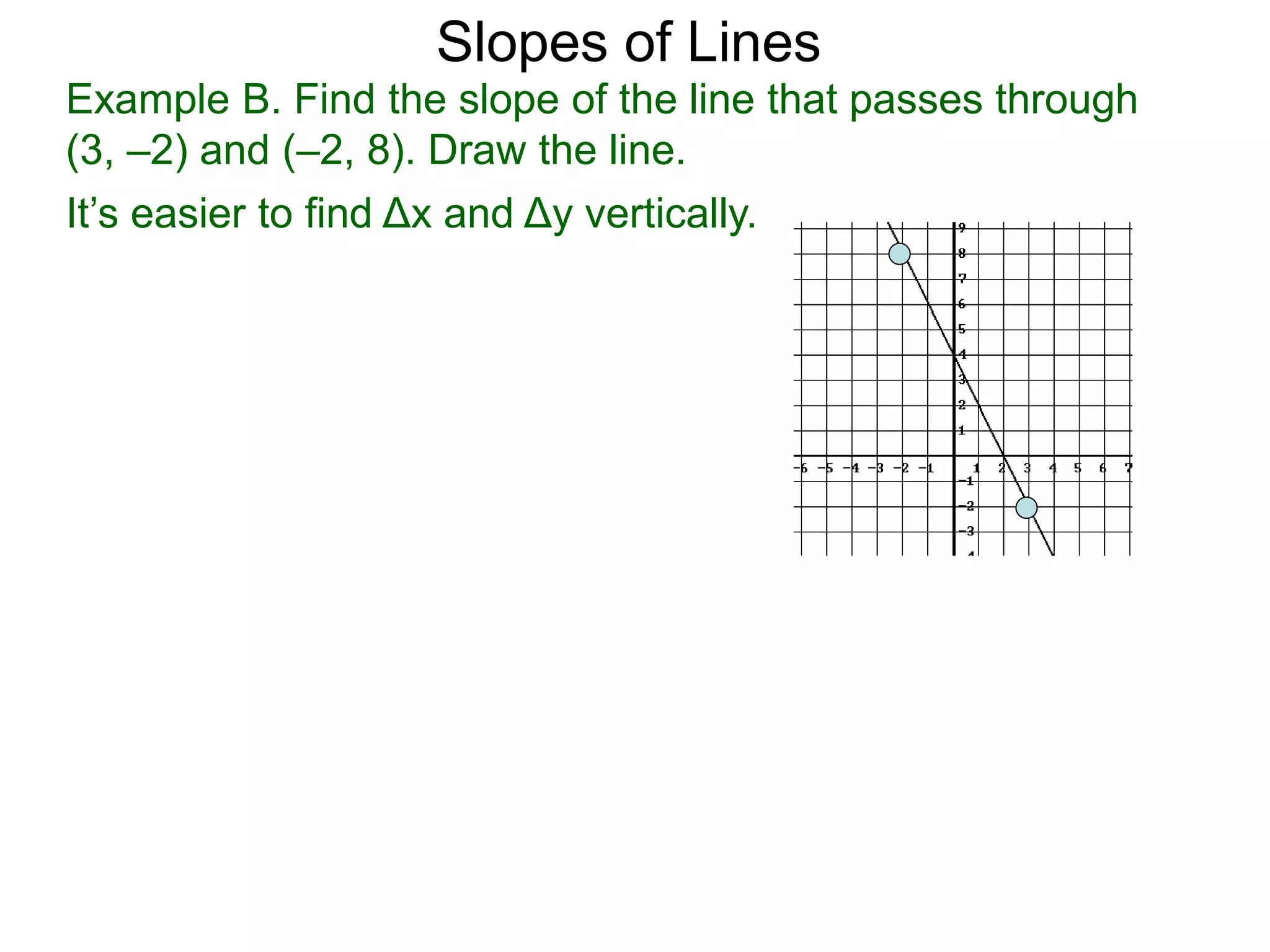
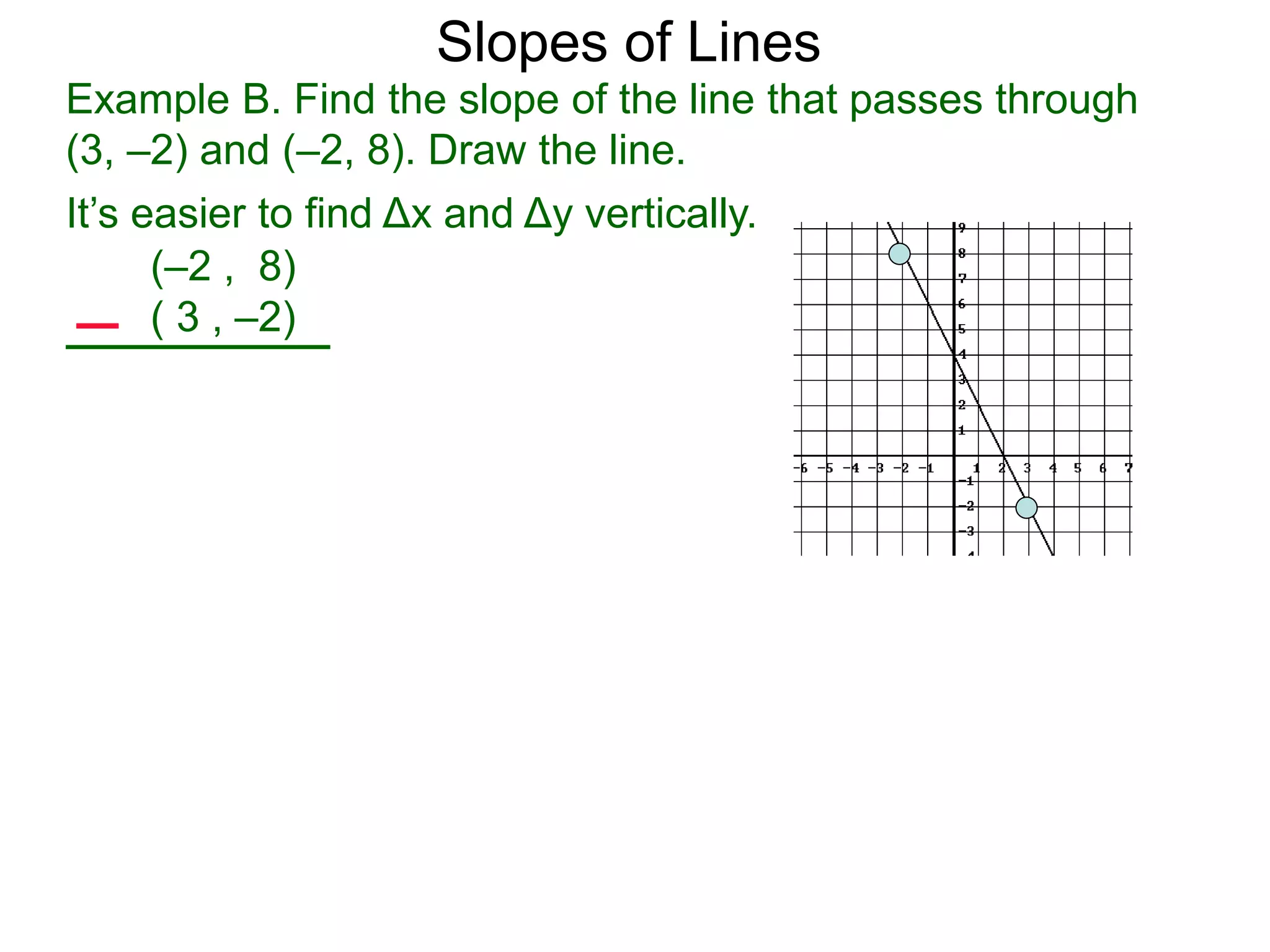
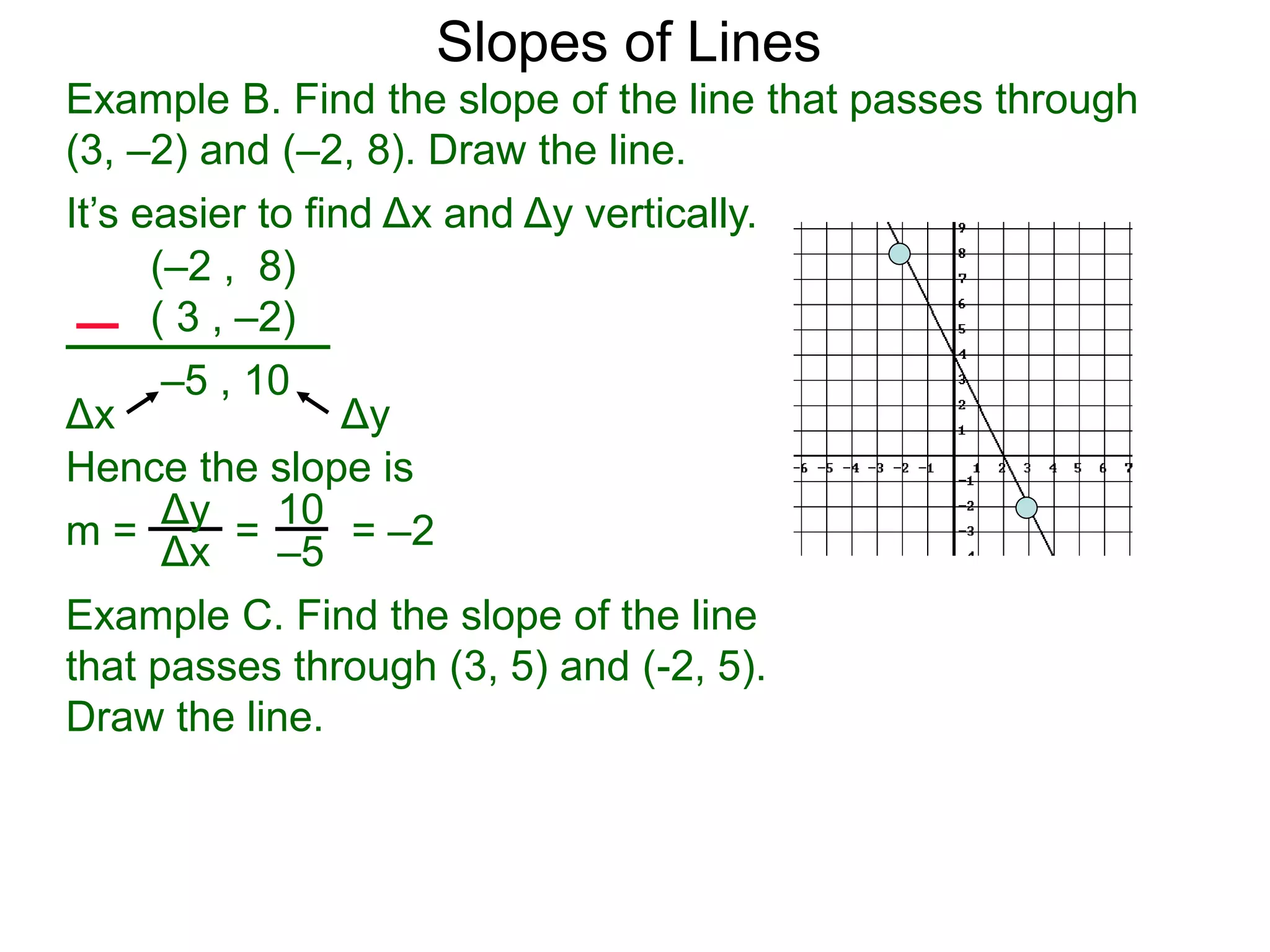
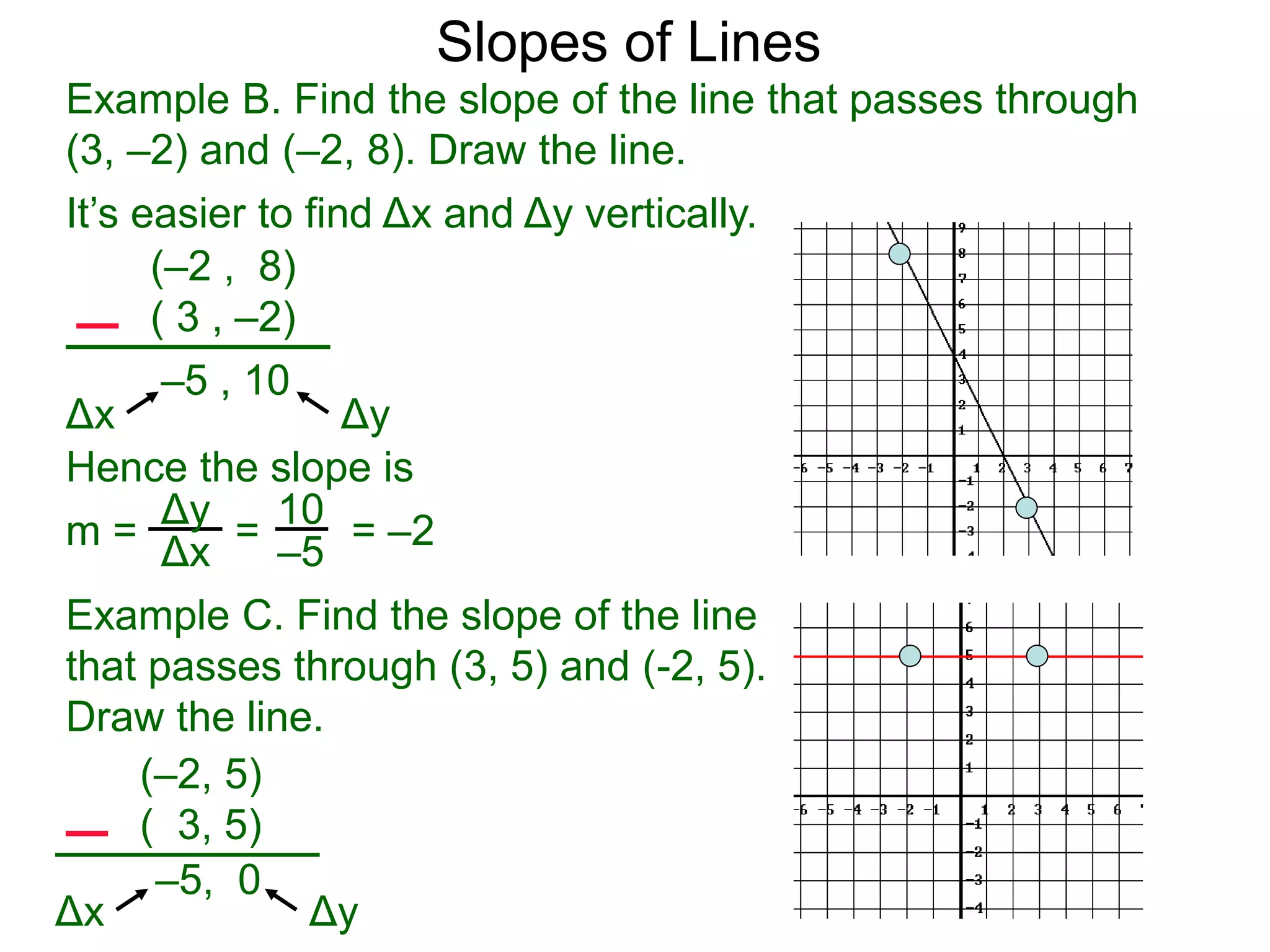
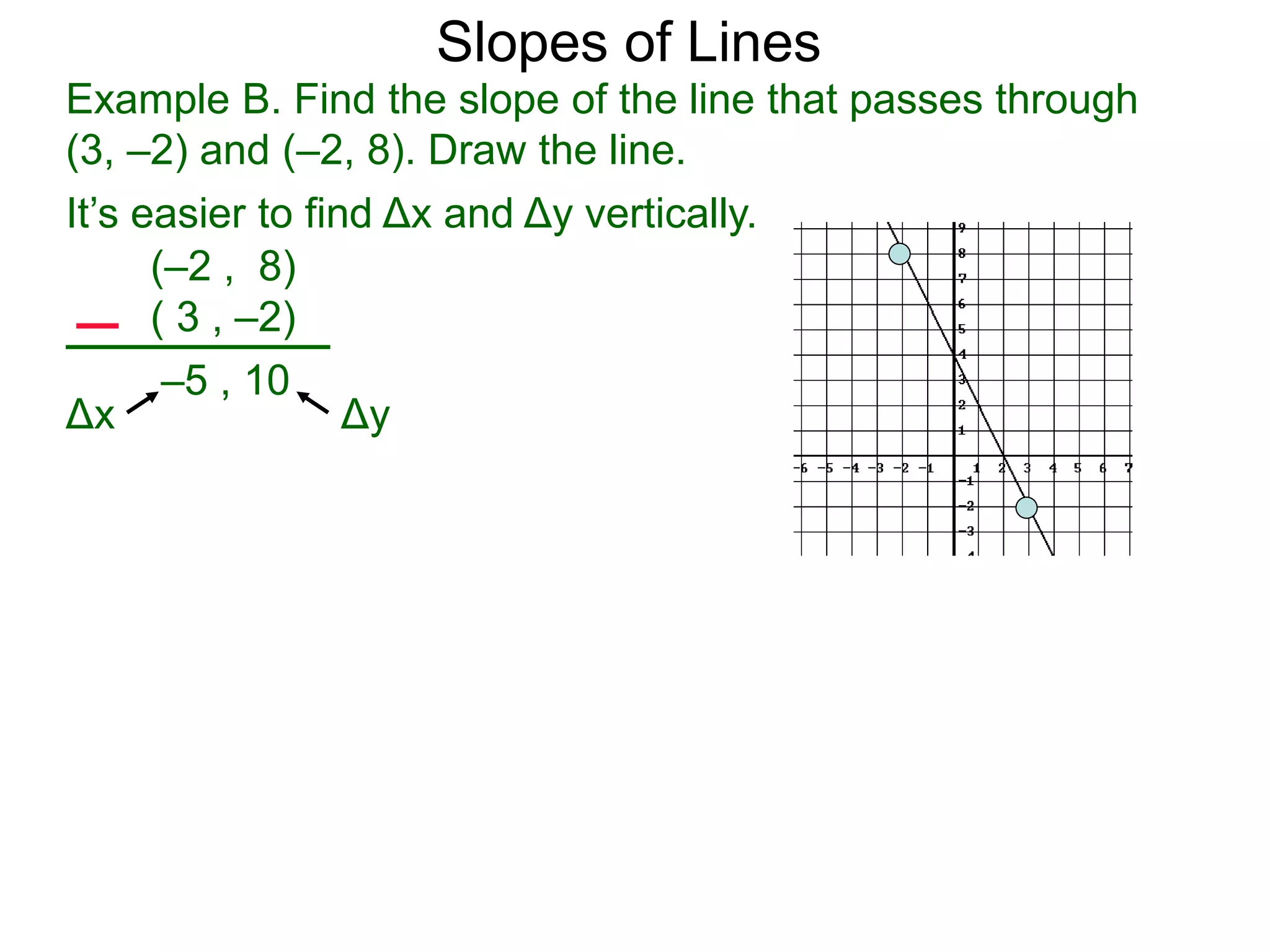
Example B. Find the slope of the line that passes through
(3, –2) and (–2, 8). Draw the line.
Slopes of Lines
Example B. Find the slope of the line that passes through
(3, –2) and (–2, 8). Draw the line.
Slopes of Lines
Example B. Find the slope of the line that passes through
(3, –2) and (–2, 8). Draw the line.
Slopes of Lines
It’s easier to find Δx and Δy vertically.
(–2 , 8)
( 3 , –2)
Example B. Find the slope of the line that passes through
(3, –2) and (–2, 8). Draw the line.
Slopes of Lines
It’s easier to find Δx and Δy vertically.
(–2 , 8)
( 3 , –2)
–5 , 10
Example B. Find the slope of the line that passes through
(3, –2) and (–2, 8). Draw the line.
Slopes of Lines
It’s easier to find Δx and Δy vertically.
Δy
(–2 , 8)
( 3 , –2)
–5 , 10
Δx
Example B. Find the slope of the line that passes through
(3, –2) and (–2, 8). Draw the line.
Slopes of Lines
It’s easier to find Δx and Δy vertically.
Δy
Δx
(–2 , 8)
( 3 , –2)
–5 , 10
Δy
Δx
Hence the slope is
Example B. Find the slope of the line that passes through
(3, –2) and (–2, 8). Draw the line.
Slopes of Lines
It’s easier to find Δx and Δy vertically.
m =
Δy
Δx
(–2 , 8)
( 3 , –2)
–5 , 10
Δy
Δx
Hence the slope is
10
–5
Example B. Find the slope of the line that passes through
(3, –2) and (–2, 8). Draw the line.
Slopes of Lines
It’s easier to find Δx and Δy vertically.
m = = = –2
Δy
Δx
(–2 , 8)
( 3 , –2)
–5 , 10
Δy
Δx
Hence the slope is
10
–5
Example B. Find the slope of the line that passes through
(3, –2) and (–2, 8). Draw the line.
Slopes of Lines
It’s easier to find Δx and Δy vertically.
m = = = –2
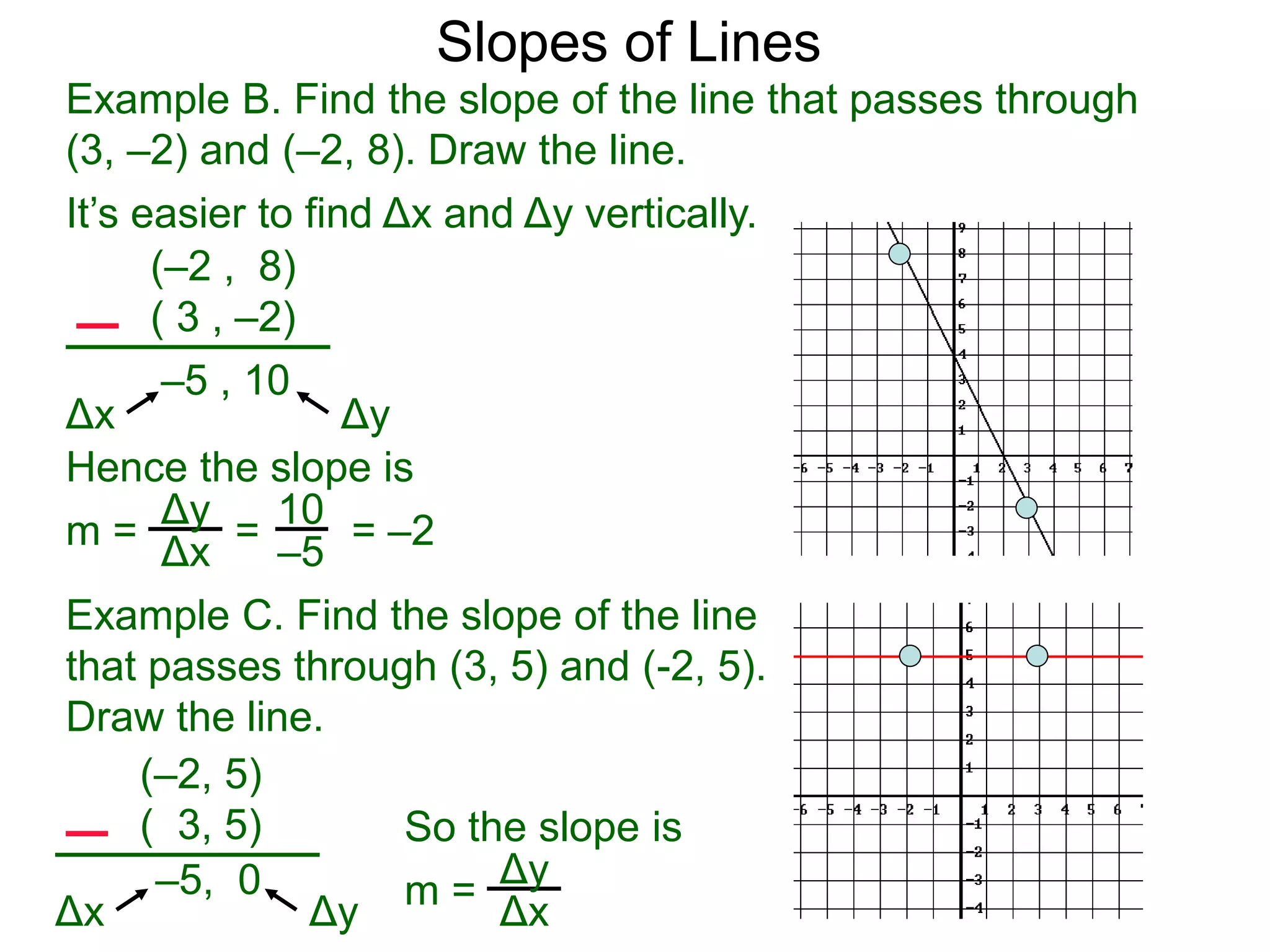
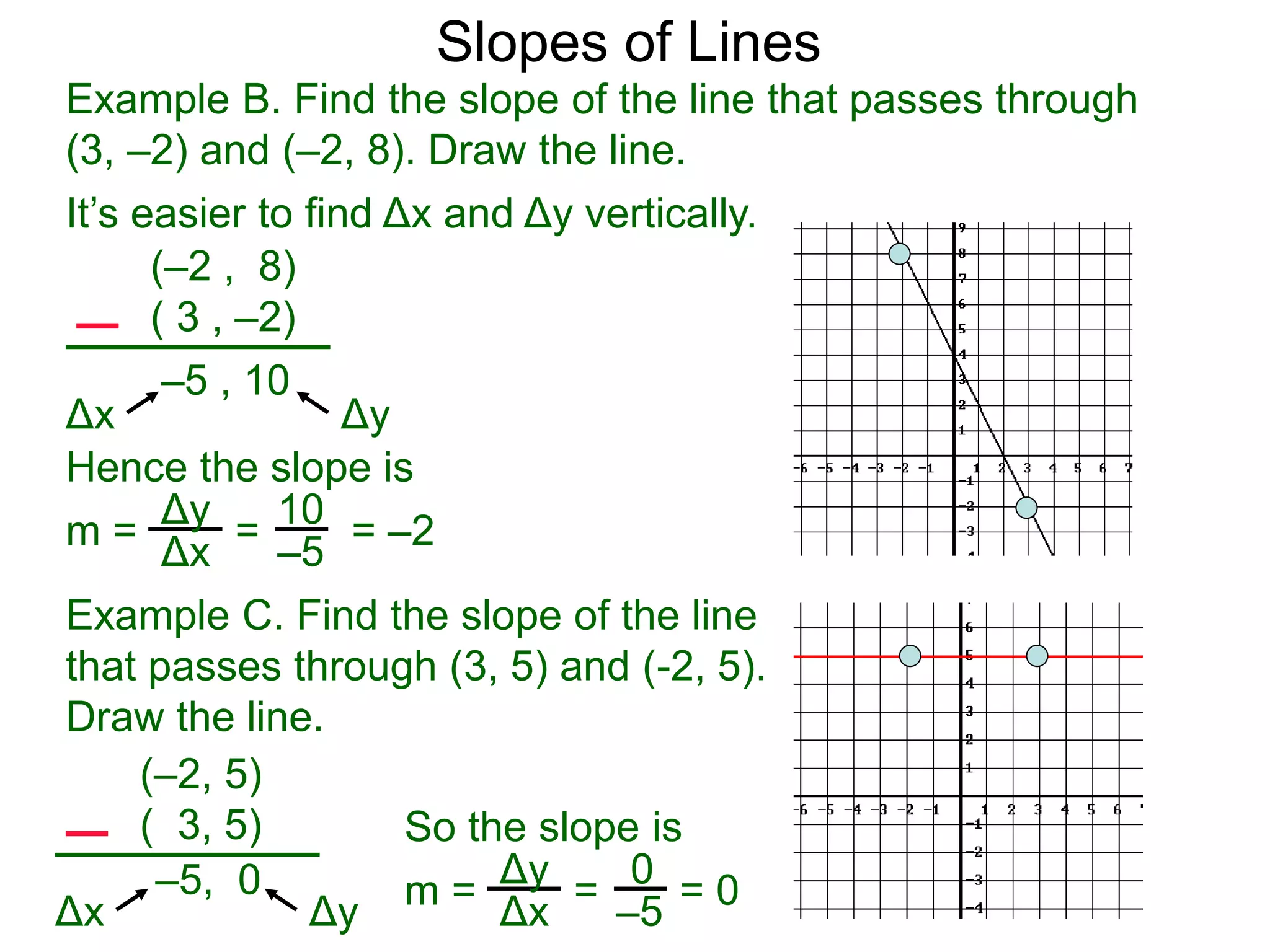
Example C. Find the slope of the line
that passes through (3, 5) and (-2, 5).
Draw the line.
Δy
Δx
(–2 , 8)
( 3 , –2)
–5 , 10
Δy
Δx
Hence the slope is
10
–5
Example B. Find the slope of the line that passes through
(3, –2) and (–2, 8). Draw the line.
Slopes of Lines
It’s easier to find Δx and Δy vertically.
m = = = –2
Example C. Find the slope of the line
that passes through (3, 5) and (-2, 5).
Draw the line.
Δy
Δx
(–2 , 8)
( 3 , –2)
–5 , 10
Δy
Δx
Hence the slope is
10
–5
Example B. Find the slope of the line that passes through
(3, –2) and (–2, 8). Draw the line.
Slopes of Lines
It’s easier to find Δx and Δy vertically.
m = = = –2
Example C. Find the slope of the line
that passes through (3, 5) and (-2, 5).
Draw the line.
(–2, 5)
( 3, 5)
Δy
Δx
(–2 , 8)
( 3 , –2)
–5 , 10
Δy
Δx
Hence the slope is
10
–5
Example B. Find the slope of the line that passes through
(3, –2) and (–2, 8). Draw the line.
Slopes of Lines
It’s easier to find Δx and Δy vertically.
m = = = –2
Example C. Find the slope of the line
that passes through (3, 5) and (-2, 5).
Draw the line.
Δy
(–2, 5)
( 3, 5)
–5, 0
Δx
Δy
Δx
(–2 , 8)
( 3 , –2)
–5 , 10
Δy
Δx
Hence the slope is
10
–5
Example B. Find the slope of the line that passes through
(3, –2) and (–2, 8). Draw the line.
Slopes of Lines
It’s easier to find Δx and Δy vertically.
m = = = –2
Example C. Find the slope of the line
that passes through (3, 5) and (-2, 5).
Draw the line.
Δy
(–2, 5)
( 3, 5)
–5, 0
Δx
So the slope is
Δx
Δy
m =
Δy
Δx
(–2 , 8)
( 3 , –2)
–5 , 10
Δy
Δx
Hence the slope is
10
–5
Example B. Find the slope of the line that passes through
(3, –2) and (–2, 8). Draw the line.
Slopes of Lines
It’s easier to find Δx and Δy vertically.
m = = = –2
Example C. Find the slope of the line
that passes through (3, 5) and (-2, 5).
Draw the line.
Δy
(–2, 5)
( 3, 5)
–5, 0
Δx
So the slope is
Δx
Δy 0
–5m = = = 0
As shown in example C, the slope of a horizontal line is 0,
i.e. it’s “tilt” is 0.
Slopes of Lines
As shown in example C, the slope of a horizontal line is 0,
i.e. it’s “tilt” is 0.
Slopes of Lines
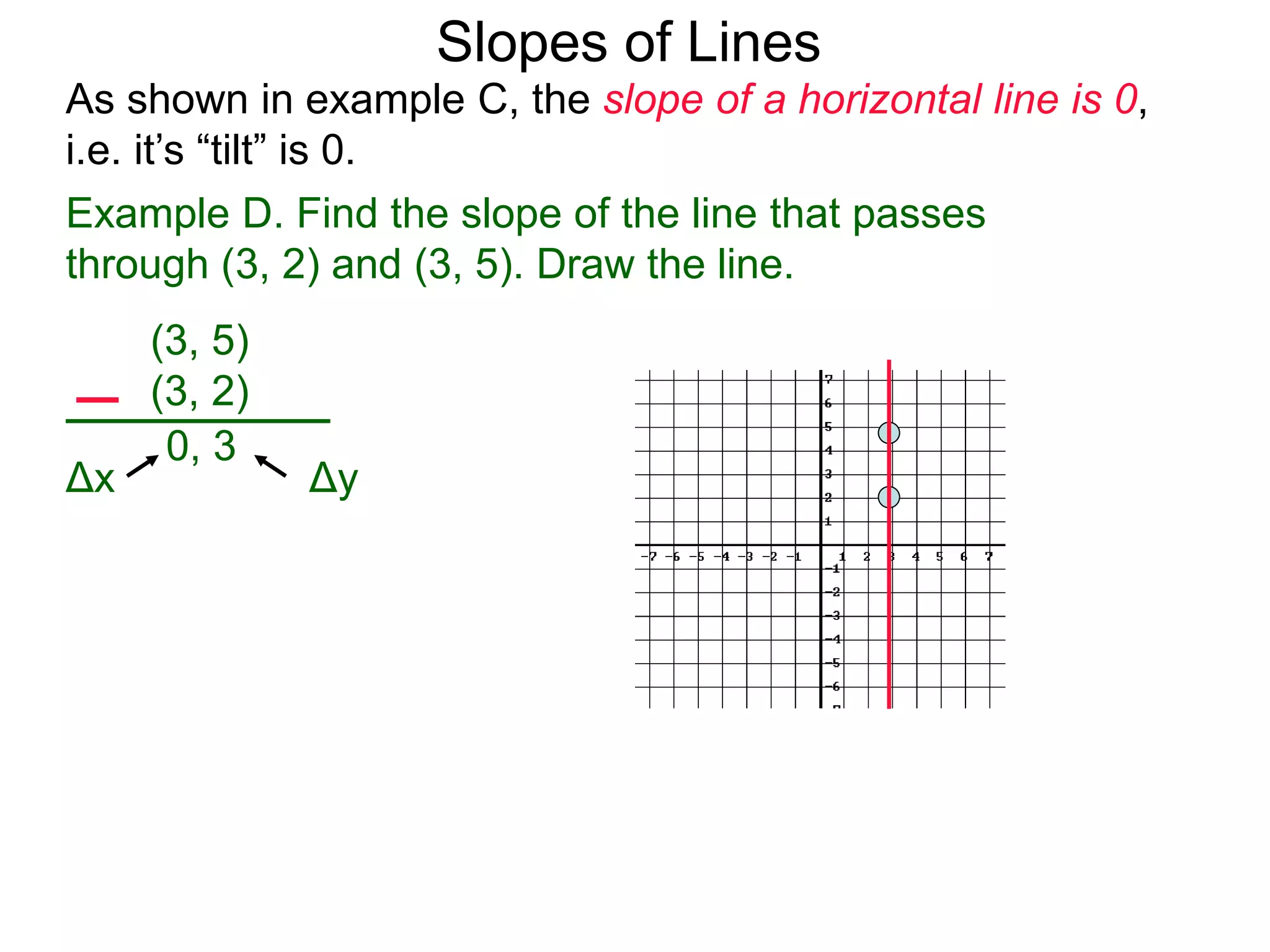
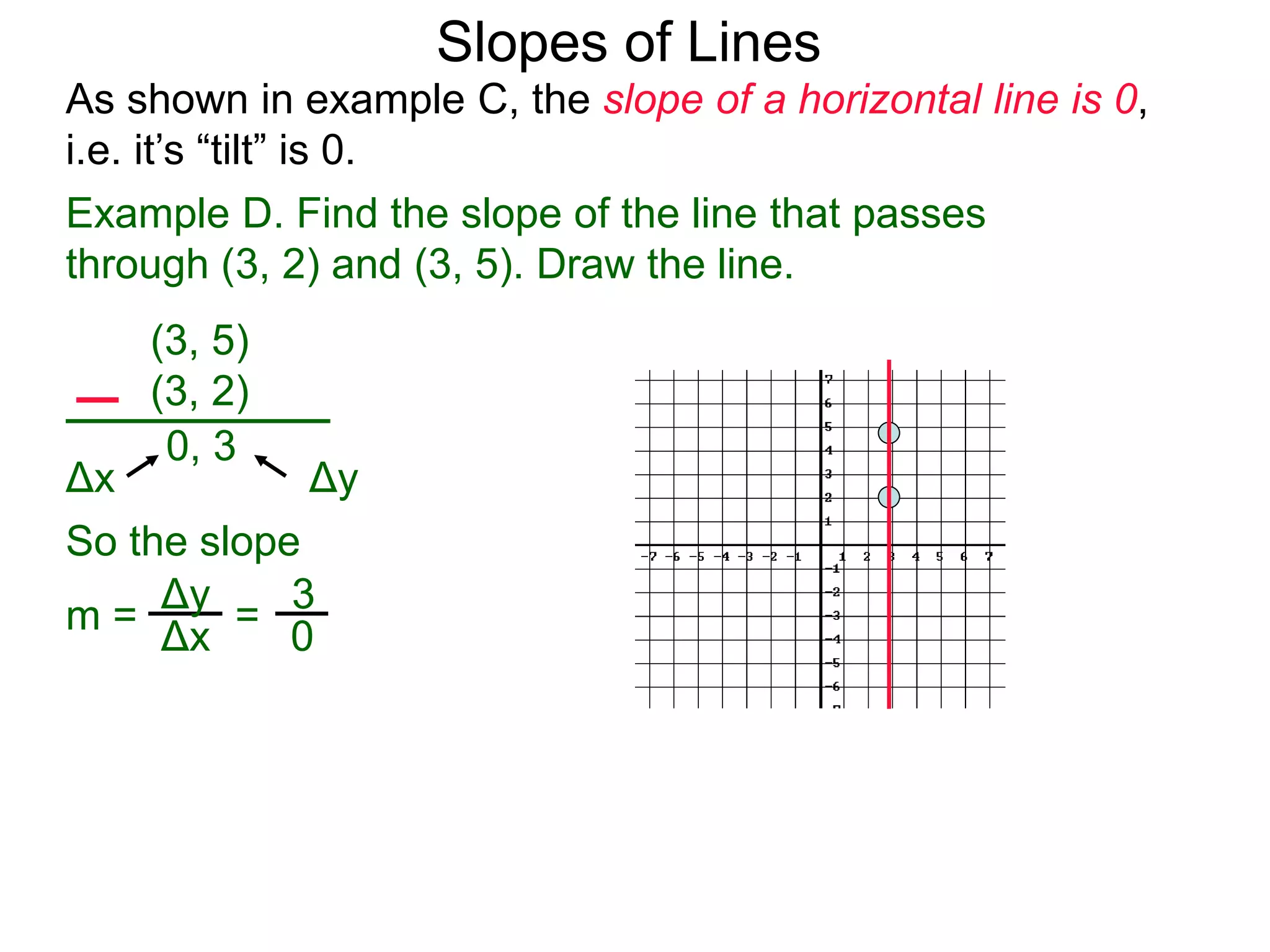
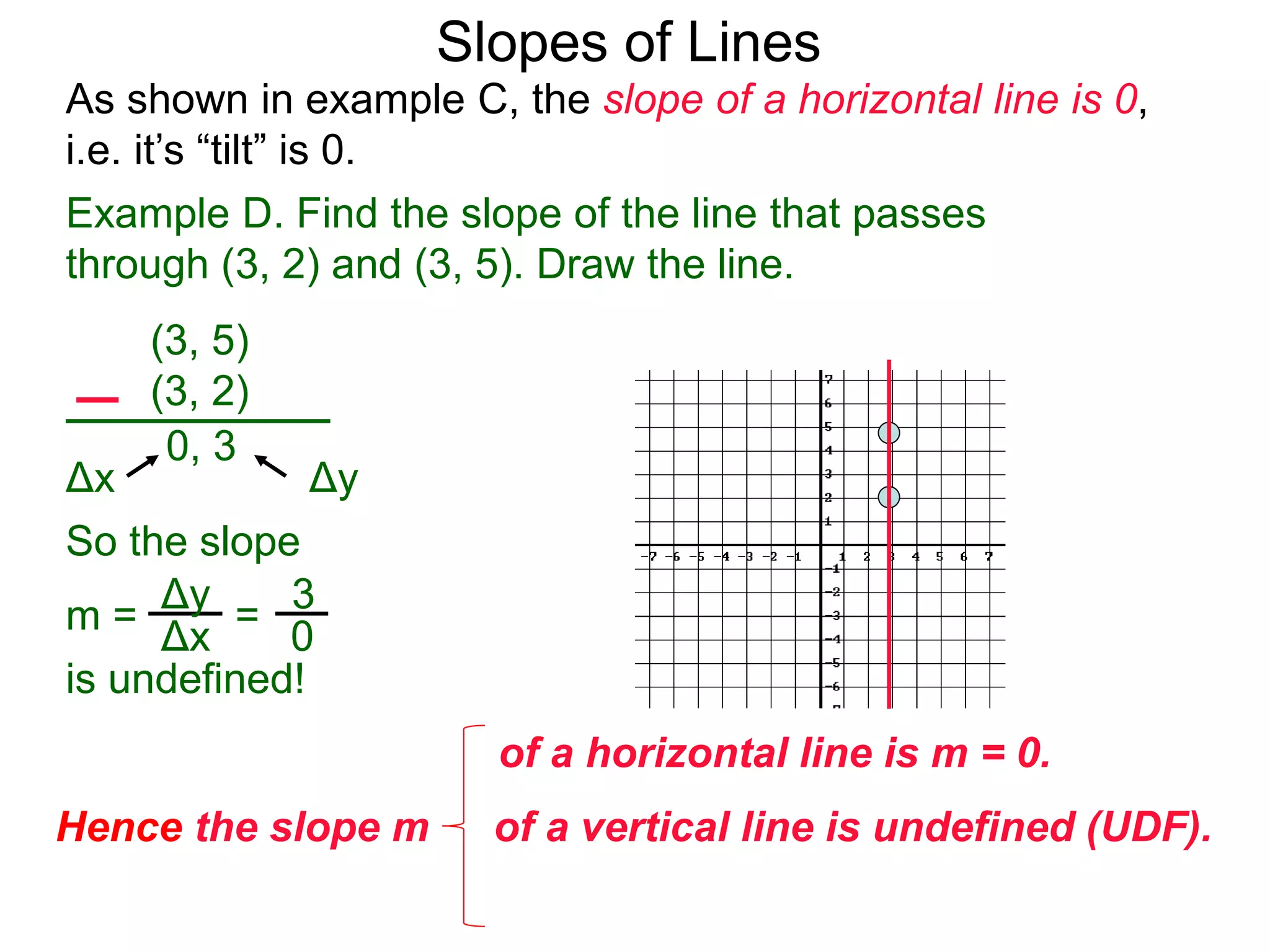
Example D. Find the slope of the line that passes
through (3, 2) and (3, 5). Draw the line.
As shown in example C, the slope of a horizontal line is 0,
i.e. it’s “tilt” is 0.
Slopes of Lines
Example D. Find the slope of the line that passes
through (3, 2) and (3, 5). Draw the line.
As shown in example C, the slope of a horizontal line is 0,
i.e. it’s “tilt” is 0.
Slopes of Lines
Example D. Find the slope of the line that passes
through (3, 2) and (3, 5). Draw the line.
Δy
(3, 5)
(3, 2)
0, 3
Δx
As shown in example C, the slope of a horizontal line is 0,
i.e. it’s “tilt” is 0.
Slopes of Lines
Example D. Find the slope of the line that passes
through (3, 2) and (3, 5). Draw the line.
Δy
(3, 5)
(3, 2)
0, 3
Δx
So the slope
Δx
Δy 3
0
m = =
As shown in example C, the slope of a horizontal line is 0,
i.e. it’s “tilt” is 0.
Slopes of Lines
Example D. Find the slope of the line that passes
through (3, 2) and (3, 5). Draw the line.
Δy
(3, 5)
(3, 2)
0, 3
Δx
So the slope
Δx
Δy 3
0
m = =
is undefined!
As shown in example C, the slope of a horizontal line is 0,
i.e. it’s “tilt” is 0.
Slopes of Lines
Example D. Find the slope of the line that passes
through (3, 2) and (3, 5). Draw the line.
Δy
(3, 5)
(3, 2)
0, 3
Δx
So the slope
Δx
Δy 3
0
m = =
is undefined!
Hence the slope m
of a horizontal line is m = 0.
As shown in example C, the slope of a horizontal line is 0,
i.e. it’s “tilt” is 0.
Slopes of Lines
Example D. Find the slope of the line that passes
through (3, 2) and (3, 5). Draw the line.
Δy
(3, 5)
(3, 2)
0, 3
Δx
So the slope
Δx
Δy 3
0
m = =
is undefined!
Hence the slope m of a vertical line is undefined (UDF).
of a horizontal line is m = 0.
As shown in example C, the slope of a horizontal line is 0,
i.e. it’s “tilt” is 0.
Slopes of Lines
Example D. Find the slope of the line that passes
through (3, 2) and (3, 5). Draw the line.
Δy
(3, 5)
(3, 2)
0, 3
Δx
So the slope
Δx
Δy 3
0
m = =
is undefined!
Hence the slope m of a vertical line is undefined (UDF).
of a horizontal line is m = 0.
of a tilted line is a non–zero number.
Exercise A. Identify the vertical and the horizontal lines by
inspection first. Find their slopes or if it’s undefined, state so.
Fine the slopes of the other ones by solving for the y.
1. x – y = 3 2. 2x = 6 3. –y – 7= 0
4. 0 = 8 – 2x 5. y = –x + 4 6. 2x/3 – 3 = 6/5
7. 2x = 6 – 2y 8. 4y/5 – 12 = 3x/4 9. 2x + 3y = 3
10. –6 = 3x – 2y 11. 3x + 2 = 4y + 3x 12. 5x/4 + 2y/3 = 2
Exercise B.
13–18. Select two points and estimate the slope of each line.
13. 14. 15.
More on Slopes
16. 17. 18.
Exercise C. Draw and find the slope of the line that passes
through the given two points. Identify the vertical line and the
horizontal lines by inspection first.
19. (0, –1), (–2, 1) 20. (1, –2), (–2, 0) 21. (1, –2), (–2, –1)
22. (3, –1), (3, 1) 23. (1, –2), (–2, 3) 24. (2, –1), (3, –1)
25. (4, –2), (–3, 1) 26. (4, –2), (4, 0) 27. (7, –2), (–2, –6)
28. (3/2, –1), (3/2, 1) 29. (3/2, –1), (1, –3/2)
30. (–5/2, –1/2), (1/2, 1) 31. (3/2, 1/3), (1/3, 1/3)
32. (–2/3, –1/4), (1/2, 2/3) 33. (3/4, –1/3), (1/3, 3/2)
More on Slopes
Exercise D.
34. Identify which lines are parallel and which one are
perpendicular.
A. The line that passes through (0, 1), (1, –2)
D. 2x – 4y = 1
B. C.
E. The line that’s perpendicular to 3y = x
F. The line with the x–intercept at 3 and y intercept at 6.
Find the slope, if possible of each of the following lines.
35. The line passes with the x intercept at x = 2,
and y–intercept at y = –5.
More on Slopes
36. The equation of the line is 3x = –5y+7
37. The equation of the line is 0 = –5y+7
38. The equation of the line is 3x = 7
39. The line is parallel to 2y = 5 – 6x
40. the line is perpendicular to 2y = 5 – 6x
41. The line is parallel to the line in problem 30.
42. the line is perpendicular to line in problem 31.
43. The line is parallel to the line in problem 33.
44. the line is perpendicular to line in problem 34.
More on Slopes
Find the slope, if possible of each of the following lines
Summary of Slope
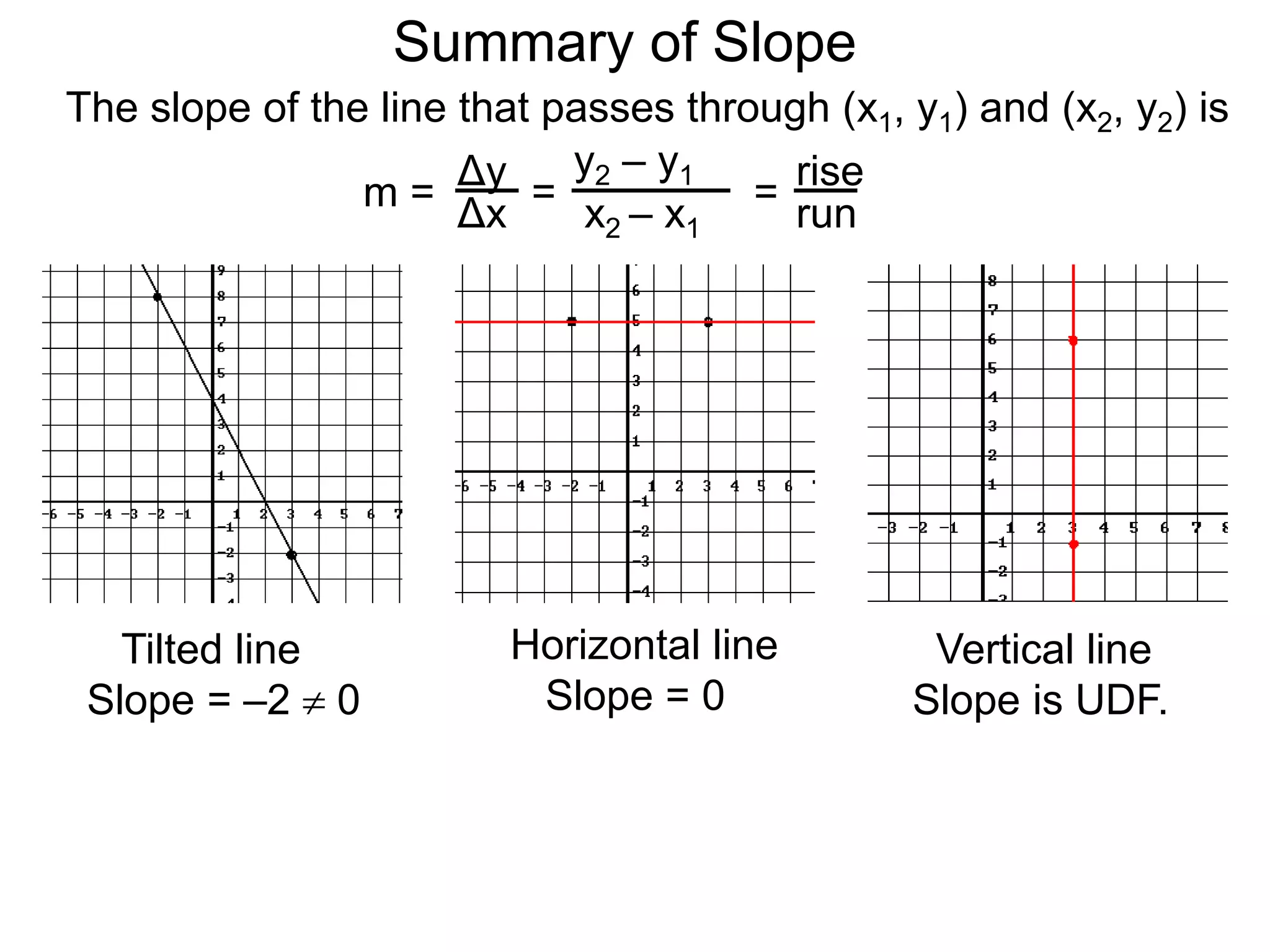
The slope of the line that passes through (x1, y1) and (x2, y2) is
Horizontal line
Slope = 0
Vertical line
Slope is UDF.
Tilted line
Slope = –2  0
rise
run
=m =
Δy
Δx
y2 – y1
x2 – x1
=
Exercise A.
Select two points and estimate the slope of each line.
1. 2. 3. 4.
Slopes of Lines
5. 6. 7. 8.
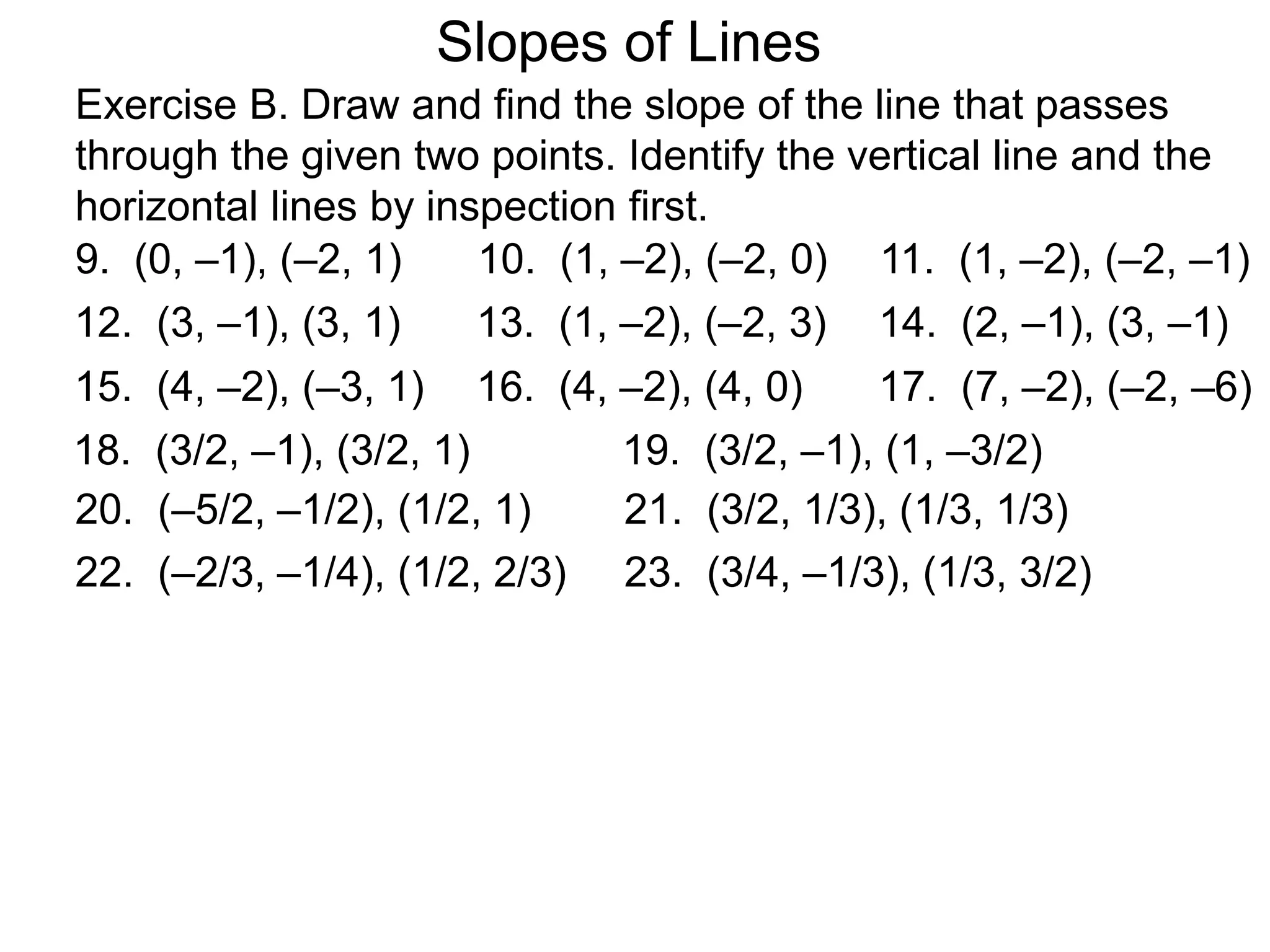
Exercise B. Draw and find the slope of the line that passes
through the given two points. Identify the vertical line and the
horizontal lines by inspection first.
9. (0, –1), (–2, 1) 10. (1, –2), (–2, 0) 11. (1, –2), (–2, –1)
12. (3, –1), (3, 1) 13. (1, –2), (–2, 3) 14. (2, –1), (3, –1)
15. (4, –2), (–3, 1) 16. (4, –2), (4, 0) 17. (7, –2), (–2, –6)
18. (3/2, –1), (3/2, 1) 19. (3/2, –1), (1, –3/2)
20. (–5/2, –1/2), (1/2, 1) 21. (3/2, 1/3), (1/3, 1/3)
22. (–2/3, –1/4), (1/2, 2/3) 23. (3/4, –1/3), (1/3, 3/2)
Slopes of Lines

36 slopes of lines-x

  • 1.
  • 2.
    Slopes of Lines Thesteepness of a street is measured in “grade”.
  • 3.
    Slopes of Lines aSeattle trolleybus climbing an 18%-grade street (Wikipedia) The steepness of a street is measured in “grade”. For example:
  • 4.
    Slopes of Lines aSeattle trolleybus climbing an 18%-grade street (Wikipedia) The steepness of a street is measured in “grade”. For example: The 18%-grade means the ratio of 18 to100 as shown here: 18 ft 100 ft
  • 5.
    Slopes of Lines aSeattle trolleybus climbing an 18%-grade street (Wikipedia) The steepness of a street is measured in “grade”. For example: The 18%-grade means the ratio of 18 to100 as shown here: 18 ft 100 ft The steepness of a roof is measured in “pitch”.
  • 6.
    Slopes of Lines aSeattle trolleybus climbing an 18%-grade street (Wikipedia) The steepness of a street is measured in “grade”. For example: The 18%-grade means the ratio of 18 to100 as shown here: 18 ft 100 ft The steepness of a roof is measured in “pitch”. For example: (12”)
  • 7.
    Slopes of Lines aSeattle trolleybus climbing an 18%-grade street (Wikipedia) The steepness of a street is measured in “grade”. For example: The 18%-grade means the ratio of 18 to100 as shown here: 18 ft 100 ft Here is outline of a roof with a pitch of 4:12 or 1/3. (12”) The steepness of a roof is measured in “pitch”. For example:
  • 8.
    Slopes of Lines aSeattle trolleybus climbing an 18%-grade street (Wikipedia) The steepness of a street is measured in “grade”. For example: The 18%-grade means the ratio of 18 to100 as shown here: 18 ft 100 ft Here is outline of a roof with a pitch of 4:12 or 1/3. (12”) The steepness of a roof is measured in “pitch”. For example: In mathematics, these measurements are called “slopes”.
  • 9.
    Slopes of Lines Theslope of a line is a number.
  • 10.
    Slopes of Lines Theslope of a line is a number. The slope of a line measures the amount of tilt, (inclination, steepness) of the line against the x-axis.
  • 11.
    Slopes of Lines Theslope of a line is a number. The slope of a line measures the amount of tilt, (inclination, steepness) of the line against the x-axis. Steep lines have slopes with large absolute value. Gradual lines have slopes with small absolute value
  • 12.
    Slopes of Lines Theslope of a line is a number. The slope of a line measures the amount of tilt, (inclination, steepness) of the line against the x-axis. Steep lines have slopes with large absolute value. Gradual lines have slopes with small absolute value Definition of Slope
  • 13.
    Slopes of Lines Definitionof Slope Notation: The Greek capital letter Δ (delta) in general means “the difference” in mathematics. The slope of a line is a number. The slope of a line measures the amount of tilt, (inclination, steepness) of the line against the x-axis. Steep lines have slopes with large absolute value. Gradual lines have slopes with small absolute value
  • 14.
    Slopes of Lines Definitionof Slope Notation: The Greek capital letter Δ (delta) in general means “the difference” in mathematics. Δy means the difference in the values of y’s, Δx means the difference the values of x’s. The slope of a line is a number. The slope of a line measures the amount of tilt, (inclination, steepness) of the line against the x-axis. Steep lines have slopes with large absolute value. Gradual lines have slopes with small absolute value
  • 15.
    Slopes of Lines Definitionof Slope Notation: The Greek capital letter Δ (delta) in general means “the difference” in mathematics. Δy means the difference in the values of y’s, Δx means the difference the values of x’s. Example A. Let y1 = –2, y2 = 5, The slope of a line is a number. The slope of a line measures the amount of tilt, (inclination, steepness) of the line against the x-axis. Steep lines have slopes with large absolute value. Gradual lines have slopes with small absolute value
  • 16.
    Slopes of Lines Definitionof Slope Notation: The Greek capital letter Δ (delta) in general means “the difference” in mathematics. Δy means the difference in the values of y’s, Δx means the difference the values of x’s. Example A. Let y1 = –2, y2 = 5, then Δy = y2 – y1 The slope of a line is a number. The slope of a line measures the amount of tilt, (inclination, steepness) of the line against the x-axis. Steep lines have slopes with large absolute value. Gradual lines have slopes with small absolute value
  • 17.
    Slopes of Lines Definitionof Slope Notation: The Greek capital letter Δ (delta) in general means “the difference” in mathematics. Δy means the difference in the values of y’s, Δx means the difference the values of x’s. Example A. Let y1 = –2, y2 = 5, then Δy = y2 – y1 = 5 – (–2) = 7 The slope of a line is a number. The slope of a line measures the amount of tilt, (inclination, steepness) of the line against the x-axis. Steep lines have slopes with large absolute value. Gradual lines have slopes with small absolute value
  • 18.
    Slopes of Lines Definitionof Slope Notation: The Greek capital letter Δ (delta) in general means “the difference” in mathematics. Δy means the difference in the values of y’s, Δx means the difference the values of x’s. Example A. Let y1 = –2, y2 = 5, then Δy = y2 – y1 = 5 – (–2) = 7 Let x1 = 7, x2 = –4, The slope of a line is a number. The slope of a line measures the amount of tilt, (inclination, steepness) of the line against the x-axis. Steep lines have slopes with large absolute value. Gradual lines have slopes with small absolute value
  • 19.
    Slopes of Lines Definitionof Slope Notation: The Greek capital letter Δ (delta) in general means “the difference” in mathematics. Δy means the difference in the values of y’s, Δx means the difference the values of x’s. Example A. Let y1 = –2, y2 = 5, then Δy = y2 – y1 = 5 – (–2) = 7 Let x1 = 7, x2 = –4, then Δ x = x2 – x1 The slope of a line is a number. The slope of a line measures the amount of tilt, (inclination, steepness) of the line against the x-axis. Steep lines have slopes with large absolute value. Gradual lines have slopes with small absolute value
  • 20.
    Slopes of Lines Definitionof Slope Notation: The Greek capital letter Δ (delta) in general means “the difference” in mathematics. Δy means the difference in the values of y’s, Δx means the difference the values of x’s. Example A. Let y1 = –2, y2 = 5, then Δy = y2 – y1 = 5 – (–2) = 7 Let x1 = 7, x2 = –4, then Δ x = x2 – x1 = –4 – 7 = –11 The slope of a line is a number. The slope of a line measures the amount of tilt, (inclination, steepness) of the line against the x-axis. Steep lines have slopes with large absolute value. Gradual lines have slopes with small absolute value
  • 21.
  • 22.
    Definition of Slope Let(x1, y1) and (x2, y2) be two points on a line, Slopes of Lines (x1, y1) (x2, y2)
  • 23.
    Definition of Slope Let(x1, y1) and (x2, y2) be two points on a line, then the slope m of the line is Δy Δxm = Slopes of Lines (x1, y1) (x2, y2)
  • 24.
    Definition of Slope Let(x1, y1) and (x2, y2) be two points on a line, then the slope m of the line is Δy Δx y2 – y1 x2 – x1 m = = Slopes of Lines (x1, y1) (x2, y2)
  • 25.
    Definition of Slope Let(x1, y1) and (x2, y2) be two points on a line, then the slope m of the line is Δy Δx y2 – y1 x2 – x1 m = = Slopes of Lines Geometry of Slope (x1, y1) (x2, y2)
  • 26.
    Definition of Slope Let(x1, y1) and (x2, y2) be two points on a line, then the slope m of the line is Δy Δx y2 – y1 x2 – x1 m = = Slopes of Lines (x1, y1) (x2, y2) Δy=y2–y1=rise Geometry of Slope Δy = y2 – y1 = the difference in the heights of the points.
  • 27.
    Definition of Slope Let(x1, y1) and (x2, y2) be two points on a line, then the slope m of the line is Δy Δx y2 – y1 x2 – x1 m = = Slopes of Lines (x1, y1) (x2, y2) Δy=y2–y1=rise Δx=x2–x1=run Geometry of Slope Δy = y2 – y1 = the difference in the heights of the points. Δx = x2 – x1 = the difference in the runs of the points.
  • 28.
    Definition of Slope Let(x1, y1) and (x2, y2) be two points on a line, then the slope m of the line is Δy Δx y2 – y1 x2 – x1 m = = Slopes of Lines (x1, y1) (x2, y2) Δy=y2–y1=rise Δx=x2–x1=run Geometry of Slope Δy = y2 – y1 = the difference in the heights of the points. Δx = x2 – x1 = the difference in the runs of the points. Δy Δx =Therefore m is the ratio of the “rise” to the “run”.
  • 29.
    Definition of Slope Let(x1, y1) and (x2, y2) be two points on a line, then the slope m of the line is Δy Δx y2 – y1 x2 – x1 m = = Slopes of Lines (x1, y1) (x2, y2) Δy=y2–y1=rise Δx=x2–x1=run Geometry of Slope Δy = y2 – y1 = the difference in the heights of the points. Δx = x2 – x1 = the difference in the runs of the points. Δy Δx =Therefore m is the ratio of the “rise” to the “run”. m = Δy Δx easy to memorize
  • 30.
    Definition of Slope Let(x1, y1) and (x2, y2) be two points on a line, then the slope m of the line is Δy Δx y2 – y1 x2 – x1 m = = Slopes of Lines (x1, y1) (x2, y2) Δy=y2–y1=rise Δx=x2–x1=run Geometry of Slope Δy = y2 – y1 = the difference in the heights of the points. Δx = x2 – x1 = the difference in the runs of the points. Δy Δx =Therefore m is the ratio of the “rise” to the “run”. m = Δy Δx y2 – y1 x2 – x1 = easy to memorize the exact formula
  • 31.
    Definition of Slope Let(x1, y1) and (x2, y2) be two points on a line, then the slope m of the line is Δy Δx y2 – y1 x2 – x1 m = = rise run = Slopes of Lines (x1, y1) (x2, y2) Δy=y2–y1=rise Δx=x2–x1=run Geometry of Slope Δy = y2 – y1 = the difference in the heights of the points. Δx = x2 – x1 = the difference in the runs of the points. Δy Δx =Therefore m is the ratio of the “rise” to the “run”. m = Δy Δx y2 – y1 x2 – x1 = easy to memorize the exact formula the geometric meaning
  • 32.
    Definition of Slope Let(x1, y1) and (x2, y2) be two points on a line, then the slope m of the line is Δy Δx y2 – y1 x2 – x1 m = = rise run = Slopes of Lines (x1, y1) (x2, y2) Δy=y2–y1=rise Δx=x2–x1=run Geometry of Slope Δy = y2 – y1 = the difference in the heights of the points. Δx = x2 – x1 = the difference in the runs of the points. Δy Δx =Therefore m is the ratio of the “rise” to the “run”. m = Δy Δx y2 – y1 x2 – x1 = easy to memorize the exact formula the geometric meaning Note that y2 – y1 x2 – x1 y1 – y2 x1 – x2 = so the numbering of the two points is not relevant– we get the same answer.
  • 33.
    Example B. Findthe slope of the line that passes through (3, –2) and (–2, 8). Draw the line. Slopes of Lines
  • 34.
    Example B. Findthe slope of the line that passes through (3, –2) and (–2, 8). Draw the line. Slopes of Lines
  • 35.
    Example B. Findthe slope of the line that passes through (3, –2) and (–2, 8). Draw the line. Slopes of Lines It’s easier to find Δx and Δy vertically.
  • 36.
    (–2 , 8) (3 , –2) Example B. Find the slope of the line that passes through (3, –2) and (–2, 8). Draw the line. Slopes of Lines It’s easier to find Δx and Δy vertically.
  • 37.
    (–2 , 8) (3 , –2) –5 , 10 Example B. Find the slope of the line that passes through (3, –2) and (–2, 8). Draw the line. Slopes of Lines It’s easier to find Δx and Δy vertically.
  • 38.
    Δy (–2 , 8) (3 , –2) –5 , 10 Δx Example B. Find the slope of the line that passes through (3, –2) and (–2, 8). Draw the line. Slopes of Lines It’s easier to find Δx and Δy vertically.
  • 39.
    Δy Δx (–2 , 8) (3 , –2) –5 , 10 Δy Δx Hence the slope is Example B. Find the slope of the line that passes through (3, –2) and (–2, 8). Draw the line. Slopes of Lines It’s easier to find Δx and Δy vertically. m =
  • 40.
    Δy Δx (–2 , 8) (3 , –2) –5 , 10 Δy Δx Hence the slope is 10 –5 Example B. Find the slope of the line that passes through (3, –2) and (–2, 8). Draw the line. Slopes of Lines It’s easier to find Δx and Δy vertically. m = = = –2
  • 41.
    Δy Δx (–2 , 8) (3 , –2) –5 , 10 Δy Δx Hence the slope is 10 –5 Example B. Find the slope of the line that passes through (3, –2) and (–2, 8). Draw the line. Slopes of Lines It’s easier to find Δx and Δy vertically. m = = = –2 Example C. Find the slope of the line that passes through (3, 5) and (-2, 5). Draw the line.
  • 42.
    Δy Δx (–2 , 8) (3 , –2) –5 , 10 Δy Δx Hence the slope is 10 –5 Example B. Find the slope of the line that passes through (3, –2) and (–2, 8). Draw the line. Slopes of Lines It’s easier to find Δx and Δy vertically. m = = = –2 Example C. Find the slope of the line that passes through (3, 5) and (-2, 5). Draw the line.
  • 43.
    Δy Δx (–2 , 8) (3 , –2) –5 , 10 Δy Δx Hence the slope is 10 –5 Example B. Find the slope of the line that passes through (3, –2) and (–2, 8). Draw the line. Slopes of Lines It’s easier to find Δx and Δy vertically. m = = = –2 Example C. Find the slope of the line that passes through (3, 5) and (-2, 5). Draw the line. (–2, 5) ( 3, 5)
  • 44.
    Δy Δx (–2 , 8) (3 , –2) –5 , 10 Δy Δx Hence the slope is 10 –5 Example B. Find the slope of the line that passes through (3, –2) and (–2, 8). Draw the line. Slopes of Lines It’s easier to find Δx and Δy vertically. m = = = –2 Example C. Find the slope of the line that passes through (3, 5) and (-2, 5). Draw the line. Δy (–2, 5) ( 3, 5) –5, 0 Δx
  • 45.
    Δy Δx (–2 , 8) (3 , –2) –5 , 10 Δy Δx Hence the slope is 10 –5 Example B. Find the slope of the line that passes through (3, –2) and (–2, 8). Draw the line. Slopes of Lines It’s easier to find Δx and Δy vertically. m = = = –2 Example C. Find the slope of the line that passes through (3, 5) and (-2, 5). Draw the line. Δy (–2, 5) ( 3, 5) –5, 0 Δx So the slope is Δx Δy m =
  • 46.
    Δy Δx (–2 , 8) (3 , –2) –5 , 10 Δy Δx Hence the slope is 10 –5 Example B. Find the slope of the line that passes through (3, –2) and (–2, 8). Draw the line. Slopes of Lines It’s easier to find Δx and Δy vertically. m = = = –2 Example C. Find the slope of the line that passes through (3, 5) and (-2, 5). Draw the line. Δy (–2, 5) ( 3, 5) –5, 0 Δx So the slope is Δx Δy 0 –5m = = = 0
  • 47.
    As shown inexample C, the slope of a horizontal line is 0, i.e. it’s “tilt” is 0. Slopes of Lines
  • 48.
    As shown inexample C, the slope of a horizontal line is 0, i.e. it’s “tilt” is 0. Slopes of Lines Example D. Find the slope of the line that passes through (3, 2) and (3, 5). Draw the line.
  • 49.
    As shown inexample C, the slope of a horizontal line is 0, i.e. it’s “tilt” is 0. Slopes of Lines Example D. Find the slope of the line that passes through (3, 2) and (3, 5). Draw the line.
  • 50.
    As shown inexample C, the slope of a horizontal line is 0, i.e. it’s “tilt” is 0. Slopes of Lines Example D. Find the slope of the line that passes through (3, 2) and (3, 5). Draw the line. Δy (3, 5) (3, 2) 0, 3 Δx
  • 51.
    As shown inexample C, the slope of a horizontal line is 0, i.e. it’s “tilt” is 0. Slopes of Lines Example D. Find the slope of the line that passes through (3, 2) and (3, 5). Draw the line. Δy (3, 5) (3, 2) 0, 3 Δx So the slope Δx Δy 3 0 m = =
  • 52.
    As shown inexample C, the slope of a horizontal line is 0, i.e. it’s “tilt” is 0. Slopes of Lines Example D. Find the slope of the line that passes through (3, 2) and (3, 5). Draw the line. Δy (3, 5) (3, 2) 0, 3 Δx So the slope Δx Δy 3 0 m = = is undefined!
  • 53.
    As shown inexample C, the slope of a horizontal line is 0, i.e. it’s “tilt” is 0. Slopes of Lines Example D. Find the slope of the line that passes through (3, 2) and (3, 5). Draw the line. Δy (3, 5) (3, 2) 0, 3 Δx So the slope Δx Δy 3 0 m = = is undefined! Hence the slope m of a horizontal line is m = 0.
  • 54.
    As shown inexample C, the slope of a horizontal line is 0, i.e. it’s “tilt” is 0. Slopes of Lines Example D. Find the slope of the line that passes through (3, 2) and (3, 5). Draw the line. Δy (3, 5) (3, 2) 0, 3 Δx So the slope Δx Δy 3 0 m = = is undefined! Hence the slope m of a vertical line is undefined (UDF). of a horizontal line is m = 0.
  • 55.
    As shown inexample C, the slope of a horizontal line is 0, i.e. it’s “tilt” is 0. Slopes of Lines Example D. Find the slope of the line that passes through (3, 2) and (3, 5). Draw the line. Δy (3, 5) (3, 2) 0, 3 Δx So the slope Δx Δy 3 0 m = = is undefined! Hence the slope m of a vertical line is undefined (UDF). of a horizontal line is m = 0. of a tilted line is a non–zero number.
  • 56.
    Exercise A. Identifythe vertical and the horizontal lines by inspection first. Find their slopes or if it’s undefined, state so. Fine the slopes of the other ones by solving for the y. 1. x – y = 3 2. 2x = 6 3. –y – 7= 0 4. 0 = 8 – 2x 5. y = –x + 4 6. 2x/3 – 3 = 6/5 7. 2x = 6 – 2y 8. 4y/5 – 12 = 3x/4 9. 2x + 3y = 3 10. –6 = 3x – 2y 11. 3x + 2 = 4y + 3x 12. 5x/4 + 2y/3 = 2 Exercise B. 13–18. Select two points and estimate the slope of each line. 13. 14. 15. More on Slopes
  • 57.
    16. 17. 18. ExerciseC. Draw and find the slope of the line that passes through the given two points. Identify the vertical line and the horizontal lines by inspection first. 19. (0, –1), (–2, 1) 20. (1, –2), (–2, 0) 21. (1, –2), (–2, –1) 22. (3, –1), (3, 1) 23. (1, –2), (–2, 3) 24. (2, –1), (3, –1) 25. (4, –2), (–3, 1) 26. (4, –2), (4, 0) 27. (7, –2), (–2, –6) 28. (3/2, –1), (3/2, 1) 29. (3/2, –1), (1, –3/2) 30. (–5/2, –1/2), (1/2, 1) 31. (3/2, 1/3), (1/3, 1/3) 32. (–2/3, –1/4), (1/2, 2/3) 33. (3/4, –1/3), (1/3, 3/2) More on Slopes
  • 58.
    Exercise D. 34. Identifywhich lines are parallel and which one are perpendicular. A. The line that passes through (0, 1), (1, –2) D. 2x – 4y = 1 B. C. E. The line that’s perpendicular to 3y = x F. The line with the x–intercept at 3 and y intercept at 6. Find the slope, if possible of each of the following lines. 35. The line passes with the x intercept at x = 2, and y–intercept at y = –5. More on Slopes
  • 59.
    36. The equationof the line is 3x = –5y+7 37. The equation of the line is 0 = –5y+7 38. The equation of the line is 3x = 7 39. The line is parallel to 2y = 5 – 6x 40. the line is perpendicular to 2y = 5 – 6x 41. The line is parallel to the line in problem 30. 42. the line is perpendicular to line in problem 31. 43. The line is parallel to the line in problem 33. 44. the line is perpendicular to line in problem 34. More on Slopes Find the slope, if possible of each of the following lines
  • 60.
    Summary of Slope Theslope of the line that passes through (x1, y1) and (x2, y2) is Horizontal line Slope = 0 Vertical line Slope is UDF. Tilted line Slope = –2  0 rise run =m = Δy Δx y2 – y1 x2 – x1 =
  • 61.
    Exercise A. Select twopoints and estimate the slope of each line. 1. 2. 3. 4. Slopes of Lines 5. 6. 7. 8.
  • 62.
    Exercise B. Drawand find the slope of the line that passes through the given two points. Identify the vertical line and the horizontal lines by inspection first. 9. (0, –1), (–2, 1) 10. (1, –2), (–2, 0) 11. (1, –2), (–2, –1) 12. (3, –1), (3, 1) 13. (1, –2), (–2, 3) 14. (2, –1), (3, –1) 15. (4, –2), (–3, 1) 16. (4, –2), (4, 0) 17. (7, –2), (–2, –6) 18. (3/2, –1), (3/2, 1) 19. (3/2, –1), (1, –3/2) 20. (–5/2, –1/2), (1/2, 1) 21. (3/2, 1/3), (1/3, 1/3) 22. (–2/3, –1/4), (1/2, 2/3) 23. (3/4, –1/3), (1/3, 3/2) Slopes of Lines