Negative Feedback Amplifiers                  Guided by : Prof. S. S. Patil       Presentation by: Vinay  Jasud (52)                                    Vinod  Arote (54)
TOPICS TO BE COVEREDIntroductionConcept of FeedbackFeedback TopologiesGeneral Characteristics of Negative Feedback AmplifiersAnalysis Of Feedback AmplifiersVoltage Series FeedbackVoltage Shunt FeedbackCurrent Series FeedbackCurrent Shunt Feedback
IntroductionFeedback (Definition)                   It is the process in which part of the output signal is returned back to the input.Types of  Feedback             1.Positive Feedback               2. Negative Feedback
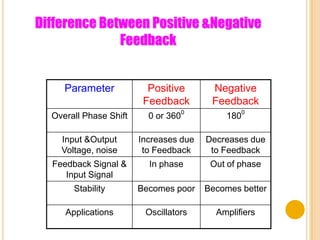
Difference Between Positive &Negative Feedback
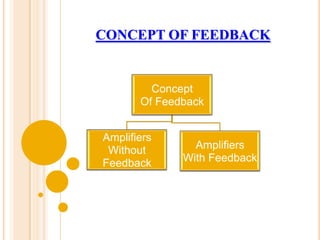
CONCEPT OF FEEDBACK
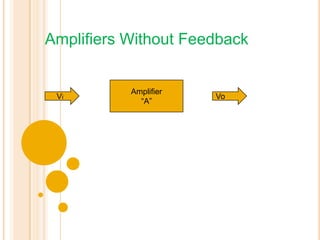
Amplifiers Without FeedbackAmplifier“A”ViVo
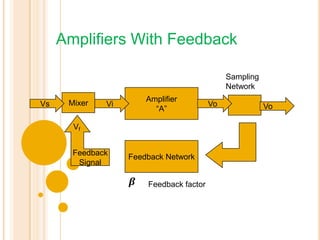
Amplifiers With FeedbackSampling NetworkAmplifier“A”MixerVoVsViVoFeedbackSignalVfFeedback NetworkFeedback factor
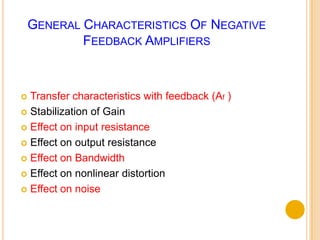
Transfer characteristics with feedback (Af )Stabilization of GainEffect on input resistanceEffect on output resistanceEffect on BandwidthEffect on nonlinear distortionEffect on noiseGeneral Characteristics Of Negative Feedback Amplifiers
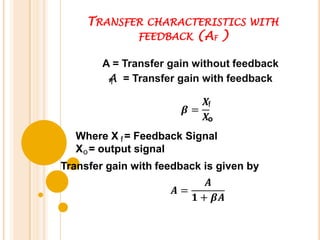
Transfer characteristics with feedback (Af )A = Transfer gain without feedbackA  = Transfer gain with feedbackff oWhere X  = Feedback SignalX  = output signalfoTransfer gain with feedback is given by
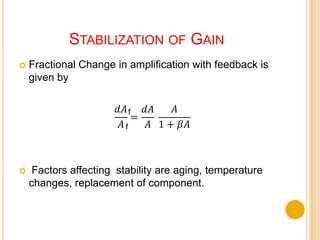
Stabilization of GainFractional Change in amplification with feedback is given by Factors affecting  stability are aging, temperature changes, replacement of component. ff
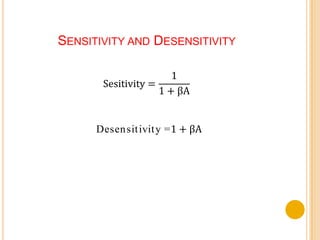
Sensitivity and Desensitivity
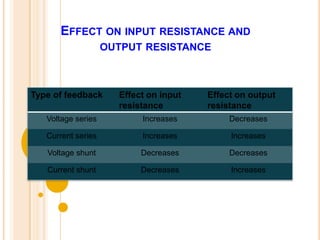
Effect on input resistance and output resistance
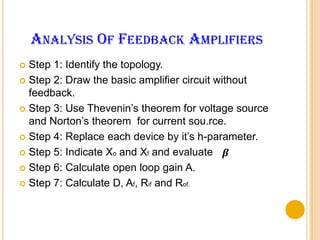
Analysis Of Feedback AmplifiersStep 1: Identify the topology.Step 2: Draw the basic amplifier circuit without feedback.Step 3: Use Thevenin’s theorem for voltage source and Norton’s theorem  for current sou.rce.Step 4: Replace each device by it’s h-parameter.Step 5: Indicate Xo and Xf and evaluate   .Step 6: Calculate open loop gain A.Step 7: Calculate D, Af, Rif and Rof.
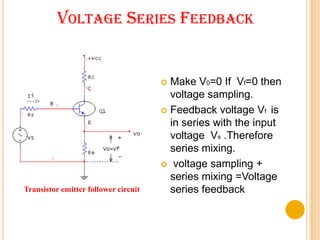
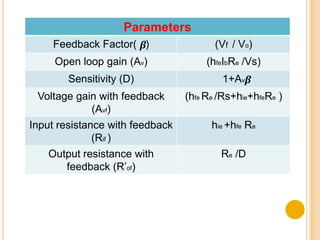
Voltage Series FeedbackMake V0=0 If  Vf=0 then voltage sampling.Feedback voltage Vf  is in series with the input voltage  Vs .Therefore series mixing. voltage sampling + series mixing =Voltage series feedbackTransistor emitter follower circuit
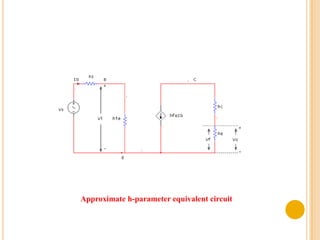
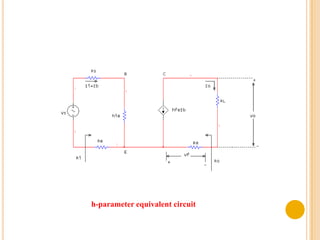
Approximate h-parameter equivalent circuit
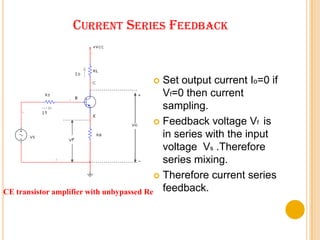
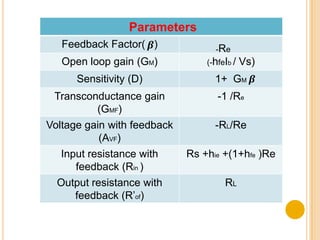
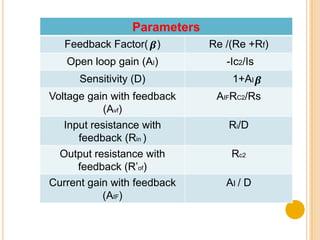
Current Series FeedbackSet output current Io=0 if Vf=0 then current sampling.Feedback voltage Vf  is in series with the input voltage  Vs .Therefore series mixing.Therefore current series feedback.   CE transistor amplifier with unbypassed Re
h-parameter equivalent circuit
-Re
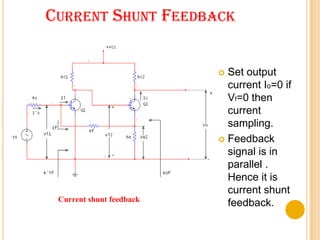
Current Shunt FeedbackSet output current Io=0 if Vf=0 then current sampling.
Feedback signal is in parallel . Hence it is current shunt feedback. Current shunt feedback
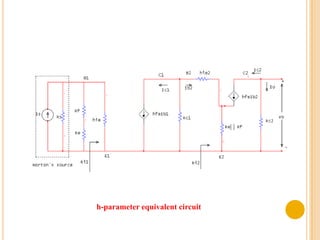
h-parameter equivalent circuit
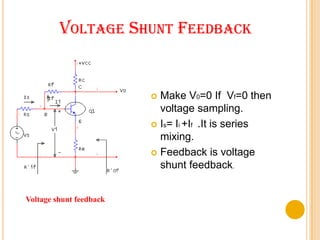
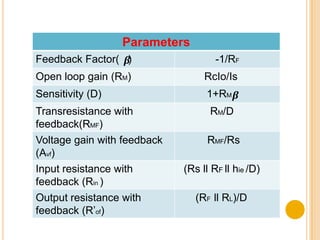
Voltage Shunt FeedbackMake V0=0 If  Vf=0 then voltage sampling.
Is= Ii +If   .It is series mixing.
Feedback is voltage shunt feedback.Voltage shunt feedback
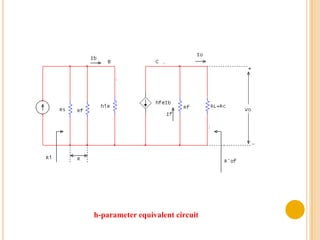
h-parameter equivalent circuit

Final