ATP
Karthick. S
DALE’S BIOLOGY
12/15/2018 1Dale's Biology
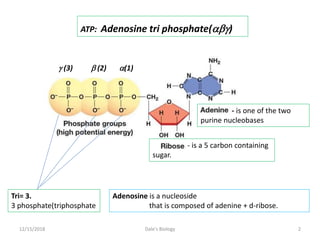
ATP: Adenosine tri phosphate()
Tri= 3.
3 phosphate(triphosphate
- is a 5 carbon containing
sugar.
Adenosine is a nucleoside
that is composed of adenine + d-ribose.
- is one of the two
purine nucleobases
 (3)  (2) (1)
12/15/2018 2Dale's Biology
is simply a nitrogen-containing molecule
 are heterocyclic amines
has the same chemical properties as a base.
They are particularly important since they make up the building blocks of DNA and
RNA:
EXAMPLE: guanine, cytosine, thymine and uracil.
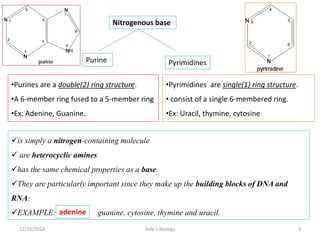
Nitrogenous base
adenine
Purine Pyrimidines
•Purines are a double(2) ring structure.
•A 6-member ring fused to a 5-member ring
•Ex: Adenine, Guanine.
•Pyrimidines are single(1) ring structure.
• consist of a single 6-membered ring.
•Ex: Uracil, thymine, cytosine
12/15/2018 3Dale's Biology
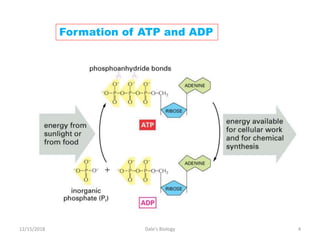
Formation of ATP and ADP
12/15/2018 4Dale's Biology
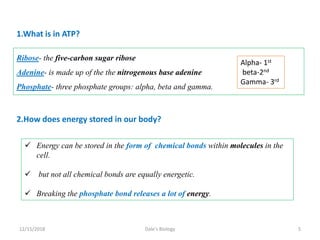
Ribose- the five-carbon sugar ribose
Adenine- is made up of the the nitrogenous base adenine
Phosphate- three phosphate groups: alpha, beta and gamma.
1.What is in ATP?
Alpha- 1st
beta-2nd
Gamma- 3rd
 Energy can be stored in the form of chemical bonds within molecules in the
cell.
 but not all chemical bonds are equally energetic.
 Breaking the phosphate bond releases a lot of energy.
2.How does energy stored in our body?
12/15/2018 5Dale's Biology
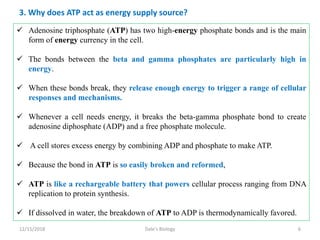
 Adenosine triphosphate (ATP) has two high-energy phosphate bonds and is the main
form of energy currency in the cell.
 The bonds between the beta and gamma phosphates are particularly high in
energy.
 When these bonds break, they release enough energy to trigger a range of cellular
responses and mechanisms.
 Whenever a cell needs energy, it breaks the beta-gamma phosphate bond to create
adenosine diphosphate (ADP) and a free phosphate molecule.
 A cell stores excess energy by combining ADP and phosphate to make ATP.
 Because the bond in ATP is so easily broken and reformed,
 ATP is like a rechargeable battery that powers cellular process ranging from DNA
replication to protein synthesis.
 If dissolved in water, the breakdown of ATP to ADP is thermodynamically favored.
3. Why does ATP act as energy supply source?
12/15/2018 6Dale's Biology
4. Does ATP store energy long term?
Short term energy storage, because it is too unstable for long-term energy storage.
When cells need to store chemical energy in a more stable form, they use
the energy from ATP to build more stable molecules.
• Initially to initiate the cleavage of this bond, activation energy is required.
• But this activation energyis considerably less in magnitude than the energy released
when high energy phosphate bond is cleaved.
• Thus, hydrolysis of 1 mole of ATP releases more than 30.5 kj of energy.
• BUT eventually what we get is 30.5kj of energy because the rest has been compensated
for the activation energy.
5.How much energy produce during ATP hydrolysis?
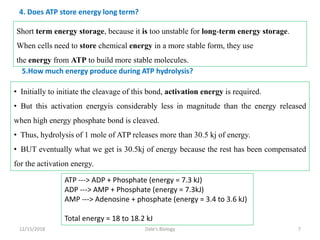
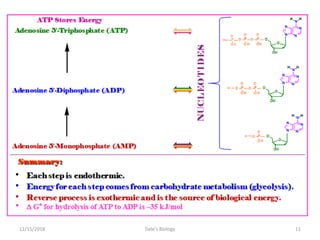
ATP ---> ADP + Phosphate (energy = 7.3 kJ)
ADP ---> AMP + Phosphate (energy = 7.3kJ)
AMP ---> Adenosine + phosphate (energy = 3.4 to 3.6 kJ)
Total energy = 18 to 18.2 kJ
12/15/2018 7Dale's Biology
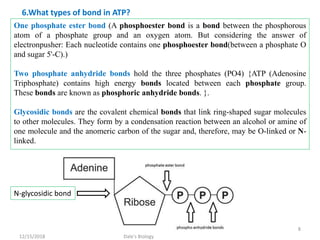
One phosphate ester bond (A phosphoester bond is a bond between the phosphorous
atom of a phosphate group and an oxygen atom. But considering the answer of
electronpusher: Each nucleotide contains one phosphoester bond(between a phosphate O
and sugar 5'-C).)
Two phosphate anhydride bonds hold the three phosphates (PO4) {ATP (Adenosine
Triphosphate) contains high energy bonds located between each phosphate group.
These bonds are known as phosphoric anhydride bonds. }.
Glycosidic bonds are the covalent chemical bonds that link ring-shaped sugar molecules
to other molecules. They form by a condensation reaction between an alcohol or amine of
one molecule and the anomeric carbon of the sugar and, therefore, may be O-linked or N-
linked.
6.What types of bond in ATP?
N-glycosidic bond
12/15/2018
8
Dale's Biology
7.Why is ATP unique?
The high-energy bonds of ATP are actually rather unstable bonds.
 Because they are unstable, the energy of ATP is readily released when ATP is
hydrolyzed in cellular reactions.
 Note that ATP is an energy-coupling agent and not a fuel. It is not a storehouse of
energy set aside for some future need.
 Rather it is produced by one set of reactions and is almost immediately consumed
by another.
 ATP is formed as it is needed, primarily by oxidative processes in the mitochondria.
Oxygen is not consumed unless ADP and a phosphate molecule are available, and
these do not become available until ATP is hydrolyzed by some energy-consuming
process.
12/15/2018 9Dale's Biology
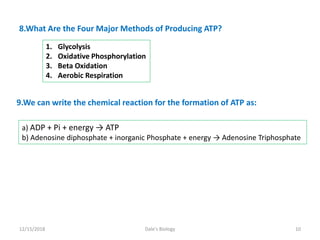
8.What Are the Four Major Methods of Producing ATP?
1. Glycolysis
2. Oxidative Phosphorylation
3. Beta Oxidation
4. Aerobic Respiration
a) ADP + Pi + energy → ATP
b) Adenosine diphosphate + inorganic Phosphate + energy → Adenosine Triphosphate
9.We can write the chemical reaction for the formation of ATP as:
12/15/2018 10Dale's Biology
12/15/2018 11Dale's Biology
12/15/2018 Dale's Biology 12
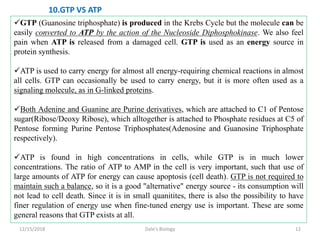
GTP (Guanosine triphosphate) is produced in the Krebs Cycle but the molecule can be
easily converted to ATP by the action of the Nucleoside Diphosphokinase. We also feel
pain when ATP is released from a damaged cell. GTP is used as an energy source in
protein synthesis.
ATP is used to carry energy for almost all energy-requiring chemical reactions in almost
all cells. GTP can occasionally be used to carry energy, but it is more often used as a
signaling molecule, as in G-linked proteins.
Both Adenine and Guanine are Purine derivatives, which are attached to C1 of Pentose
sugar(Ribose/Deoxy Ribose), which alltogether is attached to Phosphate residues at C5 of
Pentose forming Purine Pentose Triphosphates(Adenosine and Guanosine Triphosphate
respectively).
ATP is found in high concentrations in cells, while GTP is in much lower
concentrations. The ratio of ATP to AMP in the cell is very important, such that use of
large amounts of ATP for energy can cause apoptosis (cell death). GTP is not required to
maintain such a balance, so it is a good "alternative" energy source - its consumption will
not lead to cell death. Since it is in small quanitites, there is also the possibility to have
finer regulation of energy use when fine-tuned energy use is important. These are some
general reasons that GTP exists at all.
10.GTP VS ATP
12/15/2018 Dale's Biology 13
When the amount of ATP available is in excess of the body's requirements, the liver
uses theexcess ATP and excess glucose to produce molecules called glycogen (a
polymeric form of glucose) that is stored in the liver and skeletal muscle cells.
11.What will happen excess ATP?
size of the purine base would give it different binding properties (larger
hydrophobic surface area) than the smaller pyrimidines.
The evolution of ATP was related to energy first before life development in the
earliest time at 4.2 billion years ago, while the evolution of GTP was later because it
needed oxygen atom in the GTP molecule (remember, the oxygen level in the
atmosphere was very low at that earlier time!). That means the signalling function of
cells was developed much later than the energy production in the mitochondria.
12.Why is ATP? Why not others(GTP,TTP,CTP)?
12/15/2018 Dale's Biology 14
in a human cell. There are 10 to 20 mitochondria in a cell; one ATP synthase
complex generates 100 to 150 ATP molecules each second.
13.How much ATP produce every seconds?
yes, for an enzyme to function, sometimes energy is needed. ... The
molecule ATP(adenosine triphosphate) can function as a coenzyme. When a
phosphate group is removed, turning ATP into ADP (adenosine diphosphate),
energy is released.
14.Is ATP coenzyme?
Each cell in the human body is estimated to use between 1 and 2 billion ATPs per
minute, which comes to roughly 1 × 10²³ for a typical human body. In the span of 24
hours, the body's cells produce about 441 pounds (200 kilograms) of ATP.
15.How much ATP human use per day?
12/15/2018 Dale's Biology 15
H+ combines with O- inside the mitochondria creating water (H2O). (In most
Eukaryotic cells, 36 ATP are produced from 1 glucose molecule: 2 from Glycolysis
and 2 from the Citric Acid Cycle by substrate level phosphorylation, and 32 from
Electron Transport by oxidative phosphorylation.
16.How is 36 ATP produce?
1. If left hand side of chemical equation is ADP + water then right hand
side of that chemical equation is equal to
1. AMP + Pi + energy
2. APM + Mi + energy
3. BMP + Bi + energy
4. TDA + Ti + energy
Because, ATP is not stable.so, I will release one phosphate
when interact with water
2.Biologist who discovered ATP is
1. Daniel Olive
2. Daniel Koshland
3. Karl Lohmann
4. Emil August
3.Nobel Prize winner biologist who proposed ATP as major energy-
transfer molecule in cells is
1. Fritz Lipmann(1941)
2. Emil August
3. Daniel Koshland
4. Karl Lohmann
12/15/2018 16Dale's Biology
4.Cells have only a small amount of ATP on hand at any given time. Why
is this true?
ATP is efficient for transferring, but not for long-term storage of energy.
5.A single molecule of ______ can store ______ energy than a single
molecule of ATP.
glucose; 90 times more
6.When is energy released from an ATP molecule?
when the bond between the 2nd and 3rd phosphate is broken
7.How can ADP can be transformed into ATP?
adding energy and a phosphate group
8.Energy from ATP is necessary for
9.ATP is necessary for living things because it is the basic energy source for all cells.
protein synthesis, muscles contraction, active transport
12/15/2018 17Dale's Biology
10.Hydrolysis of phosphate groups in ATP is an
Exergonic process-positive flow of energy from the system to the surroundings.
11.Reaction by which chemical energy that has been stored in high
energy phosphoanhydride bonds in ATP is released is called
ATP hydrolysis
12. Anabolism and catabolism are chemically linked in the form of
ATP.
Anabolism is an energy intake process where small molecules build upto large
molecules .
catabolism involves release of energy where large molecules tear down to smaller
molecules
13. Which of the following statements is false about ATP
hydrolysis?
a) It is highly exergonic
b) Activation energy is relatively high
c) ∆G‘°=-30.5kJ/mol
d) ∆G‘°=30.5kJ/mol12/15/2018
18
Dale's Biology
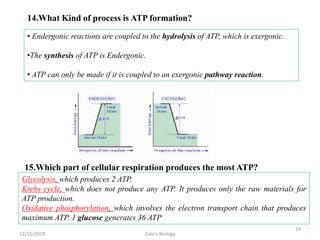
• Endergonic reactions are coupled to the hydrolysis of ATP, which is exergonic.
•The synthesis of ATP is Endergonic.
• ATP can only be made if it is coupled to an exergonic pathway reaction.
14.What Kind of process is ATP formation?
15.Which part of cellular respiration produces the most ATP?
Glycolysis, which produces 2 ATP.
Krebs cycle, which does not produce any ATP. It produces only the raw materials for
ATP production.
Oxidative phosphorylation, which involves the electron transport chain that produces
maximum ATP. 1 glucose generates 36 ATP
12/15/2018
19
Dale's Biology
16. Water does a nucleophilic attack on phosphate
monoester producing--- inorganic phosphate
17. Energy released by breakdown of bonds is
1. hydra energy
2. thermal energy
3. potential energy
4. kinetic energy
18. Released kinetic energy by breakdown of enzymes is stored in bonds of
ATP molecules in form of
potential energy
12/15/2018 20Dale's Biology

What is an ATP

  • 1.
  • 2.
    ATP: Adenosine triphosphate() Tri= 3. 3 phosphate(triphosphate - is a 5 carbon containing sugar. Adenosine is a nucleoside that is composed of adenine + d-ribose. - is one of the two purine nucleobases  (3)  (2) (1) 12/15/2018 2Dale's Biology
  • 3.
    is simply anitrogen-containing molecule  are heterocyclic amines has the same chemical properties as a base. They are particularly important since they make up the building blocks of DNA and RNA: EXAMPLE: guanine, cytosine, thymine and uracil. Nitrogenous base adenine Purine Pyrimidines •Purines are a double(2) ring structure. •A 6-member ring fused to a 5-member ring •Ex: Adenine, Guanine. •Pyrimidines are single(1) ring structure. • consist of a single 6-membered ring. •Ex: Uracil, thymine, cytosine 12/15/2018 3Dale's Biology
  • 4.
    Formation of ATPand ADP 12/15/2018 4Dale's Biology
  • 5.
    Ribose- the five-carbonsugar ribose Adenine- is made up of the the nitrogenous base adenine Phosphate- three phosphate groups: alpha, beta and gamma. 1.What is in ATP? Alpha- 1st beta-2nd Gamma- 3rd  Energy can be stored in the form of chemical bonds within molecules in the cell.  but not all chemical bonds are equally energetic.  Breaking the phosphate bond releases a lot of energy. 2.How does energy stored in our body? 12/15/2018 5Dale's Biology
  • 6.
     Adenosine triphosphate(ATP) has two high-energy phosphate bonds and is the main form of energy currency in the cell.  The bonds between the beta and gamma phosphates are particularly high in energy.  When these bonds break, they release enough energy to trigger a range of cellular responses and mechanisms.  Whenever a cell needs energy, it breaks the beta-gamma phosphate bond to create adenosine diphosphate (ADP) and a free phosphate molecule.  A cell stores excess energy by combining ADP and phosphate to make ATP.  Because the bond in ATP is so easily broken and reformed,  ATP is like a rechargeable battery that powers cellular process ranging from DNA replication to protein synthesis.  If dissolved in water, the breakdown of ATP to ADP is thermodynamically favored. 3. Why does ATP act as energy supply source? 12/15/2018 6Dale's Biology
  • 7.
    4. Does ATPstore energy long term? Short term energy storage, because it is too unstable for long-term energy storage. When cells need to store chemical energy in a more stable form, they use the energy from ATP to build more stable molecules. • Initially to initiate the cleavage of this bond, activation energy is required. • But this activation energyis considerably less in magnitude than the energy released when high energy phosphate bond is cleaved. • Thus, hydrolysis of 1 mole of ATP releases more than 30.5 kj of energy. • BUT eventually what we get is 30.5kj of energy because the rest has been compensated for the activation energy. 5.How much energy produce during ATP hydrolysis? ATP ---> ADP + Phosphate (energy = 7.3 kJ) ADP ---> AMP + Phosphate (energy = 7.3kJ) AMP ---> Adenosine + phosphate (energy = 3.4 to 3.6 kJ) Total energy = 18 to 18.2 kJ 12/15/2018 7Dale's Biology
  • 8.
    One phosphate esterbond (A phosphoester bond is a bond between the phosphorous atom of a phosphate group and an oxygen atom. But considering the answer of electronpusher: Each nucleotide contains one phosphoester bond(between a phosphate O and sugar 5'-C).) Two phosphate anhydride bonds hold the three phosphates (PO4) {ATP (Adenosine Triphosphate) contains high energy bonds located between each phosphate group. These bonds are known as phosphoric anhydride bonds. }. Glycosidic bonds are the covalent chemical bonds that link ring-shaped sugar molecules to other molecules. They form by a condensation reaction between an alcohol or amine of one molecule and the anomeric carbon of the sugar and, therefore, may be O-linked or N- linked. 6.What types of bond in ATP? N-glycosidic bond 12/15/2018 8 Dale's Biology
  • 9.
    7.Why is ATPunique? The high-energy bonds of ATP are actually rather unstable bonds.  Because they are unstable, the energy of ATP is readily released when ATP is hydrolyzed in cellular reactions.  Note that ATP is an energy-coupling agent and not a fuel. It is not a storehouse of energy set aside for some future need.  Rather it is produced by one set of reactions and is almost immediately consumed by another.  ATP is formed as it is needed, primarily by oxidative processes in the mitochondria. Oxygen is not consumed unless ADP and a phosphate molecule are available, and these do not become available until ATP is hydrolyzed by some energy-consuming process. 12/15/2018 9Dale's Biology
  • 10.
    8.What Are theFour Major Methods of Producing ATP? 1. Glycolysis 2. Oxidative Phosphorylation 3. Beta Oxidation 4. Aerobic Respiration a) ADP + Pi + energy → ATP b) Adenosine diphosphate + inorganic Phosphate + energy → Adenosine Triphosphate 9.We can write the chemical reaction for the formation of ATP as: 12/15/2018 10Dale's Biology
  • 11.
  • 12.
    12/15/2018 Dale's Biology12 GTP (Guanosine triphosphate) is produced in the Krebs Cycle but the molecule can be easily converted to ATP by the action of the Nucleoside Diphosphokinase. We also feel pain when ATP is released from a damaged cell. GTP is used as an energy source in protein synthesis. ATP is used to carry energy for almost all energy-requiring chemical reactions in almost all cells. GTP can occasionally be used to carry energy, but it is more often used as a signaling molecule, as in G-linked proteins. Both Adenine and Guanine are Purine derivatives, which are attached to C1 of Pentose sugar(Ribose/Deoxy Ribose), which alltogether is attached to Phosphate residues at C5 of Pentose forming Purine Pentose Triphosphates(Adenosine and Guanosine Triphosphate respectively). ATP is found in high concentrations in cells, while GTP is in much lower concentrations. The ratio of ATP to AMP in the cell is very important, such that use of large amounts of ATP for energy can cause apoptosis (cell death). GTP is not required to maintain such a balance, so it is a good "alternative" energy source - its consumption will not lead to cell death. Since it is in small quanitites, there is also the possibility to have finer regulation of energy use when fine-tuned energy use is important. These are some general reasons that GTP exists at all. 10.GTP VS ATP
  • 13.
    12/15/2018 Dale's Biology13 When the amount of ATP available is in excess of the body's requirements, the liver uses theexcess ATP and excess glucose to produce molecules called glycogen (a polymeric form of glucose) that is stored in the liver and skeletal muscle cells. 11.What will happen excess ATP? size of the purine base would give it different binding properties (larger hydrophobic surface area) than the smaller pyrimidines. The evolution of ATP was related to energy first before life development in the earliest time at 4.2 billion years ago, while the evolution of GTP was later because it needed oxygen atom in the GTP molecule (remember, the oxygen level in the atmosphere was very low at that earlier time!). That means the signalling function of cells was developed much later than the energy production in the mitochondria. 12.Why is ATP? Why not others(GTP,TTP,CTP)?
  • 14.
    12/15/2018 Dale's Biology14 in a human cell. There are 10 to 20 mitochondria in a cell; one ATP synthase complex generates 100 to 150 ATP molecules each second. 13.How much ATP produce every seconds? yes, for an enzyme to function, sometimes energy is needed. ... The molecule ATP(adenosine triphosphate) can function as a coenzyme. When a phosphate group is removed, turning ATP into ADP (adenosine diphosphate), energy is released. 14.Is ATP coenzyme? Each cell in the human body is estimated to use between 1 and 2 billion ATPs per minute, which comes to roughly 1 × 10²³ for a typical human body. In the span of 24 hours, the body's cells produce about 441 pounds (200 kilograms) of ATP. 15.How much ATP human use per day?
  • 15.
    12/15/2018 Dale's Biology15 H+ combines with O- inside the mitochondria creating water (H2O). (In most Eukaryotic cells, 36 ATP are produced from 1 glucose molecule: 2 from Glycolysis and 2 from the Citric Acid Cycle by substrate level phosphorylation, and 32 from Electron Transport by oxidative phosphorylation. 16.How is 36 ATP produce?
  • 16.
    1. If lefthand side of chemical equation is ADP + water then right hand side of that chemical equation is equal to 1. AMP + Pi + energy 2. APM + Mi + energy 3. BMP + Bi + energy 4. TDA + Ti + energy Because, ATP is not stable.so, I will release one phosphate when interact with water 2.Biologist who discovered ATP is 1. Daniel Olive 2. Daniel Koshland 3. Karl Lohmann 4. Emil August 3.Nobel Prize winner biologist who proposed ATP as major energy- transfer molecule in cells is 1. Fritz Lipmann(1941) 2. Emil August 3. Daniel Koshland 4. Karl Lohmann 12/15/2018 16Dale's Biology
  • 17.
    4.Cells have onlya small amount of ATP on hand at any given time. Why is this true? ATP is efficient for transferring, but not for long-term storage of energy. 5.A single molecule of ______ can store ______ energy than a single molecule of ATP. glucose; 90 times more 6.When is energy released from an ATP molecule? when the bond between the 2nd and 3rd phosphate is broken 7.How can ADP can be transformed into ATP? adding energy and a phosphate group 8.Energy from ATP is necessary for 9.ATP is necessary for living things because it is the basic energy source for all cells. protein synthesis, muscles contraction, active transport 12/15/2018 17Dale's Biology
  • 18.
    10.Hydrolysis of phosphategroups in ATP is an Exergonic process-positive flow of energy from the system to the surroundings. 11.Reaction by which chemical energy that has been stored in high energy phosphoanhydride bonds in ATP is released is called ATP hydrolysis 12. Anabolism and catabolism are chemically linked in the form of ATP. Anabolism is an energy intake process where small molecules build upto large molecules . catabolism involves release of energy where large molecules tear down to smaller molecules 13. Which of the following statements is false about ATP hydrolysis? a) It is highly exergonic b) Activation energy is relatively high c) ∆G‘°=-30.5kJ/mol d) ∆G‘°=30.5kJ/mol12/15/2018 18 Dale's Biology
  • 19.
    • Endergonic reactionsare coupled to the hydrolysis of ATP, which is exergonic. •The synthesis of ATP is Endergonic. • ATP can only be made if it is coupled to an exergonic pathway reaction. 14.What Kind of process is ATP formation? 15.Which part of cellular respiration produces the most ATP? Glycolysis, which produces 2 ATP. Krebs cycle, which does not produce any ATP. It produces only the raw materials for ATP production. Oxidative phosphorylation, which involves the electron transport chain that produces maximum ATP. 1 glucose generates 36 ATP 12/15/2018 19 Dale's Biology
  • 20.
    16. Water doesa nucleophilic attack on phosphate monoester producing--- inorganic phosphate 17. Energy released by breakdown of bonds is 1. hydra energy 2. thermal energy 3. potential energy 4. kinetic energy 18. Released kinetic energy by breakdown of enzymes is stored in bonds of ATP molecules in form of potential energy 12/15/2018 20Dale's Biology