Chapter 17, Section 1: Energy Resources & Fossil Fuels
                       Standards: SEV4b, c, e, f, SEV5e
What is a nonrenewable resource?
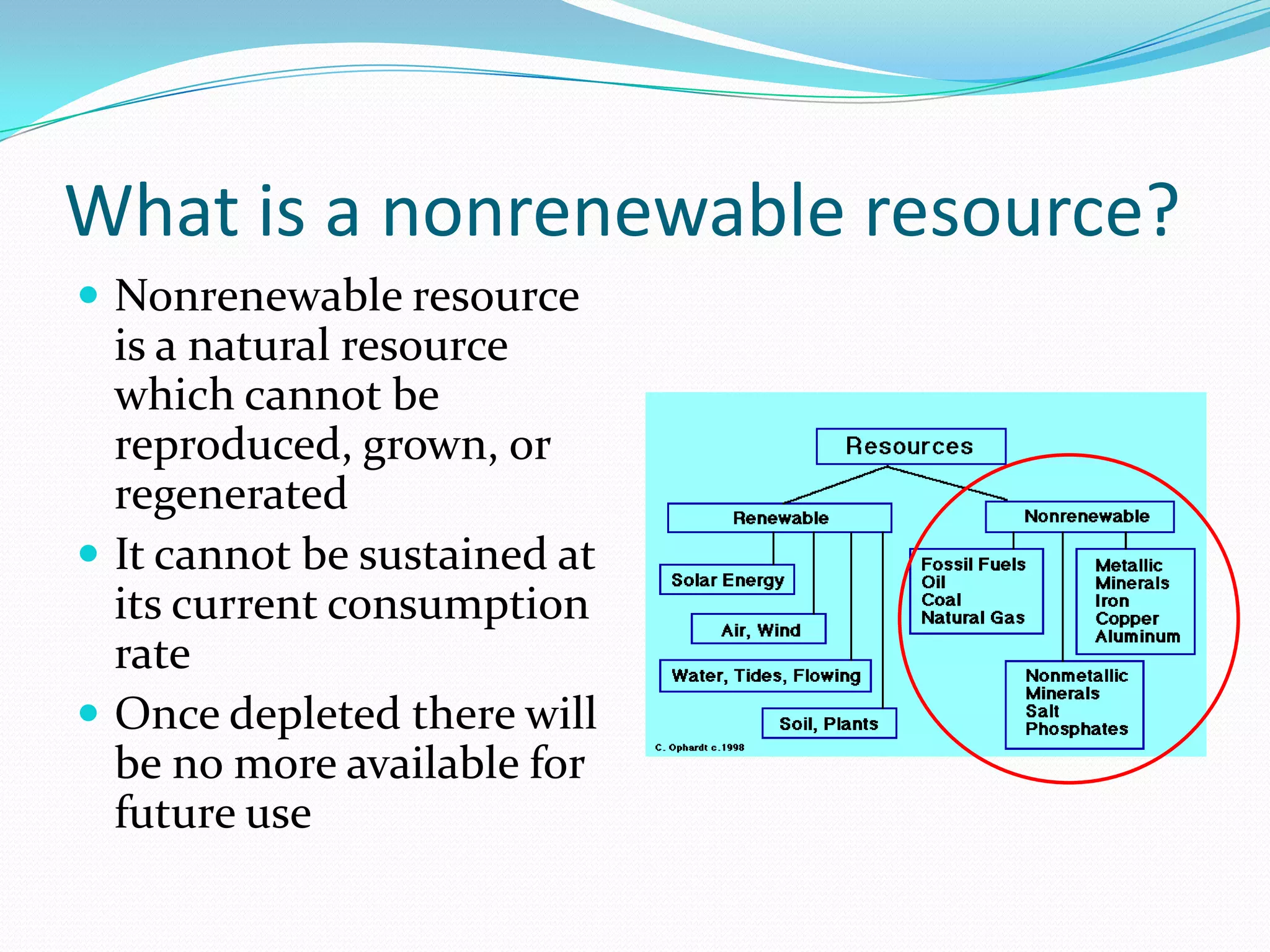
 Nonrenewable resource
  is a natural resource
  which cannot be
  reproduced, grown, or
  regenerated
 It cannot be sustained at
  its current consumption
  rate
 Once depleted there will
  be no more available for
  future use
What is a fossil fuel?
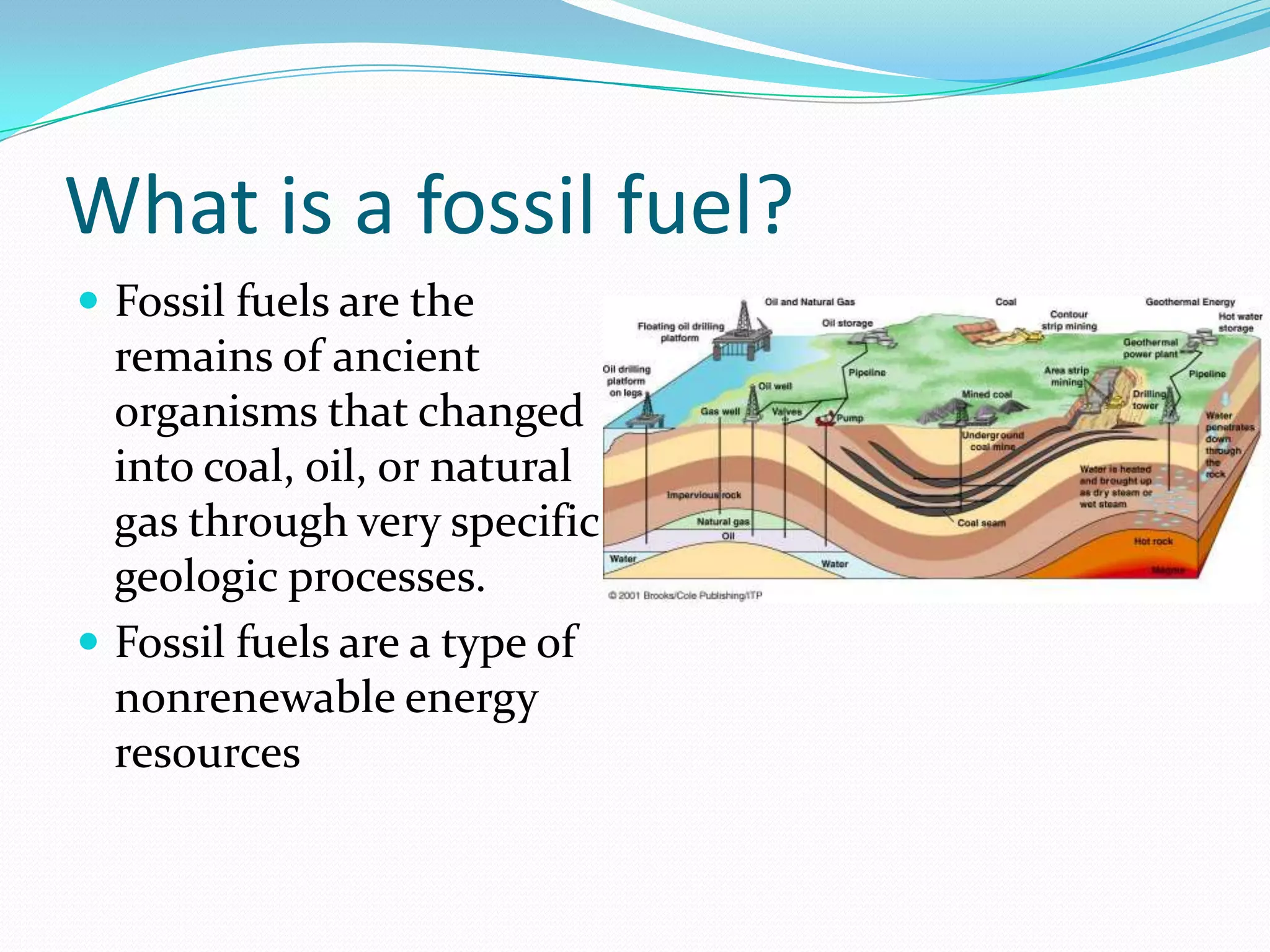
 Fossil fuels are the
  remains of ancient
  organisms that changed
  into coal, oil, or natural
  gas through very specific
  geologic processes.
 Fossil fuels are a type of
  nonrenewable energy
  resources
What are 2 problems associated
with using fossil fuels?
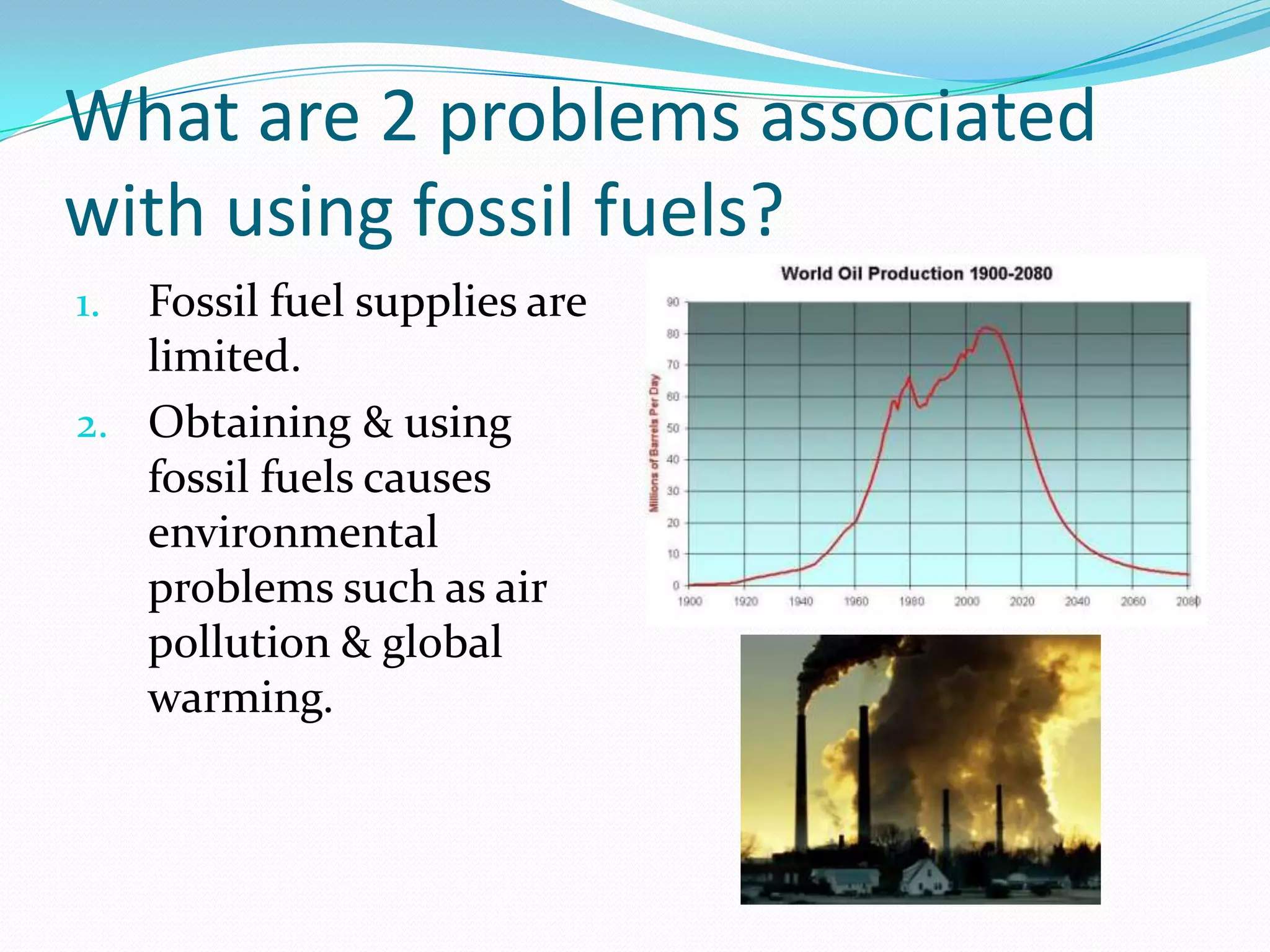
1. Fossil fuel supplies are
   limited.
2. Obtaining & using
   fossil fuels causes
   environmental
   problems such as air
   pollution & global
   warming.
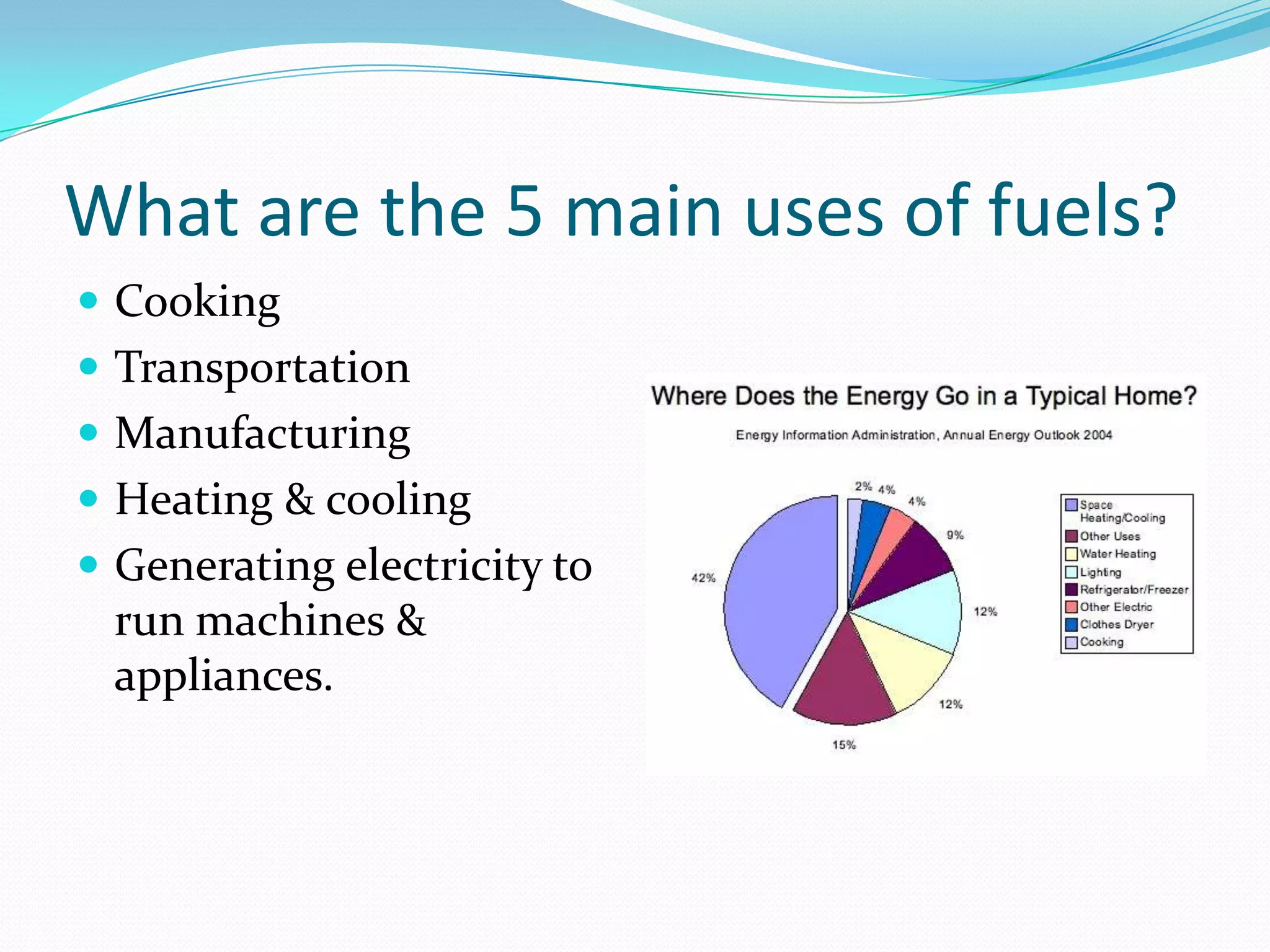
What are the 5 main uses of fuels?
 Cooking
 Transportation
 Manufacturing
 Heating & cooling
 Generating electricity to
 run machines &
 appliances.
How is electricity generated?
 Fossil fuel is burned to release heat.
 Heat is used to boil water to make
    steam. (1)
   Steam turns a turbine (rotating
    blade like a fan) (2)
   Turbine turns the electric generator
    (3)
   Electric generators produce electric
    energy by moving electrically
    conductive material within a
    magnetic field.
   Electricity is passed to a transformer
    which slows & reduces the
    electricity that comes to your home
    thru power lines. (4)
Are all fuels created equal?
 No!
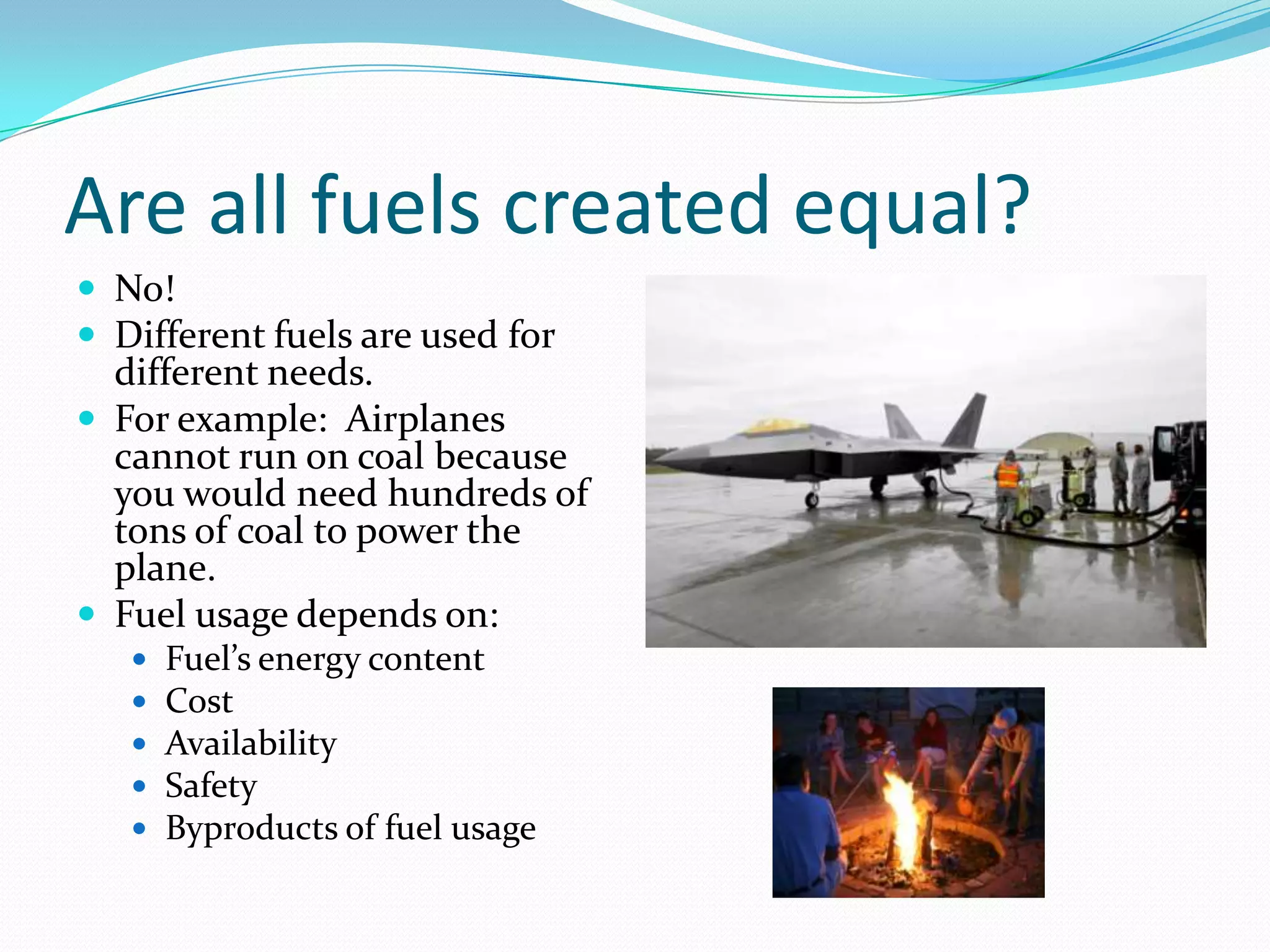
 Different fuels are used for
  different needs.
 For example: Airplanes
  cannot run on coal because
  you would need hundreds of
  tons of coal to power the
  plane.
 Fuel usage depends on:
      Fuel’s energy content
      Cost
      Availability
      Safety
      Byproducts of fuel usage
What is the “cost” of energy?
 Every product requires energy
  to make the product.
 The price you pay for the
  product reflects the cost of
  the energy.
    For example: buying a plane
     ticket includes the cost of
     fuel.
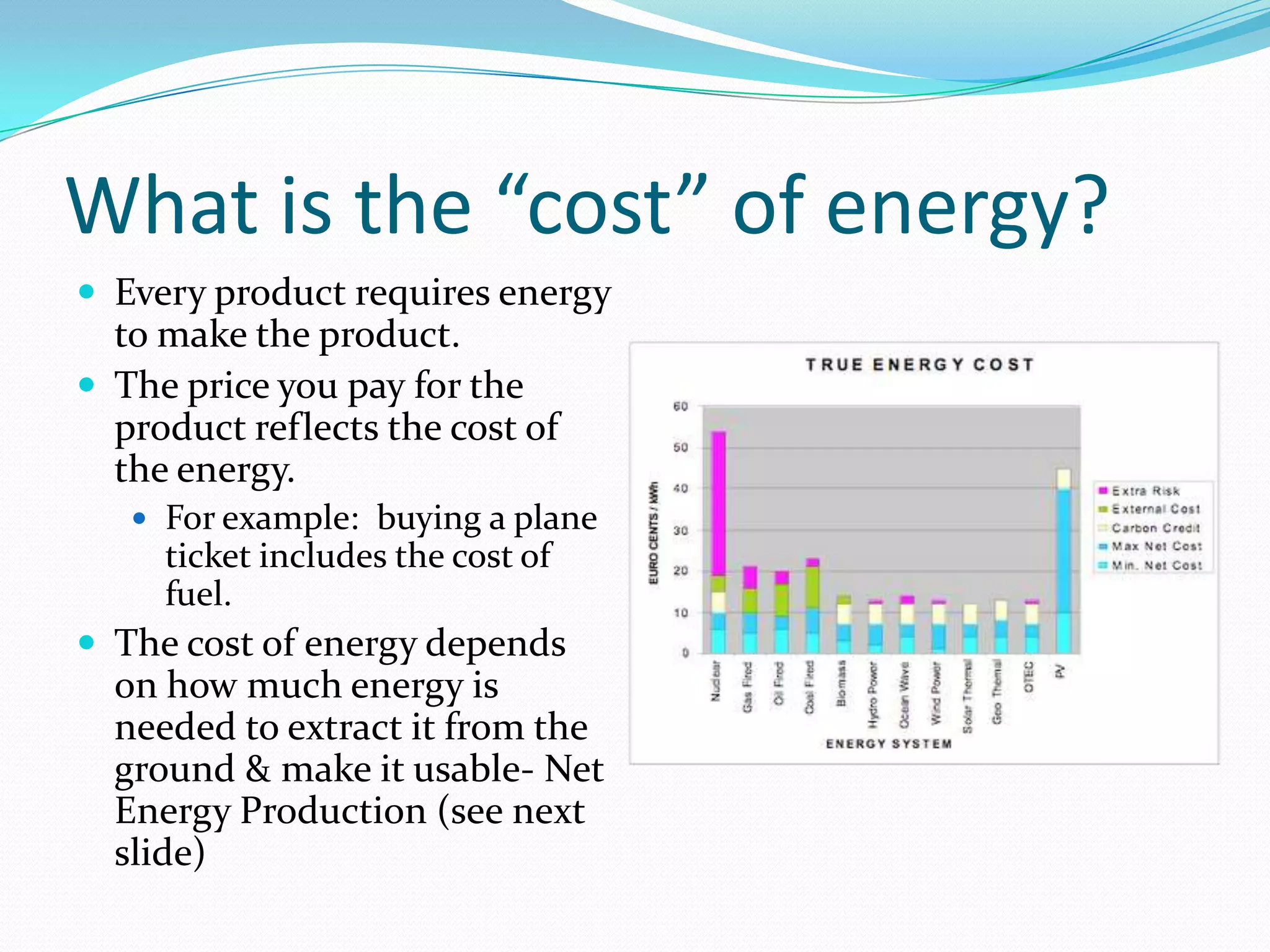
 The cost of energy depends
  on how much energy is
  needed to extract it from the
  ground & make it usable- Net
  Energy Production (see next
  slide)
Net Energy Production
 Takes energy to get energy
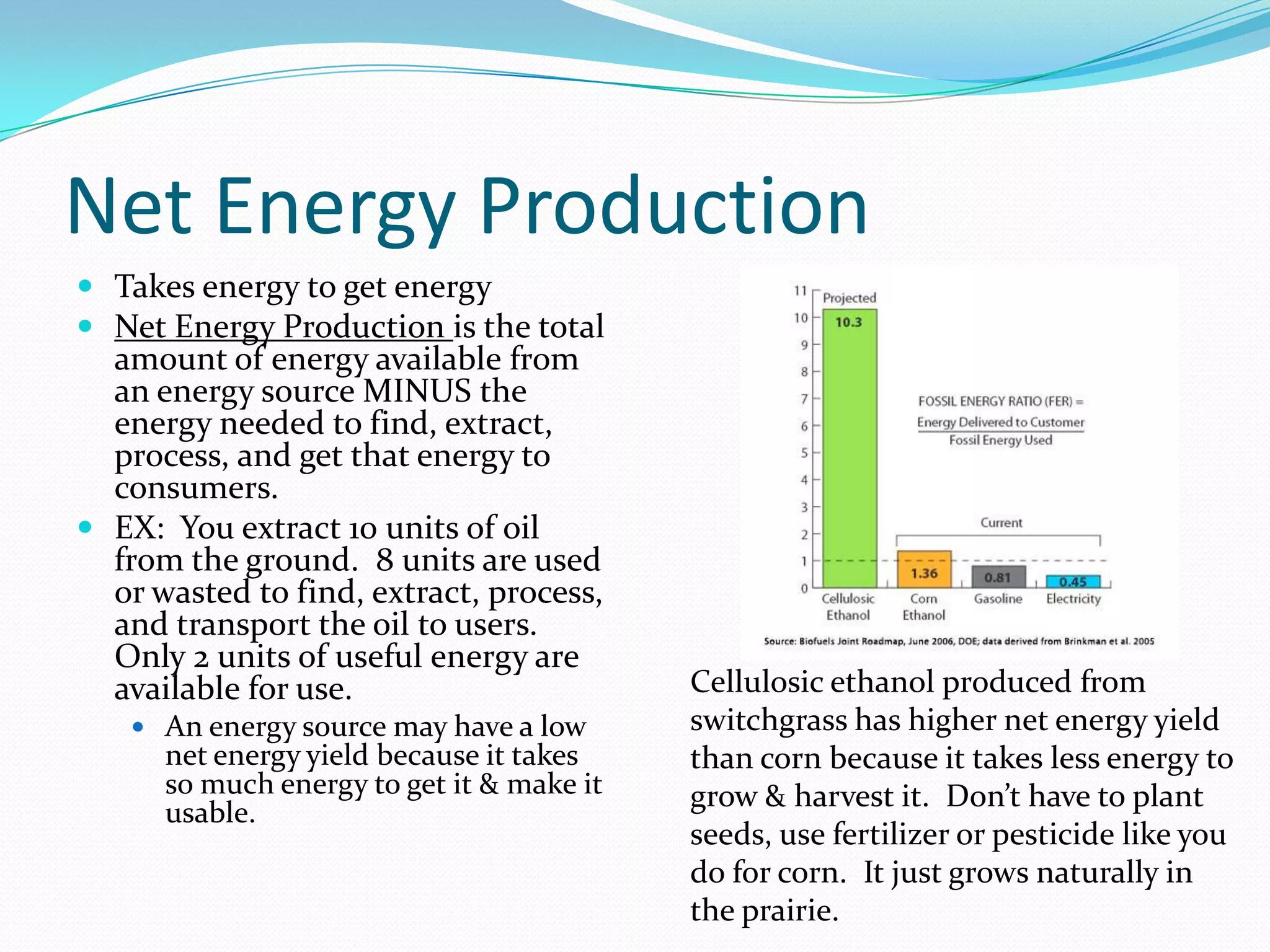
 Net Energy Production is the total
  amount of energy available from
  an energy source MINUS the
  energy needed to find, extract,
  process, and get that energy to
  consumers.
 EX: You extract 10 units of oil
  from the ground. 8 units are used
  or wasted to find, extract, process,
  and transport the oil to users.
  Only 2 units of useful energy are
  available for use.                       Cellulosic ethanol produced from
    An energy source may have a low       switchgrass has higher net energy yield
      net energy yield because it takes    than corn because it takes less energy to
      so much energy to get it & make it   grow & harvest it. Don’t have to plant
      usable.
                                           seeds, use fertilizer or pesticide like you
                                           do for corn. It just grows naturally in
                                           the prairie.
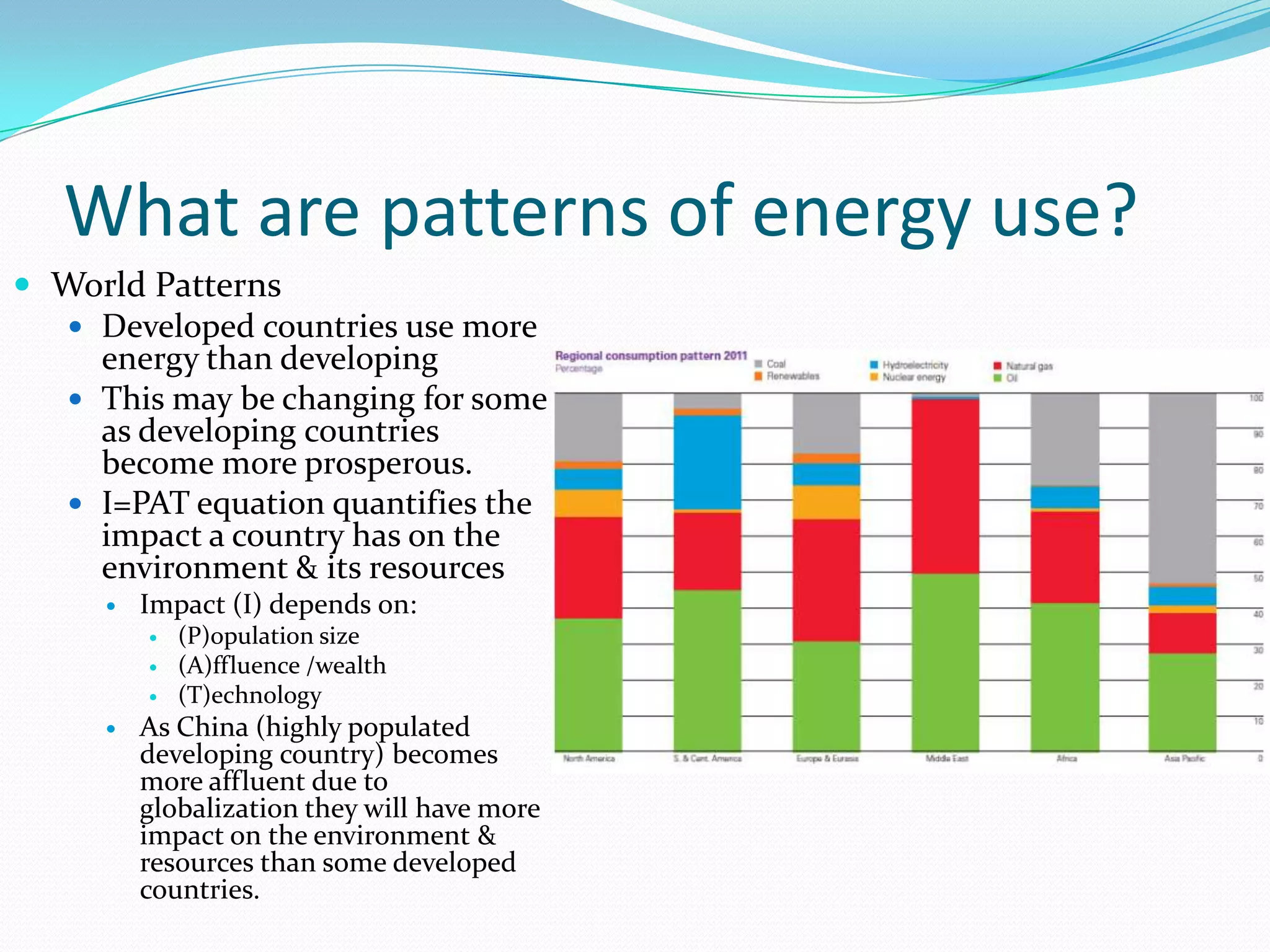
What are patterns of energy use?
 World Patterns
   Developed countries use more
    energy than developing
   This may be changing for some
    as developing countries
    become more prosperous.
   I=PAT equation quantifies the
    impact a country has on the
    environment & its resources
        Impact (I) depends on:
            (P)opulation size
            (A)ffluence /wealth
            (T)echnology
        As China (highly populated
         developing country) becomes
         more affluent due to
         globalization they will have more
         impact on the environment &
         resources than some developed
         countries.
What are patterns of energy use?
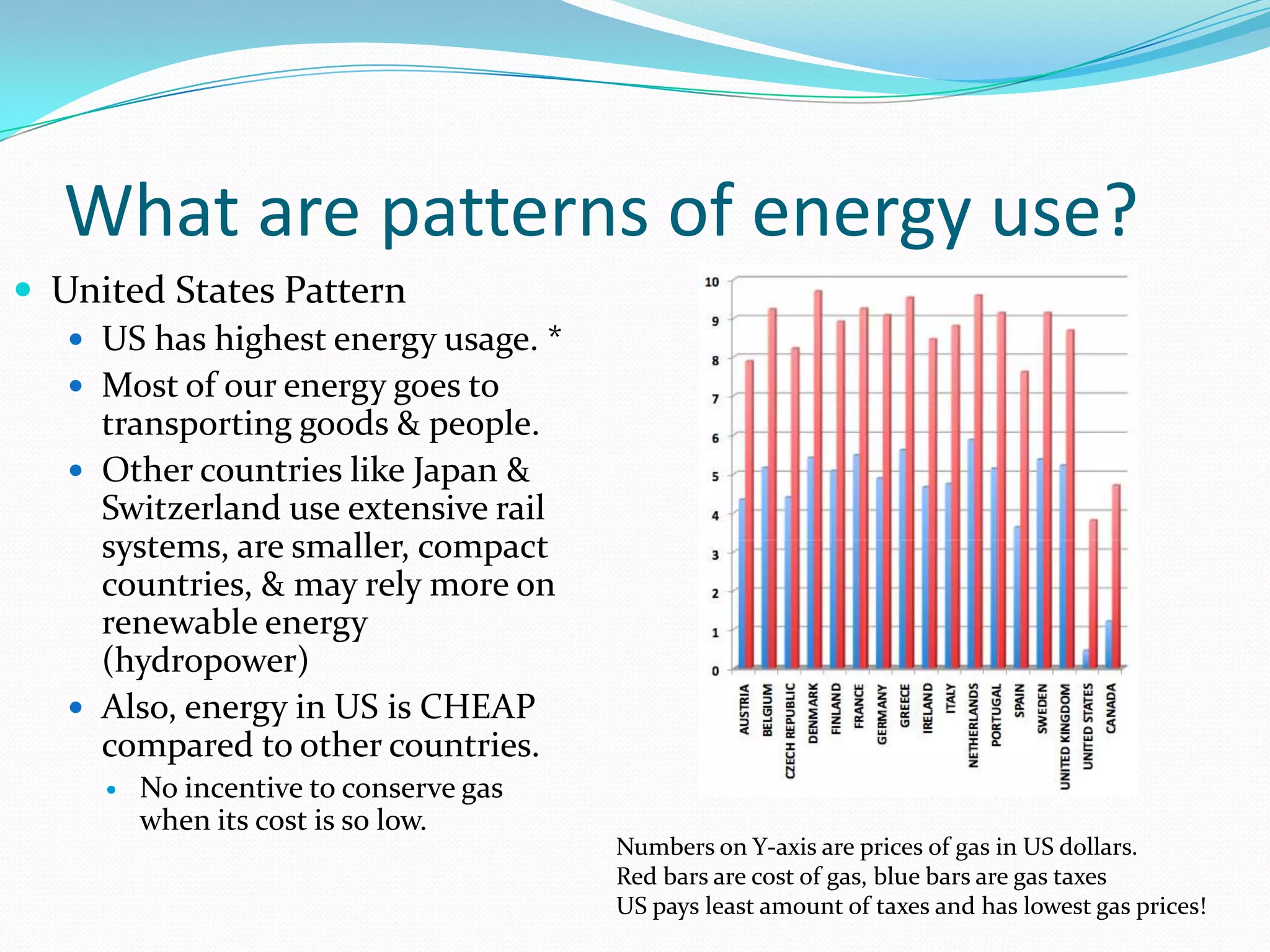
 United States Pattern
    US has highest energy usage. *
    Most of our energy goes to
     transporting goods & people.
    Other countries like Japan &
     Switzerland use extensive rail
     systems, are smaller, compact
     countries, & may rely more on
     renewable energy
     (hydropower)
    Also, energy in US is CHEAP
     compared to other countries.
        No incentive to conserve gas
         when its cost is so low.
                                        Numbers on Y-axis are prices of gas in US dollars.
                                        Red bars are cost of gas, blue bars are gas taxes
                                        US pays least amount of taxes and has lowest gas prices!
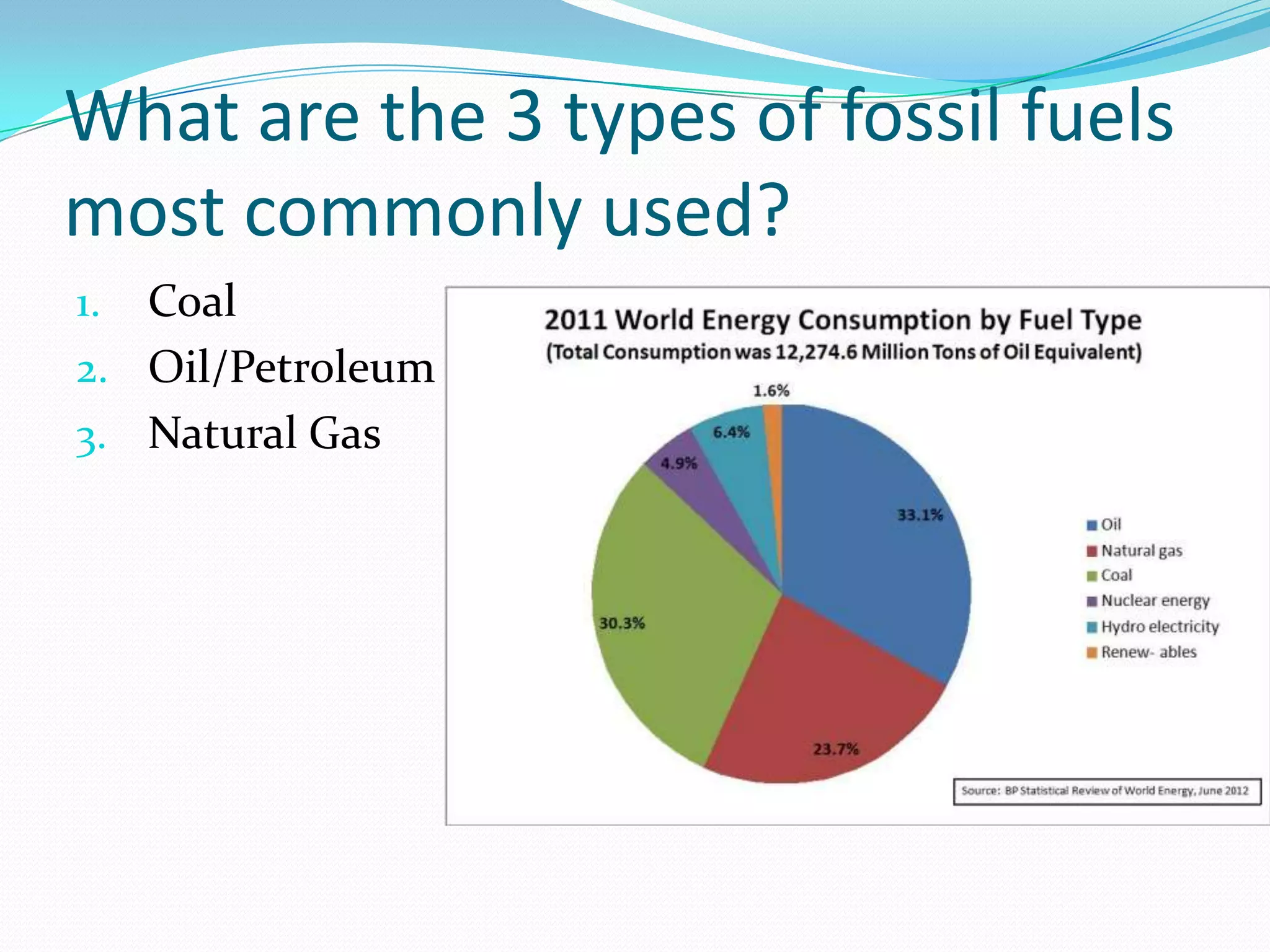
What are the 3 types of fossil fuels
most commonly used?
1. Coal
2. Oil/Petroleum
3. Natural Gas
How did coal form?
What are uses of coal?
What are the types of coal?
What are the advantages & disadvantages to using coal?
What methods are used to make coal burning cleaner?
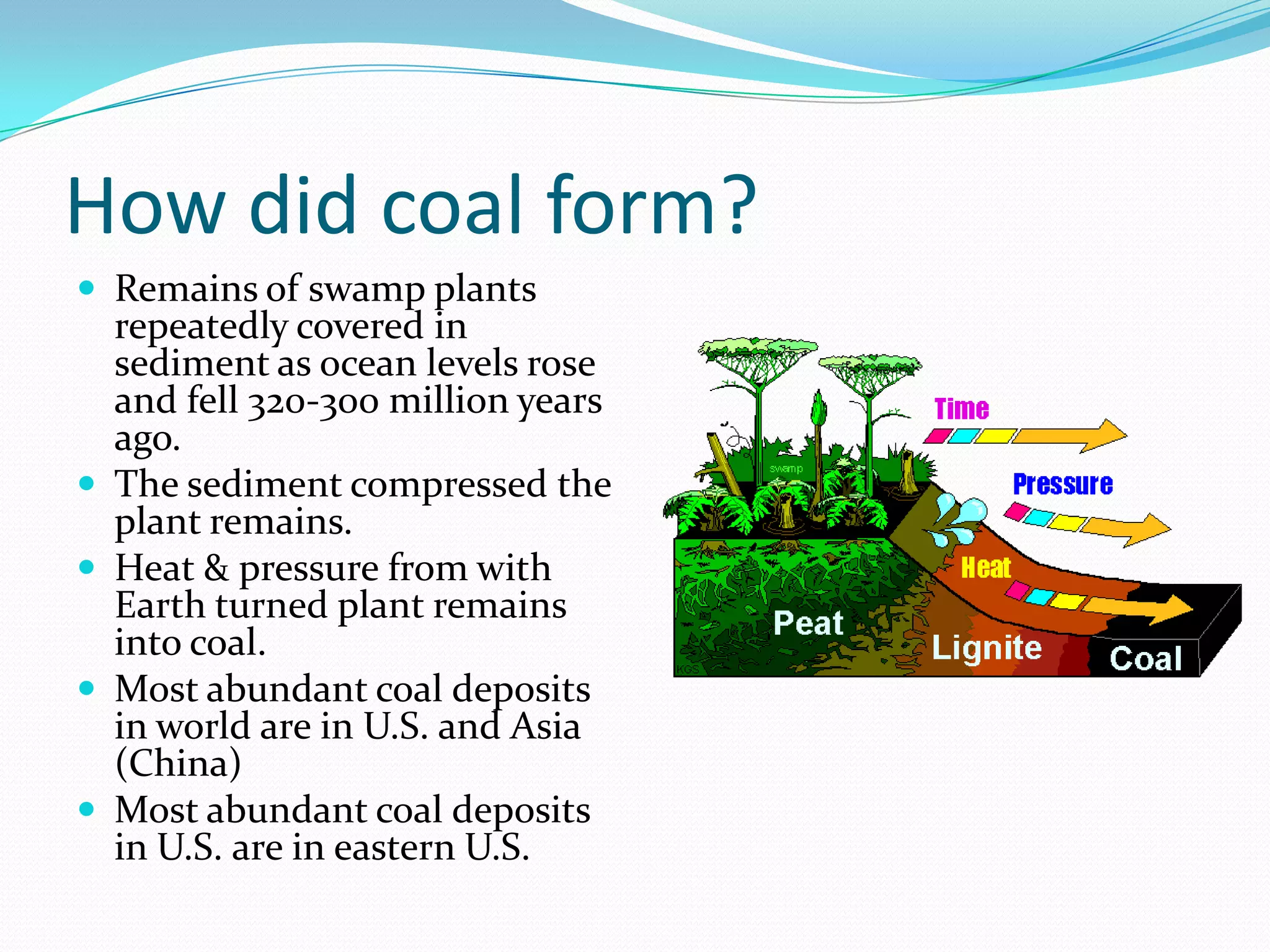
How did coal form?
 Remains of swamp plants
    repeatedly covered in
    sediment as ocean levels rose
    and fell 320-300 million years
    ago.
   The sediment compressed the
    plant remains.
   Heat & pressure from with
    Earth turned plant remains
    into coal.
   Most abundant coal deposits
    in world are in U.S. and Asia
    (China)
   Most abundant coal deposits
    in U.S. are in eastern U.S.
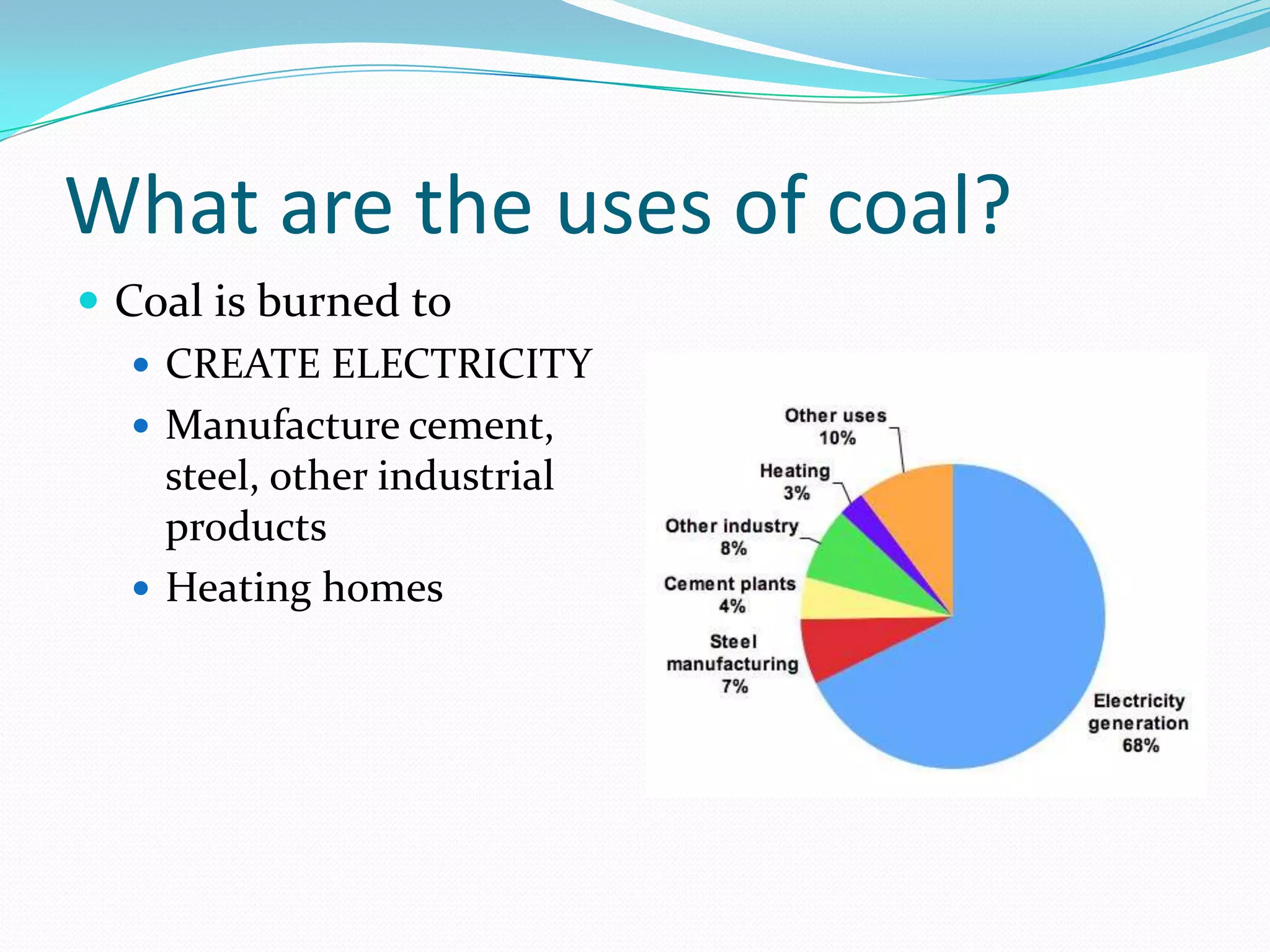
What are the uses of coal?
 Coal is burned to
    CREATE ELECTRICITY
    Manufacture cement,
     steel, other industrial
     products
    Heating homes
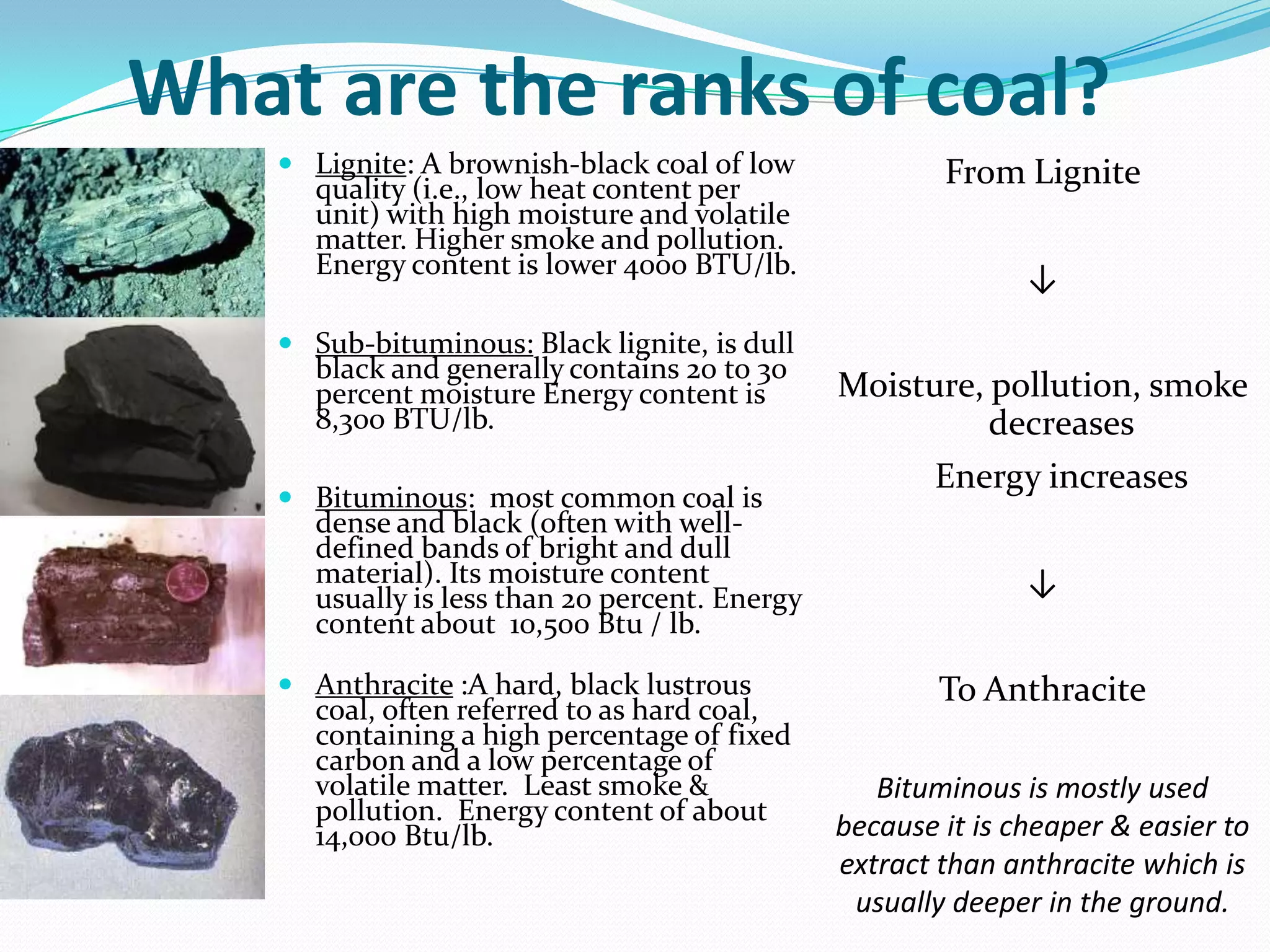
What are the ranks of coal?
     Lignite: A brownish-black coal of low             From Lignite
      quality (i.e., low heat content per
      unit) with high moisture and volatile
      matter. Higher smoke and pollution.
      Energy content is lower 4000 BTU/lb.
                                                               ↓
     Sub-bituminous: Black lignite, is dull
      black and generally contains 20 to 30
      percent moisture Energy content is        Moisture, pollution, smoke
      8,300 BTU/lb.                                       decreases
                                                       Energy increases
     Bituminous: most common coal is
      dense and black (often with well-
      defined bands of bright and dull
      material). Its moisture content                          ↓
      usually is less than 20 percent. Energy
      content about 10,500 Btu / lb.

     Anthracite :A hard, black lustrous                To Anthracite
      coal, often referred to as hard coal,
      containing a high percentage of fixed
      carbon and a low percentage of
      volatile matter. Least smoke &               Bituminous is mostly used
      pollution. Energy content of about
      14,000 Btu/lb.                            because it is cheaper & easier to
                                                extract than anthracite which is
                                                 usually deeper in the ground.
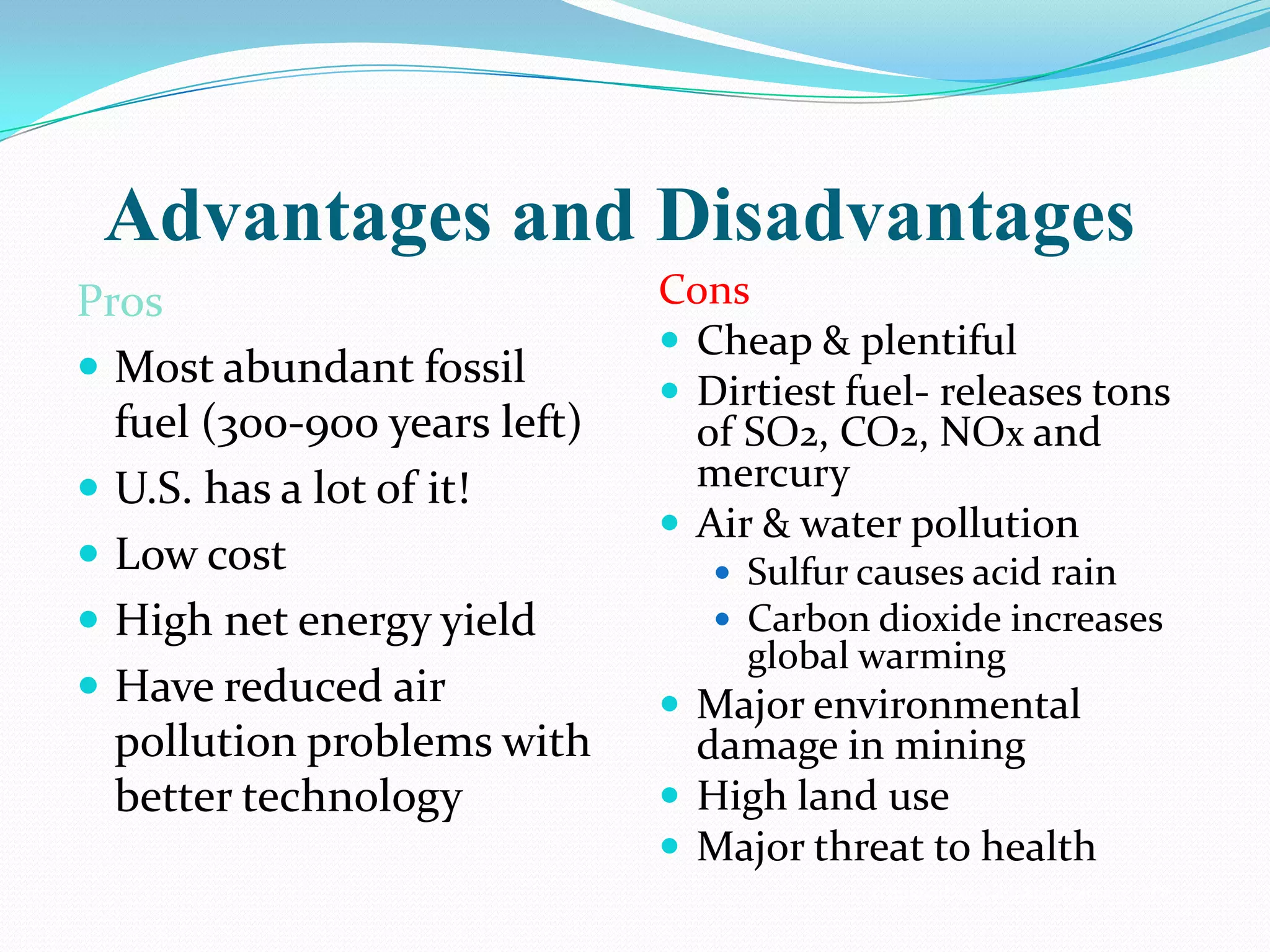
Advantages and Disadvantages
Pros                          Cons
                               Cheap & plentiful
 Most abundant fossil
                               Dirtiest fuel- releases tons
  fuel (300-900 years left)     of SO2, CO2, NOx and
 U.S. has a lot of it!         mercury
                               Air & water pollution
 Low cost                        Sulfur causes acid rain
 High net energy yield           Carbon dioxide increases
                                   global warming
 Have reduced air             Major environmental
  pollution problems with       damage in mining
  better technology            High land use
                               Major threat to health
                                          © Brooks/Cole Publishing Company / ITP
What methods are used to make
coal burning cleaner?
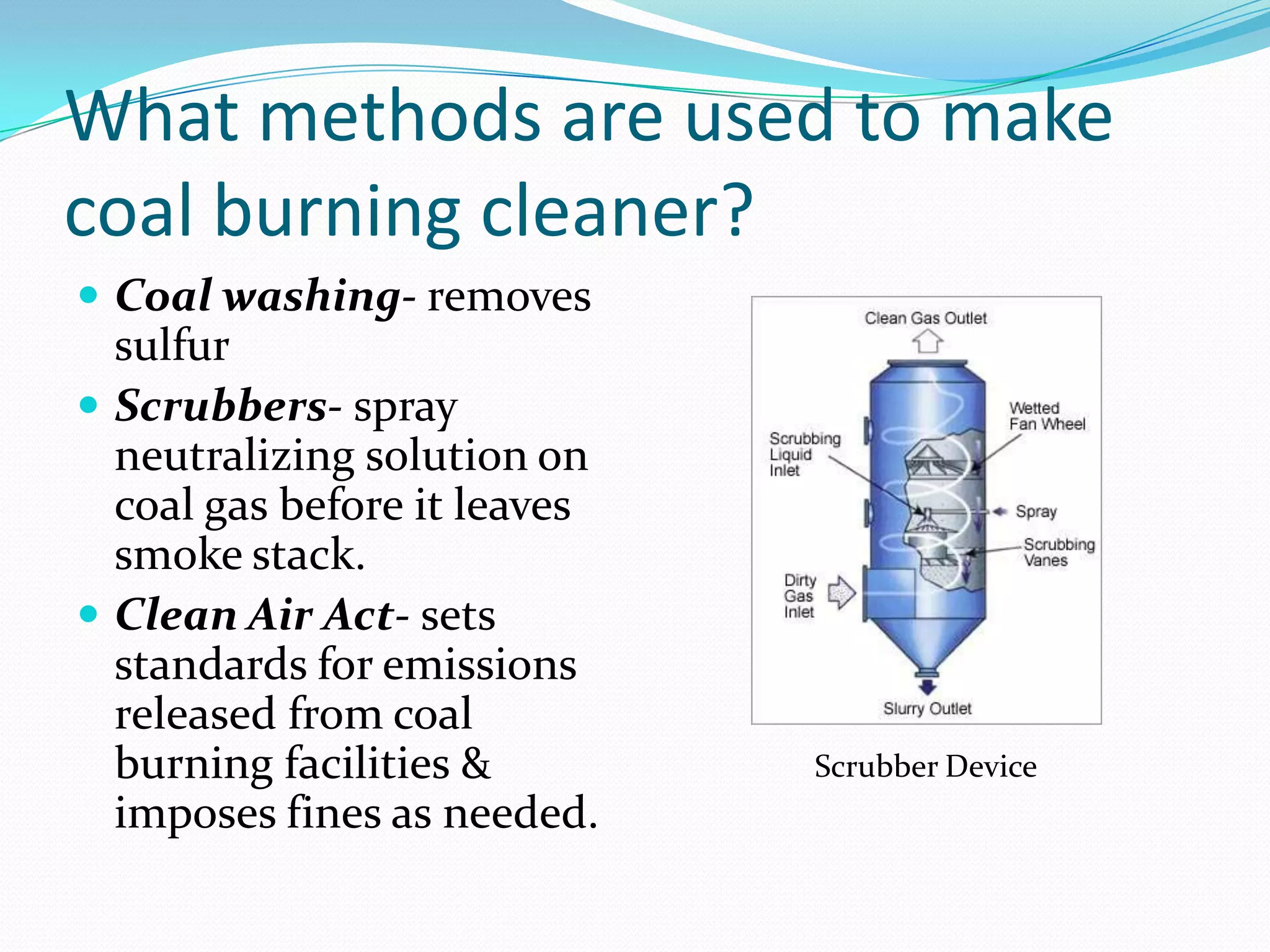
 Coal washing- removes
  sulfur
 Scrubbers- spray
  neutralizing solution on
  coal gas before it leaves
  smoke stack.
 Clean Air Act- sets
  standards for emissions
  released from coal
  burning facilities &        Scrubber Device
  imposes fines as needed.
How did oil form?
What are uses of oil?
What are the advantages & disadvantages to using oil?
What methods are used to make oil use cleaner?
How did oil form?
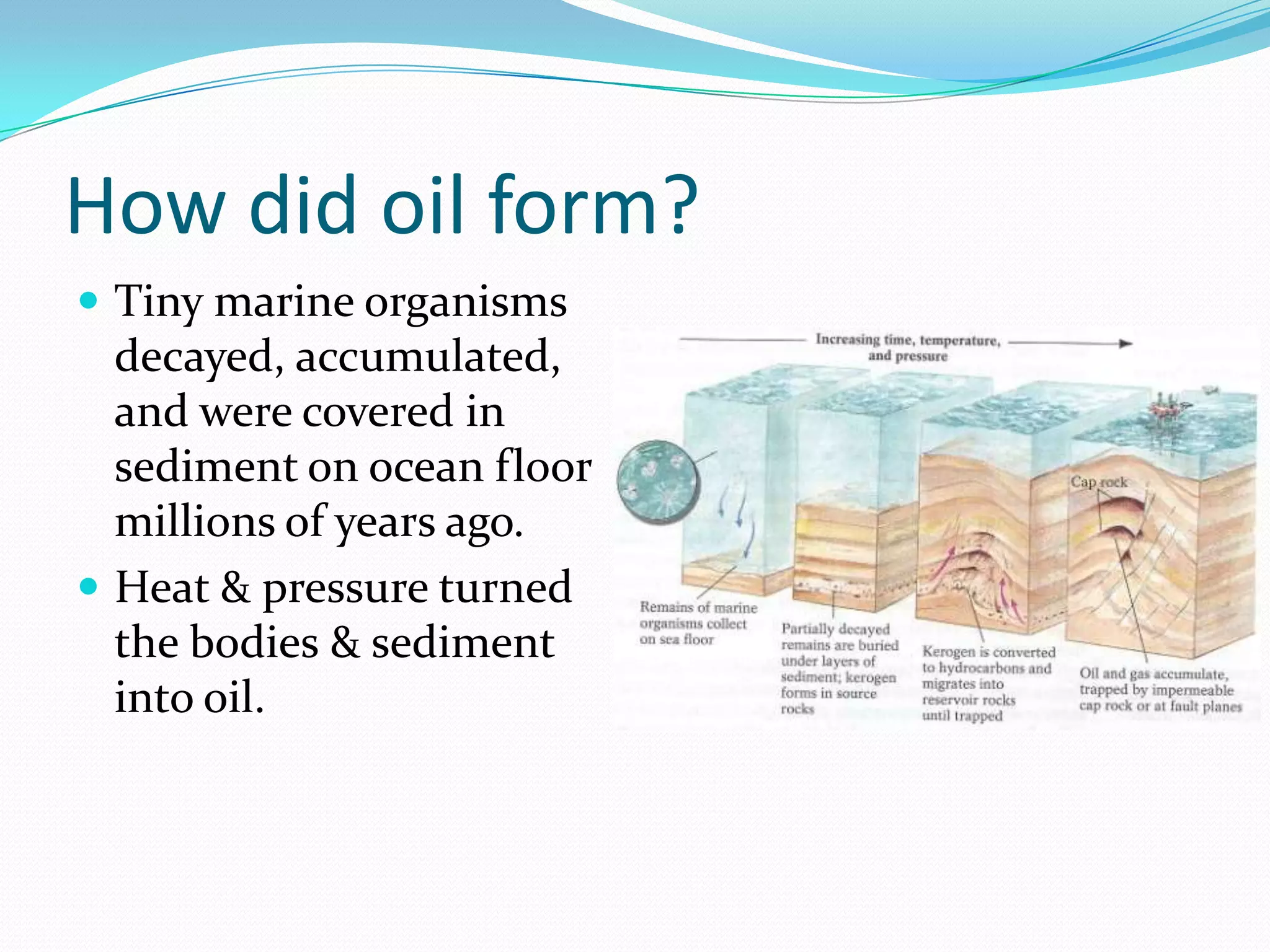
 Tiny marine organisms
  decayed, accumulated,
  and were covered in
  sediment on ocean floor
  millions of years ago.
 Heat & pressure turned
  the bodies & sediment
  into oil.
What are the uses for
oil/petroleum?
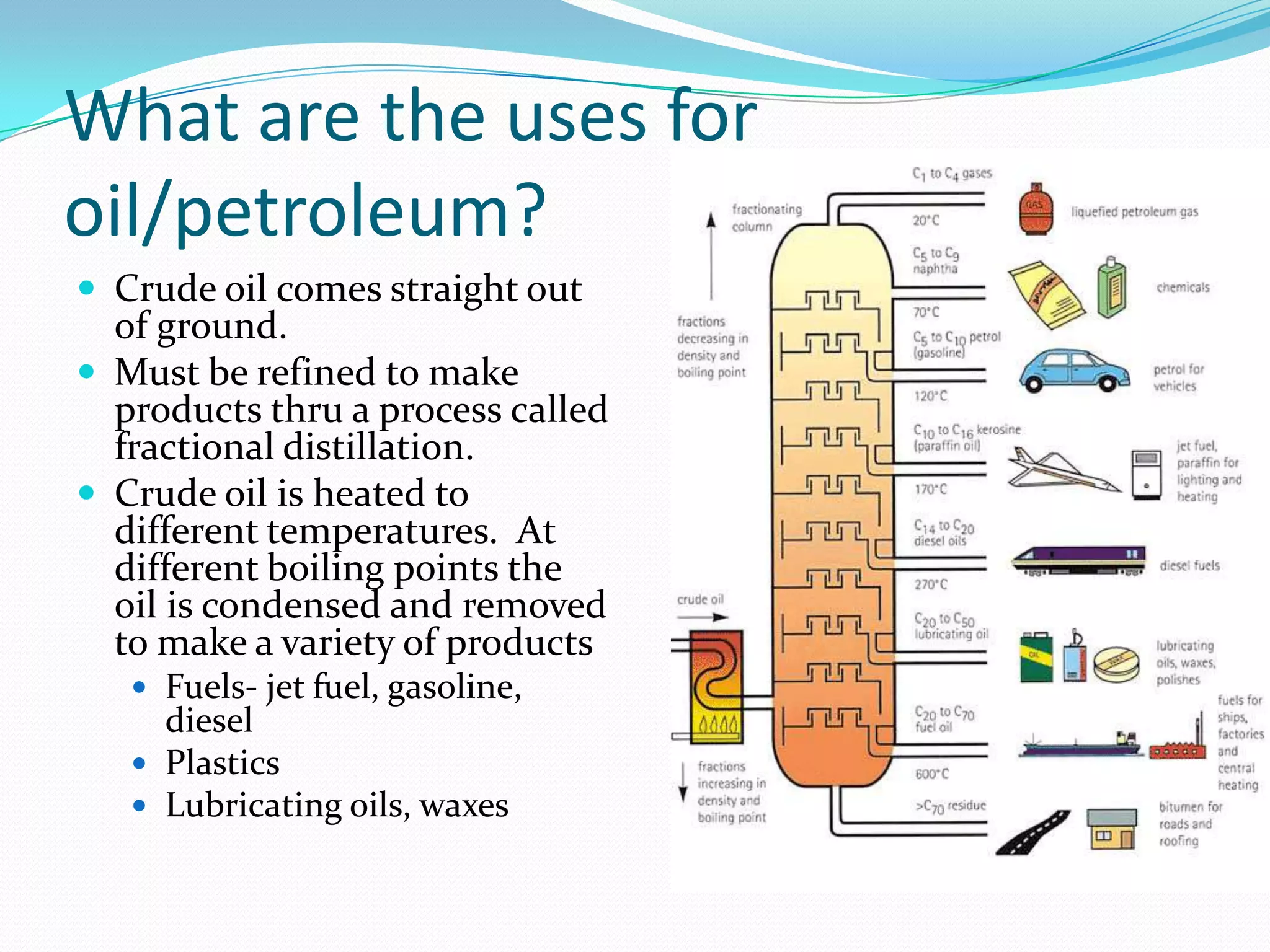
 Crude oil comes straight out
  of ground.
 Must be refined to make
  products thru a process called
  fractional distillation.
 Crude oil is heated to
  different temperatures. At
  different boiling points the
  oil is condensed and removed
  to make a variety of products
    Fuels- jet fuel, gasoline,
     diesel
    Plastics
    Lubricating oils, waxes
Advantages and Disadvantages
Pros                      Cons
 Low cost                 Projected to run out in
 High net energy yield     about 50 years.
 Easy transportation      Artificially low price
                            encourages waste. (Price is
                            low due to government
                            subsidies*)
                           Air pollution when burned
                           Releases CO2 when burned
                           Water pollution from oil
                            tankers/spills
What methods are used to make
oil use cleaner?
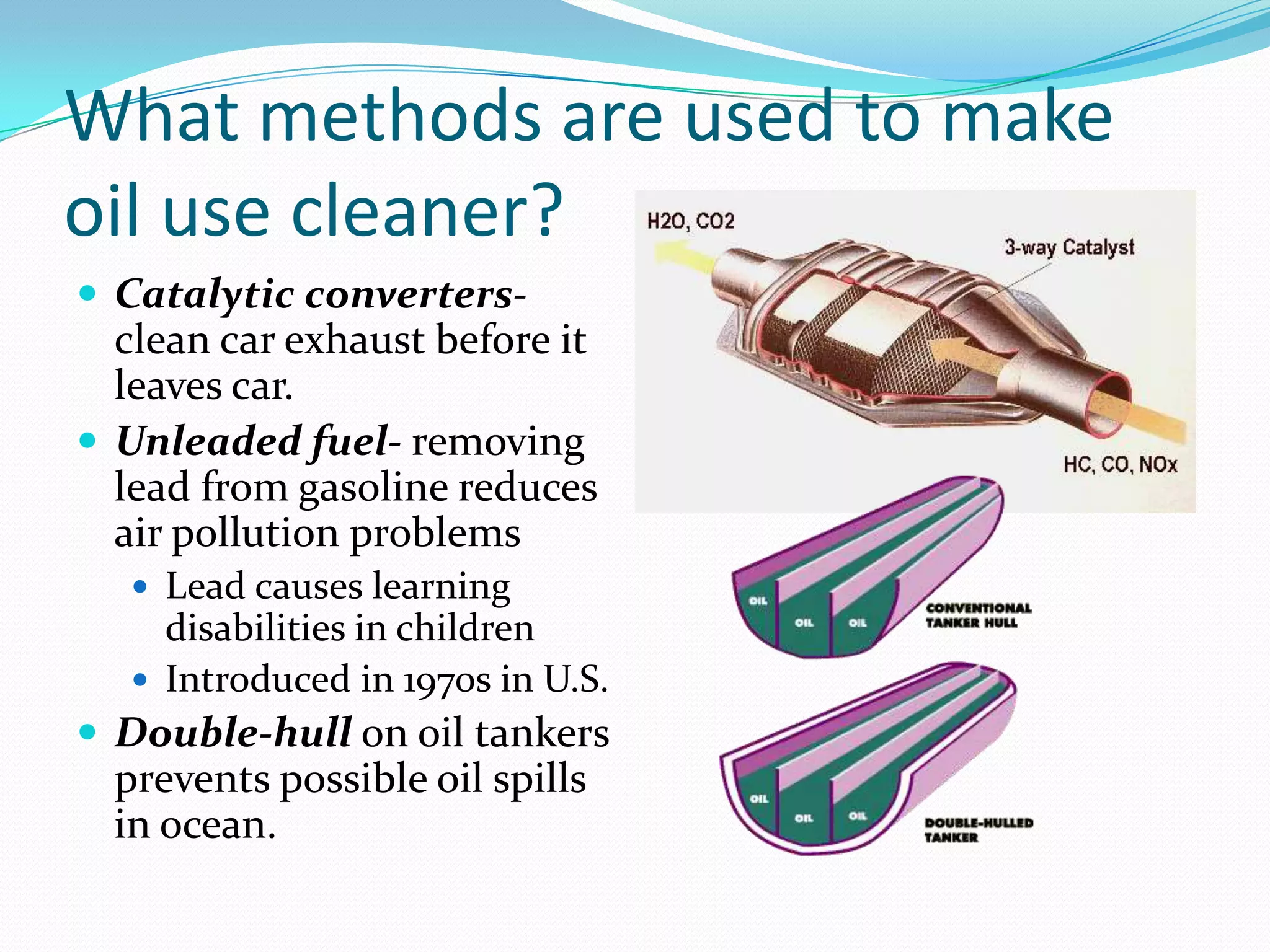
 Catalytic converters-
  clean car exhaust before it
  leaves car.
 Unleaded fuel- removing
  lead from gasoline reduces
  air pollution problems
    Lead causes learning
     disabilities in children
    Introduced in 1970s in U.S.
 Double-hull on oil tankers
  prevents possible oil spills
  in ocean.
How did natural gas form?
What are uses of natural gas?
What are the advantages & disadvantages to using natural gas?
What is fracking?
How did natural gas form?
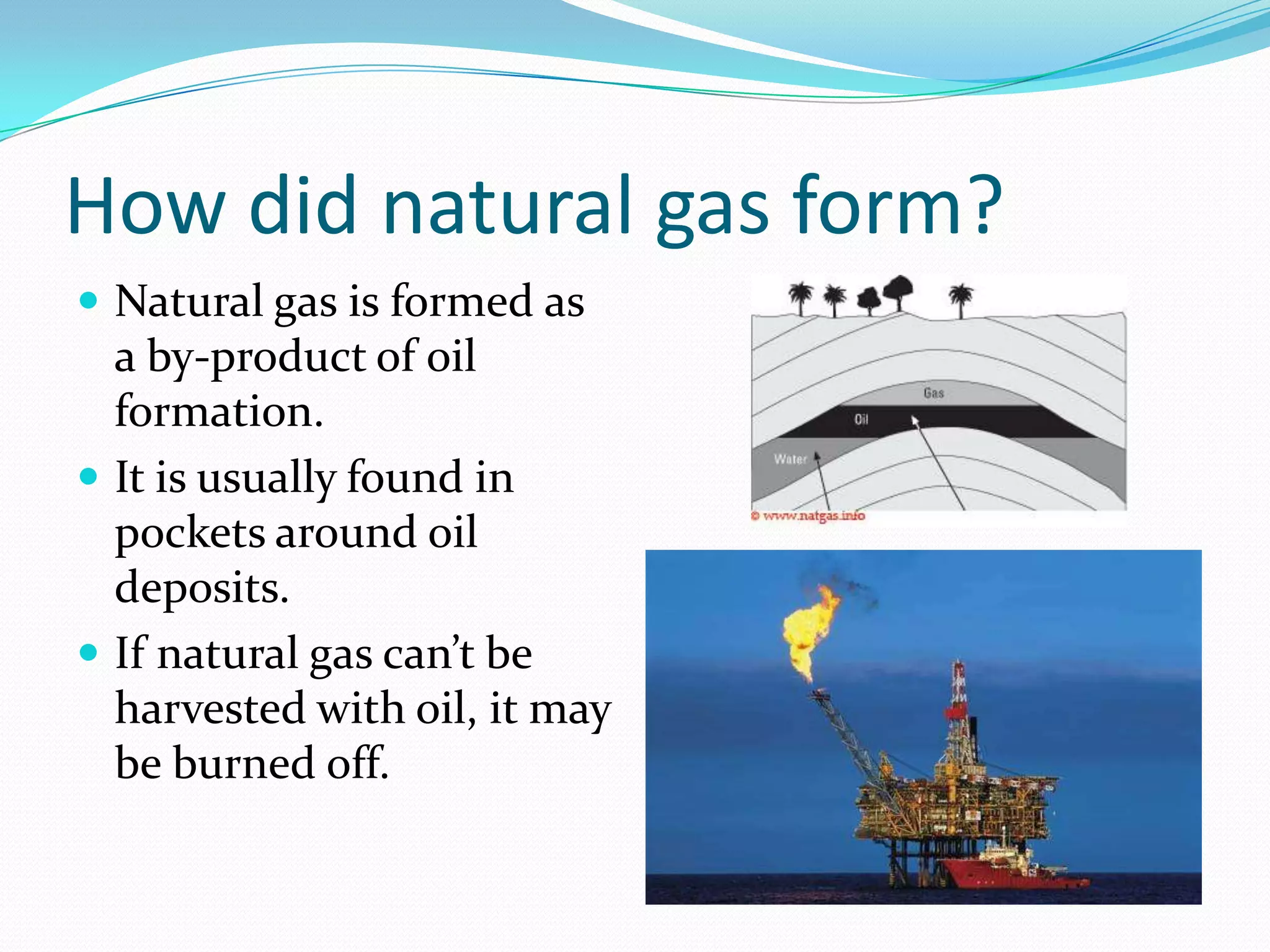
 Natural gas is formed as
  a by-product of oil
  formation.
 It is usually found in
  pockets around oil
  deposits.
 If natural gas can’t be
  harvested with oil, it may
  be burned off.
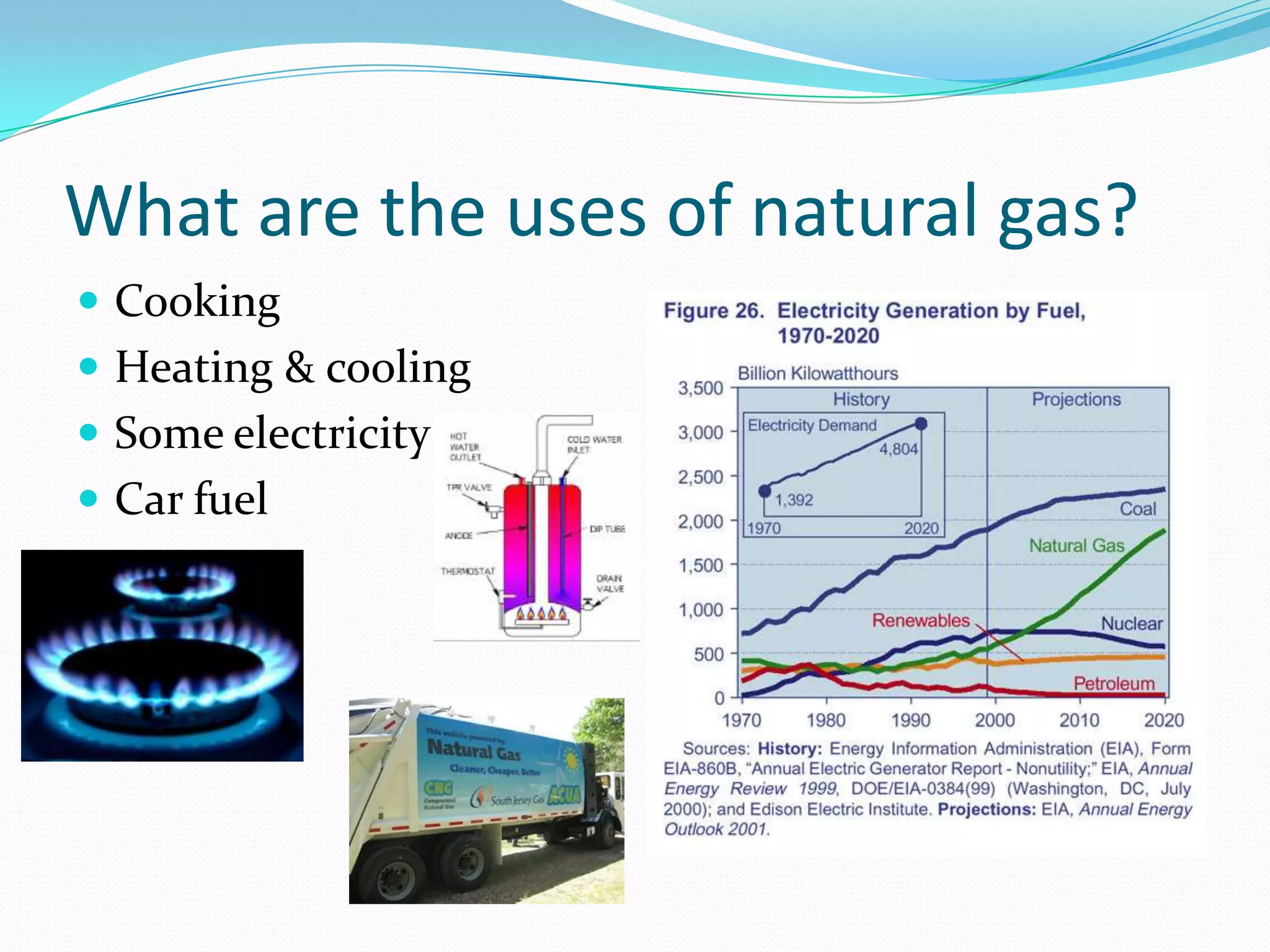
What are the uses of natural gas?
 Cooking
 Heating & cooling
 Some electricity
 Car fuel
Advantages & Disadvantages
Pros                            Cons
 125-200 year supply            Releases some CO2
 90% of the natural gas         Releases methane
  used in U.S. comes from         (greenhouse gas)
  U.S.- we don’t rely on         Explosive
  foreign countries for this     Cars- stored in pressurized
  like we do oil.                 tank which is not safe.
 High net energy yield
                                 Fracking (see next slide)
 Low cost (huge subsidies)
 Less air pollution & CO2
  emissions than oil & coal
 Less land degradation
 Easily transported by pipes
What is Hydraulic Fracturing
  AKA…“Fracking”?
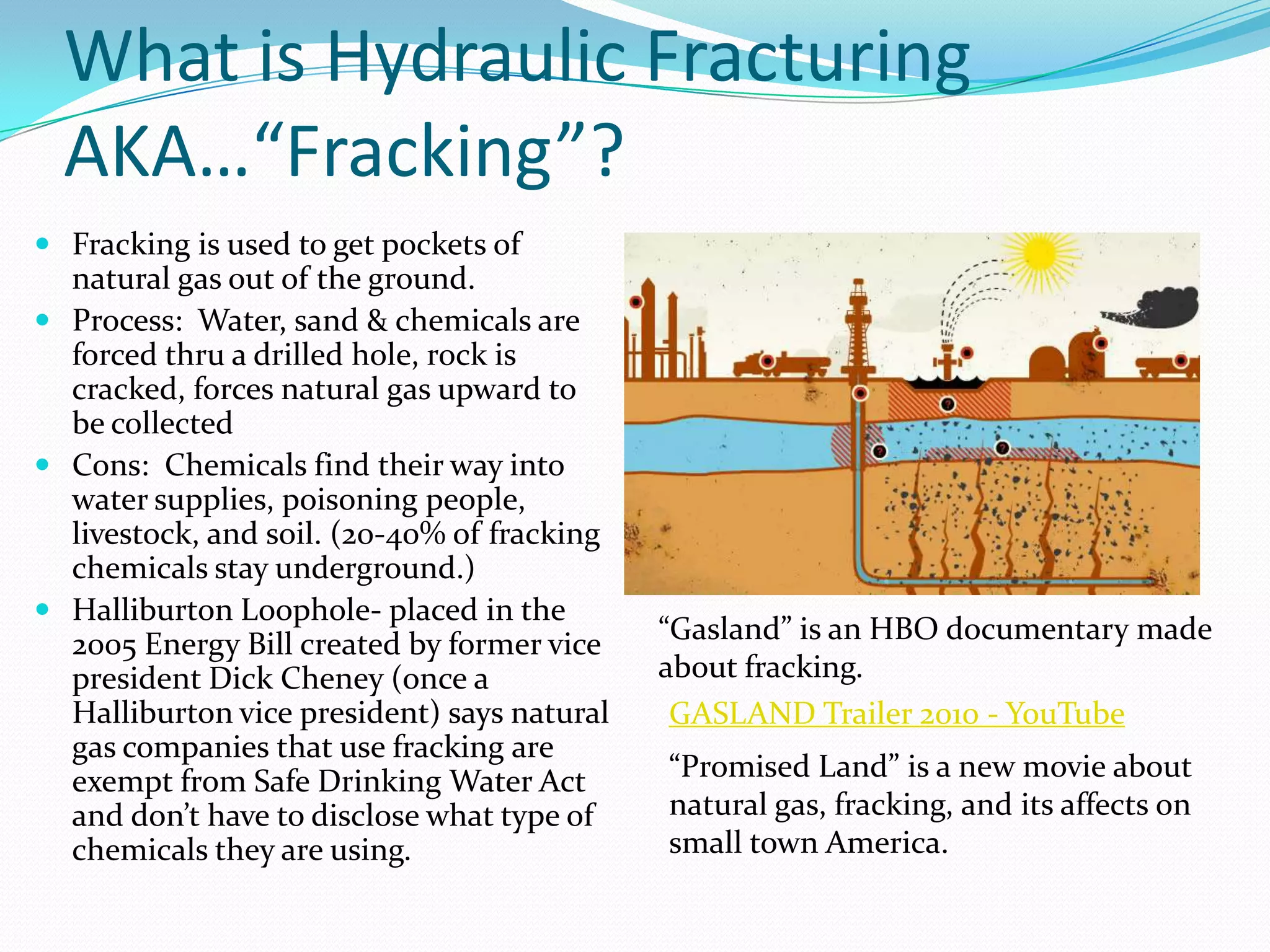
 Fracking is used to get pockets of
  natural gas out of the ground.
 Process: Water, sand & chemicals are
  forced thru a drilled hole, rock is
  cracked, forces natural gas upward to
  be collected
 Cons: Chemicals find their way into
  water supplies, poisoning people,
  livestock, and soil. (20-40% of fracking
  chemicals stay underground.)
 Halliburton Loophole- placed in the
  2005 Energy Bill created by former vice    “Gasland” is an HBO documentary made
  president Dick Cheney (once a              about fracking.
  Halliburton vice president) says natural    GASLAND Trailer 2010 - YouTube
  gas companies that use fracking are
  exempt from Safe Drinking Water Act        “Promised Land” is a new movie about
  and don’t have to disclose what type of    natural gas, fracking, and its affects on
  chemicals they are using.                  small town America.

Unit 4 ch 17 s1 energy resources & fossil fuels

  • 1.
    Chapter 17, Section1: Energy Resources & Fossil Fuels Standards: SEV4b, c, e, f, SEV5e
  • 2.
    What is anonrenewable resource?  Nonrenewable resource is a natural resource which cannot be reproduced, grown, or regenerated  It cannot be sustained at its current consumption rate  Once depleted there will be no more available for future use
  • 3.
    What is afossil fuel?  Fossil fuels are the remains of ancient organisms that changed into coal, oil, or natural gas through very specific geologic processes.  Fossil fuels are a type of nonrenewable energy resources
  • 4.
    What are 2problems associated with using fossil fuels? 1. Fossil fuel supplies are limited. 2. Obtaining & using fossil fuels causes environmental problems such as air pollution & global warming.
  • 5.
    What are the5 main uses of fuels?  Cooking  Transportation  Manufacturing  Heating & cooling  Generating electricity to run machines & appliances.
  • 6.
    How is electricitygenerated?  Fossil fuel is burned to release heat.  Heat is used to boil water to make steam. (1)  Steam turns a turbine (rotating blade like a fan) (2)  Turbine turns the electric generator (3)  Electric generators produce electric energy by moving electrically conductive material within a magnetic field.  Electricity is passed to a transformer which slows & reduces the electricity that comes to your home thru power lines. (4)
  • 7.
    Are all fuelscreated equal?  No!  Different fuels are used for different needs.  For example: Airplanes cannot run on coal because you would need hundreds of tons of coal to power the plane.  Fuel usage depends on:  Fuel’s energy content  Cost  Availability  Safety  Byproducts of fuel usage
  • 8.
    What is the“cost” of energy?  Every product requires energy to make the product.  The price you pay for the product reflects the cost of the energy.  For example: buying a plane ticket includes the cost of fuel.  The cost of energy depends on how much energy is needed to extract it from the ground & make it usable- Net Energy Production (see next slide)
  • 9.
    Net Energy Production Takes energy to get energy  Net Energy Production is the total amount of energy available from an energy source MINUS the energy needed to find, extract, process, and get that energy to consumers.  EX: You extract 10 units of oil from the ground. 8 units are used or wasted to find, extract, process, and transport the oil to users. Only 2 units of useful energy are available for use. Cellulosic ethanol produced from  An energy source may have a low switchgrass has higher net energy yield net energy yield because it takes than corn because it takes less energy to so much energy to get it & make it grow & harvest it. Don’t have to plant usable. seeds, use fertilizer or pesticide like you do for corn. It just grows naturally in the prairie.
  • 10.
    What are patternsof energy use?  World Patterns  Developed countries use more energy than developing  This may be changing for some as developing countries become more prosperous.  I=PAT equation quantifies the impact a country has on the environment & its resources  Impact (I) depends on:  (P)opulation size  (A)ffluence /wealth  (T)echnology  As China (highly populated developing country) becomes more affluent due to globalization they will have more impact on the environment & resources than some developed countries.
  • 11.
    What are patternsof energy use?  United States Pattern  US has highest energy usage. *  Most of our energy goes to transporting goods & people.  Other countries like Japan & Switzerland use extensive rail systems, are smaller, compact countries, & may rely more on renewable energy (hydropower)  Also, energy in US is CHEAP compared to other countries.  No incentive to conserve gas when its cost is so low. Numbers on Y-axis are prices of gas in US dollars. Red bars are cost of gas, blue bars are gas taxes US pays least amount of taxes and has lowest gas prices!
  • 12.
    What are the3 types of fossil fuels most commonly used? 1. Coal 2. Oil/Petroleum 3. Natural Gas
  • 13.
    How did coalform? What are uses of coal? What are the types of coal? What are the advantages & disadvantages to using coal? What methods are used to make coal burning cleaner?
  • 14.
    How did coalform?  Remains of swamp plants repeatedly covered in sediment as ocean levels rose and fell 320-300 million years ago.  The sediment compressed the plant remains.  Heat & pressure from with Earth turned plant remains into coal.  Most abundant coal deposits in world are in U.S. and Asia (China)  Most abundant coal deposits in U.S. are in eastern U.S.
  • 15.
    What are theuses of coal?  Coal is burned to  CREATE ELECTRICITY  Manufacture cement, steel, other industrial products  Heating homes
  • 16.
    What are theranks of coal?  Lignite: A brownish-black coal of low From Lignite quality (i.e., low heat content per unit) with high moisture and volatile matter. Higher smoke and pollution. Energy content is lower 4000 BTU/lb. ↓  Sub-bituminous: Black lignite, is dull black and generally contains 20 to 30 percent moisture Energy content is Moisture, pollution, smoke 8,300 BTU/lb. decreases Energy increases  Bituminous: most common coal is dense and black (often with well- defined bands of bright and dull material). Its moisture content ↓ usually is less than 20 percent. Energy content about 10,500 Btu / lb.  Anthracite :A hard, black lustrous To Anthracite coal, often referred to as hard coal, containing a high percentage of fixed carbon and a low percentage of volatile matter. Least smoke & Bituminous is mostly used pollution. Energy content of about 14,000 Btu/lb. because it is cheaper & easier to extract than anthracite which is usually deeper in the ground.
  • 17.
    Advantages and Disadvantages Pros Cons  Cheap & plentiful  Most abundant fossil  Dirtiest fuel- releases tons fuel (300-900 years left) of SO2, CO2, NOx and  U.S. has a lot of it! mercury  Air & water pollution  Low cost  Sulfur causes acid rain  High net energy yield  Carbon dioxide increases global warming  Have reduced air  Major environmental pollution problems with damage in mining better technology  High land use  Major threat to health © Brooks/Cole Publishing Company / ITP
  • 18.
    What methods areused to make coal burning cleaner?  Coal washing- removes sulfur  Scrubbers- spray neutralizing solution on coal gas before it leaves smoke stack.  Clean Air Act- sets standards for emissions released from coal burning facilities & Scrubber Device imposes fines as needed.
  • 19.
    How did oilform? What are uses of oil? What are the advantages & disadvantages to using oil? What methods are used to make oil use cleaner?
  • 20.
    How did oilform?  Tiny marine organisms decayed, accumulated, and were covered in sediment on ocean floor millions of years ago.  Heat & pressure turned the bodies & sediment into oil.
  • 21.
    What are theuses for oil/petroleum?  Crude oil comes straight out of ground.  Must be refined to make products thru a process called fractional distillation.  Crude oil is heated to different temperatures. At different boiling points the oil is condensed and removed to make a variety of products  Fuels- jet fuel, gasoline, diesel  Plastics  Lubricating oils, waxes
  • 22.
    Advantages and Disadvantages Pros Cons  Low cost  Projected to run out in  High net energy yield about 50 years.  Easy transportation  Artificially low price encourages waste. (Price is low due to government subsidies*)  Air pollution when burned  Releases CO2 when burned  Water pollution from oil tankers/spills
  • 23.
    What methods areused to make oil use cleaner?  Catalytic converters- clean car exhaust before it leaves car.  Unleaded fuel- removing lead from gasoline reduces air pollution problems  Lead causes learning disabilities in children  Introduced in 1970s in U.S.  Double-hull on oil tankers prevents possible oil spills in ocean.
  • 24.
    How did naturalgas form? What are uses of natural gas? What are the advantages & disadvantages to using natural gas? What is fracking?
  • 25.
    How did naturalgas form?  Natural gas is formed as a by-product of oil formation.  It is usually found in pockets around oil deposits.  If natural gas can’t be harvested with oil, it may be burned off.
  • 26.
    What are theuses of natural gas?  Cooking  Heating & cooling  Some electricity  Car fuel
  • 27.
    Advantages & Disadvantages Pros Cons  125-200 year supply  Releases some CO2  90% of the natural gas  Releases methane used in U.S. comes from (greenhouse gas) U.S.- we don’t rely on  Explosive foreign countries for this  Cars- stored in pressurized like we do oil. tank which is not safe.  High net energy yield  Fracking (see next slide)  Low cost (huge subsidies)  Less air pollution & CO2 emissions than oil & coal  Less land degradation  Easily transported by pipes
  • 28.
    What is HydraulicFracturing AKA…“Fracking”?  Fracking is used to get pockets of natural gas out of the ground.  Process: Water, sand & chemicals are forced thru a drilled hole, rock is cracked, forces natural gas upward to be collected  Cons: Chemicals find their way into water supplies, poisoning people, livestock, and soil. (20-40% of fracking chemicals stay underground.)  Halliburton Loophole- placed in the 2005 Energy Bill created by former vice “Gasland” is an HBO documentary made president Dick Cheney (once a about fracking. Halliburton vice president) says natural GASLAND Trailer 2010 - YouTube gas companies that use fracking are exempt from Safe Drinking Water Act “Promised Land” is a new movie about and don’t have to disclose what type of natural gas, fracking, and its affects on chemicals they are using. small town America.

Editor's Notes

  • #8 It would not be effective to use coal to power an airplane. Need tons of coal to do that. Jet fuel is more efficient.You would not use jet fuel to create a camp fire. Safety, availability, cost would all be issues.
  • #9 PV stands for photovoltaic (solar panels) This is different from solar thermal which uses sun to heat water.
  • #10 Why don’t we use switchgrass to make ethanol for fuel for cars? There are no government subsidies to make the growing & processing cheaper. More government subsidies are going to corn because the corn industry has more money to donate to politicians to have politicians support it.
  • #11 Countries across bottom from left to right:North AmericaS & Central AmericaEurope & EurasiaMiddle EastAfricaAsia Pacific
  • #12 * The textbook says we are 3rd highest behind Canada and United Arab Emirates BUT the book was published in 2008- 4 years ago which means it was written even earlier. Most reliable internet sources indicate US has highest.
  • #23 Subsidies are government monies paid to an industry or business to keep the cost of the product low enough for people to afford the product which is usually a high needs or high use product.
  • #26 Bottom picture- This oil rig in the middle of the ocean has no way to contain the natural gas & harvest it so the natural gas is burned off. Unfortunately this can be the cause of rig explosions which can lead to oil spills.