Conventional Energy Sources
Science
Harsh Rajada 11
Keshav Singh 12
Mansi Teotia 13
Mansi Tomer 14
Mayank Chaudhary 15
Members :
Transportation
Heating homes
Cooking
Power machinery used
for agriculture,
industry/business, homes
What else?
Why do we need energy?
Energy- capacity to do work
Power- rate of flow of energy or
rate at which work is done.
Work- application of force thru a
distance.
OPEC- Organization of
Petroleum Exporting Countries
Includes: Algeria, Ecuador,
Gabon, Indonesia, Iran, Iraq,
Kuwait, Libya, Nigeria, Qatar,
Saudi Arabia, United Arab
Emirates, & Venezuela
13 countries that hold about 67%
world oil reserves
 One calories is the amount of energy needed
to heat 1g of water 1°C.
 A kilocalorie is 1,000 calories
 1 BTU = energy to heat 1 lb of water 1°F
 1 watt (W) = 3.412 Btu/hour
 1 horsepower (hp) = 746 W
 Watt-hour- used to describe electrical
energy. Usually use kilowatt-hour (kWh)/ it
is larger.
 Laws of thermodynamics tell 2 things about
converting heat energy from steam to work…
 Conversion of heat to work is not 100% efficient
because a portion of the heat is wasted
 Efficiency of converting heat to work increases
as the heat temperature increases.
 Fire
 Muscle power from animals
 Wind & water usage
 Steam engines powered by wood
fires
 Steam engines powered by coal
 Now we use oil more because it is
easier to ship, store & burn.
 Oil use peaked in 1979, so did
prices thanks to Arab oil embargo
& Iranian revolution.
 1980’s began pursuing renewable
energies but then oil prices fell
and we went back to oil.
 In 2000, OPEC decreased
production and prices went up to
$30 per barrel
 Now oil costs $90-$100 per barrel
 Primary Energy sources-
Fossil fuels (oil, natural gas, coal)
Nuclear energy
Falling water, geothermal, solar
 Secondary Energy sources-
 Sources derived from a primary source like…
 Electricity
 Gasoline
 Alcohol fuels (gasohol)
 One barrel holds 42 gallons of oil.
 About 20 gallons of gasoline can be made
from one barrel of oil (through fractional
distillation.)
 On average, each person uses 25 barrels
of oil each year for their energy “needs”.
 The U.S. Strategic Petroleum Reserve
stores 570 million barrels of oil in
underground salt caverns along Gulf
coast. This is about a 60 day supplies
worth.
 We import ½ of our oil from unstable
countries.
 The U.S. has 1/20th
(5%)
of the world’s population
(300 million people) but
we consume 24% of the
world’s energy
 84% from fossil fuels (coal,
oil, natural gas)
 7% from nuclear power
 9% from renewable resources
(hydropower, geothermal,
solar, and biomass).
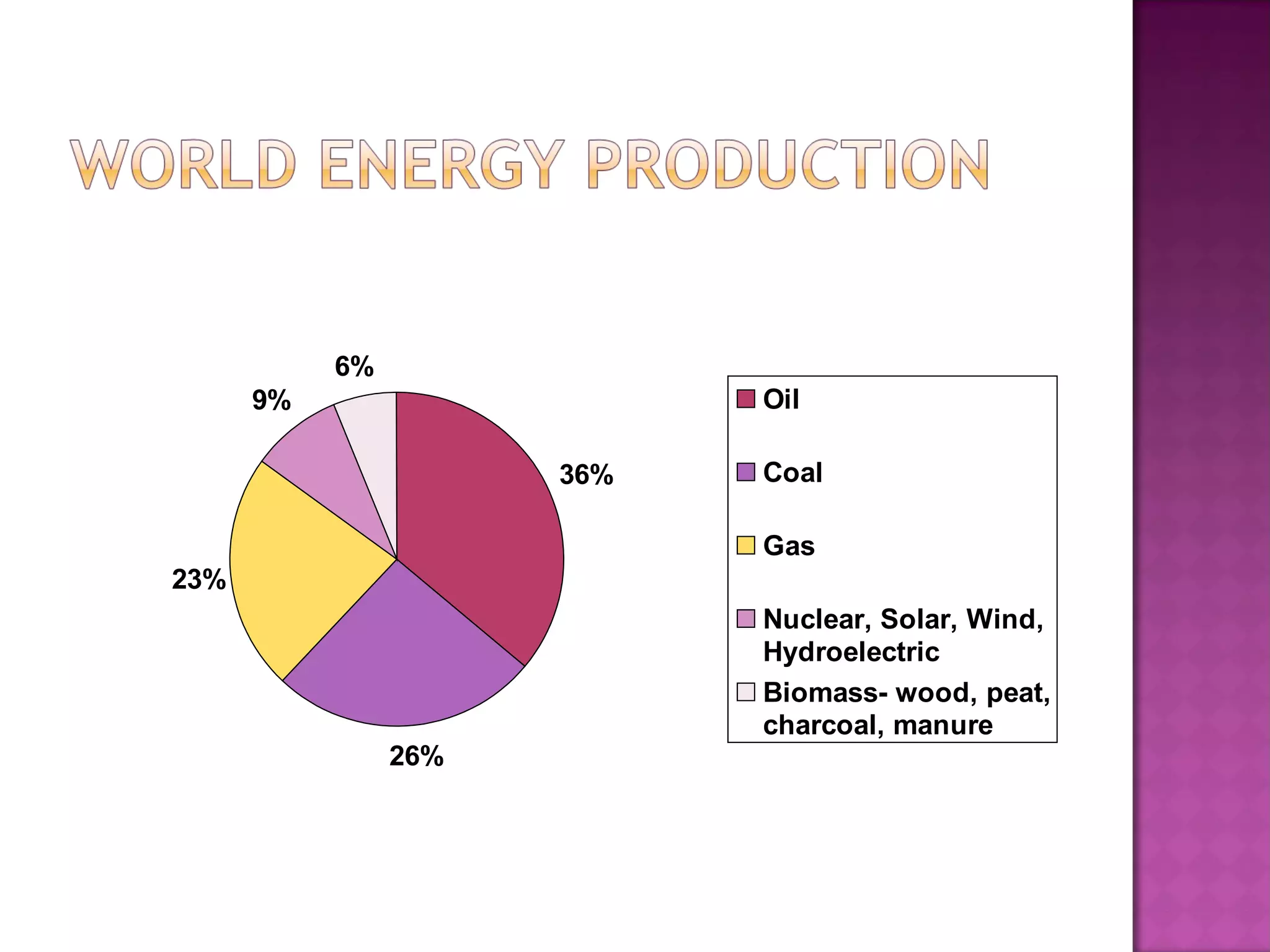
36%
26%
23%
9%
6%
Oil
Coal
Gas
Nuclear, Solar, Wind,
Hydroelectric
Biomass- wood, peat,
charcoal, manure
Energy resources removed from the
earth’s crust include: oil, natural gas,
coal, and uranium
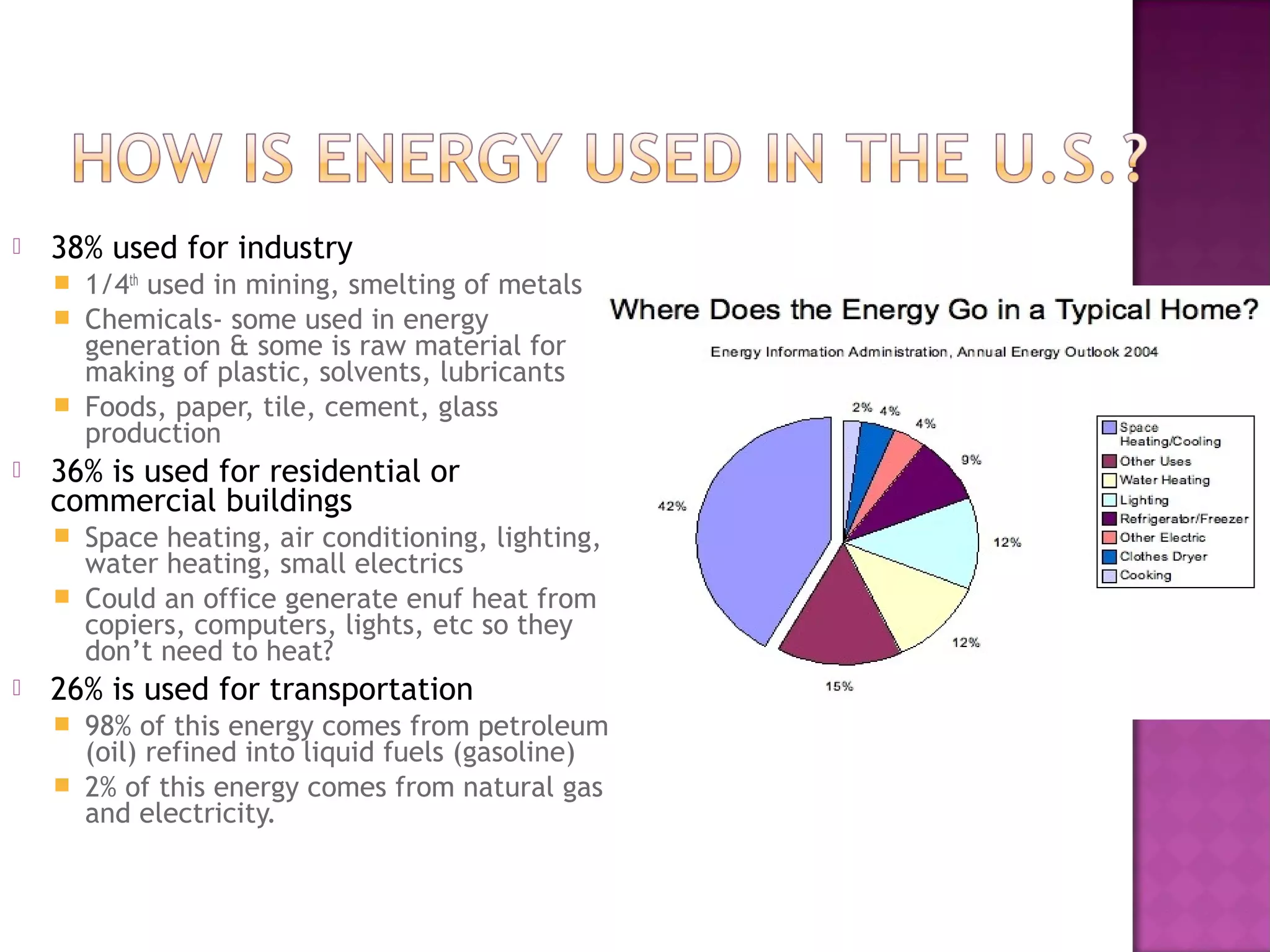
 38% used for industry
 1/4th
used in mining, smelting of metals
 Chemicals- some used in energy
generation & some is raw material for
making of plastic, solvents, lubricants
 Foods, paper, tile, cement, glass
production
 36% is used for residential or
commercial buildings
 Space heating, air conditioning, lighting,
water heating, small electrics
 Could an office generate enuf heat from
copiers, computers, lights, etc so they
don’t need to heat?
 26% is used for transportation
 98% of this energy comes from petroleum
(oil) refined into liquid fuels (gasoline)
 2% of this energy comes from natural gas
and electricity.
 About ½ of all primary energy is lost when
converted to more useful forms
 Coal
 66% is lost to thermal conversion when energy in coal is
converted to electricity.
 10% is lost when transmitted to you at home.
 Oil
 75% lost during distillation, transportation, storage,
combustion in vehicles
 Natural Gas
 10% lost in shipping & processing
 Most efficient and least polluting (has more H than C so
produces less CO2 when burned so contributes less to
global warming.)
 Non-renewable
 At projected consumption rates,
natural gas & petroleum will be
depleted by the end of the 21st
century
 Impurities are major source of
pollution
 SO2 travels on air currents & falls
with precip. as acid rain
 Mercury bio-accumulates &
biomagnifies thru ecosystems when
it travels on air currents and fall as
particulate dust or with
precipitation elsewhere.
 Burning fossil fuels produces large
amounts of CO2, which contributes
to global warming
 Makes us rely on other countries
for our energy needs. Makes us
vulnerable.
1. Liquid Hydrocarbons- Petroleum (oil)
2. Coal
3. Natural Gas
 Liquid mixture of hydrocarbons
with S, O, N impurities
 Impurities can create SO2 and
NOx air pollution
 Impurities increase efficiency of
fuel
 Formed from remains of
plankton, plants, animals in
shallow seas millions of years
ago.
 May be pumped up or may be
under pressure
 Important producers: OPEC,
Alaska, Siberia, Mexico
Oil in U.S.Oil in U.S.
•2.3% of world
reserves
•uses nearly 30%
of world
reserves;
•65% for
transportation;
•increasing
dependence on
imports. www.bio.miami.edu/beck/esc101/Chapter14&15.ppt
Crude oil is transported to a
refinery where distillation
produces petrochemicals
 Process that turns oil into different
petrochemicals
 By heating oil, different hydrocarbon chains
vaporize, are collected, condensed, then
removed to be used in various products
 Longer chains = higher boiling points
How Oil Refining Works
• Burning any fossil fuel releases carbon dioxide into
the atmosphere and thus promotes global warming.
• Comparison of CO2 emitted by fossil fuels and
nuclear power.
www.bio.miami.edu/beck/esc101/Chapter14&15.ppt
Natural gas is a naturally occurring hydrocarbon gas mixture consisting
primarily of methane, but commonly includes varying amounts of other
higher alkanes and even a lesser percentage of carbon dioxide, nitrogen
, and hydrogen sulfide.[1]
 Natural gas is an energy source often used for
heating, cooking, and electricity generation. It is also used as fuel for
vehicles and as a chemical feedstock in the manufacture of plastics and
other commercially important organic chemicals.
Natural gas is found in deep underground natural rock formations or
associated with other hydrocarbon reservoirs in coal beds and as 
methane clathrates. Petroleum is also another resource found in
proximity to and with natural gas. Most natural gas was created over
time by two mechanisms: biogenic and thermogenic. Biogenic gas is
created by methanogenic organisms in marshes, bogs, landfills, and
shallow sediments. Deeper in the earth, at greater temperature and
pressure, thermogenic gas is created from buried organic material.[2][3]
 Mixture
50–90% Methane (CH4)
Ethane (C2H6)
Propane (C3H8)
Butane (C4H10)
Hydrogen sulfide (H2S)
The image below is a schematic 
block flow diagram of a typical natural
gas processing plant. It shows the
various unit processes used to convert
raw natural gas into sales gas pipelined
to the end user markets.
Natural gas processing
 Russia Kazakhstan-
40% of world’s supply
 90-95% of natural gas
used in US is
domestic.
www.bio.miami.edu/beck/esc101/Chapter14&15.ppt
 Experts predict
increased use of
natural gas during this
century
 When a natural gas field
is tapped, propane and
butane are liquefied and
removed as liquefied
petroleum gas (LPG)
 The rest of the gas
(mostly methane) is
dried, cleaned, and
pumped into pressurized
pipelines for distribution
 Liquefied natural gas
(LNG) can be shipped in
refrigerated tanker ships
 Coal exists in many forms therefore a chemical
formula cannot be written for it.
 Coalification: After plants died they underwent
chemical decay to form a product known as peat
 Over many years, thick peat layers formed.
 Peat is converted to coal by geological events such as
land subsidence which subject the peat to great
pressures and temperatures.
garnero101.asu.edu/glg101/Lectures/L37.ppt
 Lignite: A brownish-black coal of low quality (i.e.,
low heat content per unit) with high inherent
moisture and volatile matter. Energy content is
lower 4000 BTU/lb.
 Subbituminous: Black lignite, is dull black and
generally contains 20 to 30 percent moisture Energy
content is 8,300 BTU/lb.
 Bituminous: most common coal is dense and black
(often with well-defined bands of bright and dull
material). Its moisture content usually is less than 20
percent. Energy content about 10,500 Btu / lb.
 Anthracite :A hard, black lustrous coal, often
referred to as hard coal, containing a high
percentage of fixed carbon and a low percentage of
volatile matter. Energy content of about 14,000
Btu/lb.
BituminousBituminous
AnthraciteAnthracite
SubbituminousSubbituminous
LigniteLignite
Advantages and DisadvantagesAdvantages and Disadvantages
© Brooks/Cole Publishing Company / ITP
www.bio.miami.edu/beck/esc101/Chapter14&15.ppt
Pros
 Most abundant
fossil fuel
 Major U.S.
reserves
 300 yrs. at current
consumption rates
 High net energy
yield
Cons
 Dirtiest fuel,
highest carbon
dioxide
 Major
environmental
degradation
 Major threat to
health
Main Coal DepositsMain Coal Deposits

Conventional energy sources

  • 1.
  • 2.
  • 3.
    Harsh Rajada 11 KeshavSingh 12 Mansi Teotia 13 Mansi Tomer 14 Mayank Chaudhary 15 Members :
  • 4.
    Transportation Heating homes Cooking Power machineryused for agriculture, industry/business, homes What else? Why do we need energy?
  • 5.
    Energy- capacity todo work Power- rate of flow of energy or rate at which work is done. Work- application of force thru a distance. OPEC- Organization of Petroleum Exporting Countries Includes: Algeria, Ecuador, Gabon, Indonesia, Iran, Iraq, Kuwait, Libya, Nigeria, Qatar, Saudi Arabia, United Arab Emirates, & Venezuela 13 countries that hold about 67% world oil reserves
  • 6.
     One caloriesis the amount of energy needed to heat 1g of water 1°C.  A kilocalorie is 1,000 calories  1 BTU = energy to heat 1 lb of water 1°F  1 watt (W) = 3.412 Btu/hour  1 horsepower (hp) = 746 W  Watt-hour- used to describe electrical energy. Usually use kilowatt-hour (kWh)/ it is larger.
  • 7.
     Laws ofthermodynamics tell 2 things about converting heat energy from steam to work…  Conversion of heat to work is not 100% efficient because a portion of the heat is wasted  Efficiency of converting heat to work increases as the heat temperature increases.
  • 8.
     Fire  Musclepower from animals  Wind & water usage  Steam engines powered by wood fires  Steam engines powered by coal  Now we use oil more because it is easier to ship, store & burn.  Oil use peaked in 1979, so did prices thanks to Arab oil embargo & Iranian revolution.  1980’s began pursuing renewable energies but then oil prices fell and we went back to oil.  In 2000, OPEC decreased production and prices went up to $30 per barrel  Now oil costs $90-$100 per barrel
  • 9.
     Primary Energysources- Fossil fuels (oil, natural gas, coal) Nuclear energy Falling water, geothermal, solar  Secondary Energy sources-  Sources derived from a primary source like…  Electricity  Gasoline  Alcohol fuels (gasohol)
  • 10.
     One barrelholds 42 gallons of oil.  About 20 gallons of gasoline can be made from one barrel of oil (through fractional distillation.)  On average, each person uses 25 barrels of oil each year for their energy “needs”.  The U.S. Strategic Petroleum Reserve stores 570 million barrels of oil in underground salt caverns along Gulf coast. This is about a 60 day supplies worth.  We import ½ of our oil from unstable countries.
  • 11.
     The U.S.has 1/20th (5%) of the world’s population (300 million people) but we consume 24% of the world’s energy  84% from fossil fuels (coal, oil, natural gas)  7% from nuclear power  9% from renewable resources (hydropower, geothermal, solar, and biomass).
  • 13.
  • 16.
    Energy resources removedfrom the earth’s crust include: oil, natural gas, coal, and uranium
  • 17.
     38% usedfor industry  1/4th used in mining, smelting of metals  Chemicals- some used in energy generation & some is raw material for making of plastic, solvents, lubricants  Foods, paper, tile, cement, glass production  36% is used for residential or commercial buildings  Space heating, air conditioning, lighting, water heating, small electrics  Could an office generate enuf heat from copiers, computers, lights, etc so they don’t need to heat?  26% is used for transportation  98% of this energy comes from petroleum (oil) refined into liquid fuels (gasoline)  2% of this energy comes from natural gas and electricity.
  • 18.
     About ½of all primary energy is lost when converted to more useful forms  Coal  66% is lost to thermal conversion when energy in coal is converted to electricity.  10% is lost when transmitted to you at home.  Oil  75% lost during distillation, transportation, storage, combustion in vehicles  Natural Gas  10% lost in shipping & processing  Most efficient and least polluting (has more H than C so produces less CO2 when burned so contributes less to global warming.)
  • 19.
     Non-renewable  Atprojected consumption rates, natural gas & petroleum will be depleted by the end of the 21st century  Impurities are major source of pollution  SO2 travels on air currents & falls with precip. as acid rain  Mercury bio-accumulates & biomagnifies thru ecosystems when it travels on air currents and fall as particulate dust or with precipitation elsewhere.  Burning fossil fuels produces large amounts of CO2, which contributes to global warming  Makes us rely on other countries for our energy needs. Makes us vulnerable.
  • 20.
    1. Liquid Hydrocarbons-Petroleum (oil) 2. Coal 3. Natural Gas
  • 21.
     Liquid mixtureof hydrocarbons with S, O, N impurities  Impurities can create SO2 and NOx air pollution  Impurities increase efficiency of fuel  Formed from remains of plankton, plants, animals in shallow seas millions of years ago.  May be pumped up or may be under pressure  Important producers: OPEC, Alaska, Siberia, Mexico
  • 24.
    Oil in U.S.Oilin U.S. •2.3% of world reserves •uses nearly 30% of world reserves; •65% for transportation; •increasing dependence on imports. www.bio.miami.edu/beck/esc101/Chapter14&15.ppt
  • 25.
    Crude oil istransported to a refinery where distillation produces petrochemicals
  • 26.
     Process thatturns oil into different petrochemicals  By heating oil, different hydrocarbon chains vaporize, are collected, condensed, then removed to be used in various products  Longer chains = higher boiling points
  • 27.
  • 28.
    • Burning anyfossil fuel releases carbon dioxide into the atmosphere and thus promotes global warming. • Comparison of CO2 emitted by fossil fuels and nuclear power. www.bio.miami.edu/beck/esc101/Chapter14&15.ppt
  • 29.
  • 30.
    Natural gas is anaturally occurring hydrocarbon gas mixture consisting primarily of methane, but commonly includes varying amounts of other higher alkanes and even a lesser percentage of carbon dioxide, nitrogen , and hydrogen sulfide.[1]  Natural gas is an energy source often used for heating, cooking, and electricity generation. It is also used as fuel for vehicles and as a chemical feedstock in the manufacture of plastics and other commercially important organic chemicals. Natural gas is found in deep underground natural rock formations or associated with other hydrocarbon reservoirs in coal beds and as  methane clathrates. Petroleum is also another resource found in proximity to and with natural gas. Most natural gas was created over time by two mechanisms: biogenic and thermogenic. Biogenic gas is created by methanogenic organisms in marshes, bogs, landfills, and shallow sediments. Deeper in the earth, at greater temperature and pressure, thermogenic gas is created from buried organic material.[2][3]
  • 31.
     Mixture 50–90% Methane(CH4) Ethane (C2H6) Propane (C3H8) Butane (C4H10) Hydrogen sulfide (H2S)
  • 32.
    The image belowis a schematic  block flow diagram of a typical natural gas processing plant. It shows the various unit processes used to convert raw natural gas into sales gas pipelined to the end user markets. Natural gas processing
  • 33.
     Russia Kazakhstan- 40%of world’s supply  90-95% of natural gas used in US is domestic.
  • 34.
  • 35.
     Experts predict increaseduse of natural gas during this century
  • 36.
     When anatural gas field is tapped, propane and butane are liquefied and removed as liquefied petroleum gas (LPG)  The rest of the gas (mostly methane) is dried, cleaned, and pumped into pressurized pipelines for distribution  Liquefied natural gas (LNG) can be shipped in refrigerated tanker ships
  • 37.
     Coal existsin many forms therefore a chemical formula cannot be written for it.  Coalification: After plants died they underwent chemical decay to form a product known as peat  Over many years, thick peat layers formed.  Peat is converted to coal by geological events such as land subsidence which subject the peat to great pressures and temperatures.
  • 38.
  • 40.
     Lignite: Abrownish-black coal of low quality (i.e., low heat content per unit) with high inherent moisture and volatile matter. Energy content is lower 4000 BTU/lb.  Subbituminous: Black lignite, is dull black and generally contains 20 to 30 percent moisture Energy content is 8,300 BTU/lb.  Bituminous: most common coal is dense and black (often with well-defined bands of bright and dull material). Its moisture content usually is less than 20 percent. Energy content about 10,500 Btu / lb.  Anthracite :A hard, black lustrous coal, often referred to as hard coal, containing a high percentage of fixed carbon and a low percentage of volatile matter. Energy content of about 14,000 Btu/lb.
  • 41.
  • 42.
    Advantages and DisadvantagesAdvantagesand Disadvantages © Brooks/Cole Publishing Company / ITP www.bio.miami.edu/beck/esc101/Chapter14&15.ppt Pros  Most abundant fossil fuel  Major U.S. reserves  300 yrs. at current consumption rates  High net energy yield Cons  Dirtiest fuel, highest carbon dioxide  Major environmental degradation  Major threat to health
  • 43.