Food & Agriculture
Chapter 15, Section 2: Pest
Control
Standards: SEV4a, b, c
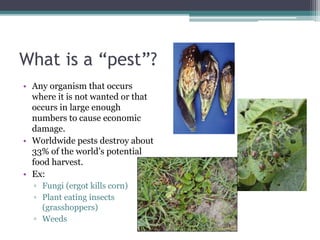
What is a “pest”?
• Any organism that occurs
where it is not wanted or that
occurs in large enough
numbers to cause economic
damage.
• Worldwide pests destroy about
33% of the world’s potential
food harvest.
• Ex:
▫ Fungi (ergot kills corn)
▫ Plant eating insects
(grasshoppers)
▫ Weeds
Why are wild plants better adapted to
avoid pests?
• Wild plants are more spread
out than crops which are
grown in large fields- harder
for pest to find them.
• Wild plants have more pest
predators on them that will eat
the pest before it gets out of
control.
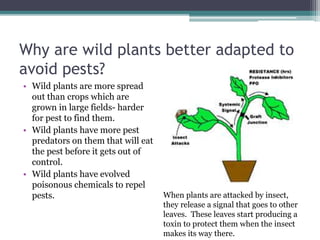
• Wild plants have evolved
poisonous chemicals to repel
pests. When plants are attacked by insect,
they release a signal that goes to other
leaves. These leaves start producing a
toxin to protect them when the insect
makes its way there.
What are pesticides?
• Chemicals that kill insects,
weeds, and other crop pests.
• Most are synthetic and some
are petroleum based
• Ex: Atrizine-
▫ Herbicide used to kill weeds
▫ Overuse has been linked to
hermaphroditism in frogs
▫ Banned in Europe, still used
in US
• Ex: Furadan
▫ Insecticide
▫ Linked to intentional
poisoning of lions in Africa
VIDEO: Lions Poisoned in
Kenya
What are the negative aspects of using
pesticides?
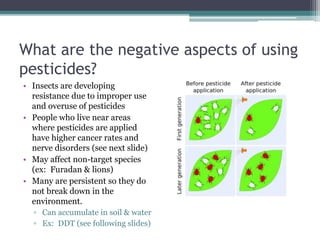
• Insects are developing
resistance due to improper use
and overuse of pesticides
• People who live near areas
where pesticides are applied
have higher cancer rates and
nerve disorders (see next slide)
• May affect non-target species
(ex: Furadan & lions)
• Many are persistent so they do
not break down in the
environment.
▫ Can accumulate in soil & water
▫ Ex: DDT (see following slides)
Pesticides & Child Development
• In the picture to the right
children were asked to draw
pictures of a person.
• The children from the foothills
were not exposed to pesticide
spraying. The children in the
valley were exposed to
pesticide spraying.
• Children exposed to pesticide
have delayed development and
mental/nerve disorders.
DDT- A Case Study
• DDT was used widely as a pesticide in the 1950’s.
• In 1970’s it was banned in the US because it was
linked to problems in predatory birds
▫ DDT was washing into waterways via rain
runoff.
▫ DDT was accumulating in the fat tissue of
small fish.
▫ These small fish eaten by big fish.
▫ Big fish eaten by eagles, osprey, condors, etc.
▫ Birds getting DDT toxin.
▫ DDT made eggshells weak so when birds sit
on them they would break.
▫ Bird population declined.
• US still makes DDT but we sell it to developing
countries like Africa who use it to control
mosquito populations to prevent the spread of
malaria.
• Because DDT is persistent you can still detect it in
the environment and in human breast milk!
What are some alternatives to using
chemical pesticides?
• Biological Pest Control
▫ Use of living organisms to
control pests
▫ Pathogen- use of a disease
causing organism to kill pests
 Ex: Bacillus thuringiensis (Bt)
can kill caterpillars when
ingested
▫ Plant Defenses- specifically
bred to have certain defenses
like tougher skin or chemical
compounds to repel pests
▫ Chemicals from Plants-
using chemicals made naturally
by plants as insecticide.
Biodegradable
 Ex: Chrysanthemums secrete
chemical used as commercial
insecticide.
What are some alternatives to using
chemical pesticides?
• Disrupting Insect Breeding
▫ Growth Regulators
 Chemical that interferes with some
stage of the pest’s life cycle
 Ex: Flea prevention pills enter blood
stream of dog and when flea sucks dogs
blood the growth regulator keeps flea
eggs from developing.
▫ Pheromones
 Hormones released by one organism to
communicate with another.
 Farmers can release excessive hormone
into fields to confuse males so they can’t
find females.
▫ Physical Barriers
 Male insects may be treated with X-rays
to make them sterile and then released.
When mate with females they can’t
produce fertilized eggs.
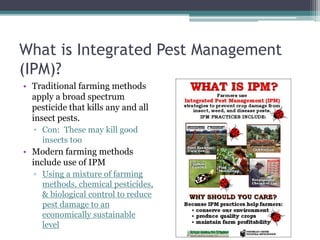
What is Integrated Pest Management
(IPM)?
• Traditional farming methods
apply a broad spectrum
pesticide that kills any and all
insect pests.
▫ Con: These may kill good
insects too
• Modern farming methods
include use of IPM
▫ Using a mixture of farming
methods, chemical pesticides,
& biological control to reduce
pest damage to an
economically sustainable
level
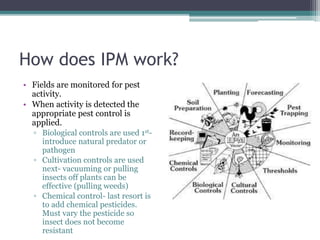
How does IPM work?
• Fields are monitored for pest
activity.
• When activity is detected the
appropriate pest control is
applied.
▫ Biological controls are used 1st-
introduce natural predator or
pathogen
▫ Cultivation controls are used
next- vacuuming or pulling
insects off plants can be
effective (pulling weeds)
▫ Chemical control- last resort is
to add chemical pesticides.
Must vary the pesticide so
insect does not become
resistant
What is selective breeding?
• Choosing your plants or
animals that have some
desirable trait and breeding
them to get a pure genetic line
of that trait so offspring have
that trait.
▫ Ex: Save seeds of corn cob
that has the most kernels of
corn. Grow this corn and use
pollen of one to pollinate
seeds of another so offspring
produce LOTS of kernels per
corn cob.
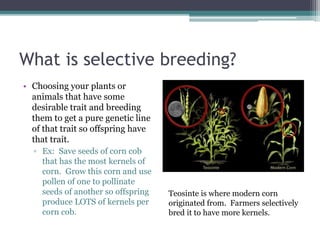
Teosinte is where modern corn
originated from. Farmers selectively
bred it to have more kernels.
What is genetic engineering?
• Faster way to produce plants or
animals that have desirable
traits.
• Process:
▫ Isolate genes form one
organism & implant them into
another.
▫ These organisms are called
genetically modified (GM)
▫ Ex:
 Bacillus thuringiensis (Bt)
bacteria has a gene that kills
caterpillars.
 This gene can be isolated from
Bt and inserted into corn
 If caterpillars eat corn they die
What are the benefits & risks of GM
foods? (See article page 436-437)
• Benefits:
▫ Probably more safe than
crossbreeding b/c can isolate
specific gene you want
▫ Vegetables & fruit can last longer
on shelves
▫ Can add nutrients to food (Golden
Rice)
▫ Crops can grow close together on
small parcels of land- get higher
yield
▫ Make food resistant to viruses,
fungi, bacteria
▫ Grow faster
▫ Have higher yields
▫ Can grow in sandy or salty soil
• Risks:
▫ Is it safe to put an animal gene into
a plant gene?
▫ Allergic reactions
 Arctic fish genes that resist
freezing are being added to
strawberries so strawberries will
be resistant to frost.
 What if someone who eats this
strawberry is allergic to fish?
▫ Religious or ethical reasons
 What if you put a pork gene into a
crop and that violates their
religious or ethical (vegetarian)
beliefs?
▫ Wild plant contamination
 If you add herbicide resistance
gene to crop and a weed cross
breeds naturally and gets that
gene then weeds will become
resistant and apply herbicide will
not kill them
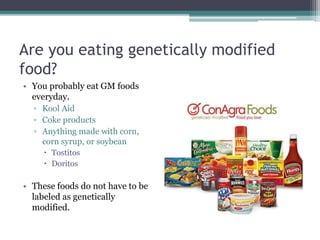
Are you eating genetically modified
food?
• You probably eat GM foods
everyday.
▫ Kool Aid
▫ Coke products
▫ Anything made with corn,
corn syrup, or soybean
 Tostitos
 Doritos
• These foods do not have to be
labeled as genetically
modified.
What is sustainable agriculture?
• Low-input farming
• Conserves natural resources &
keeps land productive
indefinitely
• Minimizes use of water,
pesticide, fertilizer
• Ex:
▫ Using crop rotation
▫ Growing crops that like sun
to shade others that need less
sun
You should be able to…
• Define the term pest
• Compare the benefits and environmental impact
of pesticide use
• Describe how biological pest control is part of
integrated pest management
• Describe how genetic engineering is used in
agriculture.

Unit 6 ch 15 s2 pest control

  • 1.
    Food & Agriculture Chapter15, Section 2: Pest Control Standards: SEV4a, b, c
  • 2.
    What is a“pest”? • Any organism that occurs where it is not wanted or that occurs in large enough numbers to cause economic damage. • Worldwide pests destroy about 33% of the world’s potential food harvest. • Ex: ▫ Fungi (ergot kills corn) ▫ Plant eating insects (grasshoppers) ▫ Weeds
  • 3.
    Why are wildplants better adapted to avoid pests? • Wild plants are more spread out than crops which are grown in large fields- harder for pest to find them. • Wild plants have more pest predators on them that will eat the pest before it gets out of control. • Wild plants have evolved poisonous chemicals to repel pests. When plants are attacked by insect, they release a signal that goes to other leaves. These leaves start producing a toxin to protect them when the insect makes its way there.
  • 4.
    What are pesticides? •Chemicals that kill insects, weeds, and other crop pests. • Most are synthetic and some are petroleum based • Ex: Atrizine- ▫ Herbicide used to kill weeds ▫ Overuse has been linked to hermaphroditism in frogs ▫ Banned in Europe, still used in US • Ex: Furadan ▫ Insecticide ▫ Linked to intentional poisoning of lions in Africa VIDEO: Lions Poisoned in Kenya
  • 5.
    What are thenegative aspects of using pesticides? • Insects are developing resistance due to improper use and overuse of pesticides • People who live near areas where pesticides are applied have higher cancer rates and nerve disorders (see next slide) • May affect non-target species (ex: Furadan & lions) • Many are persistent so they do not break down in the environment. ▫ Can accumulate in soil & water ▫ Ex: DDT (see following slides)
  • 6.
    Pesticides & ChildDevelopment • In the picture to the right children were asked to draw pictures of a person. • The children from the foothills were not exposed to pesticide spraying. The children in the valley were exposed to pesticide spraying. • Children exposed to pesticide have delayed development and mental/nerve disorders.
  • 7.
    DDT- A CaseStudy • DDT was used widely as a pesticide in the 1950’s. • In 1970’s it was banned in the US because it was linked to problems in predatory birds ▫ DDT was washing into waterways via rain runoff. ▫ DDT was accumulating in the fat tissue of small fish. ▫ These small fish eaten by big fish. ▫ Big fish eaten by eagles, osprey, condors, etc. ▫ Birds getting DDT toxin. ▫ DDT made eggshells weak so when birds sit on them they would break. ▫ Bird population declined. • US still makes DDT but we sell it to developing countries like Africa who use it to control mosquito populations to prevent the spread of malaria. • Because DDT is persistent you can still detect it in the environment and in human breast milk!
  • 8.
    What are somealternatives to using chemical pesticides? • Biological Pest Control ▫ Use of living organisms to control pests ▫ Pathogen- use of a disease causing organism to kill pests  Ex: Bacillus thuringiensis (Bt) can kill caterpillars when ingested ▫ Plant Defenses- specifically bred to have certain defenses like tougher skin or chemical compounds to repel pests ▫ Chemicals from Plants- using chemicals made naturally by plants as insecticide. Biodegradable  Ex: Chrysanthemums secrete chemical used as commercial insecticide.
  • 9.
    What are somealternatives to using chemical pesticides? • Disrupting Insect Breeding ▫ Growth Regulators  Chemical that interferes with some stage of the pest’s life cycle  Ex: Flea prevention pills enter blood stream of dog and when flea sucks dogs blood the growth regulator keeps flea eggs from developing. ▫ Pheromones  Hormones released by one organism to communicate with another.  Farmers can release excessive hormone into fields to confuse males so they can’t find females. ▫ Physical Barriers  Male insects may be treated with X-rays to make them sterile and then released. When mate with females they can’t produce fertilized eggs.
  • 10.
    What is IntegratedPest Management (IPM)? • Traditional farming methods apply a broad spectrum pesticide that kills any and all insect pests. ▫ Con: These may kill good insects too • Modern farming methods include use of IPM ▫ Using a mixture of farming methods, chemical pesticides, & biological control to reduce pest damage to an economically sustainable level
  • 11.
    How does IPMwork? • Fields are monitored for pest activity. • When activity is detected the appropriate pest control is applied. ▫ Biological controls are used 1st- introduce natural predator or pathogen ▫ Cultivation controls are used next- vacuuming or pulling insects off plants can be effective (pulling weeds) ▫ Chemical control- last resort is to add chemical pesticides. Must vary the pesticide so insect does not become resistant
  • 12.
    What is selectivebreeding? • Choosing your plants or animals that have some desirable trait and breeding them to get a pure genetic line of that trait so offspring have that trait. ▫ Ex: Save seeds of corn cob that has the most kernels of corn. Grow this corn and use pollen of one to pollinate seeds of another so offspring produce LOTS of kernels per corn cob. Teosinte is where modern corn originated from. Farmers selectively bred it to have more kernels.
  • 13.
    What is geneticengineering? • Faster way to produce plants or animals that have desirable traits. • Process: ▫ Isolate genes form one organism & implant them into another. ▫ These organisms are called genetically modified (GM) ▫ Ex:  Bacillus thuringiensis (Bt) bacteria has a gene that kills caterpillars.  This gene can be isolated from Bt and inserted into corn  If caterpillars eat corn they die
  • 14.
    What are thebenefits & risks of GM foods? (See article page 436-437) • Benefits: ▫ Probably more safe than crossbreeding b/c can isolate specific gene you want ▫ Vegetables & fruit can last longer on shelves ▫ Can add nutrients to food (Golden Rice) ▫ Crops can grow close together on small parcels of land- get higher yield ▫ Make food resistant to viruses, fungi, bacteria ▫ Grow faster ▫ Have higher yields ▫ Can grow in sandy or salty soil • Risks: ▫ Is it safe to put an animal gene into a plant gene? ▫ Allergic reactions  Arctic fish genes that resist freezing are being added to strawberries so strawberries will be resistant to frost.  What if someone who eats this strawberry is allergic to fish? ▫ Religious or ethical reasons  What if you put a pork gene into a crop and that violates their religious or ethical (vegetarian) beliefs? ▫ Wild plant contamination  If you add herbicide resistance gene to crop and a weed cross breeds naturally and gets that gene then weeds will become resistant and apply herbicide will not kill them
  • 15.
    Are you eatinggenetically modified food? • You probably eat GM foods everyday. ▫ Kool Aid ▫ Coke products ▫ Anything made with corn, corn syrup, or soybean  Tostitos  Doritos • These foods do not have to be labeled as genetically modified.
  • 16.
    What is sustainableagriculture? • Low-input farming • Conserves natural resources & keeps land productive indefinitely • Minimizes use of water, pesticide, fertilizer • Ex: ▫ Using crop rotation ▫ Growing crops that like sun to shade others that need less sun
  • 17.
    You should beable to… • Define the term pest • Compare the benefits and environmental impact of pesticide use • Describe how biological pest control is part of integrated pest management • Describe how genetic engineering is used in agriculture.

Editor's Notes

  • #9 Bottom picture: Some plants produce volatile chemicals which they release into the air when they are being attacked by an insect. These volatile chemicals attract insect predators that come and attack the insect and the plant gets protected.