C H A P T E R 1 1 , S E C T I O N 2 : WA T E R U S E &
M A N A G E M E N T
S T A N D A R D S : S C S H 2 A - B , 3 C , 4 A , 5 A , 6 A , D , 9 D
WATER
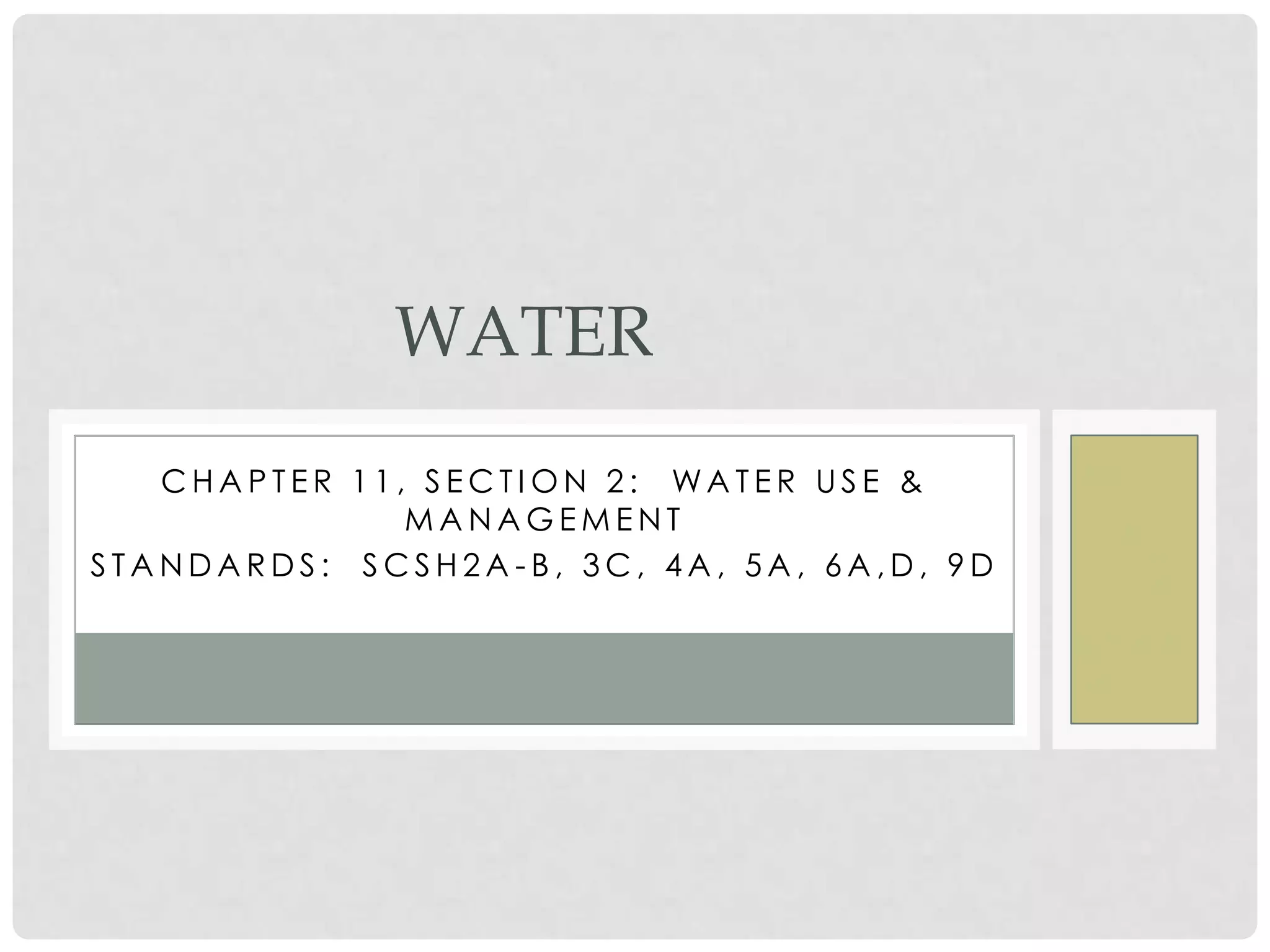
HOW DO PEOPLE USE WATER?
• Agricultural Use
• Industrial Use
• Residential/
Domestic Use
0
10
20
30
40
50
60
70
Irrigation
Industry
Domestic
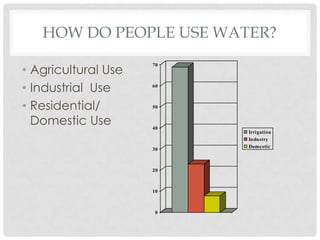
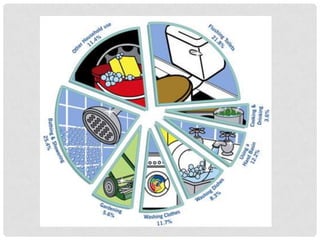
HOW IS WATER USED IN RESIDENTIAL
AREAS?
• 14% of world water use
• Varies by country
• Average person needs
1.3 gallons to survive
• U.S. resident uses 80
gallons per day
• India resident uses 10
gallons per day
• In U.S. we use it for
• Inside sources: drinking,
cooking, washing, toilet
flushing, etc.
• Outside sources:
watering lawns, washing
cars, etc.
0
5 0
10 0
15 0
2 0 0
2 5 0
Unit e d
S t a t e s
Ne t he r la nd
s
Ga mbia
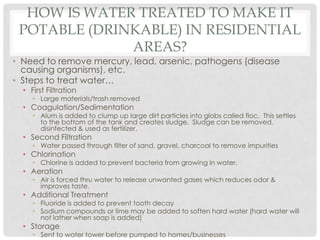
HOW IS WATER TREATED TO MAKE IT
POTABLE (DRINKABLE) IN RESIDENTIAL
AREAS?
• Need to remove mercury, lead, arsenic, pathogens (disease
causing organisms), etc.
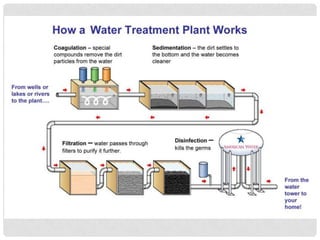
• Steps to treat water…
• First Filtration
• Large materials/trash removed
• Coagulation/Sedimentation
• Alum is added to clump up large dirt particles into globs called floc. This settles
to the bottom of the tank and creates sludge. Sludge can be removed,
disinfected & used as fertilizer.
• Second Filtration
• Water passed through filter of sand, gravel, charcoal to remove impurities
• Chlorination
• Chlorine is added to prevent bacteria from growing in water.
• Aeration
• Air is forced thru water to release unwanted gases which reduces odor &
improves taste.
• Additional Treatment
• Fluoride is added to prevent tooth decay
• Sodium compounds or lime may be added to soften hard water (hard water will
not lather when soap is added)
• Storage
• Sent to water tower before pumped to homes/businesses
HOW IS WATER USED IN INDUSTRY?
• 19% of world water use.
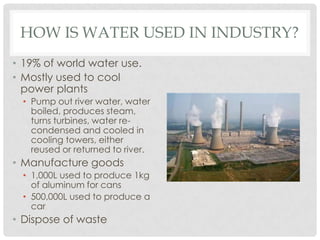
• Mostly used to cool
power plants
• Pump out river water, water
boiled, produces steam,
turns turbines, water re-
condensed and cooled in
cooling towers, either
reused or returned to river.
• Manufacture goods
• 1,000L used to produce 1kg
of aluminum for cans
• 500,000L used to produce a
car
• Dispose of waste
HOW IS WATER USED IN
AGRICULTURE?
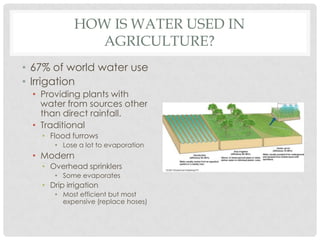
• 67% of world water use
• Irrigation
• Providing plants with
water from sources other
than direct rainfall.
• Traditional
• Flood furrows
• Lose a lot to evaporation
• Modern
• Overhead sprinklers
• Some evaporates
• Drip irrigation
• Most efficient but most
expensive (replace hoses)
WHAT ARE WATER MANAGEMENT
PROJECTS?
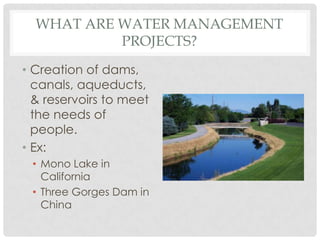
• Creation of dams,
canals, aqueducts,
& reservoirs to meet
the needs of
people.
• Ex:
• Mono Lake in
California
• Three Gorges Dam in
China
MONO LAKE, CA
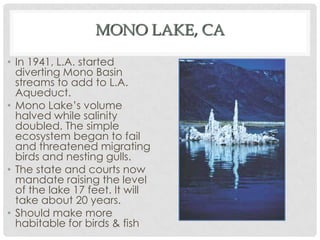
• In 1941, L.A. started
diverting Mono Basin
streams to add to L.A.
Aqueduct.
• Mono Lake’s volume
halved while salinity
doubled. The simple
ecosystem began to fail
and threatened migrating
birds and nesting gulls.
• The state and courts now
mandate raising the level
of the lake 17 feet. It will
take about 20 years.
• Should make more
habitable for birds & fish
PROS & CONS OF DAMS
• Pros:
• Creates reservoir- artificial
lake behind dam
• Collect and store water
from rain and snow
• Produce electricity
• Irrigate farm land
• Control flooding
• Provide drinking water to
cities, towns and rural
areas
• Provide recreational
activities such as
swimming, boating, fishing
• Cons:
• Enormous loss of water due
to evaporation
• Flooded land destroys
forests or cropland and
displaces people
• Danger of Dam collapse
• Downstream areas
deprived of nutrient-rich
soil, which will eventually
clog the reservoir
• Migration and spawning of
fish disrupted
• Causes water wars
between states & countries
• Expensive to build
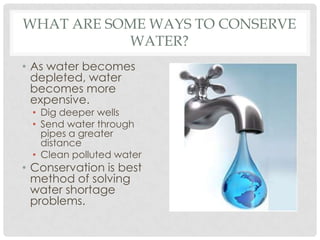
WHAT ARE SOME WAYS TO CONSERVE
WATER?
• As water becomes
depleted, water
becomes more
expensive.
• Dig deeper wells
• Send water through
pipes a greater
distance
• Clean polluted water
• Conservation is best
method of solving
water shortage
problems.
WHAT ARE SOME WAYS TO CONSERVE
WATER?
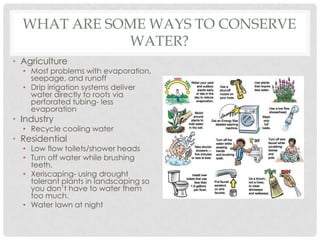
• Agriculture
• Most problems with evaporation,
seepage, and runoff
• Drip irrigation systems deliver
water directly to roots via
perforated tubing- less
evaporation
• Industry
• Recycle cooling water
• Residential
• Low flow toilets/shower heads
• Turn off water while brushing
teeth.
• Xeriscaping- using drought
tolerant plants in landscaping so
you don’t have to water them
too much.
• Water lawn at night
WHAT ARE SOME SOLUTIONS TO THE
WATER DEPLETION PROBLEM?
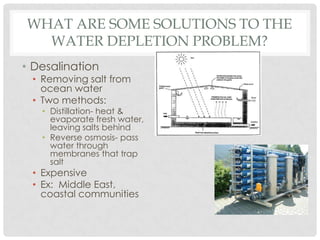
• Desalination
• Removing salt from
ocean water
• Two methods:
• Distillation- heat &
evaporate fresh water,
leaving salts behind
• Reverse osmosis- pass
water through
membranes that trap
salt
• Expensive
• Ex: Middle East,
coastal communities
WHAT ARE SOME SOLUTIONS TO THE
WATER DEPLETION PROBLEM?
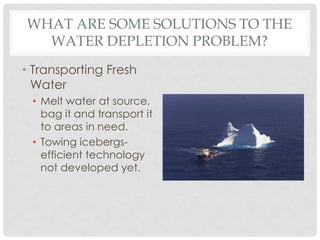
• Transporting Fresh
Water
• Melt water at source,
bag it and transport it
to areas in need.
• Towing icebergs-
efficient technology
not developed yet.
YOU SHOULD BE ABLE TO…
• Describe the patterns of global water use for each
continent shown in the bar graph in Figure 5.
• Describe the drinking water treatment process in
your own words.
• Describe the benefits and costs of dams and water
diversion projects.
• List at least three things you would do to help
conserve the world’s water supply.

Unit 7 ch 11 s2 water use & management

  • 1.
    C H AP T E R 1 1 , S E C T I O N 2 : WA T E R U S E & M A N A G E M E N T S T A N D A R D S : S C S H 2 A - B , 3 C , 4 A , 5 A , 6 A , D , 9 D WATER
  • 2.
    HOW DO PEOPLEUSE WATER? • Agricultural Use • Industrial Use • Residential/ Domestic Use 0 10 20 30 40 50 60 70 Irrigation Industry Domestic
  • 3.
    HOW IS WATERUSED IN RESIDENTIAL AREAS? • 14% of world water use • Varies by country • Average person needs 1.3 gallons to survive • U.S. resident uses 80 gallons per day • India resident uses 10 gallons per day • In U.S. we use it for • Inside sources: drinking, cooking, washing, toilet flushing, etc. • Outside sources: watering lawns, washing cars, etc. 0 5 0 10 0 15 0 2 0 0 2 5 0 Unit e d S t a t e s Ne t he r la nd s Ga mbia
  • 5.
    HOW IS WATERTREATED TO MAKE IT POTABLE (DRINKABLE) IN RESIDENTIAL AREAS? • Need to remove mercury, lead, arsenic, pathogens (disease causing organisms), etc. • Steps to treat water… • First Filtration • Large materials/trash removed • Coagulation/Sedimentation • Alum is added to clump up large dirt particles into globs called floc. This settles to the bottom of the tank and creates sludge. Sludge can be removed, disinfected & used as fertilizer. • Second Filtration • Water passed through filter of sand, gravel, charcoal to remove impurities • Chlorination • Chlorine is added to prevent bacteria from growing in water. • Aeration • Air is forced thru water to release unwanted gases which reduces odor & improves taste. • Additional Treatment • Fluoride is added to prevent tooth decay • Sodium compounds or lime may be added to soften hard water (hard water will not lather when soap is added) • Storage • Sent to water tower before pumped to homes/businesses
  • 7.
    HOW IS WATERUSED IN INDUSTRY? • 19% of world water use. • Mostly used to cool power plants • Pump out river water, water boiled, produces steam, turns turbines, water re- condensed and cooled in cooling towers, either reused or returned to river. • Manufacture goods • 1,000L used to produce 1kg of aluminum for cans • 500,000L used to produce a car • Dispose of waste
  • 8.
    HOW IS WATERUSED IN AGRICULTURE? • 67% of world water use • Irrigation • Providing plants with water from sources other than direct rainfall. • Traditional • Flood furrows • Lose a lot to evaporation • Modern • Overhead sprinklers • Some evaporates • Drip irrigation • Most efficient but most expensive (replace hoses)
  • 9.
    WHAT ARE WATERMANAGEMENT PROJECTS? • Creation of dams, canals, aqueducts, & reservoirs to meet the needs of people. • Ex: • Mono Lake in California • Three Gorges Dam in China
  • 10.
    MONO LAKE, CA •In 1941, L.A. started diverting Mono Basin streams to add to L.A. Aqueduct. • Mono Lake’s volume halved while salinity doubled. The simple ecosystem began to fail and threatened migrating birds and nesting gulls. • The state and courts now mandate raising the level of the lake 17 feet. It will take about 20 years. • Should make more habitable for birds & fish
  • 11.
    PROS & CONSOF DAMS • Pros: • Creates reservoir- artificial lake behind dam • Collect and store water from rain and snow • Produce electricity • Irrigate farm land • Control flooding • Provide drinking water to cities, towns and rural areas • Provide recreational activities such as swimming, boating, fishing • Cons: • Enormous loss of water due to evaporation • Flooded land destroys forests or cropland and displaces people • Danger of Dam collapse • Downstream areas deprived of nutrient-rich soil, which will eventually clog the reservoir • Migration and spawning of fish disrupted • Causes water wars between states & countries • Expensive to build
  • 12.
    WHAT ARE SOMEWAYS TO CONSERVE WATER? • As water becomes depleted, water becomes more expensive. • Dig deeper wells • Send water through pipes a greater distance • Clean polluted water • Conservation is best method of solving water shortage problems.
  • 13.
    WHAT ARE SOMEWAYS TO CONSERVE WATER? • Agriculture • Most problems with evaporation, seepage, and runoff • Drip irrigation systems deliver water directly to roots via perforated tubing- less evaporation • Industry • Recycle cooling water • Residential • Low flow toilets/shower heads • Turn off water while brushing teeth. • Xeriscaping- using drought tolerant plants in landscaping so you don’t have to water them too much. • Water lawn at night
  • 14.
    WHAT ARE SOMESOLUTIONS TO THE WATER DEPLETION PROBLEM? • Desalination • Removing salt from ocean water • Two methods: • Distillation- heat & evaporate fresh water, leaving salts behind • Reverse osmosis- pass water through membranes that trap salt • Expensive • Ex: Middle East, coastal communities
  • 15.
    WHAT ARE SOMESOLUTIONS TO THE WATER DEPLETION PROBLEM? • Transporting Fresh Water • Melt water at source, bag it and transport it to areas in need. • Towing icebergs- efficient technology not developed yet.
  • 16.
    YOU SHOULD BEABLE TO… • Describe the patterns of global water use for each continent shown in the bar graph in Figure 5. • Describe the drinking water treatment process in your own words. • Describe the benefits and costs of dams and water diversion projects. • List at least three things you would do to help conserve the world’s water supply.