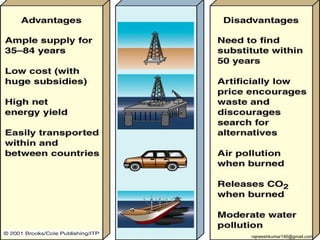
rajneeshkumar146@gmail.com
Introduction to Conventional Sources Of Energy
   The three major conventional energy sources are petroleum,
 natural gas and coal. According to the United States Department
 of Energy, these three energy sources provide about 85 percent
of the energy in the country and almost two-thirds of the electrical
power. These energy sources have been used for many years but
  are continually being improve so they have a smaller impact on
                          the environment.


                                                      rajneeshkumar146@gmail.com
Why do we need energy?
• Transportation
• Heating homes
• Cooking
• Power machinery used for agriculture,
  industry/business, homes
• What else?


                                   rajneeshkumar146@gmail.com
• Work- application of force              Some
  thru a distance.
• Energy- capacity to do work
                                      terminology…
• Power- rate of flow of energy
  or rate at which work is done.
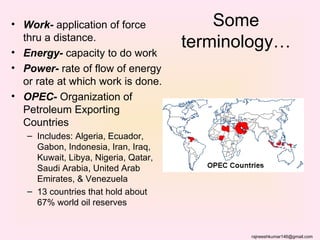
• OPEC- Organization of
  Petroleum Exporting
  Countries
   – Includes: Algeria, Ecuador,
     Gabon, Indonesia, Iran, Iraq,
     Kuwait, Libya, Nigeria, Qatar,
     Saudi Arabia, United Arab
     Emirates, & Venezuela
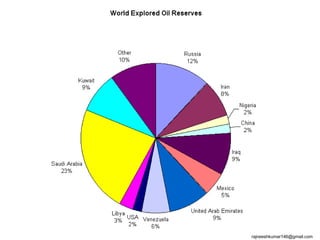
   – 13 countries that hold about
     67% world oil reserves


                                             rajneeshkumar146@gmail.com
Some conversion factors
• One calories is the amount of energy
  needed to heat 1g of water 1°C.
• A kilocalorie is 1,000 calories
• 1 BTU = energy to heat 1 lb of water 1°F
• 1 watt (W) = 3.412 Btu/hour
• 1 horsepower (hp) = 746 W
• Watt-hour- used to describe electrical
  energy. Usually use kilowatt-hour (kWh)/
  it is larger.
                                   rajneeshkumar146@gmail.com
Thermodynamics
• Laws of thermodynamics tell 2 things
  about converting heat energy from steam
  to work…
  – Conversion of heat to work is not 100%
    efficient because a portion of the heat is
    wasted
  – Efficiency of converting heat to work
    increases as the heat temperature increases.


                                        rajneeshkumar146@gmail.com
History of Energy Usage
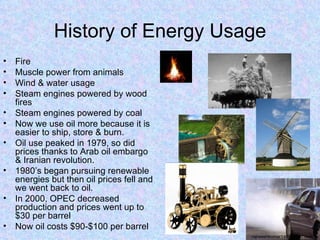
•   Fire
•   Muscle power from animals
•   Wind & water usage
•   Steam engines powered by wood
    fires
•   Steam engines powered by coal
•   Now we use oil more because it is
    easier to ship, store & burn.
•   Oil use peaked in 1979, so did
    prices thanks to Arab oil embargo
    & Iranian revolution.
•   1980’s began pursuing renewable
    energies but then oil prices fell and
    we went back to oil.
•   In 2000, OPEC decreased
    production and prices went up to
    $30 per barrel
•   Now oil costs $90-$100 per barrel
                                            rajneeshkumar146@gmail.com
Energy Sources
• Primary Energy sources-
  – Fossil fuels (oil, natural gas, coal)
  – Nuclear energy
  – Falling water, geothermal, solar
• Secondary Energy sources-
  – Sources derived from a primary source like…
     • Electricity
     • Gasoline
     • Alcohol fuels (gasohol)


                                            rajneeshkumar146@gmail.com
A few facts…
• One barrel holds 42 gallons of oil.
• About 20 gallons of gasoline can be made from
  one barrel of oil (through fractional distillation.)
• On average, each person uses 25 barrels of oil
  each year for their energy “needs”.
• The U.S. Strategic Petroleum Reserve stores
  570 million barrels of oil in underground salt
  caverns along Gulf coast. This is about a 60 day
  supplies worth.
• We import ½ of our oil from unstable countries.
                                            rajneeshkumar146@gmail.com
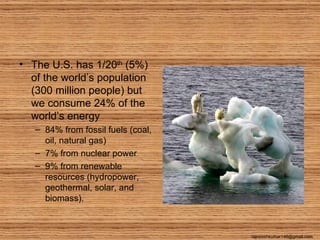
• The U.S. has 1/20th (5%)
  of the world’s population
  (300 million people) but
  we consume 24% of the
  world’s energy
   – 84% from fossil fuels (coal,
     oil, natural gas)
   – 7% from nuclear power
   – 9% from renewable
     resources (hydropower,
     geothermal, solar, and
     biomass).


                                    rajneeshkumar146@gmail.com
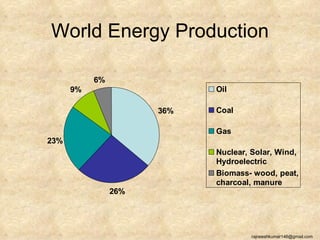
World Energy Production

           6%
      9%                    Oil

                      36%   Coal

                            Gas
23%
                            Nuclear, Solar, Wind,
                            Hydroelectric
                            Biomass- wood, peat,
                            charcoal, manure
                26%


                                    rajneeshkumar146@gmail.com
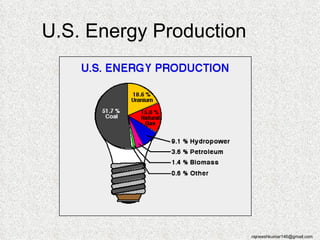
U.S. Energy Production


                         rajneeshkumar146@gmail.com
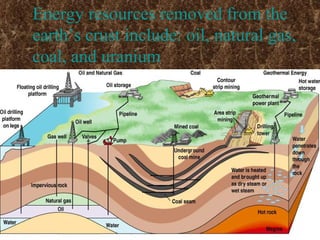
Energy resources removed from the
earth’s crust include: oil, natural gas,
coal, and uranium
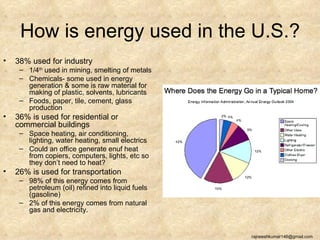
How is energy used in the U.S.?
•   38% used for industry
     – 1/4th used in mining, smelting of metals
     – Chemicals- some used in energy
       generation & some is raw material for
       making of plastic, solvents, lubricants
     – Foods, paper, tile, cement, glass
       production
•   36% is used for residential or
    commercial buildings
     – Space heating, air conditioning,
       lighting, water heating, small electrics
     – Could an office generate enuf heat
       from copiers, computers, lights, etc so
       they don’t need to heat?
•   26% is used for transportation
     – 98% of this energy comes from
       petroleum (oil) refined into liquid fuels
       (gasoline)
     – 2% of this energy comes from natural
       gas and electricity.


                                                   rajneeshkumar146@gmail.com
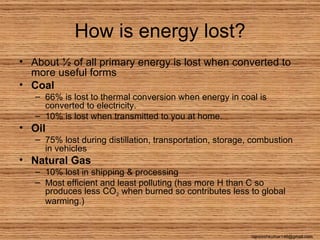
How is energy lost?
• About ½ of all primary energy is lost when converted to
  more useful forms
• Coal
   – 66% is lost to thermal conversion when energy in coal is
     converted to electricity.
   – 10% is lost when transmitted to you at home.
• Oil
   – 75% lost during distillation, transportation, storage, combustion
     in vehicles
• Natural Gas
   – 10% lost in shipping & processing
   – Most efficient and least polluting (has more H than C so
     produces less CO2 when burned so contributes less to global
     warming.)


                                                           rajneeshkumar146@gmail.com
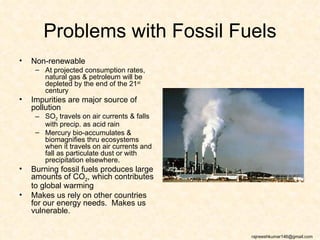
Problems with Fossil Fuels
•   Non-renewable
     – At projected consumption rates,
       natural gas & petroleum will be
       depleted by the end of the 21st
       century
•   Impurities are major source of
    pollution
     – SO2 travels on air currents & falls
       with precip. as acid rain
     – Mercury bio-accumulates &
       biomagnifies thru ecosystems
       when it travels on air currents and
       fall as particulate dust or with
       precipitation elsewhere.
•   Burning fossil fuels produces large
    amounts of CO2, which contributes
    to global warming
•   Makes us rely on other countries
    for our energy needs. Makes us
    vulnerable.


                                             rajneeshkumar146@gmail.com
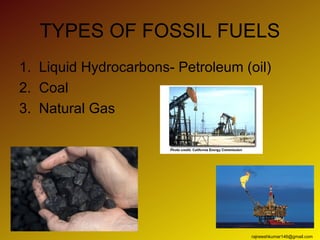
TYPES OF FOSSIL FUELS
1. Liquid Hydrocarbons- Petroleum (oil)
2. Coal
3. Natural Gas


                                   rajneeshkumar146@gmail.com
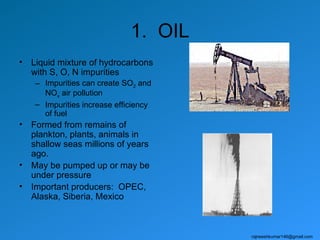
1. OIL
•   Liquid mixture of hydrocarbons
    with S, O, N impurities
     – Impurities can create SO2 and
       NOx air pollution
     – Impurities increase efficiency
       of fuel
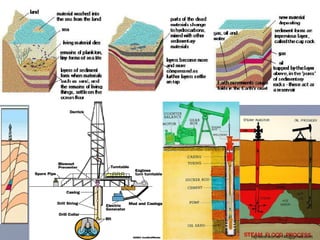
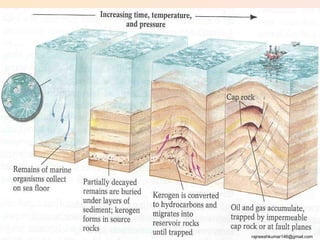
•   Formed from remains of
    plankton, plants, animals in
    shallow seas millions of years
    ago.
•   May be pumped up or may be
    under pressure
•   Important producers: OPEC,
    Alaska, Siberia, Mexico


                                        rajneeshkumar146@gmail.com
rajneeshkumar146@gmail.com
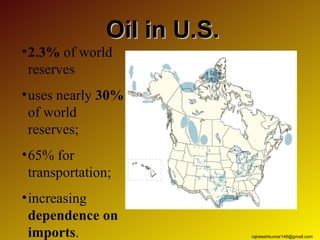
Oil in U.S.
• 2.3% of world
  reserves
• uses nearly 30%
  of world
  reserves;
• 65% for
  transportation;
• increasing
  dependence on
  imports.                    rajneeshkumar146@gmail.com
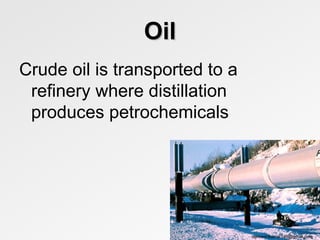
Oil
Crude oil is transported to a
 refinery where distillation
 produces petrochemicals


                                rajneeshkumar146@gmail.com
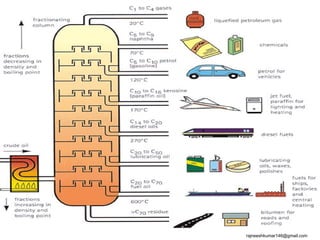
Fractional Distillation
• Process that turns oil into different
  petrochemicals
• By heating oil, different hydrocarbon
  chains vaporize, are collected,
  condensed, then removed to be used in
  various products
• Longer chains = higher boiling points


                                  rajneeshkumar146@gmail.com
rajneeshkumar146@gmail.com
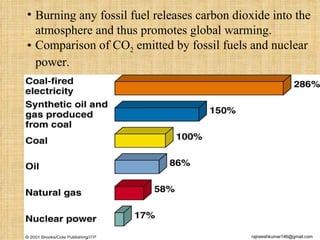
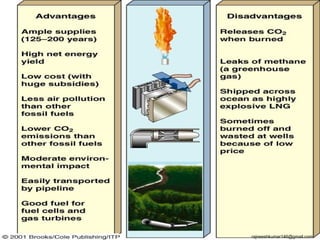
• Burning any fossil fuel releases carbon dioxide into the
  atmosphere and thus promotes global warming.
• Comparison of CO2 emitted by fossil fuels and nuclear
  power.


                                             rajneeshkumar146@gmail.com
rajneeshkumar146@gmail.com
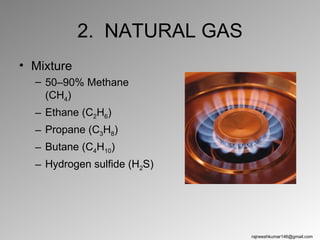
2. NATURAL GAS
• Mixture
  – 50–90% Methane
    (CH4)
  – Ethane (C2H6)
  – Propane (C3H8)
  – Butane (C4H10)
  – Hydrogen sulfide (H2S)


                             rajneeshkumar146@gmail.com
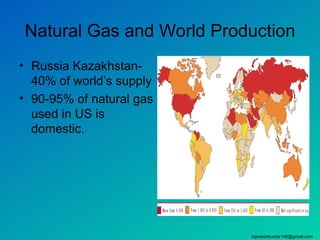
Natural Gas and World Production
• Russia Kazakhstan-
  40% of world’s supply
• 90-95% of natural gas
  used in US is
  domestic.


                          rajneeshkumar146@gmail.com
rajneeshkumar146@gmail.com
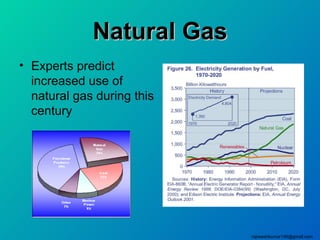
Natural Gas
• Experts predict
  increased use of
  natural gas during this
  century


                            rajneeshkumar146@gmail.com
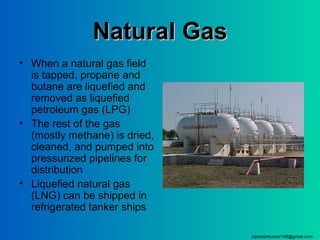
Natural Gas
• When a natural gas field
  is tapped, propane and
  butane are liquefied and
  removed as liquefied
  petroleum gas (LPG)
• The rest of the gas
  (mostly methane) is dried,
  cleaned, and pumped into
  pressurized pipelines for
  distribution
• Liquefied natural gas
  (LNG) can be shipped in
  refrigerated tanker ships

                               rajneeshkumar146@gmail.com
3. Coal
• Coal exists in many forms therefore a
  chemical formula cannot be written for it.
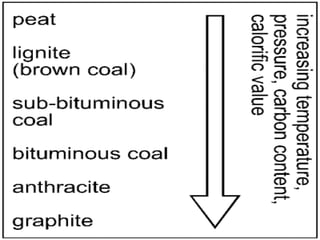
• Coalification: After plants died they
  underwent chemical decay to form a
  product known as peat
  – Over many years, thick peat layers formed.
  – Peat is converted to coal by geological events
    such as land subsidence which subject the
    peat to great pressures and temperatures.

                                      rajneeshkumar146@gmail.com
rajneeshkumar146@gmail.com
•
       Ranks of Coal
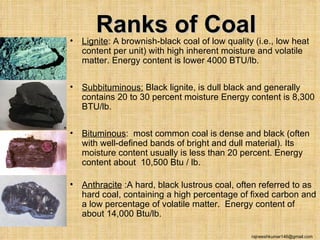
    Lignite: A brownish-black coal of low quality (i.e., low heat
    content per unit) with high inherent moisture and volatile
    matter. Energy content is lower 4000 BTU/lb.

•   Subbituminous: Black lignite, is dull black and generally
    contains 20 to 30 percent moisture Energy content is 8,300
    BTU/lb.

•   Bituminous: most common coal is dense and black (often
    with well-defined bands of bright and dull material). Its
    moisture content usually is less than 20 percent. Energy
    content about 10,500 Btu / lb.

•   Anthracite :A hard, black lustrous coal, often referred to as
    hard coal, containing a high percentage of fixed carbon and
    a low percentage of volatile matter. Energy content of
    about 14,000 Btu/lb.

                                                 rajneeshkumar146@gmail.com
Main Coal Deposits


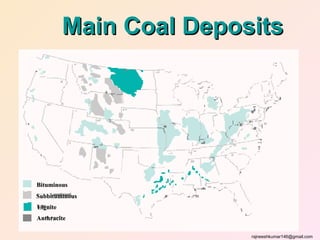
Bituminous
Subbituminous
Lignite
Anthracite

                         rajneeshkumar146@gmail.com
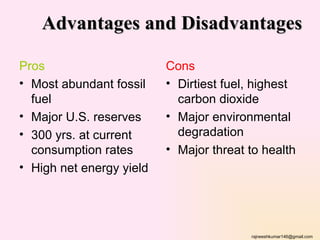
Advantages and Disadvantages

Pros                      Cons
• Most abundant fossil    • Dirtiest fuel, highest
  fuel                      carbon dioxide
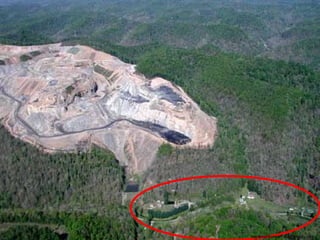
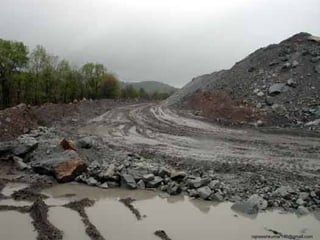
• Major U.S. reserves     • Major environmental
• 300 yrs. at current       degradation
  consumption rates       • Major threat to health
• High net energy yield


                                         rajneeshkumar146@gmail.com
rajneeshkumar146@gmail.com
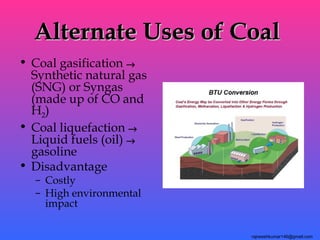
Alternate Uses of Coal
• Coal gasification →
  Synthetic natural gas
  (SNG) or Syngas
  (made up of CO and
  H2)
• Coal liquefaction →
  Liquid fuels (oil) →
  gasoline
• Disadvantage
  – Costly
  – High environmental
    impact

                          rajneeshkumar146@gmail.com
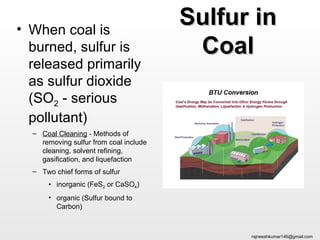
• When coal is
                                        Sulfur in
  burned, sulfur is                      Coal
  released primarily
  as sulfur dioxide
  (SO2 - serious
  pollutant)
  – Coal Cleaning - Methods of
    removing sulfur from coal include
    cleaning, solvent refining,
    gasification, and liquefaction
  – Two chief forms of sulfur
      • inorganic (FeS2 or CaSO4)
      • organic (Sulfur bound to
        Carbon)


                                              rajneeshkumar146@gmail.com
Removing Sulfur after Combustion
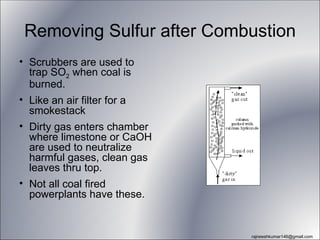
• Scrubbers are used to
  trap SO2 when coal is
  burned.
• Like an air filter for a
  smokestack
• Dirty gas enters chamber
  where limestone or CaOH
  are used to neutralize
  harmful gases, clean gas
  leaves thru top.
• Not all coal fired
  powerplants have these.


                             rajneeshkumar146@gmail.com
Effects of Sulfur Pollution
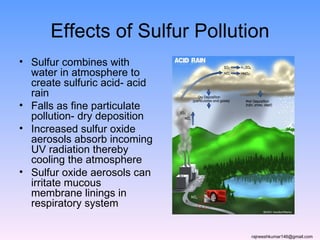
• Sulfur combines with
  water in atmosphere to
  create sulfuric acid- acid
  rain
• Falls as fine particulate
  pollution- dry deposition
• Increased sulfur oxide
  aerosols absorb incoming
  UV radiation thereby
  cooling the atmosphere
• Sulfur oxide aerosols can
  irritate mucous
  membrane linings in
  respiratory system

                               rajneeshkumar146@gmail.com
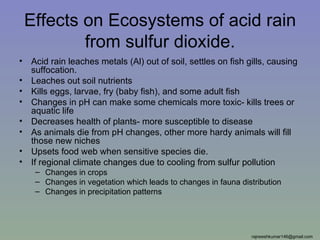
Effects on Ecosystems of acid rain
            from sulfur dioxide.
•   Acid rain leaches metals (Al) out of soil, settles on fish gills, causing
    suffocation.
•   Leaches out soil nutrients
•   Kills eggs, larvae, fry (baby fish), and some adult fish
•   Changes in pH can make some chemicals more toxic- kills trees or
    aquatic life
•   Decreases health of plants- more susceptible to disease
•   As animals die from pH changes, other more hardy animals will fill
    those new niches
•   Upsets food web when sensitive species die.
•   If regional climate changes due to cooling from sulfur pollution
     – Changes in crops
     – Changes in vegetation which leads to changes in fauna distribution
     – Changes in precipitation patterns


                                                                rajneeshkumar146@gmail.com

Conventional energy sources

  • 1.
  • 2.
    Introduction to ConventionalSources Of Energy The three major conventional energy sources are petroleum, natural gas and coal. According to the United States Department of Energy, these three energy sources provide about 85 percent of the energy in the country and almost two-thirds of the electrical power. These energy sources have been used for many years but are continually being improve so they have a smaller impact on the environment. rajneeshkumar146@gmail.com
  • 3.
    Why do weneed energy? • Transportation • Heating homes • Cooking • Power machinery used for agriculture, industry/business, homes • What else? rajneeshkumar146@gmail.com
  • 4.
    • Work- applicationof force Some thru a distance. • Energy- capacity to do work terminology… • Power- rate of flow of energy or rate at which work is done. • OPEC- Organization of Petroleum Exporting Countries – Includes: Algeria, Ecuador, Gabon, Indonesia, Iran, Iraq, Kuwait, Libya, Nigeria, Qatar, Saudi Arabia, United Arab Emirates, & Venezuela – 13 countries that hold about 67% world oil reserves rajneeshkumar146@gmail.com
  • 5.
    Some conversion factors •One calories is the amount of energy needed to heat 1g of water 1°C. • A kilocalorie is 1,000 calories • 1 BTU = energy to heat 1 lb of water 1°F • 1 watt (W) = 3.412 Btu/hour • 1 horsepower (hp) = 746 W • Watt-hour- used to describe electrical energy. Usually use kilowatt-hour (kWh)/ it is larger. rajneeshkumar146@gmail.com
  • 6.
    Thermodynamics • Laws ofthermodynamics tell 2 things about converting heat energy from steam to work… – Conversion of heat to work is not 100% efficient because a portion of the heat is wasted – Efficiency of converting heat to work increases as the heat temperature increases. rajneeshkumar146@gmail.com
  • 7.
    History of EnergyUsage • Fire • Muscle power from animals • Wind & water usage • Steam engines powered by wood fires • Steam engines powered by coal • Now we use oil more because it is easier to ship, store & burn. • Oil use peaked in 1979, so did prices thanks to Arab oil embargo & Iranian revolution. • 1980’s began pursuing renewable energies but then oil prices fell and we went back to oil. • In 2000, OPEC decreased production and prices went up to $30 per barrel • Now oil costs $90-$100 per barrel rajneeshkumar146@gmail.com
  • 8.
    Energy Sources • PrimaryEnergy sources- – Fossil fuels (oil, natural gas, coal) – Nuclear energy – Falling water, geothermal, solar • Secondary Energy sources- – Sources derived from a primary source like… • Electricity • Gasoline • Alcohol fuels (gasohol) rajneeshkumar146@gmail.com
  • 9.
    A few facts… •One barrel holds 42 gallons of oil. • About 20 gallons of gasoline can be made from one barrel of oil (through fractional distillation.) • On average, each person uses 25 barrels of oil each year for their energy “needs”. • The U.S. Strategic Petroleum Reserve stores 570 million barrels of oil in underground salt caverns along Gulf coast. This is about a 60 day supplies worth. • We import ½ of our oil from unstable countries. rajneeshkumar146@gmail.com
  • 10.
    • The U.S.has 1/20th (5%) of the world’s population (300 million people) but we consume 24% of the world’s energy – 84% from fossil fuels (coal, oil, natural gas) – 7% from nuclear power – 9% from renewable resources (hydropower, geothermal, solar, and biomass). rajneeshkumar146@gmail.com
  • 11.
    World Energy Production 6% 9% Oil 36% Coal Gas 23% Nuclear, Solar, Wind, Hydroelectric Biomass- wood, peat, charcoal, manure 26% rajneeshkumar146@gmail.com
  • 12.
    U.S. Energy Production rajneeshkumar146@gmail.com
  • 13.
    Energy resources removedfrom the earth’s crust include: oil, natural gas, coal, and uranium
  • 14.
    How is energyused in the U.S.? • 38% used for industry – 1/4th used in mining, smelting of metals – Chemicals- some used in energy generation & some is raw material for making of plastic, solvents, lubricants – Foods, paper, tile, cement, glass production • 36% is used for residential or commercial buildings – Space heating, air conditioning, lighting, water heating, small electrics – Could an office generate enuf heat from copiers, computers, lights, etc so they don’t need to heat? • 26% is used for transportation – 98% of this energy comes from petroleum (oil) refined into liquid fuels (gasoline) – 2% of this energy comes from natural gas and electricity. rajneeshkumar146@gmail.com
  • 15.
    How is energylost? • About ½ of all primary energy is lost when converted to more useful forms • Coal – 66% is lost to thermal conversion when energy in coal is converted to electricity. – 10% is lost when transmitted to you at home. • Oil – 75% lost during distillation, transportation, storage, combustion in vehicles • Natural Gas – 10% lost in shipping & processing – Most efficient and least polluting (has more H than C so produces less CO2 when burned so contributes less to global warming.) rajneeshkumar146@gmail.com
  • 16.
    Problems with FossilFuels • Non-renewable – At projected consumption rates, natural gas & petroleum will be depleted by the end of the 21st century • Impurities are major source of pollution – SO2 travels on air currents & falls with precip. as acid rain – Mercury bio-accumulates & biomagnifies thru ecosystems when it travels on air currents and fall as particulate dust or with precipitation elsewhere. • Burning fossil fuels produces large amounts of CO2, which contributes to global warming • Makes us rely on other countries for our energy needs. Makes us vulnerable. rajneeshkumar146@gmail.com
  • 17.
    TYPES OF FOSSILFUELS 1. Liquid Hydrocarbons- Petroleum (oil) 2. Coal 3. Natural Gas rajneeshkumar146@gmail.com
  • 18.
    1. OIL • Liquid mixture of hydrocarbons with S, O, N impurities – Impurities can create SO2 and NOx air pollution – Impurities increase efficiency of fuel • Formed from remains of plankton, plants, animals in shallow seas millions of years ago. • May be pumped up or may be under pressure • Important producers: OPEC, Alaska, Siberia, Mexico rajneeshkumar146@gmail.com
  • 19.
  • 20.
  • 21.
    Oil in U.S. •2.3% of world reserves • uses nearly 30% of world reserves; • 65% for transportation; • increasing dependence on imports. rajneeshkumar146@gmail.com
  • 22.
    Oil Crude oil istransported to a refinery where distillation produces petrochemicals rajneeshkumar146@gmail.com
  • 23.
    Fractional Distillation • Processthat turns oil into different petrochemicals • By heating oil, different hydrocarbon chains vaporize, are collected, condensed, then removed to be used in various products • Longer chains = higher boiling points rajneeshkumar146@gmail.com
  • 24.
  • 25.
    • Burning anyfossil fuel releases carbon dioxide into the atmosphere and thus promotes global warming. • Comparison of CO2 emitted by fossil fuels and nuclear power. rajneeshkumar146@gmail.com
  • 26.
  • 27.
    2. NATURAL GAS •Mixture – 50–90% Methane (CH4) – Ethane (C2H6) – Propane (C3H8) – Butane (C4H10) – Hydrogen sulfide (H2S) rajneeshkumar146@gmail.com
  • 28.
    Natural Gas andWorld Production • Russia Kazakhstan- 40% of world’s supply • 90-95% of natural gas used in US is domestic. rajneeshkumar146@gmail.com
  • 29.
  • 30.
    Natural Gas • Expertspredict increased use of natural gas during this century rajneeshkumar146@gmail.com
  • 31.
    Natural Gas • Whena natural gas field is tapped, propane and butane are liquefied and removed as liquefied petroleum gas (LPG) • The rest of the gas (mostly methane) is dried, cleaned, and pumped into pressurized pipelines for distribution • Liquefied natural gas (LNG) can be shipped in refrigerated tanker ships rajneeshkumar146@gmail.com
  • 32.
    3. Coal • Coalexists in many forms therefore a chemical formula cannot be written for it. • Coalification: After plants died they underwent chemical decay to form a product known as peat – Over many years, thick peat layers formed. – Peat is converted to coal by geological events such as land subsidence which subject the peat to great pressures and temperatures. rajneeshkumar146@gmail.com
  • 33.
  • 35.
    Ranks of Coal Lignite: A brownish-black coal of low quality (i.e., low heat content per unit) with high inherent moisture and volatile matter. Energy content is lower 4000 BTU/lb. • Subbituminous: Black lignite, is dull black and generally contains 20 to 30 percent moisture Energy content is 8,300 BTU/lb. • Bituminous: most common coal is dense and black (often with well-defined bands of bright and dull material). Its moisture content usually is less than 20 percent. Energy content about 10,500 Btu / lb. • Anthracite :A hard, black lustrous coal, often referred to as hard coal, containing a high percentage of fixed carbon and a low percentage of volatile matter. Energy content of about 14,000 Btu/lb. rajneeshkumar146@gmail.com
  • 36.
  • 37.
    Advantages and Disadvantages Pros Cons • Most abundant fossil • Dirtiest fuel, highest fuel carbon dioxide • Major U.S. reserves • Major environmental • 300 yrs. at current degradation consumption rates • Major threat to health • High net energy yield rajneeshkumar146@gmail.com
  • 38.
  • 39.
  • 40.
    Alternate Uses ofCoal • Coal gasification → Synthetic natural gas (SNG) or Syngas (made up of CO and H2) • Coal liquefaction → Liquid fuels (oil) → gasoline • Disadvantage – Costly – High environmental impact rajneeshkumar146@gmail.com
  • 41.
    • When coalis Sulfur in burned, sulfur is Coal released primarily as sulfur dioxide (SO2 - serious pollutant) – Coal Cleaning - Methods of removing sulfur from coal include cleaning, solvent refining, gasification, and liquefaction – Two chief forms of sulfur • inorganic (FeS2 or CaSO4) • organic (Sulfur bound to Carbon) rajneeshkumar146@gmail.com
  • 42.
    Removing Sulfur afterCombustion • Scrubbers are used to trap SO2 when coal is burned. • Like an air filter for a smokestack • Dirty gas enters chamber where limestone or CaOH are used to neutralize harmful gases, clean gas leaves thru top. • Not all coal fired powerplants have these. rajneeshkumar146@gmail.com
  • 43.
    Effects of SulfurPollution • Sulfur combines with water in atmosphere to create sulfuric acid- acid rain • Falls as fine particulate pollution- dry deposition • Increased sulfur oxide aerosols absorb incoming UV radiation thereby cooling the atmosphere • Sulfur oxide aerosols can irritate mucous membrane linings in respiratory system rajneeshkumar146@gmail.com
  • 44.
    Effects on Ecosystemsof acid rain from sulfur dioxide. • Acid rain leaches metals (Al) out of soil, settles on fish gills, causing suffocation. • Leaches out soil nutrients • Kills eggs, larvae, fry (baby fish), and some adult fish • Changes in pH can make some chemicals more toxic- kills trees or aquatic life • Decreases health of plants- more susceptible to disease • As animals die from pH changes, other more hardy animals will fill those new niches • Upsets food web when sensitive species die. • If regional climate changes due to cooling from sulfur pollution – Changes in crops – Changes in vegetation which leads to changes in fauna distribution – Changes in precipitation patterns rajneeshkumar146@gmail.com