Ch 9, Section 2: Changing Population
Trends
Standards: SEV5e


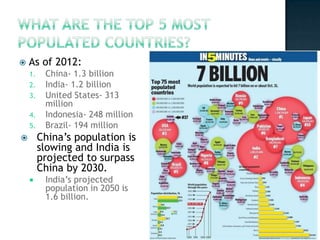
As of 2012:
1.

2.
3.
4.
5.

China- 1.3 billion
India- 1.2 billion
United States- 313
million
Indonesia- 248 million
Brazil- 194 million

China’s population is
slowing and India is
projected to surpass
China by 2030.





India’s projected
population in 2050 is
1.6 billion.
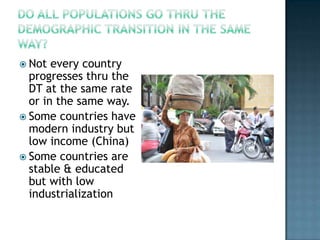
 Not

every country
progresses thru the
DT at the same rate
or in the same way.
 Some countries have
modern industry but
low income (China)
 Some countries are
stable & educated
but with low
industrialization




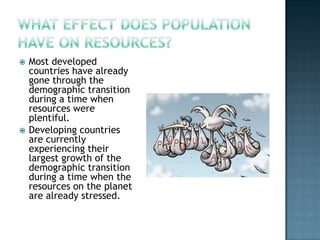
Most developed
countries have already
gone through the
demographic transition
during a time when
resources were
plentiful.
Developing countries
are currently
experiencing their
largest growth of the
demographic transition
during a time when the
resources on the planet
are already stressed.




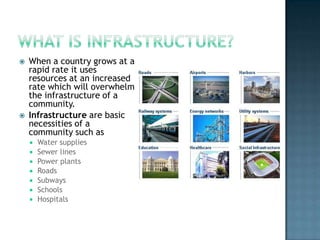
When a country grows at a
rapid rate it uses
resources at an increased
rate which will overwhelm
the infrastructure of a
community.
Infrastructure are basic
necessities of a
community such as








Water supplies
Sewer lines
Power plants
Roads
Subways
Schools
Hospitals
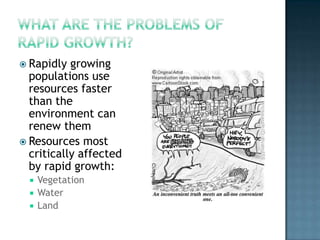
 Rapidly

growing
populations use
resources faster
than the
environment can
renew them
 Resources most
critically affected
by rapid growth:
Vegetation
 Water
 Land

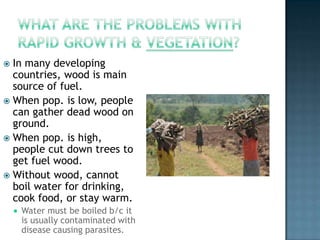
In many developing
countries, wood is main
source of fuel.
 When pop. is low, people
can gather dead wood on
ground.
 When pop. is high,
people cut down trees to
get fuel wood.
 Without wood, cannot
boil water for drinking,
cook food, or stay warm.




Water must be boiled b/c it
is usually contaminated with
disease causing parasites.






If population grows too
rapidly, the local water
supply cannot keep up.
Water supplies may dry up
faster than they can be
replaced by rain water
Plumbing infrastructure may
be non-existent or not
sufficient for growing
population




People may drink and wash
from same water used for
sewage disposal.
Causes outbreaks of disease
such as cholera, typhoid, and
dysentery




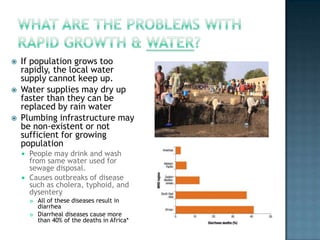
All of these diseases result in
diarrhea
Diarrheal diseases cause more
than 40% of the deaths in Africa*
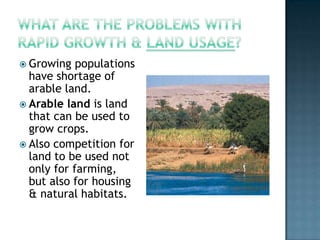
 Growing

populations
have shortage of
arable land.
 Arable land is land
that can be used to
grow crops.
 Also competition for
land to be used not
only for farming,
but also for housing
& natural habitats.


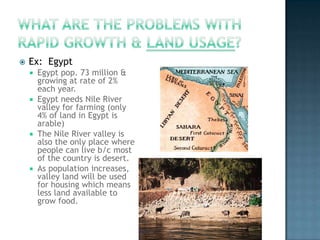
Ex: Egypt
Egypt pop. 73 million &
growing at rate of 2%
each year.
 Egypt needs Nile River
valley for farming (only
4% of land in Egypt is
arable)
 The Nile River valley is
also the only place where
people can live b/c most
of the country is desert.
 As population increases,
valley land will be used
for housing which means
less land available to
grow food.







Another problem with land
usage is urbanization.
Urbanization- when people
in rural areas move to cities.
Urbanization leads to
suburban sprawl- people
move to suburbs around
cities and commute into
cities for work.
City infrastructure can’t
keep up with immigration of
people into cities or suburbs






Lots of traffic jams
Less land for farms
Inadequate plumbing
Not enough or inadequate
housing

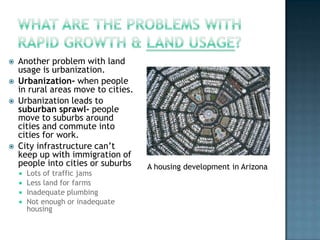
A housing development in Arizona
Less developed
countries are
beginning to realize
the economic strain
overpopulation has on
their countries.
 Some governments try
to limit birth rate by:







Offering monetary
incentives/tax
incentives to only have
1-2 kids
Advertising family
planning programs
Legal punishments
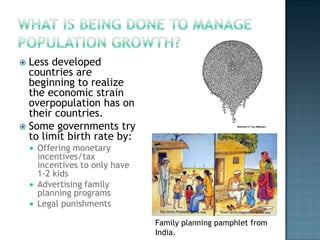
Family planning pamphlet from
India.
 Conference

held

by United
Nations
 Debated
relationship
between
populations,
development,
and environment



Results of Conference:


Provide access to family
planning methods & related
reproductive health services



Reduce infant mortality rates
to below 35/1000 live births &
under 5 year old mortality
rates to 45/1000



Close gap in maternal
mortality btwn developed &
developing countries.



Increase life expectancy at
birth to more than 75 years.



Achieve universal access to &
completion of primary
education. Ensure the widest
and earliest possible access by
girls and women to secondary
& higher levels of education






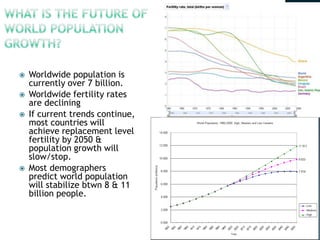
Worldwide population is
currently over 7 billion.
Worldwide fertility rates
are declining
If current trends continue,
most countries will
achieve replacement level
fertility by 2050 &
population growth will
slow/stop.
Most demographers
predict world population
will stabilize btwn 8 & 11
billion people.

Unit 3 a ch 9 s2 changing population trends

  • 1.
    Ch 9, Section2: Changing Population Trends Standards: SEV5e
  • 2.
     As of 2012: 1. 2. 3. 4. 5. China-1.3 billion India- 1.2 billion United States- 313 million Indonesia- 248 million Brazil- 194 million China’s population is slowing and India is projected to surpass China by 2030.   India’s projected population in 2050 is 1.6 billion.
  • 3.
     Not every country progressesthru the DT at the same rate or in the same way.  Some countries have modern industry but low income (China)  Some countries are stable & educated but with low industrialization
  • 4.
      Most developed countries havealready gone through the demographic transition during a time when resources were plentiful. Developing countries are currently experiencing their largest growth of the demographic transition during a time when the resources on the planet are already stressed.
  • 5.
      When a countrygrows at a rapid rate it uses resources at an increased rate which will overwhelm the infrastructure of a community. Infrastructure are basic necessities of a community such as        Water supplies Sewer lines Power plants Roads Subways Schools Hospitals
  • 6.
     Rapidly growing populations use resourcesfaster than the environment can renew them  Resources most critically affected by rapid growth: Vegetation  Water  Land 
  • 7.
    In many developing countries,wood is main source of fuel.  When pop. is low, people can gather dead wood on ground.  When pop. is high, people cut down trees to get fuel wood.  Without wood, cannot boil water for drinking, cook food, or stay warm.   Water must be boiled b/c it is usually contaminated with disease causing parasites.
  • 8.
       If population growstoo rapidly, the local water supply cannot keep up. Water supplies may dry up faster than they can be replaced by rain water Plumbing infrastructure may be non-existent or not sufficient for growing population   People may drink and wash from same water used for sewage disposal. Causes outbreaks of disease such as cholera, typhoid, and dysentery   All of these diseases result in diarrhea Diarrheal diseases cause more than 40% of the deaths in Africa*
  • 9.
     Growing populations have shortageof arable land.  Arable land is land that can be used to grow crops.  Also competition for land to be used not only for farming, but also for housing & natural habitats.
  • 10.
     Ex: Egypt Egypt pop.73 million & growing at rate of 2% each year.  Egypt needs Nile River valley for farming (only 4% of land in Egypt is arable)  The Nile River valley is also the only place where people can live b/c most of the country is desert.  As population increases, valley land will be used for housing which means less land available to grow food. 
  • 11.
        Another problem withland usage is urbanization. Urbanization- when people in rural areas move to cities. Urbanization leads to suburban sprawl- people move to suburbs around cities and commute into cities for work. City infrastructure can’t keep up with immigration of people into cities or suburbs     Lots of traffic jams Less land for farms Inadequate plumbing Not enough or inadequate housing A housing development in Arizona
  • 12.
    Less developed countries are beginningto realize the economic strain overpopulation has on their countries.  Some governments try to limit birth rate by:     Offering monetary incentives/tax incentives to only have 1-2 kids Advertising family planning programs Legal punishments Family planning pamphlet from India.
  • 13.
     Conference held by United Nations Debated relationship between populations, development, and environment  Results of Conference:  Provide access to family planning methods & related reproductive health services  Reduce infant mortality rates to below 35/1000 live births & under 5 year old mortality rates to 45/1000  Close gap in maternal mortality btwn developed & developing countries.  Increase life expectancy at birth to more than 75 years.  Achieve universal access to & completion of primary education. Ensure the widest and earliest possible access by girls and women to secondary & higher levels of education
  • 14.
        Worldwide population is currentlyover 7 billion. Worldwide fertility rates are declining If current trends continue, most countries will achieve replacement level fertility by 2050 & population growth will slow/stop. Most demographers predict world population will stabilize btwn 8 & 11 billion people.

Editor's Notes

  • #9 According to WHO- World Health Organization