Milankovitch
Cycles and
Earth’s Climate
Change
- By
Chilukuri Lakshmi Sravani
CC20MTECH11006
Overview
• Introduction -------------------------------------------------------3
• Three Variations in Orbit of Earth around Sun ---------------4
• Eccentricity --------------------------------------------------------5
• Obliquity ----------------------------------------------------------8
• Precession --------------------------------------------------------11
• Ice Ages due to Milankovitch cycles -------------------------13
• Stratigraphy ------------------------------------------------------14
• Summary ---------------------------------------------------------15
2
Introduction
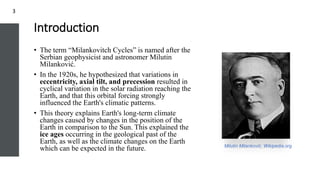
• The term “Milankovitch Cycles” is named after the
Serbian geophysicist and astronomer Milutin
Milanković.
• In the 1920s, he hypothesized that variations in
eccentricity, axial tilt, and precession resulted in
cyclical variation in the solar radiation reaching the
Earth, and that this orbital forcing strongly
influenced the Earth's climatic patterns.
• This theory explains Earth's long-term climate
changes caused by changes in the position of the
Earth in comparison to the Sun. This explained the
ice ages occurring in the geological past of the
Earth, as well as the climate changes on the Earth
which can be expected in the future. Milutin Milanković, Wikipedia.org
3
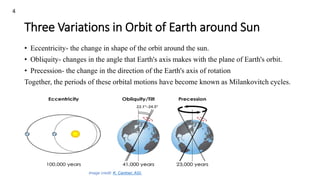
Three Variations in Orbit of Earth around Sun
• Eccentricity- the change in shape of the orbit around the sun.
• Obliquity- changes in the angle that Earth's axis makes with the plane of Earth's orbit.
• Precession- the change in the direction of the Earth's axis of rotation
Together, the periods of these orbital motions have become known as Milankovitch cycles.
Image credit: K. Cantner, AGI.
4
Eccentricity
• Eccentricity is a term used to describe the shape of
Earth's orbit around the sun.
• The variation of Earth's orbit around the sun ranges
from an almost exact circle (eccentricity = 0.0034) to
a slightly elongated shape (eccentricity = 0.058).
• The current eccentricity of Earth is 0.0167.
• The eccentricity changes on a cycle taking
approximately 1,00,000 years.
• Perihelion - when the Earth is closest to the Sun
(usually happens in January)
• Aphelion - when the Earth is furthest from the Sun
(usually happens in June)
https://www.youtube.com/watch?v=X1XrtqubGPE
https://www.quantamagazine.org/how-earths-climate-changes-
naturally-and-why-things-are-different-now-20200721/
5
Solar Insolation.
• The average solar irradiance received by earth on
the top of its atmosphere is 1360 W/m2.
• Insolation on circular area received from sun is
πR^2. This insolation is distributed over the surface
of Earth which is 4πR^2, where R is Radius of
Earth.
• So, the average solar insolation at the top of the
atmosphere over its entire spherical surface is 340
W/m2.
• The impact of the eccentricity includes change in
the amount of solar energy from perihelion (around
January 3) to aphelion (around July 4).
• The numbers for the eccentricity are not constant.
The eccentricity changes in time. The period varies
between 1,00,000 years to 4,00,000 years. https://sureshemre.wordpress.com/2014/05/03/difference-between-the-precession-of-
the-equinoxes-and-the-precession-of-earths-axis/
6
Perihelion
For the minimum value of the eccentricity e the
amount of solar radiation received by the Earth
(insolation) is 3 % less than at present, and for the
maximum value of e the radiation is 9 % greater
than at present.
Aphelion
For the minimum value of the eccentricity e the
amount of solar radiation received by the Earth
(insolation) is 3 % greater than at present, and for
the maximum value of e the radiation is 8 % less.
The difference of the insolation at perihelion and
at aphelion is 7 % at present, and 17 % for the
maximum eccentricity.
Effects of Eccentricity on Solar Insolation.
https://www.researchgate.net/figure/Eccentricity-of-
earths-orbit_fig2_328773252
7
Obliquity
• Obliquity is the variation of the tilt of the
earth’s axis away from the orbital plane.
• Currently, the axis of rotation for the
earth is tilted at 23.5°.
• However, this value changes from a
minimum of 22.5° to a maximum of
24.5°.
• Earth takes 41,000 years to complete one
cycle.
https://sures
hemre.wordp
ress.com/201
4/05/03/diffe
rence-
between-the-
precession-
of-the-
equinoxes-
and-the-
precession-
of-earths-
axis/
https://www.
quantamagazi
ne.org/how-
earths-
climate-
changes-
naturally-and-
why-things-
are-different-
now-
20200721/
8
• The axial tilt causes seasons because the tilt determines the amount of solar energy
deposited per square-meter on a given location on the Earth’s surface, especially in
locations away from the equator. The axial tilt and the solar insolation are directly related.
The more tilt means more severe seasons - warmer summers and colder winters; less
tilt means less severe seasons - cooler summers and milder winters.
https://www.research
gate.net/figure/The-
present-day-orbit-of-
the-Earth-around-the-
Sun-the-beginning-
and-length-of-
the_fig1_291797677
9
Beam Spreading
• The energy present per square meter of
sunlight spreads over a larger area as the angle
of incidence increases.
• Thus the same amount of incident energy is
spread over a larger area of the surface near
the poles than at the equator.
Attenuation
• The distance travelled by rays of the sun to hit
the earth’s surface near the poles is nearly 2.5
times that of the distance travelled at the equator.
This results in increases attenuation of the solar
radiation near the poles.
Latitude has a very large effect on the mean temperature of various locations
of the earth. The reason why this happens is due to two factors:
Dennis L.Hartmann, Global Physical Climatology, Edition-2, Chapter 2 -
The Global Energy Balance, 2016, Pages 25-48
10
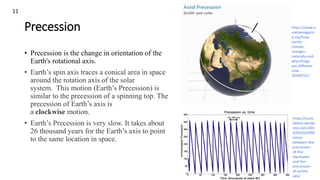
Precession
• Precession is the change in orientation of the
Earth's rotational axis.
• Earth’s spin axis traces a conical area in space
around the rotation axis of the solar
system. This motion (Earth’s Precession) is
similar to the precession of a spinning top. The
precession of Earth’s axis is
a clockwise motion.
• Earth’s Precession is very slow. It takes about
26 thousand years for the Earth’s axis to point
to the same location in space.
https://sures
hemre.wordp
ress.com/201
4/05/03/diffe
rence-
between-the-
precession-
of-the-
equinoxes-
and-the-
precession-
of-earths-
axis/
https://www.q
uantamagazin
e.org/how-
earths-
climate-
changes-
naturally-and-
why-things-
are-different-
now-
20200721/
11
• An extra day is added to February in each year divisible by four. The leap year system gets an
extra tweak by excluding century years not divisible by 400.
• If it weren’t for this leap year fix, June 21, 15014, would indeed become winter in the
Northern Hemisphere. Instead, Northern Hemisphere residents will still be welcoming
summer on that date.
https://astronomy.com/magazine/ask-astro/2014/10/shifting-seasons
12
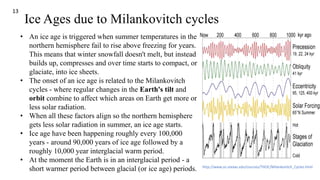
Ice Ages due to Milankovitch cycles
http://www.zo.utexas.edu/courses/THOC/Milankovitch_Cycles.html
• An ice age is triggered when summer temperatures in the
northern hemisphere fail to rise above freezing for years.
This means that winter snowfall doesn't melt, but instead
builds up, compresses and over time starts to compact, or
glaciate, into ice sheets.
• The onset of an ice age is related to the Milankovitch
cycles - where regular changes in the Earth's tilt and
orbit combine to affect which areas on Earth get more or
less solar radiation.
• When all these factors align so the northern hemisphere
gets less solar radiation in summer, an ice age starts.
• Ice age have been happening roughly every 100,000
years - around 90,000 years of ice age followed by a
roughly 10,000 year interglacial warm period.
• At the moment the Earth is in an interglacial period - a
short warmer period between glacial (or ice age) periods.
13
Stratigraphy
• Vital to idea for stratigraphy is the amount of
insolation(incoming solar radiation) at 65°N, a bit
south of the Arctic Circle. At that latitude, insolation
can vary seasonally by 25%. Reduction in summer
insolation allow some winter ice to survive.
• (i) The oxygen isotopic(O18) composition of
planktonic foraminifera
• (ii) Ts, an estimate of summer sea-surface
temperatures at the core site, derived from a
statistical analysis of radiolarian assemblages
• (iii) percentage of Cy-cladophora davisiana, the
relative abundance of a radiolarian species not used
in the estimation of Ts.
• It turns out these cycles are quite similar to cycles in
the orbital parameter of the Earth around the Sun.
Hays, J., Variations in the Earth's Orbit: Pacemaker of the Ice Ages ,
Vol-194, pp. 1121-1132 1977/01/01, Science (New York, N.Y.)
•High 18O  low T
• Low 18O  high T
14
Summary
• Past changes in climate have often been triggered by changes in orbital characteristics
known as Milankovitch Cycles .
• Variations in earth’s eccentricity, obliquity, and precession alter the seasonality of solar
radiation. It is the seasonality and location of insolation that impact the contrast between
the seasons.
• Low eccentricity
• Low obliquity
• Large Earth-Sun Distance in NH Summer
Net Effect: Less seasonal contrast
• High eccentricity
• High obliquity (tilt)
• Small Earth-Sun Distance in NH Summer
Net Effect: More seasonal contrast
Glacial Inter-Glacial
globalchange
.umich.edu/V
ostok,
Milankovitch
Cycles -
Global
Change
15
Thank you!!
YouTube Video https://www.youtube.com/watch?v=iA788usYNWA
16

Milancovitch cycles

  • 1.
    Milankovitch Cycles and Earth’s Climate Change -By Chilukuri Lakshmi Sravani CC20MTECH11006
  • 2.
    Overview • Introduction -------------------------------------------------------3 •Three Variations in Orbit of Earth around Sun ---------------4 • Eccentricity --------------------------------------------------------5 • Obliquity ----------------------------------------------------------8 • Precession --------------------------------------------------------11 • Ice Ages due to Milankovitch cycles -------------------------13 • Stratigraphy ------------------------------------------------------14 • Summary ---------------------------------------------------------15 2
  • 3.
    Introduction • The term“Milankovitch Cycles” is named after the Serbian geophysicist and astronomer Milutin Milanković. • In the 1920s, he hypothesized that variations in eccentricity, axial tilt, and precession resulted in cyclical variation in the solar radiation reaching the Earth, and that this orbital forcing strongly influenced the Earth's climatic patterns. • This theory explains Earth's long-term climate changes caused by changes in the position of the Earth in comparison to the Sun. This explained the ice ages occurring in the geological past of the Earth, as well as the climate changes on the Earth which can be expected in the future. Milutin Milanković, Wikipedia.org 3
  • 4.
    Three Variations inOrbit of Earth around Sun • Eccentricity- the change in shape of the orbit around the sun. • Obliquity- changes in the angle that Earth's axis makes with the plane of Earth's orbit. • Precession- the change in the direction of the Earth's axis of rotation Together, the periods of these orbital motions have become known as Milankovitch cycles. Image credit: K. Cantner, AGI. 4
  • 5.
    Eccentricity • Eccentricity isa term used to describe the shape of Earth's orbit around the sun. • The variation of Earth's orbit around the sun ranges from an almost exact circle (eccentricity = 0.0034) to a slightly elongated shape (eccentricity = 0.058). • The current eccentricity of Earth is 0.0167. • The eccentricity changes on a cycle taking approximately 1,00,000 years. • Perihelion - when the Earth is closest to the Sun (usually happens in January) • Aphelion - when the Earth is furthest from the Sun (usually happens in June) https://www.youtube.com/watch?v=X1XrtqubGPE https://www.quantamagazine.org/how-earths-climate-changes- naturally-and-why-things-are-different-now-20200721/ 5
  • 6.
    Solar Insolation. • Theaverage solar irradiance received by earth on the top of its atmosphere is 1360 W/m2. • Insolation on circular area received from sun is πR^2. This insolation is distributed over the surface of Earth which is 4πR^2, where R is Radius of Earth. • So, the average solar insolation at the top of the atmosphere over its entire spherical surface is 340 W/m2. • The impact of the eccentricity includes change in the amount of solar energy from perihelion (around January 3) to aphelion (around July 4). • The numbers for the eccentricity are not constant. The eccentricity changes in time. The period varies between 1,00,000 years to 4,00,000 years. https://sureshemre.wordpress.com/2014/05/03/difference-between-the-precession-of- the-equinoxes-and-the-precession-of-earths-axis/ 6
  • 7.
    Perihelion For the minimumvalue of the eccentricity e the amount of solar radiation received by the Earth (insolation) is 3 % less than at present, and for the maximum value of e the radiation is 9 % greater than at present. Aphelion For the minimum value of the eccentricity e the amount of solar radiation received by the Earth (insolation) is 3 % greater than at present, and for the maximum value of e the radiation is 8 % less. The difference of the insolation at perihelion and at aphelion is 7 % at present, and 17 % for the maximum eccentricity. Effects of Eccentricity on Solar Insolation. https://www.researchgate.net/figure/Eccentricity-of- earths-orbit_fig2_328773252 7
  • 8.
    Obliquity • Obliquity isthe variation of the tilt of the earth’s axis away from the orbital plane. • Currently, the axis of rotation for the earth is tilted at 23.5°. • However, this value changes from a minimum of 22.5° to a maximum of 24.5°. • Earth takes 41,000 years to complete one cycle. https://sures hemre.wordp ress.com/201 4/05/03/diffe rence- between-the- precession- of-the- equinoxes- and-the- precession- of-earths- axis/ https://www. quantamagazi ne.org/how- earths- climate- changes- naturally-and- why-things- are-different- now- 20200721/ 8
  • 9.
    • The axialtilt causes seasons because the tilt determines the amount of solar energy deposited per square-meter on a given location on the Earth’s surface, especially in locations away from the equator. The axial tilt and the solar insolation are directly related. The more tilt means more severe seasons - warmer summers and colder winters; less tilt means less severe seasons - cooler summers and milder winters. https://www.research gate.net/figure/The- present-day-orbit-of- the-Earth-around-the- Sun-the-beginning- and-length-of- the_fig1_291797677 9
  • 10.
    Beam Spreading • Theenergy present per square meter of sunlight spreads over a larger area as the angle of incidence increases. • Thus the same amount of incident energy is spread over a larger area of the surface near the poles than at the equator. Attenuation • The distance travelled by rays of the sun to hit the earth’s surface near the poles is nearly 2.5 times that of the distance travelled at the equator. This results in increases attenuation of the solar radiation near the poles. Latitude has a very large effect on the mean temperature of various locations of the earth. The reason why this happens is due to two factors: Dennis L.Hartmann, Global Physical Climatology, Edition-2, Chapter 2 - The Global Energy Balance, 2016, Pages 25-48 10
  • 11.
    Precession • Precession isthe change in orientation of the Earth's rotational axis. • Earth’s spin axis traces a conical area in space around the rotation axis of the solar system. This motion (Earth’s Precession) is similar to the precession of a spinning top. The precession of Earth’s axis is a clockwise motion. • Earth’s Precession is very slow. It takes about 26 thousand years for the Earth’s axis to point to the same location in space. https://sures hemre.wordp ress.com/201 4/05/03/diffe rence- between-the- precession- of-the- equinoxes- and-the- precession- of-earths- axis/ https://www.q uantamagazin e.org/how- earths- climate- changes- naturally-and- why-things- are-different- now- 20200721/ 11
  • 12.
    • An extraday is added to February in each year divisible by four. The leap year system gets an extra tweak by excluding century years not divisible by 400. • If it weren’t for this leap year fix, June 21, 15014, would indeed become winter in the Northern Hemisphere. Instead, Northern Hemisphere residents will still be welcoming summer on that date. https://astronomy.com/magazine/ask-astro/2014/10/shifting-seasons 12
  • 13.
    Ice Ages dueto Milankovitch cycles http://www.zo.utexas.edu/courses/THOC/Milankovitch_Cycles.html • An ice age is triggered when summer temperatures in the northern hemisphere fail to rise above freezing for years. This means that winter snowfall doesn't melt, but instead builds up, compresses and over time starts to compact, or glaciate, into ice sheets. • The onset of an ice age is related to the Milankovitch cycles - where regular changes in the Earth's tilt and orbit combine to affect which areas on Earth get more or less solar radiation. • When all these factors align so the northern hemisphere gets less solar radiation in summer, an ice age starts. • Ice age have been happening roughly every 100,000 years - around 90,000 years of ice age followed by a roughly 10,000 year interglacial warm period. • At the moment the Earth is in an interglacial period - a short warmer period between glacial (or ice age) periods. 13
  • 14.
    Stratigraphy • Vital toidea for stratigraphy is the amount of insolation(incoming solar radiation) at 65°N, a bit south of the Arctic Circle. At that latitude, insolation can vary seasonally by 25%. Reduction in summer insolation allow some winter ice to survive. • (i) The oxygen isotopic(O18) composition of planktonic foraminifera • (ii) Ts, an estimate of summer sea-surface temperatures at the core site, derived from a statistical analysis of radiolarian assemblages • (iii) percentage of Cy-cladophora davisiana, the relative abundance of a radiolarian species not used in the estimation of Ts. • It turns out these cycles are quite similar to cycles in the orbital parameter of the Earth around the Sun. Hays, J., Variations in the Earth's Orbit: Pacemaker of the Ice Ages , Vol-194, pp. 1121-1132 1977/01/01, Science (New York, N.Y.) •High 18O  low T • Low 18O  high T 14
  • 15.
    Summary • Past changesin climate have often been triggered by changes in orbital characteristics known as Milankovitch Cycles . • Variations in earth’s eccentricity, obliquity, and precession alter the seasonality of solar radiation. It is the seasonality and location of insolation that impact the contrast between the seasons. • Low eccentricity • Low obliquity • Large Earth-Sun Distance in NH Summer Net Effect: Less seasonal contrast • High eccentricity • High obliquity (tilt) • Small Earth-Sun Distance in NH Summer Net Effect: More seasonal contrast Glacial Inter-Glacial globalchange .umich.edu/V ostok, Milankovitch Cycles - Global Change 15
  • 16.
    Thank you!! YouTube Videohttps://www.youtube.com/watch?v=iA788usYNWA 16

Editor's Notes

  • #14 The Pleistocene is the geological epoch that lasted from about 2,580,000 to 11,700 years ago, spanning the world's most recent period of repeated glaciations. The end of the Pleistocene corresponds with the end of the last glacial period. Climate forcing is the physical process of affecting the climate on the Earth through a number of forcing factors. ... Examples of some of the most important types of forcings include: variations in solar radiation levels, volcanic eruptions, changing albedo, and changing levels of greenhouse gases in the atmosphere