Energy Flow in Ecosystems Environmental Science
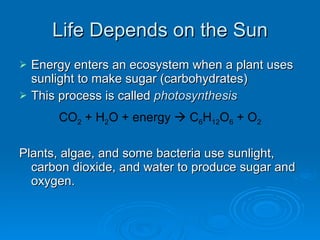
Life Depends on the Sun Energy enters an ecosystem when a plant uses sunlight to make sugar (carbohydrates) This process is called  photosynthesis CO 2  + H 2 O + energy    C 6 H 12 O 6  + O 2 Plants, algae, and some bacteria use sunlight, carbon dioxide, and water to produce sugar and oxygen.
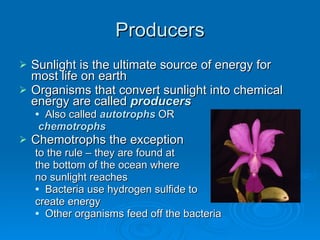
Producers Sunlight is the ultimate source of energy for most life on earth Organisms that convert sunlight into chemical energy are called  producers Also called  autotrophs  OR chemotrophs Chemotrophs the exception to the rule – they are found at  the bottom of the ocean where  no sunlight reaches Bacteria use hydrogen sulfide to create energy Other organisms feed off the bacteria
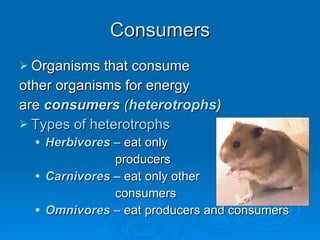
Consumers Organisms that consume  other organisms for energy  are  consumers   ( heterotrophs) Types of heterotrophs Herbivores  – eat only  producers Carnivores  – eat only other  consumers Omnivores  – eat producers and consumers
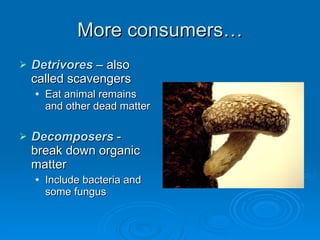
More consumers… Detrivores  – also called scavengers Eat animal remains and other dead matter Decomposers  -  break down organic matter  Include bacteria and some fungus
Cellular Respriation The process in which cells use sugar to create energy is called  cellular respiration C 6 H 12 O 6  + O 2     CO 2  + H 2 O + energy Cells use glucose (sugar) and oxygen to produce carbon dioxide, water, and energy. Cellular respiration occurs inside the cells of most organisms
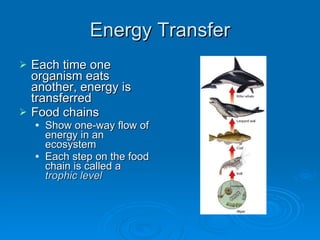
Energy Transfer Each time one organism eats another, energy is transferred Food chains Show one-way flow of energy in an ecosystem Each step on the food chain is called a  trophic level
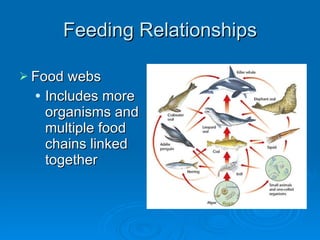
Feeding Relationships Food webs Includes more organisms and multiple food chains linked together
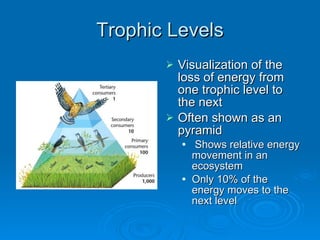
Trophic Levels Visualization of the loss of energy from one trophic level to the next Often shown as an pyramid Shows relative energy movement in an ecosystem Only 10% of the energy moves to the next level
Biomagnification Pollution can lead to  biomagnification  – the concentration of toxic substances in organisms as you move up trophic levels Ex. DDT and birds of prey; mercury in tuna and sharks

Energy flow in ecosystems

  • 1.
    Energy Flow inEcosystems Environmental Science
  • 2.
    Life Depends onthe Sun Energy enters an ecosystem when a plant uses sunlight to make sugar (carbohydrates) This process is called photosynthesis CO 2 + H 2 O + energy  C 6 H 12 O 6 + O 2 Plants, algae, and some bacteria use sunlight, carbon dioxide, and water to produce sugar and oxygen.
  • 3.
    Producers Sunlight isthe ultimate source of energy for most life on earth Organisms that convert sunlight into chemical energy are called producers Also called autotrophs OR chemotrophs Chemotrophs the exception to the rule – they are found at the bottom of the ocean where no sunlight reaches Bacteria use hydrogen sulfide to create energy Other organisms feed off the bacteria
  • 4.
    Consumers Organisms thatconsume other organisms for energy are consumers ( heterotrophs) Types of heterotrophs Herbivores – eat only producers Carnivores – eat only other consumers Omnivores – eat producers and consumers
  • 5.
    More consumers… Detrivores – also called scavengers Eat animal remains and other dead matter Decomposers - break down organic matter Include bacteria and some fungus
  • 6.
    Cellular Respriation Theprocess in which cells use sugar to create energy is called cellular respiration C 6 H 12 O 6 + O 2  CO 2 + H 2 O + energy Cells use glucose (sugar) and oxygen to produce carbon dioxide, water, and energy. Cellular respiration occurs inside the cells of most organisms
  • 7.
    Energy Transfer Eachtime one organism eats another, energy is transferred Food chains Show one-way flow of energy in an ecosystem Each step on the food chain is called a trophic level
  • 8.
    Feeding Relationships Foodwebs Includes more organisms and multiple food chains linked together
  • 9.
    Trophic Levels Visualizationof the loss of energy from one trophic level to the next Often shown as an pyramid Shows relative energy movement in an ecosystem Only 10% of the energy moves to the next level
  • 10.
    Biomagnification Pollution canlead to biomagnification – the concentration of toxic substances in organisms as you move up trophic levels Ex. DDT and birds of prey; mercury in tuna and sharks