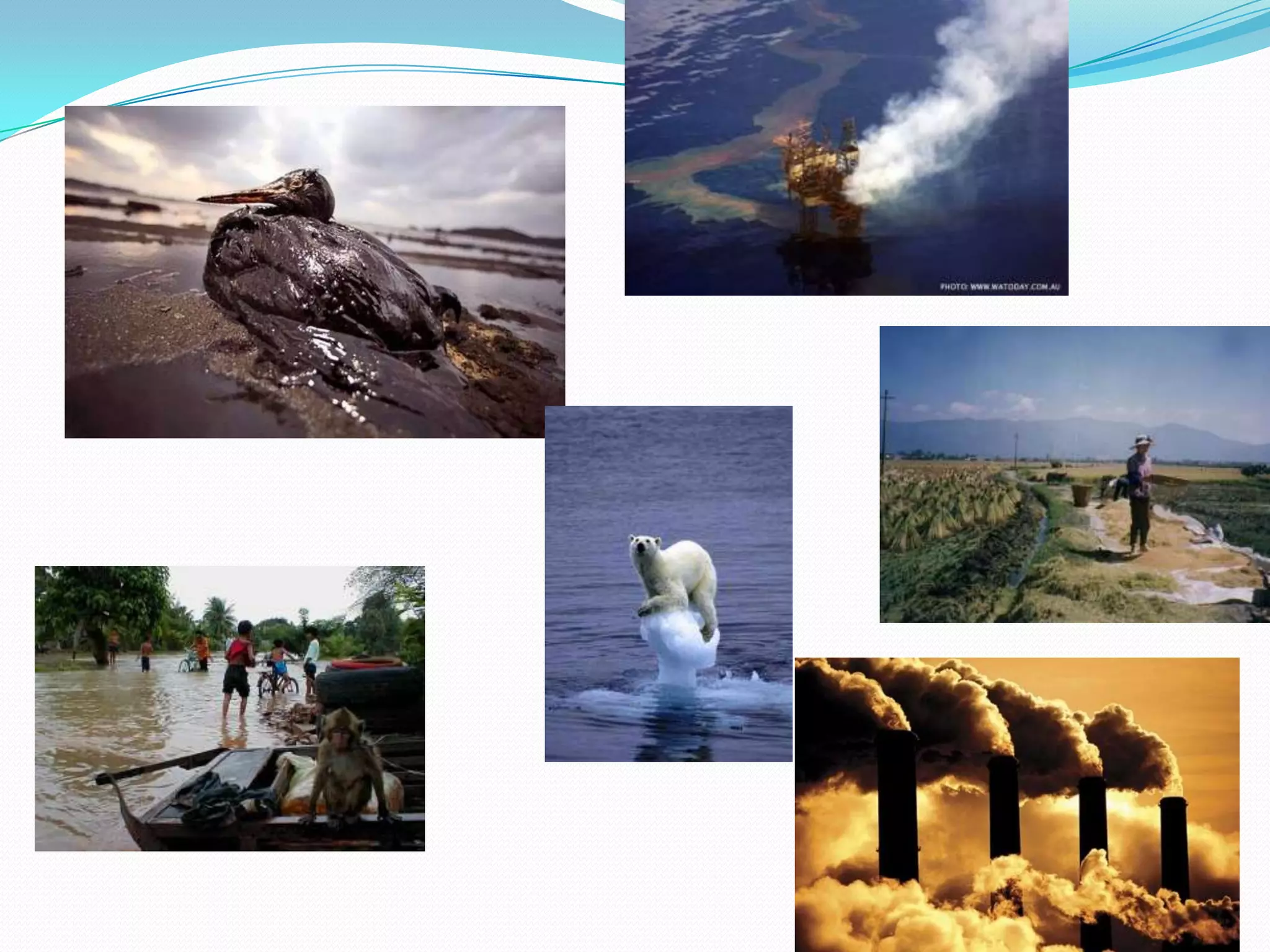
Group activity
 Solutions for:
    Global warming
    CO2 emission
    Fossil fuels
Aim: to explore different sources of energy –
renewable and non-renewable energy
Objectives:
 Explain what are renewable and non-renewable
  energies
 Describe what it is the greenhouse effect and the main
  factors responsible for it
 Identify alternatives to the use of fossil fuels
 Give examples of renewable sources of energy and
  their utilisation
 Identify advantages and disadvantages of using
  renewable energy and non-renewable energy
Non-renewable and renewable resources

 What do you think non-
renewable resources are?


          And


 Renewable Resources?
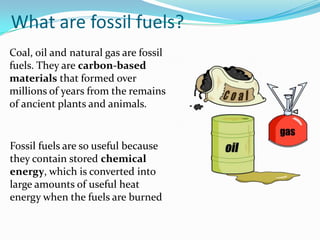
Renewable                          Non-renewable


                                      Non-renewable energy
Renewable energy resources can
                                      resources is a natural resource
be replaced or regenerated and will
                                      that cannot be re-made or re-
never run out
                                      grown at a scale comparable to
                                      its consumption.

 Examples: wind and solar.            Examples: coal , oil and
                                      natural gas.
What are fossil fuels?
Coal, oil and natural gas are fossil
fuels. They are carbon-based
materials that formed over
millions of years from the remains
of ancient plants and animals.


Fossil fuels are so useful because
they contain stored chemical
energy, which is converted into
large amounts of useful heat
energy when the fuels are burned
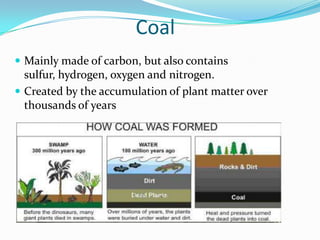
Coal
 Mainly made of carbon, but also contains
  sulfur, hydrogen, oxygen and nitrogen.
 Created by the accumulation of plant matter over
  thousands of years
Coal
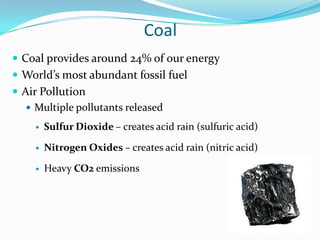
 Coal provides around 24% of our energy
 World’s most abundant fossil fuel
 Air Pollution
    Multiple pollutants released

        Sulfur Dioxide – creates acid rain (sulfuric acid)

        Nitrogen Oxides – creates acid rain (nitric acid)

        Heavy CO2 emissions
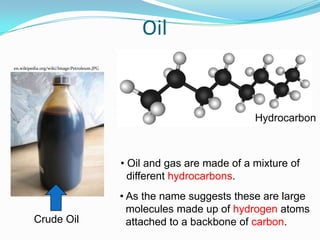
Oil
en.wikipedia.org/wiki/Image:Petroleum.JPG


                                                                        Hydrocarbon


                                            • Oil and gas are made of a mixture of
                                              different hydrocarbons.
                                            • As the name suggests these are large
                                              molecules made up of hydrogen atoms
         Crude Oil                            attached to a backbone of carbon.
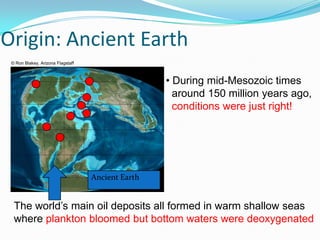
Origin: Ancient Earth
 © Ron Blakey, Arizona Flagstaff


                                                   • During mid-Mesozoic times
                                                     around 150 million years ago,
                                                     conditions were just right!


                                   Ancient Earth


  The world’s main oil deposits all formed in warm shallow seas
  where plankton bloomed but bottom waters were deoxygenated
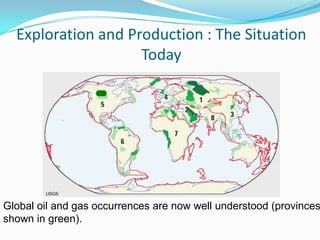
Exploration and Production : The Situation
                    Today


        USGS


Global oil and gas occurrences are now well understood (provinces
shown in green).
Natural Gas
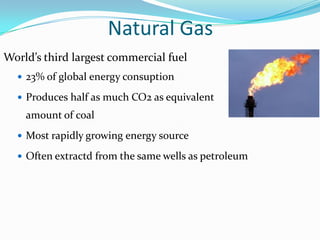
World’s third largest commercial fuel
   23% of global energy consuption

   Produces half as much CO2 as equivalent
    amount of coal
   Most rapidly growing energy source

   Often extractd from the same wells as petroleum
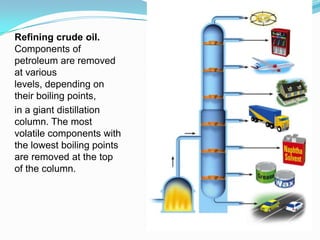
Refining crude oil.
Components of
petroleum are removed
at various
levels, depending on
their boiling points,
in a giant distillation
column. The most
volatile components with
the lowest boiling points
are removed at the top
of the column.
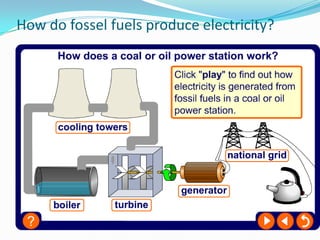
How do fossel fuels produce electricity?
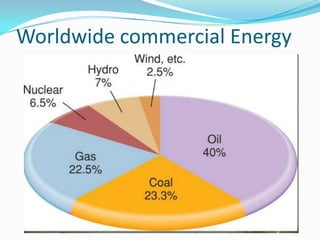
Worldwide commercial Energy
Current Energy Sources
 Fossil Fuels currently provide about 85% of all
 commercial energy in the world.
   Other renewable sources (wind, solar, hydroelectric)

    make up 9% of commercially power

   Nuclear power make up 6% of commercial power.
Per Capita Consumption
 Richest 20 countries consume nearly 80% of natural
 gas, 65% of oil, and 50% of coal production annually.

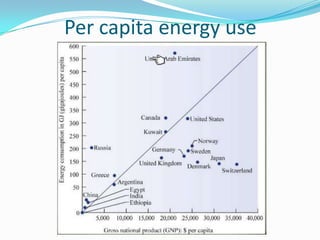
   On average in richest countries, each person uses more
    than 200Gj of energy annually.

   In poorest countries of the world, each person generally
    consumes less than one Gj annually.
Per capita energy use
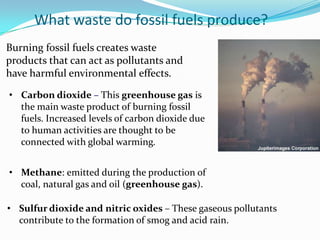
What waste do fossil fuels produce?
Burning fossil fuels creates waste
products that can act as pollutants and
have harmful environmental effects.

• Carbon dioxide – This greenhouse gas is
  the main waste product of burning fossil
  fuels. Increased levels of carbon dioxide due
  to human activities are thought to be
  connected with global warming.


• Methane: emitted during the production of
  coal, natural gas and oil (greenhouse gas).

• Sulfur dioxide and nitric oxides – These gaseous pollutants
  contribute to the formation of smog and acid rain.
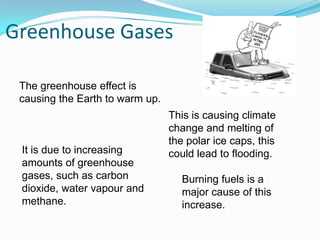
Greenhouse Gases

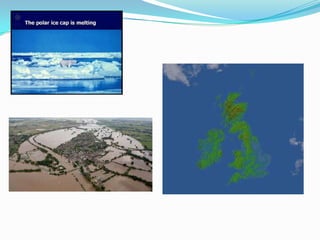
 The greenhouse effect is
 causing the Earth to warm up.
                                 This is causing climate
                                 change and melting of
                                 the polar ice caps, this
 It is due to increasing         could lead to flooding.
 amounts of greenhouse
 gases, such as carbon             Burning fuels is a
 dioxide, water vapour and         major cause of this
 methane.                          increase.
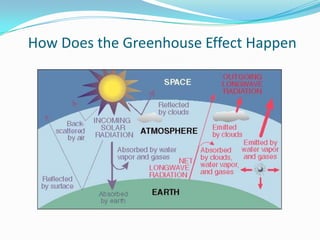
How Does the Greenhouse Effect Happen

  Greenhouse gases absorb infra-red
  radiation, but not visible or ultraviolet
  radiation from the sun.


   They let the sun’s radiation in, but
   stop some of the earth’s infra-red
   radiation out.

 Video
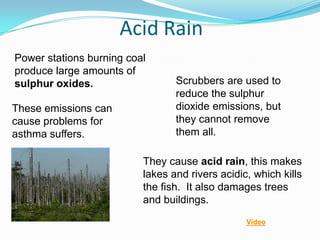
Acid Rain
Power stations burning coal
produce large amounts of
sulphur oxides.                  Scrubbers are used to
                                 reduce the sulphur
These emissions can              dioxide emissions, but
cause problems for               they cannot remove
asthma suffers.                  them all.

                          They cause acid rain, this makes
                          lakes and rivers acidic, which kills
                          the fish. It also damages trees
                          and buildings.
                                                 Video
Advantages and Disadvantages
Fossil Fuels
Transporting oil and gas to the power stations is easy;
Relatively inexpensive; High net energy yield; efficient
distribution system
Pollution by producing CO2, methane and sulphur dioxide.
Mining coal can be difficult and dangerous. Destroys large
areas of the landscape.
Renewable Energies
• These are resources found in nature that are self-
  regenerating:

   •   Sunlight
   •   Wind
   •   Geothermal heat
   •   Biomass
   •   Wave
   •   Tides


• These resources are normally used to produce clean (or
  green) energy. This production does not lead to climate
  change and involve emission of pollutants
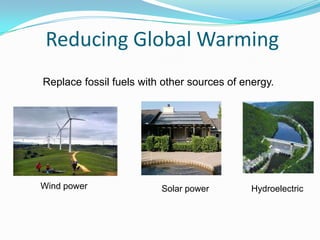
Reducing Global Warming
Replace fossil fuels with other sources of energy.


Wind power               Solar power         Hydroelectric
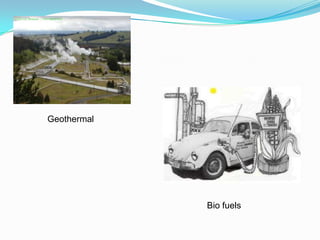
Geothermal


             Bio fuels
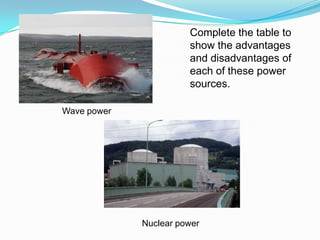
Complete the table to
                       show the advantages
                       and disadvantages of
                       each of these power
                       sources.

Wave power


             Nuclear power
Why are renewable energy growing in
       importance and popularity?

 To avert irreversible climate damage

 Increasing oil prices

 Unrealiability of non-renewable resurces (e.g. the
  depletion of oil wells)
Solar Power
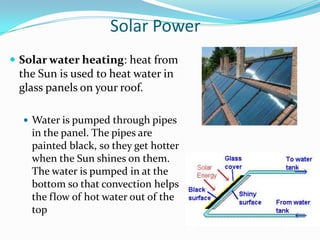
 Solar water heating: heat from
 the Sun is used to heat water in
 glass panels on your roof.

   Water is pumped through pipes
    in the panel. The pipes are
    painted black, so they get hotter
    when the Sun shines on them.
    The water is pumped in at the
    bottom so that convection helps
    the flow of hot water out of the
    top
Solar Power

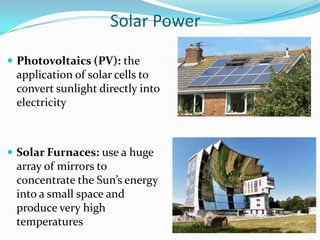
 Photovoltaics (PV): the
 application of solar cells to
 convert sunlight directly into
 electricity


 Solar Furnaces: use a huge
 array of mirrors to
 concentrate the Sun’s energy
 into a small space and
 produce very high
 temperatures
Advantages and Disadvantages
Solar energy
Pollution free with no waste products. It can be
used where there is no easy way to get electricity
to a remote place.
Doesn’t work at night. High initial cost, very large
arrays needed for large scale production. It can be
unreliable.
Wind Power
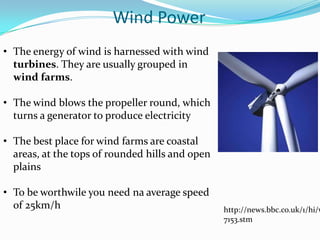
• The energy of wind is harnessed with wind
  turbines. They are usually grouped in
  wind farms.

• The wind blows the propeller round, which
  turns a generator to produce electricity

• The best place for wind farms are coastal
  areas, at the tops of rounded hills and open
  plains

• To be worthwile you need na average speed
  of 25km/h                                      http://news.bbc.co.uk/1/hi/w
                                                 7153.stm
Advantages and Disadvantages
Wind power
Renewable, pollution and waste free. A good method of
supplying energy to remote areas
High initial cost for large scale generation, not reliable in
calm weather. Not predictable – some days have no wind.
Large wind farms have environmental impact, both visual
and noise. Can kill birds.
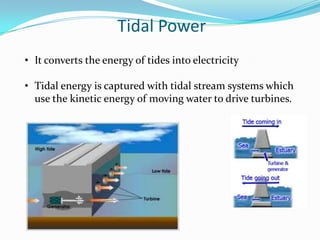
Tidal Power
• It converts the energy of tides into electricity

• Tidal energy is captured with tidal stream systems which
  use the kinetic energy of moving water to drive turbines.
Advantages and Disadvantages

Tidal Power
Pollution and waste free. Once built it is free. It produces
electricity reliably. Not expensive to maintain
Few suitable sites for tidal barrages. It only provides power
for around 10 hours each day. A barrage is very expensive
to build and affects a very wide area. Many birds rely on the
tide uncovering the mud flats to feed.
Hydroelectric Power
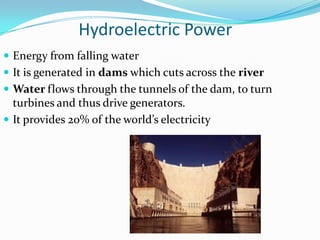
 Energy from falling water
 It is generated in dams which cuts across the river
 Water flows through the tunnels of the dam, to turn
  turbines and thus drive generators.
 It provides 20% of the world’s electricity
Advantages and Disadvantages
Hydroelectric
Renewable, quite predictable and reliable, pollution
and waste free. Can be used on a large scale. Water
can be stored ready to cope with picks in demand.
Costly to install, hard to find a suitable site (impact on
residents and the environment)
Environmental impact: It will flood a vary large area
upstream causing problems for the animals that used
to live there; water quality and quantity downstream
can be affected
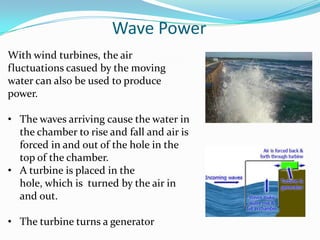
Wave Power
With wind turbines, the air
fluctuations casued by the moving
water can also be used to produce
power.

• The waves arriving cause the water in
  the chamber to rise and fall and air is
  forced in and out of the hole in the
  top of the chamber.
• A turbine is placed in the
  hole, which is turned by the air in
  and out.

• The turbine turns a generator
Advantages and Disadvantages
Waste free. Not expensive to operate and maintain. Can
produce a great deal of energy.

Needs a suitable site. Depends on the waves. Some designs
are noisy. Must be able to withstand very rough weather.
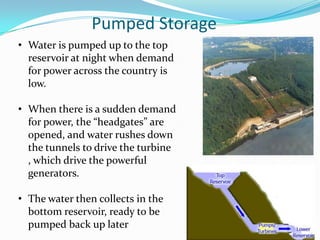
Pumped Storage
• Water is pumped up to the top
  reservoir at night when demand
  for power across the country is
  low.

• When there is a sudden demand
  for power, the “headgates” are
  opened, and water rushes down
  the tunnels to drive the turbine
  , which drive the powerful
  generators.

• The water then collects in the
  bottom reservoir, ready to be
  pumped back up later
Advantages and Disadvantages
Pumped storage reservoir

Little effect on the landscape. No pollution or waste.
Without some means of storing energy for quick
release, we’d be in trouble

Expensive to built. Once used, you can’t use it again until
you’ve pumped the water back up.
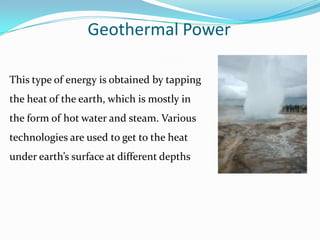
Geothermal Power

This type of energy is obtained by tapping
the heat of the earth, which is mostly in
the form of hot water and steam. Various
technologies are used to get to the heat
under earth’s surface at different depths
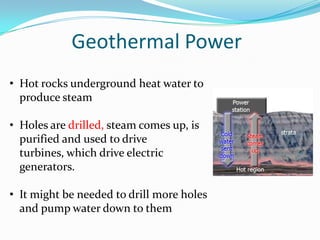
Geothermal Power
• Hot rocks underground heat water to
  produce steam

• Holes are drilled, steam comes up, is
  purified and used to drive
  turbines, which drive electric
  generators.

• It might be needed to drill more holes
  and pump water down to them
Advantages and Disadvantages
Geothermal


Pollution free. Power stations do not take much room. Once
geothermal station built energy almost free.
Not widely available (few places where Power stations can
be built), expensive to set up, technological problems.
Hazardous gases and minerals may come up from
underground.
Biomass
  Biomass consists of living or recently dead organisms or
   other biological material i.e. carbon. Biomass is used to
   produce biofuel. The most commun material for biofuels
   are photosynthetic plants such as sugar cane.

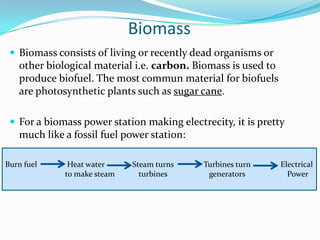
  For a biomass power station making electrecity, it is pretty
   much like a fossil fuel power station:

Burn fuel     Heat water     Steam turns    Turbines turn      Electrical
             to make steam     turbines      generators          Power
Advantages and Disadvantages
Biomass
They help to reduce waste. Tend to be cheap. Less
demand on fossil fuels.

Not a large enough supply to replace fossil fuels at present
rates of use. It makes greenhouse effects like fossil fuels
do. Some waste material are not available all year round.
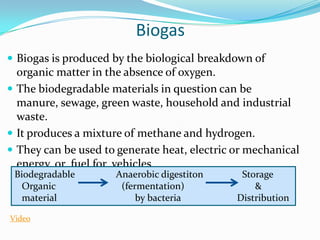
Biogas
 Biogas is produced by the biological breakdown of
  organic matter in the absence of oxygen.
 The biodegradable materials in question can be
  manure, sewage, green waste, household and industrial
  waste.
 It produces a mixture of methane and hydrogen.
 They can be used to generate heat, electric or mechanical
  energy, or fuel for vehicles.
 Biodegradable       Anaerobic digestiton      Storage
   Organic            (fermentation)              &
   material               by bacteria         Distribution

Video
Advantages and Disadvantages
Biogas
The methane gas from the waste would otherwise end up
in the atmosphere. It tends to be cheap. Less demand on
fossil fuels.
The biogas is burnt so it makes greenhouse gases just like
fossil fuels.
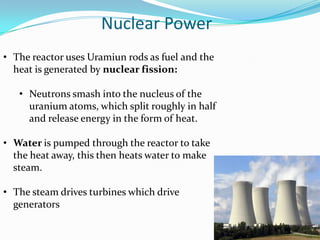
Nuclear Power
• The reactor uses Uramiun rods as fuel and the
  heat is generated by nuclear fission:

   • Neutrons smash into the nucleus of the
     uranium atoms, which split roughly in half
     and release energy in the form of heat.

• Water is pumped through the reactor to take
  the heat away, this then heats water to make
  steam.

• The steam drives turbines which drive
  generators
Advantages and Disadvantages
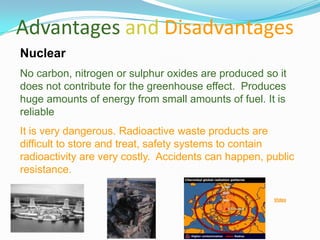
Nuclear
No carbon, nitrogen or sulphur oxides are produced so it
does not contribute for the greenhouse effect. Produces
huge amounts of energy from small amounts of fuel. It is
reliable
It is very dangerous. Radioactive waste products are
difficult to store and treat, safety systems to contain
radioactivity are very costly. Accidents can happen, public
resistance.

                                                      Video
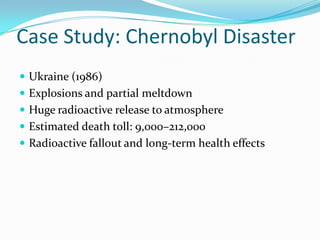
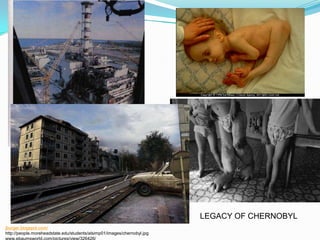
Case Study: Chernobyl Disaster
 Ukraine (1986)
 Explosions and partial meltdown
 Huge radioactive release to atmosphere
 Estimated death toll: 9,000–212,000
 Radioactive fallout and long-term health effects
LEGACY OF CHERNOBYL
jburger.blogspot.com/
http://people.moreheadstate.edu/students/alsimp01/images/chernobyl.jpg

Renewable and non renewable energies

  • 2.
    Group activity  Solutionsfor:  Global warming  CO2 emission  Fossil fuels
  • 4.
    Aim: to exploredifferent sources of energy – renewable and non-renewable energy Objectives:  Explain what are renewable and non-renewable energies  Describe what it is the greenhouse effect and the main factors responsible for it  Identify alternatives to the use of fossil fuels  Give examples of renewable sources of energy and their utilisation  Identify advantages and disadvantages of using renewable energy and non-renewable energy
  • 5.
    Non-renewable and renewableresources What do you think non- renewable resources are? And Renewable Resources?
  • 6.
    Renewable Non-renewable Non-renewable energy Renewable energy resources can resources is a natural resource be replaced or regenerated and will that cannot be re-made or re- never run out grown at a scale comparable to its consumption. Examples: wind and solar. Examples: coal , oil and natural gas.
  • 7.
    What are fossilfuels? Coal, oil and natural gas are fossil fuels. They are carbon-based materials that formed over millions of years from the remains of ancient plants and animals. Fossil fuels are so useful because they contain stored chemical energy, which is converted into large amounts of useful heat energy when the fuels are burned
  • 8.
    Coal  Mainly madeof carbon, but also contains sulfur, hydrogen, oxygen and nitrogen.  Created by the accumulation of plant matter over thousands of years
  • 9.
    Coal  Coal providesaround 24% of our energy  World’s most abundant fossil fuel  Air Pollution  Multiple pollutants released  Sulfur Dioxide – creates acid rain (sulfuric acid)  Nitrogen Oxides – creates acid rain (nitric acid)  Heavy CO2 emissions
  • 10.
    Oil en.wikipedia.org/wiki/Image:Petroleum.JPG Hydrocarbon • Oil and gas are made of a mixture of different hydrocarbons. • As the name suggests these are large molecules made up of hydrogen atoms Crude Oil attached to a backbone of carbon.
  • 11.
    Origin: Ancient Earth © Ron Blakey, Arizona Flagstaff • During mid-Mesozoic times around 150 million years ago, conditions were just right! Ancient Earth The world’s main oil deposits all formed in warm shallow seas where plankton bloomed but bottom waters were deoxygenated
  • 12.
    Exploration and Production: The Situation Today USGS Global oil and gas occurrences are now well understood (provinces shown in green).
  • 13.
    Natural Gas World’s thirdlargest commercial fuel  23% of global energy consuption  Produces half as much CO2 as equivalent amount of coal  Most rapidly growing energy source  Often extractd from the same wells as petroleum
  • 14.
    Refining crude oil. Componentsof petroleum are removed at various levels, depending on their boiling points, in a giant distillation column. The most volatile components with the lowest boiling points are removed at the top of the column.
  • 15.
    How do fosselfuels produce electricity?
  • 16.
  • 17.
    Current Energy Sources Fossil Fuels currently provide about 85% of all commercial energy in the world.  Other renewable sources (wind, solar, hydroelectric) make up 9% of commercially power  Nuclear power make up 6% of commercial power.
  • 18.
    Per Capita Consumption Richest 20 countries consume nearly 80% of natural gas, 65% of oil, and 50% of coal production annually.  On average in richest countries, each person uses more than 200Gj of energy annually.  In poorest countries of the world, each person generally consumes less than one Gj annually.
  • 19.
  • 20.
    What waste dofossil fuels produce? Burning fossil fuels creates waste products that can act as pollutants and have harmful environmental effects. • Carbon dioxide – This greenhouse gas is the main waste product of burning fossil fuels. Increased levels of carbon dioxide due to human activities are thought to be connected with global warming. • Methane: emitted during the production of coal, natural gas and oil (greenhouse gas). • Sulfur dioxide and nitric oxides – These gaseous pollutants contribute to the formation of smog and acid rain.
  • 21.
    Greenhouse Gases Thegreenhouse effect is causing the Earth to warm up. This is causing climate change and melting of the polar ice caps, this It is due to increasing could lead to flooding. amounts of greenhouse gases, such as carbon Burning fuels is a dioxide, water vapour and major cause of this methane. increase.
  • 23.
    How Does theGreenhouse Effect Happen
  • 24.
    How Does theGreenhouse Effect Happen Greenhouse gases absorb infra-red radiation, but not visible or ultraviolet radiation from the sun. They let the sun’s radiation in, but stop some of the earth’s infra-red radiation out. Video
  • 25.
    Acid Rain Power stationsburning coal produce large amounts of sulphur oxides. Scrubbers are used to reduce the sulphur These emissions can dioxide emissions, but cause problems for they cannot remove asthma suffers. them all. They cause acid rain, this makes lakes and rivers acidic, which kills the fish. It also damages trees and buildings. Video
  • 26.
    Advantages and Disadvantages FossilFuels Transporting oil and gas to the power stations is easy; Relatively inexpensive; High net energy yield; efficient distribution system Pollution by producing CO2, methane and sulphur dioxide. Mining coal can be difficult and dangerous. Destroys large areas of the landscape.
  • 27.
    Renewable Energies • Theseare resources found in nature that are self- regenerating: • Sunlight • Wind • Geothermal heat • Biomass • Wave • Tides • These resources are normally used to produce clean (or green) energy. This production does not lead to climate change and involve emission of pollutants
  • 28.
    Reducing Global Warming Replacefossil fuels with other sources of energy. Wind power Solar power Hydroelectric
  • 29.
    Geothermal Bio fuels
  • 30.
    Complete the tableto show the advantages and disadvantages of each of these power sources. Wave power Nuclear power
  • 31.
    Why are renewableenergy growing in importance and popularity?  To avert irreversible climate damage  Increasing oil prices  Unrealiability of non-renewable resurces (e.g. the depletion of oil wells)
  • 32.
    Solar Power  Solarwater heating: heat from the Sun is used to heat water in glass panels on your roof.  Water is pumped through pipes in the panel. The pipes are painted black, so they get hotter when the Sun shines on them. The water is pumped in at the bottom so that convection helps the flow of hot water out of the top
  • 33.
    Solar Power  Photovoltaics(PV): the application of solar cells to convert sunlight directly into electricity  Solar Furnaces: use a huge array of mirrors to concentrate the Sun’s energy into a small space and produce very high temperatures
  • 34.
    Advantages and Disadvantages Solarenergy Pollution free with no waste products. It can be used where there is no easy way to get electricity to a remote place. Doesn’t work at night. High initial cost, very large arrays needed for large scale production. It can be unreliable.
  • 35.
    Wind Power • Theenergy of wind is harnessed with wind turbines. They are usually grouped in wind farms. • The wind blows the propeller round, which turns a generator to produce electricity • The best place for wind farms are coastal areas, at the tops of rounded hills and open plains • To be worthwile you need na average speed of 25km/h http://news.bbc.co.uk/1/hi/w 7153.stm
  • 36.
    Advantages and Disadvantages Windpower Renewable, pollution and waste free. A good method of supplying energy to remote areas High initial cost for large scale generation, not reliable in calm weather. Not predictable – some days have no wind. Large wind farms have environmental impact, both visual and noise. Can kill birds.
  • 37.
    Tidal Power • Itconverts the energy of tides into electricity • Tidal energy is captured with tidal stream systems which use the kinetic energy of moving water to drive turbines.
  • 38.
    Advantages and Disadvantages TidalPower Pollution and waste free. Once built it is free. It produces electricity reliably. Not expensive to maintain Few suitable sites for tidal barrages. It only provides power for around 10 hours each day. A barrage is very expensive to build and affects a very wide area. Many birds rely on the tide uncovering the mud flats to feed.
  • 39.
    Hydroelectric Power  Energyfrom falling water  It is generated in dams which cuts across the river  Water flows through the tunnels of the dam, to turn turbines and thus drive generators.  It provides 20% of the world’s electricity
  • 40.
    Advantages and Disadvantages Hydroelectric Renewable,quite predictable and reliable, pollution and waste free. Can be used on a large scale. Water can be stored ready to cope with picks in demand. Costly to install, hard to find a suitable site (impact on residents and the environment) Environmental impact: It will flood a vary large area upstream causing problems for the animals that used to live there; water quality and quantity downstream can be affected
  • 41.
    Wave Power With windturbines, the air fluctuations casued by the moving water can also be used to produce power. • The waves arriving cause the water in the chamber to rise and fall and air is forced in and out of the hole in the top of the chamber. • A turbine is placed in the hole, which is turned by the air in and out. • The turbine turns a generator
  • 42.
    Advantages and Disadvantages Wastefree. Not expensive to operate and maintain. Can produce a great deal of energy. Needs a suitable site. Depends on the waves. Some designs are noisy. Must be able to withstand very rough weather.
  • 43.
    Pumped Storage • Wateris pumped up to the top reservoir at night when demand for power across the country is low. • When there is a sudden demand for power, the “headgates” are opened, and water rushes down the tunnels to drive the turbine , which drive the powerful generators. • The water then collects in the bottom reservoir, ready to be pumped back up later
  • 44.
    Advantages and Disadvantages Pumpedstorage reservoir Little effect on the landscape. No pollution or waste. Without some means of storing energy for quick release, we’d be in trouble Expensive to built. Once used, you can’t use it again until you’ve pumped the water back up.
  • 45.
    Geothermal Power This typeof energy is obtained by tapping the heat of the earth, which is mostly in the form of hot water and steam. Various technologies are used to get to the heat under earth’s surface at different depths
  • 46.
    Geothermal Power • Hotrocks underground heat water to produce steam • Holes are drilled, steam comes up, is purified and used to drive turbines, which drive electric generators. • It might be needed to drill more holes and pump water down to them
  • 47.
    Advantages and Disadvantages Geothermal Pollutionfree. Power stations do not take much room. Once geothermal station built energy almost free. Not widely available (few places where Power stations can be built), expensive to set up, technological problems. Hazardous gases and minerals may come up from underground.
  • 48.
    Biomass  Biomassconsists of living or recently dead organisms or other biological material i.e. carbon. Biomass is used to produce biofuel. The most commun material for biofuels are photosynthetic plants such as sugar cane.  For a biomass power station making electrecity, it is pretty much like a fossil fuel power station: Burn fuel Heat water Steam turns Turbines turn Electrical to make steam turbines generators Power
  • 49.
    Advantages and Disadvantages Biomass Theyhelp to reduce waste. Tend to be cheap. Less demand on fossil fuels. Not a large enough supply to replace fossil fuels at present rates of use. It makes greenhouse effects like fossil fuels do. Some waste material are not available all year round.
  • 50.
    Biogas  Biogas isproduced by the biological breakdown of organic matter in the absence of oxygen.  The biodegradable materials in question can be manure, sewage, green waste, household and industrial waste.  It produces a mixture of methane and hydrogen.  They can be used to generate heat, electric or mechanical energy, or fuel for vehicles. Biodegradable Anaerobic digestiton Storage Organic (fermentation) & material by bacteria Distribution Video
  • 51.
    Advantages and Disadvantages Biogas Themethane gas from the waste would otherwise end up in the atmosphere. It tends to be cheap. Less demand on fossil fuels. The biogas is burnt so it makes greenhouse gases just like fossil fuels.
  • 52.
    Nuclear Power • Thereactor uses Uramiun rods as fuel and the heat is generated by nuclear fission: • Neutrons smash into the nucleus of the uranium atoms, which split roughly in half and release energy in the form of heat. • Water is pumped through the reactor to take the heat away, this then heats water to make steam. • The steam drives turbines which drive generators
  • 53.
    Advantages and Disadvantages Nuclear Nocarbon, nitrogen or sulphur oxides are produced so it does not contribute for the greenhouse effect. Produces huge amounts of energy from small amounts of fuel. It is reliable It is very dangerous. Radioactive waste products are difficult to store and treat, safety systems to contain radioactivity are very costly. Accidents can happen, public resistance. Video
  • 54.
    Case Study: ChernobylDisaster  Ukraine (1986)  Explosions and partial meltdown  Huge radioactive release to atmosphere  Estimated death toll: 9,000–212,000  Radioactive fallout and long-term health effects
  • 55.