Peephole Optimization Techniques
In Compiler Design
Anul Chaudhary
131CC00304
Contents
Example
Replacement Rules
What is an Peephole Optimization
Types of Optimization Techniques
What is an Optimization
2
Conclusion
References
What is Optimization?
Optimization is the process of transforming a
piece of code to make more efficient(either in
terms of time or space) without changing its
output or side-effects. The only difference
visible to the code’s user should be that it runs
faster and/or consumes less memory. It is really
a misnomer that the name implies you are
finding an “optimal” solution— in truth,
optimization aims to improve, not perfect, the
result.
Types of Optimization
Optimization can be categorized broadly into two types :
1. Machine Independent
2. Machine dependent
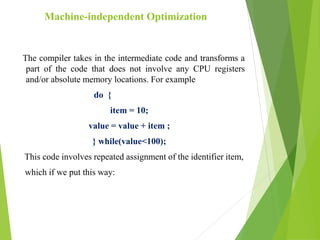
Machine-independent Optimization
The compiler takes in the intermediate code and transforms a
part of the code that does not involve any CPU registers
and/or absolute memory locations. For example
do {
item = 10;
value = value + item ;
} while(value<100);
This code involves repeated assignment of the identifier item,
which if we put this way:
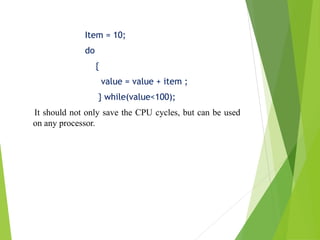
Item = 10;
do
{
value = value + item ;
} while(value<100);
It should not only save the CPU cycles, but can be used
on any processor.
Machine-dependent Optimization
Machine-dependent optimization is done after the target
code has been generated and when the code is
transformed according to the target machine architecture.
It involves CPU registers and may have absolute memory
references rather than relative references. Machine-
dependent optimizers put efforts to take maximum
advantage of memory hierarchy.
Peephole Optimization
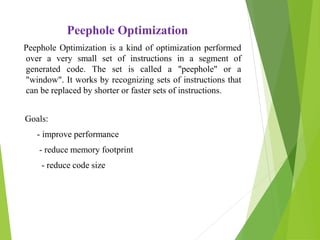
Peephole Optimization is a kind of optimization performed
over a very small set of instructions in a segment of
generated code. The set is called a "peephole" or a
"window". It works by recognizing sets of instructions that
can be replaced by shorter or faster sets of instructions.
Goals:
- improve performance
- reduce memory footprint
- reduce code size
Replacement Rules
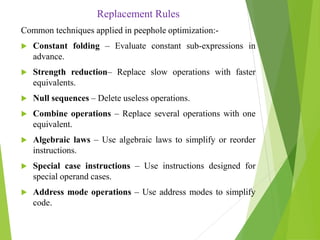
Common techniques applied in peephole optimization:-
 Constant folding – Evaluate constant sub-expressions in
advance.
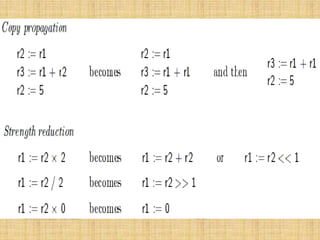
 Strength reduction– Replace slow operations with faster
equivalents.
 Null sequences – Delete useless operations.
 Combine operations – Replace several operations with one
equivalent.
 Algebraic laws – Use algebraic laws to simplify or reorder
instructions.
 Special case instructions – Use instructions designed for
special operand cases.
 Address mode operations – Use address modes to simplify
code.
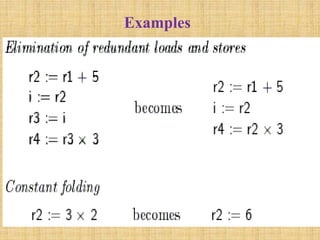
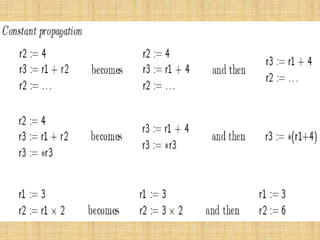
Examples
Fall 2011“Advanced Compiler Techniques”
References
 https://en.wikipedia.org/wiki/Peephole_optimization
 http://www.iosrjournals.org/iosr-jce/papers/Vol9-
Issue4/N0948086.pdf?id=255
 https://class.coursera.org/compilers/lecture/76
Thank You

Peephole optimization techniques in compiler design

  • 1.
    Peephole Optimization Techniques InCompiler Design Anul Chaudhary 131CC00304
  • 2.
    Contents Example Replacement Rules What isan Peephole Optimization Types of Optimization Techniques What is an Optimization 2 Conclusion References
  • 3.
    What is Optimization? Optimizationis the process of transforming a piece of code to make more efficient(either in terms of time or space) without changing its output or side-effects. The only difference visible to the code’s user should be that it runs faster and/or consumes less memory. It is really a misnomer that the name implies you are finding an “optimal” solution— in truth, optimization aims to improve, not perfect, the result.
  • 4.
    Types of Optimization Optimizationcan be categorized broadly into two types : 1. Machine Independent 2. Machine dependent
  • 5.
    Machine-independent Optimization The compilertakes in the intermediate code and transforms a part of the code that does not involve any CPU registers and/or absolute memory locations. For example do { item = 10; value = value + item ; } while(value<100); This code involves repeated assignment of the identifier item, which if we put this way:
  • 6.
    Item = 10; do { value= value + item ; } while(value<100); It should not only save the CPU cycles, but can be used on any processor.
  • 7.
    Machine-dependent Optimization Machine-dependent optimizationis done after the target code has been generated and when the code is transformed according to the target machine architecture. It involves CPU registers and may have absolute memory references rather than relative references. Machine- dependent optimizers put efforts to take maximum advantage of memory hierarchy.
  • 8.
    Peephole Optimization Peephole Optimizationis a kind of optimization performed over a very small set of instructions in a segment of generated code. The set is called a "peephole" or a "window". It works by recognizing sets of instructions that can be replaced by shorter or faster sets of instructions. Goals: - improve performance - reduce memory footprint - reduce code size
  • 9.
    Replacement Rules Common techniquesapplied in peephole optimization:-  Constant folding – Evaluate constant sub-expressions in advance.  Strength reduction– Replace slow operations with faster equivalents.  Null sequences – Delete useless operations.  Combine operations – Replace several operations with one equivalent.  Algebraic laws – Use algebraic laws to simplify or reorder instructions.  Special case instructions – Use instructions designed for special operand cases.  Address mode operations – Use address modes to simplify code.
  • 10.
  • 12.
  • 13.
  • 14.