CSE539: Advanced Computer Architecture
PART-IV

{Chapter 10, 11}
Software for Parallel Programming
Book: “Advanced Computer Architecture – Parallelism, Scalability, Programmability”, Hwang & Jotwani

Sumit Mittu
Assistant Professor, CSE/IT
Lovely Professional University
sumit.12735@lpu.co.in
In this chapter…
• Chapter 10
o Parallel Programming Models
o Parallel Languages and Compilers

• Chapter 11
o Parallel Programming Environments

Sumit Mittu, Assistant Professor, CSE/IT, Lovely Professional University

2
PARALLEL PROGRAMING MODELS
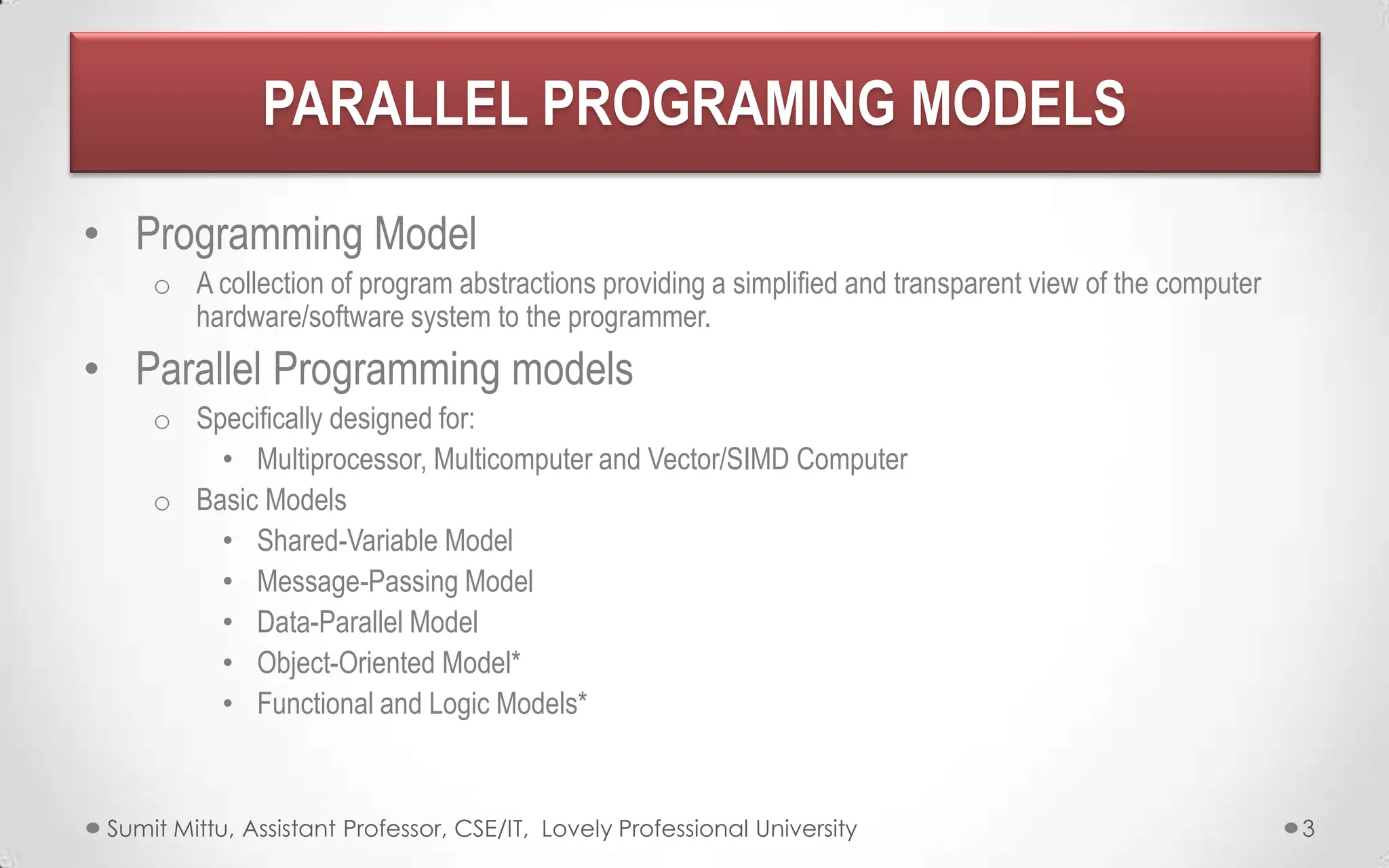
• Programming Model
o A collection of program abstractions providing a simplified and transparent view of the computer
hardware/software system to the programmer.

• Parallel Programming models
o Specifically designed for:
• Multiprocessor, Multicomputer and Vector/SIMD Computer
o Basic Models
• Shared-Variable Model
• Message-Passing Model
• Data-Parallel Model
• Object-Oriented Model*
• Functional and Logic Models*

Sumit Mittu, Assistant Professor, CSE/IT, Lovely Professional University

3
PARALLEL PROGRAMING MODELS
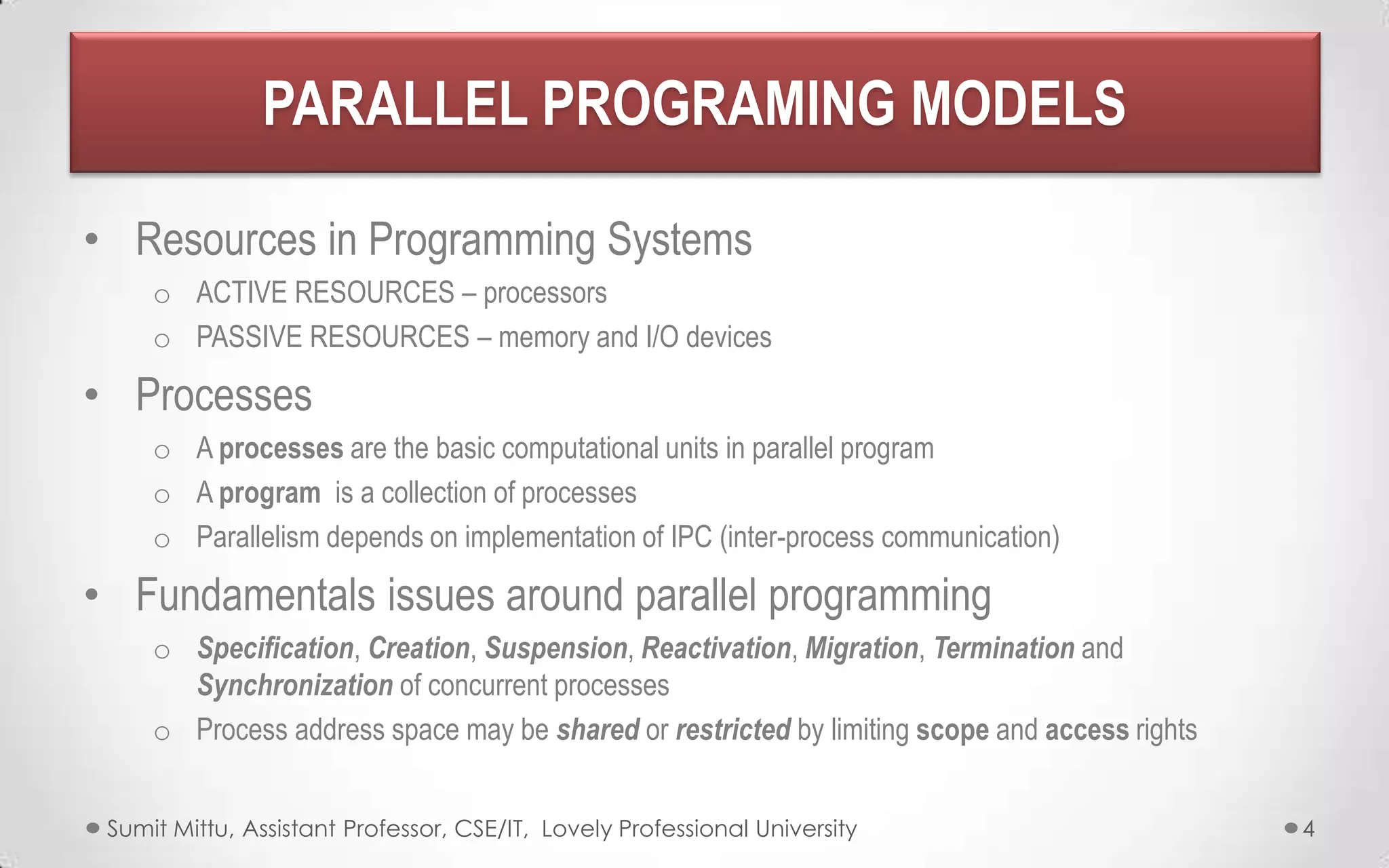
• Resources in Programming Systems
o ACTIVE RESOURCES – processors
o PASSIVE RESOURCES – memory and I/O devices

• Processes
o A processes are the basic computational units in parallel program
o A program is a collection of processes
o Parallelism depends on implementation of IPC (inter-process communication)

• Fundamentals issues around parallel programming
o Specification, Creation, Suspension, Reactivation, Migration, Termination and
Synchronization of concurrent processes
o Process address space may be shared or restricted by limiting scope and access rights
Sumit Mittu, Assistant Professor, CSE/IT, Lovely Professional University

4
PARALLEL PROGRAMING MODELS
Shared-Variable Model
• Shared Variable Communication
o Shared Variable and mutual exclusion
o Main Issues:
• Protected access of critical sections
• Memory Consistency
• Atomicity of Memory Operations
• Fast synchronization
• Shared data structures
• Fast data movement techniques
o Critical Section (CS)
• Code segments accessing shared variable with atomic operation
• Requirements – Mutual Exclusion, No Deadlock in waiting, Non-preemption, Eventual Entry
Sumit Mittu, Assistant Professor, CSE/IT, Lovely Professional University

5
PARALLEL PROGRAMING MODELS
Shared-Variable Model
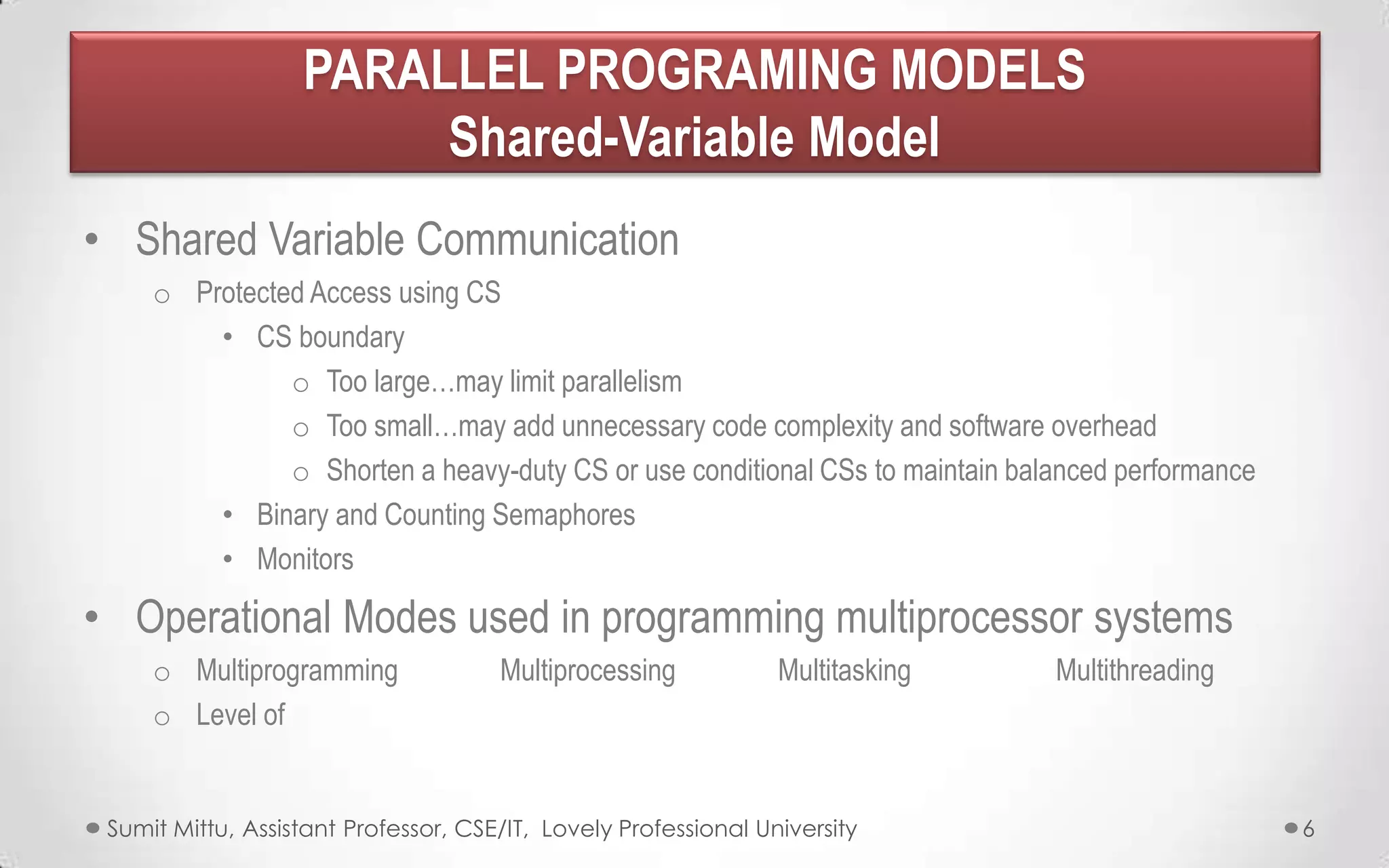
• Shared Variable Communication
o Protected Access using CS
• CS boundary
o Too large…may limit parallelism
o Too small…may add unnecessary code complexity and software overhead
o Shorten a heavy-duty CS or use conditional CSs to maintain balanced performance
• Binary and Counting Semaphores
• Monitors

• Operational Modes used in programming multiprocessor systems
o Multiprogramming
o Level of

Multiprocessing

Multitasking

Sumit Mittu, Assistant Professor, CSE/IT, Lovely Professional University

Multithreading

6
PARALLEL PROGRAMING MODELS
Shared-Variable Model
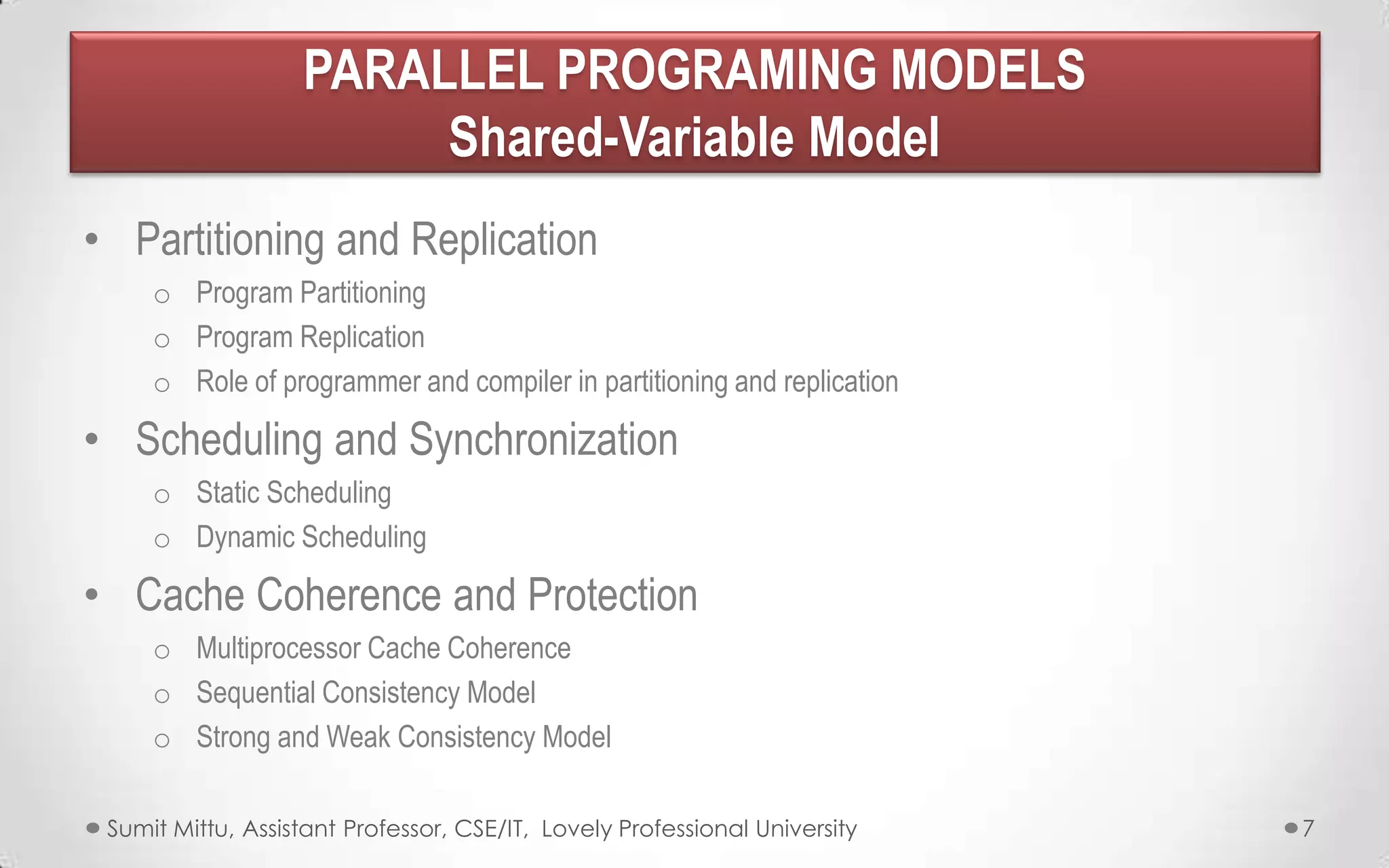
• Partitioning and Replication
o Program Partitioning
o Program Replication
o Role of programmer and compiler in partitioning and replication

• Scheduling and Synchronization
o Static Scheduling
o Dynamic Scheduling

• Cache Coherence and Protection
o Multiprocessor Cache Coherence
o Sequential Consistency Model
o Strong and Weak Consistency Model
Sumit Mittu, Assistant Professor, CSE/IT, Lovely Professional University

7
PARALLEL PROGRAMING MODELS
Message-Passing Model
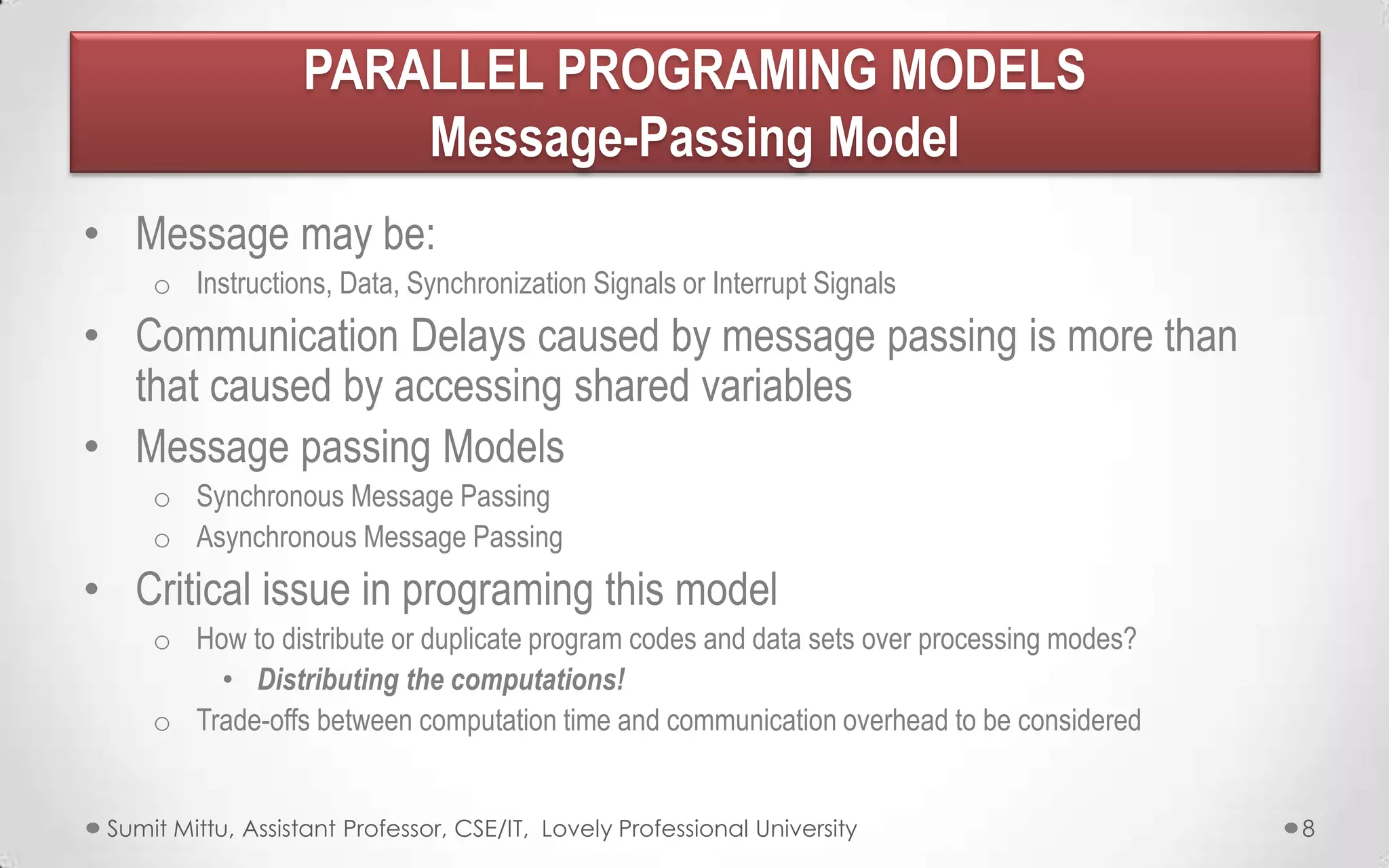
• Message may be:
o Instructions, Data, Synchronization Signals or Interrupt Signals

• Communication Delays caused by message passing is more than
that caused by accessing shared variables
• Message passing Models
o Synchronous Message Passing
o Asynchronous Message Passing

• Critical issue in programing this model
o How to distribute or duplicate program codes and data sets over processing modes?
• Distributing the computations!
o Trade-offs between computation time and communication overhead to be considered
Sumit Mittu, Assistant Professor, CSE/IT, Lovely Professional University

8
PARALLEL PROGRAMING MODELS
Message-Passing Model
• Synchronous Message Passing
o
o
o
o
o

Sender and receiver processes synchronized in time and space
No need of mutual exclusion
No buffers required
Blocking communication scheme
Uniform Communication Delays, in general

• Asynchronous Message Passing
o
o
o
o

Sender and receiver processes do not require to be synchronized in time and space
Often uses buffers in channels
Non-blocking communication scheme
Non-uniform or arbitrary communication delays

Sumit Mittu, Assistant Professor, CSE/IT, Lovely Professional University

9
PARALLEL PROGRAMING MODELS
Data-Parallel Model
•
•
•
•
•
•
•
•
•

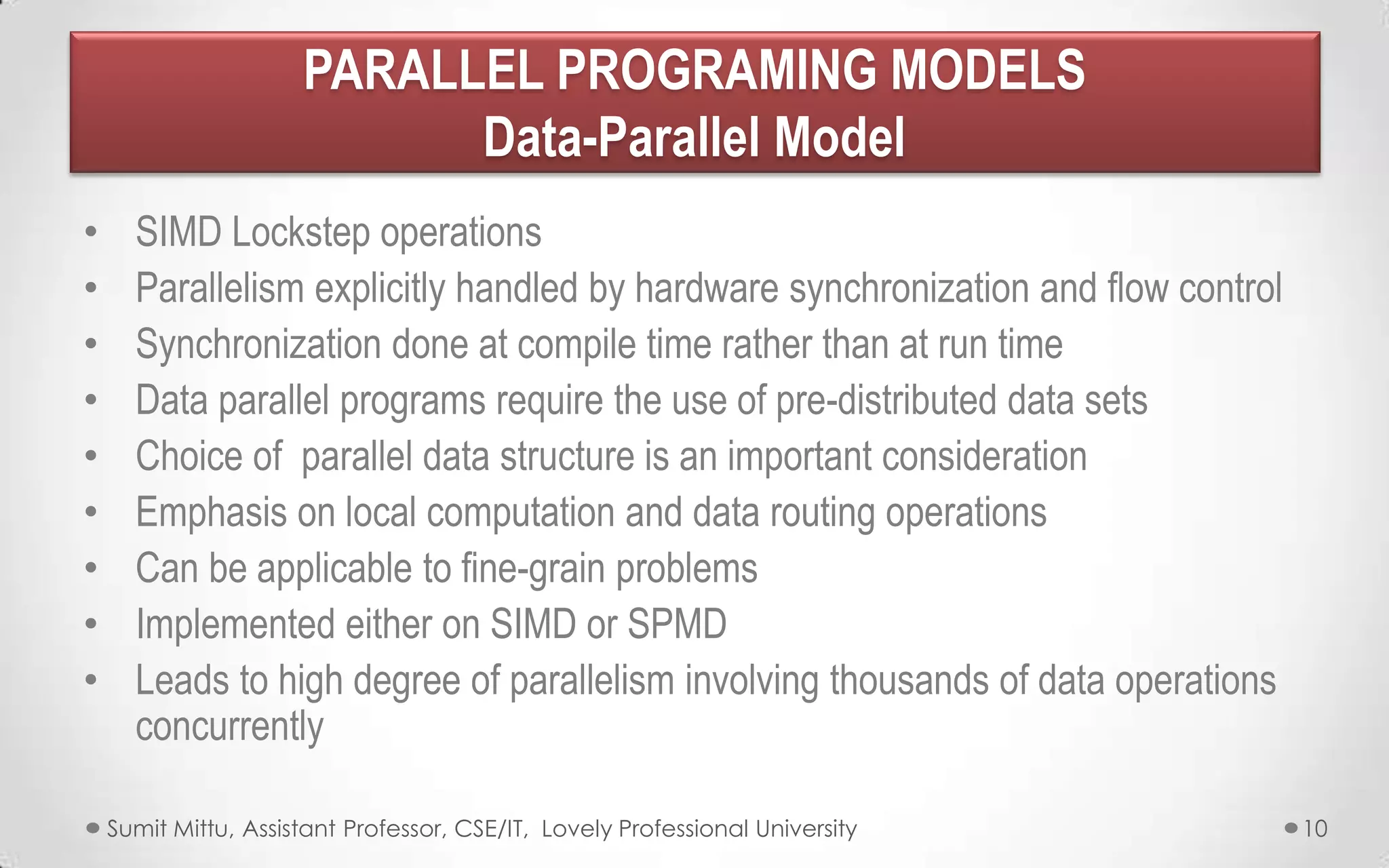
SIMD Lockstep operations
Parallelism explicitly handled by hardware synchronization and flow control
Synchronization done at compile time rather than at run time
Data parallel programs require the use of pre-distributed data sets
Choice of parallel data structure is an important consideration
Emphasis on local computation and data routing operations
Can be applicable to fine-grain problems
Implemented either on SIMD or SPMD
Leads to high degree of parallelism involving thousands of data operations
concurrently
Sumit Mittu, Assistant Professor, CSE/IT, Lovely Professional University

10
PARALLEL PROGRAMING MODELS
Data-Parallel Model
• Data Parallelism
o
o
o
o

Illiac-IV processing model
Connection Machine CM-2 processing model
Synchronous SIMD programming v/s Asynchronous MIMD programming
SIMD Characterization for data parallelism
• Scalar operations and scalar data operands
• Vector operations and vector data operands
• Constant data operands
• Masking operations
• Data-routing operations

Sumit Mittu, Assistant Professor, CSE/IT, Lovely Professional University

11
PARALLEL PROGRAMING MODELS
Data-Parallel Model
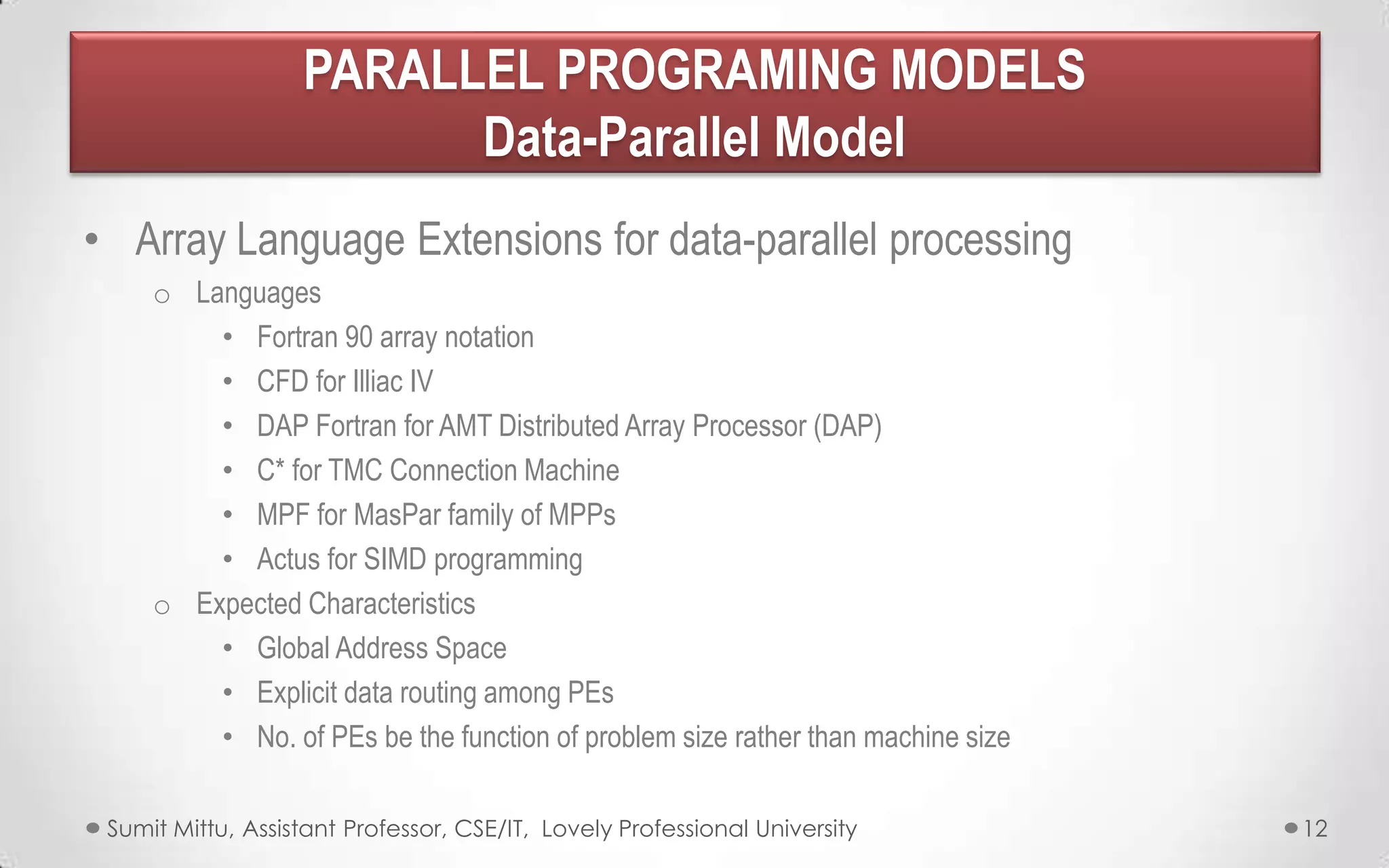
• Array Language Extensions for data-parallel processing
o Languages
• Fortran 90 array notation
• CFD for Illiac IV
• DAP Fortran for AMT Distributed Array Processor (DAP)
• C* for TMC Connection Machine
• MPF for MasPar family of MPPs
• Actus for SIMD programming
o Expected Characteristics
• Global Address Space
• Explicit data routing among PEs
• No. of PEs be the function of problem size rather than machine size
Sumit Mittu, Assistant Professor, CSE/IT, Lovely Professional University

12
PARALLEL PROGRAMING MODELS
Data-Parallel Model
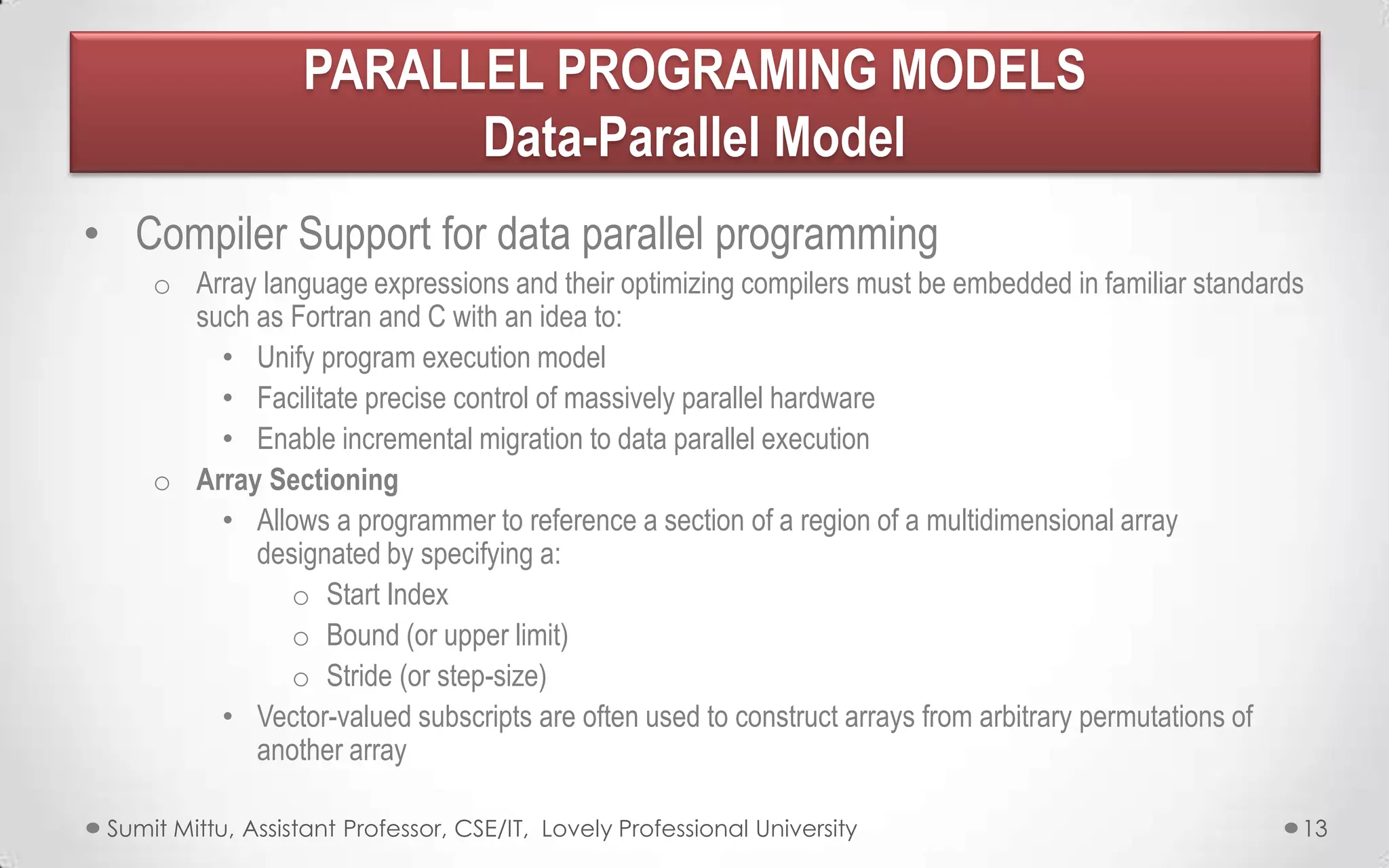
• Compiler Support for data parallel programming
o Array language expressions and their optimizing compilers must be embedded in familiar standards
such as Fortran and C with an idea to:
• Unify program execution model
• Facilitate precise control of massively parallel hardware
• Enable incremental migration to data parallel execution
o Array Sectioning
• Allows a programmer to reference a section of a region of a multidimensional array
designated by specifying a:
o Start Index
o Bound (or upper limit)
o Stride (or step-size)
• Vector-valued subscripts are often used to construct arrays from arbitrary permutations of
another array
Sumit Mittu, Assistant Professor, CSE/IT, Lovely Professional University

13
PARALLEL LANGUAGES AND COMPILERS
Language Features for Parallelism
• Chang and Smith (1990) classified language features for parallel
programming into 6 classes according to functionality:
o
o
o
o
o
o

Optimization features
Availability features
Synchronization/Communication features
Parallelism Control features
Data Parallelism features
Process Management features

• In practice, real languages might have some or no features of these
incorporated in them.
o The features act as guidelines for user-friendly and efficient programming environment
o Compiler support, OS assistance, integration with existing environment is required
Sumit Mittu, Assistant Professor, CSE/IT, Lovely Professional University

14
PARALLEL LANGUAGES AND COMPILERS
Language Features for Parallelism
• Optimization features
o Used for Program restructuring and compilation directives in coverting sequentially coded program
into parallel forms
o Purpose: to match software parallelism with hardware parallelism in target machine
o Automated parallelizer
• Express C, Alliant FX Fortran compiler
o Semi-automated parallelizer
• DINO
o Interactive restructure support
• MIMDizer from Pacific Sierra

Sumit Mittu, Assistant Professor, CSE/IT, Lovely Professional University

15
PARALLEL LANGUAGES AND COMPILERS
Language Features for Parallelism
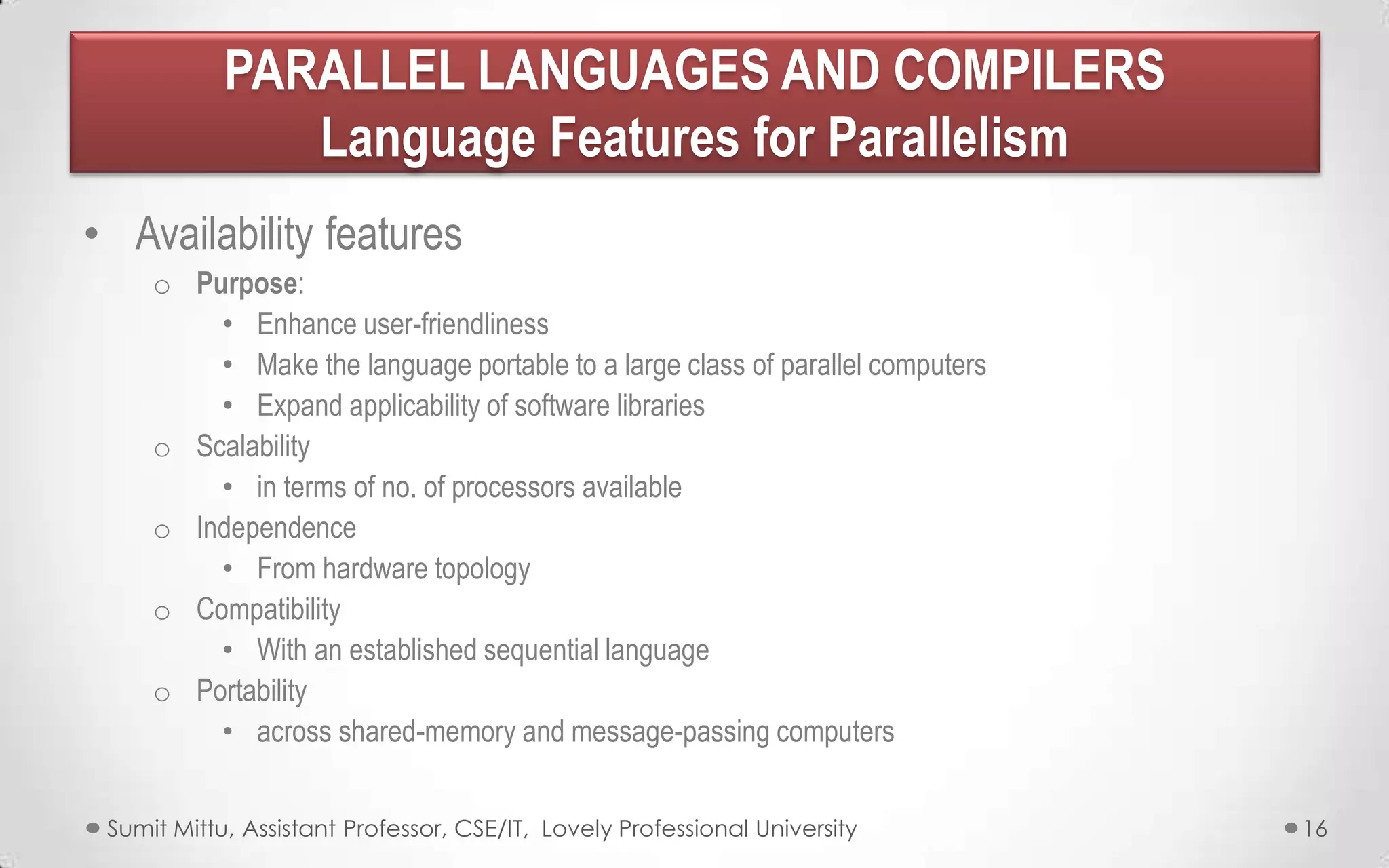
• Availability features
o Purpose:
• Enhance user-friendliness
• Make the language portable to a large class of parallel computers
• Expand applicability of software libraries
o Scalability
• in terms of no. of processors available
o Independence
• From hardware topology
o Compatibility
• With an established sequential language
o Portability
• across shared-memory and message-passing computers
Sumit Mittu, Assistant Professor, CSE/IT, Lovely Professional University

16
PARALLEL LANGUAGES AND COMPILERS
Language Features for Parallelism
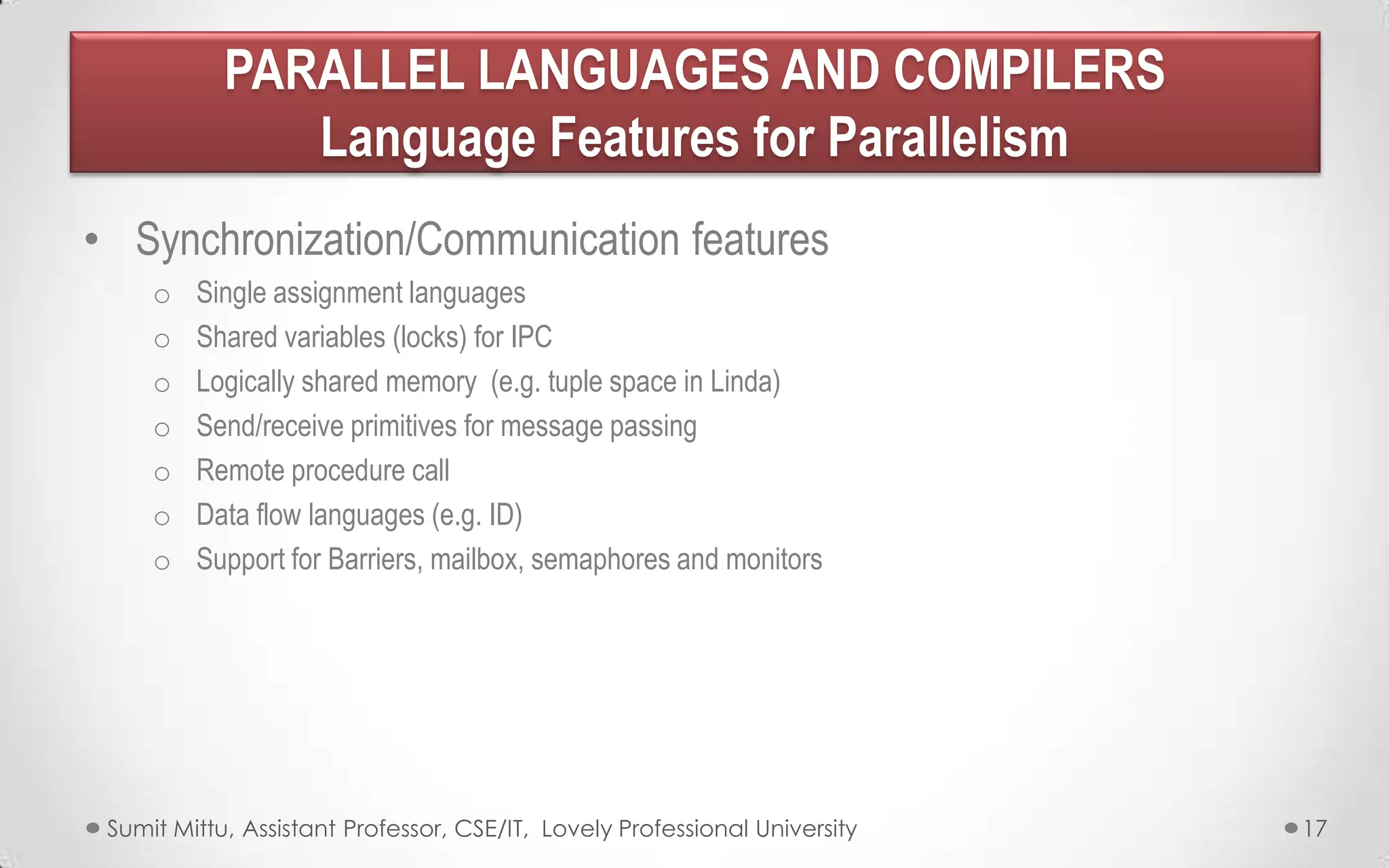
• Synchronization/Communication features
o
o
o
o
o
o
o

Single assignment languages
Shared variables (locks) for IPC
Logically shared memory (e.g. tuple space in Linda)
Send/receive primitives for message passing
Remote procedure call
Data flow languages (e.g. ID)
Support for Barriers, mailbox, semaphores and monitors

Sumit Mittu, Assistant Professor, CSE/IT, Lovely Professional University

17
PARALLEL LANGUAGES AND COMPILERS
Language Features for Parallelism
• Parallelism Control features
o
o
o
o
o
o
o
o
o

Coarse, Medium or Fine grain parallelism
Explicit or Implicit parallelism
Global parallelism
Loop parallelism
Task-split parallelism
Shared task queue
Divide-and-conquer paradigm
Shared abstract data types
Task dependency specification

Sumit Mittu, Assistant Professor, CSE/IT, Lovely Professional University

18
PARALLEL LANGUAGES AND COMPILERS
Language Features for Parallelism
• Data Parallelism features
o Purpose:
• How data are accessed and distributed in SIMD or MIMD computers
o Runtime automatic Decomposition
• Express C
o Mapping Specification
• DINO
o Virtual Processor Support
• PISCES 2 and DINO
o Direct Access to Shared Data
• Linda
o SPMD
• DINO and Hypertasking
Sumit Mittu, Assistant Professor, CSE/IT, Lovely Professional University

19
PARALLEL LANGUAGES AND COMPILERS
Language Features for Parallelism
• Process Management features
o Purpose:
• Efficient creation of parallel processes
• Implement multi-threading or multi-asking
• Program Partitioning and Replication
• Dynamic Load balancing at runtime
o Dynamic Process creation
o LWP (threads)
o Replicated Workers
o Partitioned networks
o Automatic Load Balancing

Sumit Mittu, Assistant Professor, CSE/IT, Lovely Professional University

20
PARALLEL LANGUAGES AND COMPILERS
Parallel Language Constructs
• Fortran 90 Array Notations
o Lower Bound : Upper Bound : Stride
• E1 : E2 : E3
• E1: E2
• E1: * : E3
• E1 : *
• E1
• *

• Parallel Flow Control
o
o
o
o

Doall – Endall or Forall – Endall
Doacross – Endacross or ParDo – ParEnd
Cobegin – Coend or ParBegin – ParEnd
Fork – Join

Sumit Mittu, Assistant Professor, CSE/IT, Lovely Professional University

21
PARALLEL LANGUAGES AND COMPILERS
Optimizing Compilers for Parallelism
• Major Phases of parallelizing compiler
o Phase I : Flow Analysis
• Data Dependence
• Control Dependence
• Reuse Analysis
o Phase II : Program Optimizations
• Vectorization
• Parallelizations
• Locality
• Pipelining
o Phase III : Parallel Code Generation
• Granularity
• Degree of Parallelism
• Code Scheduling
Sumit Mittu, Assistant Professor, CSE/IT, Lovely Professional University

Flow Analyis

Program
Optimizations

Parallel Code
Generation
22
PARALLEL LANGUAGES AND COMPILERS
Optimizing Compilers for Parallelism
• Parallelizing Compilers
o Parafrase [1984]
• David Kuck, University of Illinois
• Vectorization of paralleiszation of Fortran 77 programs
o Parafrase 2
• David Kuck, University of Illinois
• Parallelization of C or Pascal programs
o KAP vectorizer
• Kuck and associatesBased on Parafrase 2
o PFC, PFC+ and Parascope
• Allen and Kennedy (1984)
o Other compilers
• PTRAN, Alliant FX/F, Convex Vectorizing compiler, Cray CFT compiler, VAST vectorizer, etc.
Sumit Mittu, Assistant Professor, CSE/IT, Lovely Professional University

23
PARALLEL PROGRAMMING ENVIRONMENTS
• Constituents of Environment for parallel programming
o
o
o
o

Hardware Platforms or Machine models
Languages Supported
OS and Software Tools
Application Packages

• Software Tools and Environments
o Parallel Languages
o Integrated Environment Components
• Editor
• Debugger
• Performance Monitors
• Program Visualizers

Sumit Mittu, Assistant Professor, CSE/IT, Lovely Professional University

24
PARALLEL PROGRAMMING ENVIRONMENTS
• Fig 11.1

Sumit Mittu, Assistant Professor, CSE/IT, Lovely Professional University

25
PARALLEL PROGRAMMING ENVIRONMENTS
• Types of Integrated Environment
o Basic: Provides simple tools for
• Program tracing facility for debugging and performance monitoring
• Graphic mechanism for specifying dependence graphs
o Limited: Provides tools for
• Parallel Debugging
• Performance monitoring
• Program visualization beyond capability of basic environments
o Well-developed: Provides intensive tools for
• Debugging programs
• Interaction of textual/graphical representations of parallel program
• Visualization support for performance monitoring, program visualization, parallel I/O, etc.
Sumit Mittu, Assistant Professor, CSE/IT, Lovely Professional University

26
PARALLEL PROGRAMMING ENVIRONMENTS
• Environment Features
o Design Issues
• Compatibility
• Expressiveness
• Ease of use
• Efficiency
• Portability
o Parallel languages may developed as extension to existing sequential languages
o A new parallel programming language has the advantage of:
• Using high-level parallel concepts or constructs for parallelism instead of imperative
(algorithmic) languages which are inherently sequential
o Special optimizing compilers detect parallelism and transform sequential constructs into parallel.
Sumit Mittu, Assistant Professor, CSE/IT, Lovely Professional University

27
PARALLEL PROGRAMMING ENVIRONMENTS
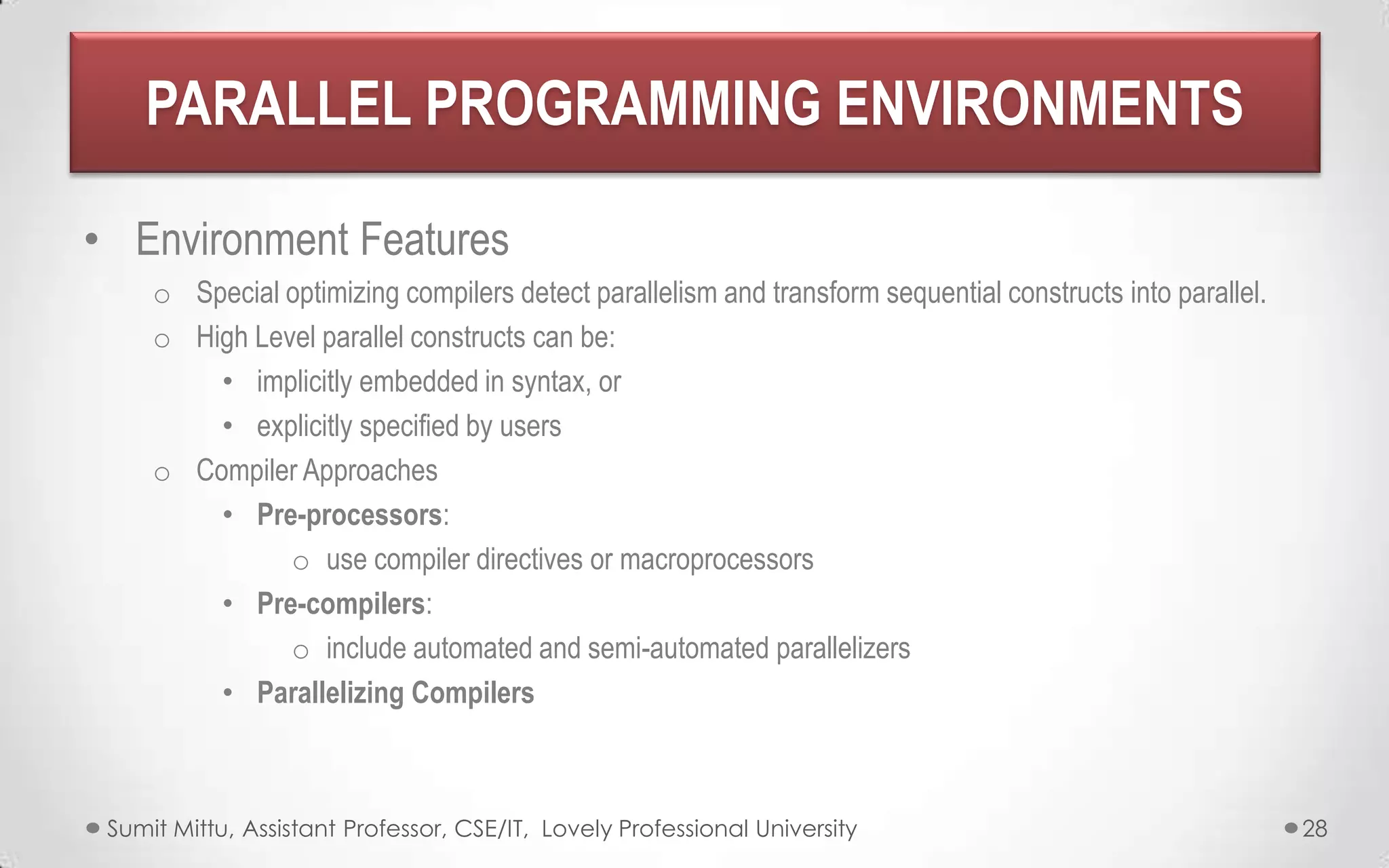
• Environment Features
o Special optimizing compilers detect parallelism and transform sequential constructs into parallel.
o High Level parallel constructs can be:
• implicitly embedded in syntax, or
• explicitly specified by users
o Compiler Approaches
• Pre-processors:
o use compiler directives or macroprocessors
• Pre-compilers:
o include automated and semi-automated parallelizers
• Parallelizing Compilers

Sumit Mittu, Assistant Professor, CSE/IT, Lovely Professional University

28
PARALLEL PROGRAMMING ENVIRONMENTS
• Fig 11.2

Sumit Mittu, Assistant Professor, CSE/IT, Lovely Professional University

29
PARALLEL PROGRAMMING ENVIRONMENTS
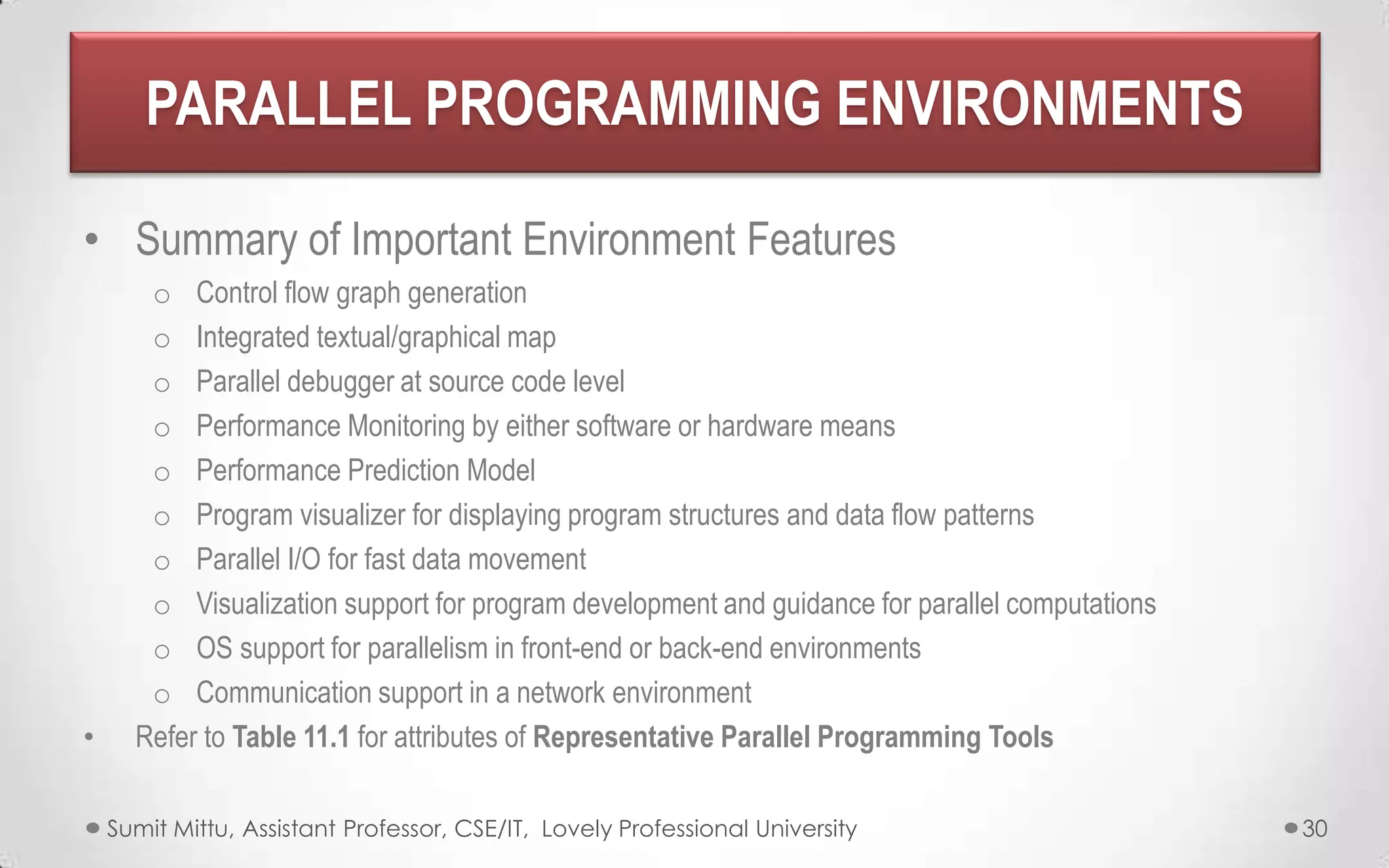
• Summary of Important Environment Features

•

o Control flow graph generation
o Integrated textual/graphical map
o Parallel debugger at source code level
o Performance Monitoring by either software or hardware means
o Performance Prediction Model
o Program visualizer for displaying program structures and data flow patterns
o Parallel I/O for fast data movement
o Visualization support for program development and guidance for parallel computations
o OS support for parallelism in front-end or back-end environments
o Communication support in a network environment
Refer to Table 11.1 for attributes of Representative Parallel Programming Tools
Sumit Mittu, Assistant Professor, CSE/IT, Lovely Professional University

30
PARALLEL PROGRAMMING ENVIRONMENTS
Case Studies
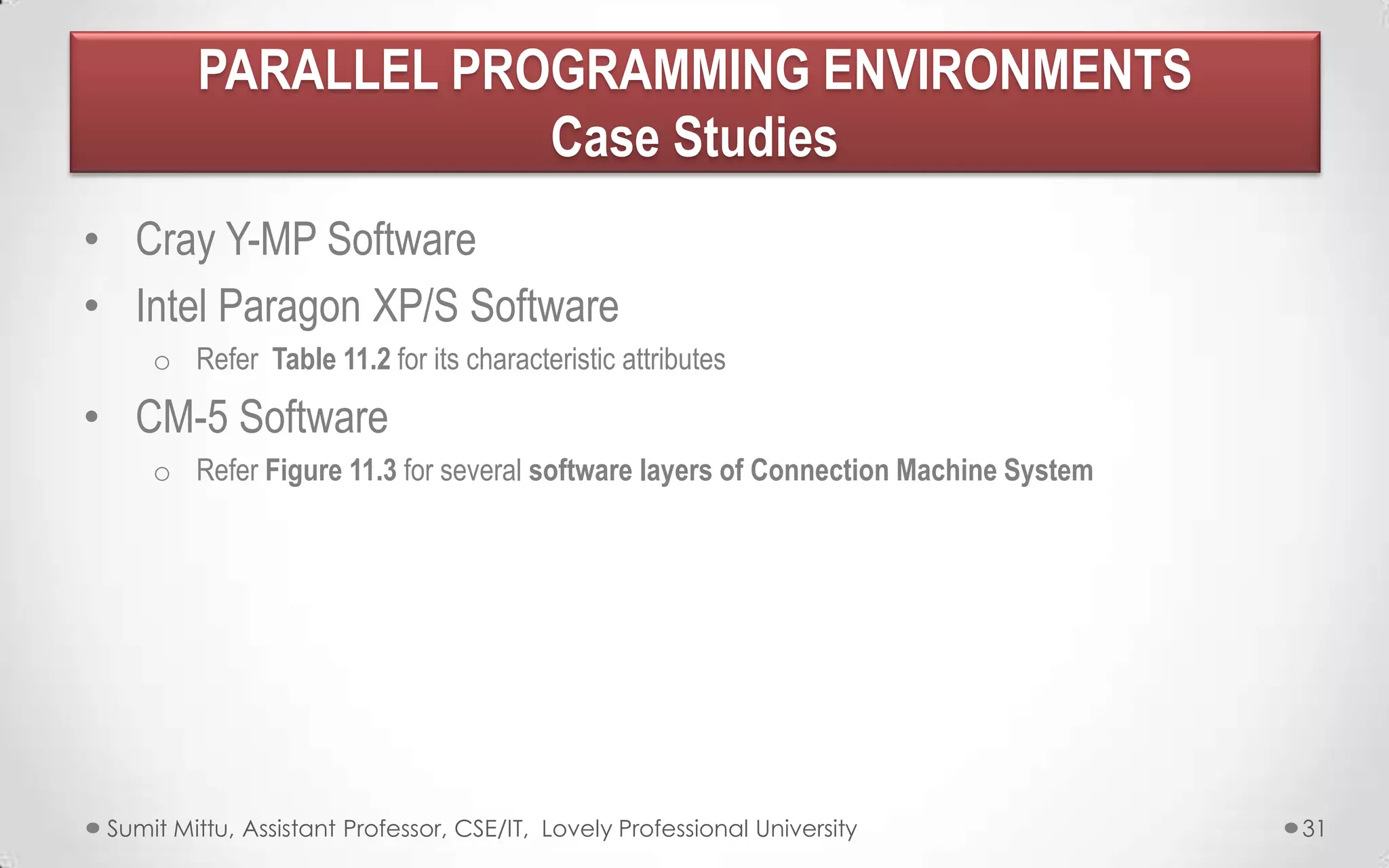
• Cray Y-MP Software
• Intel Paragon XP/S Software
o Refer Table 11.2 for its characteristic attributes

• CM-5 Software
o Refer Figure 11.3 for several software layers of Connection Machine System

Sumit Mittu, Assistant Professor, CSE/IT, Lovely Professional University

31
PARALLEL PROGRAMMING ENVIRONMENTS
Case Studies

Sumit Mittu, Assistant Professor, CSE/IT, Lovely Professional University

32
That’s All Folks!
Attempt your best in exams

Sumit Mittu, Assistant Professor, CSE/IT, Lovely Professional University

33

Aca2 10 11

  • 1.
    CSE539: Advanced ComputerArchitecture PART-IV {Chapter 10, 11} Software for Parallel Programming Book: “Advanced Computer Architecture – Parallelism, Scalability, Programmability”, Hwang & Jotwani Sumit Mittu Assistant Professor, CSE/IT Lovely Professional University sumit.12735@lpu.co.in
  • 2.
    In this chapter… •Chapter 10 o Parallel Programming Models o Parallel Languages and Compilers • Chapter 11 o Parallel Programming Environments Sumit Mittu, Assistant Professor, CSE/IT, Lovely Professional University 2
  • 3.
    PARALLEL PROGRAMING MODELS •Programming Model o A collection of program abstractions providing a simplified and transparent view of the computer hardware/software system to the programmer. • Parallel Programming models o Specifically designed for: • Multiprocessor, Multicomputer and Vector/SIMD Computer o Basic Models • Shared-Variable Model • Message-Passing Model • Data-Parallel Model • Object-Oriented Model* • Functional and Logic Models* Sumit Mittu, Assistant Professor, CSE/IT, Lovely Professional University 3
  • 4.
    PARALLEL PROGRAMING MODELS •Resources in Programming Systems o ACTIVE RESOURCES – processors o PASSIVE RESOURCES – memory and I/O devices • Processes o A processes are the basic computational units in parallel program o A program is a collection of processes o Parallelism depends on implementation of IPC (inter-process communication) • Fundamentals issues around parallel programming o Specification, Creation, Suspension, Reactivation, Migration, Termination and Synchronization of concurrent processes o Process address space may be shared or restricted by limiting scope and access rights Sumit Mittu, Assistant Professor, CSE/IT, Lovely Professional University 4
  • 5.
    PARALLEL PROGRAMING MODELS Shared-VariableModel • Shared Variable Communication o Shared Variable and mutual exclusion o Main Issues: • Protected access of critical sections • Memory Consistency • Atomicity of Memory Operations • Fast synchronization • Shared data structures • Fast data movement techniques o Critical Section (CS) • Code segments accessing shared variable with atomic operation • Requirements – Mutual Exclusion, No Deadlock in waiting, Non-preemption, Eventual Entry Sumit Mittu, Assistant Professor, CSE/IT, Lovely Professional University 5
  • 6.
    PARALLEL PROGRAMING MODELS Shared-VariableModel • Shared Variable Communication o Protected Access using CS • CS boundary o Too large…may limit parallelism o Too small…may add unnecessary code complexity and software overhead o Shorten a heavy-duty CS or use conditional CSs to maintain balanced performance • Binary and Counting Semaphores • Monitors • Operational Modes used in programming multiprocessor systems o Multiprogramming o Level of Multiprocessing Multitasking Sumit Mittu, Assistant Professor, CSE/IT, Lovely Professional University Multithreading 6
  • 7.
    PARALLEL PROGRAMING MODELS Shared-VariableModel • Partitioning and Replication o Program Partitioning o Program Replication o Role of programmer and compiler in partitioning and replication • Scheduling and Synchronization o Static Scheduling o Dynamic Scheduling • Cache Coherence and Protection o Multiprocessor Cache Coherence o Sequential Consistency Model o Strong and Weak Consistency Model Sumit Mittu, Assistant Professor, CSE/IT, Lovely Professional University 7
  • 8.
    PARALLEL PROGRAMING MODELS Message-PassingModel • Message may be: o Instructions, Data, Synchronization Signals or Interrupt Signals • Communication Delays caused by message passing is more than that caused by accessing shared variables • Message passing Models o Synchronous Message Passing o Asynchronous Message Passing • Critical issue in programing this model o How to distribute or duplicate program codes and data sets over processing modes? • Distributing the computations! o Trade-offs between computation time and communication overhead to be considered Sumit Mittu, Assistant Professor, CSE/IT, Lovely Professional University 8
  • 9.
    PARALLEL PROGRAMING MODELS Message-PassingModel • Synchronous Message Passing o o o o o Sender and receiver processes synchronized in time and space No need of mutual exclusion No buffers required Blocking communication scheme Uniform Communication Delays, in general • Asynchronous Message Passing o o o o Sender and receiver processes do not require to be synchronized in time and space Often uses buffers in channels Non-blocking communication scheme Non-uniform or arbitrary communication delays Sumit Mittu, Assistant Professor, CSE/IT, Lovely Professional University 9
  • 10.
    PARALLEL PROGRAMING MODELS Data-ParallelModel • • • • • • • • • SIMD Lockstep operations Parallelism explicitly handled by hardware synchronization and flow control Synchronization done at compile time rather than at run time Data parallel programs require the use of pre-distributed data sets Choice of parallel data structure is an important consideration Emphasis on local computation and data routing operations Can be applicable to fine-grain problems Implemented either on SIMD or SPMD Leads to high degree of parallelism involving thousands of data operations concurrently Sumit Mittu, Assistant Professor, CSE/IT, Lovely Professional University 10
  • 11.
    PARALLEL PROGRAMING MODELS Data-ParallelModel • Data Parallelism o o o o Illiac-IV processing model Connection Machine CM-2 processing model Synchronous SIMD programming v/s Asynchronous MIMD programming SIMD Characterization for data parallelism • Scalar operations and scalar data operands • Vector operations and vector data operands • Constant data operands • Masking operations • Data-routing operations Sumit Mittu, Assistant Professor, CSE/IT, Lovely Professional University 11
  • 12.
    PARALLEL PROGRAMING MODELS Data-ParallelModel • Array Language Extensions for data-parallel processing o Languages • Fortran 90 array notation • CFD for Illiac IV • DAP Fortran for AMT Distributed Array Processor (DAP) • C* for TMC Connection Machine • MPF for MasPar family of MPPs • Actus for SIMD programming o Expected Characteristics • Global Address Space • Explicit data routing among PEs • No. of PEs be the function of problem size rather than machine size Sumit Mittu, Assistant Professor, CSE/IT, Lovely Professional University 12
  • 13.
    PARALLEL PROGRAMING MODELS Data-ParallelModel • Compiler Support for data parallel programming o Array language expressions and their optimizing compilers must be embedded in familiar standards such as Fortran and C with an idea to: • Unify program execution model • Facilitate precise control of massively parallel hardware • Enable incremental migration to data parallel execution o Array Sectioning • Allows a programmer to reference a section of a region of a multidimensional array designated by specifying a: o Start Index o Bound (or upper limit) o Stride (or step-size) • Vector-valued subscripts are often used to construct arrays from arbitrary permutations of another array Sumit Mittu, Assistant Professor, CSE/IT, Lovely Professional University 13
  • 14.
    PARALLEL LANGUAGES ANDCOMPILERS Language Features for Parallelism • Chang and Smith (1990) classified language features for parallel programming into 6 classes according to functionality: o o o o o o Optimization features Availability features Synchronization/Communication features Parallelism Control features Data Parallelism features Process Management features • In practice, real languages might have some or no features of these incorporated in them. o The features act as guidelines for user-friendly and efficient programming environment o Compiler support, OS assistance, integration with existing environment is required Sumit Mittu, Assistant Professor, CSE/IT, Lovely Professional University 14
  • 15.
    PARALLEL LANGUAGES ANDCOMPILERS Language Features for Parallelism • Optimization features o Used for Program restructuring and compilation directives in coverting sequentially coded program into parallel forms o Purpose: to match software parallelism with hardware parallelism in target machine o Automated parallelizer • Express C, Alliant FX Fortran compiler o Semi-automated parallelizer • DINO o Interactive restructure support • MIMDizer from Pacific Sierra Sumit Mittu, Assistant Professor, CSE/IT, Lovely Professional University 15
  • 16.
    PARALLEL LANGUAGES ANDCOMPILERS Language Features for Parallelism • Availability features o Purpose: • Enhance user-friendliness • Make the language portable to a large class of parallel computers • Expand applicability of software libraries o Scalability • in terms of no. of processors available o Independence • From hardware topology o Compatibility • With an established sequential language o Portability • across shared-memory and message-passing computers Sumit Mittu, Assistant Professor, CSE/IT, Lovely Professional University 16
  • 17.
    PARALLEL LANGUAGES ANDCOMPILERS Language Features for Parallelism • Synchronization/Communication features o o o o o o o Single assignment languages Shared variables (locks) for IPC Logically shared memory (e.g. tuple space in Linda) Send/receive primitives for message passing Remote procedure call Data flow languages (e.g. ID) Support for Barriers, mailbox, semaphores and monitors Sumit Mittu, Assistant Professor, CSE/IT, Lovely Professional University 17
  • 18.
    PARALLEL LANGUAGES ANDCOMPILERS Language Features for Parallelism • Parallelism Control features o o o o o o o o o Coarse, Medium or Fine grain parallelism Explicit or Implicit parallelism Global parallelism Loop parallelism Task-split parallelism Shared task queue Divide-and-conquer paradigm Shared abstract data types Task dependency specification Sumit Mittu, Assistant Professor, CSE/IT, Lovely Professional University 18
  • 19.
    PARALLEL LANGUAGES ANDCOMPILERS Language Features for Parallelism • Data Parallelism features o Purpose: • How data are accessed and distributed in SIMD or MIMD computers o Runtime automatic Decomposition • Express C o Mapping Specification • DINO o Virtual Processor Support • PISCES 2 and DINO o Direct Access to Shared Data • Linda o SPMD • DINO and Hypertasking Sumit Mittu, Assistant Professor, CSE/IT, Lovely Professional University 19
  • 20.
    PARALLEL LANGUAGES ANDCOMPILERS Language Features for Parallelism • Process Management features o Purpose: • Efficient creation of parallel processes • Implement multi-threading or multi-asking • Program Partitioning and Replication • Dynamic Load balancing at runtime o Dynamic Process creation o LWP (threads) o Replicated Workers o Partitioned networks o Automatic Load Balancing Sumit Mittu, Assistant Professor, CSE/IT, Lovely Professional University 20
  • 21.
    PARALLEL LANGUAGES ANDCOMPILERS Parallel Language Constructs • Fortran 90 Array Notations o Lower Bound : Upper Bound : Stride • E1 : E2 : E3 • E1: E2 • E1: * : E3 • E1 : * • E1 • * • Parallel Flow Control o o o o Doall – Endall or Forall – Endall Doacross – Endacross or ParDo – ParEnd Cobegin – Coend or ParBegin – ParEnd Fork – Join Sumit Mittu, Assistant Professor, CSE/IT, Lovely Professional University 21
  • 22.
    PARALLEL LANGUAGES ANDCOMPILERS Optimizing Compilers for Parallelism • Major Phases of parallelizing compiler o Phase I : Flow Analysis • Data Dependence • Control Dependence • Reuse Analysis o Phase II : Program Optimizations • Vectorization • Parallelizations • Locality • Pipelining o Phase III : Parallel Code Generation • Granularity • Degree of Parallelism • Code Scheduling Sumit Mittu, Assistant Professor, CSE/IT, Lovely Professional University Flow Analyis Program Optimizations Parallel Code Generation 22
  • 23.
    PARALLEL LANGUAGES ANDCOMPILERS Optimizing Compilers for Parallelism • Parallelizing Compilers o Parafrase [1984] • David Kuck, University of Illinois • Vectorization of paralleiszation of Fortran 77 programs o Parafrase 2 • David Kuck, University of Illinois • Parallelization of C or Pascal programs o KAP vectorizer • Kuck and associatesBased on Parafrase 2 o PFC, PFC+ and Parascope • Allen and Kennedy (1984) o Other compilers • PTRAN, Alliant FX/F, Convex Vectorizing compiler, Cray CFT compiler, VAST vectorizer, etc. Sumit Mittu, Assistant Professor, CSE/IT, Lovely Professional University 23
  • 24.
    PARALLEL PROGRAMMING ENVIRONMENTS •Constituents of Environment for parallel programming o o o o Hardware Platforms or Machine models Languages Supported OS and Software Tools Application Packages • Software Tools and Environments o Parallel Languages o Integrated Environment Components • Editor • Debugger • Performance Monitors • Program Visualizers Sumit Mittu, Assistant Professor, CSE/IT, Lovely Professional University 24
  • 25.
    PARALLEL PROGRAMMING ENVIRONMENTS •Fig 11.1 Sumit Mittu, Assistant Professor, CSE/IT, Lovely Professional University 25
  • 26.
    PARALLEL PROGRAMMING ENVIRONMENTS •Types of Integrated Environment o Basic: Provides simple tools for • Program tracing facility for debugging and performance monitoring • Graphic mechanism for specifying dependence graphs o Limited: Provides tools for • Parallel Debugging • Performance monitoring • Program visualization beyond capability of basic environments o Well-developed: Provides intensive tools for • Debugging programs • Interaction of textual/graphical representations of parallel program • Visualization support for performance monitoring, program visualization, parallel I/O, etc. Sumit Mittu, Assistant Professor, CSE/IT, Lovely Professional University 26
  • 27.
    PARALLEL PROGRAMMING ENVIRONMENTS •Environment Features o Design Issues • Compatibility • Expressiveness • Ease of use • Efficiency • Portability o Parallel languages may developed as extension to existing sequential languages o A new parallel programming language has the advantage of: • Using high-level parallel concepts or constructs for parallelism instead of imperative (algorithmic) languages which are inherently sequential o Special optimizing compilers detect parallelism and transform sequential constructs into parallel. Sumit Mittu, Assistant Professor, CSE/IT, Lovely Professional University 27
  • 28.
    PARALLEL PROGRAMMING ENVIRONMENTS •Environment Features o Special optimizing compilers detect parallelism and transform sequential constructs into parallel. o High Level parallel constructs can be: • implicitly embedded in syntax, or • explicitly specified by users o Compiler Approaches • Pre-processors: o use compiler directives or macroprocessors • Pre-compilers: o include automated and semi-automated parallelizers • Parallelizing Compilers Sumit Mittu, Assistant Professor, CSE/IT, Lovely Professional University 28
  • 29.
    PARALLEL PROGRAMMING ENVIRONMENTS •Fig 11.2 Sumit Mittu, Assistant Professor, CSE/IT, Lovely Professional University 29
  • 30.
    PARALLEL PROGRAMMING ENVIRONMENTS •Summary of Important Environment Features • o Control flow graph generation o Integrated textual/graphical map o Parallel debugger at source code level o Performance Monitoring by either software or hardware means o Performance Prediction Model o Program visualizer for displaying program structures and data flow patterns o Parallel I/O for fast data movement o Visualization support for program development and guidance for parallel computations o OS support for parallelism in front-end or back-end environments o Communication support in a network environment Refer to Table 11.1 for attributes of Representative Parallel Programming Tools Sumit Mittu, Assistant Professor, CSE/IT, Lovely Professional University 30
  • 31.
    PARALLEL PROGRAMMING ENVIRONMENTS CaseStudies • Cray Y-MP Software • Intel Paragon XP/S Software o Refer Table 11.2 for its characteristic attributes • CM-5 Software o Refer Figure 11.3 for several software layers of Connection Machine System Sumit Mittu, Assistant Professor, CSE/IT, Lovely Professional University 31
  • 32.
    PARALLEL PROGRAMMING ENVIRONMENTS CaseStudies Sumit Mittu, Assistant Professor, CSE/IT, Lovely Professional University 32
  • 33.
    That’s All Folks! Attemptyour best in exams Sumit Mittu, Assistant Professor, CSE/IT, Lovely Professional University 33