This document defines and describes different types of employee separation. There are two main categories of separation - voluntary and involuntary. Voluntary separation includes resignations and retirements. Involuntary separation includes dismissal for reasons like absenteeism or misconduct, as well as temporary layoffs due to lack of work or materials. Layoffs require compensation and recall of senior employees first. Retrenchment is termination due to replacement of labor by machines or department closure. Downsizing reduces workforce size during losses or restructuring. Exit interviews and succession planning can help minimize turnover.
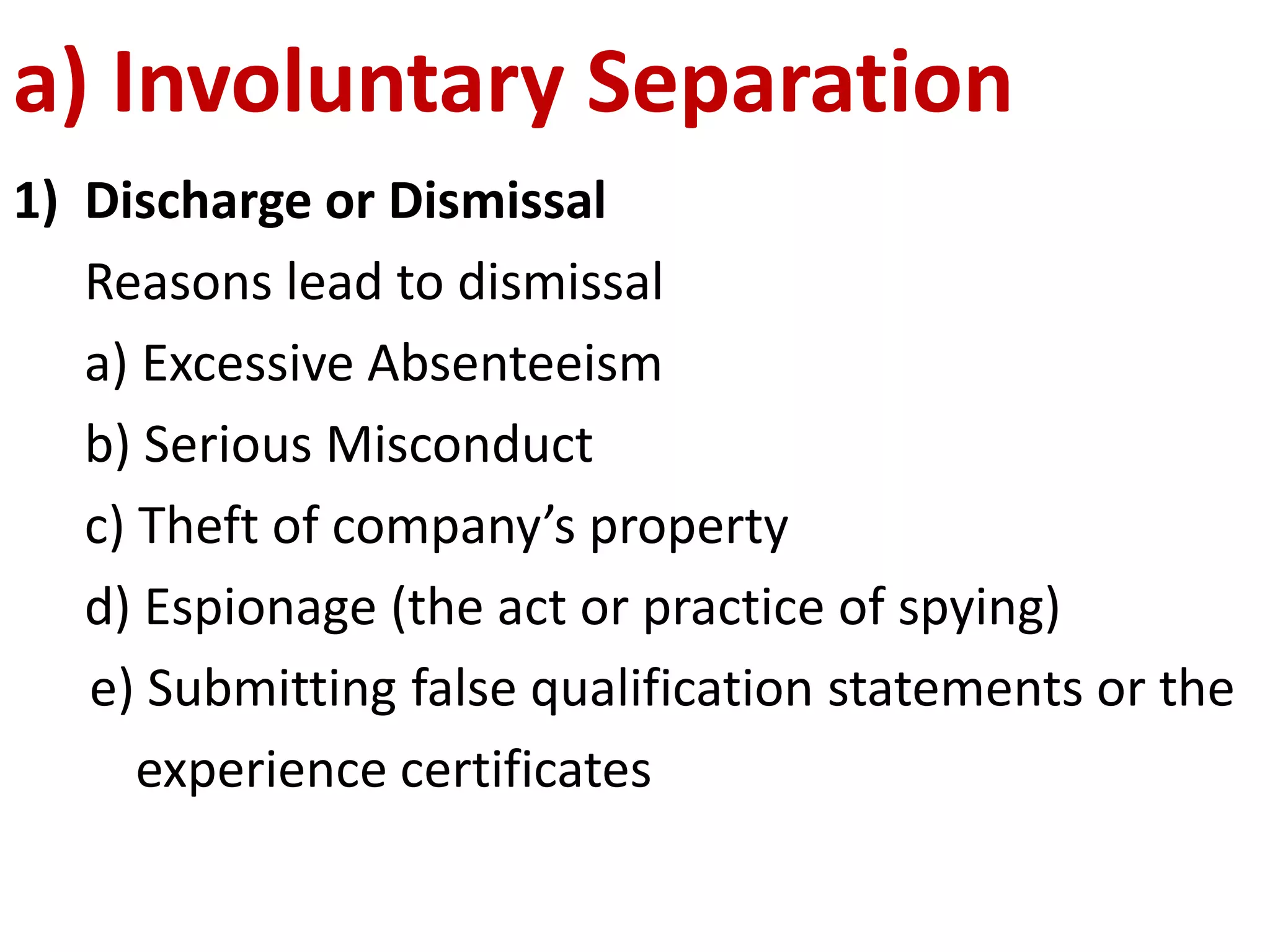
a) Involuntary Separation
1) Discharge or Dismissal
Reasons lead to dismissal
a) Excessive Absenteeism
b) Serious Misconduct
c) Theft of company’s property
d) Espionage (the act or practice of spying)
e) Submitting false qualification statements or the
experience certificates
6.
a) Involuntary Separation
2) Layoff:
A layoff is a temporary separation of the
employee at the request of the employer.
Layoff is the failure, refusal or inability of an
employer to provide employment to an employee
whose name is present on the rolls of the
company but who has not been retrenched.
7.
a) Involuntary Separation
2) Layoff:
Layoff may be for a definite period
After this definite period ends, the employee will
be recalled by the employer for duty.
Layoffs could be due to shortage of raw materials,
economic recession, accumulation of stocks, or
for any other reason
8.
a) Involuntary Separation
2) Layoff:
Industrial disputes Act,1947 makes it mandatory
on the part of the employer to pay compensation
for all the days that an employee has been laid
off.
Compensation must be half of the normal wages
the employee would have earned, if he was
working.
9.
a) Involuntary Separation
2) Layoff:
At the time of recall: Employees with the longest
period of service are recalled first and then the
employees with the shortest period are recalled.
The management may seek to recall those
employees whose skills are essential for the
resumption of production or services.
10.
a) Involuntary Separation
3) Retrenchment:
It refers to the termination of the services of
employees because of the replacement of labour
by machines or the closure of a department due
to lack of demand for the products manufactured.
It is different from Layoff. In the retrenchment,
the employee stops being in the employment of
the organization.
11.
a) Involuntary Separation
3) Retrenchment:
It is different from dismissal. Retrenchment is
forced on both the employer and the employee is
dismissed because of the fault of the employee.
In Retrenchment service of several employees is
terminated, and in dismissal the services of only
few employees is terminated
12.
a) Involuntary Separation
4) Voluntary Retirement Scheme (VRS):
This is another type of separation where surplus
labour is reduced by paying them handsome
compensations.
Management prefer to pay hefty sums and reduce
staff strength than retaining surplus labour and
continuing them to pay compensation.
VRS is perceived as a painless and time saving
method of trimming staff strength, as the
organization offers the compensation only to
those employee who opt for VRS.
13.
a) Involuntary Separation
5) Downsizing:
Means reducing the size of workforce.
If organization face any of the following situations
a) When the organization is constantly incurring
losses over a period of years.
b) When the organization goes in for
restructuring.
How to ManageSeparation Effectively?
• Employee separation needs to be handled with
sensitivity, discretion and speed so that exits can
happen smoothly and on good terms.
• After all, former employees are the most effective
brand ambassadors for the company’s employer
brand equity.
16.
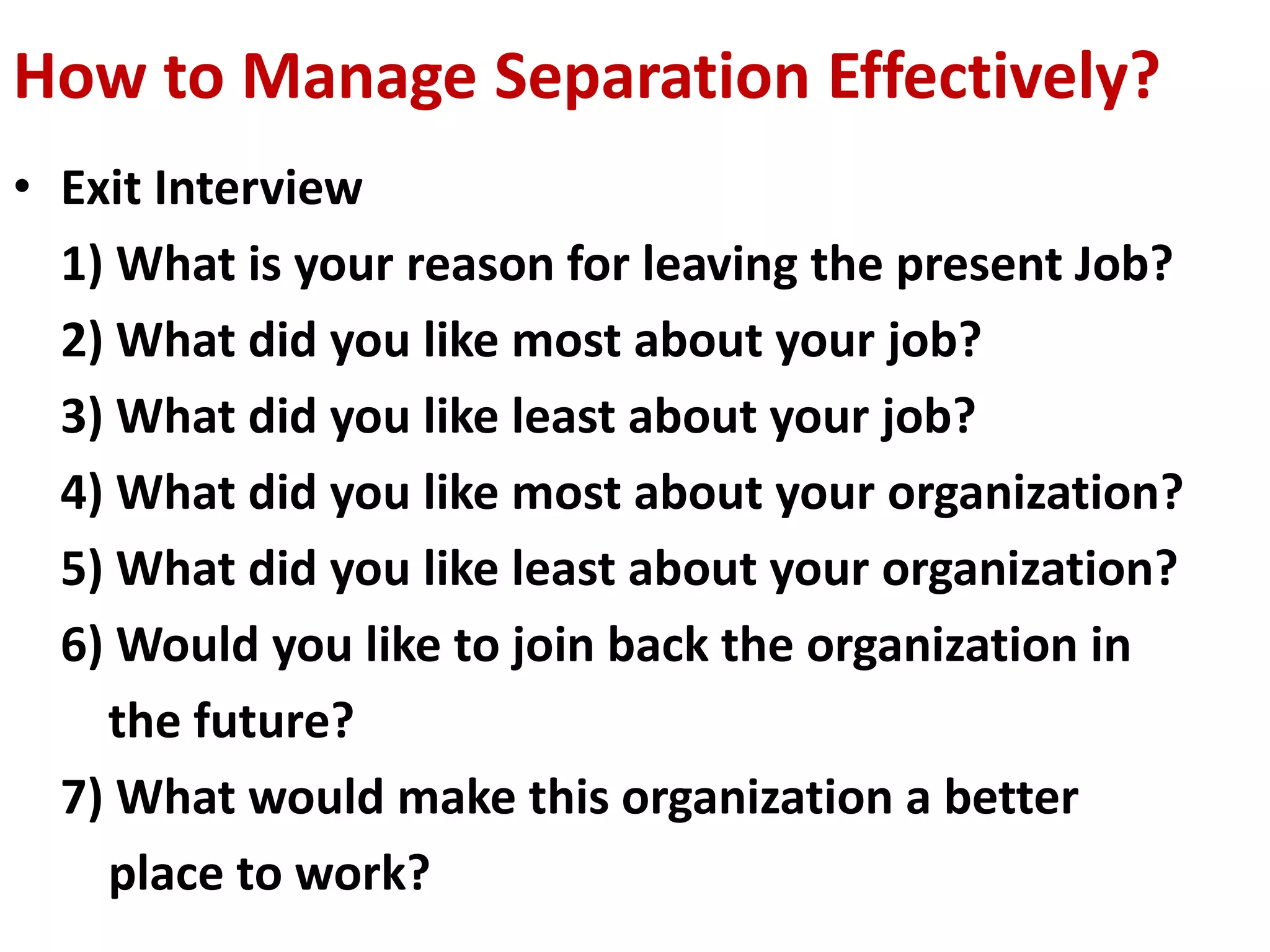
How to ManageSeparation Effectively?
• Exit Interview
1) What is your reason for leaving the present Job?
2) What did you like most about your job?
3) What did you like least about your job?
4) What did you like most about your organization?
5) What did you like least about your organization?
6) Would you like to join back the organization in
the future?
7) What would make this organization a better
place to work?
How to Minimizeturnover?
• 1) Succession Planning: Includes training
programmes and series of job assignments leading
to top positions.
• Succession planning is also an important way to
identify, develop, retain and allocate key members
of your workforce long before any talent gap
occurs.
19.
How to Minimizeturnover?
• 2) Career Development:
• Organization devise and implement several
initiatives in order to develop their employees’s
careers.
• Most significant of them are career planning,
workshops, career, counseling, mentoring,
personal development plans and career
workbooks.
20.
How to Minimizeturnover?
• 2) Career Development:
• Implementation of these plans helps companies
earn credibility amongst employees and
commitment towards building ‘intellectual capital’
which is the strength of any organization.
• The impact of career development/succession
planning programmes can be seen through the
productivity indicator, engagement surveys and
reduction in attrition rate.