Presented By: MBA 2D
Abhishek Shandilya
14MBA 1358
Nancy Sindhwani 14MBA
1366
Vikas Chandel 14MBA
Presented
To:
Dr. Rupali
CONTENTS
1. Introduction
2. Purpose of HR audit
3. Objective of HR audit
4. Benefits of HR audit
5. Frequency of HR audit(Period)
6. Significance of HR audit
7. Scope of HR audit
8. Methods of auditing
9. Tasks of Auditor
10. HRM Auditing Process
11. Audit Report
INTRODUCTION
An HR audit is a process to review
implementation of institutions’ policies and
procedures, ensuring compliance with
employment laws, implement best practices and
educate managers.
•The purpose of the audit is to reveal the
strengths and weaknesses in the organization's
human resources system and issues needing
resolution.
•The audit works best when the focus is on
analyzing and improving the HR function in
the organization
PURPOSE OF HR AUDIT
OBJECTIVES OF HR AUDIT
1. Effectiveness: To review performance of HR Department and its activities to
determine effectiveness.
2. Implementation: To locate gaps & failings in applying Polices, Procedures & Practices.
3. Rectification: To take corrective steps to rectify shortcomings .
4. Evaluation: To evaluate HR Staff & employees.
5. Modify: To review & Modify HR System to meet challenges in comparison with other
organizations.
6. Questioning: To seek answers to “What, Why & When” while implementing Policies,
Practices in managing HRs
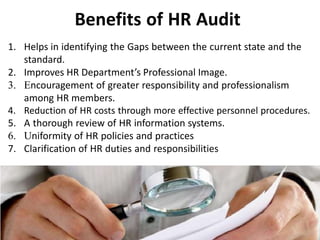
Benefits of HR Audit
1. Helps in identifying the Gaps between the current state and the
standard.
2. Improves HR Department’s Professional Image.
3. Encouragement of greater responsibility and professionalism
among HR members.
4. Reduction of HR costs through more effective personnel procedures.
5. A thorough review of HR information systems.
6. Uniformity of HR policies and practices
7. Clarification of HR duties and responsibilities
Frequency of HR audit
 It is best to have a HR audit once in a year. The HR audit, if
conducted continuously and regularly, then it becomes a fairly
managed process.
 Usually, the frequency of the audit being conducted depends on
the company.
 Management must see to it that a well efficient audit is done on
yearly basis.
1. Essential for Organization success.
2. It Provides Required Feedback.
3. Managing Rising Labor Costs.
4. HR Audit can avoid Government
intervention
5. HRP protect Employees interests
HR Audit Significance:
The Scope of Human
Resource Audits
• Audit of Corporate Strategy
The organization is going to gain competitive advantage.
• Audit of the Human Resource Function
Human Resource Information System, Staffing and Development.
• Audit of Managerial Compliance
Human resource policies and procedures.
• Audit of Employee Satisfaction
To learn how well employee needs are met.
Audit of the Human Resource Function
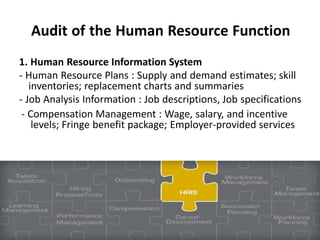
1. Human Resource Information System
- Human Resource Plans : Supply and demand estimates; skill
inventories; replacement charts and summaries
- Job Analysis Information : Job descriptions, Job specifications
- Compensation Management : Wage, salary, and incentive
levels; Fringe benefit package; Employer-provided services
2. Staffing and Development
• Recruiting : sources, availability,
employment applications
• Selection : selection ratios, selection
procedures, equal opportunity.
• Training and development :
orientation program, training
objectives and procedures, learning
rates
• Career development : internal
placement, career planning program,
human resource development efforts
Audit of Managerial Compliance
• Compliance with laws is especially important.
When safety, compensation, or labor laws are
violated, the government holds the company
responsible.
• If managers ignore policies or violate
employee relationslaws, the audit should
uncover these errors so that corrective action
can be started.
Audit of Employee Satisfaction
• It refers to an employee’s general
attitude toward his or her job.
• When employee needs are unmet,
turnover, absenteeism, and union
activity are more likely. To learn
how well employee needs are met.
• The teamcollects information about
wages, benefits, supervisory
practices, career planning assistance,
and other dimensions of job.
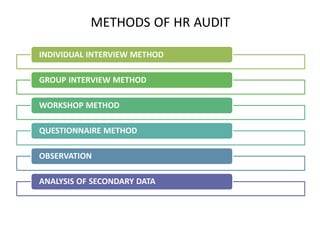
INDIVIDUAL INTERVIEW METHOD
GROUP INTERVIEW METHOD
WORKSHOP METHOD
QUESTIONNAIRE METHOD
OBSERVATION
ANALYSIS OF SECONDARY DATA
ANALYSIS OF REPORTS, RECORDS.
METHODS OF HR AUDIT
• Top level management and
senior managers are
interviewed, individually. It helps
in following:
•
 Knowing their thinking about
future plans and opportunities
available for the company
 Knowing about their
expectations from the HR audit
 Getting sensitive information
pertaining to working styles and
culture
INDIVIDUAL INTERVIEW METHOD
Group interviews and discussions with the
employees and executives of large companies for HR
audit, facilitate collection of information about
effectiveness of existing systems.
GROUP INTERVIEW METHOD
Workshop Methods also known as Large Scale Interactive Process (LSIP) is
conducted in some cases of audit.
WORKSHOP METHOD
• Feed back about various dimensions of HRD, including
the competency base of HRD staff, the styles of line
managers, the implementation of various HRD
systems, etc are obtained through a detailed
questionnaire from individuals or groups for HR audit.
• This method helps in benchmarking.
QUESTIONNAIRE
METHOD
• The auditors should physically visit
the workplace
• To assess the extent to which a
congenial and supportive human
welfare oriented climate exists in
the company.
• This is essential because
employees are not likely to give
their best if they do not live in
good surroundings
• The observations can be
conducted using a check list of
questions.
OBSERVATION
 Analysis of secondary data can give an insight into the HRD
assets and liabilities of the company.
 Analysis of age profiles of the employees, analysis of the
training attended, analysis of the minutes of the meetings held
etc., help in determining the assets and liabilities.
ANALYSIS OF SECONDARY DATA
Tasks of Auditors
• Determine the objectives
of each activity
• Identify who is responsible
for each activity.
• Review the policies and
procedures used to achieve
these activities.
• Prepare a report commending
proper objectives, policies, and
procedures.
• Develop an action plan to
correct errors in each activity.
• Follow up the action plan to
see if it solved the problems
found through the audit.
HRM AUDITING PROCESS
• PHASE 1: FOUNDATIONAL/INITIATION
• PHASE 2: ASSESSMENT
• PHASE 3: CONCLUDING AND REPORTING
PHASE 1: FOUNDATIONAL/INITIATION
•Determine the purpose and objectives of the audit
•Determine the scope of the audit
•Determine the organizational components to be audited
•Determine the auditing tool to be used
•Determine costs and resources needed to perform the audit
•Determine audit team governance
PHASE 2: ASSESSMENT
• DETERMINE EMPLOYMENT ISSUES
• ACCOUNTABILITY
• FORMULATING AUDITING METHODOLOGY AND
TOOLS
• DEVELOPING A CHECKLIST
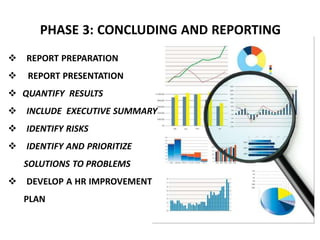
PHASE 3: CONCLUDING AND REPORTING
 REPORT PREPARATION
 REPORT PRESENTATION
 QUANTIFY RESULTS
 INCLUDE EXECUTIVE SUMMARY
 IDENTIFY RISKS
 IDENTIFY AND PRIORITIZE
SOLUTIONS TO PROBLEMS
 DEVELOP A HR IMPROVEMENT
PLAN
The Process comes to end with preparation of Report. Report may
be Clean or Qualified. It is Qualified if HR Performance contains
Gaps for which remedies suggested. Report is Clean where
Performance is fairly Satisfactory
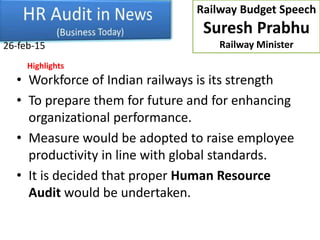
• Workforce of Indian railways is its strength
• To prepare them for future and for enhancing
organizational performance.
• Measure would be adopted to raise employee
productivity in line with global standards.
• It is decided that proper Human Resource
Audit would be undertaken.
26-feb-15
Railway Budget Speech
Suresh Prabhu
Railway Minister
Highlights
HR Audit

HR Audit

  • 1.
    Presented By: MBA2D Abhishek Shandilya 14MBA 1358 Nancy Sindhwani 14MBA 1366 Vikas Chandel 14MBA Presented To: Dr. Rupali
  • 2.
    CONTENTS 1. Introduction 2. Purposeof HR audit 3. Objective of HR audit 4. Benefits of HR audit 5. Frequency of HR audit(Period) 6. Significance of HR audit 7. Scope of HR audit 8. Methods of auditing 9. Tasks of Auditor 10. HRM Auditing Process 11. Audit Report
  • 3.
    INTRODUCTION An HR auditis a process to review implementation of institutions’ policies and procedures, ensuring compliance with employment laws, implement best practices and educate managers.
  • 4.
    •The purpose ofthe audit is to reveal the strengths and weaknesses in the organization's human resources system and issues needing resolution. •The audit works best when the focus is on analyzing and improving the HR function in the organization PURPOSE OF HR AUDIT
  • 5.
    OBJECTIVES OF HRAUDIT 1. Effectiveness: To review performance of HR Department and its activities to determine effectiveness. 2. Implementation: To locate gaps & failings in applying Polices, Procedures & Practices. 3. Rectification: To take corrective steps to rectify shortcomings . 4. Evaluation: To evaluate HR Staff & employees. 5. Modify: To review & Modify HR System to meet challenges in comparison with other organizations. 6. Questioning: To seek answers to “What, Why & When” while implementing Policies, Practices in managing HRs
  • 6.
    Benefits of HRAudit 1. Helps in identifying the Gaps between the current state and the standard. 2. Improves HR Department’s Professional Image. 3. Encouragement of greater responsibility and professionalism among HR members. 4. Reduction of HR costs through more effective personnel procedures. 5. A thorough review of HR information systems. 6. Uniformity of HR policies and practices 7. Clarification of HR duties and responsibilities
  • 7.
    Frequency of HRaudit  It is best to have a HR audit once in a year. The HR audit, if conducted continuously and regularly, then it becomes a fairly managed process.  Usually, the frequency of the audit being conducted depends on the company.  Management must see to it that a well efficient audit is done on yearly basis.
  • 8.
    1. Essential forOrganization success. 2. It Provides Required Feedback. 3. Managing Rising Labor Costs. 4. HR Audit can avoid Government intervention 5. HRP protect Employees interests HR Audit Significance:
  • 9.
    The Scope ofHuman Resource Audits • Audit of Corporate Strategy The organization is going to gain competitive advantage. • Audit of the Human Resource Function Human Resource Information System, Staffing and Development. • Audit of Managerial Compliance Human resource policies and procedures. • Audit of Employee Satisfaction To learn how well employee needs are met.
  • 10.
    Audit of theHuman Resource Function 1. Human Resource Information System - Human Resource Plans : Supply and demand estimates; skill inventories; replacement charts and summaries - Job Analysis Information : Job descriptions, Job specifications - Compensation Management : Wage, salary, and incentive levels; Fringe benefit package; Employer-provided services
  • 11.
    2. Staffing andDevelopment • Recruiting : sources, availability, employment applications • Selection : selection ratios, selection procedures, equal opportunity. • Training and development : orientation program, training objectives and procedures, learning rates • Career development : internal placement, career planning program, human resource development efforts
  • 12.
    Audit of ManagerialCompliance • Compliance with laws is especially important. When safety, compensation, or labor laws are violated, the government holds the company responsible. • If managers ignore policies or violate employee relationslaws, the audit should uncover these errors so that corrective action can be started.
  • 13.
    Audit of EmployeeSatisfaction • It refers to an employee’s general attitude toward his or her job. • When employee needs are unmet, turnover, absenteeism, and union activity are more likely. To learn how well employee needs are met. • The teamcollects information about wages, benefits, supervisory practices, career planning assistance, and other dimensions of job.
  • 14.
    INDIVIDUAL INTERVIEW METHOD GROUPINTERVIEW METHOD WORKSHOP METHOD QUESTIONNAIRE METHOD OBSERVATION ANALYSIS OF SECONDARY DATA ANALYSIS OF REPORTS, RECORDS. METHODS OF HR AUDIT
  • 15.
    • Top levelmanagement and senior managers are interviewed, individually. It helps in following: •  Knowing their thinking about future plans and opportunities available for the company  Knowing about their expectations from the HR audit  Getting sensitive information pertaining to working styles and culture INDIVIDUAL INTERVIEW METHOD
  • 16.
    Group interviews anddiscussions with the employees and executives of large companies for HR audit, facilitate collection of information about effectiveness of existing systems. GROUP INTERVIEW METHOD
  • 17.
    Workshop Methods alsoknown as Large Scale Interactive Process (LSIP) is conducted in some cases of audit. WORKSHOP METHOD
  • 18.
    • Feed backabout various dimensions of HRD, including the competency base of HRD staff, the styles of line managers, the implementation of various HRD systems, etc are obtained through a detailed questionnaire from individuals or groups for HR audit. • This method helps in benchmarking. QUESTIONNAIRE METHOD
  • 19.
    • The auditorsshould physically visit the workplace • To assess the extent to which a congenial and supportive human welfare oriented climate exists in the company. • This is essential because employees are not likely to give their best if they do not live in good surroundings • The observations can be conducted using a check list of questions. OBSERVATION
  • 20.
     Analysis ofsecondary data can give an insight into the HRD assets and liabilities of the company.  Analysis of age profiles of the employees, analysis of the training attended, analysis of the minutes of the meetings held etc., help in determining the assets and liabilities. ANALYSIS OF SECONDARY DATA
  • 21.
    Tasks of Auditors •Determine the objectives of each activity • Identify who is responsible for each activity. • Review the policies and procedures used to achieve these activities. • Prepare a report commending proper objectives, policies, and procedures. • Develop an action plan to correct errors in each activity. • Follow up the action plan to see if it solved the problems found through the audit.
  • 22.
    HRM AUDITING PROCESS •PHASE 1: FOUNDATIONAL/INITIATION • PHASE 2: ASSESSMENT • PHASE 3: CONCLUDING AND REPORTING
  • 23.
    PHASE 1: FOUNDATIONAL/INITIATION •Determinethe purpose and objectives of the audit •Determine the scope of the audit •Determine the organizational components to be audited •Determine the auditing tool to be used •Determine costs and resources needed to perform the audit •Determine audit team governance
  • 24.
    PHASE 2: ASSESSMENT •DETERMINE EMPLOYMENT ISSUES • ACCOUNTABILITY • FORMULATING AUDITING METHODOLOGY AND TOOLS • DEVELOPING A CHECKLIST
  • 25.
    PHASE 3: CONCLUDINGAND REPORTING  REPORT PREPARATION  REPORT PRESENTATION  QUANTIFY RESULTS  INCLUDE EXECUTIVE SUMMARY  IDENTIFY RISKS  IDENTIFY AND PRIORITIZE SOLUTIONS TO PROBLEMS  DEVELOP A HR IMPROVEMENT PLAN
  • 26.
    The Process comesto end with preparation of Report. Report may be Clean or Qualified. It is Qualified if HR Performance contains Gaps for which remedies suggested. Report is Clean where Performance is fairly Satisfactory
  • 27.
    • Workforce ofIndian railways is its strength • To prepare them for future and for enhancing organizational performance. • Measure would be adopted to raise employee productivity in line with global standards. • It is decided that proper Human Resource Audit would be undertaken. 26-feb-15 Railway Budget Speech Suresh Prabhu Railway Minister Highlights