International Human Resource
Management
Ligo Koshy, Assistant Professor, MACFAST
Importance of International Human
Resource Management
• Globalization is gaining momentum
• Markets are no longer protected from foreign
competition
• A large proportion of workforce is located in other
countries away from their homes and home
countries
• Quality human resources are a must for
implementing global competitive strategies.
Ligo Koshy, Assistant Professor, MACFAST
Definition
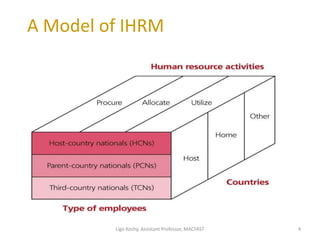
• Morgan defines international HRM as the interplay
among three dimensions-human resource activities,
type of employees, and countries of operation.
Ligo Koshy, Assistant Professor, MACFAST
4
A Model of IHRM
Ligo Koshy, Assistant Professor, MACFAST
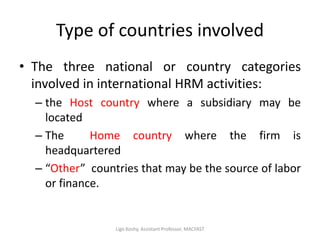
Type of countries involved
• The three national or country categories
involved in international HRM activities:
– the Host country where a subsidiary may be
located
– The Home country where the firm is
headquartered
– “Other” countries that may be the source of labor
or finance.
Ligo Koshy, Assistant Professor, MACFAST
Type of Employees
• The three types of employees of an international
firm:
• Host-country nationals (HCNs),
• Parent-country nationals (PCNs)
• Third country nationals (TCNs).
• Eg: IBM employs Australian citizens (HCNs) in its
Australian operations, often sends U.S. citizens
(PCNs) to Asia-Pacific countries on assignment, and
may send some of its Singaporean employees on all
assignment to its Japanese operations (as TCNs).
Ligo Koshy, Assistant Professor, MACFAST
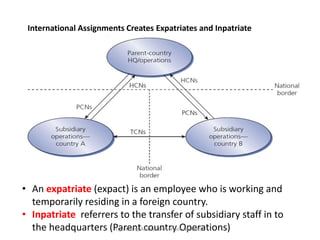
• An expatriate (expact) is an employee who is working and
temporarily residing in a foreign country.
• Inpatriate referrers to the transfer of subsidiary staff in to
the headquarters (Parent country Operations)
International Assignments Creates Expatriates and Inpatriate
Ligo Koshy, Assistant Professor, MACFAST
HR Activities
• The three broad human resource activities:
procurement, allocation, and utilization.
• Human Resource Planning
• Staffing(Recruitment & Selection)
• Training and Development
• Performance Management
• Compensation and Benefits
• Labour Relations ( Industrial Relations)
Ligo Koshy, Assistant Professor, MACFAST
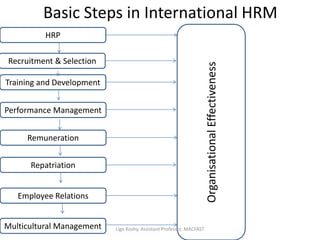
Basic Steps in International HRM
HRP
Recruitment & Selection
Training and Development
Performance Management
Remuneration
Repatriation
Employee Relations
Multicultural Management
OrganisationalEffectiveness
Ligo Koshy, Assistant Professor, MACFAST
Differences between HRM &
IHRM
Ligo Koshy, Assistant Professor, MACFAST
Difference between Domestic HRM
and IHRM
• Six factors that differentiate international
from domestic HRM. These factors are as
follows (Dowling).
1. More HR activities
2. The need for a broader perspective
3. More involvement in employees’ personal lives
4. Changes in emphasis as the workforce mix of
expatriates and locals varies
5. Risk exposure
6. More external influences.
Ligo Koshy, Assistant Professor, MACFAST
More HR Activities
• International environment requires the HR
department to undertake more HR activities than
those in domestic HR.
• They are :
• international taxation
• international relocation and orientation
• administrative services for expatriates
• host government relations
• language translation services
Ligo Koshy, Assistant Professor, MACFAST
Each function of HR has a new
dimensions in IHRM
• Human Resource planning
• Difficulty in implementing HR procedure in host
countries
• Providing developmental opportunities for
international managers
Ligo Koshy, Assistant Professor, MACFAST
Each function of HR has a new
dimensions in IHRM
• Employee hiring
• Ability to mix with the organisation’s culture
• Ethnocentric, Polycentric and geocentric approach to
staffing
• Selection of expatriates
• Coping with expatriate failure
• Managing repatriation process
Ligo Koshy, Assistant Professor, MACFAST
Each function of HR has a new
dimensions in IHRM
• Training and development
• Emphasis on Cultural training
• Language Training
• Training in manners and mannerisms
Ligo Koshy, Assistant Professor, MACFAST
Each function of HR has a new
dimensions in IHRM
• Compensation
• Devising an appropriate strategy to compensate
expatriates
• Minimizing discrepancies in pay between parent, host
ad third county nationals
• Issues related to re-entry of expatriates in to the home
country
Ligo Koshy, Assistant Professor, MACFAST
Each function of HR has a new
dimensions in IHRM
• Performance management
• Constraints while operating in host countries need to
be considered
• Physical distance, time differences add to complexity
• identification of raters to evaluate subsidiary
performance
Ligo Koshy, Assistant Professor, MACFAST
Each function of HR has a new
dimensions in IHRM
• Industrial relations
• Who should handle industrial relations problem in a
subsidiary?
• What should be the attitude of the parent company
towards unions in a subsidiary?
• What should be the union tactics in subsidiaries?
Ligo Koshy, Assistant Professor, MACFAST
Difference between Domestic HRM
and IHRM
• Need for Broader Perspective
• Need to design and administer programmes focuses on
more than one country
• Eg: co-ordinate pay systems in different countries while
taking in to consideration of different currencies and
the exchange rates
• Handling fringe benefits (concept of family in employee
health insurance schemes)
• Concept of promotion, overtime etc.
Ligo Koshy, Assistant Professor, MACFAST
Difference between Domestic HRM
and IHRM
• More involvement in Employee’s Personal Lives
• Greater degree of involvement in the personal lives of
PCN’s and TCN’s
• MNE’s maintain an “International Human Resource
Service” section to coordinate the administration of PCN’s
and TCN’s ( banking, Housing arrangements, health care,
all aspects of remuneration, child care, home rental while
on assignments, co-ordinating the home visits, final
repatriation)
Ligo Koshy, Assistant Professor, MACFAST
Difference between Domestic HRM
and IHRM
• Changes on Emphasis
• Emphasis on various HR activities will change as the
International business matures.
• Eg: Need for the PCN’s and TCN’s declines and more
HCN’s in the workforce.
• Resources previously allocated for the expatriate
compensation and benefits to activities such as training
and development
Ligo Koshy, Assistant Professor, MACFAST
Difference between Domestic HRM
and IHRM
• Risk Exposure
• Risk Exposure is high in IHRM
• (Kidnapping , Terrorism, Racism)
• Need for Emergency evacuation procedures
• Seizure of MNC’s Assets in a foreign Country
Ligo Koshy, Assistant Professor, MACFAST
The organisational Context of
IHRM
Ligo Koshy, Assistant Professor, MACFAST
Standardization & localization of
HRM practices
Ligo Koshy, Assistant Professor, MACFAST
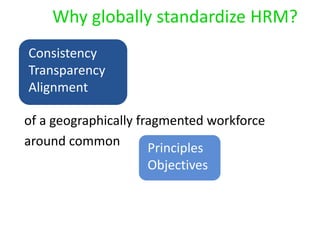
Consistency
Transparency
Alignment
Why globally standardize HRM?
of a geographically fragmented workforce
around common Principles
Objectives
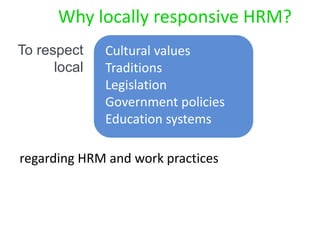
Cultural values
Traditions
Legislation
Government policies
Education systems
Why locally responsive HRM?
regarding HRM and work practices
To respect
local
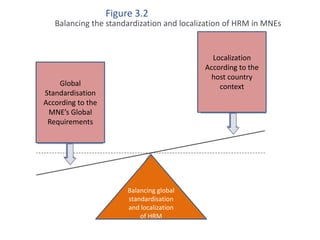
Balancing the standardization and localization of HRM in MNEs
Figure 3.2
Global
Standardisation
According to the
MNE’s Global
Requirements
Localization
According to the
host country
context
Balancing global
standardisation
and localization
of HRM
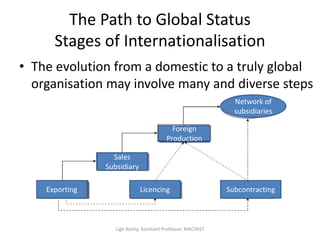
The Path to Global Status
Stages of Internationalisation
• The evolution from a domestic to a truly global
organisation may involve many and diverse steps
Exporting
Sales
Subsidiary
Foreign
Production
Licencing Subcontracting
Network of
subsidiaries
Ligo Koshy, Assistant Professor, MACFAST
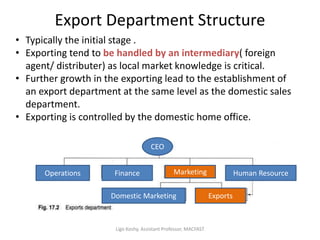
Export Department Structure
• Typically the initial stage .
• Exporting tend to be handled by an intermediary( foreign
agent/ distributer) as local market knowledge is critical.
• Further growth in the exporting lead to the establishment of
an export department at the same level as the domestic sales
department.
• Exporting is controlled by the domestic home office.
CEO
Operations Finance Marketing Human Resource
Domestic Marketing Exports
Ligo Koshy, Assistant Professor, MACFAST
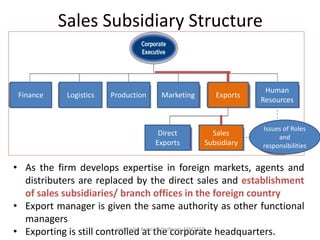
Sales Subsidiary Structure
• As the firm develops expertise in foreign markets, agents and
distributers are replaced by the direct sales and establishment
of sales subsidiaries/ branch offices in the foreign country
• Export manager is given the same authority as other functional
managers
• Exporting is still controlled at the corporate headquarters.
Finance Logistics Production Marketing Exports
Human
Resources
Direct
Exports
Sales
Subsidiary
Issues of Roles
and
responsibilities
Ligo Koshy, Assistant Professor, MACFAST
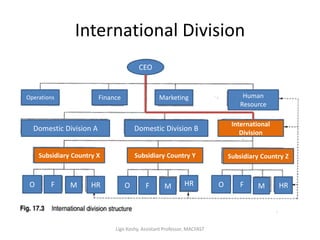
International Division
Operations Finance Marketing Human
Resource
International
Division
Domestic Division A Domestic Division B
Subsidiary Country X Subsidiary Country Y Subsidiary Country Z
CEO
O O OF F FM M MHR HR HR
Ligo Koshy, Assistant Professor, MACFAST
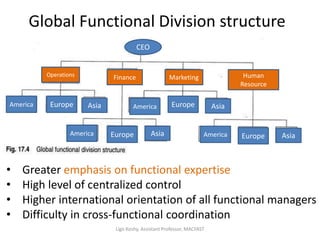
Global Functional Division structure
• Greater emphasis on functional expertise
• High level of centralized control
• Higher international orientation of all functional managers
• Difficulty in cross-functional coordination
America
AmericaAmerica
AmericaEurope
Europe
Europe
Europe
Asia
Asia Asia
Asia
Operations Finance Marketing Human
Resource
CEO
Ligo Koshy, Assistant Professor, MACFAST
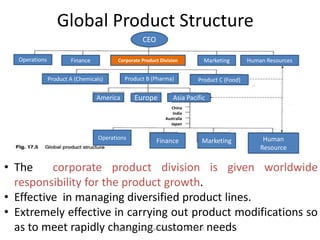
Global Product Structure
• The corporate product division is given worldwide
responsibility for the product growth.
• Effective in managing diversified product lines.
• Extremely effective in carrying out product modifications so
as to meet rapidly changing customer needs
CEO
Operations
Finance Marketing Human
Resource
America Europe Asia Pacific
Operations Finance Marketing Human ResourcesCorporate Product Division
Product C (Food)Product B (Pharma)Product A (Chemicals)
China
India
Australia
Japan
Ligo Koshy, Assistant Professor, MACFAST
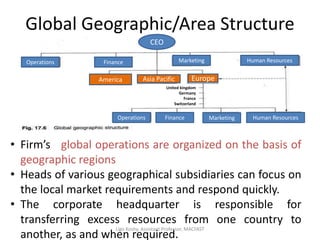
Global Geographic/Area Structure
• Firm’s global operations are organized on the basis of
geographic regions
• Heads of various geographical subsidiaries can focus on
the local market requirements and respond quickly.
• The corporate headquarter is responsible for
transferring excess resources from one country to
another, as and when required.
Operations Finance Marketing Human Resources
America Asia Pacific Europe
CEO
United kingdom
Germany
France
Switzerland
Ligo Koshy, Assistant Professor, MACFAST
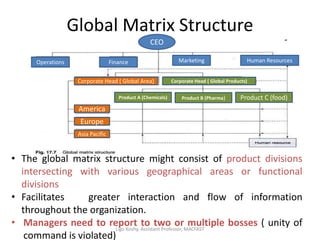
Global Matrix Structure
• The global matrix structure might consist of product divisions
intersecting with various geographical areas or functional
divisions
• Facilitates greater interaction and flow of information
throughout the organization.
• Managers need to report to two or multiple bosses ( unity of
command is violated)
Operations Finance Marketing Human Resources
America
Europe
Asia Pacific
CEO
Corporate Head ( Global Area) Corporate Head ( Global Products)
Product A (Chemicals) Product B (Pharma) Product C (food)
Ligo Koshy, Assistant Professor, MACFAST
Internationally, matrix is difficult
• Dual reporting
• Many communication channels
• Overlapping responsibilities
• Distance, language, time, & culture barriers
Mixed Structure
• Manage the difficulties of the matrix form
• Organisations pursued area structures added
worldwide product managers and product-
divisionalized firms reintroduced international
division to co-ordinate across product lines.
Ligo Koshy, Assistant Professor, MACFAST
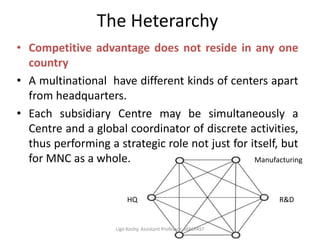
The Heterarchy
• Competitive advantage does not reside in any one
country
• A multinational have different kinds of centers apart
from headquarters.
• Each subsidiary Centre may be simultaneously a
Centre and a global coordinator of discrete activities,
thus performing a strategic role not just for itself, but
for MNC as a whole.
HQ R&D
Manufacturing
Ligo Koshy, Assistant Professor, MACFAST
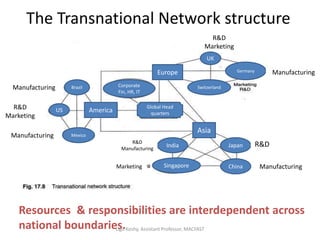
The Transnational Network structure
Resources & responsibilities are interdependent across
national boundaries.
UK
Germany
Asia
Japan
China
India
Singapore
Europe
America
Brazil
Mexico
SwitzerlandCorporate
Fin, HR, IT
Global Head
quarters
US
Manufacturing
Manufacturing
Manufacturing
Manufacturing
R&D
Marketing
R&D
Marketing
Marketing
R&D
Manufacturing
R&D
Ligo Koshy, Assistant Professor, MACFAST
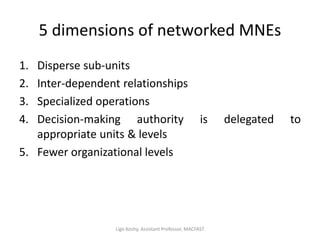
5 dimensions of networked MNEs
1. Disperse sub-units
2. Inter-dependent relationships
3. Specialized operations
4. Decision-making authority is delegated to
appropriate units & levels
5. Fewer organizational levels
Ligo Koshy, Assistant Professor, MACFAST
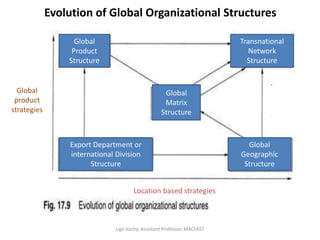
Evolution of Global Organizational Structures
Global
Product
Structure
Global
Geographic
Structure
Export Department or
international Division
Structure
Global
Matrix
Structure
Transnational
Network
Structure
Location based strategies
Global
product
strategies
Ligo Koshy, Assistant Professor, MACFAST
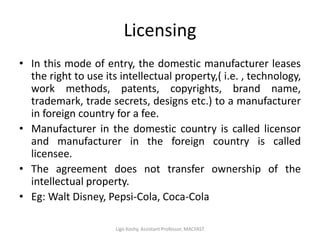
Licensing
• In this mode of entry, the domestic manufacturer leases
the right to use its intellectual property,( i.e. , technology,
work methods, patents, copyrights, brand name,
trademark, trade secrets, designs etc.) to a manufacturer
in foreign country for a fee.
• Manufacturer in the domestic country is called licensor
and manufacturer in the foreign country is called
licensee.
• The agreement does not transfer ownership of the
intellectual property.
• Eg: Walt Disney, Pepsi-Cola, Coca-Cola
Ligo Koshy, Assistant Professor, MACFAST
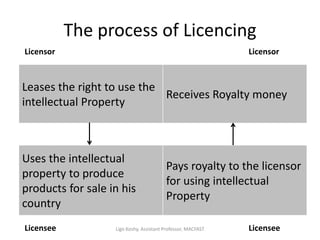
The process of Licencing
Leases the right to use the
intellectual Property
Receives Royalty money
Uses the intellectual
property to produce
products for sale in his
country
Pays royalty to the licensor
for using intellectual
Property
Licensor Licensor
Licensee LicenseeLigo Koshy, Assistant Professor, MACFAST
Subcontracting
• Subcontracting refers to the process of
entering a contractual agreement with an
outside person or company to perform a
certain amount of work.
• The out-side person or company in this
arrangement is known as a subcontractor
Ligo Koshy, Assistant Professor, MACFAST

International human resource management ihrm

  • 1.
    International Human Resource Management LigoKoshy, Assistant Professor, MACFAST
  • 2.
    Importance of InternationalHuman Resource Management • Globalization is gaining momentum • Markets are no longer protected from foreign competition • A large proportion of workforce is located in other countries away from their homes and home countries • Quality human resources are a must for implementing global competitive strategies. Ligo Koshy, Assistant Professor, MACFAST
  • 3.
    Definition • Morgan definesinternational HRM as the interplay among three dimensions-human resource activities, type of employees, and countries of operation. Ligo Koshy, Assistant Professor, MACFAST
  • 4.
    4 A Model ofIHRM Ligo Koshy, Assistant Professor, MACFAST
  • 5.
    Type of countriesinvolved • The three national or country categories involved in international HRM activities: – the Host country where a subsidiary may be located – The Home country where the firm is headquartered – “Other” countries that may be the source of labor or finance. Ligo Koshy, Assistant Professor, MACFAST
  • 6.
    Type of Employees •The three types of employees of an international firm: • Host-country nationals (HCNs), • Parent-country nationals (PCNs) • Third country nationals (TCNs). • Eg: IBM employs Australian citizens (HCNs) in its Australian operations, often sends U.S. citizens (PCNs) to Asia-Pacific countries on assignment, and may send some of its Singaporean employees on all assignment to its Japanese operations (as TCNs). Ligo Koshy, Assistant Professor, MACFAST
  • 7.
    • An expatriate(expact) is an employee who is working and temporarily residing in a foreign country. • Inpatriate referrers to the transfer of subsidiary staff in to the headquarters (Parent country Operations) International Assignments Creates Expatriates and Inpatriate Ligo Koshy, Assistant Professor, MACFAST
  • 8.
    HR Activities • Thethree broad human resource activities: procurement, allocation, and utilization. • Human Resource Planning • Staffing(Recruitment & Selection) • Training and Development • Performance Management • Compensation and Benefits • Labour Relations ( Industrial Relations) Ligo Koshy, Assistant Professor, MACFAST
  • 9.
    Basic Steps inInternational HRM HRP Recruitment & Selection Training and Development Performance Management Remuneration Repatriation Employee Relations Multicultural Management OrganisationalEffectiveness Ligo Koshy, Assistant Professor, MACFAST
  • 10.
    Differences between HRM& IHRM Ligo Koshy, Assistant Professor, MACFAST
  • 11.
    Difference between DomesticHRM and IHRM • Six factors that differentiate international from domestic HRM. These factors are as follows (Dowling). 1. More HR activities 2. The need for a broader perspective 3. More involvement in employees’ personal lives 4. Changes in emphasis as the workforce mix of expatriates and locals varies 5. Risk exposure 6. More external influences. Ligo Koshy, Assistant Professor, MACFAST
  • 12.
    More HR Activities •International environment requires the HR department to undertake more HR activities than those in domestic HR. • They are : • international taxation • international relocation and orientation • administrative services for expatriates • host government relations • language translation services Ligo Koshy, Assistant Professor, MACFAST
  • 13.
    Each function ofHR has a new dimensions in IHRM • Human Resource planning • Difficulty in implementing HR procedure in host countries • Providing developmental opportunities for international managers Ligo Koshy, Assistant Professor, MACFAST
  • 14.
    Each function ofHR has a new dimensions in IHRM • Employee hiring • Ability to mix with the organisation’s culture • Ethnocentric, Polycentric and geocentric approach to staffing • Selection of expatriates • Coping with expatriate failure • Managing repatriation process Ligo Koshy, Assistant Professor, MACFAST
  • 15.
    Each function ofHR has a new dimensions in IHRM • Training and development • Emphasis on Cultural training • Language Training • Training in manners and mannerisms Ligo Koshy, Assistant Professor, MACFAST
  • 16.
    Each function ofHR has a new dimensions in IHRM • Compensation • Devising an appropriate strategy to compensate expatriates • Minimizing discrepancies in pay between parent, host ad third county nationals • Issues related to re-entry of expatriates in to the home country Ligo Koshy, Assistant Professor, MACFAST
  • 17.
    Each function ofHR has a new dimensions in IHRM • Performance management • Constraints while operating in host countries need to be considered • Physical distance, time differences add to complexity • identification of raters to evaluate subsidiary performance Ligo Koshy, Assistant Professor, MACFAST
  • 18.
    Each function ofHR has a new dimensions in IHRM • Industrial relations • Who should handle industrial relations problem in a subsidiary? • What should be the attitude of the parent company towards unions in a subsidiary? • What should be the union tactics in subsidiaries? Ligo Koshy, Assistant Professor, MACFAST
  • 19.
    Difference between DomesticHRM and IHRM • Need for Broader Perspective • Need to design and administer programmes focuses on more than one country • Eg: co-ordinate pay systems in different countries while taking in to consideration of different currencies and the exchange rates • Handling fringe benefits (concept of family in employee health insurance schemes) • Concept of promotion, overtime etc. Ligo Koshy, Assistant Professor, MACFAST
  • 20.
    Difference between DomesticHRM and IHRM • More involvement in Employee’s Personal Lives • Greater degree of involvement in the personal lives of PCN’s and TCN’s • MNE’s maintain an “International Human Resource Service” section to coordinate the administration of PCN’s and TCN’s ( banking, Housing arrangements, health care, all aspects of remuneration, child care, home rental while on assignments, co-ordinating the home visits, final repatriation) Ligo Koshy, Assistant Professor, MACFAST
  • 21.
    Difference between DomesticHRM and IHRM • Changes on Emphasis • Emphasis on various HR activities will change as the International business matures. • Eg: Need for the PCN’s and TCN’s declines and more HCN’s in the workforce. • Resources previously allocated for the expatriate compensation and benefits to activities such as training and development Ligo Koshy, Assistant Professor, MACFAST
  • 22.
    Difference between DomesticHRM and IHRM • Risk Exposure • Risk Exposure is high in IHRM • (Kidnapping , Terrorism, Racism) • Need for Emergency evacuation procedures • Seizure of MNC’s Assets in a foreign Country Ligo Koshy, Assistant Professor, MACFAST
  • 23.
    The organisational Contextof IHRM Ligo Koshy, Assistant Professor, MACFAST
  • 24.
    Standardization & localizationof HRM practices Ligo Koshy, Assistant Professor, MACFAST
  • 25.
    Consistency Transparency Alignment Why globally standardizeHRM? of a geographically fragmented workforce around common Principles Objectives
  • 26.
    Cultural values Traditions Legislation Government policies Educationsystems Why locally responsive HRM? regarding HRM and work practices To respect local
  • 27.
    Balancing the standardizationand localization of HRM in MNEs Figure 3.2 Global Standardisation According to the MNE’s Global Requirements Localization According to the host country context Balancing global standardisation and localization of HRM
  • 28.
    The Path toGlobal Status Stages of Internationalisation • The evolution from a domestic to a truly global organisation may involve many and diverse steps Exporting Sales Subsidiary Foreign Production Licencing Subcontracting Network of subsidiaries Ligo Koshy, Assistant Professor, MACFAST
  • 29.
    Export Department Structure •Typically the initial stage . • Exporting tend to be handled by an intermediary( foreign agent/ distributer) as local market knowledge is critical. • Further growth in the exporting lead to the establishment of an export department at the same level as the domestic sales department. • Exporting is controlled by the domestic home office. CEO Operations Finance Marketing Human Resource Domestic Marketing Exports Ligo Koshy, Assistant Professor, MACFAST
  • 30.
    Sales Subsidiary Structure •As the firm develops expertise in foreign markets, agents and distributers are replaced by the direct sales and establishment of sales subsidiaries/ branch offices in the foreign country • Export manager is given the same authority as other functional managers • Exporting is still controlled at the corporate headquarters. Finance Logistics Production Marketing Exports Human Resources Direct Exports Sales Subsidiary Issues of Roles and responsibilities Ligo Koshy, Assistant Professor, MACFAST
  • 31.
    International Division Operations FinanceMarketing Human Resource International Division Domestic Division A Domestic Division B Subsidiary Country X Subsidiary Country Y Subsidiary Country Z CEO O O OF F FM M MHR HR HR Ligo Koshy, Assistant Professor, MACFAST
  • 32.
    Global Functional Divisionstructure • Greater emphasis on functional expertise • High level of centralized control • Higher international orientation of all functional managers • Difficulty in cross-functional coordination America AmericaAmerica AmericaEurope Europe Europe Europe Asia Asia Asia Asia Operations Finance Marketing Human Resource CEO Ligo Koshy, Assistant Professor, MACFAST
  • 33.
    Global Product Structure •The corporate product division is given worldwide responsibility for the product growth. • Effective in managing diversified product lines. • Extremely effective in carrying out product modifications so as to meet rapidly changing customer needs CEO Operations Finance Marketing Human Resource America Europe Asia Pacific Operations Finance Marketing Human ResourcesCorporate Product Division Product C (Food)Product B (Pharma)Product A (Chemicals) China India Australia Japan Ligo Koshy, Assistant Professor, MACFAST
  • 34.
    Global Geographic/Area Structure •Firm’s global operations are organized on the basis of geographic regions • Heads of various geographical subsidiaries can focus on the local market requirements and respond quickly. • The corporate headquarter is responsible for transferring excess resources from one country to another, as and when required. Operations Finance Marketing Human Resources Operations Finance Marketing Human Resources America Asia Pacific Europe CEO United kingdom Germany France Switzerland Ligo Koshy, Assistant Professor, MACFAST
  • 35.
    Global Matrix Structure •The global matrix structure might consist of product divisions intersecting with various geographical areas or functional divisions • Facilitates greater interaction and flow of information throughout the organization. • Managers need to report to two or multiple bosses ( unity of command is violated) Operations Finance Marketing Human Resources America Europe Asia Pacific CEO Corporate Head ( Global Area) Corporate Head ( Global Products) Product A (Chemicals) Product B (Pharma) Product C (food) Ligo Koshy, Assistant Professor, MACFAST
  • 36.
    Internationally, matrix isdifficult • Dual reporting • Many communication channels • Overlapping responsibilities • Distance, language, time, & culture barriers
  • 37.
    Mixed Structure • Managethe difficulties of the matrix form • Organisations pursued area structures added worldwide product managers and product- divisionalized firms reintroduced international division to co-ordinate across product lines. Ligo Koshy, Assistant Professor, MACFAST
  • 38.
    The Heterarchy • Competitiveadvantage does not reside in any one country • A multinational have different kinds of centers apart from headquarters. • Each subsidiary Centre may be simultaneously a Centre and a global coordinator of discrete activities, thus performing a strategic role not just for itself, but for MNC as a whole. HQ R&D Manufacturing Ligo Koshy, Assistant Professor, MACFAST
  • 39.
    The Transnational Networkstructure Resources & responsibilities are interdependent across national boundaries. UK Germany Asia Japan China India Singapore Europe America Brazil Mexico SwitzerlandCorporate Fin, HR, IT Global Head quarters US Manufacturing Manufacturing Manufacturing Manufacturing R&D Marketing R&D Marketing Marketing R&D Manufacturing R&D Ligo Koshy, Assistant Professor, MACFAST
  • 40.
    5 dimensions ofnetworked MNEs 1. Disperse sub-units 2. Inter-dependent relationships 3. Specialized operations 4. Decision-making authority is delegated to appropriate units & levels 5. Fewer organizational levels Ligo Koshy, Assistant Professor, MACFAST
  • 41.
    Evolution of GlobalOrganizational Structures Global Product Structure Global Geographic Structure Export Department or international Division Structure Global Matrix Structure Transnational Network Structure Location based strategies Global product strategies Ligo Koshy, Assistant Professor, MACFAST
  • 42.
    Licensing • In thismode of entry, the domestic manufacturer leases the right to use its intellectual property,( i.e. , technology, work methods, patents, copyrights, brand name, trademark, trade secrets, designs etc.) to a manufacturer in foreign country for a fee. • Manufacturer in the domestic country is called licensor and manufacturer in the foreign country is called licensee. • The agreement does not transfer ownership of the intellectual property. • Eg: Walt Disney, Pepsi-Cola, Coca-Cola Ligo Koshy, Assistant Professor, MACFAST
  • 43.
    The process ofLicencing Leases the right to use the intellectual Property Receives Royalty money Uses the intellectual property to produce products for sale in his country Pays royalty to the licensor for using intellectual Property Licensor Licensor Licensee LicenseeLigo Koshy, Assistant Professor, MACFAST
  • 44.
    Subcontracting • Subcontracting refersto the process of entering a contractual agreement with an outside person or company to perform a certain amount of work. • The out-side person or company in this arrangement is known as a subcontractor Ligo Koshy, Assistant Professor, MACFAST

Editor's Notes

  • #24 Focuses on internal responses to deal with the global environment while the firm grows international. Structural responses to international growth Control and coordination mechanisms , including cultural control Effect of responses on human resource management approaches and activities.
  • #30 Exporting tend to be handled by an intermediary(foreign agent or a distributer) as local market knowledge is critical
  • #31 Agents and distributers are often replaced by direct sales with the establishment of sales subsidiaries or branch offices in the foreign market. Use of PCN or HCN to control the operations in the host country
  • #42 Companies with emphasis on global business strategies move towards global product structures whereas those with emphasis on location base strategies move towards global geographic structures. Subsequently, a large number of companies graduate to a matrix or trans-national network structure due to dual demands of local adaptations pressures and globalization. In practice, most companies hardly adopt either pure matrix or trans-national structures; rather they opt for hybrid structures incorporating both.