Unit 2 INTERACTION SUMMARY
1
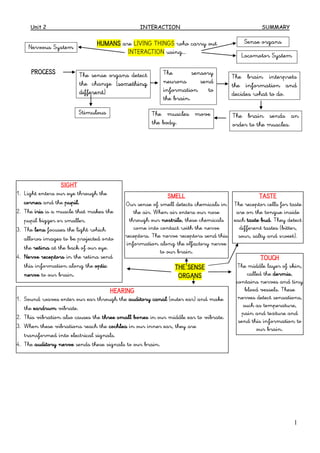
THE SENSE
ORGANS
HUMANS are LIVING THINGS who carry out
INTERACTION using…
PROCESS The sense organs detect
the change (something
different)
The sensory
neurons send
information to
the brain.
The brain interprets
the information and
decides what to do.
The brain sends an
order to the muscles.
The muscles move
the body.
Stimulous
Sense organs
Locomotor System
Nervous System
SIGHT
1. Light enters our eye through the
cornea and the pupil.
2. The iris is a muscle that makes the
pupil bigger or smaller.
3. The lens focuses the light which
allows images to be projected onto
the retina at the back of our eye.
4. Nerve receptors in the retina send
this information along the optic
nerve to our brain.
SMELL
Our sense of smell detects chemicals in
the air. When air enters our nose
through our nostrils, these chemicals
come into contact with the nerve
receptors. The nerve receptors send this
information along the olfactory nerve
to our brain.
TASTE
The receptor cells for taste
are on the tongue inside
each taste bud. They detect
different tastes (bitter,
sour, salty and sweet).
HEARING
1. Sound waves enter our ear through the auditory canal (outer ear) and make
the eardrum vibrate.
2. This vibration also causes the three small bones in our middle ear to vibrate.
3. When these vibrations reach the cochlea in our inner ear, they are
transformed into electrical signals.
4. The auditory nerve sends these signals to our brain.
The main function of the semicircular canals in our inner ear is to keep our
balance and equilibrium.
TOUCH
The middle layer of skin,
called the dermis,
contains nerves and tiny
blood vessels. These
nerves detect sensations,
such as temperature,
pain and texture and
send this information to
our brain.
Unit 2 INTERACTION SUMMARY
2
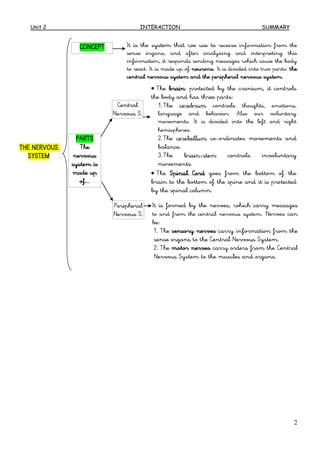
CONCEPT It is the system that we use to receive information from the
sense organs, and after analyzing and interpreting this
information, it responds sending messages which cause the body
to react. It is made up of neurons. It is divided into two parts: the
central nervous system and the peripheral nervous system.
PARTS
The
nervous
system is
made up
of...
THE NERVOUS
SYSTEM
Central
Nervous S.
Peripheral
Nervous S.
 The brain: protected by the cranium, it controls
the body and has three parts:
1.The cerebrum controls thoughts, emotions,
language and behavior. Also our voluntary
movements. It is divided into the left and right
hemispheres.
2.The cerebellum co-ordinates movements and
balance.
3.The brain-stem controls involuntary
movements.
 The Spinal Cord goes from the bottom of the
brain to the bottom of the spine and it is protected
by the spinal column.
It is formed by the nerves, which carry messages
to and from the central nervous system. Nerves can
be:
1. The sensory nerves carry information from the
sense organs to the Central Nervous System.
2. The motor nerves carry orders from the Central
Nervous System to the muscles and organs.
Unit 2 INTERACTION SUMMARY
3
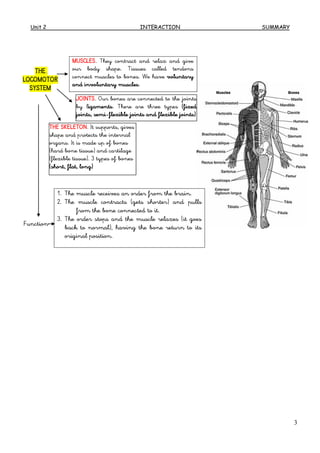
THE
LOCOMOTOR
SYSTEM
Function
1. The muscle receives an order from the brain.
2. The muscle contracts (gets shorter) and pulls
from the bone connected to it.
3. The order stops and the muscle relaxes (it goes
back to normal), having the bone return to its
original position.
MUSCLES. They contract and relax and give
our body shape. Tissues called tendons
connect muscles to bones. We have voluntary
and involuntary muscles.
JOINTS. Our bones are connected to the joints
by ligaments. There are three types (fixed
joints, semi-flexible joints and flexible joints)
THE SKELETON. It supports, gives
shape and protects the internal
organs. It is made up of bones
(hard bone tissue) and cartilage
(flexible tissue). 3 types of bones
(short, flat, long)

Unit 2 diagram

  • 1.
    Unit 2 INTERACTIONSUMMARY 1 THE SENSE ORGANS HUMANS are LIVING THINGS who carry out INTERACTION using… PROCESS The sense organs detect the change (something different) The sensory neurons send information to the brain. The brain interprets the information and decides what to do. The brain sends an order to the muscles. The muscles move the body. Stimulous Sense organs Locomotor System Nervous System SIGHT 1. Light enters our eye through the cornea and the pupil. 2. The iris is a muscle that makes the pupil bigger or smaller. 3. The lens focuses the light which allows images to be projected onto the retina at the back of our eye. 4. Nerve receptors in the retina send this information along the optic nerve to our brain. SMELL Our sense of smell detects chemicals in the air. When air enters our nose through our nostrils, these chemicals come into contact with the nerve receptors. The nerve receptors send this information along the olfactory nerve to our brain. TASTE The receptor cells for taste are on the tongue inside each taste bud. They detect different tastes (bitter, sour, salty and sweet). HEARING 1. Sound waves enter our ear through the auditory canal (outer ear) and make the eardrum vibrate. 2. This vibration also causes the three small bones in our middle ear to vibrate. 3. When these vibrations reach the cochlea in our inner ear, they are transformed into electrical signals. 4. The auditory nerve sends these signals to our brain. The main function of the semicircular canals in our inner ear is to keep our balance and equilibrium. TOUCH The middle layer of skin, called the dermis, contains nerves and tiny blood vessels. These nerves detect sensations, such as temperature, pain and texture and send this information to our brain.
  • 2.
    Unit 2 INTERACTIONSUMMARY 2 CONCEPT It is the system that we use to receive information from the sense organs, and after analyzing and interpreting this information, it responds sending messages which cause the body to react. It is made up of neurons. It is divided into two parts: the central nervous system and the peripheral nervous system. PARTS The nervous system is made up of... THE NERVOUS SYSTEM Central Nervous S. Peripheral Nervous S.  The brain: protected by the cranium, it controls the body and has three parts: 1.The cerebrum controls thoughts, emotions, language and behavior. Also our voluntary movements. It is divided into the left and right hemispheres. 2.The cerebellum co-ordinates movements and balance. 3.The brain-stem controls involuntary movements.  The Spinal Cord goes from the bottom of the brain to the bottom of the spine and it is protected by the spinal column. It is formed by the nerves, which carry messages to and from the central nervous system. Nerves can be: 1. The sensory nerves carry information from the sense organs to the Central Nervous System. 2. The motor nerves carry orders from the Central Nervous System to the muscles and organs.
  • 3.
    Unit 2 INTERACTIONSUMMARY 3 THE LOCOMOTOR SYSTEM Function 1. The muscle receives an order from the brain. 2. The muscle contracts (gets shorter) and pulls from the bone connected to it. 3. The order stops and the muscle relaxes (it goes back to normal), having the bone return to its original position. MUSCLES. They contract and relax and give our body shape. Tissues called tendons connect muscles to bones. We have voluntary and involuntary muscles. JOINTS. Our bones are connected to the joints by ligaments. There are three types (fixed joints, semi-flexible joints and flexible joints) THE SKELETON. It supports, gives shape and protects the internal organs. It is made up of bones (hard bone tissue) and cartilage (flexible tissue). 3 types of bones (short, flat, long)