The Nervous System Chapter Five
Chapter Five 5-1: The Nervous System
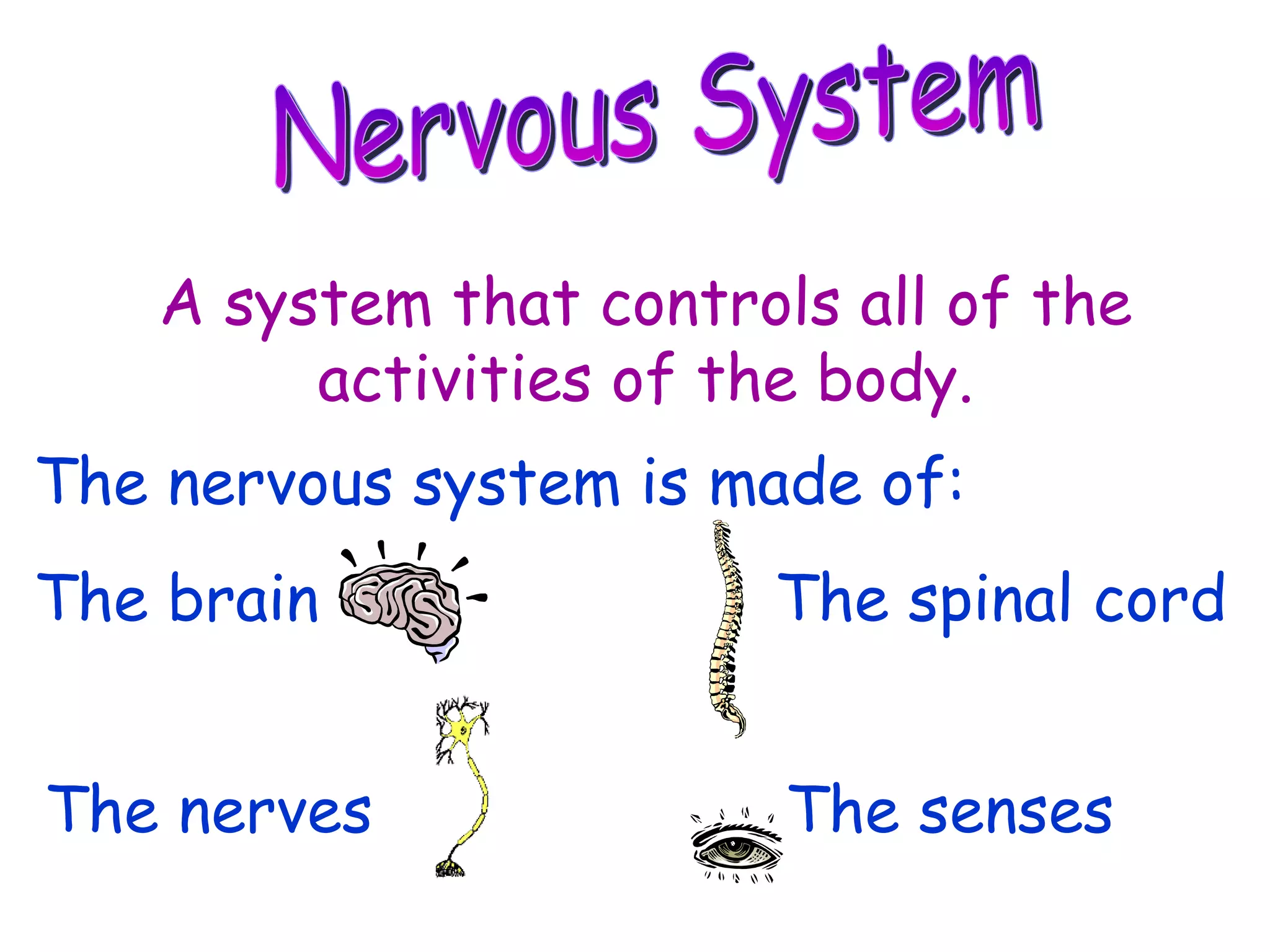
Nervous System A system that controls all of the activities of the body. The nervous system is made of: The brain The spinal cord The nerves The senses
The nervous system also allows you to react to a  stimulus. Stimulus A stimulus is a change in the environment. Example:  A hot stove Or… tripping over a rock
Your reactions are  automatic. Automatic Automatic means that you do not have to think about your reactions. Example:  If a bug flies by your eye,  you will blink.
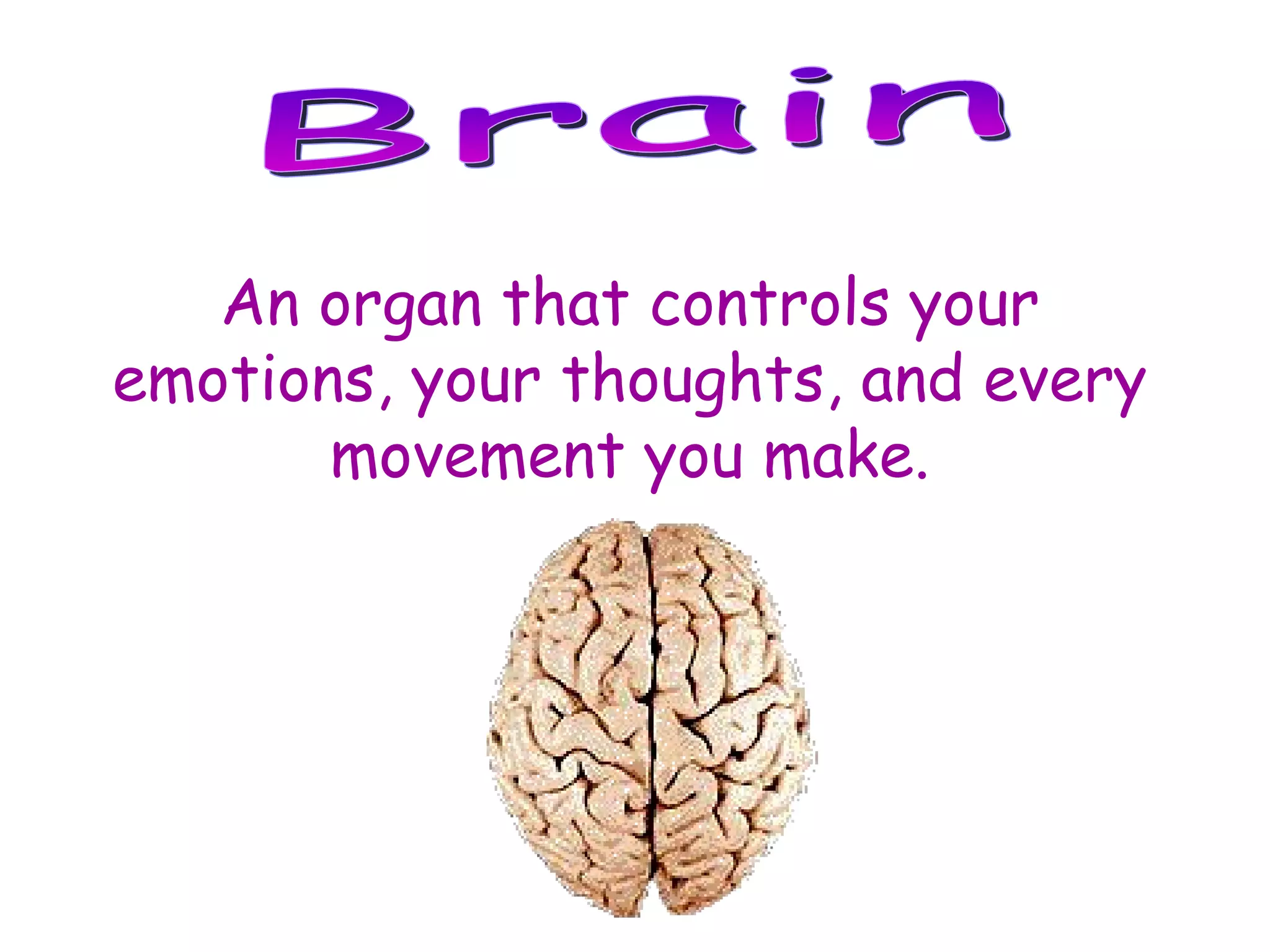
Brain An organ that controls your emotions, your thoughts, and every movement you make.
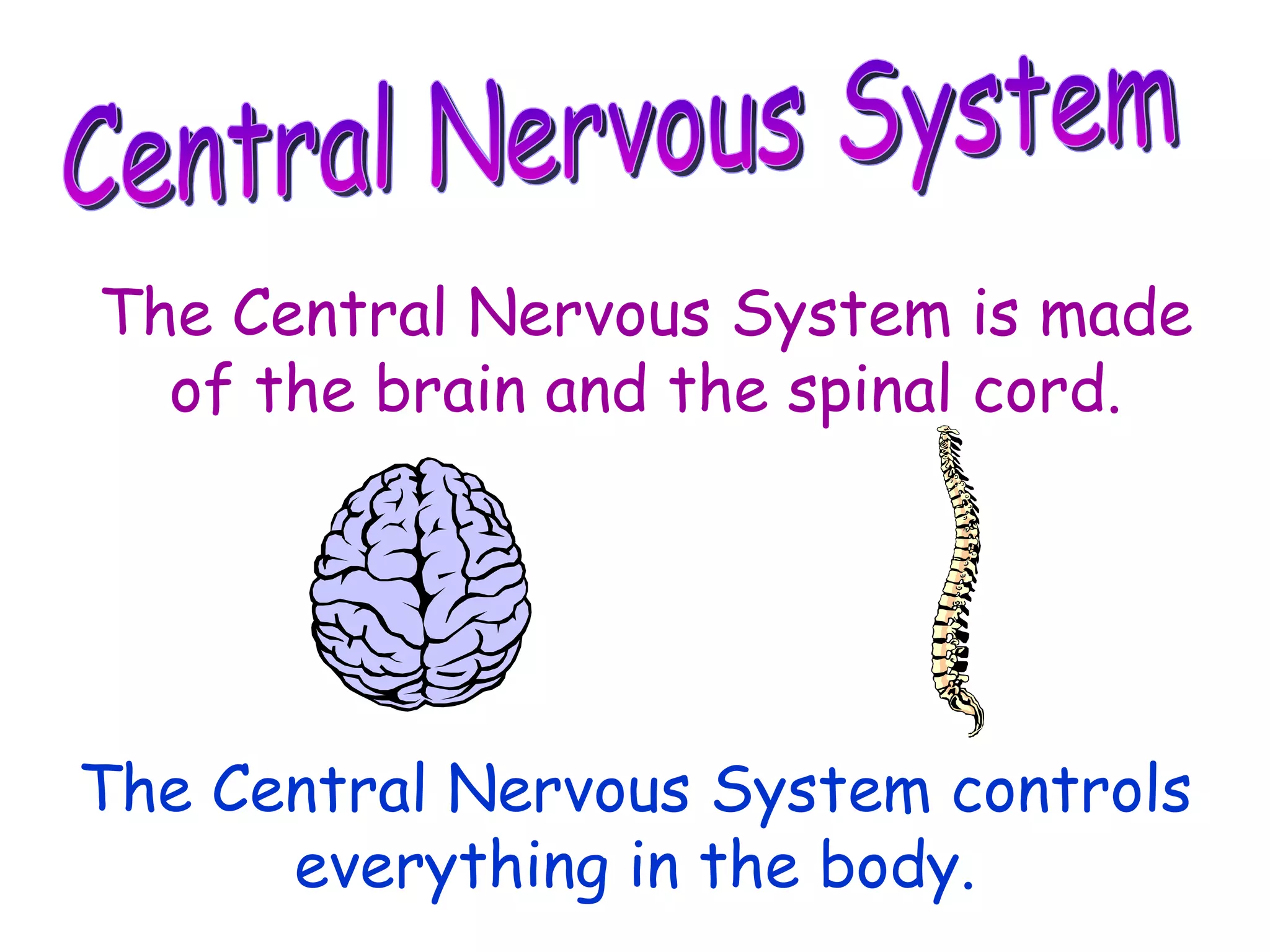
Central Nervous System The Central Nervous System is made of the brain and the spinal cord. The Central Nervous System controls everything in the body.
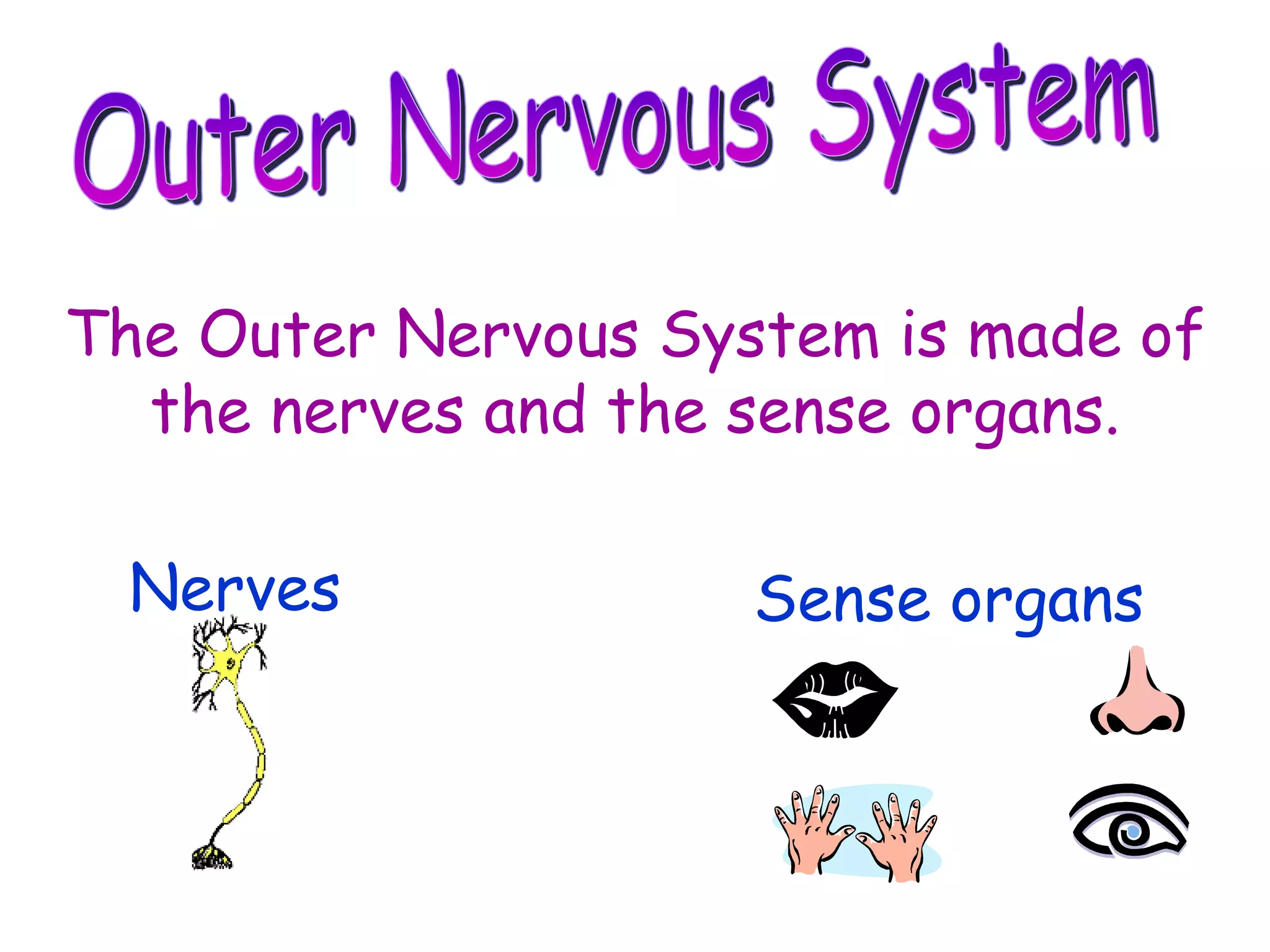
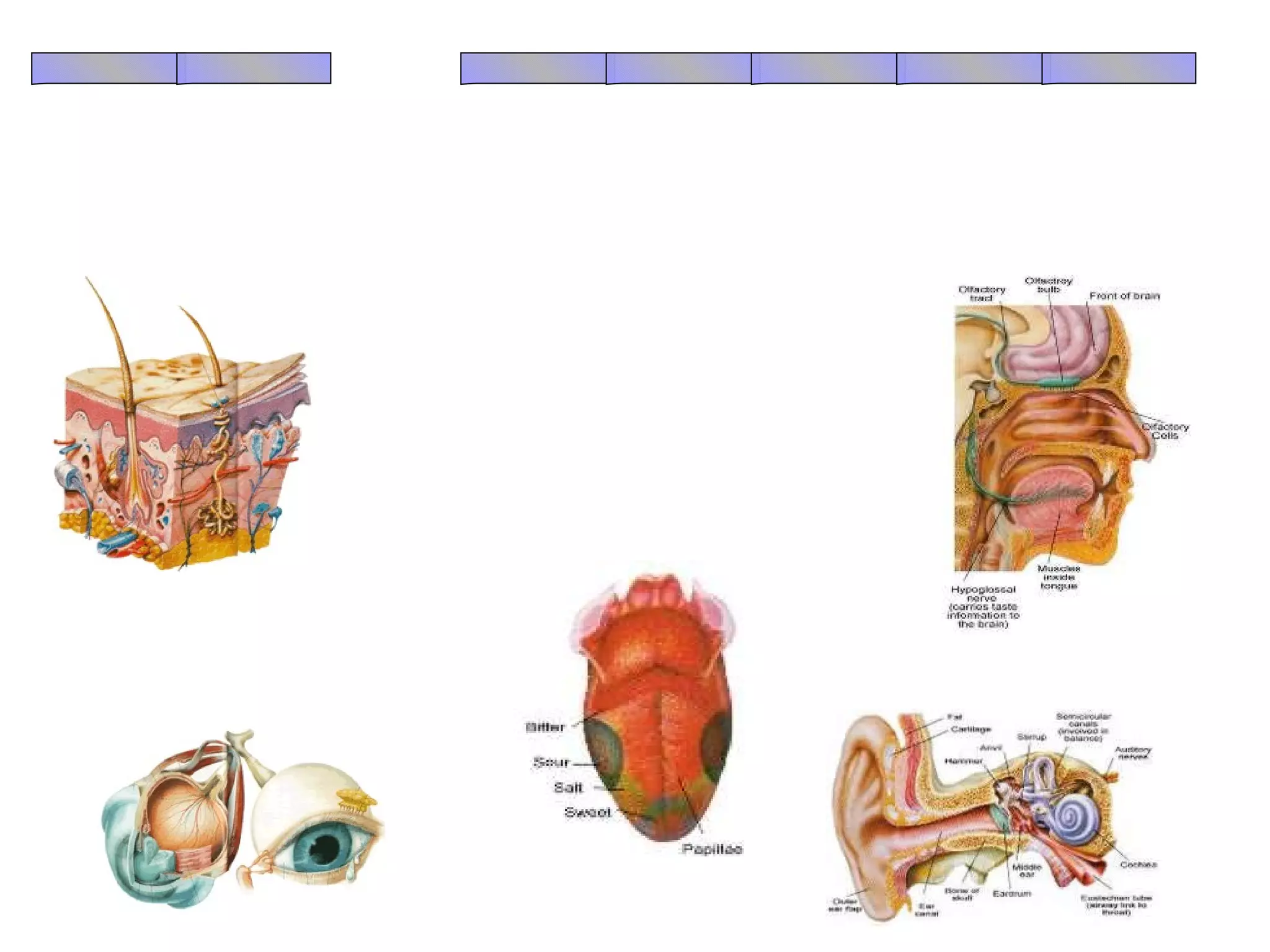
Outer Nervous System The Outer Nervous System is made of the nerves and the sense organs. Nerves Sense organs
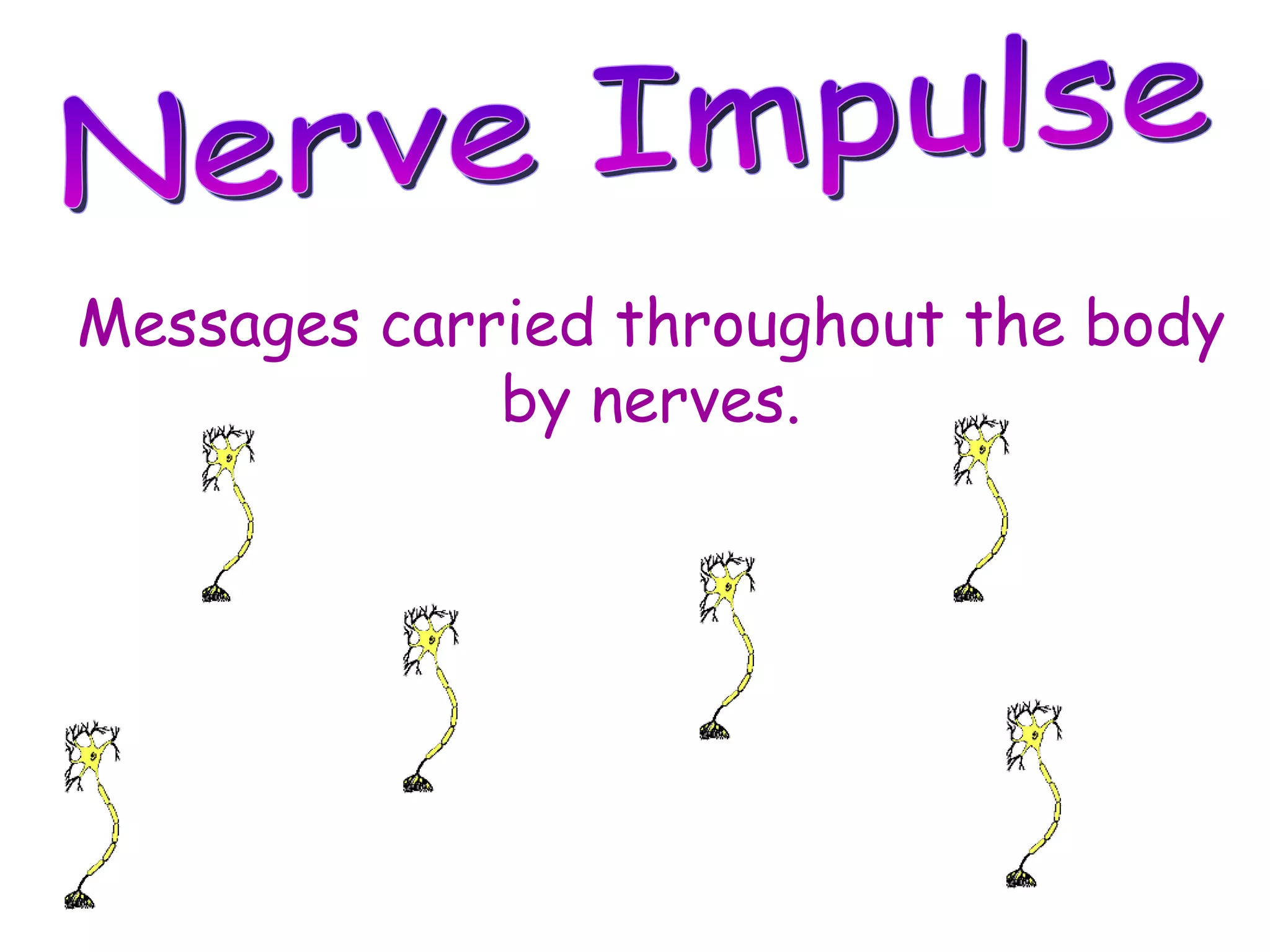
Nerve Impulse Messages carried throughout the body by nerves.
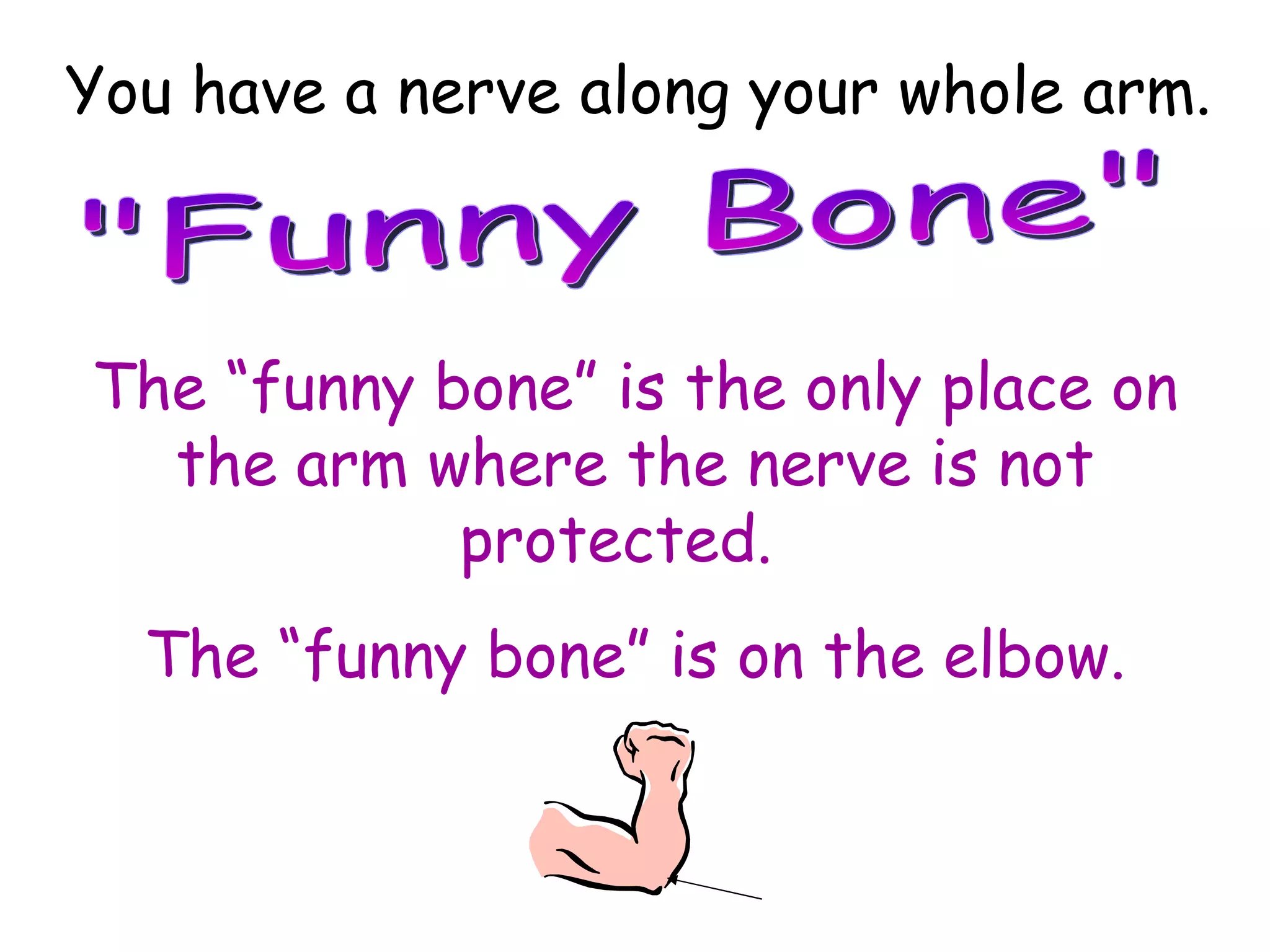
"Funny Bone" You have a nerve along your whole arm. The “funny bone” is the only place on the arm where the nerve is not protected.  The “funny bone” is on the elbow.
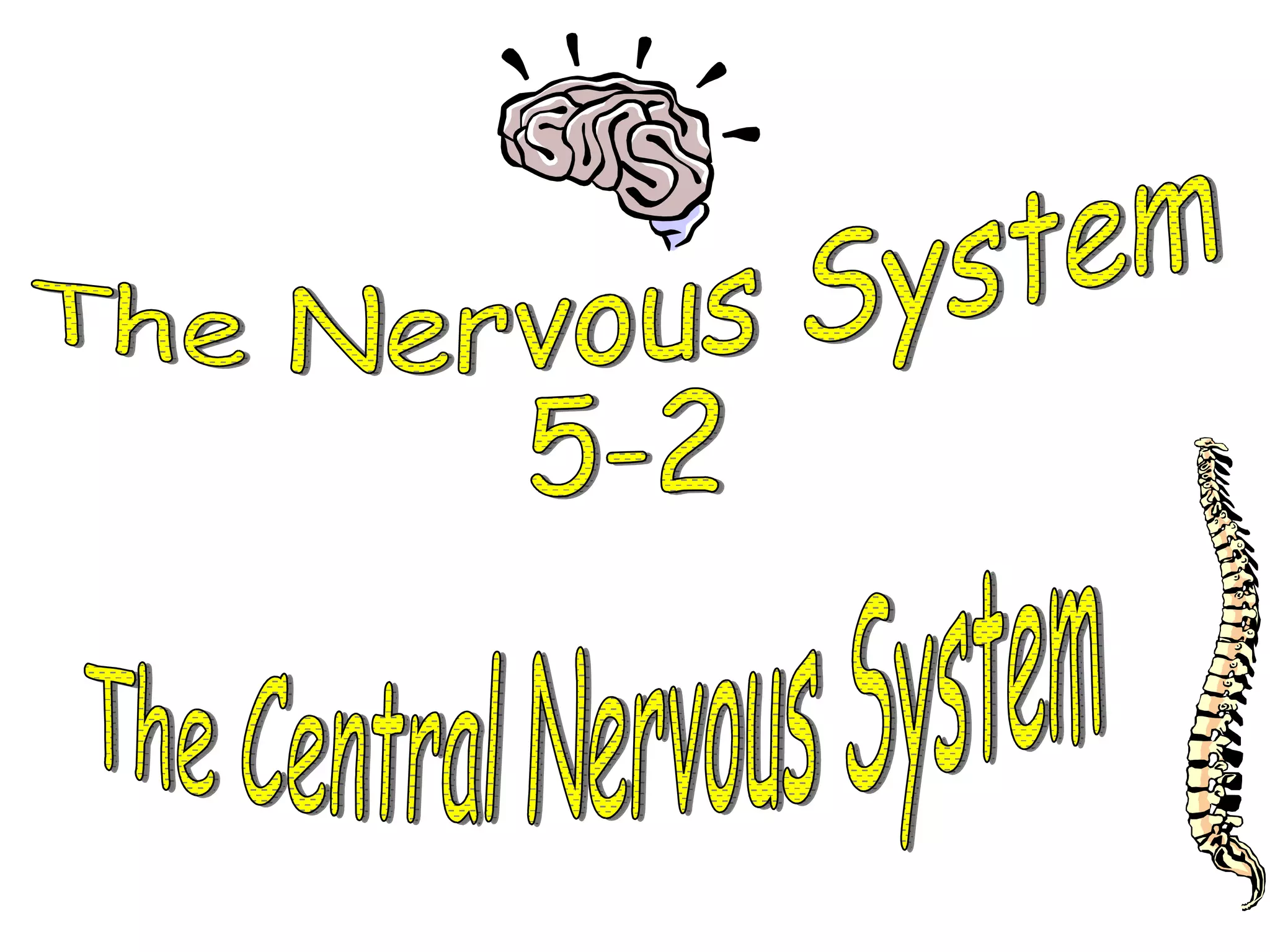
The Nervous System 5-2 The Central Nervous System
The Central Nervous System *  The Central Nervous System controls all of the body’s activities. *  The Central Nervous System is made of two main organs. 1.  The brain 2.  The spinal cord
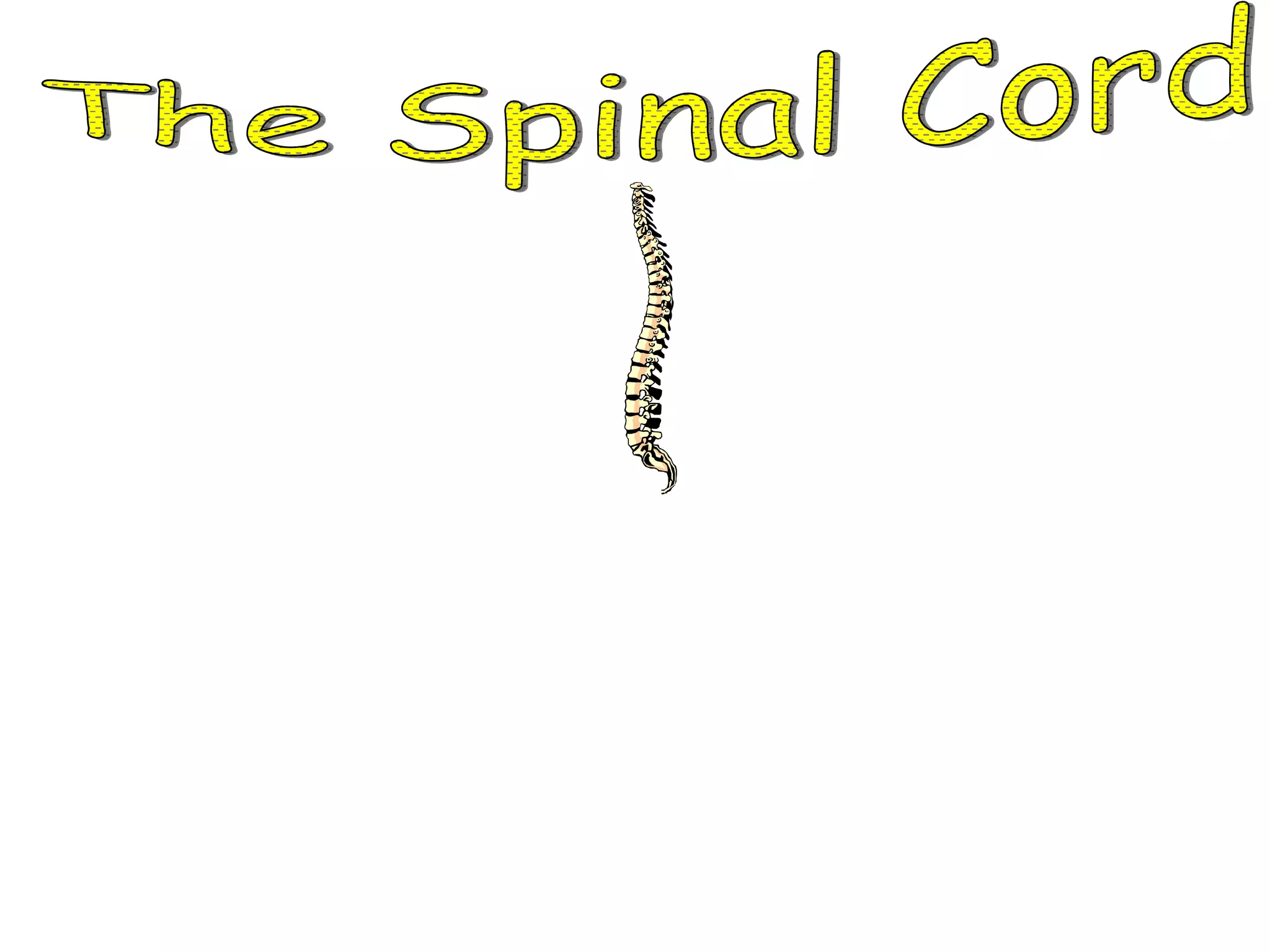
The Spinal Cord *  The spinal cord sends messages to the brain. *  The spinal cord is the part of the nervous system that connects the brain to the rest of the nervous system.
The Brain *  The brain controls everything in the body. *  The brain is made of more than 10 billion nerves! *  The brain is divided into three parts and is protected by the skull.
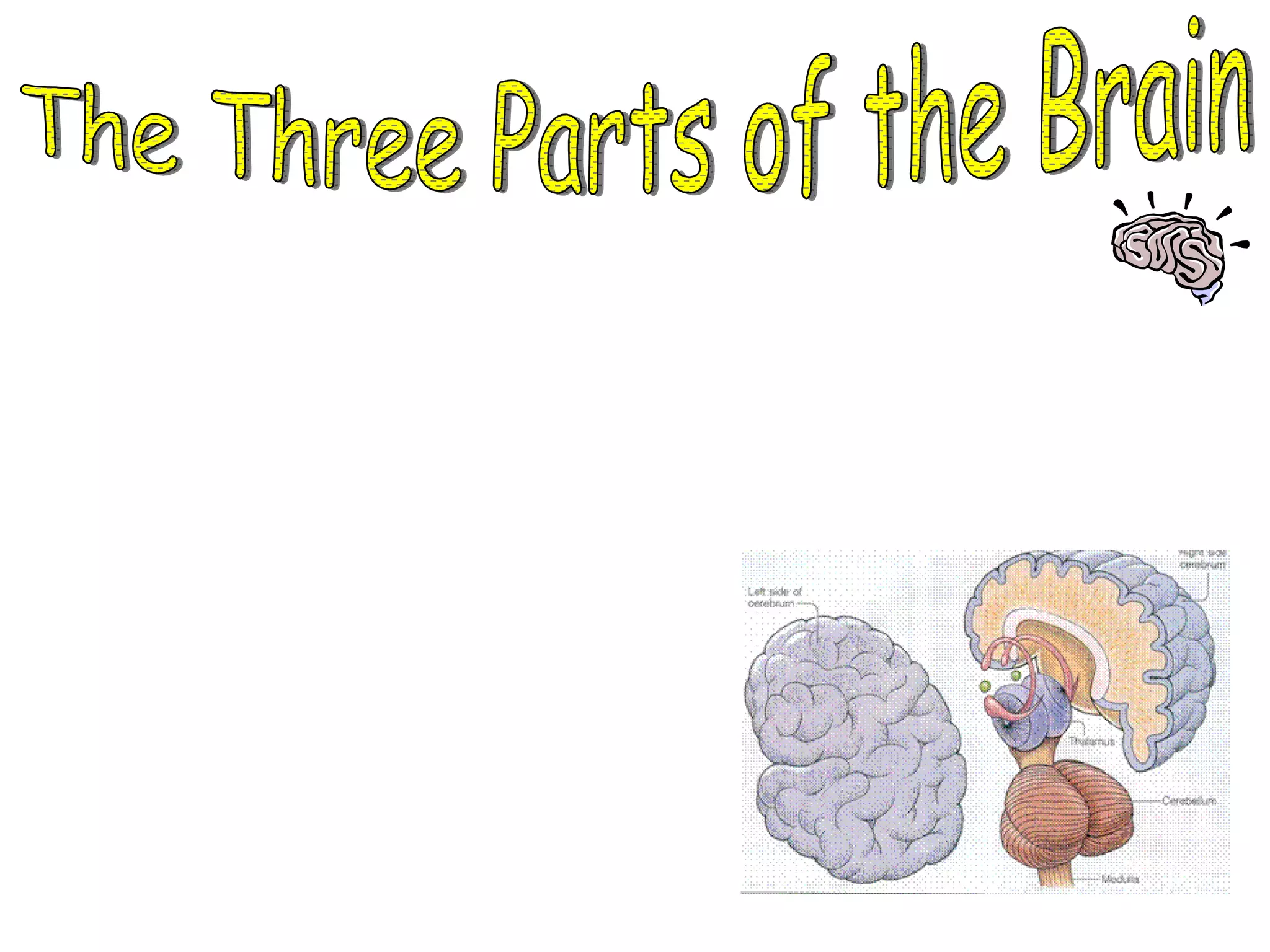
The Three Parts of the Brain *  The Brain has three main parts… 1.  The Cerebrum 2.  The Cerebellum 3.  The Brain Stem
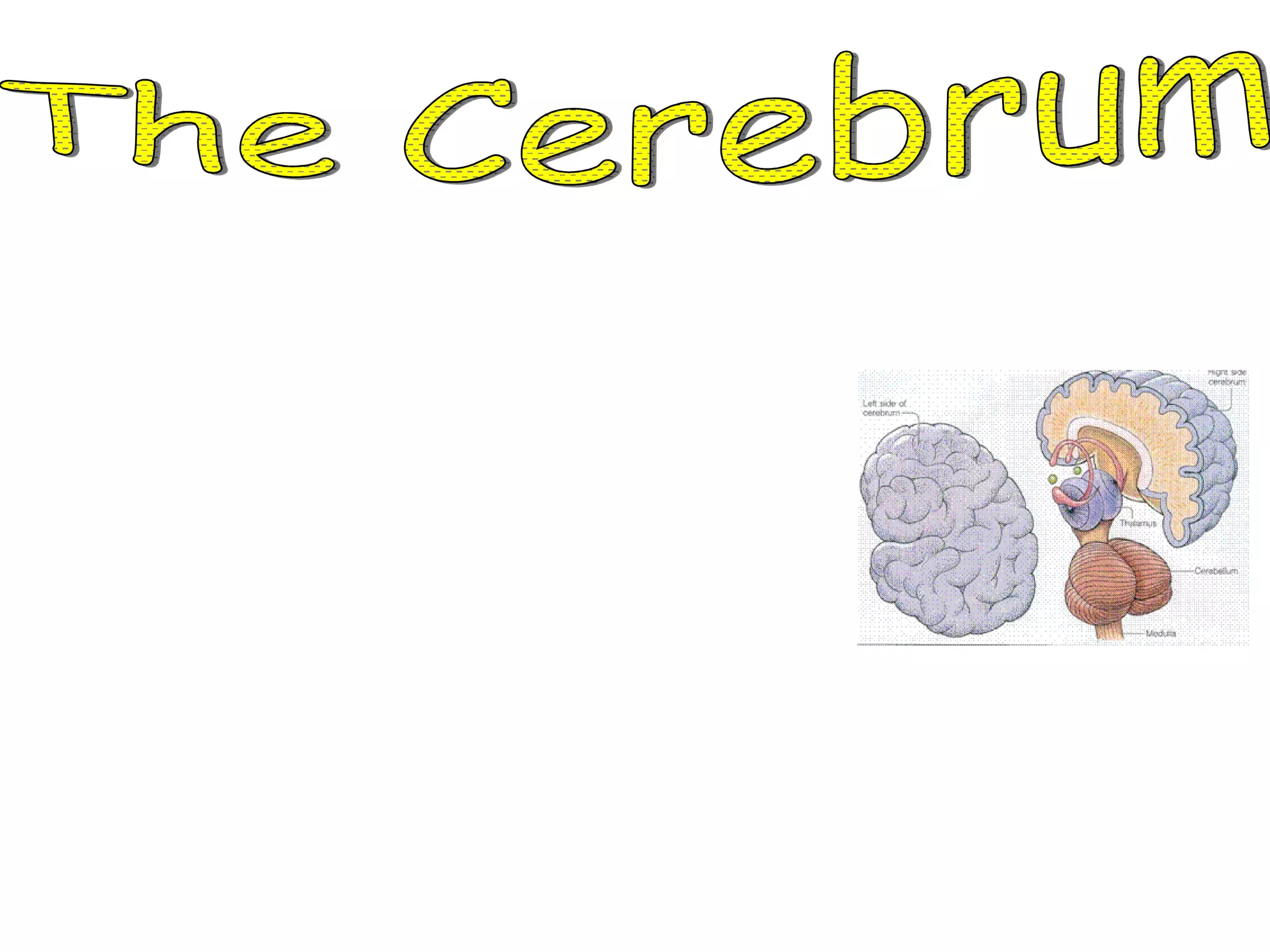
The Cerebrum *  The Cerebrum is the largest part of the brain. 1.  The cerebrum controls your thinking. 2.  The cerebrum controls your memory. 3.  The cerebrum controls your speaking. 4.  The cerebrum controls your movement and identifies the information gathered by your sense organs.
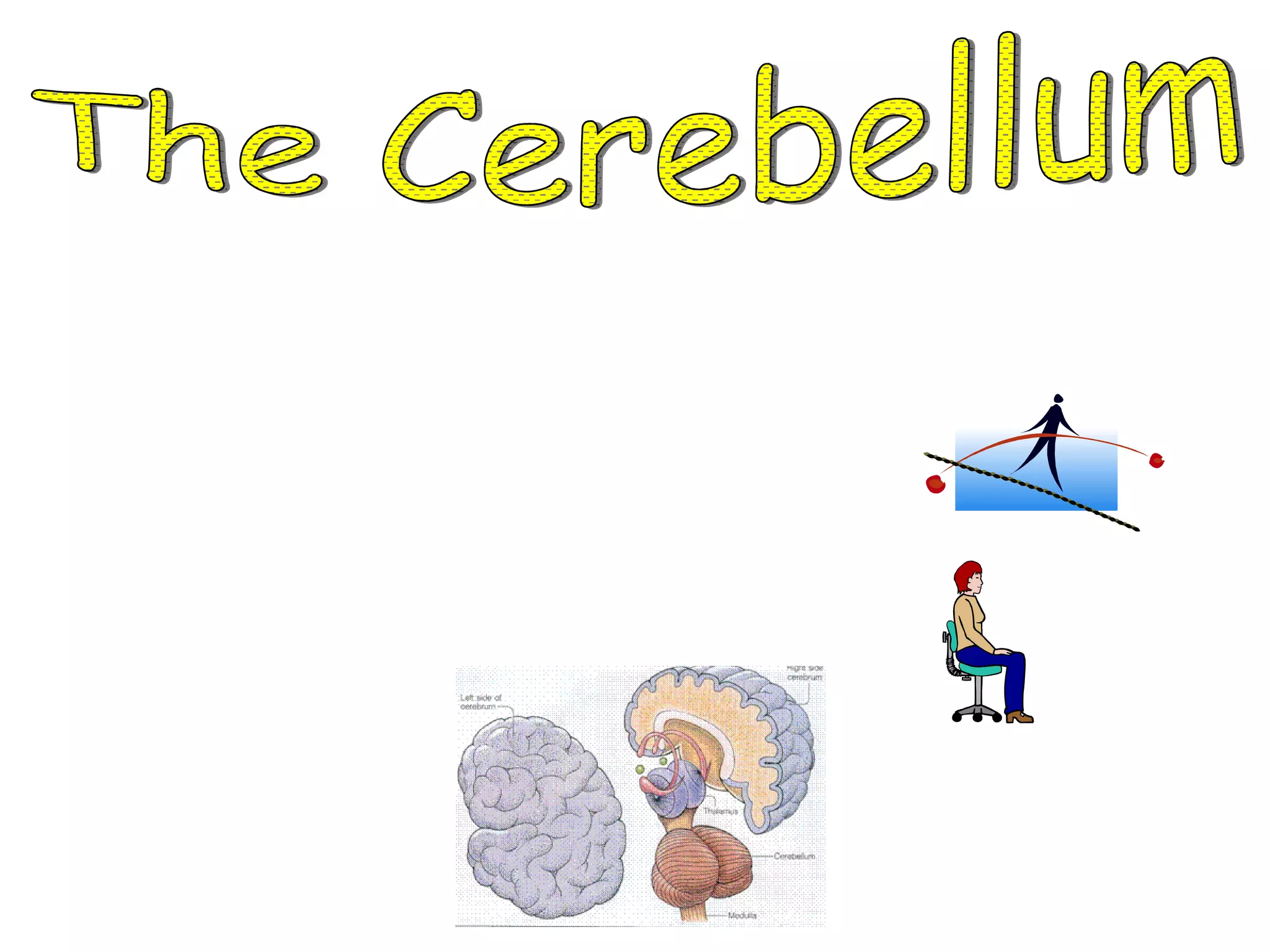
The Cerebellum *  The cerebellum is below and to the back of the cerebrum. 1.  The cerebellum controls you balance. 2.  The cerebellum controls your posture.
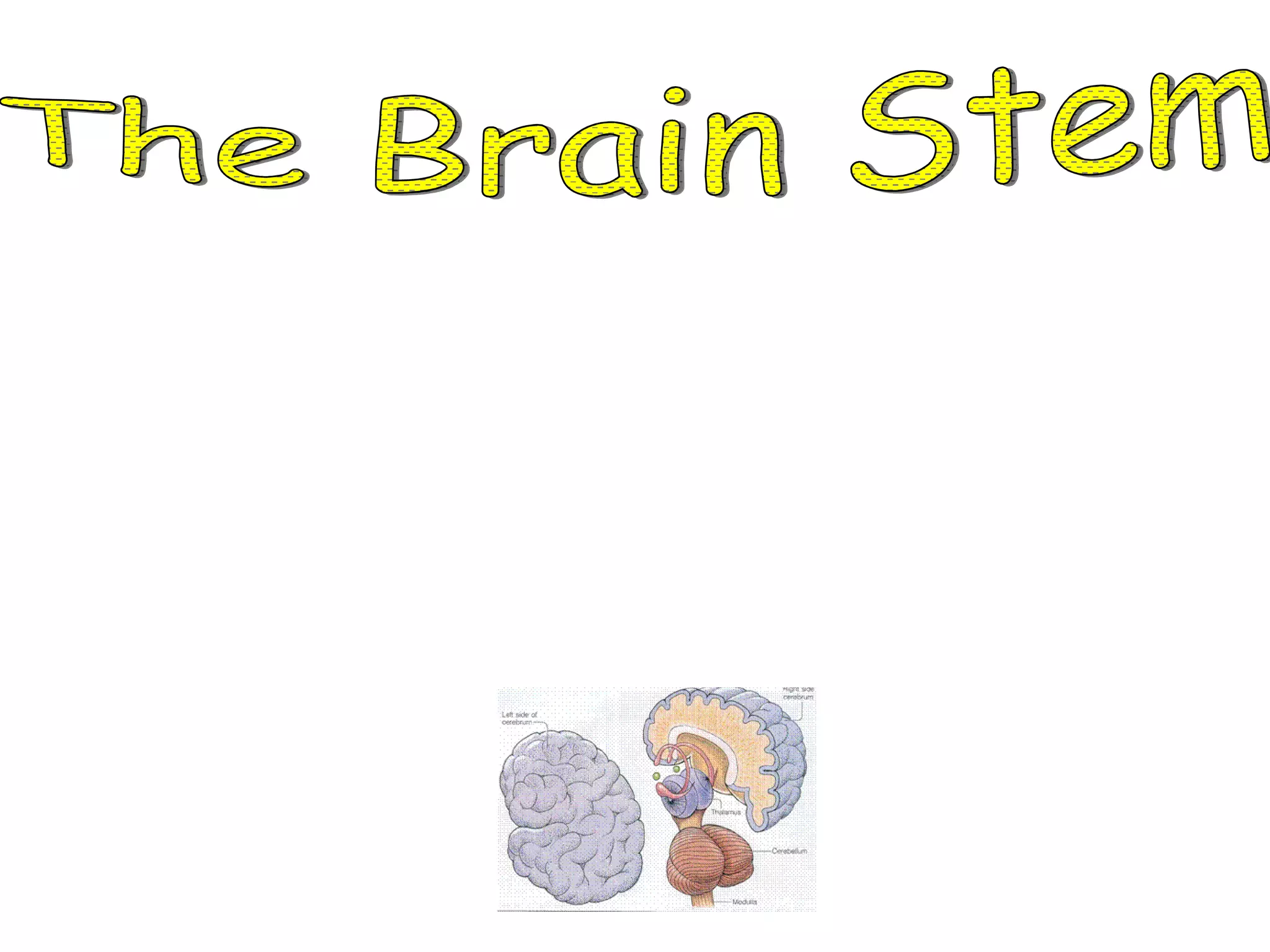
The Brain Stem *  The Brain Stem connects the brain to the spinal cord. *  The nerves in the brain stem control your heartbeat, breathing, and blood pressure.
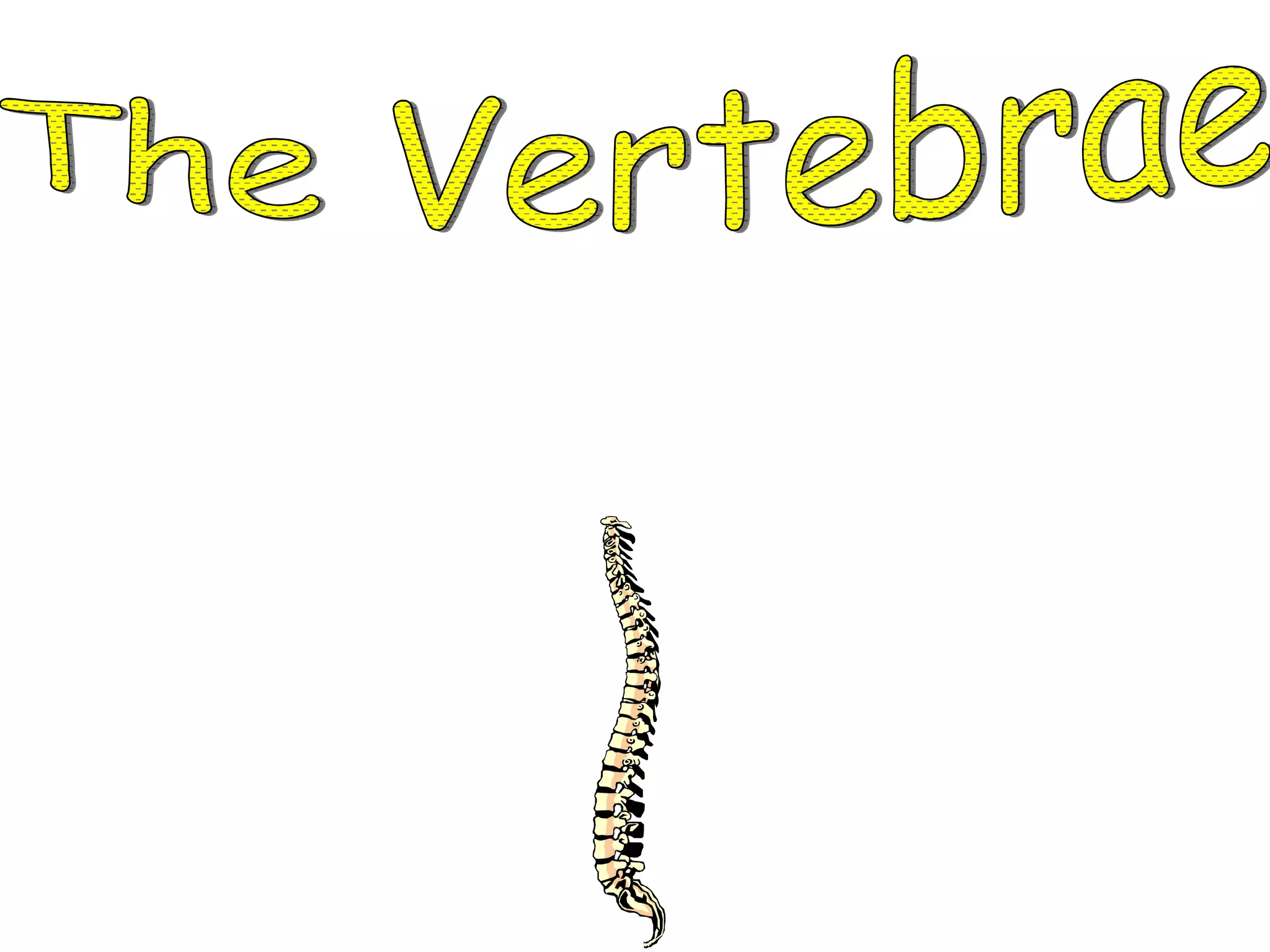
The Vertebrae *  The vertebrae are the many bones that protect the nerves in the spinal cord.
The Outer Nervous System
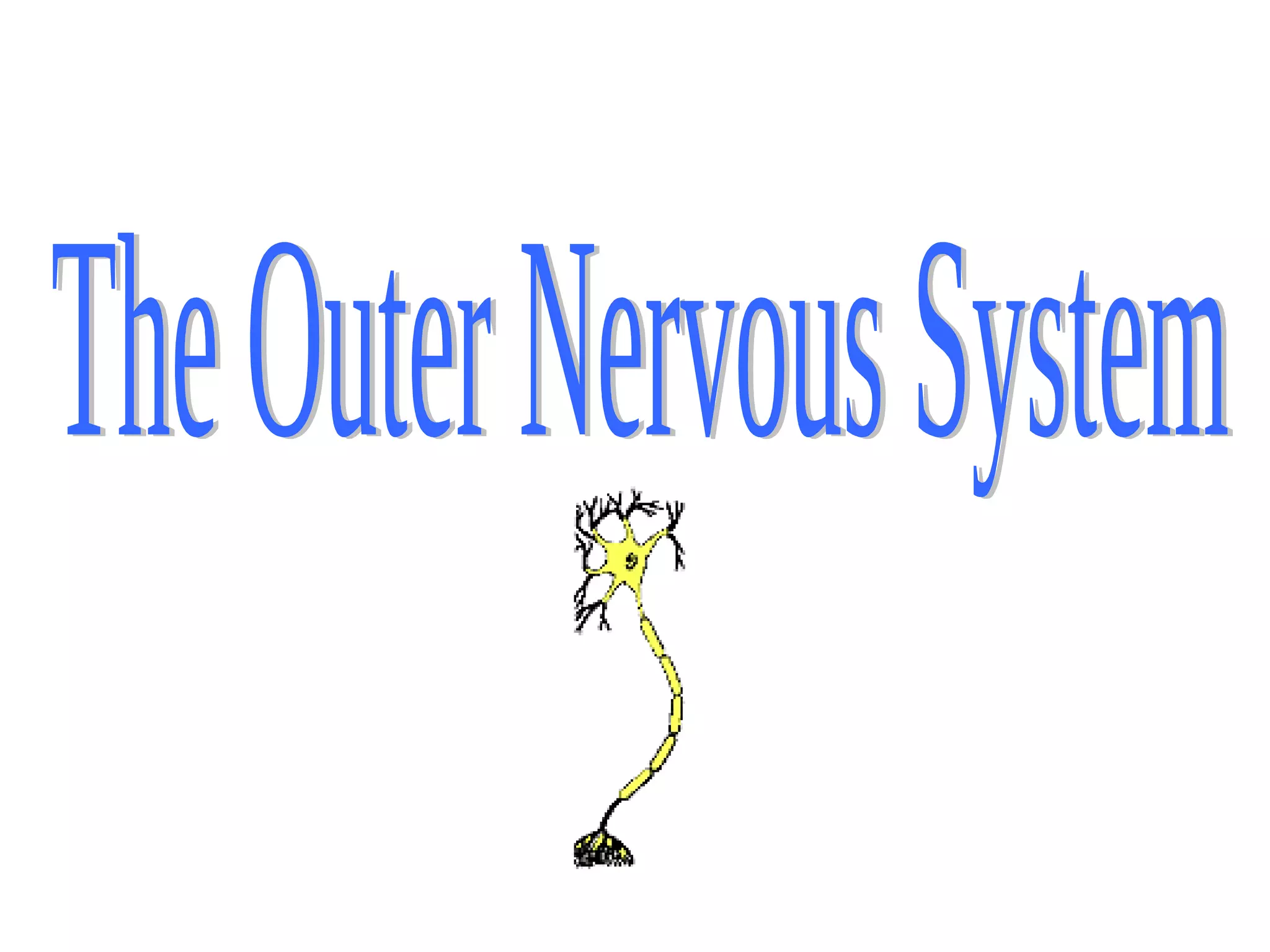
Outer Nervous System *  The Outer Nervous System’s job is to connect the Central Nervous System to the rest of the body. *  The outer nervous system carries messages between the central nervous system and the rest of the body.
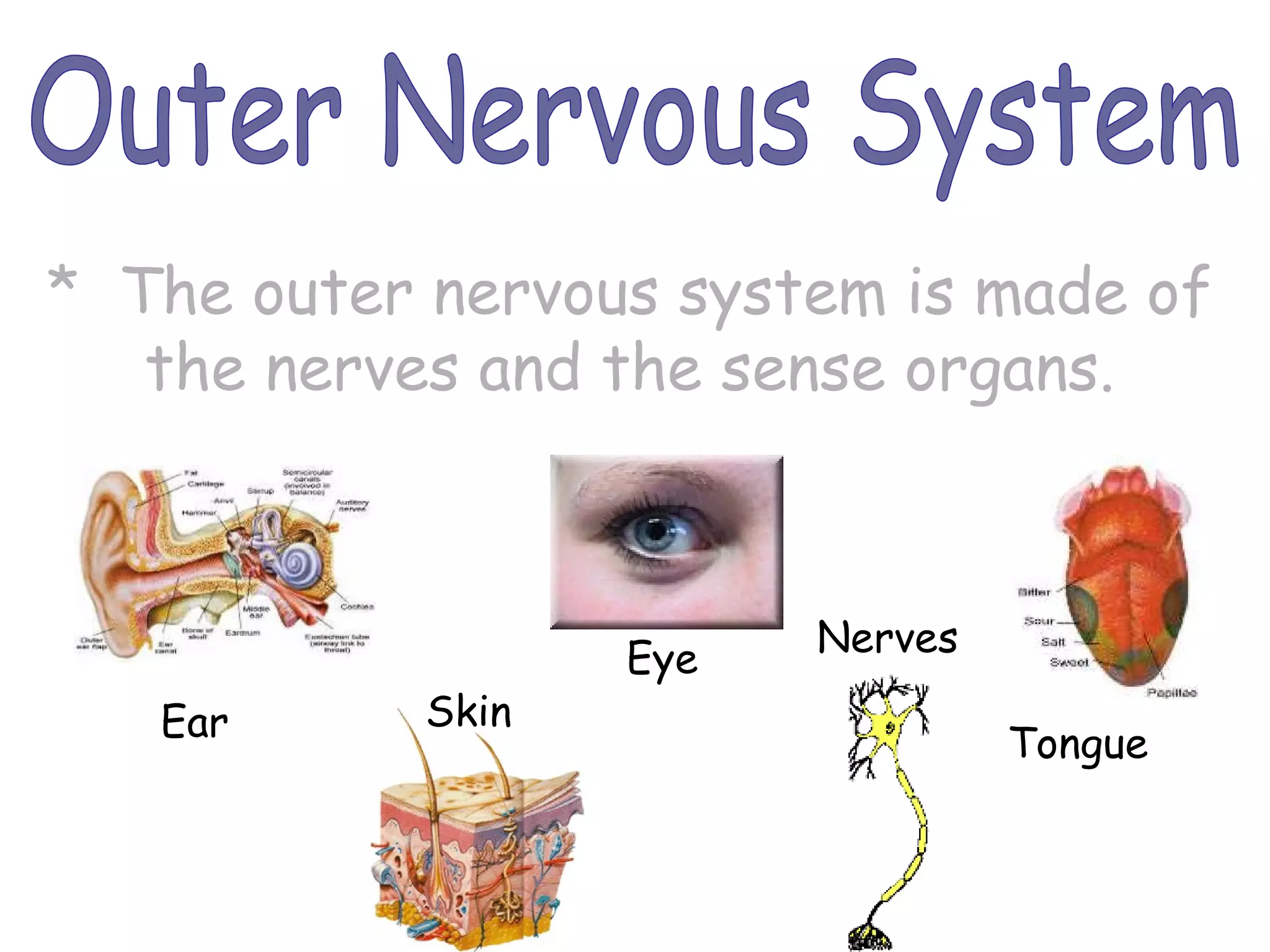
Outer Nervous System *  The outer nervous system is made of the nerves and the sense organs. Ear Eye Skin Nerves Tongue
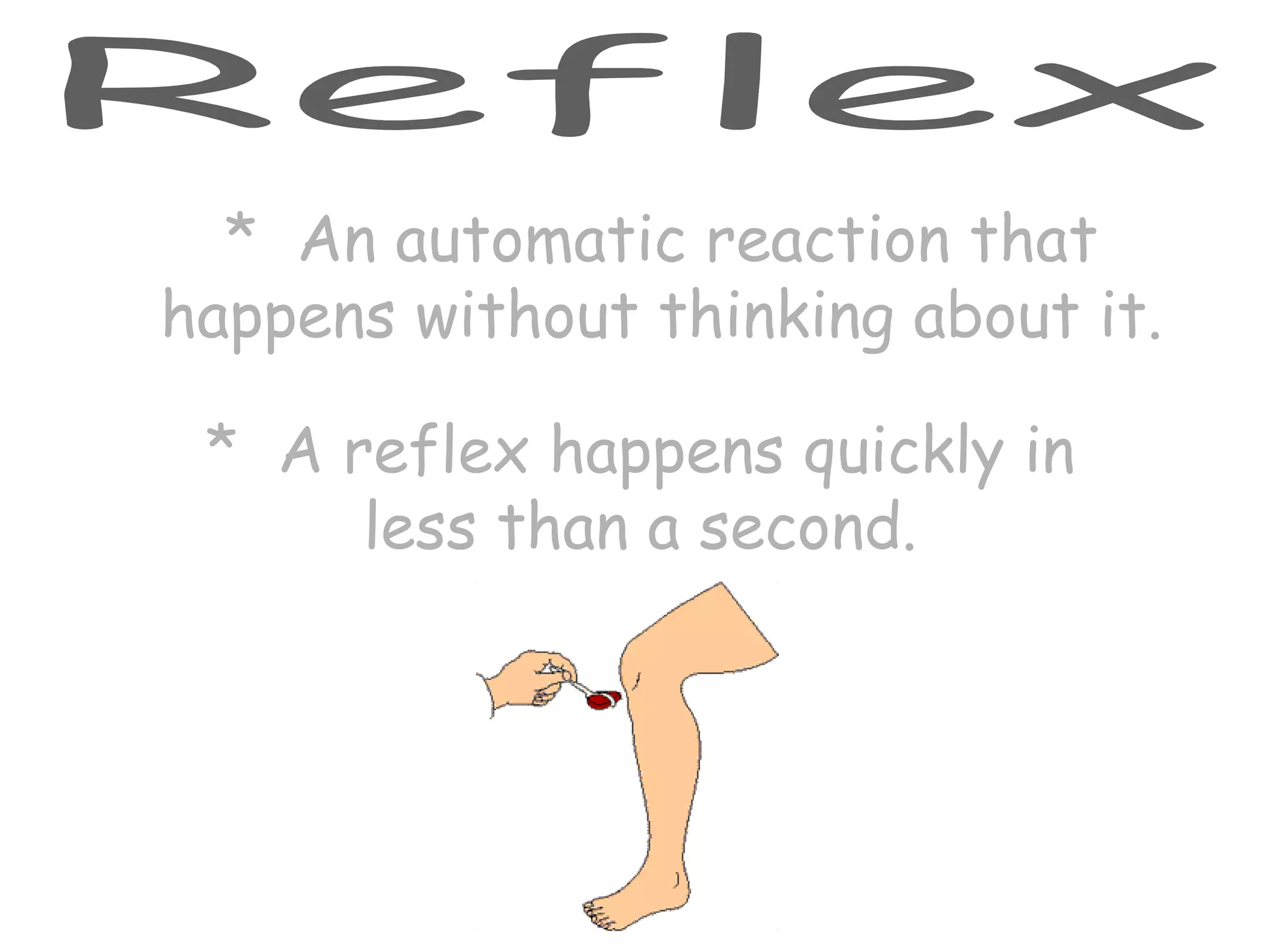
Reflex *  An automatic reaction that happens without thinking about it. *  A reflex happens quickly in less than a second.
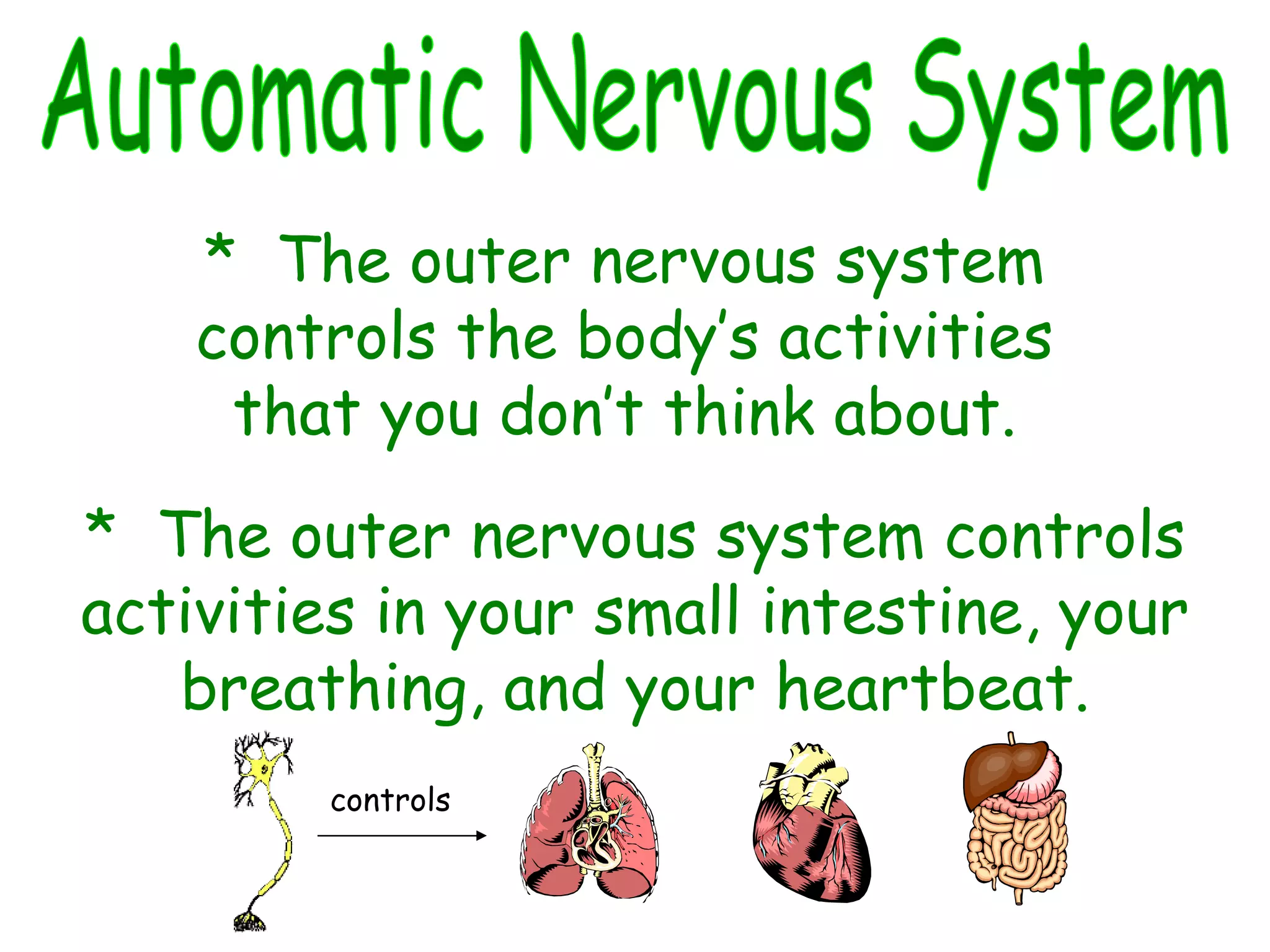
Automatic Nervous System *  The outer nervous system controls the body’s activities that you don’t think about. *  The outer nervous system controls activities in your small intestine, your breathing, and your heartbeat. controls
__  _____
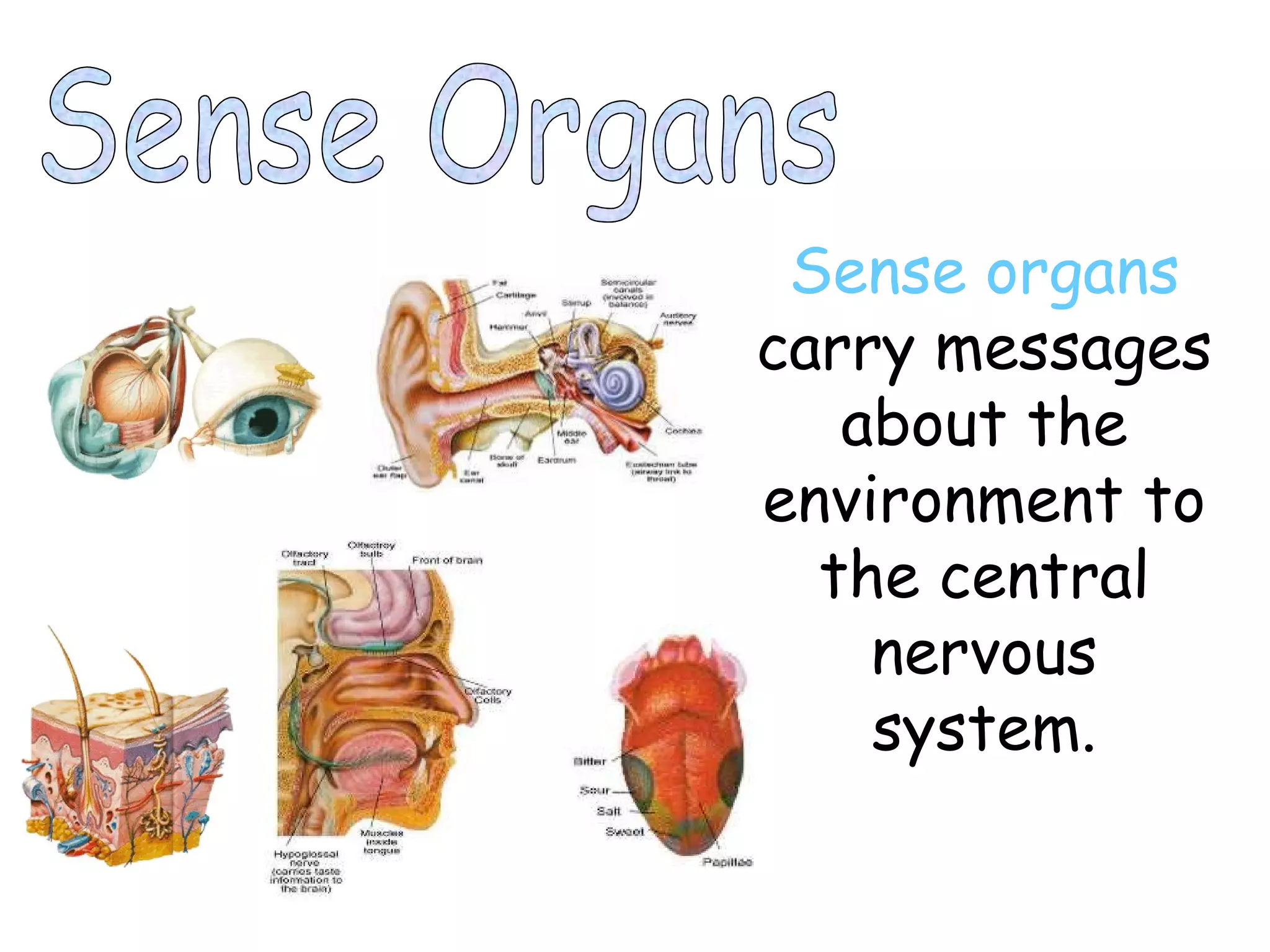
Sense Organs Sense organs  carry messages about the environment to the central nervous system.
Sense Organs The eyes, ears, nose, tongue, and skin are examples of sense organs. The sense organs gather information (light, sound, heat, and pressure) from the environment.
Environment The  environment  is everything outside the body. The sense organs gather information from outside the body, then send the messages to the brain.
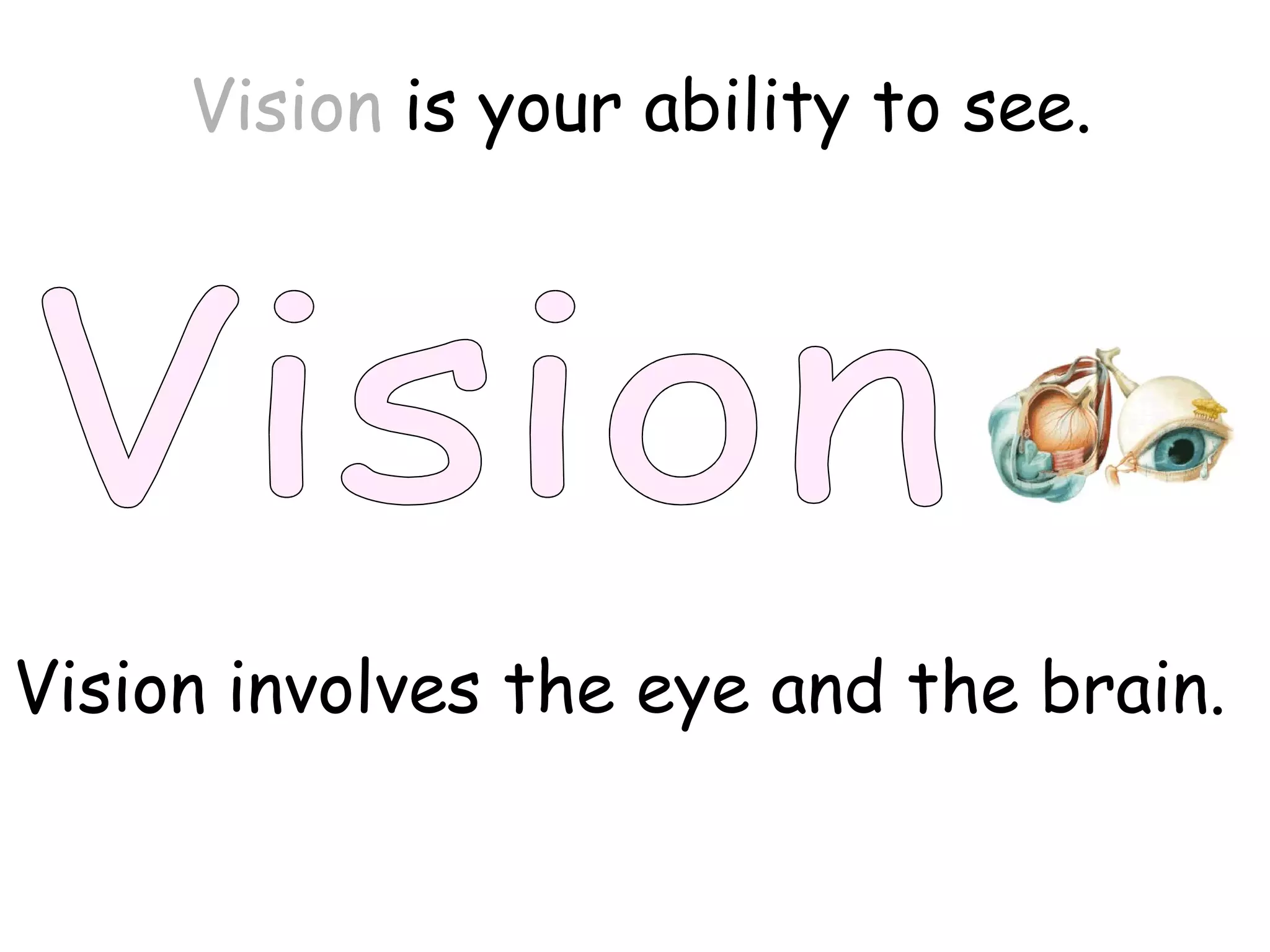
Vision Vision  is your ability to see. Vision involves the eye and the brain.
The Eye The eye  is one of your sense organs. The eye is made of the  iris   and the  pupil . The eye gathers pictures and sends them to the brain.
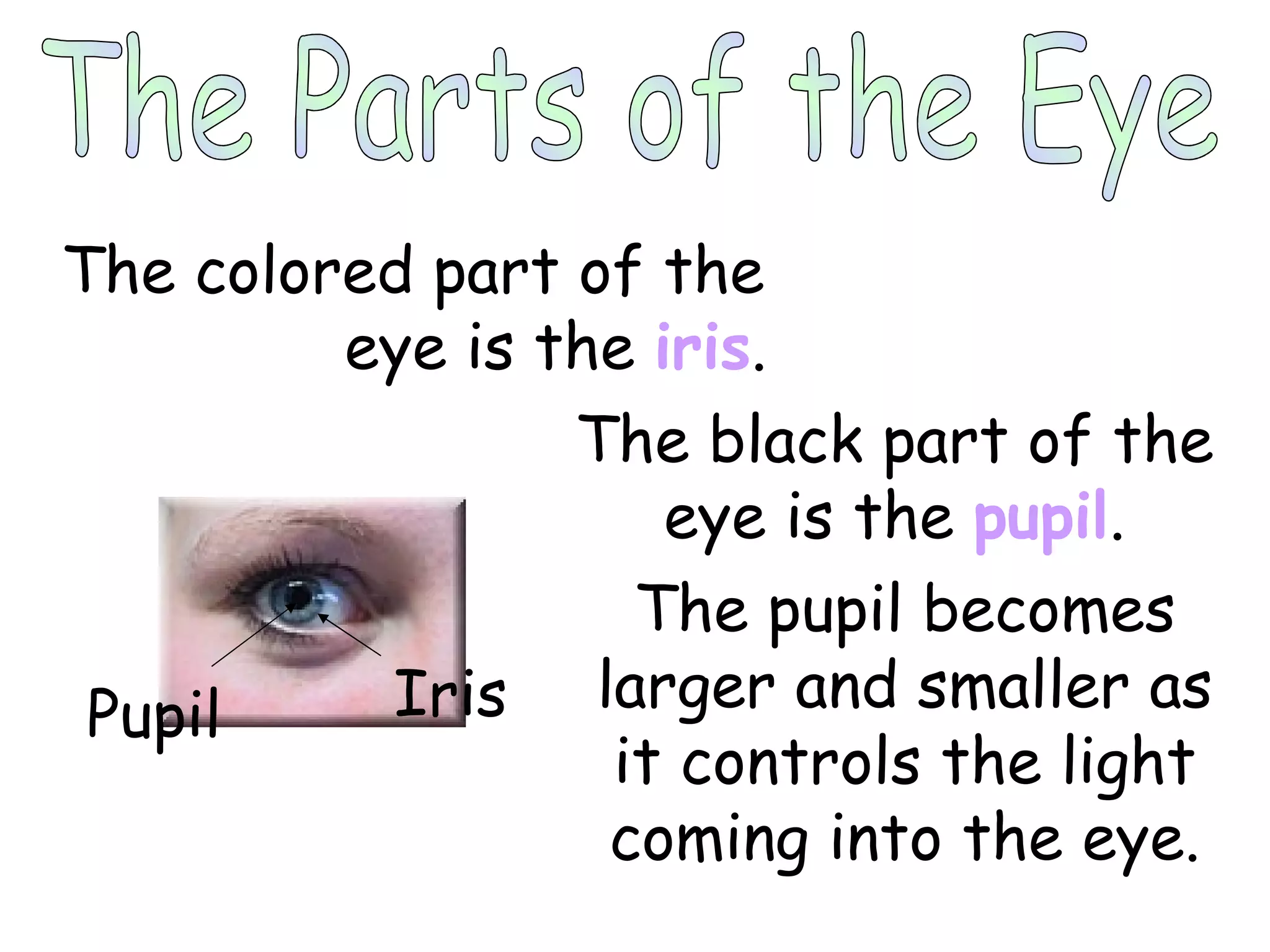
The Parts of the Eye The colored part of the  eye is the  iris . The black part of the eye is the  pupil . The pupil becomes larger and smaller as it controls the light coming into the eye. Iris Pupil
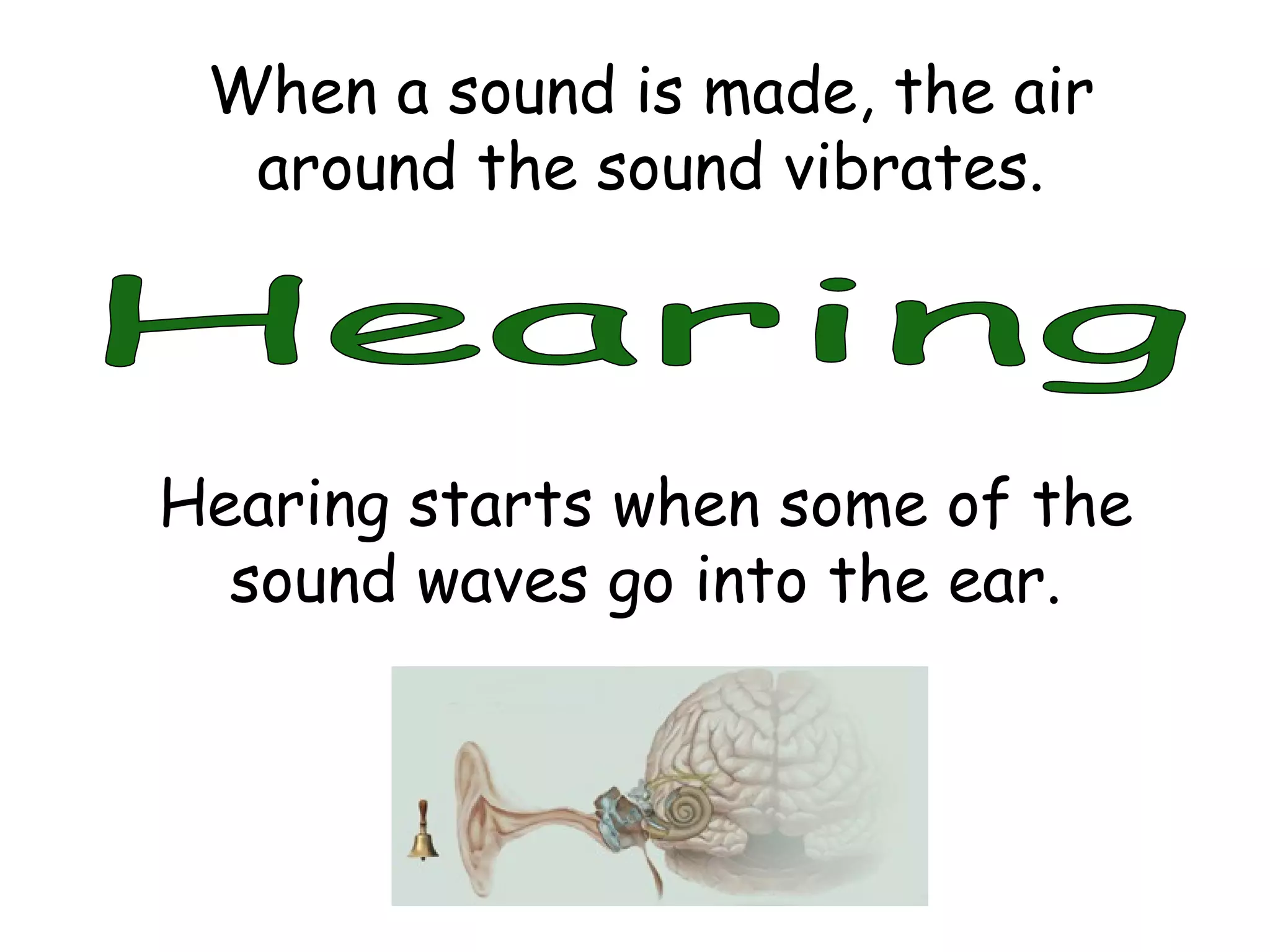
Hearing When a sound is made, the air around the sound vibrates. Hearing starts when some of the sound waves go into the ear.
Parts of the Ear There are nine main parts of the ear. 1.  Pinna 2.  Ear canal 3.  Ear drum 5.  Anvil 6.  Stirrup 7.  Cochlea 4.  Hammer 8.  Eustachian tube 9.  Auditory nerve
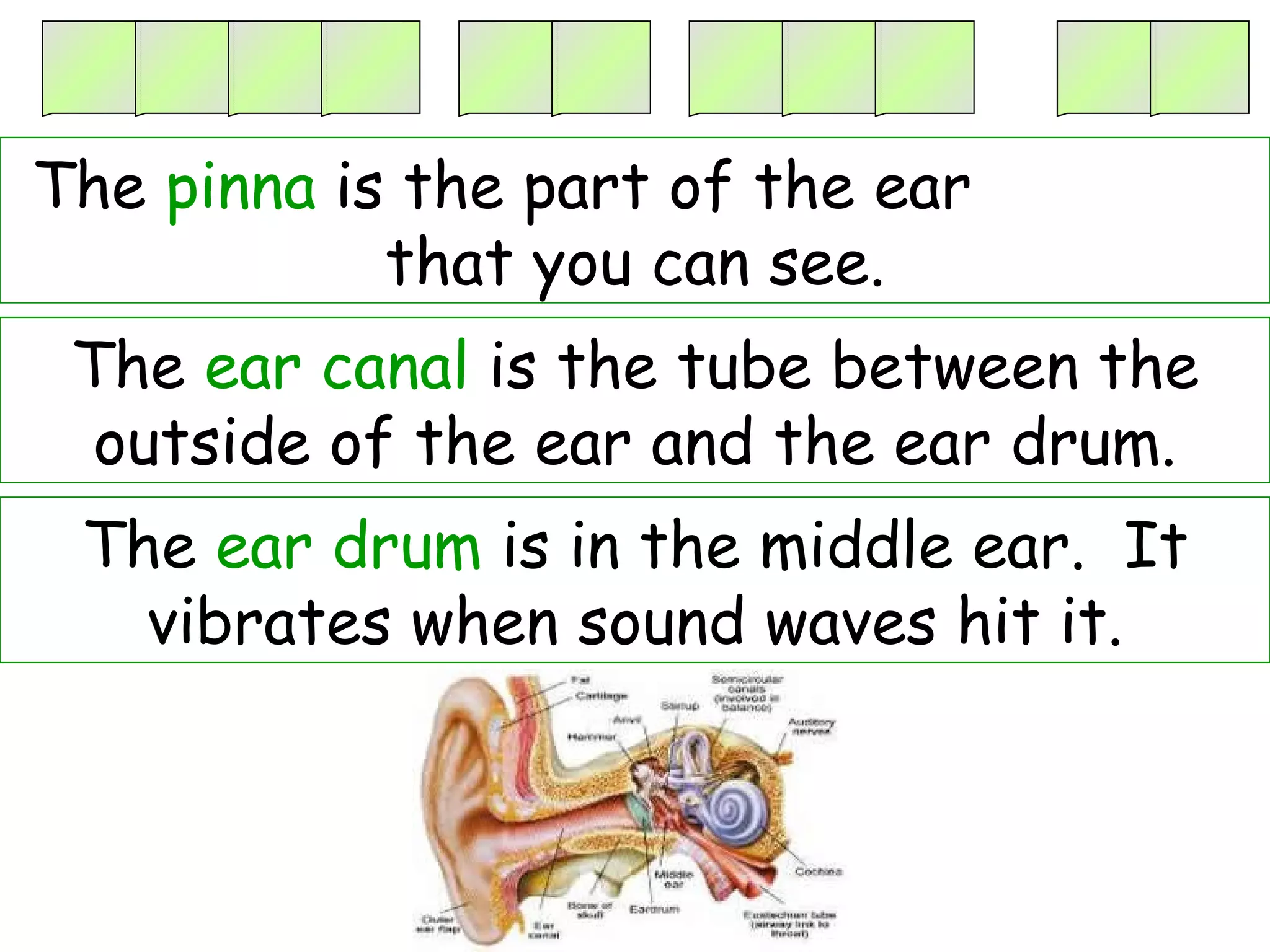
____ __ ___  __ The  ear canal  is the tube between the outside of the ear and the ear drum. The  ear drum  is in the middle ear.  It vibrates when sound waves hit it. The  pinna  is the part of the ear  that you can see.
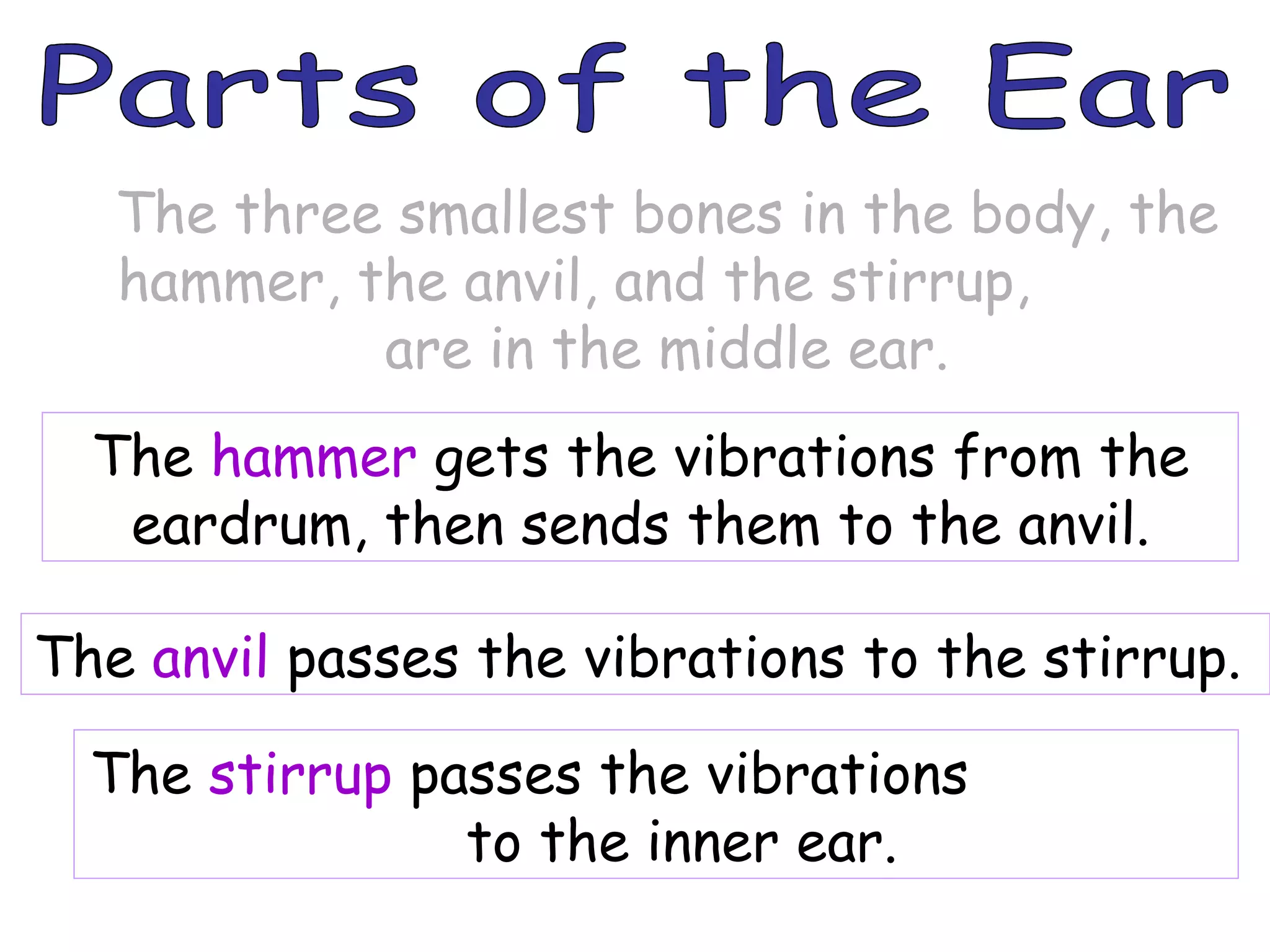
Parts of the Ear The three smallest bones in the body, the hammer, the anvil, and the stirrup,  are in the middle ear. The  hammer  gets the vibrations from the eardrum, then sends them to the anvil. The  anvil  passes the vibrations to the stirrup. The  stirrup  passes the vibrations  to the inner ear.
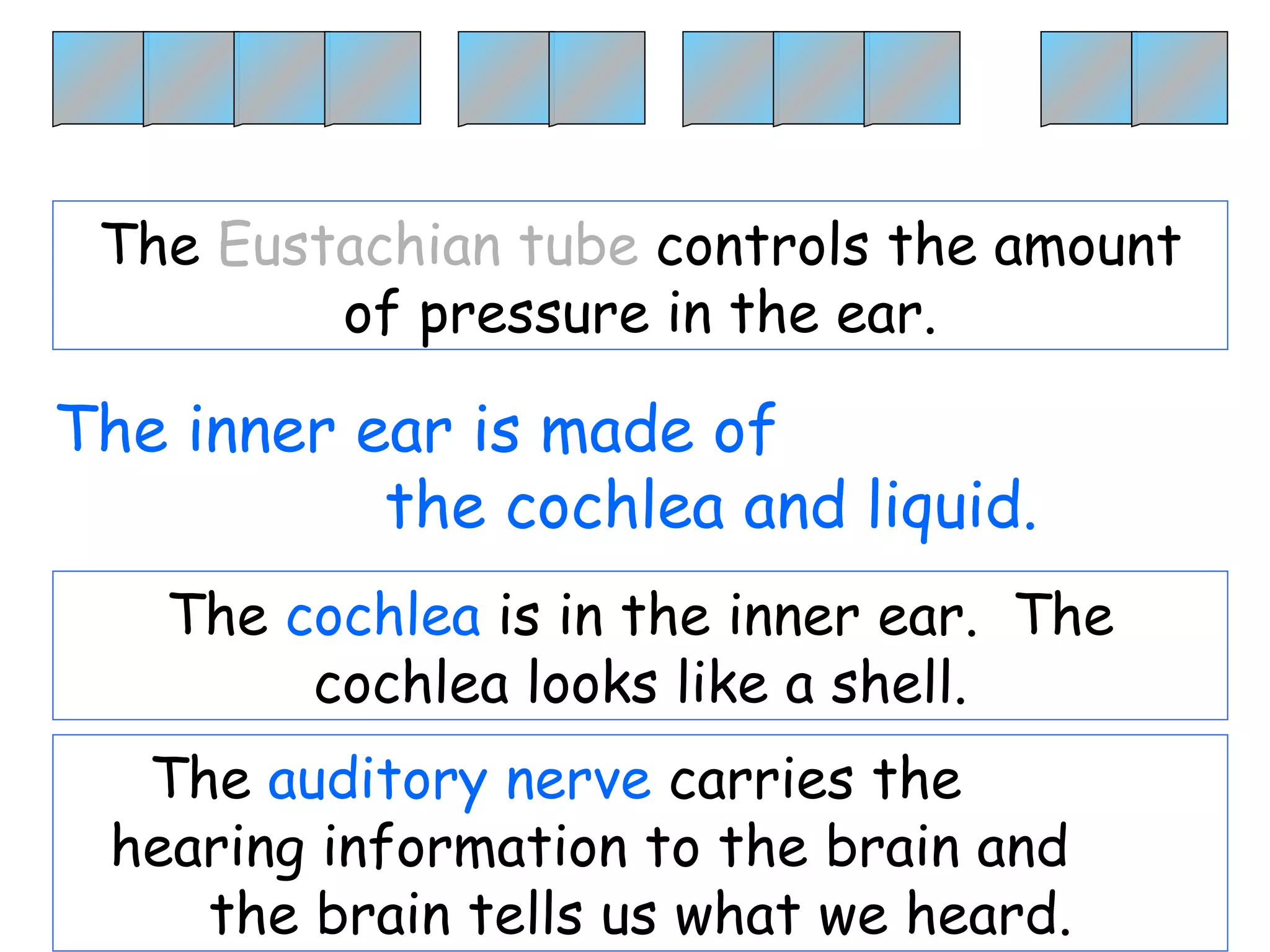
____ __ ___  __ The inner ear is made of  the cochlea and liquid. The  cochlea  is in the inner ear.  The cochlea looks like a shell. The  Eustachian tube  controls the amount of pressure in the ear. The  auditory nerve  carries the  hearing information to the brain and  the brain tells us what we heard.
The Ear and Balance The ear works with the brain to control your balance. All of your movements are controlled by balance and muscles. The liquid in your inner ear is responsible for your balance. The liquid in your ear moves when we move.  The liquid movement sends information to the brain to tell it how we are moving.
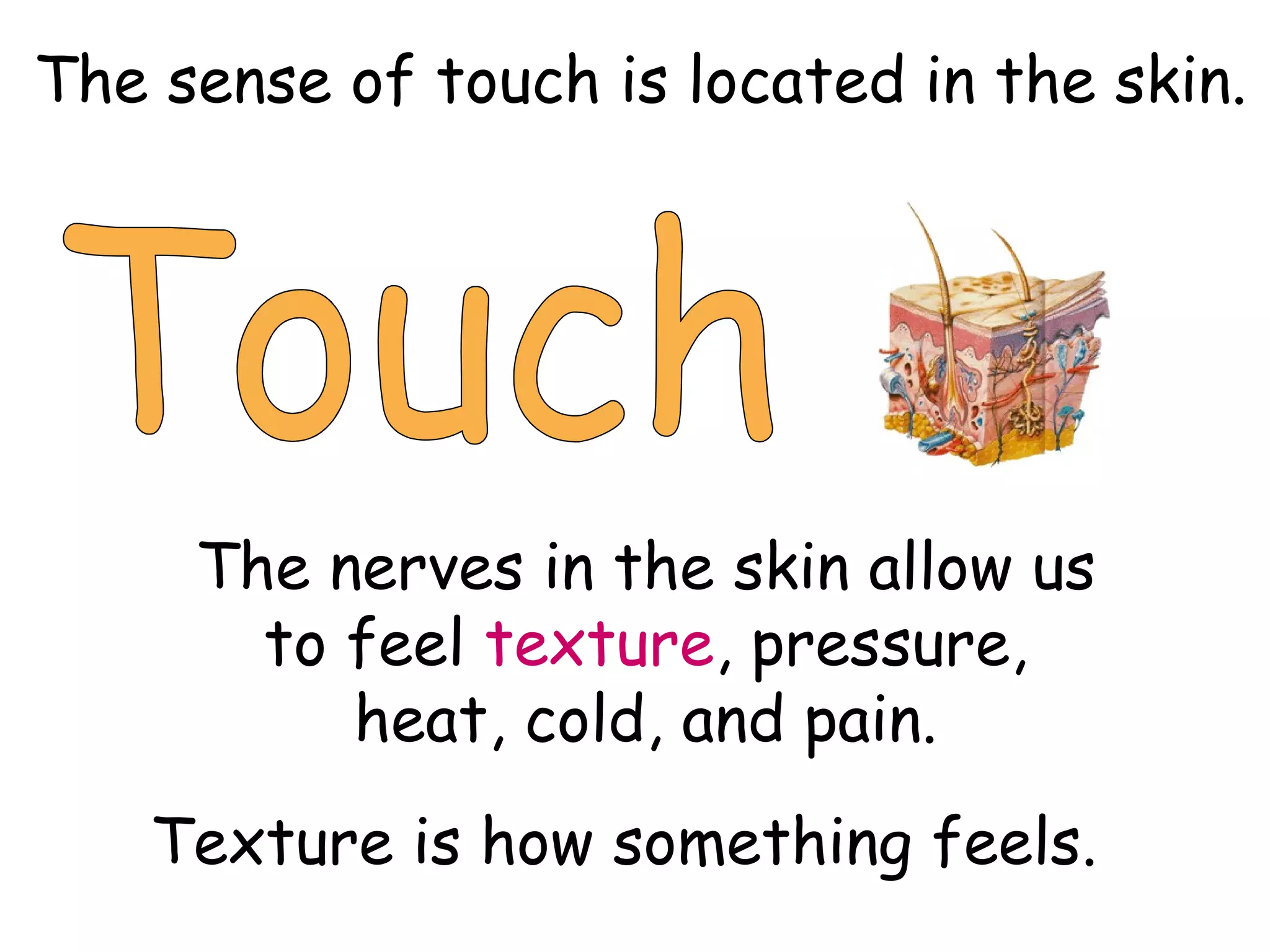
Touch The sense of touch is located in the skin. The nerves in the skin allow us to feel  texture , pressure, heat, cold, and pain. Texture is how something feels.
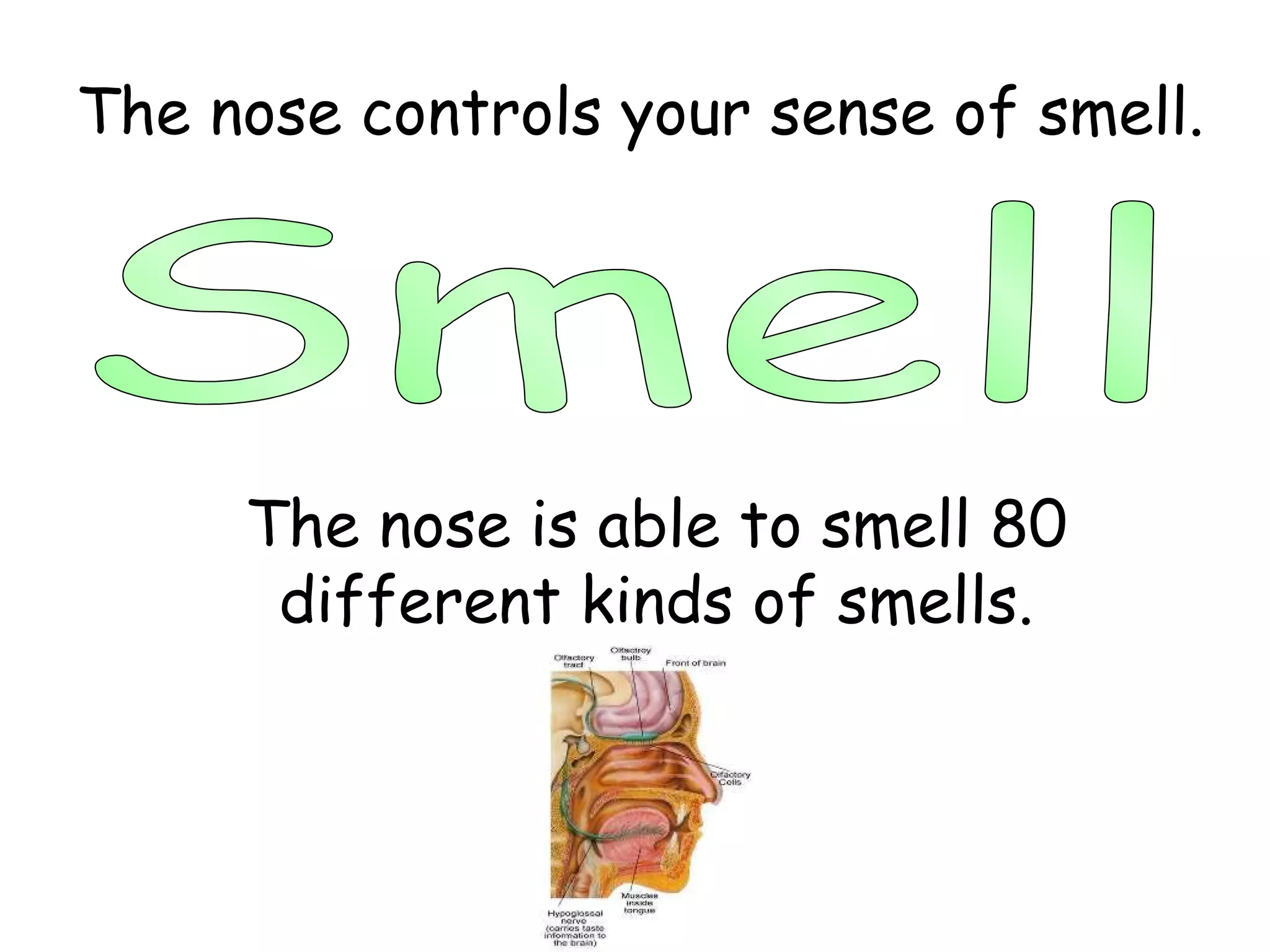
Smell The nose controls your sense of smell. The nose is able to smell 80 different kinds of smells.
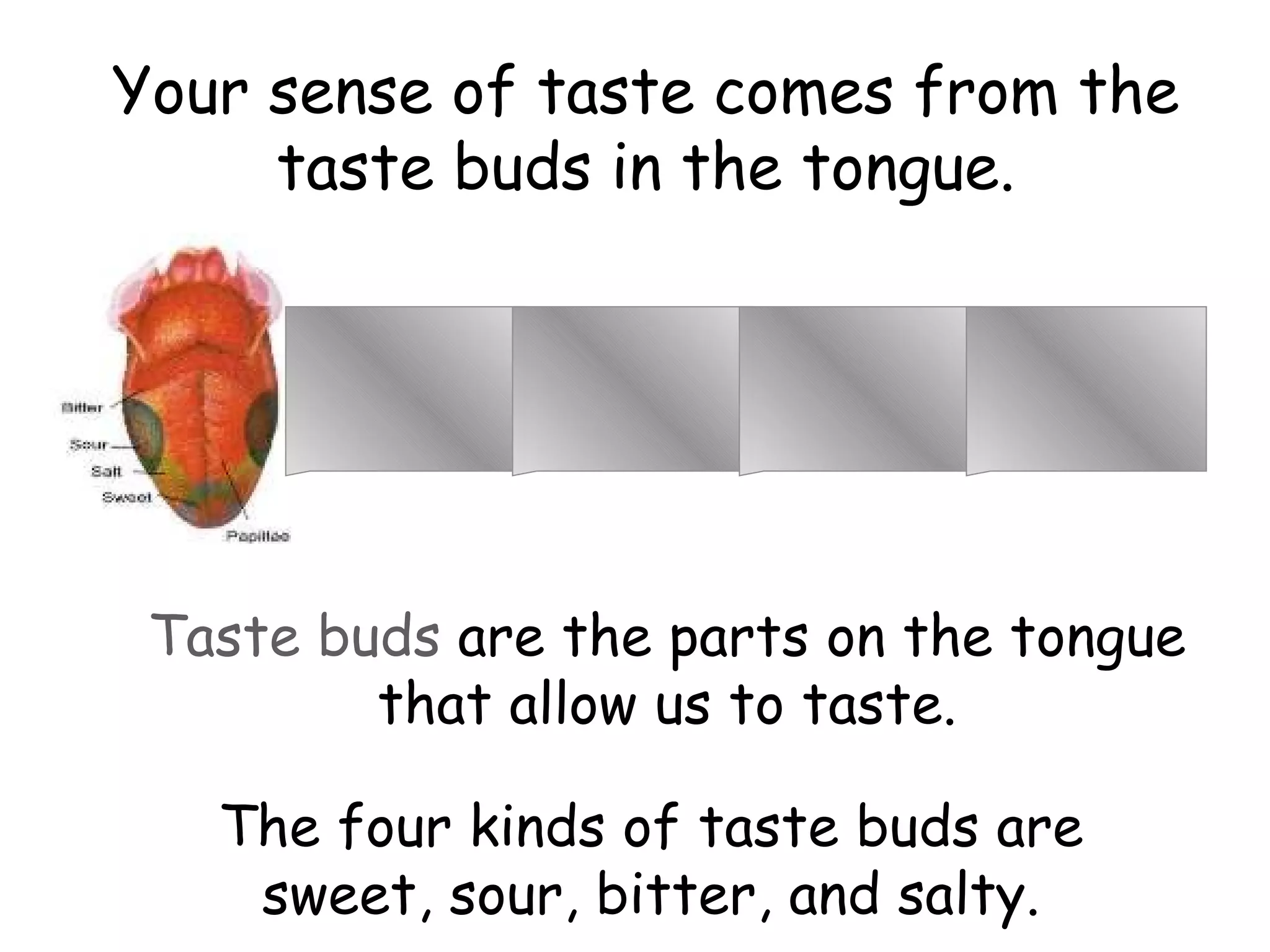
Your sense of taste comes from the taste buds in the tongue. Taste buds  are the parts on the tongue that allow us to taste. The four kinds of taste buds are sweet, sour, bitter, and salty. ____
Flavors Tastes and smells work  together to make flavors. Flavors  are the tastes  of food and drinks.

The Nervous System

  • 1.
    The Nervous SystemChapter Five
  • 2.
    Chapter Five 5-1:The Nervous System
  • 3.
    Nervous System Asystem that controls all of the activities of the body. The nervous system is made of: The brain The spinal cord The nerves The senses
  • 4.
    The nervous systemalso allows you to react to a stimulus. Stimulus A stimulus is a change in the environment. Example: A hot stove Or… tripping over a rock
  • 5.
    Your reactions are automatic. Automatic Automatic means that you do not have to think about your reactions. Example: If a bug flies by your eye, you will blink.
  • 6.
    Brain An organthat controls your emotions, your thoughts, and every movement you make.
  • 7.
    Central Nervous SystemThe Central Nervous System is made of the brain and the spinal cord. The Central Nervous System controls everything in the body.
  • 8.
    Outer Nervous SystemThe Outer Nervous System is made of the nerves and the sense organs. Nerves Sense organs
  • 9.
    Nerve Impulse Messagescarried throughout the body by nerves.
  • 10.
    "Funny Bone" Youhave a nerve along your whole arm. The “funny bone” is the only place on the arm where the nerve is not protected. The “funny bone” is on the elbow.
  • 11.
    The Nervous System5-2 The Central Nervous System
  • 12.
    The Central NervousSystem * The Central Nervous System controls all of the body’s activities. * The Central Nervous System is made of two main organs. 1. The brain 2. The spinal cord
  • 13.
    The Spinal Cord* The spinal cord sends messages to the brain. * The spinal cord is the part of the nervous system that connects the brain to the rest of the nervous system.
  • 14.
    The Brain * The brain controls everything in the body. * The brain is made of more than 10 billion nerves! * The brain is divided into three parts and is protected by the skull.
  • 15.
    The Three Partsof the Brain * The Brain has three main parts… 1. The Cerebrum 2. The Cerebellum 3. The Brain Stem
  • 16.
    The Cerebrum * The Cerebrum is the largest part of the brain. 1. The cerebrum controls your thinking. 2. The cerebrum controls your memory. 3. The cerebrum controls your speaking. 4. The cerebrum controls your movement and identifies the information gathered by your sense organs.
  • 17.
    The Cerebellum * The cerebellum is below and to the back of the cerebrum. 1. The cerebellum controls you balance. 2. The cerebellum controls your posture.
  • 18.
    The Brain Stem* The Brain Stem connects the brain to the spinal cord. * The nerves in the brain stem control your heartbeat, breathing, and blood pressure.
  • 19.
    The Vertebrae * The vertebrae are the many bones that protect the nerves in the spinal cord.
  • 20.
  • 21.
    Outer Nervous System* The Outer Nervous System’s job is to connect the Central Nervous System to the rest of the body. * The outer nervous system carries messages between the central nervous system and the rest of the body.
  • 22.
    Outer Nervous System* The outer nervous system is made of the nerves and the sense organs. Ear Eye Skin Nerves Tongue
  • 23.
    Reflex * An automatic reaction that happens without thinking about it. * A reflex happens quickly in less than a second.
  • 24.
    Automatic Nervous System* The outer nervous system controls the body’s activities that you don’t think about. * The outer nervous system controls activities in your small intestine, your breathing, and your heartbeat. controls
  • 25.
  • 26.
    Sense Organs Senseorgans carry messages about the environment to the central nervous system.
  • 27.
    Sense Organs Theeyes, ears, nose, tongue, and skin are examples of sense organs. The sense organs gather information (light, sound, heat, and pressure) from the environment.
  • 28.
    Environment The environment is everything outside the body. The sense organs gather information from outside the body, then send the messages to the brain.
  • 29.
    Vision Vision is your ability to see. Vision involves the eye and the brain.
  • 30.
    The Eye Theeye is one of your sense organs. The eye is made of the iris and the pupil . The eye gathers pictures and sends them to the brain.
  • 31.
    The Parts ofthe Eye The colored part of the eye is the iris . The black part of the eye is the pupil . The pupil becomes larger and smaller as it controls the light coming into the eye. Iris Pupil
  • 32.
    Hearing When asound is made, the air around the sound vibrates. Hearing starts when some of the sound waves go into the ear.
  • 33.
    Parts of theEar There are nine main parts of the ear. 1. Pinna 2. Ear canal 3. Ear drum 5. Anvil 6. Stirrup 7. Cochlea 4. Hammer 8. Eustachian tube 9. Auditory nerve
  • 34.
    ____ __ ___ __ The ear canal is the tube between the outside of the ear and the ear drum. The ear drum is in the middle ear. It vibrates when sound waves hit it. The pinna is the part of the ear that you can see.
  • 35.
    Parts of theEar The three smallest bones in the body, the hammer, the anvil, and the stirrup, are in the middle ear. The hammer gets the vibrations from the eardrum, then sends them to the anvil. The anvil passes the vibrations to the stirrup. The stirrup passes the vibrations to the inner ear.
  • 36.
    ____ __ ___ __ The inner ear is made of the cochlea and liquid. The cochlea is in the inner ear. The cochlea looks like a shell. The Eustachian tube controls the amount of pressure in the ear. The auditory nerve carries the hearing information to the brain and the brain tells us what we heard.
  • 37.
    The Ear andBalance The ear works with the brain to control your balance. All of your movements are controlled by balance and muscles. The liquid in your inner ear is responsible for your balance. The liquid in your ear moves when we move. The liquid movement sends information to the brain to tell it how we are moving.
  • 38.
    Touch The senseof touch is located in the skin. The nerves in the skin allow us to feel texture , pressure, heat, cold, and pain. Texture is how something feels.
  • 39.
    Smell The nosecontrols your sense of smell. The nose is able to smell 80 different kinds of smells.
  • 40.
    Your sense oftaste comes from the taste buds in the tongue. Taste buds are the parts on the tongue that allow us to taste. The four kinds of taste buds are sweet, sour, bitter, and salty. ____
  • 41.
    Flavors Tastes andsmells work together to make flavors. Flavors are the tastes of food and drinks.