Nervous System6th Grade Science
I. FunctionA. Receive information (Stimulation)B. Store informationC. Make decisionsD. Send Responses to Body (Response)E. Maintain Homeostasis
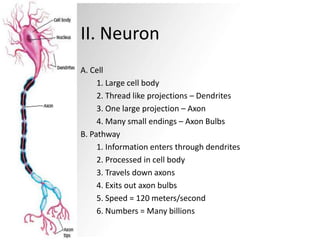
II. NeuronA. Cell	1. Large cell body	2. Thread like projections – Dendrites	3. One large projection – Axon	4. Many small endings – Axon BulbsB. Pathway	1. Information enters through dendrites	2. Processed in cell body	3. Travels down axons	4. Exits out axon bulbs	5. Speed = 120 meters/second	6. Numbers = Many billions
C. Synapse 1. Axon Bulbi. Release chemical		a. Neurotransmitter		b. Exocytosis	ii. Signal dendrite	iii. Up to 10,000 links
III. PartsA. Central Nervous System (CNS)1. Braini. Number = 100 billion neurons	ii. Parts				a. Cerebrum (thought)			b. Cerebellum (muscle)			c. Brain Stem (life support)2. Spinal Cord (link to PNS)
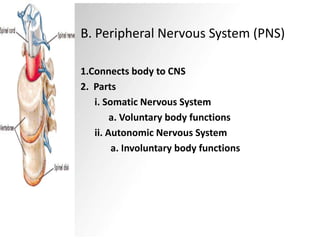
B. Peripheral Nervous System (PNS)1.Connects body to CNS2.  Partsi. Somatic Nervous Systema. Voluntary body functionsii. Autonomic Nervous System	a. Involuntary body functions
IV. ReflexesA. Rapid Response (without knowledge)	1. Sensory Neuron Detects	2. Spinal Cord Sends Response	3. Nerves Move Muscles in hand	4. Spinal Cord Notifies Brain of action taken
V. InjuriesA. Concussions	1. Bruising Brain	2. Brain Pushed against skull	3. May result in death or long term damageB. Spinal Cord	1. Lack control below injured nerves	2. Result in paralysis or death
VI. DrugsA. Definition: Any chemical that changes behaviorB. Drug Abuse: Deliberate misuse of drug	1. Mood changes	2. Lying & Cheating	3. Forgetfulness	4. Withdrawn	5. Aggressive	6. Slurred speech
C. Tolerance1. Body adjusts to drug so large amounts are needed2. Overdose becomes higher risk
D. Addiction1. Body altered by drug2. Physical dependence on chemical3. Sever withdrawal symptoms may occur when normal body chemistry is restored
E. Other Effects1. Pathogens for dirty needles2. Legal problems3. School/work problems
F. Types of Drugs1. Depressantsi. Slow central nervous systemii. Muscles relax to point of sleep2. Stimulantsi. Speed up Central Nervous Systemii. Rapid heart rate, breathing, …3. Inhalants: Into lungs4. Hallucinogens: see or hear things not real5. Steroidsi. Increase muscle sizeii. Internal organ damageiii. Mood alteration
6. Alcoholi. Absorbed directly by stomachii. Blood Alcohol Concentration (BAC)	a. 0.1 BAC is 0.1% alcohol	b. 0.08 BAC is legally drunkiii. Danger	 Every two minutes someone dead by alcoholiv. Long Term Abuse	a. Mental change	b. Liver Damage
Quiz

Nervous system

  • 1.
  • 2.
    I. FunctionA. Receiveinformation (Stimulation)B. Store informationC. Make decisionsD. Send Responses to Body (Response)E. Maintain Homeostasis
  • 3.
    II. NeuronA. Cell 1.Large cell body 2. Thread like projections – Dendrites 3. One large projection – Axon 4. Many small endings – Axon BulbsB. Pathway 1. Information enters through dendrites 2. Processed in cell body 3. Travels down axons 4. Exits out axon bulbs 5. Speed = 120 meters/second 6. Numbers = Many billions
  • 4.
    C. Synapse 1.Axon Bulbi. Release chemical a. Neurotransmitter b. Exocytosis ii. Signal dendrite iii. Up to 10,000 links
  • 5.
    III. PartsA. CentralNervous System (CNS)1. Braini. Number = 100 billion neurons ii. Parts a. Cerebrum (thought) b. Cerebellum (muscle) c. Brain Stem (life support)2. Spinal Cord (link to PNS)
  • 6.
    B. Peripheral NervousSystem (PNS)1.Connects body to CNS2. Partsi. Somatic Nervous Systema. Voluntary body functionsii. Autonomic Nervous System a. Involuntary body functions
  • 7.
    IV. ReflexesA. RapidResponse (without knowledge) 1. Sensory Neuron Detects 2. Spinal Cord Sends Response 3. Nerves Move Muscles in hand 4. Spinal Cord Notifies Brain of action taken
  • 8.
    V. InjuriesA. Concussions 1.Bruising Brain 2. Brain Pushed against skull 3. May result in death or long term damageB. Spinal Cord 1. Lack control below injured nerves 2. Result in paralysis or death
  • 9.
    VI. DrugsA. Definition:Any chemical that changes behaviorB. Drug Abuse: Deliberate misuse of drug 1. Mood changes 2. Lying & Cheating 3. Forgetfulness 4. Withdrawn 5. Aggressive 6. Slurred speech
  • 10.
    C. Tolerance1. Bodyadjusts to drug so large amounts are needed2. Overdose becomes higher risk
  • 11.
    D. Addiction1. Bodyaltered by drug2. Physical dependence on chemical3. Sever withdrawal symptoms may occur when normal body chemistry is restored
  • 12.
    E. Other Effects1.Pathogens for dirty needles2. Legal problems3. School/work problems
  • 13.
    F. Types ofDrugs1. Depressantsi. Slow central nervous systemii. Muscles relax to point of sleep2. Stimulantsi. Speed up Central Nervous Systemii. Rapid heart rate, breathing, …3. Inhalants: Into lungs4. Hallucinogens: see or hear things not real5. Steroidsi. Increase muscle sizeii. Internal organ damageiii. Mood alteration
  • 14.
    6. Alcoholi. Absorbeddirectly by stomachii. Blood Alcohol Concentration (BAC) a. 0.1 BAC is 0.1% alcohol b. 0.08 BAC is legally drunkiii. Danger Every two minutes someone dead by alcoholiv. Long Term Abuse a. Mental change b. Liver Damage
  • 15.