Unit 2 sensitivity and
coordination

   Maria boizas
Stimuli

 A  stimulus is anything you
   see,hear,touch,smell or taste.
  There are two types of stimuli:
    Internalstimuli
    External stimuli
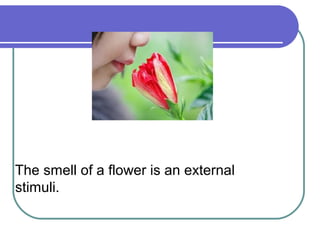
The smell of a flower is an external
stimuli.
receptors


 Thereare two types of receptors:
  Internal receptors

  External receptors
Responses

 A   response is the body’s answer to a
   stimulus
  There are two different types of
   responses:
    Muscular responses
    Glandular responses
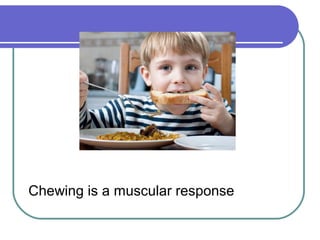
Chewing is a muscular response
The senses
sight
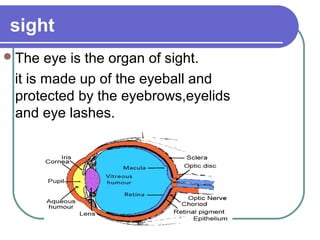
 The  eye is the organ of sight.
 it is made up of the eyeball and
 protected by the eyebrows,eyelids
 and eye lashes.
Process of sight

  First light goes through the cornea.
  Then light passes through the pupil,the
   opening of the iris.
  After that light passes through the lens
   with focuses the image on the retina.
  The information in the retina travels to
   the brain through the optic nerve
smell
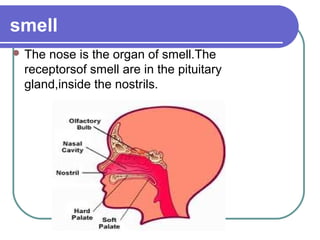
 Thenose is the organ of smell.The
 receptorsof smell are in the pituitary
 gland,inside the nostrils.
hearing
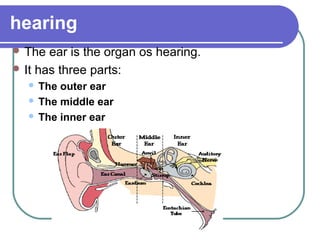
 The  ear is the organ os hearing.
 It has three parts:
   The outer ear
   The middle ear

   The inner ear
The process of hearing

  First the outer ear receives sounds
  Then the middle ear changes sounds
   into vibrations.
  Finally the inner ear changes vibrations
   into nerve impulses that go to the brain
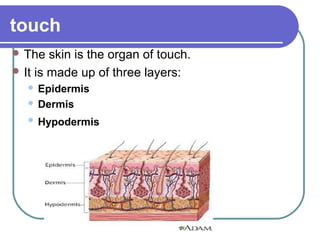
touch
 The   skin is the organ of touch.
 It is made up of three layers:
    Epidermis
    Dermis

      Hypodermis
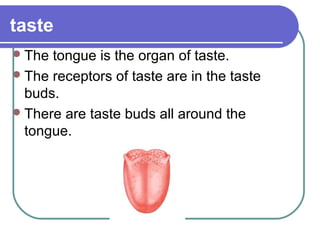
taste
 The tongue is the organ of taste.
 The receptors of taste are in the taste
  buds.
 There are taste buds all around the
  tongue.
The nervous system


 The nervous system is made up of
  nerve centres and nerves.
 The
    peripheral nervous system is
 made up of:
   Sensory nerves
   Motor nerves

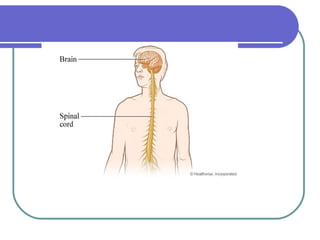
 The central nervous system has two
 parts:
   The brain
   The spinal cord
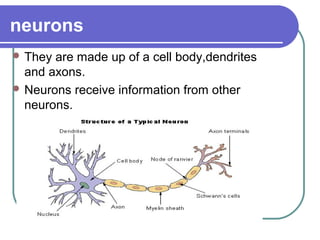
neurons
 They are made up of a cell body,dendrites
  and axons.
 Neurons receive information from other
  neurons.
Voluntary and involuntary
movements


 Ourbodies react to stimuli making
 voluntary or involuntary movements.
Voluntary movements

  When  we see the clouds our sensory
   nerves inform the brain about this.
  Our brain processes the information and
   produces a response.
  Our motor nerves transmit a response to
   the muscles.
Involuntary movements


  The spinal cord produces a response in
  the case of involuntary movements.
    Sensory   nerves transmit information about
     involuntary movements to the spinal cord.
    The spinal cord produces a very fast
     response.
The skeletal system

  Theskeletal and muscular system is in
  charge of carrying muscular responses
  created by the nervous system.it is
  made up of the skeleton and the
  musculature.
The skeleton

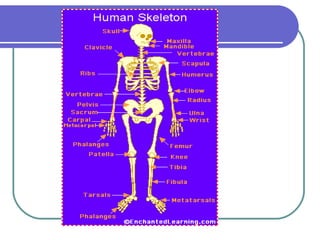
  The skeleton is made up of all the bones
  in the body.
    Head  bones:skull bones and facial bones.
    Trunk bones:spine and rib cage.

    Limb bones:there are two groups the upper
     limb bones and the lower limb bones.
joints

  The  joints are located where two or more
   bones meet.Bones are connected by
   ligaments.
  There are three types of joints:
    Moveable   joints
    Semi-moveable joints

    Fixed joints
The musculature

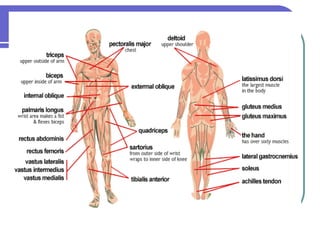
    The musculature is the set of muscles in the
     body.locomotor muscles are conected to the
     bones.when they contract or relax,they move the
     bones.
    Head muscles:masseter,buccinator and orbicular.
    Trunk muscles:sternocleidomastoid,abdominal,
     pectoral,intercostal and trapezius.
    Limb muscles:biceps,triceps,deltoid,quadriceps,
     gluteus and calf muscles.
 .
The end

Sensitivity and coordination by María

  • 1.
    Unit 2 sensitivityand coordination Maria boizas
  • 2.
    Stimuli A stimulus is anything you see,hear,touch,smell or taste.  There are two types of stimuli:  Internalstimuli  External stimuli
  • 3.
    The smell ofa flower is an external stimuli.
  • 4.
    receptors  Thereare twotypes of receptors: Internal receptors External receptors
  • 5.
    Responses A response is the body’s answer to a stimulus  There are two different types of responses:  Muscular responses  Glandular responses
  • 6.
    Chewing is amuscular response
  • 7.
  • 8.
    sight  The eye is the organ of sight. it is made up of the eyeball and protected by the eyebrows,eyelids and eye lashes.
  • 9.
    Process of sight  First light goes through the cornea.  Then light passes through the pupil,the opening of the iris.  After that light passes through the lens with focuses the image on the retina.  The information in the retina travels to the brain through the optic nerve
  • 10.
    smell  Thenose isthe organ of smell.The receptorsof smell are in the pituitary gland,inside the nostrils.
  • 11.
    hearing  The ear is the organ os hearing.  It has three parts:  The outer ear  The middle ear  The inner ear
  • 12.
    The process ofhearing  First the outer ear receives sounds  Then the middle ear changes sounds into vibrations.  Finally the inner ear changes vibrations into nerve impulses that go to the brain
  • 13.
    touch  The skin is the organ of touch.  It is made up of three layers:  Epidermis  Dermis  Hypodermis
  • 14.
    taste  The tongueis the organ of taste.  The receptors of taste are in the taste buds.  There are taste buds all around the tongue.
  • 15.
    The nervous system The nervous system is made up of nerve centres and nerves.
  • 16.
     The peripheral nervous system is made up of:  Sensory nerves  Motor nerves  The central nervous system has two parts:  The brain  The spinal cord
  • 18.
    neurons  They aremade up of a cell body,dendrites and axons.  Neurons receive information from other neurons.
  • 19.
    Voluntary and involuntary movements Ourbodies react to stimuli making voluntary or involuntary movements.
  • 20.
    Voluntary movements When we see the clouds our sensory nerves inform the brain about this.  Our brain processes the information and produces a response.  Our motor nerves transmit a response to the muscles.
  • 21.
    Involuntary movements The spinal cord produces a response in the case of involuntary movements.  Sensory nerves transmit information about involuntary movements to the spinal cord.  The spinal cord produces a very fast response.
  • 22.
    The skeletal system  Theskeletal and muscular system is in charge of carrying muscular responses created by the nervous system.it is made up of the skeleton and the musculature.
  • 23.
    The skeleton The skeleton is made up of all the bones in the body.  Head bones:skull bones and facial bones.  Trunk bones:spine and rib cage.  Limb bones:there are two groups the upper limb bones and the lower limb bones.
  • 25.
    joints  The joints are located where two or more bones meet.Bones are connected by ligaments.  There are three types of joints:  Moveable joints  Semi-moveable joints  Fixed joints
  • 27.
    The musculature  The musculature is the set of muscles in the body.locomotor muscles are conected to the bones.when they contract or relax,they move the bones.  Head muscles:masseter,buccinator and orbicular.  Trunk muscles:sternocleidomastoid,abdominal, pectoral,intercostal and trapezius.  Limb muscles:biceps,triceps,deltoid,quadriceps, gluteus and calf muscles. .
  • 28.