UNIT 6 INVERTEBRATES SCIENCE
OTHER INVERTEBRATE GROUPS (Otros grupos de invertebrados)
Cnidarians, annelids or echinoderms (cnidarios, anélidos o equinodermos).
Science 3º - Educación Primaria
Contenido mínimo para estudiar:
 Invertebrates can be divided into groups. They don’t have a backbone.
ARTHROPODS (ARTRÓPODOS)
INSECTS
(insectos)
ARACHNIDS
(arácnidos)
MYRIAPODS
(miriápodos)
CRUSTACEANS
(crustáceos)
Exoskeleton (exoesqueleto).
2 antennae (antenas).
6 legs.
Most have wings.
Their bodies have 3
sections: head, thorax
and abdomen. (Suscuerpos
tienen 3 secciones:cabeza, tórax y
abdomen).
 Exoskeleton.
 8 eyes.
 8 legs.
 Their bodies have
2 sections: head
and abdomen.
 Exoskeleton.
 2 antennae.
 Lots of legs
(Muchas patas).
 Their bodies
have lots of
sections.
 Exoskeleton.
 4 antennae.
 2 eyes.
 Most have 8 legs
and 2 claws
(garras).
MOLLUSCS (MOLUSCOS)
GASTROPODS
(gasterópodos)
BIVALVES
(bivalvos)
CEPHALOPODS
(cefalópodos)
Soft body (cuerpo blando).
2 eyes on the end of antennae (dos
ojos al final de las
antenas).
Some have a
shell (caparazón o concha).
They live on land (tierra)and in
water.
Soft body.
2 shells connected
at one point (dos
conchas conectadas en un
punto).
They
live in
water.
 Soft body.
 Head with tentacles.
 They live in water.
 Most don’t have a shell.
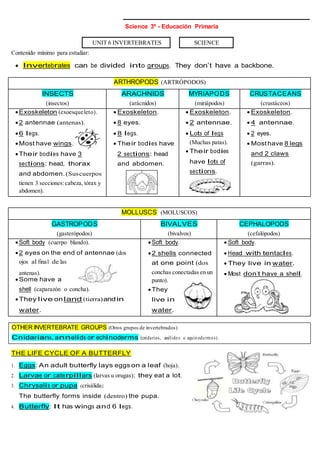
THE LIFE CYCLE OF A BUTTERFLY
1. Eggs: An adult butterfly lays eggs on a leaf (hoja).
2. Larvae or caterpillars (larvas u orugas): they eat a lot.
3. Chrysalis or pupa (crisálida):
The butterfly forms inside (dentro) the pupa.
4. Butterfly: It has wings and 6 legs.

Summary

  • 1.
    UNIT 6 INVERTEBRATESSCIENCE OTHER INVERTEBRATE GROUPS (Otros grupos de invertebrados) Cnidarians, annelids or echinoderms (cnidarios, anélidos o equinodermos). Science 3º - Educación Primaria Contenido mínimo para estudiar:  Invertebrates can be divided into groups. They don’t have a backbone. ARTHROPODS (ARTRÓPODOS) INSECTS (insectos) ARACHNIDS (arácnidos) MYRIAPODS (miriápodos) CRUSTACEANS (crustáceos) Exoskeleton (exoesqueleto). 2 antennae (antenas). 6 legs. Most have wings. Their bodies have 3 sections: head, thorax and abdomen. (Suscuerpos tienen 3 secciones:cabeza, tórax y abdomen).  Exoskeleton.  8 eyes.  8 legs.  Their bodies have 2 sections: head and abdomen.  Exoskeleton.  2 antennae.  Lots of legs (Muchas patas).  Their bodies have lots of sections.  Exoskeleton.  4 antennae.  2 eyes.  Most have 8 legs and 2 claws (garras). MOLLUSCS (MOLUSCOS) GASTROPODS (gasterópodos) BIVALVES (bivalvos) CEPHALOPODS (cefalópodos) Soft body (cuerpo blando). 2 eyes on the end of antennae (dos ojos al final de las antenas). Some have a shell (caparazón o concha). They live on land (tierra)and in water. Soft body. 2 shells connected at one point (dos conchas conectadas en un punto). They live in water.  Soft body.  Head with tentacles.  They live in water.  Most don’t have a shell. THE LIFE CYCLE OF A BUTTERFLY 1. Eggs: An adult butterfly lays eggs on a leaf (hoja). 2. Larvae or caterpillars (larvas u orugas): they eat a lot. 3. Chrysalis or pupa (crisálida): The butterfly forms inside (dentro) the pupa. 4. Butterfly: It has wings and 6 legs.