Fire Insurance
Asst. Prof. Parasmani Jangid
SDJ International College
History
• The Great Fire in 1666 that devastated one
third of London, reducing to ruins over
13,000 houses and 89 churches (including
St. Paul’s) it was realized that there was a
need for the provision of compensation.
• The real establishment of the insurance
came only after the great fire which took
place in London in Sept. 1666.
• It lasted for four days and nights, burning
over 436 acres of ground and destroying
over 13,000 buildings.
• During that time also fire insurance did not
developed with great speed because of slow
progress of commerce and trade.
• The first fire insurance company was
established in 1681, named as “The first
office”.
• The next fire insurance company came in
London as “Corporation of London”.
• In 1696 “Hand in Hand Society” was
established.
• After that the “sun Fire Office” was
formed in 1710 to transact insurance of
goods.
• In 1714, “Union Fire Office” was
created.
• The “West Minister” was established in
1717.
• The development of the fire insurance
is linked industrial revolution and has
resulted into the growth of fire business
in India.
What is Fire Insurance ???
• A fire insurance policy involves an
insurance company agreeing to pay a
certain amount equivalent to the estimated
loss caused by fire to the insured, within
the time specified in the contract.
Objects Covered Under fire insurance
1) Building
2) Electrical installation in buildings
3) Machinery, Plant and equipment
4) Goods ( raw materials, stocks in process, semi finished, finished etc
) in factories
5) Godowns, Goods in open
6) Contents in dwellings (Household)
7) Shops, Hotels etc.
8) Furniture, fixture and fittings, pipelines located inside or outside
the compound etc.
Objects Not covered in fire insurance
• Loss Due to fire cause by-
Earthquake
Attack of foreign enemy
Civil strike (war)
Mutiny (Pub. Vs Govt.)
Military rising
• Loss caused by Underground fire
• Loss caused by burning of property by order of
any public authority
Who Can avail Fire Insurance ???
• Any person or firm that has a financial
interest in the property to be insured
can avail this insurance. This means
that owners of property, firms that
holds property in trust or on
commission and Financial Institutions
which have a financial interest in a
property can avail this insurance
Causes of Fire/Physical and Moral Hazards of
Fire Insurance
Fire damage is the result of two types of risk:
1. Physical Risk: It refers to the natural risk of
fire in the property which may occur due to
smoke, construction, artificial lighting and
heating, lack of extinguishing apparatus etc.
2. Moral Risk: The moral risk depends upon the
man as physical risk depends on the property.
The property may be set on fire by the owner
or by any person with his willingness,
carelessness and lack of sense of duty may
also increase the fire damage. Thus, where the
property was destroyed with the willingness of
the property owner, is known as moral hazard.
Principles of Fire Insurance
• Insurable Interest
• Utmost Good Faith
• Indemnity
• Subrogation
• Warranty
• Proximate Causes
• Contribution and Average
Procedure for taking Fire Insurance
1. Selecting an Insurance Company
2. Filling of proposal form
3. Acceptance of proposal form
4. Evidence of prestige
5. Acceptance of first premium
6. Commencement of risk
7. Cover note: The insurer issues a cover note when the
risk is accepted provisionally. This cover note is a
document providing evidence of insurance when the
loss occurs prior to the issue of the policy.
8. A duly stamped issue of policy certificate
Advantage of fire insurance
• Fire insurance provides advantages to the
enterprise in the following ways
• Loss of life
• Machines security
• Medical expenses
• Fire insurance provides the advantages for the
homeowner in these ways
• property security
• Any damage recovery
• Electronic part security
Fire Insurance Policies
Asst. Prof. Parasmani Jangid
SDJ International College
Types of Fire Insurance Policies
1. Specific Policy
2. Valued Policy
3. Average Policy
4. Floating Policy
5. Adjustable Policy
6. Comprehensive Policy
7. Blanket Policy
8. Consequential Loss Policy
9. Declaration Policy
10. Reinstatement Policy or Replacement Policy
11. Excess Policy
12. Maximum Value with Discount Policy
13. Collective Policy
14. Sprinkler Leakage Policy
15. Transit Policy
16. Rent Policy
17. Building in course of Construction Policy
• A specific policy is a type of policy in which
the property is insured for a specific sum
irrespective of its value.
• If there is loss, the stated amount will have
to be paid to the policyholder.
• But the actual value of the subject matter
is not considered in this respect.
• For example, if a property is insured for Rs.
10000 though its actual value is Rs. 20000.
In the event of loss to property, not more
than Rs. 10000 can be recovered.
• In this policy the cover is a fixed amount agreed upon
at the time of signing the contract.
• The insurance company pays that amount apart from of
the actual loss due to fire.
• The insured is benefited when the market value of the
property declines , but suffer loss when the market
value appreciates.
• It is also known as insured policy.
• The valued insurance policy is usually offered for such
items like jewellery, furs, or paintings, which value is
difficult to estimate once they are damaged or
destroyed by fire.
• If the ‘average clause’ is applicable to a policy, it is called
Average Policy.
• It is for those who has an under insured policy.
• Average clause is added to penalize the insured for taking
up a policy for a lesser sum than the value of the property.
The compensation payable is proportionately reduced if
the value of the policy is less than the value of the
property. Suppose that the property worth Rs.100,000 is
insured for Rs.80,000 and the loss caused by fire is
Rs.60,000 then the amount of claim to be paid by the
insurer will be 80,000/1,00,000 *60,000= Rs.48,000.The
insured is given an amount less by Rs.12000, due to the
under insured sum. It discourages the insured to get
under-valued policy.
• It is taken out for those goods which are frequently
changing in a warehouse. This policy can be taken on
those goods which are lying on different localities or
godowns.
• Since quantity of goods lying in the warehouse or at
different places fluctuate from time to time, it becomes
difficult for the owner to take a specific policy.
• Floating policies are suitable to those traders or
products whose raw-materials or merchandise are lying
at different localities or godowns.
• For example:-Some of the goods of other trader are
kept in one godown, and few kept in another godown,
some kept in the railway godown or some at the sea
port open. To cover the risk of goods lying at different
places under one policy.
• It is issued for existing stock.
• In this policy premium rate shall be adjusted
according to increase or decrease in the value
of stock, this change will be notified to the
insurer by the insured.
• In case of loss by fire, the amount notified by
the insured at the maturity of the policy is
taken as final and indemnified up to that limit.
• It is a contract limited to merchandise or stock
in trade other than farming stock
• A policy may be taken up to cover up all types of
risks, including fire. A policy may be issued to cover
risk like fire, explosion, lightening, robbery, riots,
labour disturbances etc. This is called a
comprehensive policy or all risk policy.
• When all the subject matters or properties
placed at different store houses or
godowns are insured as a single policy, the
policy is known as a blanket policy.
• It is considered to be an Extention of
floating Policy.
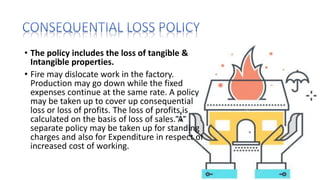
• The policy includes the loss of tangible &
Intangible properties.
• Fire may dislocate work in the factory.
Production may go down while the fixed
expenses continue at the same rate. A policy
may be taken up to cover up consequential
loss or loss of profits. The loss of profits is
calculated on the basis of loss of sales. A
separate policy may be taken up for standing
charges and also for Expenditure in respect of
increased cost of working.
• Under the declaration policy, the insured takes out insurance for
the maximum amount that he considers would be at risk during the
period of the policy.
• On a fixed date of every month or a specific period, the insured
furnishes a declaration of the amount. The premium is
provisionally paid to 75% of the annual premium amount.
• Practically; the annual premium is determined on the average of
these declarations, If the premium is higher than the provisional
premium already paid, the insured has to pay the difference to the
insurer. On the other hand, if the premium so calculated is lesser
than the premium already paid, the excess is returned to the
policyholder.
• The declaration must be made on a specified day or within the next
14 days, otherwise, the sum insured will be deemed to be the
declaration value. The policy is applicable only to stocks and the
sole property of the insured.
• The value of risks is an average of the each day of the month or the
highest value at risk during the month. Declaration policy is not
available for a short period stock in process, stock at Railway siding.
• Premium is adjusted at the expiry of policy. The policy is very
advantageous to those business men whose stocks fluctuate from
time to time.
• Covers the cost of replacement of object according to its condition. Any
technical improvements will go to the account of the insured.
• Reinstatement must be carried out by the insured in order to obtain the
benefits of the special basis of settlement.
• The work of reinstatement must be completed within 12 months from
the date of loss, failing which the claim will be settled on market value
basis.
• The insured also needs to pay higher rate of premium.
• The underwriter provides compensation on the basis of market price of
the property. The amount of compensation is calculated after taking into
account the amount of depreciation. A replacement policy provides that
compensation will be according to the replacement price. The new asset
should be similar to the one which has been lost. The amount of
compensation will depend upon the market price of the new assets so
that it is replaced without additional cost to the insured. Note that this
policy is not issued on stock, materials or merchantise.
• Sometimes, the stock of a businessman may fluctuate from time to time
and he may be unable to take one policy or specific policy.
• If he takes policy for a higher amount, he has to pay a higher premium.
• On the other hand if he takes insurance for a lower amount, he will have
to bear the proportionate amount of loss.
• The insured in this case can purchase two policies, one ‘First Loss Policy”
and second, ‘excess policy.’ The ‘First Loss Policy’ will cover that stock
below which the stock never goes.
• The minimum level of stock can be found out from the past experience
and for the other portion of stock which exceeds the minimum limit; he
can purchase another policy called ‘excess policy’.
• The actual value of the excess stock is declared every month. The amount
of premium is calculated on the average monthly excess amount.
• Since the chances of payment on the excess amount are very remote, the
rate of premium is also very nominal.
• Thus; the insured will pay a very nominal premium as compared to the
premium payable on the total amount had the policy been a specific one.
The average .clause also applies to this policy.
• Under this policy, no declaration or adjustment of
policy is required, but the policy is taken for a
maximum amount and full premium is paid thereon.
• At the end of the year, in the case of no loss, one-
third of the premium paid is returned to the
policyholder.
• This policy is similar to the declaration policy where
botheration of checking and recording declarations
is avoided.
• It serves as a rough and ready method of coverage
for the maximum amount. This policy is not issued
on all types of commodities and is confined only to
selected commodities.
• This collective policy is sometimes issued for
convenience. A business man takes different
fire insurances from various insurance
companies for his own property. At that time
he has to pay premiums to each individual
insurer company. Also he has to approach each
company for necessary changes or
amendments in individual policy. But this
policy helps the insured in avoiding the
wastage of time and money in approaching all
the companies. Under this policy only one
company takes the responsibility to receive the
premiums and amendments
• This policy insures the destruction of or
damage to by water accidentally discharged
or leaking from automatic sprinkler
installation in the insured premises. However,
The discharge or leakage of water due to
heat caused by fire, repair or alteration of
building nr sprinkler installation, earthquake,
war, explosion are not covered by this policy.
Policy Conditions
Implied Conditions
1. Existence of property (at the time of proposing)
2. Insured Property (at the time of claiming)
3. Insurable Interest ( at the time of proposing as well as at the time of claiming)
4. Good Faith ( at the time of proposing as well as at the time of claiming)
5. Identity of subject matter (at the time of proposing)
Express Conditions
1. Misdescription (must not be false description)
2. Alteration (removal, change of interest, increase in risk)
3. Exclusions (exceptional perils, loss events, natural hazards, etc.)
4. Fraud (provisions regarding fraud must be mentioned)
5. Claim (investigation)
6. Reinstate Clause (replacement policy must be clear to them)
7. Insurer’s Rights after fire (enter premises, possession, salvage, sell the property
on insured behalf)
8. Subrogation
9. Warranties
10. Arbitration ( dispute)
11. Purchase’s interest clause
12. Loss procedure (formality you suppose to follow.)
13. Contribution & Average (more then one policy for one subject matter, Under
valued policy)
Thank You

Fire Insurance

  • 1.
    Fire Insurance Asst. Prof.Parasmani Jangid SDJ International College
  • 3.
    History • The GreatFire in 1666 that devastated one third of London, reducing to ruins over 13,000 houses and 89 churches (including St. Paul’s) it was realized that there was a need for the provision of compensation.
  • 4.
    • The realestablishment of the insurance came only after the great fire which took place in London in Sept. 1666. • It lasted for four days and nights, burning over 436 acres of ground and destroying over 13,000 buildings. • During that time also fire insurance did not developed with great speed because of slow progress of commerce and trade. • The first fire insurance company was established in 1681, named as “The first office”. • The next fire insurance company came in London as “Corporation of London”.
  • 5.
    • In 1696“Hand in Hand Society” was established. • After that the “sun Fire Office” was formed in 1710 to transact insurance of goods. • In 1714, “Union Fire Office” was created. • The “West Minister” was established in 1717. • The development of the fire insurance is linked industrial revolution and has resulted into the growth of fire business in India.
  • 6.
    What is FireInsurance ??? • A fire insurance policy involves an insurance company agreeing to pay a certain amount equivalent to the estimated loss caused by fire to the insured, within the time specified in the contract.
  • 7.
    Objects Covered Underfire insurance 1) Building 2) Electrical installation in buildings 3) Machinery, Plant and equipment 4) Goods ( raw materials, stocks in process, semi finished, finished etc ) in factories 5) Godowns, Goods in open 6) Contents in dwellings (Household) 7) Shops, Hotels etc. 8) Furniture, fixture and fittings, pipelines located inside or outside the compound etc.
  • 8.
    Objects Not coveredin fire insurance • Loss Due to fire cause by- Earthquake Attack of foreign enemy Civil strike (war) Mutiny (Pub. Vs Govt.) Military rising • Loss caused by Underground fire • Loss caused by burning of property by order of any public authority
  • 9.
    Who Can availFire Insurance ??? • Any person or firm that has a financial interest in the property to be insured can avail this insurance. This means that owners of property, firms that holds property in trust or on commission and Financial Institutions which have a financial interest in a property can avail this insurance
  • 10.
    Causes of Fire/Physicaland Moral Hazards of Fire Insurance Fire damage is the result of two types of risk: 1. Physical Risk: It refers to the natural risk of fire in the property which may occur due to smoke, construction, artificial lighting and heating, lack of extinguishing apparatus etc. 2. Moral Risk: The moral risk depends upon the man as physical risk depends on the property. The property may be set on fire by the owner or by any person with his willingness, carelessness and lack of sense of duty may also increase the fire damage. Thus, where the property was destroyed with the willingness of the property owner, is known as moral hazard.
  • 11.
    Principles of FireInsurance • Insurable Interest • Utmost Good Faith • Indemnity • Subrogation • Warranty • Proximate Causes • Contribution and Average
  • 12.
    Procedure for takingFire Insurance 1. Selecting an Insurance Company 2. Filling of proposal form 3. Acceptance of proposal form 4. Evidence of prestige 5. Acceptance of first premium 6. Commencement of risk 7. Cover note: The insurer issues a cover note when the risk is accepted provisionally. This cover note is a document providing evidence of insurance when the loss occurs prior to the issue of the policy. 8. A duly stamped issue of policy certificate
  • 13.
    Advantage of fireinsurance • Fire insurance provides advantages to the enterprise in the following ways • Loss of life • Machines security • Medical expenses • Fire insurance provides the advantages for the homeowner in these ways • property security • Any damage recovery • Electronic part security
  • 14.
    Fire Insurance Policies Asst.Prof. Parasmani Jangid SDJ International College
  • 15.
    Types of FireInsurance Policies 1. Specific Policy 2. Valued Policy 3. Average Policy 4. Floating Policy 5. Adjustable Policy 6. Comprehensive Policy 7. Blanket Policy 8. Consequential Loss Policy 9. Declaration Policy
  • 16.
    10. Reinstatement Policyor Replacement Policy 11. Excess Policy 12. Maximum Value with Discount Policy 13. Collective Policy 14. Sprinkler Leakage Policy 15. Transit Policy 16. Rent Policy 17. Building in course of Construction Policy
  • 17.
    • A specificpolicy is a type of policy in which the property is insured for a specific sum irrespective of its value. • If there is loss, the stated amount will have to be paid to the policyholder. • But the actual value of the subject matter is not considered in this respect. • For example, if a property is insured for Rs. 10000 though its actual value is Rs. 20000. In the event of loss to property, not more than Rs. 10000 can be recovered.
  • 18.
    • In thispolicy the cover is a fixed amount agreed upon at the time of signing the contract. • The insurance company pays that amount apart from of the actual loss due to fire. • The insured is benefited when the market value of the property declines , but suffer loss when the market value appreciates. • It is also known as insured policy. • The valued insurance policy is usually offered for such items like jewellery, furs, or paintings, which value is difficult to estimate once they are damaged or destroyed by fire.
  • 19.
    • If the‘average clause’ is applicable to a policy, it is called Average Policy. • It is for those who has an under insured policy. • Average clause is added to penalize the insured for taking up a policy for a lesser sum than the value of the property. The compensation payable is proportionately reduced if the value of the policy is less than the value of the property. Suppose that the property worth Rs.100,000 is insured for Rs.80,000 and the loss caused by fire is Rs.60,000 then the amount of claim to be paid by the insurer will be 80,000/1,00,000 *60,000= Rs.48,000.The insured is given an amount less by Rs.12000, due to the under insured sum. It discourages the insured to get under-valued policy.
  • 20.
    • It istaken out for those goods which are frequently changing in a warehouse. This policy can be taken on those goods which are lying on different localities or godowns. • Since quantity of goods lying in the warehouse or at different places fluctuate from time to time, it becomes difficult for the owner to take a specific policy. • Floating policies are suitable to those traders or products whose raw-materials or merchandise are lying at different localities or godowns. • For example:-Some of the goods of other trader are kept in one godown, and few kept in another godown, some kept in the railway godown or some at the sea port open. To cover the risk of goods lying at different places under one policy.
  • 21.
    • It isissued for existing stock. • In this policy premium rate shall be adjusted according to increase or decrease in the value of stock, this change will be notified to the insurer by the insured. • In case of loss by fire, the amount notified by the insured at the maturity of the policy is taken as final and indemnified up to that limit. • It is a contract limited to merchandise or stock in trade other than farming stock
  • 22.
    • A policymay be taken up to cover up all types of risks, including fire. A policy may be issued to cover risk like fire, explosion, lightening, robbery, riots, labour disturbances etc. This is called a comprehensive policy or all risk policy.
  • 23.
    • When allthe subject matters or properties placed at different store houses or godowns are insured as a single policy, the policy is known as a blanket policy. • It is considered to be an Extention of floating Policy.
  • 24.
    • The policyincludes the loss of tangible & Intangible properties. • Fire may dislocate work in the factory. Production may go down while the fixed expenses continue at the same rate. A policy may be taken up to cover up consequential loss or loss of profits. The loss of profits is calculated on the basis of loss of sales. A separate policy may be taken up for standing charges and also for Expenditure in respect of increased cost of working.
  • 25.
    • Under thedeclaration policy, the insured takes out insurance for the maximum amount that he considers would be at risk during the period of the policy. • On a fixed date of every month or a specific period, the insured furnishes a declaration of the amount. The premium is provisionally paid to 75% of the annual premium amount. • Practically; the annual premium is determined on the average of these declarations, If the premium is higher than the provisional premium already paid, the insured has to pay the difference to the insurer. On the other hand, if the premium so calculated is lesser than the premium already paid, the excess is returned to the policyholder. • The declaration must be made on a specified day or within the next 14 days, otherwise, the sum insured will be deemed to be the declaration value. The policy is applicable only to stocks and the sole property of the insured. • The value of risks is an average of the each day of the month or the highest value at risk during the month. Declaration policy is not available for a short period stock in process, stock at Railway siding. • Premium is adjusted at the expiry of policy. The policy is very advantageous to those business men whose stocks fluctuate from time to time.
  • 26.
    • Covers thecost of replacement of object according to its condition. Any technical improvements will go to the account of the insured. • Reinstatement must be carried out by the insured in order to obtain the benefits of the special basis of settlement. • The work of reinstatement must be completed within 12 months from the date of loss, failing which the claim will be settled on market value basis. • The insured also needs to pay higher rate of premium. • The underwriter provides compensation on the basis of market price of the property. The amount of compensation is calculated after taking into account the amount of depreciation. A replacement policy provides that compensation will be according to the replacement price. The new asset should be similar to the one which has been lost. The amount of compensation will depend upon the market price of the new assets so that it is replaced without additional cost to the insured. Note that this policy is not issued on stock, materials or merchantise.
  • 27.
    • Sometimes, thestock of a businessman may fluctuate from time to time and he may be unable to take one policy or specific policy. • If he takes policy for a higher amount, he has to pay a higher premium. • On the other hand if he takes insurance for a lower amount, he will have to bear the proportionate amount of loss. • The insured in this case can purchase two policies, one ‘First Loss Policy” and second, ‘excess policy.’ The ‘First Loss Policy’ will cover that stock below which the stock never goes. • The minimum level of stock can be found out from the past experience and for the other portion of stock which exceeds the minimum limit; he can purchase another policy called ‘excess policy’. • The actual value of the excess stock is declared every month. The amount of premium is calculated on the average monthly excess amount. • Since the chances of payment on the excess amount are very remote, the rate of premium is also very nominal. • Thus; the insured will pay a very nominal premium as compared to the premium payable on the total amount had the policy been a specific one. The average .clause also applies to this policy.
  • 28.
    • Under thispolicy, no declaration or adjustment of policy is required, but the policy is taken for a maximum amount and full premium is paid thereon. • At the end of the year, in the case of no loss, one- third of the premium paid is returned to the policyholder. • This policy is similar to the declaration policy where botheration of checking and recording declarations is avoided. • It serves as a rough and ready method of coverage for the maximum amount. This policy is not issued on all types of commodities and is confined only to selected commodities.
  • 29.
    • This collectivepolicy is sometimes issued for convenience. A business man takes different fire insurances from various insurance companies for his own property. At that time he has to pay premiums to each individual insurer company. Also he has to approach each company for necessary changes or amendments in individual policy. But this policy helps the insured in avoiding the wastage of time and money in approaching all the companies. Under this policy only one company takes the responsibility to receive the premiums and amendments
  • 30.
    • This policyinsures the destruction of or damage to by water accidentally discharged or leaking from automatic sprinkler installation in the insured premises. However, The discharge or leakage of water due to heat caused by fire, repair or alteration of building nr sprinkler installation, earthquake, war, explosion are not covered by this policy.
  • 31.
    Policy Conditions Implied Conditions 1.Existence of property (at the time of proposing) 2. Insured Property (at the time of claiming) 3. Insurable Interest ( at the time of proposing as well as at the time of claiming) 4. Good Faith ( at the time of proposing as well as at the time of claiming) 5. Identity of subject matter (at the time of proposing)
  • 32.
    Express Conditions 1. Misdescription(must not be false description) 2. Alteration (removal, change of interest, increase in risk) 3. Exclusions (exceptional perils, loss events, natural hazards, etc.) 4. Fraud (provisions regarding fraud must be mentioned) 5. Claim (investigation) 6. Reinstate Clause (replacement policy must be clear to them) 7. Insurer’s Rights after fire (enter premises, possession, salvage, sell the property on insured behalf) 8. Subrogation 9. Warranties 10. Arbitration ( dispute) 11. Purchase’s interest clause 12. Loss procedure (formality you suppose to follow.) 13. Contribution & Average (more then one policy for one subject matter, Under valued policy)
  • 33.