STRATEGIC
LEADERSHIP
MPA 210 Strategic Planning Management
REPORTER:
JEFFERSON V. DE VERA
JOSEFINA BITONIO, DPA
PROFESSOR
• "All men can see the tactics
whereby I conquer, but what none
can see is the strategy out of which
great victory evolved." ~ 
Sun Tzu
Strategic
leadership
• Is the ability to anticipate,
envision, maintain
flexibility, and empower
others to create strategic
change as necessary.
• Because of the complex and
often global orientation of
the jobs, strategic leaders
must learn how to effectively
influence human behavior in
an uncertain environment.
Transformational
leadership
• Entails motivating
followers to do more
than is expected, to
continuously enrich
their capabilities, and to
place the organization’s
interest above their own.
Objectives of Strategic Leadership
• Strategic leadership provides the vision, direction,
the purpose for growth, and context for the
success of the corporation. It also initiates
"outside-the-box" thinking to generate future
growth. Strategic leadership is not about
micromanaging business strategies. Rather, it
provides the umbrella under which businesses
devise appropriate strategies and create value.
In short, strategic leadership answers
two questions:
• What – by providing the vision and direction, creating the
context for growth, and
• How – by sketching out a road map for the organization that
will allow it to unleash its full potential; by crafting
the corporation's portfolio, determining what businesses should
be there, what the performance requirements of the business are,
and what types of alliances make sense; and by defining the
means (the culture, values, and way of working together)
needed to achieve corporate vision and goals.
• Not all managers have the capacity to
become effective strategic leaders,
furthermore, it may be that strategic
leadership skills can be analyzed as a
hierarchy in which manager must master
lower-level skills before they fine-tine
higher-level skills, as illustrated in the
following levels from the book Good to
Great by Jim Collins.
Highly Capable Individual
Competent Managers
Contributing Team Members
Effective Leader
Executive
Level 1 Highly Capable Individual
•The most basic skills for becoming
a capable individual are developing
skills and a strong work ethic.
Level 2: Contributing Team Members
• Next, a person must be able to work
effectively in teams and make useful
contributions to the achievement of
the team goals.
Level 3: Competent Managers
•Once the two lower-level skills are
mastered, competent management
comes from the ability to organize
people and resources so as to
achieve organizational objectives.
Level 4: Effective Leader
• Not all competent managers are effective
leaders. Leadership entails the ability to
articulate a clear strategic intent and
motivate followers to high level of
performance.
Level 5: Executive.
• These are people with unwavering resolve to lead
their companies to greatness. Frequently they are
humble, attributing success to the team they have
assembled rather than focusing on their own personal
achievements. A level 5 leader might also be called
Transformational Leader.
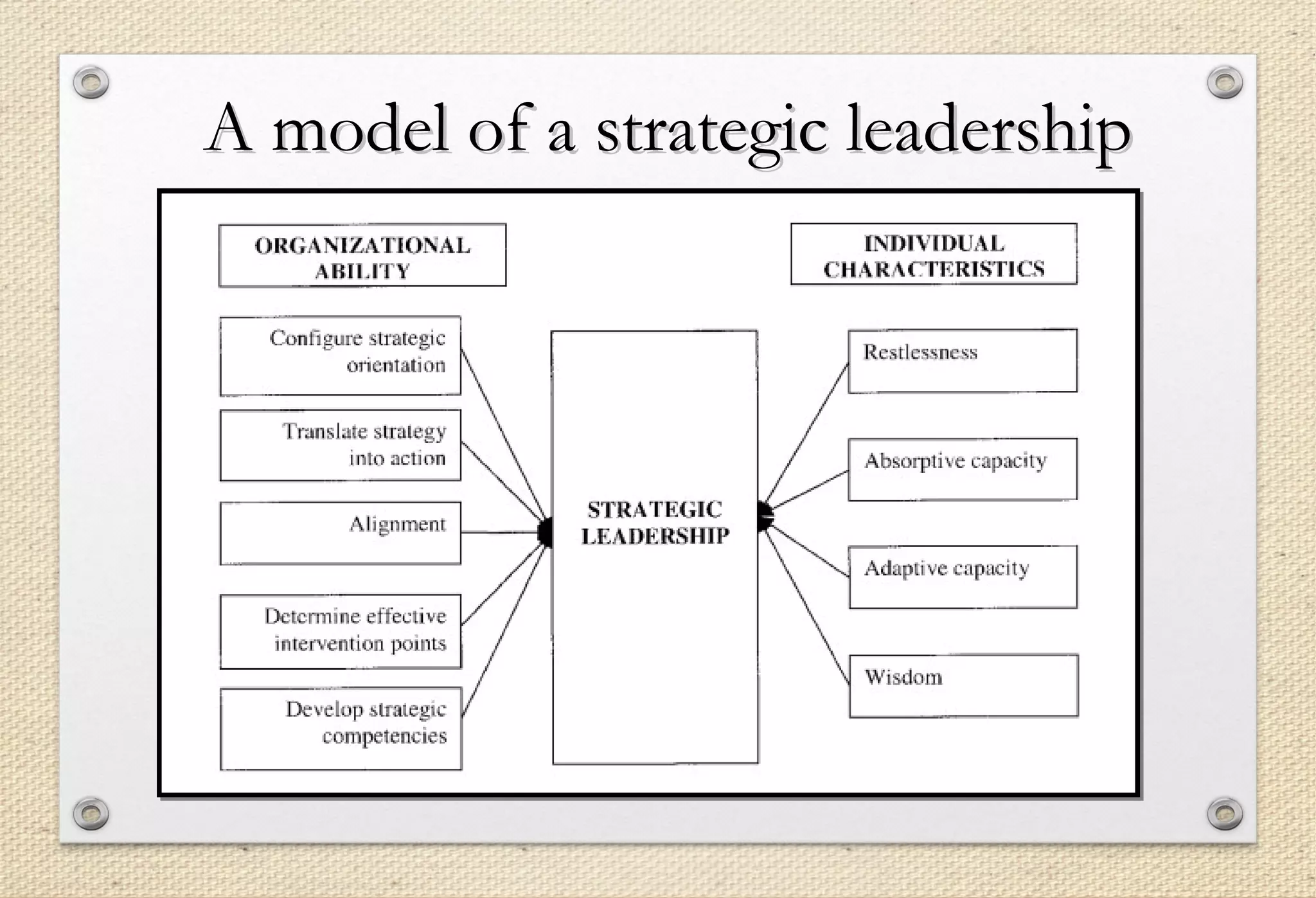
A model of a strategic leadershipA model of a strategic leadership
Strategic leaders have the ability to
be strategically oriented.
• This quality involves the ability to consider both the long-
term future (Stacey, 1992; Boisot, 1995; Beare, 2001;
• Adair, 2002), seeing the bigger picture, as well
understanding the current contextual setting of the
organization. Strategic orientation is the ability to link long-
range visions and concepts to daily work.
• The importance of creating the strategy with others, and
not just communicating it to others, may be the critical skill
that strategic leaders deploy in determining the strategic
direction of the organization (Kakabadse et al., 1998;
Boal & Hooijberg, 2001).
Strategic leaders have the ability to
translate strategy into action.
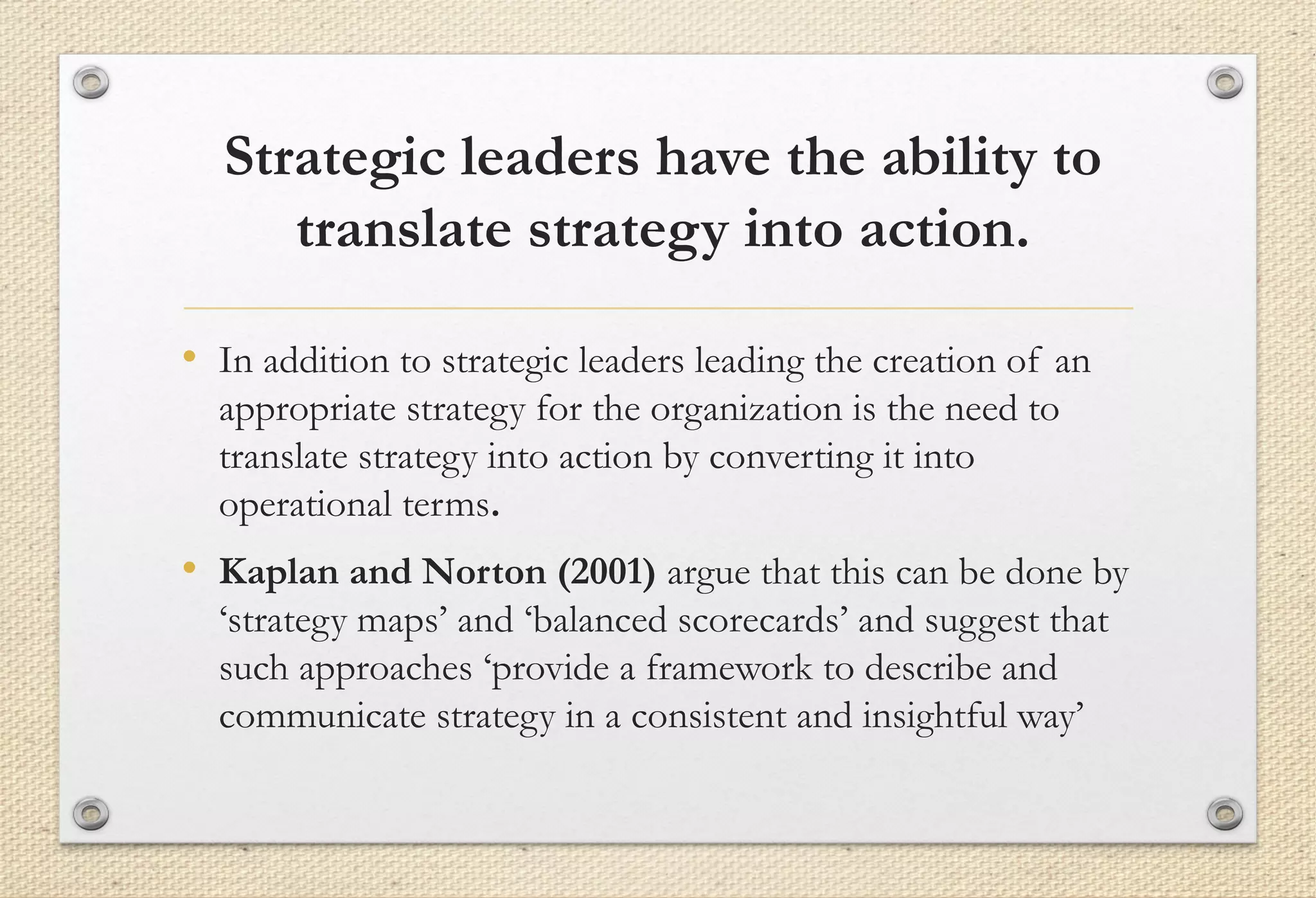
• In addition to strategic leaders leading the creation of an
appropriate strategy for the organization is the need to
translate strategy into action by converting it into
operational terms.
• Kaplan and Norton (2001) argue that this can be done by
‘strategy maps’ and ‘balanced scorecards’ and suggest that
such approaches ‘provide a framework to describe and
communicate strategy in a consistent and insightful way’
• Tichy and Sharman (1993) put forward a
three-stage process that strategic leaders are
able to undertake, the components of which
are:
• awakening;
• envisioning;
• re-architecturing
Awakening
• The awakening stage involves building an
agreement within the school that a continuation
of the current way of working is inadequate if it
wants to be effective in the future. This may
involve the process, described by Davies (2004),
of enhancing participation and motivation to
understand the necessity for change, through
strategic conversations.
Envioning
• The envisioning stage is building a clear
and understandable picture of what this
new way of operating looks like. This may
initially involve the creation of strategic
intent (Hamel & Prahalad, 1994) and
building the capacity to achieve it.
Re-architecture
•Once this has been completed,
then the new architecture will
emerge and be the
organizational basis for action.
Strategic leaders have the ability to align
people and organizations.
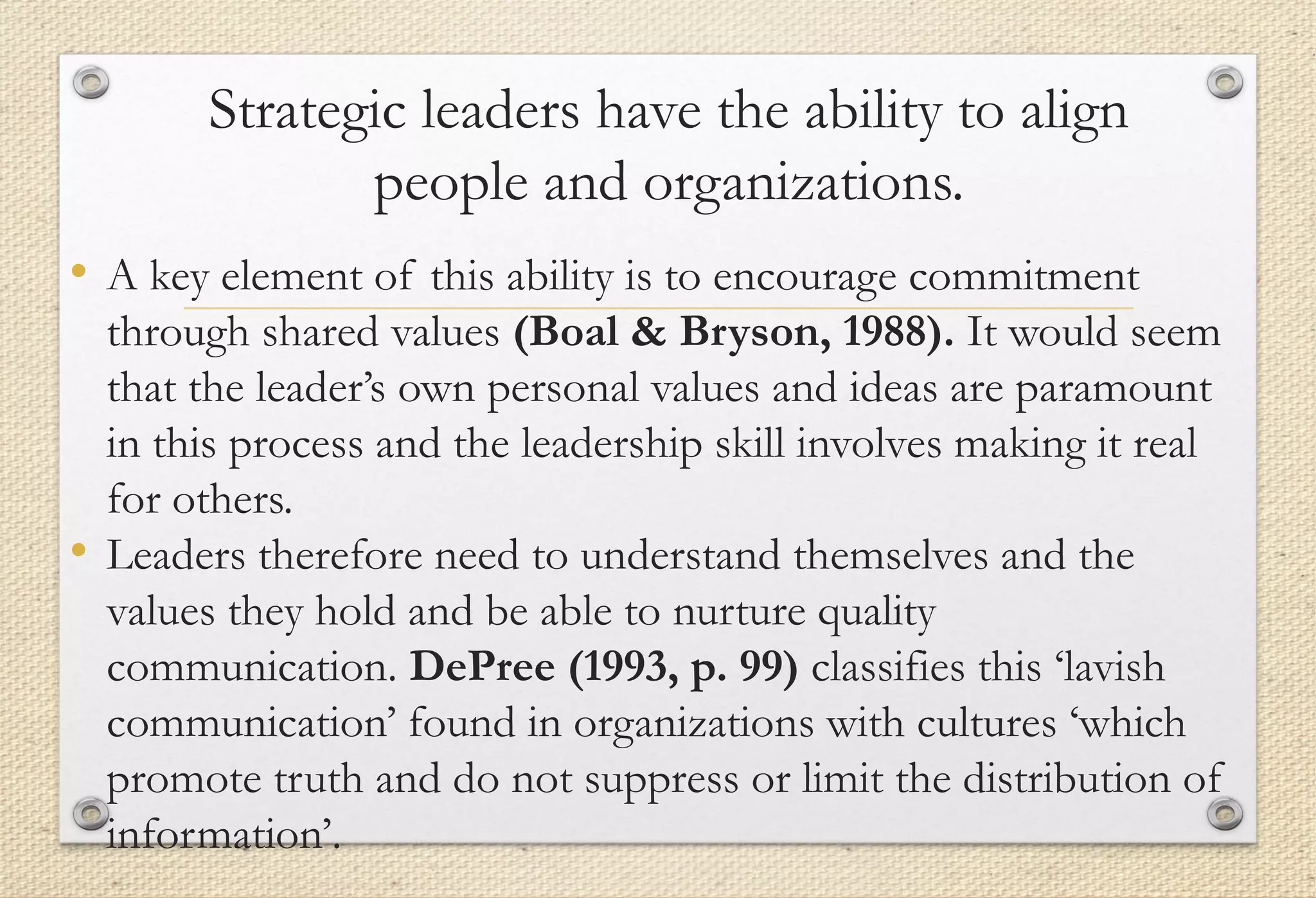
• A key element of this ability is to encourage commitment
through shared values (Boal & Bryson, 1988). It would seem
that the leader’s own personal values and ideas are paramount
in this process and the leadership skill involves making it real
for others.
• Leaders therefore need to understand themselves and the
values they hold and be able to nurture quality
communication. DePree (1993, p. 99) classifies this ‘lavish
communication’ found in organizations with cultures ‘which
promote truth and do not suppress or limit the distribution of
information’.
Strategic leaders have the ability to
determine effective intervention
points
• . Strategic leaders are able to define the key
moment for strategic change in organizations.
This is a concept that Burgleman and Grove
(1996) call strategic inflection points. These are
critical points in an organization’s development
when it is possible to develop new visions, create
new strategies and move in new directions.
Strategic leaders have the ability to
determine effective intervention points.
• Strategic leaders are able to define the key
moment for strategic change in organizations.
This is a concept that Burgleman and Grove
(1996) call strategic inflection points. These are
critical points in an organization’s development
when it is possible to develop new visions,
create new strategies and move in new
directions.
Strategic leaders have the ability
to develop strategic capabilities.
• Creativity in problem-solving and team-
working could also be considered resources
that give the school deep-seated strategic
capabilities or abilities.
• Strategic leaders have a dissatisfaction or
restlessness with the present.
• Strategic leaders have absorptive capacity.
• Strategic leaders have adaptive capacity.
• Strategic leaders have leadership wisdom.
Personal characteristics
Conclusion
• Much of the debate about leadership has been focused
on transformational leadership with an increasing
emphasis on instructional leadership which has been
rebranded as ‘learning-centred leadership’. While these
are very significant perspectives there is a danger that
learning-centred leadership will be concerned with
current approaches and outcomes. While we would
support this as it is the
REFERENCES
• http://www.1000ventures.com/business_guide/crosscuttin
gs/leadership_strategic.html
• Global Dimensions of Public Administration and
Governance
• http://edl793standard1.pbworks.com/f/Stategic+Leaders
hip+with+Notes.pdf
• Strategic leadership by Barbara J. Davies and Brent Davies

Strategic Leadership

  • 1.
    STRATEGIC LEADERSHIP MPA 210 StrategicPlanning Management REPORTER: JEFFERSON V. DE VERA JOSEFINA BITONIO, DPA PROFESSOR
  • 2.
    • "All mencan see the tactics whereby I conquer, but what none can see is the strategy out of which great victory evolved." ~  Sun Tzu
  • 3.
    Strategic leadership • Is theability to anticipate, envision, maintain flexibility, and empower others to create strategic change as necessary. • Because of the complex and often global orientation of the jobs, strategic leaders must learn how to effectively influence human behavior in an uncertain environment. Transformational leadership • Entails motivating followers to do more than is expected, to continuously enrich their capabilities, and to place the organization’s interest above their own.
  • 4.
    Objectives of StrategicLeadership • Strategic leadership provides the vision, direction, the purpose for growth, and context for the success of the corporation. It also initiates "outside-the-box" thinking to generate future growth. Strategic leadership is not about micromanaging business strategies. Rather, it provides the umbrella under which businesses devise appropriate strategies and create value.
  • 5.
    In short, strategicleadership answers two questions: • What – by providing the vision and direction, creating the context for growth, and • How – by sketching out a road map for the organization that will allow it to unleash its full potential; by crafting the corporation's portfolio, determining what businesses should be there, what the performance requirements of the business are, and what types of alliances make sense; and by defining the means (the culture, values, and way of working together) needed to achieve corporate vision and goals.
  • 6.
    • Not allmanagers have the capacity to become effective strategic leaders, furthermore, it may be that strategic leadership skills can be analyzed as a hierarchy in which manager must master lower-level skills before they fine-tine higher-level skills, as illustrated in the following levels from the book Good to Great by Jim Collins.
  • 7.
    Highly Capable Individual CompetentManagers Contributing Team Members Effective Leader Executive
  • 8.
    Level 1 HighlyCapable Individual •The most basic skills for becoming a capable individual are developing skills and a strong work ethic.
  • 9.
    Level 2: ContributingTeam Members • Next, a person must be able to work effectively in teams and make useful contributions to the achievement of the team goals.
  • 10.
    Level 3: CompetentManagers •Once the two lower-level skills are mastered, competent management comes from the ability to organize people and resources so as to achieve organizational objectives.
  • 11.
    Level 4: EffectiveLeader • Not all competent managers are effective leaders. Leadership entails the ability to articulate a clear strategic intent and motivate followers to high level of performance.
  • 12.
    Level 5: Executive. •These are people with unwavering resolve to lead their companies to greatness. Frequently they are humble, attributing success to the team they have assembled rather than focusing on their own personal achievements. A level 5 leader might also be called Transformational Leader.
  • 13.
    A model ofa strategic leadershipA model of a strategic leadership
  • 14.
    Strategic leaders havethe ability to be strategically oriented. • This quality involves the ability to consider both the long- term future (Stacey, 1992; Boisot, 1995; Beare, 2001; • Adair, 2002), seeing the bigger picture, as well understanding the current contextual setting of the organization. Strategic orientation is the ability to link long- range visions and concepts to daily work. • The importance of creating the strategy with others, and not just communicating it to others, may be the critical skill that strategic leaders deploy in determining the strategic direction of the organization (Kakabadse et al., 1998; Boal & Hooijberg, 2001).
  • 15.
    Strategic leaders havethe ability to translate strategy into action. • In addition to strategic leaders leading the creation of an appropriate strategy for the organization is the need to translate strategy into action by converting it into operational terms. • Kaplan and Norton (2001) argue that this can be done by ‘strategy maps’ and ‘balanced scorecards’ and suggest that such approaches ‘provide a framework to describe and communicate strategy in a consistent and insightful way’
  • 16.
    • Tichy andSharman (1993) put forward a three-stage process that strategic leaders are able to undertake, the components of which are: • awakening; • envisioning; • re-architecturing
  • 17.
    Awakening • The awakeningstage involves building an agreement within the school that a continuation of the current way of working is inadequate if it wants to be effective in the future. This may involve the process, described by Davies (2004), of enhancing participation and motivation to understand the necessity for change, through strategic conversations.
  • 18.
    Envioning • The envisioningstage is building a clear and understandable picture of what this new way of operating looks like. This may initially involve the creation of strategic intent (Hamel & Prahalad, 1994) and building the capacity to achieve it.
  • 19.
    Re-architecture •Once this hasbeen completed, then the new architecture will emerge and be the organizational basis for action.
  • 20.
    Strategic leaders havethe ability to align people and organizations. • A key element of this ability is to encourage commitment through shared values (Boal & Bryson, 1988). It would seem that the leader’s own personal values and ideas are paramount in this process and the leadership skill involves making it real for others. • Leaders therefore need to understand themselves and the values they hold and be able to nurture quality communication. DePree (1993, p. 99) classifies this ‘lavish communication’ found in organizations with cultures ‘which promote truth and do not suppress or limit the distribution of information’.
  • 21.
    Strategic leaders havethe ability to determine effective intervention points • . Strategic leaders are able to define the key moment for strategic change in organizations. This is a concept that Burgleman and Grove (1996) call strategic inflection points. These are critical points in an organization’s development when it is possible to develop new visions, create new strategies and move in new directions.
  • 22.
    Strategic leaders havethe ability to determine effective intervention points. • Strategic leaders are able to define the key moment for strategic change in organizations. This is a concept that Burgleman and Grove (1996) call strategic inflection points. These are critical points in an organization’s development when it is possible to develop new visions, create new strategies and move in new directions.
  • 23.
    Strategic leaders havethe ability to develop strategic capabilities. • Creativity in problem-solving and team- working could also be considered resources that give the school deep-seated strategic capabilities or abilities.
  • 24.
    • Strategic leadershave a dissatisfaction or restlessness with the present. • Strategic leaders have absorptive capacity. • Strategic leaders have adaptive capacity. • Strategic leaders have leadership wisdom. Personal characteristics
  • 25.
    Conclusion • Much ofthe debate about leadership has been focused on transformational leadership with an increasing emphasis on instructional leadership which has been rebranded as ‘learning-centred leadership’. While these are very significant perspectives there is a danger that learning-centred leadership will be concerned with current approaches and outcomes. While we would support this as it is the
  • 26.
    REFERENCES • http://www.1000ventures.com/business_guide/crosscuttin gs/leadership_strategic.html • GlobalDimensions of Public Administration and Governance • http://edl793standard1.pbworks.com/f/Stategic+Leaders hip+with+Notes.pdf • Strategic leadership by Barbara J. Davies and Brent Davies