Building High Performing Teams

          Facilitated by
          Marion Stone
Agenda
1. Definition of a Team
2. Team Growth
3. Developing ‘High Performance’
  – Leadership
  – Membership
  – Methods of working together
1. Team Maintenance
1.
DEFINITION OF A TEAM
Group vs. Team
Working Together                 Team

• Complementary effort by a      • Cooperative effort require
  group of people e.g. lifting     to carry out a joint task e.g.
  something, stuffing              maintenance crews,
  envelopes                        project teams
Definition of a Team

•   Working towards a shared purpose or goal
•   Complementary skills
•   Sharing responsibility
•   Interdependence
•   Collaborative decision making – acting as a unit
•   Characterised by participation, trust,
    communication, struggles, collaboration, clear
                      struggles
    roles, quality control
Definition of a Team

   "None of us is as smart as all of us." Ken
                   Blanchard
 "Teamwork is the ability to work together
  toward a common vision. It is the fuel that
 allows common people to attain uncommon
          results." Andrew Carnegie

TEAM = Together Everyone Achieves More
2.
TEAM GROWTH
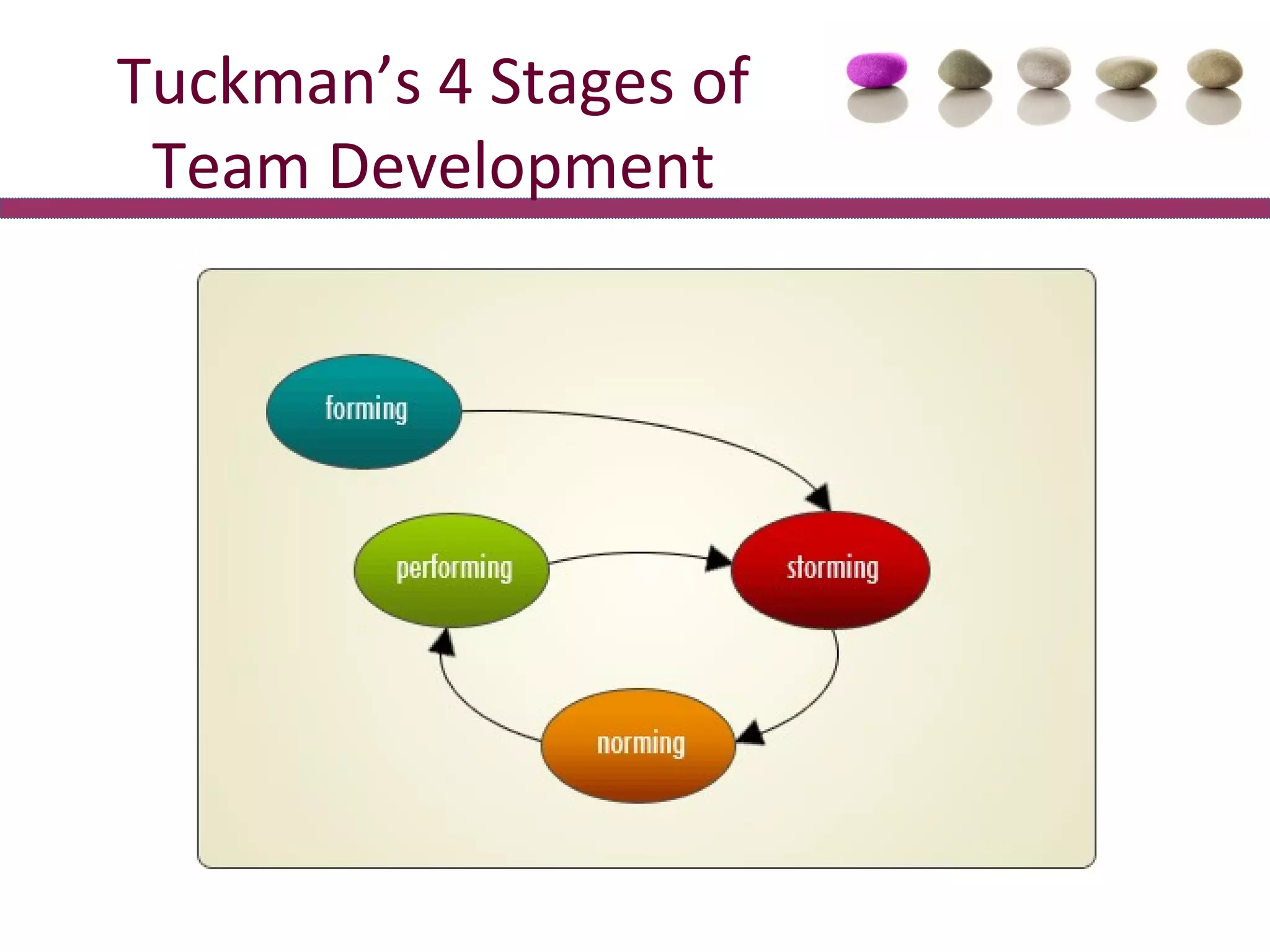
Tuckman’s 4 Stages of
 Team Development
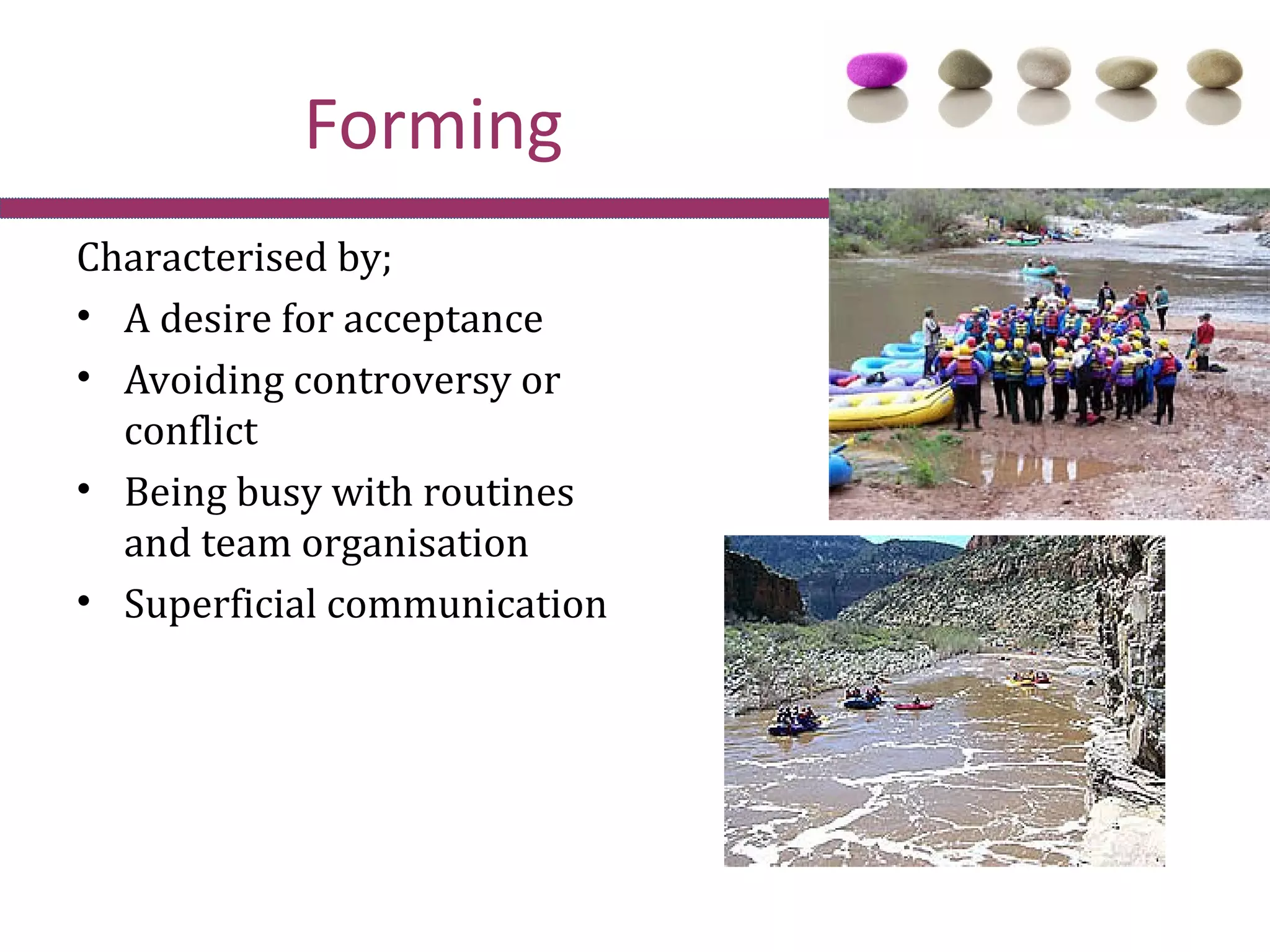
Forming
Characterised by;
• A desire for acceptance
• Avoiding controversy or
  conflict
• Being busy with routines
  and team organisation
• Superficial communication
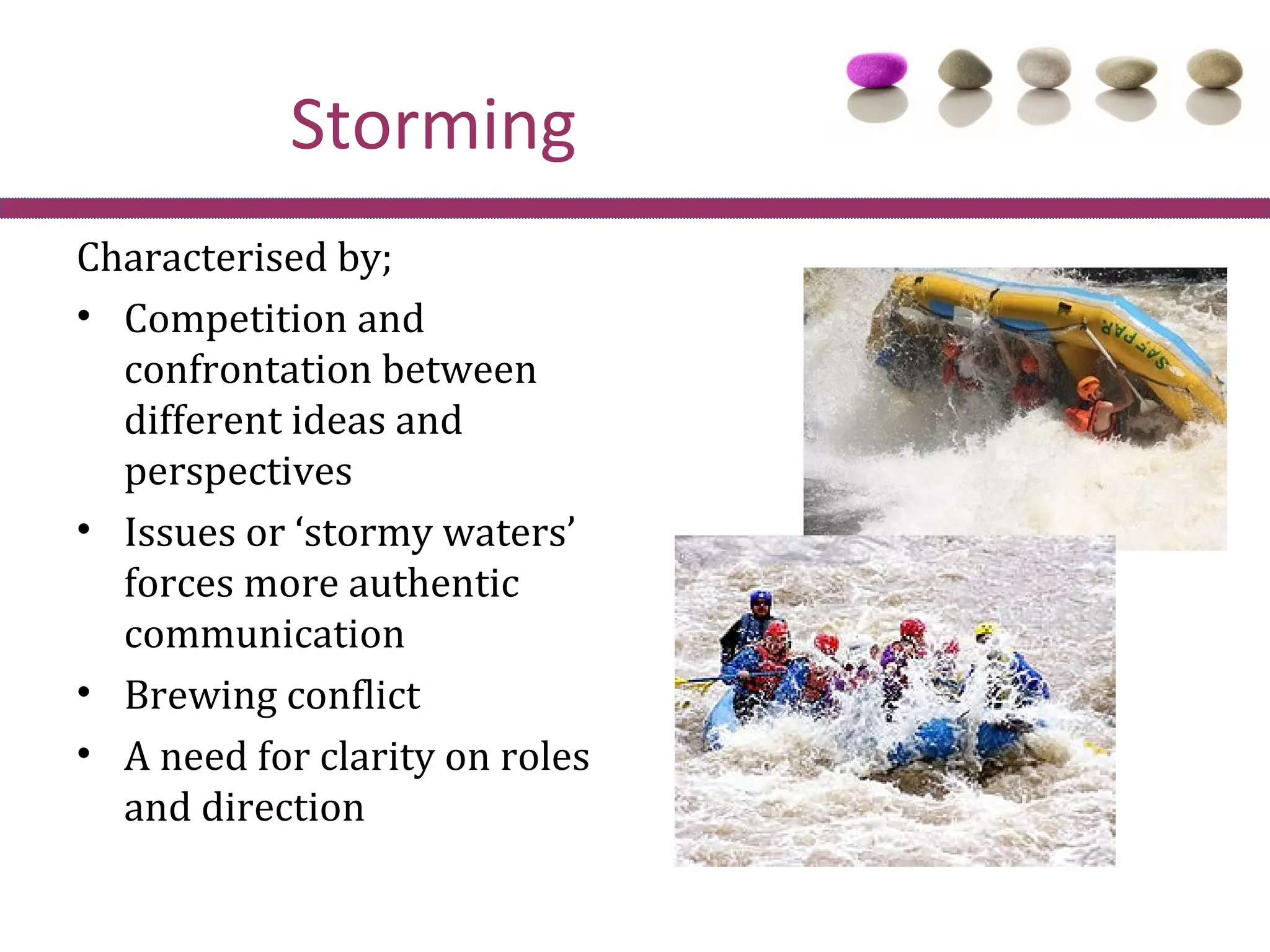
Storming
Characterised by;
• Competition and
  confrontation between
  different ideas and
  perspectives
• Issues or ‘stormy waters’
  forces more authentic
  communication
• Brewing conflict
• A need for clarity on roles
  and direction
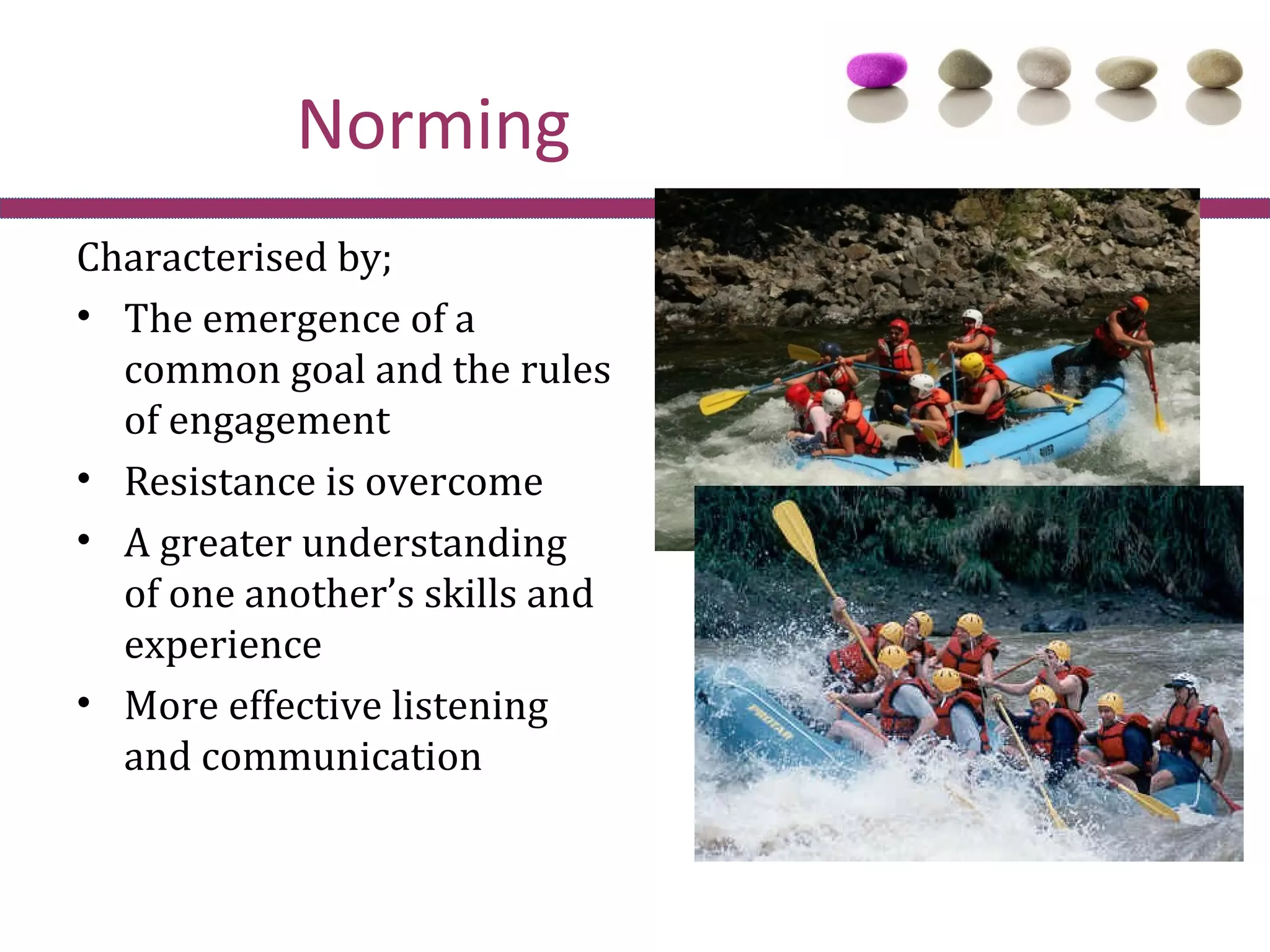
Norming
Characterised by;
• The emergence of a
  common goal and the rules
  of engagement
• Resistance is overcome
• A greater understanding
  of one another’s skills and
  experience
• More effective listening
  and communication
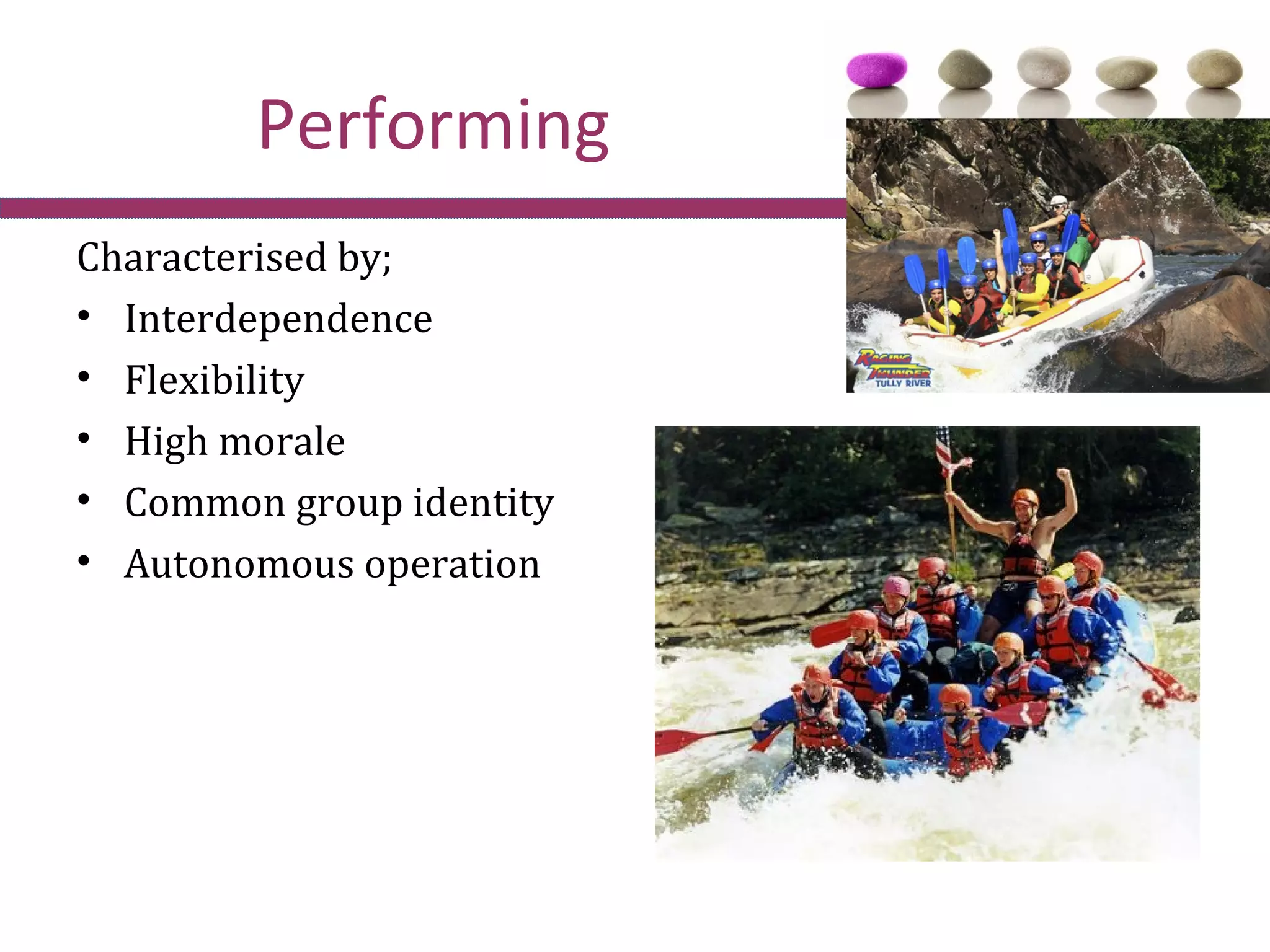
Performing
Characterised by;
• Interdependence
• Flexibility
• High morale
• Common group identity
• Autonomous operation
Questions

Why would teams go back to norming &
storming stages?
Useful questions –
What will it take to move the Team to
‘performing’?
What needs our immediate attention going
forward?
3.
DEVELOPING HIGH PERFORMANCE
What produces High
   Performance?

• The average work group and the
  exceptional team can be compared to two
  horses; both with the same muscles, leg and
  lungs. One is an ordinary riding horse and
  the other a winner of the Durban July
• What makes them different?
Ingredients of High
     Performance

1.Leadership – build team, provide direction
  an inspire to a common purpose
2.Membership – clear roles
3.Methods of working together – common
  ways of doing things (problem solving, decision
  making and innovative thinking)
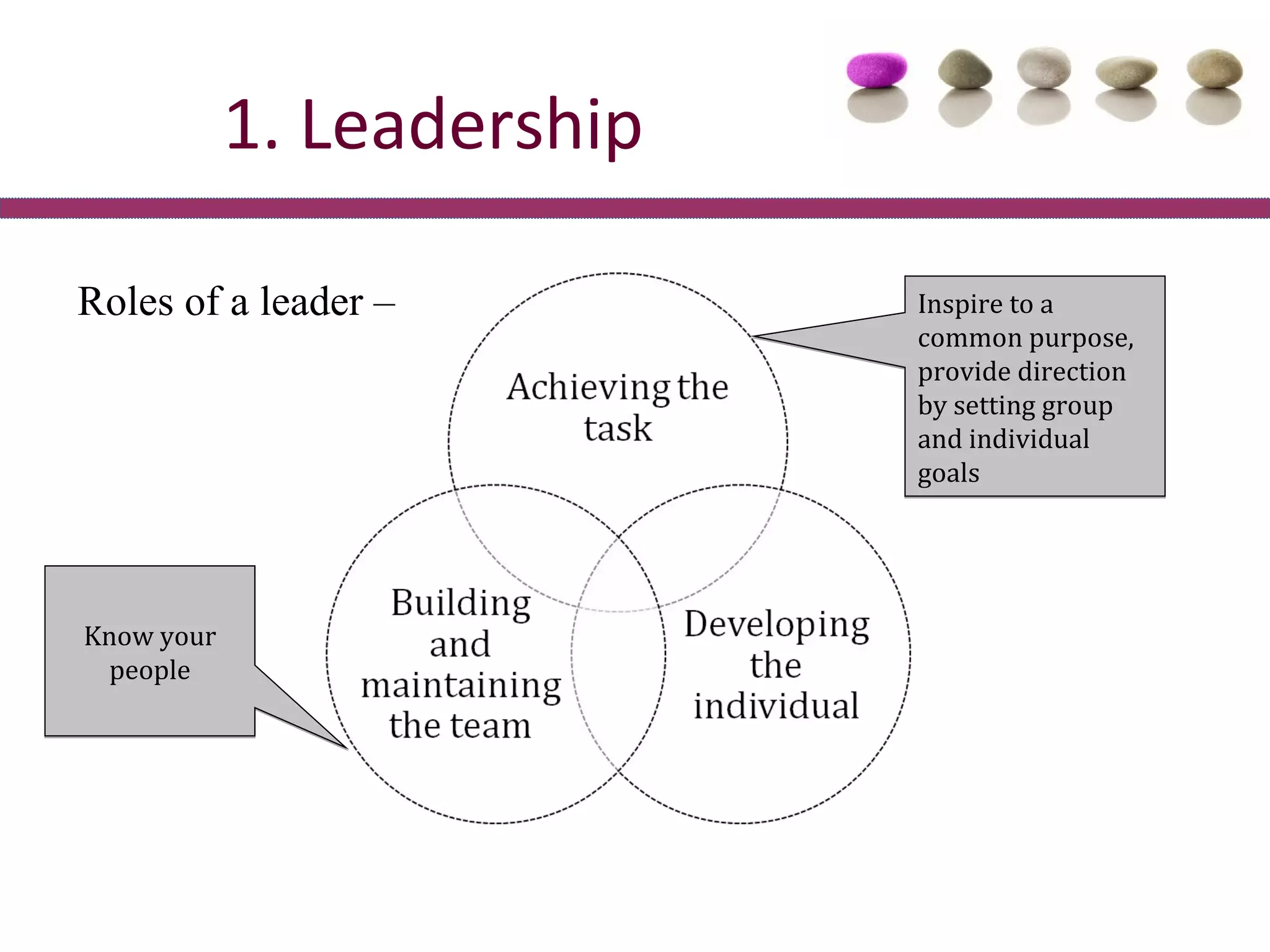
1. Leadership

Roles of a leader –         Inspire to a
                            common purpose,
                            provide direction
                            by setting group
                            and individual
                            goals


Know your
 people
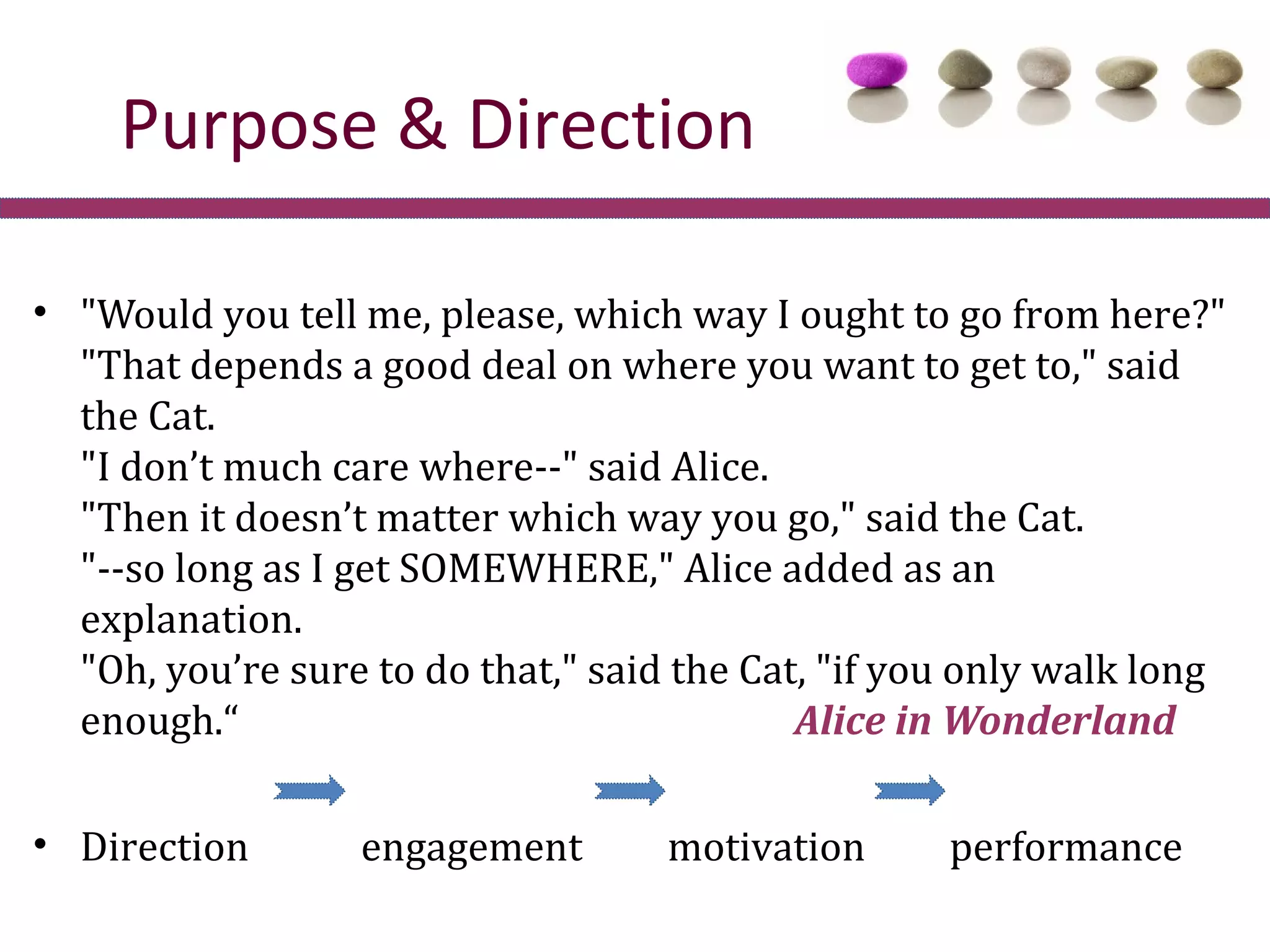
Purpose & Direction

• "Would you tell me, please, which way I ought to go from here?"
  "That depends a good deal on where you want to get to," said
  the Cat.
  "I don’t much care where--" said Alice.
  "Then it doesn’t matter which way you go," said the Cat.
  "--so long as I get SOMEWHERE," Alice added as an
  explanation.
  "Oh, you’re sure to do that," said the Cat, "if you only walk long
  enough.“                                  Alice in Wonderland

• Direction       engagement        motivation      performance
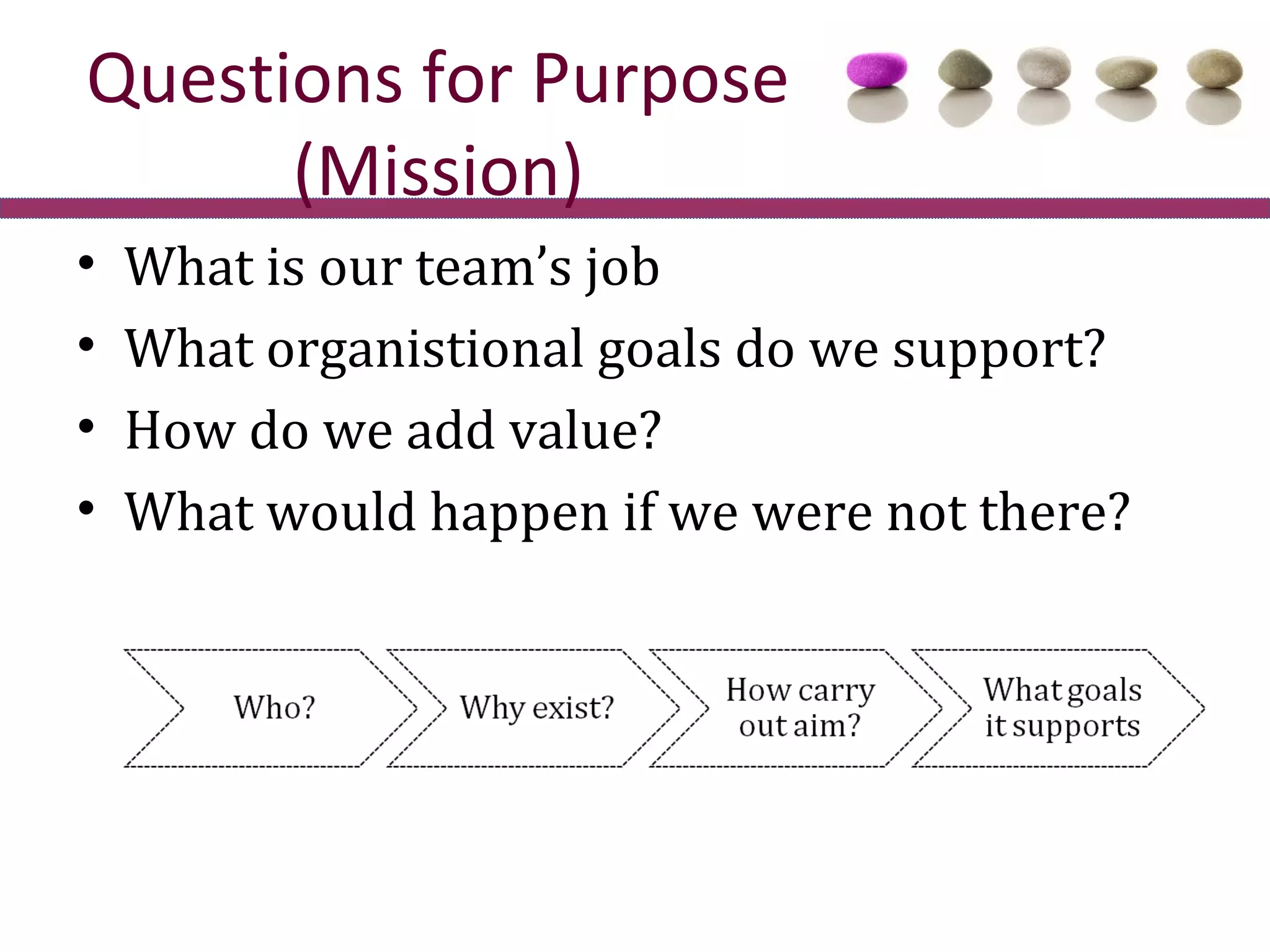
Questions for Purpose
      (Mission)
•   What is our team’s job
•   What organistional goals do we support?
•   How do we add value?
•   What would happen if we were not there?
Examples
• School District #77 wants happy and healthy
  students. To that end, the district's personnel
  strives, through a coordinated school health
  program, to provide students with experiences
  that are designed to motivate and enable them to
  maintain and improve their health.

• McDonald's vision is to be the world's best quick
  service restaurant experience. Being the best
  means providing outstanding quality, service,
  cleanliness, and value, so that we make every
  customer in every restaurant smile
Break it down

Goal 1: Obtain a Customer Satisfaction      Measure: Customer Satisfaction
rating of 98% on the internal stakeholder   Rating
satisfaction survey

Action Steps                  Who           By When       Resources
Summarise scorecard results   Sally &       9 August
                              Achmat
Review scorecard with each    Sally &       30 Sep        Administrative
stakeholder to check where    Achmat                      support to set up
needs and expectations are                                meetings
not being met
2. Membership
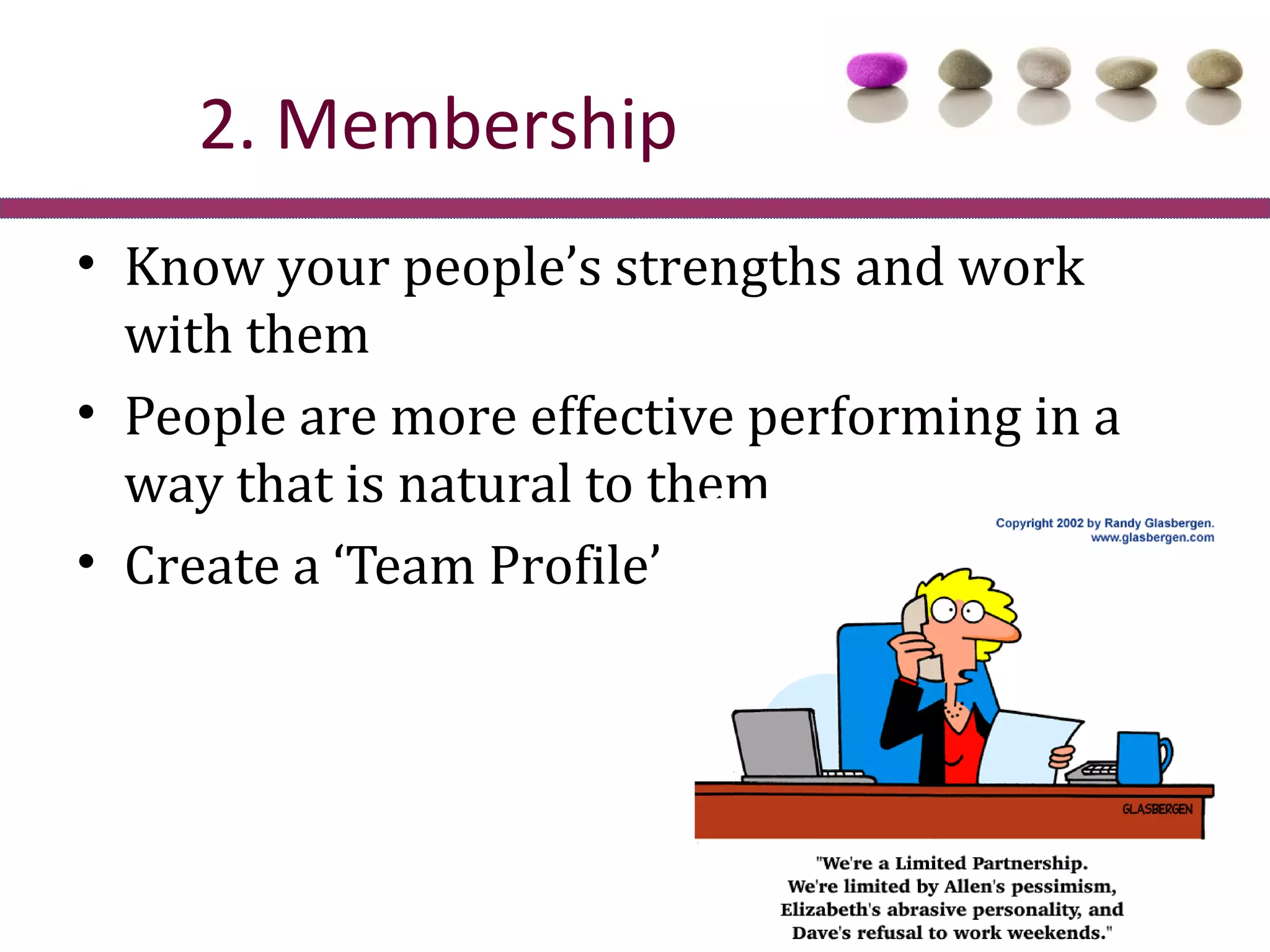
• Know your people’s strengths and work
  with them
• People are more effective performing in a
  way that is natural to them
• Create a ‘Team Profile’
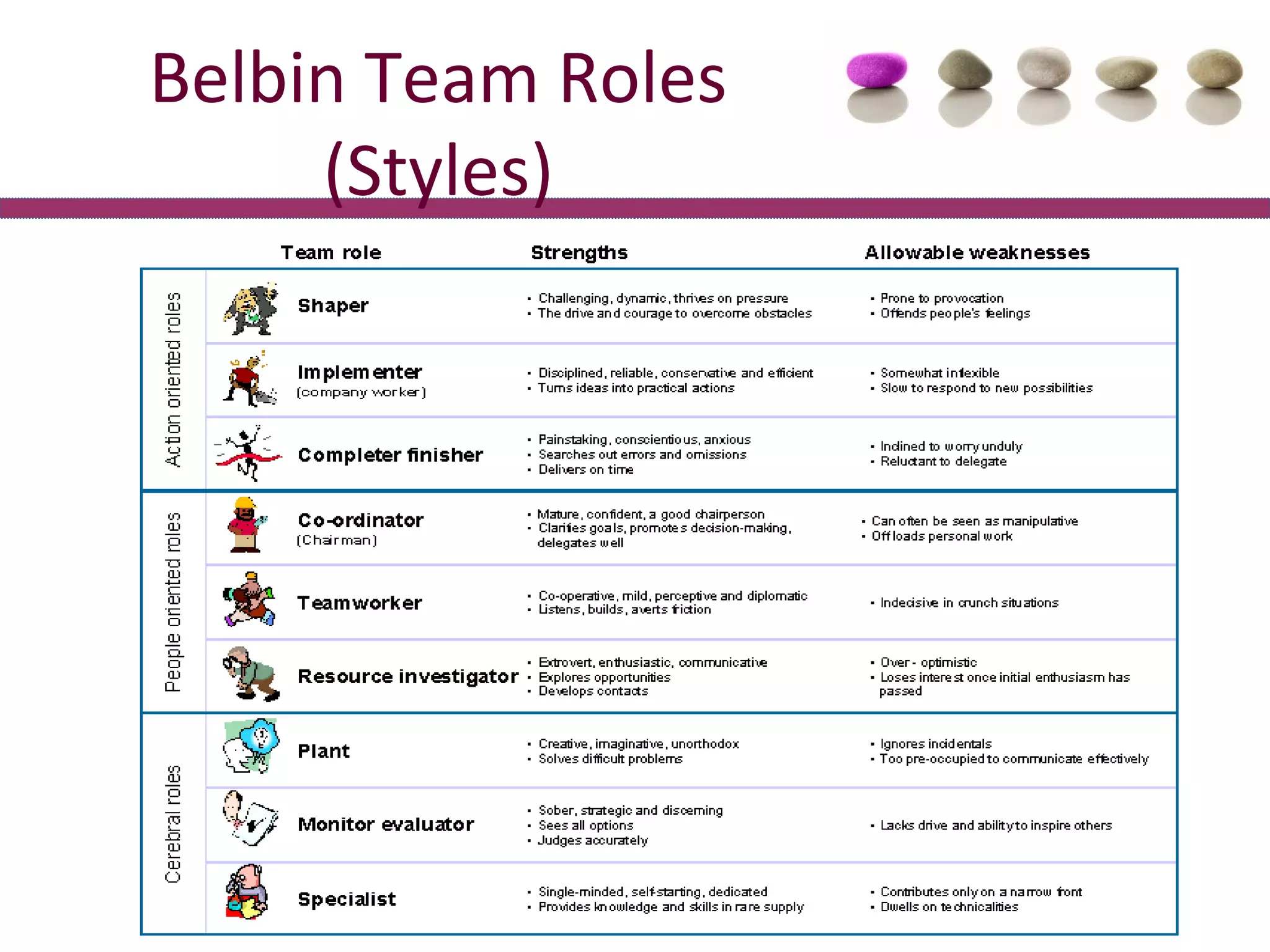
Belbin Team Roles
     (Styles)
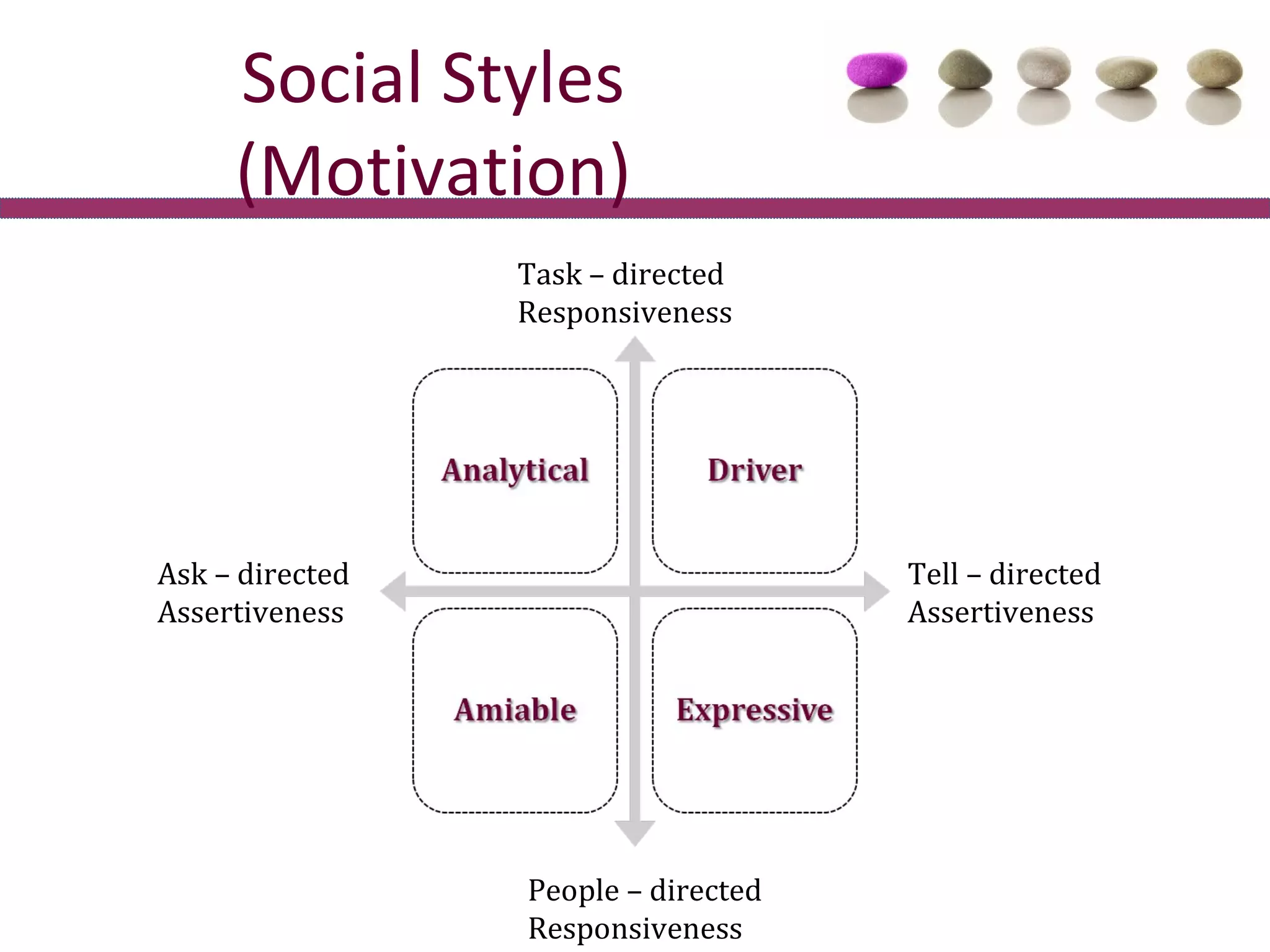
Social Styles
     (Motivation)
                 Task – directed
                 Responsiveness


Ask – directed                       Tell – directed
Assertiveness                        Assertiveness


                 People – directed
                 Responsiveness
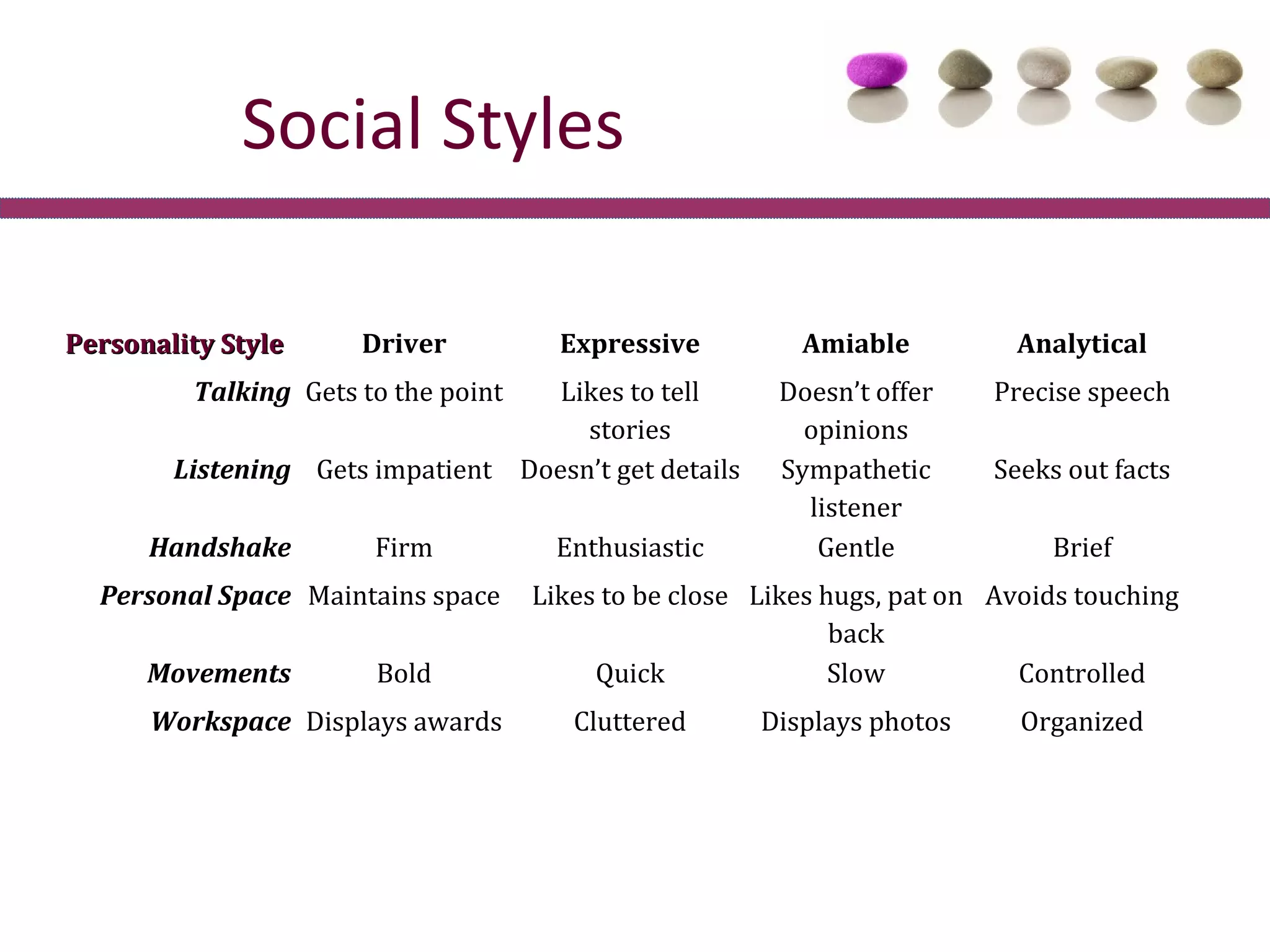
Social Styles

Personality Style     Driver           Expressive         Amiable          Analytical
         Talking Gets to the point  Likes to tell       Doesn’t offer     Precise speech
                                      stories             opinions
        Listening Gets impatient Doesn’t get details    Sympathetic       Seeks out facts
                                                          listener
      Handshake        Firm           Enthusiastic         Gentle              Brief
  Personal Space Maintains space     Likes to be close Likes hugs, pat on Avoids touching
                                                              back
      Movements        Bold               Quick               Slow          Controlled
      Workspace Displays awards         Cluttered      Displays photos      Organized
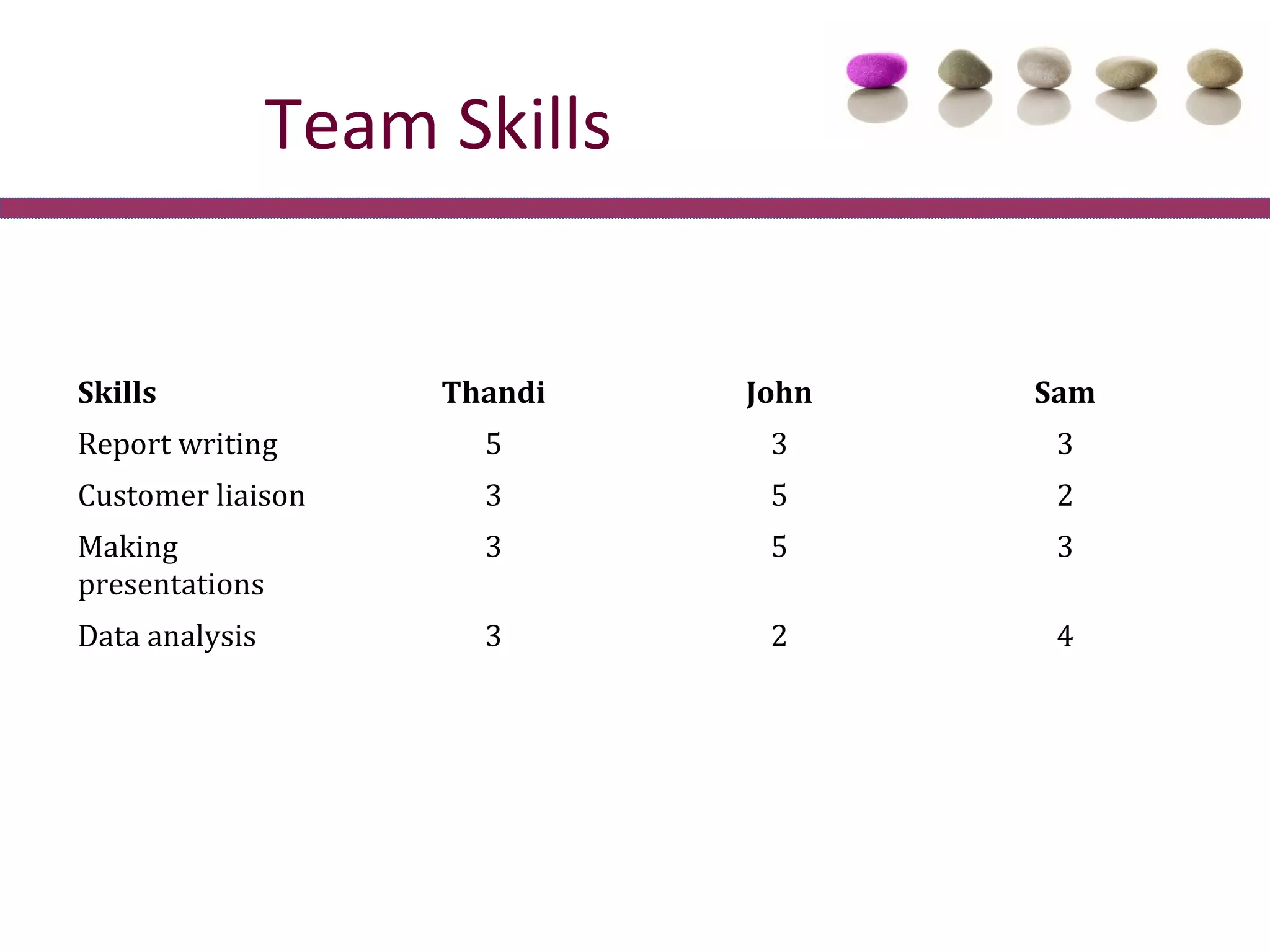
Team Skills


Skills               Thandi   John   Sam
Report writing         5       3      3
Customer liaison       3       5      2
Making                 3       5      3
presentations
Data analysis          3       2      4
3. Methods of
    Working Together
• How will you communicate?
• How will you manage meetings?
• How will you problem solve?
• How will you resolve conflict and
  disagreements?
• Scope of authority
    – What decisions can be made without
      consultation and which require involvement
Significance
• How attracted are you to staying for an
  extra hour? (Scale of 1 to 10)
• What caused you to write that answer?
• What would have to change in order to
  raise the number
4.
TEAM MAINTENANCE
Symptoms
•   Low morale
•   Lost sense of purpose, direction
•   Communication is superficial
•   Signs of mistrust
•   Low enthusiasm
•   Development of cliques and sub groups
•   Complaints about your leadership
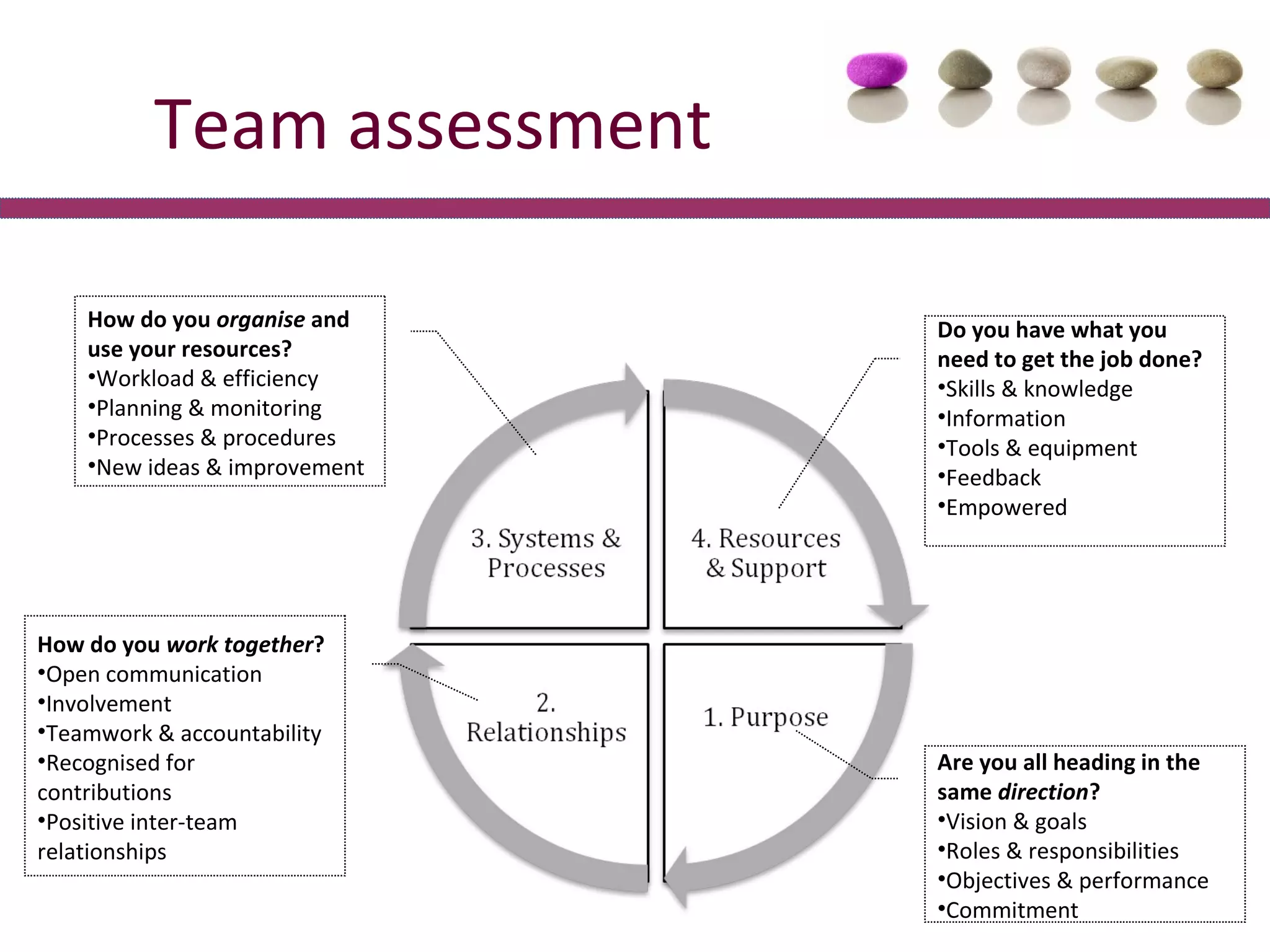
Team assessment

    How do you organise and    Do you have what you
    use your resources?        need to get the job done?
    •Workload & efficiency     •Skills & knowledge
    •Planning & monitoring     •Information
    •Processes & procedures    •Tools & equipment
    •New ideas & improvement   •Feedback
                               •Empowered


How do you work together?
•Open communication
•Involvement
•Teamwork & accountability
•Recognised for                Are you all heading in the
contributions                  same direction?
•Positive inter-team           •Vision & goals
relationships                  •Roles & responsibilities
                               •Objectives & performance
                               •Commitment
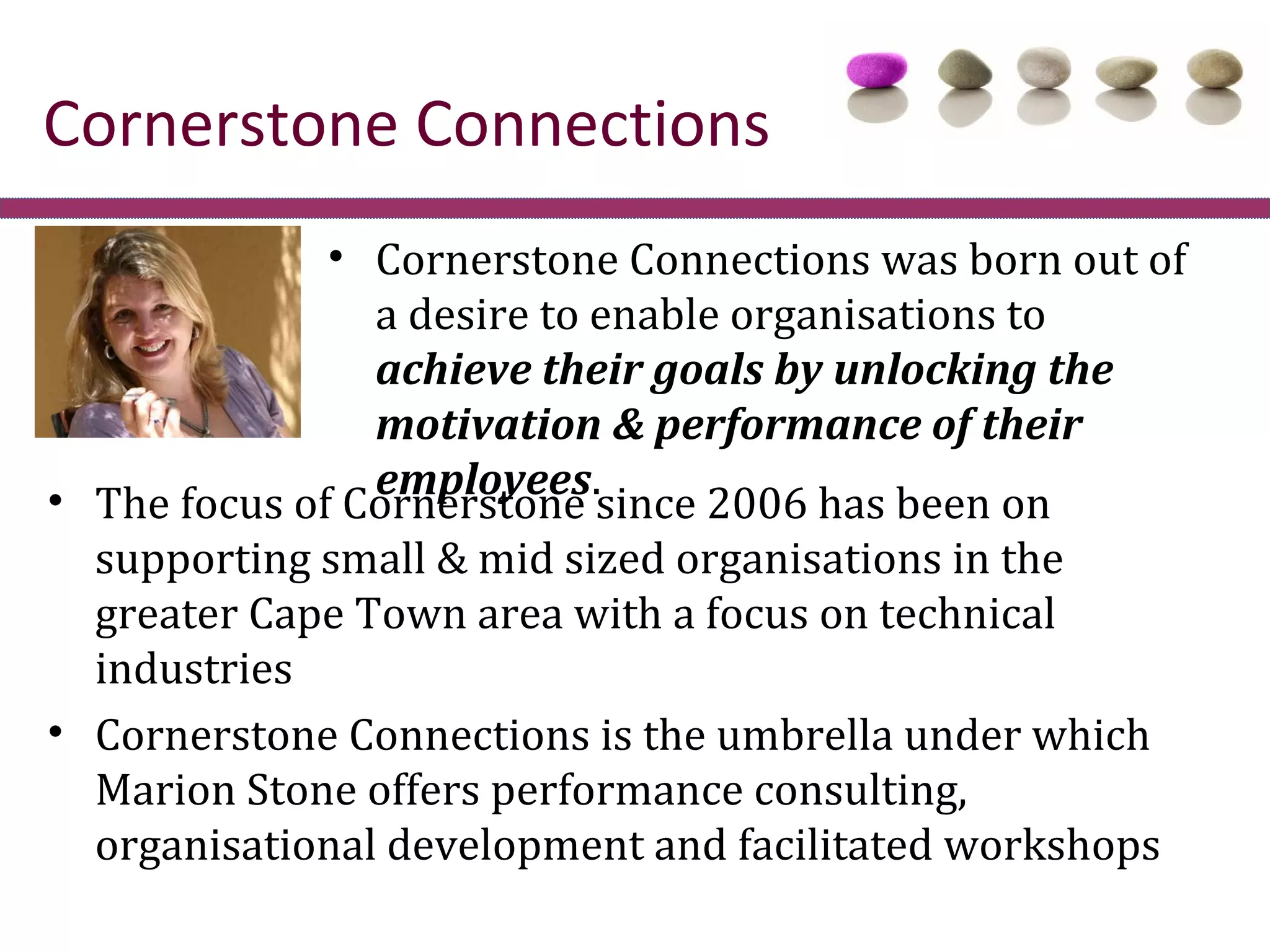
Cornerstone Connections
              • Cornerstone Connections was born out of
                a desire to enable organisations to
                achieve their goals by unlocking the
                motivation & performance of their
                employees.
• The focus of Cornerstone since 2006 has been on
  supporting small & mid sized organisations in the
  greater Cape Town area with a focus on technical
  industries
• Cornerstone Connections is the umbrella under which
  Marion Stone offers performance consulting,
  organisational development and facilitated workshops
Client History

•   Vital Health Foods – Food Manufacturing
•   Elex Khanyisa – Electrical testing
•   Mazars – Accountants
•   Netcare – Healthcare
•   Pesto Princess – Food Manufacturing
•   Bergstan – Consulting Engineers


                                              SABPP
What next?

• Ask me for details of my ½ day Strategy sessions
• Visit my website for more information & resources
  www.cornerstoneconnections.co.za
• Sign up for an informative, free monthly
  newsletter on my homepage or by leaving me your
  card.
• Connect with me via my LinkedIn profile


                  www.cornerstoneconnections.co.za   34

Building High Performing Teams

  • 1.
    Building High PerformingTeams Facilitated by Marion Stone
  • 2.
    Agenda 1. Definition ofa Team 2. Team Growth 3. Developing ‘High Performance’ – Leadership – Membership – Methods of working together 1. Team Maintenance
  • 3.
  • 4.
    Group vs. Team WorkingTogether Team • Complementary effort by a • Cooperative effort require group of people e.g. lifting to carry out a joint task e.g. something, stuffing maintenance crews, envelopes project teams
  • 5.
    Definition of aTeam • Working towards a shared purpose or goal • Complementary skills • Sharing responsibility • Interdependence • Collaborative decision making – acting as a unit • Characterised by participation, trust, communication, struggles, collaboration, clear struggles roles, quality control
  • 6.
    Definition of aTeam "None of us is as smart as all of us." Ken Blanchard "Teamwork is the ability to work together toward a common vision. It is the fuel that allows common people to attain uncommon results." Andrew Carnegie TEAM = Together Everyone Achieves More
  • 7.
  • 8.
    Tuckman’s 4 Stagesof Team Development
  • 9.
    Forming Characterised by; • Adesire for acceptance • Avoiding controversy or conflict • Being busy with routines and team organisation • Superficial communication
  • 10.
    Storming Characterised by; • Competitionand confrontation between different ideas and perspectives • Issues or ‘stormy waters’ forces more authentic communication • Brewing conflict • A need for clarity on roles and direction
  • 11.
    Norming Characterised by; • Theemergence of a common goal and the rules of engagement • Resistance is overcome • A greater understanding of one another’s skills and experience • More effective listening and communication
  • 12.
    Performing Characterised by; • Interdependence •Flexibility • High morale • Common group identity • Autonomous operation
  • 13.
    Questions Why would teamsgo back to norming & storming stages? Useful questions – What will it take to move the Team to ‘performing’? What needs our immediate attention going forward?
  • 14.
  • 15.
    What produces High Performance? • The average work group and the exceptional team can be compared to two horses; both with the same muscles, leg and lungs. One is an ordinary riding horse and the other a winner of the Durban July • What makes them different?
  • 16.
    Ingredients of High Performance 1.Leadership – build team, provide direction an inspire to a common purpose 2.Membership – clear roles 3.Methods of working together – common ways of doing things (problem solving, decision making and innovative thinking)
  • 17.
    1. Leadership Roles ofa leader – Inspire to a common purpose, provide direction by setting group and individual goals Know your people
  • 18.
    Purpose & Direction •"Would you tell me, please, which way I ought to go from here?" "That depends a good deal on where you want to get to," said the Cat. "I don’t much care where--" said Alice. "Then it doesn’t matter which way you go," said the Cat. "--so long as I get SOMEWHERE," Alice added as an explanation. "Oh, you’re sure to do that," said the Cat, "if you only walk long enough.“ Alice in Wonderland • Direction engagement motivation performance
  • 19.
    Questions for Purpose (Mission) • What is our team’s job • What organistional goals do we support? • How do we add value? • What would happen if we were not there?
  • 20.
    Examples • School District#77 wants happy and healthy students. To that end, the district's personnel strives, through a coordinated school health program, to provide students with experiences that are designed to motivate and enable them to maintain and improve their health. • McDonald's vision is to be the world's best quick service restaurant experience. Being the best means providing outstanding quality, service, cleanliness, and value, so that we make every customer in every restaurant smile
  • 21.
    Break it down Goal1: Obtain a Customer Satisfaction Measure: Customer Satisfaction rating of 98% on the internal stakeholder Rating satisfaction survey Action Steps Who By When Resources Summarise scorecard results Sally & 9 August Achmat Review scorecard with each Sally & 30 Sep Administrative stakeholder to check where Achmat support to set up needs and expectations are meetings not being met
  • 22.
    2. Membership • Knowyour people’s strengths and work with them • People are more effective performing in a way that is natural to them • Create a ‘Team Profile’
  • 23.
  • 24.
    Social Styles (Motivation) Task – directed Responsiveness Ask – directed Tell – directed Assertiveness Assertiveness People – directed Responsiveness
  • 25.
    Social Styles Personality Style Driver Expressive Amiable Analytical Talking Gets to the point Likes to tell Doesn’t offer Precise speech stories opinions Listening Gets impatient Doesn’t get details Sympathetic Seeks out facts listener Handshake Firm Enthusiastic Gentle Brief Personal Space Maintains space Likes to be close Likes hugs, pat on Avoids touching back Movements Bold Quick Slow Controlled Workspace Displays awards Cluttered Displays photos Organized
  • 26.
    Team Skills Skills Thandi John Sam Report writing 5 3 3 Customer liaison 3 5 2 Making 3 5 3 presentations Data analysis 3 2 4
  • 27.
    3. Methods of Working Together • How will you communicate? • How will you manage meetings? • How will you problem solve? • How will you resolve conflict and disagreements? • Scope of authority – What decisions can be made without consultation and which require involvement
  • 28.
    Significance • How attractedare you to staying for an extra hour? (Scale of 1 to 10) • What caused you to write that answer? • What would have to change in order to raise the number
  • 29.
  • 30.
    Symptoms • Low morale • Lost sense of purpose, direction • Communication is superficial • Signs of mistrust • Low enthusiasm • Development of cliques and sub groups • Complaints about your leadership
  • 31.
    Team assessment How do you organise and Do you have what you use your resources? need to get the job done? •Workload & efficiency •Skills & knowledge •Planning & monitoring •Information •Processes & procedures •Tools & equipment •New ideas & improvement •Feedback •Empowered How do you work together? •Open communication •Involvement •Teamwork & accountability •Recognised for Are you all heading in the contributions same direction? •Positive inter-team •Vision & goals relationships •Roles & responsibilities •Objectives & performance •Commitment
  • 32.
    Cornerstone Connections • Cornerstone Connections was born out of a desire to enable organisations to achieve their goals by unlocking the motivation & performance of their employees. • The focus of Cornerstone since 2006 has been on supporting small & mid sized organisations in the greater Cape Town area with a focus on technical industries • Cornerstone Connections is the umbrella under which Marion Stone offers performance consulting, organisational development and facilitated workshops
  • 33.
    Client History • Vital Health Foods – Food Manufacturing • Elex Khanyisa – Electrical testing • Mazars – Accountants • Netcare – Healthcare • Pesto Princess – Food Manufacturing • Bergstan – Consulting Engineers SABPP
  • 34.
    What next? • Askme for details of my ½ day Strategy sessions • Visit my website for more information & resources www.cornerstoneconnections.co.za • Sign up for an informative, free monthly newsletter on my homepage or by leaving me your card. • Connect with me via my LinkedIn profile www.cornerstoneconnections.co.za 34

Editor's Notes

  • #27 And motivations e.g. relationship building, leader, variety, technical expert