
Managing Quality 
Improvement Teams and Projects
Why do you suppose the voice of 
participation and teamwork to manage 
business today? 
• One of the biggest reasons is Complexity that drive 
workers from routine work to the knowledge work, 
which is work that involves the development and 
transmission of knowledge and information.
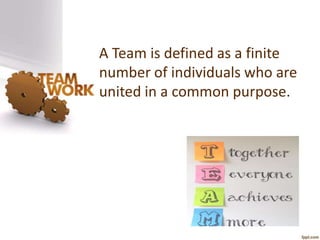
A Team is defined as a finite 
number of individuals who are 
united in a common purpose.
Why employees enjoy teams? 
• Mutuality: the need for 
mutual support and 
encouragement . 
• Recognition for personal 
achievement: by rewards, 
incentives and status. 
• Belonging: the individual’s 
need for supportive, 
cohesive, and friendly team 
relations. 
• Bounded power: the need for 
authority and control over 
project resources and people 
to influence decisions and 
opportunities. 
• Creative autonomy :give 
employees opportunity to use 
their creativity , and enjoy 
good working conditions.
Leading teams for quality 
• Employee empowerment: means giving 
power to team members who had little control over 
their jobs. 
• Is an important factor in improving employee moral 
and performance. 
• Tell employees that their thoughts and ideas are 
valued.
Flattening hierarchies for 
improved effectiveness 
Having many layers of management can increase the 
time required to perform work. 
Top managers have eliminated layers of bureaucratic 
managers in order to improve communication and 
simplify work.
Team leader roles and 
responsibilities 
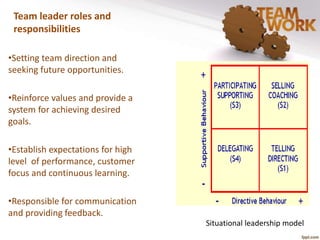
•Setting team direction and 
seeking future opportunities. 
•Reinforce values and provide a 
system for achieving desired 
goals. 
•Establish expectations for high 
level of performance, customer 
focus and continuous learning. 
•Responsible for communication 
and providing feedback. 
Situational leadership model
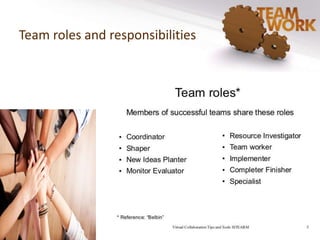
Team roles and responsibilities
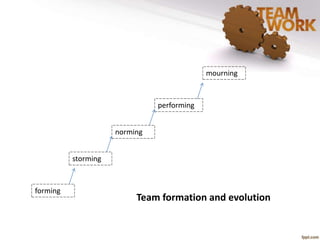
Team formation and evolution 
storming 
forming 
performing 
norming 
mourning
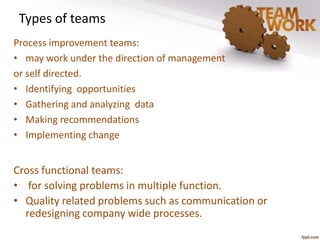
Types of teams 
Process improvement teams: 
• may work under the direction of management 
or self directed. 
• Identifying opportunities 
• Gathering and analyzing data 
• Making recommendations 
• Implementing change 
Cross functional teams: 
• for solving problems in multiple function. 
• Quality related problems such as communication or 
redesigning company wide processes.
Types of teams 
Tiger teams: 
• Is a high powered team assigned to work on a specific 
problem for a short period of time. 
Natural work groups 
• Are teams organized around a common product, 
customer, or service. 
• The tasks: increasing responsiveness to customer and 
market demand.
Types of teams 
Self directed work teams 
• Is chartered to work on projects identified by team members 
themselves. 
• Little s: are made up of employees empowered to identify 
opportunities for improvement, select projects, and complete 
implementation. 
• Big S: teams are involved in managing the different functions 
of the company. Ex: decisions in finance, pay, processes, 
customers …
Types of teams 
Virtual teams 
• These teams rarely or never physically meet . 
• Internet and intranet-based applications called teamwork, 
allow us to access the web, build a team, share ideas, hold 
virtual meetings, brainstorm, keep schedules, and archive past 
results with people around the world
Implementing teams 
The role of facilitator is to make it easy for the group to 
know : 
where it is going? 
Why it wants to get there? 
How to get there? 
And what it is going to do next?
• Meeting management: is an important skill for a 
facilitator of quality improvement teams. 
Steps required for planning a meeting: 
• Defining an agenda 
• Developing meeting objectives 
• Designing the agenda activity outline 
• Using process techniques
Conflict resolution in teams 
• As people work closely together in teams, 
conflicts arise. 
Four recognizable stages occur in the conflict resolution 
process: 
• Frustration: competition and aggression. 
• Conceptualization and orientation: opponents 
identify the issues that need to be resolved. 
• Interaction: team members discuss problems. 
• Outcome: the problem is resolved.
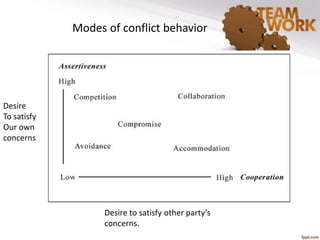
Desire to satisfy other party’s 
concerns. 
Desire 
To satisfy 
Our own 
concerns 
Modes of conflict behavior
Leaders resolve conflict in a variety 
of ways: 
1. Passive conflict resolution 
2. Win-win 
3. Structured problem solving 
4. Confronting conflicts 
5. Choosing a winner 
6. Selecting a better alternative 
7. Preventing conflict
Tools used in controlling projects
1. Qualifying projects 
• To determine the worthiness of a project on 
different dimensions. 
• Commonly used method are cost-benefits analysis 
using payback period. 
• Direct cost , indirect cost, expected returns for 
projects.
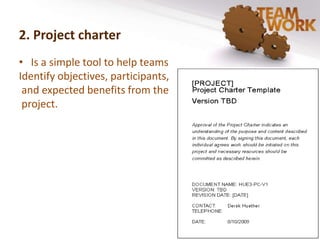
2. Project charter 
• Is a simple tool to help teams 
Identify objectives, participants, 
and expected benefits from the 
project.
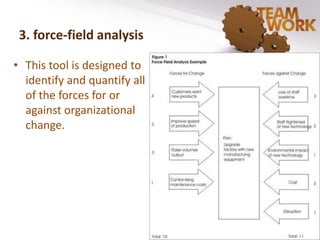
3. force-field analysis 
• This tool is designed to 
identify and quantify all 
of the forces for or 
against organizational 
change.
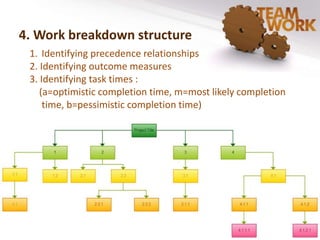
4. Work breakdown structure 
1. Identifying precedence relationships 
2. Identifying outcome measures 
3. Identifying task times : 
(a=optimistic completion time, m=most likely completion 
time, b=pessimistic completion time)
Work breakdown structure 
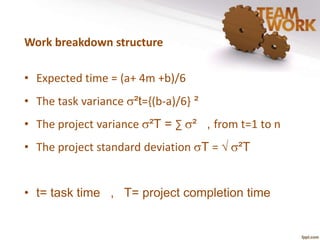
• Expected time = (a+ 4m +b)/6 
• The task variance ²t={(b-a)/6} ² 
• The project variance ²T = Σ ² , from t=1 to n 
• The project standard deviation T = √ ²T 
• t= task time , T= project completion time
5. Activity network diagram 
• The following steps are used to develop 
a Program evaluation review technique (PERT chart): 
• List all the tasks. 
• Determine task time. 
• Indicate which tasks depend on the completion of the 
other tasks in the project. 
• Draw the network diagram.
Activity network diagram 
• Compute early start and early finish times from left 
to right. 
• Compute late start and late finish times from right to 
left. 
• Compute slack times slack time = late start – early 
start. 
• Determine the critical path that links activities with 
zero slack.
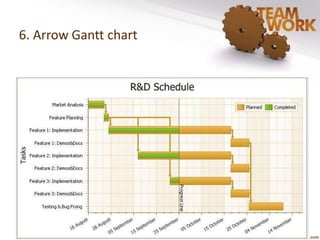
6. Arrow Gantt chart
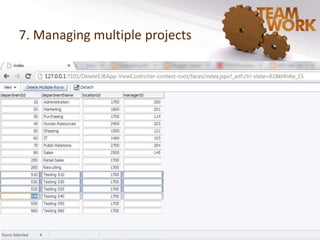
7. Managing multiple projects
Team and project

Team and project

  • 1.
    Managing Quality ImprovementTeams and Projects
  • 2.
    Why do yousuppose the voice of participation and teamwork to manage business today? • One of the biggest reasons is Complexity that drive workers from routine work to the knowledge work, which is work that involves the development and transmission of knowledge and information.
  • 3.
    A Team isdefined as a finite number of individuals who are united in a common purpose.
  • 4.
    Why employees enjoyteams? • Mutuality: the need for mutual support and encouragement . • Recognition for personal achievement: by rewards, incentives and status. • Belonging: the individual’s need for supportive, cohesive, and friendly team relations. • Bounded power: the need for authority and control over project resources and people to influence decisions and opportunities. • Creative autonomy :give employees opportunity to use their creativity , and enjoy good working conditions.
  • 5.
    Leading teams forquality • Employee empowerment: means giving power to team members who had little control over their jobs. • Is an important factor in improving employee moral and performance. • Tell employees that their thoughts and ideas are valued.
  • 6.
    Flattening hierarchies for improved effectiveness Having many layers of management can increase the time required to perform work. Top managers have eliminated layers of bureaucratic managers in order to improve communication and simplify work.
  • 7.
    Team leader rolesand responsibilities •Setting team direction and seeking future opportunities. •Reinforce values and provide a system for achieving desired goals. •Establish expectations for high level of performance, customer focus and continuous learning. •Responsible for communication and providing feedback. Situational leadership model
  • 8.
    Team roles andresponsibilities
  • 9.
    Team formation andevolution storming forming performing norming mourning
  • 10.
    Types of teams Process improvement teams: • may work under the direction of management or self directed. • Identifying opportunities • Gathering and analyzing data • Making recommendations • Implementing change Cross functional teams: • for solving problems in multiple function. • Quality related problems such as communication or redesigning company wide processes.
  • 11.
    Types of teams Tiger teams: • Is a high powered team assigned to work on a specific problem for a short period of time. Natural work groups • Are teams organized around a common product, customer, or service. • The tasks: increasing responsiveness to customer and market demand.
  • 12.
    Types of teams Self directed work teams • Is chartered to work on projects identified by team members themselves. • Little s: are made up of employees empowered to identify opportunities for improvement, select projects, and complete implementation. • Big S: teams are involved in managing the different functions of the company. Ex: decisions in finance, pay, processes, customers …
  • 13.
    Types of teams Virtual teams • These teams rarely or never physically meet . • Internet and intranet-based applications called teamwork, allow us to access the web, build a team, share ideas, hold virtual meetings, brainstorm, keep schedules, and archive past results with people around the world
  • 14.
    Implementing teams Therole of facilitator is to make it easy for the group to know : where it is going? Why it wants to get there? How to get there? And what it is going to do next?
  • 15.
    • Meeting management:is an important skill for a facilitator of quality improvement teams. Steps required for planning a meeting: • Defining an agenda • Developing meeting objectives • Designing the agenda activity outline • Using process techniques
  • 16.
    Conflict resolution inteams • As people work closely together in teams, conflicts arise. Four recognizable stages occur in the conflict resolution process: • Frustration: competition and aggression. • Conceptualization and orientation: opponents identify the issues that need to be resolved. • Interaction: team members discuss problems. • Outcome: the problem is resolved.
  • 17.
    Desire to satisfyother party’s concerns. Desire To satisfy Our own concerns Modes of conflict behavior
  • 18.
    Leaders resolve conflictin a variety of ways: 1. Passive conflict resolution 2. Win-win 3. Structured problem solving 4. Confronting conflicts 5. Choosing a winner 6. Selecting a better alternative 7. Preventing conflict
  • 19.
    Tools used incontrolling projects
  • 20.
    1. Qualifying projects • To determine the worthiness of a project on different dimensions. • Commonly used method are cost-benefits analysis using payback period. • Direct cost , indirect cost, expected returns for projects.
  • 21.
    2. Project charter • Is a simple tool to help teams Identify objectives, participants, and expected benefits from the project.
  • 22.
    3. force-field analysis • This tool is designed to identify and quantify all of the forces for or against organizational change.
  • 23.
    4. Work breakdownstructure 1. Identifying precedence relationships 2. Identifying outcome measures 3. Identifying task times : (a=optimistic completion time, m=most likely completion time, b=pessimistic completion time)
  • 24.
    Work breakdown structure • Expected time = (a+ 4m +b)/6 • The task variance ²t={(b-a)/6} ² • The project variance ²T = Σ ² , from t=1 to n • The project standard deviation T = √ ²T • t= task time , T= project completion time
  • 25.
    5. Activity networkdiagram • The following steps are used to develop a Program evaluation review technique (PERT chart): • List all the tasks. • Determine task time. • Indicate which tasks depend on the completion of the other tasks in the project. • Draw the network diagram.
  • 26.
    Activity network diagram • Compute early start and early finish times from left to right. • Compute late start and late finish times from right to left. • Compute slack times slack time = late start – early start. • Determine the critical path that links activities with zero slack.
  • 27.
  • 28.