Chapter 9 Notes Part I Covalent Bonding
Obj. 1…Octet Rule Recall that all elements want 8 valence e-. metals will  lose  their valence e-. non-metals will  gain  more valence e-. - (+) cations - (-) anions noble gases do not gain or lose e-.  - happy already! *** atoms need other atoms in order to lose/gain e-. - electronegativity differences determine bond. - metals = low / non-metals = high electroneg.
Obj. 2…Ionic Bonds transfer  of e- b/n (+) cation and (-) anion. - compounds created are neutral - 10% of all bonds -  strongest  bond - forms crystalline  solids -  highest  melting/boiling pts. - can conduct electricity in molten states.
Obj. 3…Pure Covalent Bonds equal sharing  of e- b/n non-metals ( molecule ) . - compounds created are neutral - 2% of all bonds -  weakest   bond - typically form  gases -  lowest  melting/boiling pts. - do  NOT  conduct electricity!
Obj. 4…Polar Covalent Bonds un-equal sharing  of e- b/n non-metals ( molecule ) . - compounds created are neutral - 88% of all bonds -  intermediate   bond strength - typically form  soft solids  and  liquids -  intermediate  melting/boiling pts. -  some  conduct electricity in molten states.
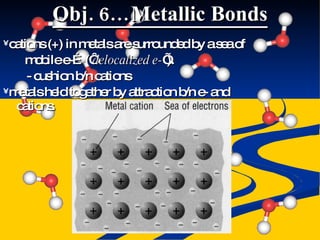
Obj. 6…Metallic Bonds cations (+) in metals are surrounded by a sea of mobile e-…(‘ delocalized e- ’). metals held together by attraction b/n e- and  - cushion b/n cations cations.
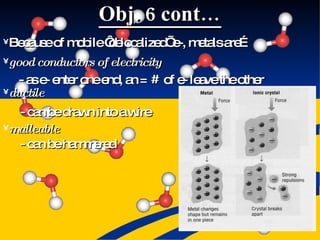
Obj. 6 cont… good conductors of electricity - as e- enter one end, an =  #  of e- leave the other ductile - can be drawn into a wire Because of mobile ‘delocalized’ e-, metals are… malleable - can be hammered
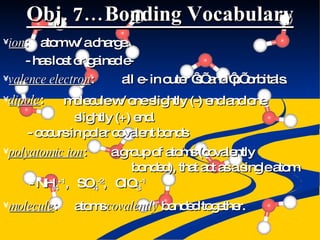
Obj. 7…Bonding Vocabulary ion : atom w/ a charge. - has lost or gained e- valence electron : all e- in outer ‘s’ and ‘p’ orbitals. dipole : molecule w/ one slightly (-) end and one slightly (+) end. - occurs in polar covalent bonds polyatomic ion : a group of atoms (covalently bonded), that act as a single atom - NH 4 +1 ,  SO 4 -2 ,  ClO 3 -1 molecule : atoms  covalently  bonded together.
Covalent Bonding A covalent bond occurs between two non-metals Electrostatic bonding does not occur—in other words, there is no “give and take” of electrons
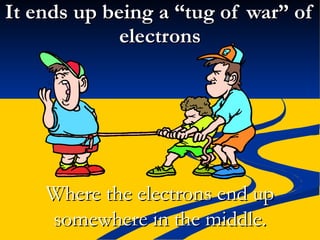
It ends up being a “tug of war” of electrons Where the electrons end up somewhere in the middle.
Single Bonds A single bond occurs when one pair of electrons is shared by two atoms. This pair of bonded electrons is called a  shared pair .
Double and Triple Bonds Double bonds occur when two atoms have two shared pair of electrons Triple bonds occur when two atoms share three pair of electrons
Sigma and Pi Bonds How do covalent bonds form between two elements? By the combining of their p orbitals.
Sigma and Pi Bonds The first bond between two atoms is a sigma bond (  ) and it forms because of end-to-end overlap of p orbitals.
Sigma and Pi Bonds Any other bonds between the same atoms would be a pi bond (  ) and they form because of side-to-side overlap of p orbitals.
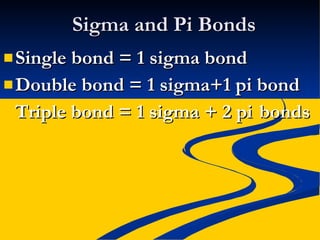
Sigma and Pi Bonds Single bond = 1 sigma bond Double bond = 1 sigma+1 pi bond Triple bond = 1 sigma + 2 pi  bonds
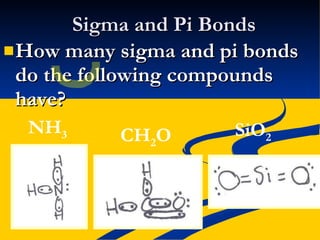
Sigma and Pi Bonds How many sigma and pi bonds do the following compounds have? NH 3 CH 2 O SiO 2
Strength of Covalent Bonds The strength of a covalent bond depends on how much distance separates the bonded nuclei. This is known as bond length. Determined by size of the atoms and how many electrons pairs are shared.
The shorter the bond length, the stronger the bond. Single bonds, such as F 2 , are weaker than double bonds, such as those in O 2. Double bonds are weaker than triple bonds, such as N 2 .
Naming Molecules 9.2 Rules to name binary molecular compounds. 1.  The first element in the formula is always named first, using the entire element name. 2.  The second element in the formula is named using the root of the element and adding the  suffix –ide . 3.  Prefixes are used to indicate the number of atoms of each type that are present in the compound.
Prefixes in Covalent Compounds 1  mono- 2  di- 3  tri- 4  tetra- 5  penta- 6  hexa- 7  hepta- 8  octa- 9  non- 10 deca One exception – the first element in the formula never uses the prefix mono-. When the element name begins with a vowel drop the final letter in the prefix.  CO carbon monoxide  not  monocarbon monooxide
Naming Acids binary acids A binary acid contains hydrogen and one other element. Use the prefix  hydro-  to name the hydrogen. Use the root of the second element plus the suffix  -ic acid.  HBr  hydrobromic acid
Naming Oxyacids Contains an oxyanion referred to as oxyacids. If anion suffix is -ate, it is replaced with the suffix -ic.  HNO 3  (nitrate ion)  nitric acid If anion suffix is -ite, it is replaced with the suffix -ous.  HNO 2   (nitrite ion)  nitrous acid
Writing Formulas from Names The name of any binary molecule allows you to write the correct formula with ease. Subscripts are determined from the prefixes used in the name  because the name indicates the exact number of each atom present in the molecule.  Carbon Monoxide  CO
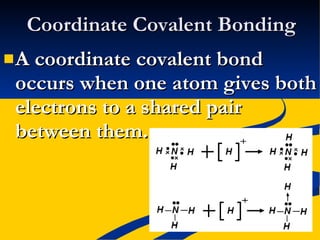
Coordinate Covalent Bonding A coordinate covalent bond occurs when one atom gives both electrons to a shared pair between them.
Coordinate Covalent Bonding In a line diagram, instead of a straight line showing a shared pair, the coordinate covalent bond is shown as an arrow.
Resonance If you draw the covalent bonding diagram of some compounds there is not only one way to draw it.
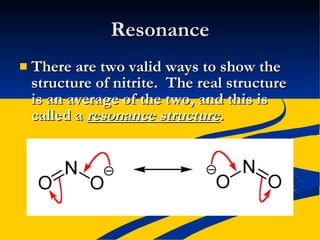
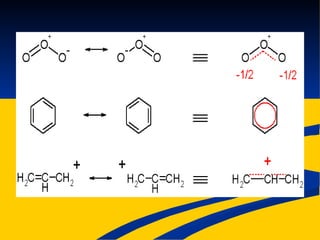
Resonance There are two valid ways to show the structure of nitrite.  The real structure is an average of the two, and this is called a  resonance structure .
Resonance, cont. Earlier chemists thought the compound just quickly flipped back and forth between the two structures (or resonated). This is proven to be untrue now using bond lengths.
 
An Addendum to Lewis Structures Carbon and silicon are exceptions to the pattern of how to place electrons in a Lewis Dot Structure.
An Addendum to Lewis Structures This is because they have hybrid orbitals (where the s and p sublevels blend together and have four equal energy orbitals.)
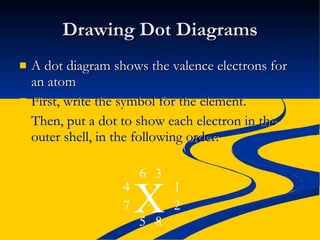
Drawing Dot Diagrams A dot diagram shows the valence electrons for an atom First, write the symbol for the element. Then, put a dot to show each electron in the outer shell, in the following order: X 1 2 8 5 7 4 6 3
The reason for this order, is the first two spots for electrons represent the one orbital in the s sublevel, the last three spots represent the three orbitals of the p sublevel.
Your book’s way to Draw Lewis Dot Structures 1.  Predict the location of certain atoms. a.  Hydrogen is always a terminal. b.  The atom with the least attraction for shared electrons in the molecule is the central atom. 2.  Find the total number of electrons available for bonding. This total is the number of valence electrons in the atoms in the molecule.
3.  Determine the number of bonding pairs by dividing the number of electrons available for  bonding by two. 4.  Place one bonding pair (single bond) between the central atom and each of the terminal atoms. 5.  Subtract the number of pairs you used in step 4 from the number of bonding pairs you determined in step 3.
6.  If the central atom is not surrounded by four electron pairs, it does not have an octet.  You  must convert one or two of the lone pairs on the terminal atoms to a double bond or a triple bond between the terminal atom and the central atom
Exceptions to the Octet Rule Some molecules and ions do not obey the octet rule.  Three reasons exist for these exceptions. 1.  A small group of molecules has an odd number of valence electrons and cannot form an octet around each atom. 2.  Coordinate covalent bond.
3.  The third group of compounds that does not follow the octet rule has central atoms that  contain more than eight valence.  This electron arrangement is referred to as an  expanded octet .
Covalent Bonding and  Polyatomic Ions A polyatomic ion is really just a  charged molecule  that bonds ionically. The charge signifies how many electrons are given/taken away.
Practice CN - SiF 4 C 2 H 4 NBr 3
Chapter 16 Notes Part II VSEPR Theory
The VSEPR Theory VSEPR stands for Valence Shell Electron Pair Repulsion theory All atoms have electrons orbiting the nucleus
The VSEPR Theory This creates several different shapes that molecules can be in. These like charges repel, causing the atoms bonded to the central atom to move as far away from each other as possible.
Shapes not involving  unshared pairs: The following shapes come about from compounds where the central atom does not have unshared pairs of electrons:
Shapes not involving  unshared pairs: Linear Trigonal Planar Tetrahedral Trigonal Bipyramidal
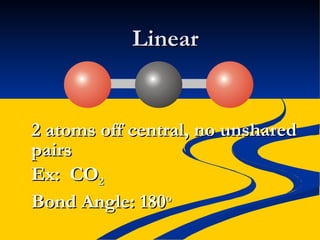
Linear 2 atoms off central, no unshared pairs Ex:  CO 2 Bond Angle: 180 o
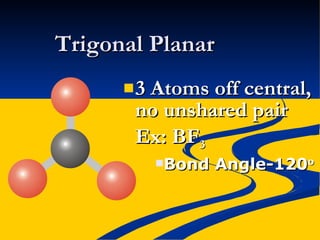
Trigonal Planar 3 Atoms off central, no unshared pair Ex: BF 3 Bond Angle-120 o
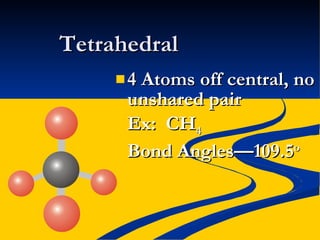
Tetrahedral 4 Atoms off central, no unshared pair Ex:  CH 4 Bond Angles—109.5 o
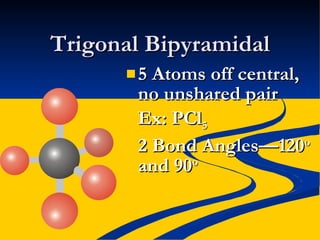
Trigonal Bipyramidal 5 Atoms off central, no unshared pair Ex: PCl 5 2 Bond Angles—120 o  and 90 o
Shapes that involve an unshared pair: These shapes are altered by one or more unshared pair on the central atom. Bent Pyramidal
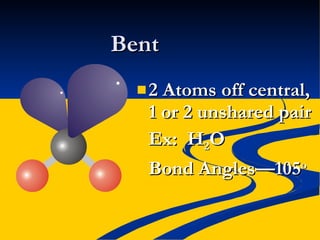
Bent 2 Atoms off central, 1 or 2 unshared pair Ex:  H 2 O Bond Angles—105 o
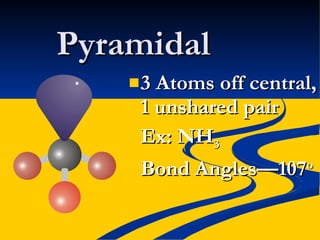
Pyramidal 3 Atoms off central, 1 unshared pair Ex: NH 3 Bond Angles—107 o
Obj. 8… Intra molecular Bonds vs.  Inter molecular Attraction Intramolecular bonds : - bonds w/in a molecule - i.e. holds H and O together in water (H 2 O) - ionic, covalent, polar covalent and metallic Intermolecular attraction : - attraction b/n two or more different molecules. - i.e. holds H 2 O molecules together in a pond.   ** always weaker than intramolecular bonds. - strength indicates solid, liquid or gas.
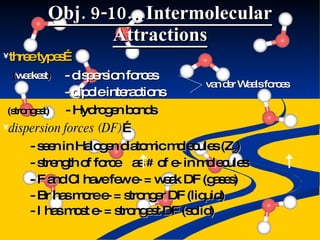
Obj. 9-10…Intermolecular Attractions three types… - dispersion forces - dipole interactions - Hydrogen bonds van der Waals forces ( weakest ) (strongest) dispersion forces (DF) … - seen in Halogen diatomic molecules (Z 2 ) - strength of force  as  #  of e- in molecules  - F and Cl have few e- = weak DF (gases)   - Br has more e- = stronger DF (liquid)   - I has most e- = strongest DF (solid)
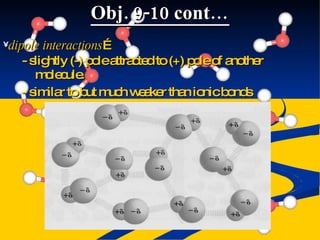
Obj. 9-10 cont… dipole interactions … - slightly (-) pole attracted to (+) pole of another molecule. - similar to but much weaker than ionic bonds
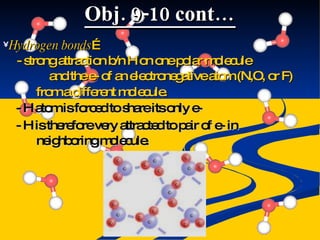
Obj. 9-10 cont… Hydrogen bonds … - strong attraction b/n H on one polar molecule and the e- of an electronegative atom (N,O, or F) from a different molecule. - H atom is forced to share its only e- - H is therefore very attracted to pair of e- in neighboring molecule.
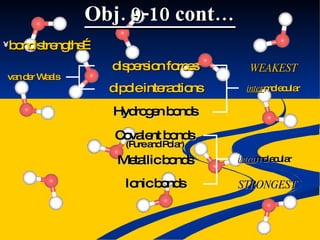
Obj. 9-10 cont… bond strengths… dispersion forces dipole interactions Hydrogen bonds Covalent bonds Metallic bonds Ionic bonds van der Waals inter molecular intra molecular WEAKEST STRONGEST (Pure and Polar)
Chapter 16 Notes, part III Bond Polarity and Molecular Polarity
Types of Bonds Up until now, we have assumed that there are two types of bonds: Covalent and Ionic. This is true, but covalent bonds can be broken into two categories
Nonpolar Covalent In nonpolar covalent bonding electrons are shared  equally . Electrons spend an equal amount of time with both elements in the bond. Typical in diatomic elements:   Br 2 , I 2 , N 2 , Cl 2 , H 2  O 2 , F 2 ,
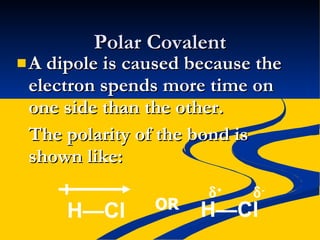
Polar Covalent In polar covalent bonding, electrons are still shared, but they are shared  unequally . This is due to one nucleus pulling the shared pair harder than the other. This creates a  dipole —a bond where one side is slightly positive and the other is slightly negative.
A dipole is caused because the electron spends more time on one side than the other. The polarity of the bond is shown like: Polar Covalent H—Cl  H—Cl    +    - OR
Ionic Bonds In an ionic bond, electrons are  transferred . The nucleus of one element pulls hard enough to take electrons away completely.
How can you tell what kind of bond there is? By looking at the difference in electronegativity! Remember, electronegativity is the tendency of an atom to attract an electron when bonding. The more electronegative, the more it will pull electrons.
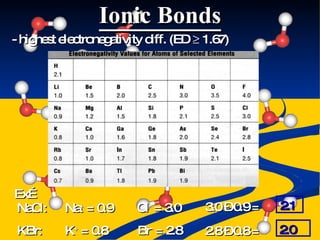
Ionic Bonds - highest electronegativity diff. (ED    1.67) Ex… NaCl: Na +  = 0.9 Cl -  = 3.0 3.0 – 0.9 =  KBr: K +  = 0.8 Br -  = 2.8 2.8 – 0.8 =  2.1 2.0
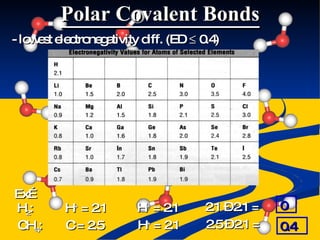
Polar Covalent Bonds - lowest electronegativity diff. (ED    0.4) Ex… H 2 : H +  = 2.1 H +  = 2.1 2.1 – 2.1 =  0 CH 4 : C = 2.5 H +  = 2.1 2.5 – 2.1 =  0.4
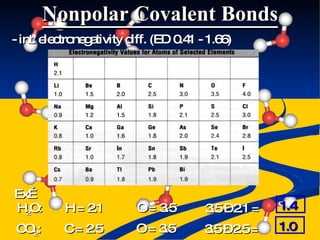
Nonpolar Covalent Bonds - int. electronegativity diff. (ED 0.41 - 1.66) Ex… H 2 O: H = 2.1 O = 3.5 3.5 – 2.1 =  1.4 CO 2 : C = 2.5 O = 3.5 3.5 – 2.5 =  1.0
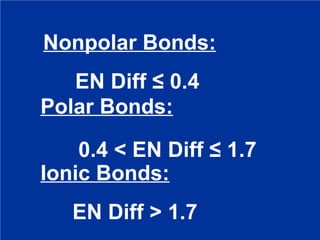
Nonpolar Bonds: EN Diff  ≤ 0.4 Polar Bonds:   0.4  < EN Diff  ≤  1.7   Ionic Bonds: EN Diff  > 1.7
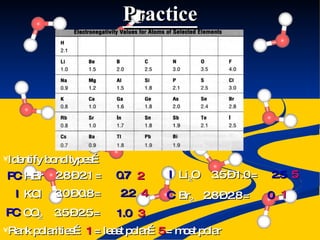
Practice Identify bond types… HBr KCl CO 2 2.8 – 2.1 = 0.7 PC 3.0 – 0.8 = 2.2 I 3.5 – 2.5 = 1.0 PC Li 2 O 3.5 – 1.0 = 2.5 I Br 2 2.8 – 2.8 = 0 Rank polarities…  1  = least polar… 5  = most polar 1 2 3 4 5 C
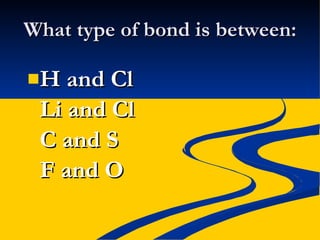
What type of bond is between: H and Cl Li and Cl C and S F and O
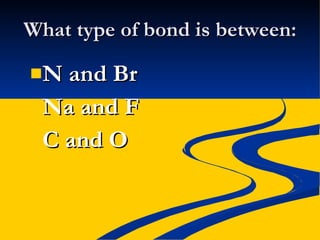
What type of bond is between: N and Br  Na and F C and O
Polar Molecules If the slightly positive and slightly negative ends of polar bonds can collect on two different sides of a molecule, it can make an entire molecule polar.
Polar Molecules If bonds are nonpolar, a molecule will always  be nonpolar.
Polar Molecules If bonds are polar and the shape of a molecule is symmetrical, the molecule will be nonpolar because the charges cancel out. (Linear, trigonal planar, tetrahedral and trigonal bipyramidal are the symmetrical shapes we talked about.)
Polar Molecules If bonds are polar and the molecule is asymmetrical, the molecule will be polar! (Bent and pyramidal molecules are asymmetrical)

Chapter 9 Pptrevised

  • 1.
    Chapter 9 NotesPart I Covalent Bonding
  • 2.
    Obj. 1…Octet RuleRecall that all elements want 8 valence e-. metals will lose their valence e-. non-metals will gain more valence e-. - (+) cations - (-) anions noble gases do not gain or lose e-. - happy already! *** atoms need other atoms in order to lose/gain e-. - electronegativity differences determine bond. - metals = low / non-metals = high electroneg.
  • 3.
    Obj. 2…Ionic Bondstransfer of e- b/n (+) cation and (-) anion. - compounds created are neutral - 10% of all bonds - strongest bond - forms crystalline solids - highest melting/boiling pts. - can conduct electricity in molten states.
  • 4.
    Obj. 3…Pure CovalentBonds equal sharing of e- b/n non-metals ( molecule ) . - compounds created are neutral - 2% of all bonds - weakest bond - typically form gases - lowest melting/boiling pts. - do NOT conduct electricity!
  • 5.
    Obj. 4…Polar CovalentBonds un-equal sharing of e- b/n non-metals ( molecule ) . - compounds created are neutral - 88% of all bonds - intermediate bond strength - typically form soft solids and liquids - intermediate melting/boiling pts. - some conduct electricity in molten states.
  • 6.
    Obj. 6…Metallic Bondscations (+) in metals are surrounded by a sea of mobile e-…(‘ delocalized e- ’). metals held together by attraction b/n e- and - cushion b/n cations cations.
  • 7.
    Obj. 6 cont…good conductors of electricity - as e- enter one end, an = # of e- leave the other ductile - can be drawn into a wire Because of mobile ‘delocalized’ e-, metals are… malleable - can be hammered
  • 8.
    Obj. 7…Bonding Vocabularyion : atom w/ a charge. - has lost or gained e- valence electron : all e- in outer ‘s’ and ‘p’ orbitals. dipole : molecule w/ one slightly (-) end and one slightly (+) end. - occurs in polar covalent bonds polyatomic ion : a group of atoms (covalently bonded), that act as a single atom - NH 4 +1 , SO 4 -2 , ClO 3 -1 molecule : atoms covalently bonded together.
  • 9.
    Covalent Bonding Acovalent bond occurs between two non-metals Electrostatic bonding does not occur—in other words, there is no “give and take” of electrons
  • 10.
    It ends upbeing a “tug of war” of electrons Where the electrons end up somewhere in the middle.
  • 11.
    Single Bonds Asingle bond occurs when one pair of electrons is shared by two atoms. This pair of bonded electrons is called a shared pair .
  • 12.
    Double and TripleBonds Double bonds occur when two atoms have two shared pair of electrons Triple bonds occur when two atoms share three pair of electrons
  • 13.
    Sigma and PiBonds How do covalent bonds form between two elements? By the combining of their p orbitals.
  • 14.
    Sigma and PiBonds The first bond between two atoms is a sigma bond (  ) and it forms because of end-to-end overlap of p orbitals.
  • 15.
    Sigma and PiBonds Any other bonds between the same atoms would be a pi bond (  ) and they form because of side-to-side overlap of p orbitals.
  • 16.
    Sigma and PiBonds Single bond = 1 sigma bond Double bond = 1 sigma+1 pi bond Triple bond = 1 sigma + 2 pi bonds
  • 17.
    Sigma and PiBonds How many sigma and pi bonds do the following compounds have? NH 3 CH 2 O SiO 2
  • 18.
    Strength of CovalentBonds The strength of a covalent bond depends on how much distance separates the bonded nuclei. This is known as bond length. Determined by size of the atoms and how many electrons pairs are shared.
  • 19.
    The shorter thebond length, the stronger the bond. Single bonds, such as F 2 , are weaker than double bonds, such as those in O 2. Double bonds are weaker than triple bonds, such as N 2 .
  • 20.
    Naming Molecules 9.2Rules to name binary molecular compounds. 1. The first element in the formula is always named first, using the entire element name. 2. The second element in the formula is named using the root of the element and adding the suffix –ide . 3. Prefixes are used to indicate the number of atoms of each type that are present in the compound.
  • 21.
    Prefixes in CovalentCompounds 1 mono- 2 di- 3 tri- 4 tetra- 5 penta- 6 hexa- 7 hepta- 8 octa- 9 non- 10 deca One exception – the first element in the formula never uses the prefix mono-. When the element name begins with a vowel drop the final letter in the prefix. CO carbon monoxide not monocarbon monooxide
  • 22.
    Naming Acids binaryacids A binary acid contains hydrogen and one other element. Use the prefix hydro- to name the hydrogen. Use the root of the second element plus the suffix -ic acid. HBr hydrobromic acid
  • 23.
    Naming Oxyacids Containsan oxyanion referred to as oxyacids. If anion suffix is -ate, it is replaced with the suffix -ic. HNO 3 (nitrate ion) nitric acid If anion suffix is -ite, it is replaced with the suffix -ous. HNO 2 (nitrite ion) nitrous acid
  • 24.
    Writing Formulas fromNames The name of any binary molecule allows you to write the correct formula with ease. Subscripts are determined from the prefixes used in the name because the name indicates the exact number of each atom present in the molecule. Carbon Monoxide CO
  • 25.
    Coordinate Covalent BondingA coordinate covalent bond occurs when one atom gives both electrons to a shared pair between them.
  • 26.
    Coordinate Covalent BondingIn a line diagram, instead of a straight line showing a shared pair, the coordinate covalent bond is shown as an arrow.
  • 27.
    Resonance If youdraw the covalent bonding diagram of some compounds there is not only one way to draw it.
  • 28.
    Resonance There aretwo valid ways to show the structure of nitrite. The real structure is an average of the two, and this is called a resonance structure .
  • 29.
    Resonance, cont. Earlierchemists thought the compound just quickly flipped back and forth between the two structures (or resonated). This is proven to be untrue now using bond lengths.
  • 30.
  • 31.
    An Addendum toLewis Structures Carbon and silicon are exceptions to the pattern of how to place electrons in a Lewis Dot Structure.
  • 32.
    An Addendum toLewis Structures This is because they have hybrid orbitals (where the s and p sublevels blend together and have four equal energy orbitals.)
  • 33.
    Drawing Dot DiagramsA dot diagram shows the valence electrons for an atom First, write the symbol for the element. Then, put a dot to show each electron in the outer shell, in the following order: X 1 2 8 5 7 4 6 3
  • 34.
    The reason forthis order, is the first two spots for electrons represent the one orbital in the s sublevel, the last three spots represent the three orbitals of the p sublevel.
  • 35.
    Your book’s wayto Draw Lewis Dot Structures 1. Predict the location of certain atoms. a. Hydrogen is always a terminal. b. The atom with the least attraction for shared electrons in the molecule is the central atom. 2. Find the total number of electrons available for bonding. This total is the number of valence electrons in the atoms in the molecule.
  • 36.
    3. Determinethe number of bonding pairs by dividing the number of electrons available for bonding by two. 4. Place one bonding pair (single bond) between the central atom and each of the terminal atoms. 5. Subtract the number of pairs you used in step 4 from the number of bonding pairs you determined in step 3.
  • 37.
    6. Ifthe central atom is not surrounded by four electron pairs, it does not have an octet. You must convert one or two of the lone pairs on the terminal atoms to a double bond or a triple bond between the terminal atom and the central atom
  • 38.
    Exceptions to theOctet Rule Some molecules and ions do not obey the octet rule. Three reasons exist for these exceptions. 1. A small group of molecules has an odd number of valence electrons and cannot form an octet around each atom. 2. Coordinate covalent bond.
  • 39.
    3. Thethird group of compounds that does not follow the octet rule has central atoms that contain more than eight valence. This electron arrangement is referred to as an expanded octet .
  • 40.
    Covalent Bonding and Polyatomic Ions A polyatomic ion is really just a charged molecule that bonds ionically. The charge signifies how many electrons are given/taken away.
  • 41.
    Practice CN -SiF 4 C 2 H 4 NBr 3
  • 42.
    Chapter 16 NotesPart II VSEPR Theory
  • 43.
    The VSEPR TheoryVSEPR stands for Valence Shell Electron Pair Repulsion theory All atoms have electrons orbiting the nucleus
  • 44.
    The VSEPR TheoryThis creates several different shapes that molecules can be in. These like charges repel, causing the atoms bonded to the central atom to move as far away from each other as possible.
  • 45.
    Shapes not involving unshared pairs: The following shapes come about from compounds where the central atom does not have unshared pairs of electrons:
  • 46.
    Shapes not involving unshared pairs: Linear Trigonal Planar Tetrahedral Trigonal Bipyramidal
  • 47.
    Linear 2 atomsoff central, no unshared pairs Ex: CO 2 Bond Angle: 180 o
  • 48.
    Trigonal Planar 3Atoms off central, no unshared pair Ex: BF 3 Bond Angle-120 o
  • 49.
    Tetrahedral 4 Atomsoff central, no unshared pair Ex: CH 4 Bond Angles—109.5 o
  • 50.
    Trigonal Bipyramidal 5Atoms off central, no unshared pair Ex: PCl 5 2 Bond Angles—120 o and 90 o
  • 51.
    Shapes that involvean unshared pair: These shapes are altered by one or more unshared pair on the central atom. Bent Pyramidal
  • 52.
    Bent 2 Atomsoff central, 1 or 2 unshared pair Ex: H 2 O Bond Angles—105 o
  • 53.
    Pyramidal 3 Atomsoff central, 1 unshared pair Ex: NH 3 Bond Angles—107 o
  • 54.
    Obj. 8… Intramolecular Bonds vs. Inter molecular Attraction Intramolecular bonds : - bonds w/in a molecule - i.e. holds H and O together in water (H 2 O) - ionic, covalent, polar covalent and metallic Intermolecular attraction : - attraction b/n two or more different molecules. - i.e. holds H 2 O molecules together in a pond. ** always weaker than intramolecular bonds. - strength indicates solid, liquid or gas.
  • 55.
    Obj. 9-10…Intermolecular Attractionsthree types… - dispersion forces - dipole interactions - Hydrogen bonds van der Waals forces ( weakest ) (strongest) dispersion forces (DF) … - seen in Halogen diatomic molecules (Z 2 ) - strength of force as # of e- in molecules - F and Cl have few e- = weak DF (gases) - Br has more e- = stronger DF (liquid) - I has most e- = strongest DF (solid)
  • 56.
    Obj. 9-10 cont…dipole interactions … - slightly (-) pole attracted to (+) pole of another molecule. - similar to but much weaker than ionic bonds
  • 57.
    Obj. 9-10 cont…Hydrogen bonds … - strong attraction b/n H on one polar molecule and the e- of an electronegative atom (N,O, or F) from a different molecule. - H atom is forced to share its only e- - H is therefore very attracted to pair of e- in neighboring molecule.
  • 58.
    Obj. 9-10 cont…bond strengths… dispersion forces dipole interactions Hydrogen bonds Covalent bonds Metallic bonds Ionic bonds van der Waals inter molecular intra molecular WEAKEST STRONGEST (Pure and Polar)
  • 59.
    Chapter 16 Notes,part III Bond Polarity and Molecular Polarity
  • 60.
    Types of BondsUp until now, we have assumed that there are two types of bonds: Covalent and Ionic. This is true, but covalent bonds can be broken into two categories
  • 61.
    Nonpolar Covalent Innonpolar covalent bonding electrons are shared equally . Electrons spend an equal amount of time with both elements in the bond. Typical in diatomic elements: Br 2 , I 2 , N 2 , Cl 2 , H 2 O 2 , F 2 ,
  • 62.
    Polar Covalent Inpolar covalent bonding, electrons are still shared, but they are shared unequally . This is due to one nucleus pulling the shared pair harder than the other. This creates a dipole —a bond where one side is slightly positive and the other is slightly negative.
  • 63.
    A dipole iscaused because the electron spends more time on one side than the other. The polarity of the bond is shown like: Polar Covalent H—Cl H—Cl  +  - OR
  • 64.
    Ionic Bonds Inan ionic bond, electrons are transferred . The nucleus of one element pulls hard enough to take electrons away completely.
  • 65.
    How can youtell what kind of bond there is? By looking at the difference in electronegativity! Remember, electronegativity is the tendency of an atom to attract an electron when bonding. The more electronegative, the more it will pull electrons.
  • 66.
    Ionic Bonds -highest electronegativity diff. (ED  1.67) Ex… NaCl: Na + = 0.9 Cl - = 3.0 3.0 – 0.9 = KBr: K + = 0.8 Br - = 2.8 2.8 – 0.8 = 2.1 2.0
  • 67.
    Polar Covalent Bonds- lowest electronegativity diff. (ED  0.4) Ex… H 2 : H + = 2.1 H + = 2.1 2.1 – 2.1 = 0 CH 4 : C = 2.5 H + = 2.1 2.5 – 2.1 = 0.4
  • 68.
    Nonpolar Covalent Bonds- int. electronegativity diff. (ED 0.41 - 1.66) Ex… H 2 O: H = 2.1 O = 3.5 3.5 – 2.1 = 1.4 CO 2 : C = 2.5 O = 3.5 3.5 – 2.5 = 1.0
  • 69.
    Nonpolar Bonds: ENDiff ≤ 0.4 Polar Bonds: 0.4 < EN Diff ≤ 1.7 Ionic Bonds: EN Diff > 1.7
  • 70.
    Practice Identify bondtypes… HBr KCl CO 2 2.8 – 2.1 = 0.7 PC 3.0 – 0.8 = 2.2 I 3.5 – 2.5 = 1.0 PC Li 2 O 3.5 – 1.0 = 2.5 I Br 2 2.8 – 2.8 = 0 Rank polarities… 1 = least polar… 5 = most polar 1 2 3 4 5 C
  • 71.
    What type ofbond is between: H and Cl Li and Cl C and S F and O
  • 72.
    What type ofbond is between: N and Br Na and F C and O
  • 73.
    Polar Molecules Ifthe slightly positive and slightly negative ends of polar bonds can collect on two different sides of a molecule, it can make an entire molecule polar.
  • 74.
    Polar Molecules Ifbonds are nonpolar, a molecule will always be nonpolar.
  • 75.
    Polar Molecules Ifbonds are polar and the shape of a molecule is symmetrical, the molecule will be nonpolar because the charges cancel out. (Linear, trigonal planar, tetrahedral and trigonal bipyramidal are the symmetrical shapes we talked about.)
  • 76.
    Polar Molecules Ifbonds are polar and the molecule is asymmetrical, the molecule will be polar! (Bent and pyramidal molecules are asymmetrical)