UNIT 11
 Biodiversity refers to the total number of
species found in an area.
 Includes the large variety of species, different
ecosystems and genetic differences.
 Endangered species: species in danger of
extinction
 Threatened species: species likely to become
endangered in the near future
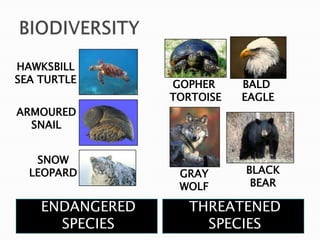
ENDANGERED
SPECIES
THREATENED
SPECIES
GOPHER
TORTOISE
BALD
EAGLE
GRAY
WOLF
BLACK
BEAR
HAWKSBILL
SEA TURTLE
ARMOURED
SNAIL
SNOW
LEOPARD
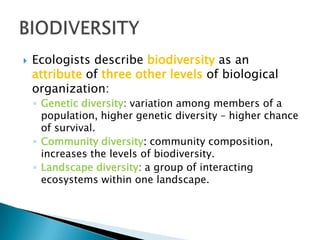
 Ecologists describe biodiversity as an
attribute of three other levels of biological
organization:
◦ Genetic diversity: variation among members of a
population, higher genetic diversity – higher chance
of survival.
◦ Community diversity: community composition,
increases the levels of biodiversity.
◦ Landscape diversity: a group of interacting
ecosystems within one landscape.
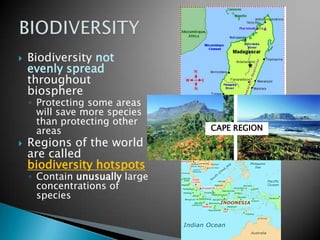
 Biodiversity not
evenly spread
throughout
biosphere
◦ Protecting some areas
will save more species
than protecting other
areas
 Regions of the world
are called
biodiversity hotspots
◦ Contain unusually large
concentrations of
species
CAPE REGION
 INDIGENOUS
SPECIES
 Occurs in a place
naturally
 Native
 A species can be
indigenous to a
number of places at
once
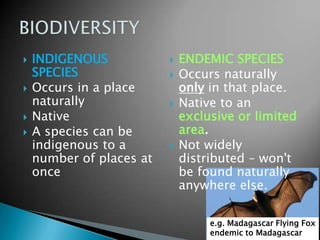
 ENDEMIC SPECIES
 Occurs naturally
only in that place.
 Native to an
exclusive or limited
area.
 Not widely
distributed – won't
be found naturally
anywhere else.
e.g. Madagascar Flying Fox
endemic to Madagascar
 More than a million species of living
organisms discovered and described
◦ Estimated ±30 million species still to be discovered
 Scientists involved in describing species are
called taxonomists
 Plant & animal species identified exhibit great
deal of variation
◦ In form, structure, mode of life & other aspects
 Plants & animals need to be divided into
discrete groups based on the differences
◦ In order to study them.
 Classification: the scientific practice of
identifying, naming and grouping of living
organisms.
 Branches of biology that deal with
classification:
◦ Taxonomy deals with describing and naming
organisms.
◦ Systematics deals with grouping and arranging the
described taxa into a hierarchical classification.
 Makes studying living organisms convenient.
 Helps in specific identification of an organism.
 Study of a few representatives from each distinct
group helps to integrate idea of life as a whole.
 Reveals relationships among various groups of
organisms.
 Provides information about plants and animals
occurring in specific geographical regions.
 Indicates evolutionary relationship
◦ Establishing gradually increasing complexity of form and
structure in different groups of organisms.
 ARISTOTLE (Greek philosopher)
◦ 1st to classify organisms
◦ Either as plants or animals
◦ He formulated the 2 kingdom system = Plantae
and Animalia
◦ Plant group subdivided into 3 smaller groups:
shrubs, herbs, and trees.
◦ Animals subdivided into groups according to
where they lived: on land, water or in the air.
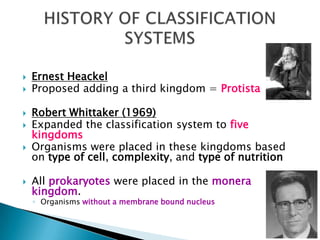
 Ernest Heackel
 Proposed adding a third kingdom = Protista
 Robert Whittaker (1969)
 Expanded the classification system to five
kingdoms
 Organisms were placed in these kingdoms based
on type of cell, complexity, and type of nutrition
 All prokaryotes were placed in the monera
kingdom.
◦ Organisms without a membrane bound nucleus
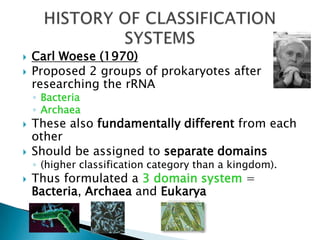
 Carl Woese (1970)
 Proposed 2 groups of prokaryotes after
researching the rRNA
◦ Bacteria
◦ Archaea
 These also fundamentally different from each
other
 Should be assigned to separate domains
◦ (higher classification category than a kingdom).
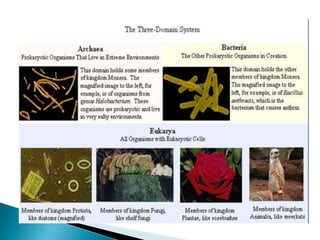
 Thus formulated a 3 domain system =
Bacteria, Archaea and Eukarya
Linnaeus’s System
 Carolus Linnaeus (Swedish Botanist)
developed a method of classifying organisms
properly.
 Based on classifying according to physical &
structural similarities.
◦ E.g. he might use the similarities in flower parts as
a basis for classifying flowering plants.
 Became foundational way for today’s modern
classification systems.
 Modern classification systems use a two-word
naming system called Binomial Nomenclature
◦ Bi: two
◦ Nomial: associated with a name
 Species is given a unique and stable name
 Meant that each species is composed of two
Latinised words (similar to name & surname)
1. Genus
2. species
 First word identifies the genus name of the
organism.
 A genus (plural form = genera) consists of a
group of similar species.
 Second word, the species, often describes a
characteristic of the organism.
 Scientific name = the Genus name + species
name
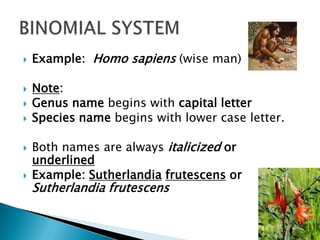
 Example: Homo sapiens (wise man)
 Note:
 Genus name begins with capital letter
 Species name begins with lower case letter.
 Both names are always italicized or
underlined
 Example: Sutherlandia frutescens or
Sutherlandia frutescens
 Latin is the language of scientific names
 Many organisms have common names just
like you might have nicknames.
 Example:
◦ Sutherlandia frutescens (scientific)
◦ Cancer bush / Kankerbos (common)
 Accepted by speakers of all languages
 Each name applies only to one species
 Each species has only one name
 A Kingdom is the largest group in the
classification system
 Encompasses all the related species
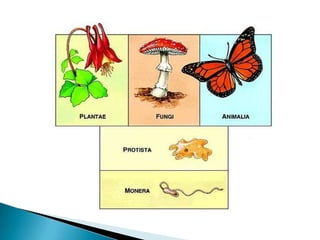
 Living organisms are subdivided into 5 major
kingdoms:
◦ MONERA
◦ PROTISTA
◦ FUNGI
◦ PLANTAE
◦ ANIMALIA
◦ (Organisms cannot belong to more than one)
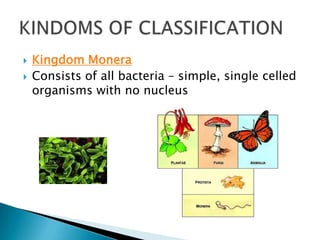
 Kingdom Monera
 Consists of all bacteria – simple, single celled
organisms with no nucleus
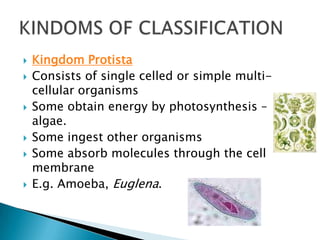
 Kingdom Protista
 Consists of single celled or simple multi-
cellular organisms
 Some obtain energy by photosynthesis –
algae.
 Some ingest other organisms
 Some absorb molecules through the cell
membrane
 E.g. Amoeba, Euglena.
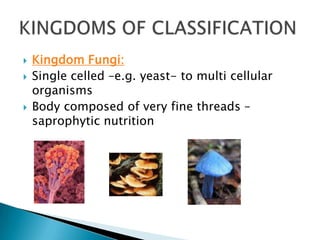
 Kingdom Fungi:
 Single celled –e.g. yeast- to multi cellular
organisms
 Body composed of very fine threads –
saprophytic nutrition
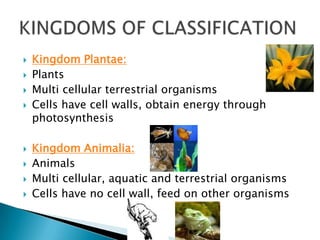
 Kingdom Plantae:
 Plants
 Multi cellular terrestrial organisms
 Cells have cell walls, obtain energy through
photosynthesis
 Kingdom Animalia:
 Animals
 Multi cellular, aquatic and terrestrial organisms
 Cells have no cell wall, feed on other organisms
Unit 11 biodiversity and classification

Unit 11 biodiversity and classification

  • 1.
  • 2.
     Biodiversity refersto the total number of species found in an area.  Includes the large variety of species, different ecosystems and genetic differences.  Endangered species: species in danger of extinction  Threatened species: species likely to become endangered in the near future
  • 3.
  • 4.
     Ecologists describebiodiversity as an attribute of three other levels of biological organization: ◦ Genetic diversity: variation among members of a population, higher genetic diversity – higher chance of survival. ◦ Community diversity: community composition, increases the levels of biodiversity. ◦ Landscape diversity: a group of interacting ecosystems within one landscape.
  • 5.
     Biodiversity not evenlyspread throughout biosphere ◦ Protecting some areas will save more species than protecting other areas  Regions of the world are called biodiversity hotspots ◦ Contain unusually large concentrations of species CAPE REGION
  • 6.
     INDIGENOUS SPECIES  Occursin a place naturally  Native  A species can be indigenous to a number of places at once  ENDEMIC SPECIES  Occurs naturally only in that place.  Native to an exclusive or limited area.  Not widely distributed – won't be found naturally anywhere else. e.g. Madagascar Flying Fox endemic to Madagascar
  • 7.
     More thana million species of living organisms discovered and described ◦ Estimated ±30 million species still to be discovered  Scientists involved in describing species are called taxonomists
  • 8.
     Plant &animal species identified exhibit great deal of variation ◦ In form, structure, mode of life & other aspects  Plants & animals need to be divided into discrete groups based on the differences ◦ In order to study them.
  • 9.
     Classification: thescientific practice of identifying, naming and grouping of living organisms.  Branches of biology that deal with classification: ◦ Taxonomy deals with describing and naming organisms. ◦ Systematics deals with grouping and arranging the described taxa into a hierarchical classification.
  • 10.
     Makes studyingliving organisms convenient.  Helps in specific identification of an organism.  Study of a few representatives from each distinct group helps to integrate idea of life as a whole.  Reveals relationships among various groups of organisms.  Provides information about plants and animals occurring in specific geographical regions.  Indicates evolutionary relationship ◦ Establishing gradually increasing complexity of form and structure in different groups of organisms.
  • 11.
     ARISTOTLE (Greekphilosopher) ◦ 1st to classify organisms ◦ Either as plants or animals ◦ He formulated the 2 kingdom system = Plantae and Animalia ◦ Plant group subdivided into 3 smaller groups: shrubs, herbs, and trees. ◦ Animals subdivided into groups according to where they lived: on land, water or in the air.
  • 12.
     Ernest Heackel Proposed adding a third kingdom = Protista  Robert Whittaker (1969)  Expanded the classification system to five kingdoms  Organisms were placed in these kingdoms based on type of cell, complexity, and type of nutrition  All prokaryotes were placed in the monera kingdom. ◦ Organisms without a membrane bound nucleus
  • 13.
     Carl Woese(1970)  Proposed 2 groups of prokaryotes after researching the rRNA ◦ Bacteria ◦ Archaea  These also fundamentally different from each other  Should be assigned to separate domains ◦ (higher classification category than a kingdom).  Thus formulated a 3 domain system = Bacteria, Archaea and Eukarya
  • 15.
    Linnaeus’s System  CarolusLinnaeus (Swedish Botanist) developed a method of classifying organisms properly.  Based on classifying according to physical & structural similarities. ◦ E.g. he might use the similarities in flower parts as a basis for classifying flowering plants.  Became foundational way for today’s modern classification systems.
  • 16.
     Modern classificationsystems use a two-word naming system called Binomial Nomenclature ◦ Bi: two ◦ Nomial: associated with a name  Species is given a unique and stable name  Meant that each species is composed of two Latinised words (similar to name & surname) 1. Genus 2. species
  • 17.
     First wordidentifies the genus name of the organism.  A genus (plural form = genera) consists of a group of similar species.  Second word, the species, often describes a characteristic of the organism.  Scientific name = the Genus name + species name
  • 18.
     Example: Homosapiens (wise man)  Note:  Genus name begins with capital letter  Species name begins with lower case letter.  Both names are always italicized or underlined  Example: Sutherlandia frutescens or Sutherlandia frutescens
  • 19.
     Latin isthe language of scientific names  Many organisms have common names just like you might have nicknames.  Example: ◦ Sutherlandia frutescens (scientific) ◦ Cancer bush / Kankerbos (common)  Accepted by speakers of all languages  Each name applies only to one species  Each species has only one name
  • 20.
     A Kingdomis the largest group in the classification system  Encompasses all the related species  Living organisms are subdivided into 5 major kingdoms: ◦ MONERA ◦ PROTISTA ◦ FUNGI ◦ PLANTAE ◦ ANIMALIA ◦ (Organisms cannot belong to more than one)
  • 21.
     Kingdom Monera Consists of all bacteria – simple, single celled organisms with no nucleus
  • 22.
     Kingdom Protista Consists of single celled or simple multi- cellular organisms  Some obtain energy by photosynthesis – algae.  Some ingest other organisms  Some absorb molecules through the cell membrane  E.g. Amoeba, Euglena.
  • 23.
     Kingdom Fungi: Single celled –e.g. yeast- to multi cellular organisms  Body composed of very fine threads – saprophytic nutrition
  • 24.
     Kingdom Plantae: Plants  Multi cellular terrestrial organisms  Cells have cell walls, obtain energy through photosynthesis  Kingdom Animalia:  Animals  Multi cellular, aquatic and terrestrial organisms  Cells have no cell wall, feed on other organisms

Editor's Notes

  • #14 The Archaea are a group of single-celled microorganisms. Eukarya: The domain comprised of eukaryotes or organisms whose cells contain a true nucleus