UNIT 5:
ANIMAL
REPRODUCTION AND
DEVELOPMENT
Campbell & Reece, 2010:
Chapters 46, 47
INTRODUCTION
 Animal reproduction takes
many forms
 Animal form and function can
be viewed broadly as
adaptations contributing to
reproductive success.
 Both asexual and sexual
reproduction occur in the
animal kingdom.
Sexual reproduction
Is the creation of an offspring
by fusion
of a male gamete (sperm)
and female gamete (egg)
to form a zygote
Asexual reproduction
Is creation of offspring
without the fusion of egg and
sperm.
ASEXUAL
REPRODUCTION
Mechanisms of Asexual
Reproduction
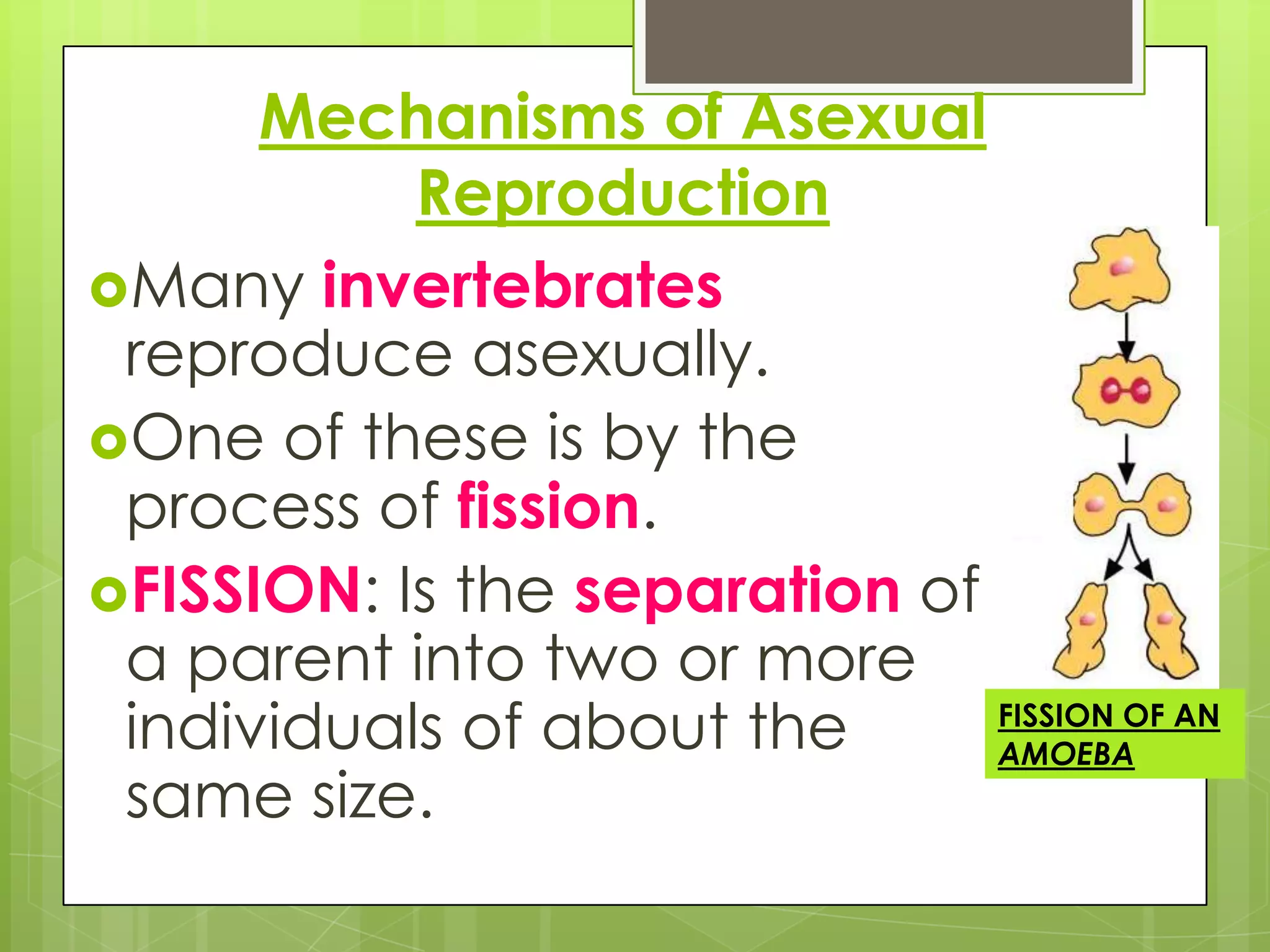
Many invertebrates
reproduce asexually.
One of these is by the
process of fission.
FISSION: Is the separation of
a parent into two or more
individuals of about the
same size.
FISSION OF AN
AMOEBA
Fission of a sea anemone to producer
two daughter organisms
Second method: BUDDING
In budding, new individuals arise
from outgrowths of existing ones
BUDDING OF A
HYDRA
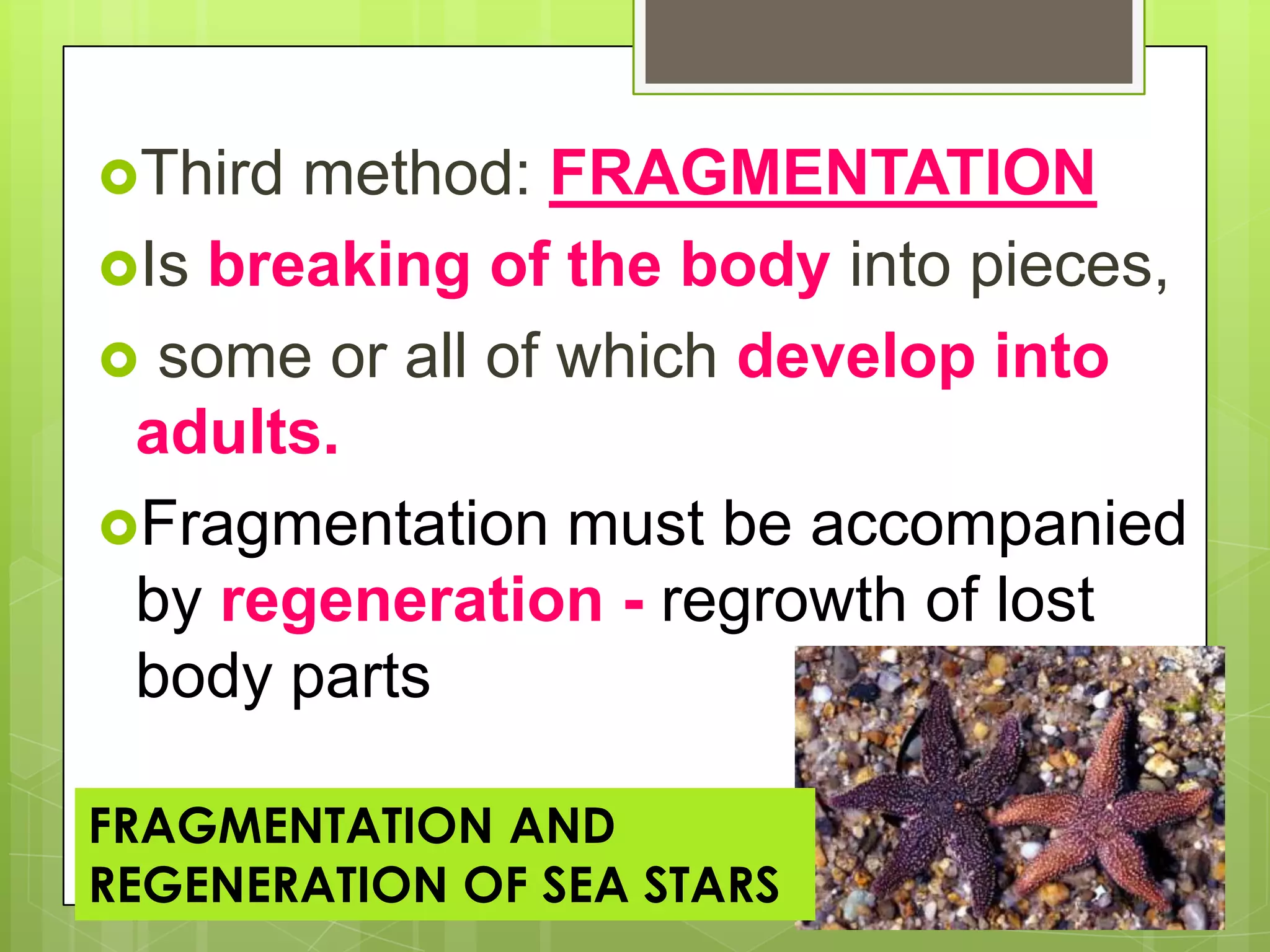
Third method: FRAGMENTATION
Is breaking of the body into pieces,
 some or all of which develop into
adults.
Fragmentation must be accompanied
by regeneration - regrowth of lost
body parts
FRAGMENTATION AND
REGENERATION OF SEA STARS
 Fourth method: Parthenogenesis
 Is the development of a new
individual from an unfertilized egg
SEXUAL
REPRODUCTION
Introduction to sexual
Reproduction in animals
Almost all eukaryotic species
reproduce sexually.
Sexual reproduction results in
genetic recombination –
variation within species.
Genetic recombination provides
potential advantages:
1. An increase in variation in offspring,
2. An increase in the reproductive
success of parents in changing
environments.
3. An increase in the rate of
adaptation.
4. Elimination of harmful genes from
a population.
REPRODUCTIVE
CYCLES AND
PATTERNS
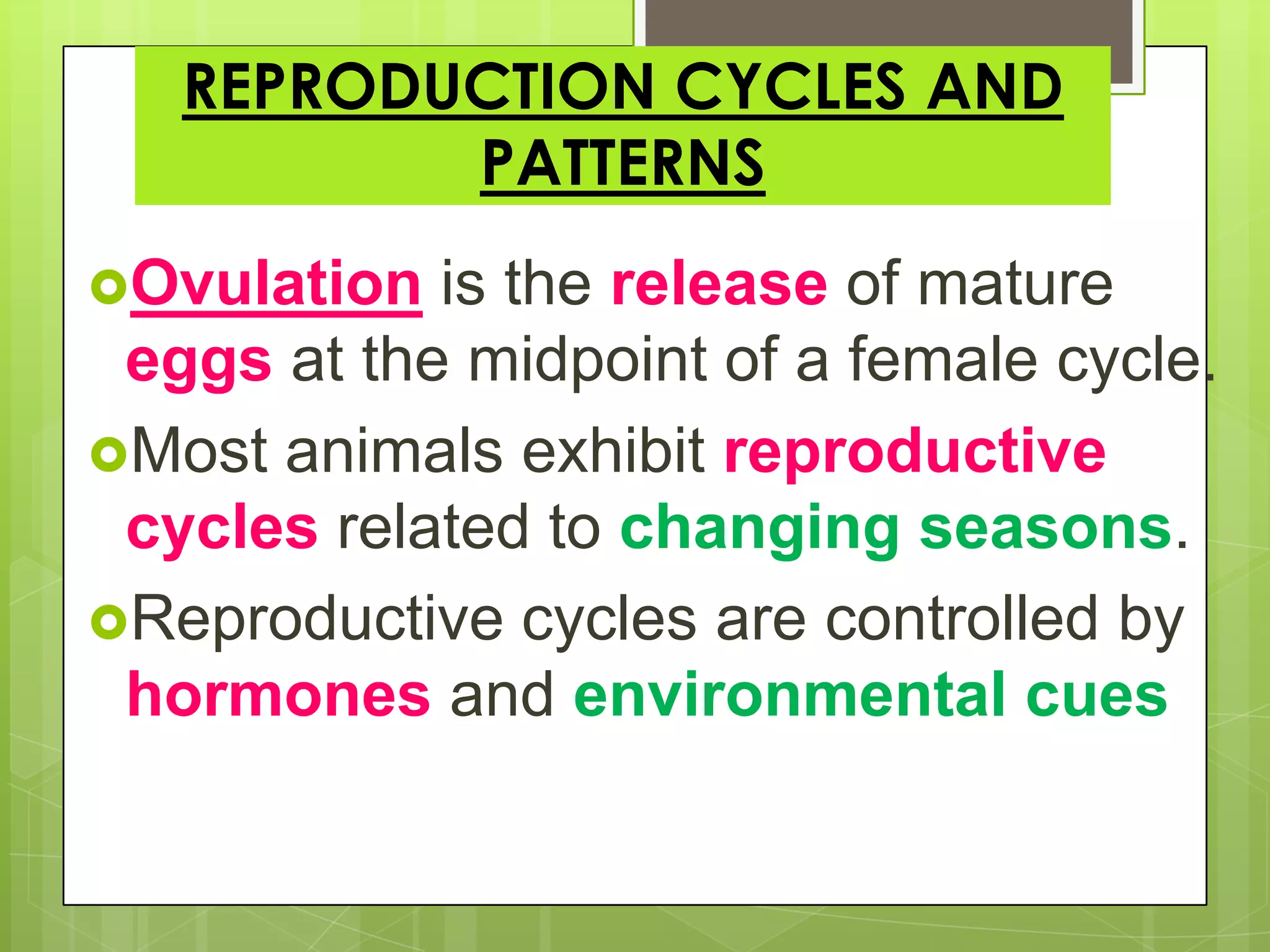
REPRODUCTION CYCLES AND
PATTERNS
Ovulation is the release of mature
eggs at the midpoint of a female cycle.
Most animals exhibit reproductive
cycles related to changing seasons.
Reproductive cycles are controlled by
hormones and environmental cues
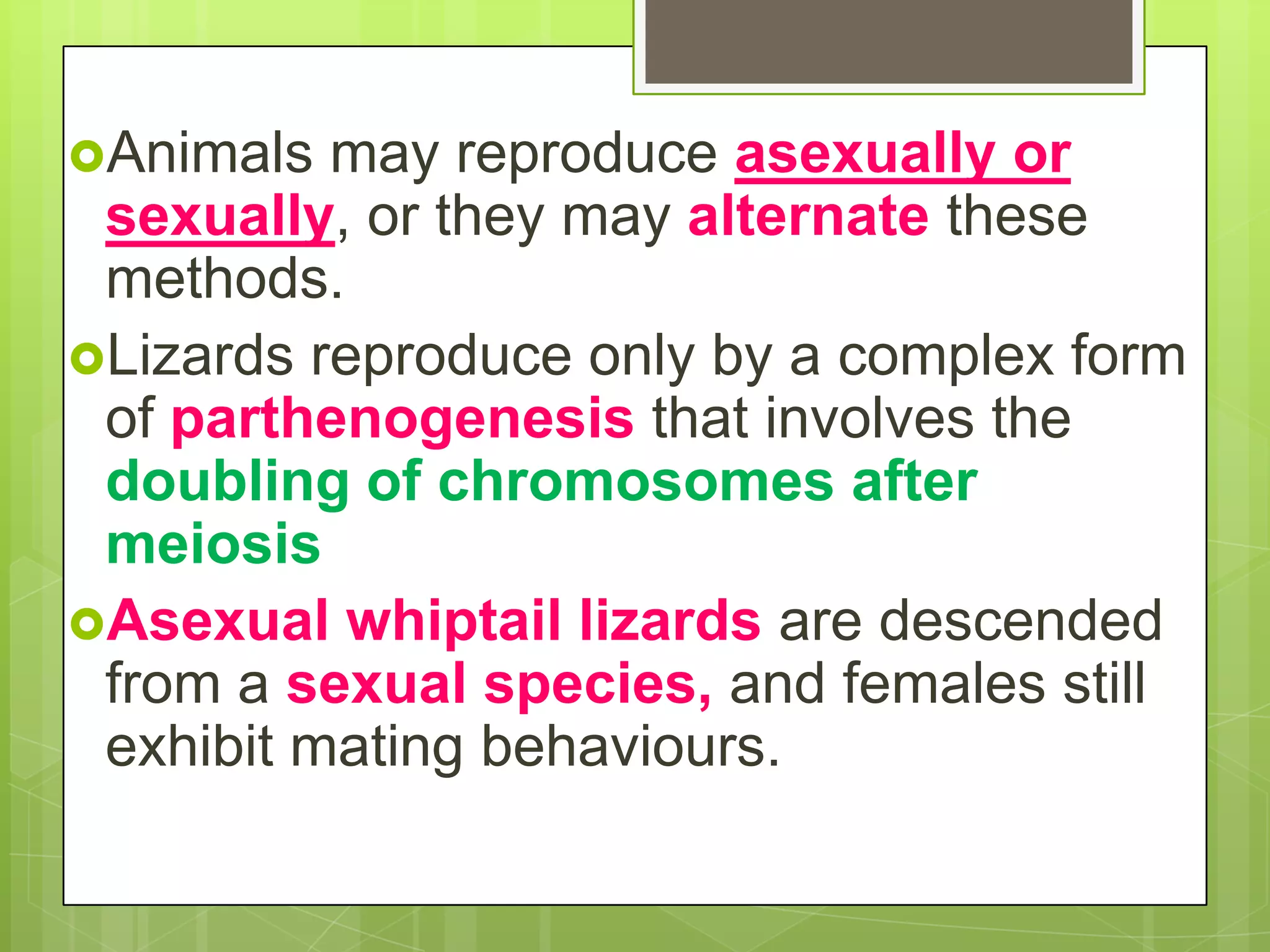
Animals may reproduce asexually or
sexually, or they may alternate these
methods.
Lizards reproduce only by a complex form
of parthenogenesis that involves the
doubling of chromosomes after
meiosis
Asexual whiptail lizards are descended
from a sexual species, and females still
exhibit mating behaviours.
Sexual behavior in
parthenogenetic lizards
Sexual reproduction is a special
problem for organisms that
seldom encounter a mate.
One solution is hermaphroditism,
in which each individual has male
and female reproductive systems
Some hermaphrodites can self-
fertilize.
C. elegans makes both sperm
and eggs and can reproduce
by self-fertilization.
Individuals of some species undergo
sex reversals
Some species exhibit male to
female reversal (for example,
certain oysters),
while others exhibit female to male
reversal (for example, a coral reef
fish)
HOW DO
ORGANISMS
ENSURE THE
SURVIVAL OF
THEIR
OFFSPRING?
Ensuring the Survival of Offspring
All species produce more
offspring than the environment
can handle.
The proportion that survives is
small.
Species with external fertilization
produce more gametes than
species with internal fertilization.
Species with internal fertilization
provide greater protection of the
embryos and more parental care.
The embryos of some terrestrial animals
develop in amniote eggs with
protective layers.
Other animals retain the embryo,
which develops inside the female.
In many animals, parental care helps
ensure survival of offspring.
 AMNIOTIC EGG OF A CHICKEN
 PARENTAL CARE OF AN INVERTEBRATE
GAMETE
PRODUCTION
AND DELIVERY
Gamete Production and Delivery
Sexually reproducing animals have
systems producing gametes.
These individuals have gonads -
organs producing gametes.
Male gonads : Testis
Female gonads: Ovaries
Some gametes form from
undifferentiated tissue.
GONADS: MALE – TESTIS AND
FEMALE - OVARIES
Complex systems contain many
sets of:
 accessory tubes
 and glands that
carry
nourish,
and protect gametes and
developing embryos.
Some organisms have a cloaca:
is a common opening between
the external environment and the
digestive, excretory, and
reproductive systems
Common in non-mammalian
vertebrates;
Mammals usually have a
separate opening to the digestive
tract.
CLOACA OF A LIZARD
Monogamy is relatively rare
among animals.
Males and/or females which
have mechanisms to decrease
the chance of their mate mating
with another individual.
COURTSHIP
BEHAVIOUR
Courtship, in
animals –
behaviour that
results in mating and
eventual
reproduction
Courtship behaviours can
include:
special calls,
postures, and
movements,
special plumage,
bright colours or
other ornamentation
EXAMPLES
The 'dancing' done by male
birds of paradise.
Method of
reproduction in
which eggs are
laid and
embryos
develop
Three Methods of reproduction in
which eggs are laid and embryos
develop
Ovipary
Ovovivipary
Vivipary
OVIPARYOUS ORGANISMS
Reproduction in which eggs are laid
and embryos develop outside the
mother's body.
Each egg eventually hatching into a
young animal.
Little or no development occurs within
the mother's body.
Most invertebrates and many
vertebrates reproduce in this way.
Ovoviviparous:
Animals produce eggs, but instead
of laying the eggs, the eggs develop
within the mother's body.
The young eat unfertilized eggs in
the womb for nourishment
The young are born alive
without placental attachment
(umbilical cord),
as certain reptiles, fishes, sharks,
insects.
VIVIPAROUS
Where the embryo develops
within the uterus.
and is nourished through a
yolk sac placenta from the
mother’s blood.
Young are born alive.
 most mammals and some
reptiles and fishes.
OVOVIVIPAROUS
ANIMAL
DEVELOPMENT
Introduction to animal development
The question of how a zygote becomes
an animal?
The first step is cell division (mitosis)
Second step: Cell differentiation (Is the
specialization of cells in structure and
function)
Third step: Morphogenesis (Is the
process by which an animal takes
shape.)
Fertilization
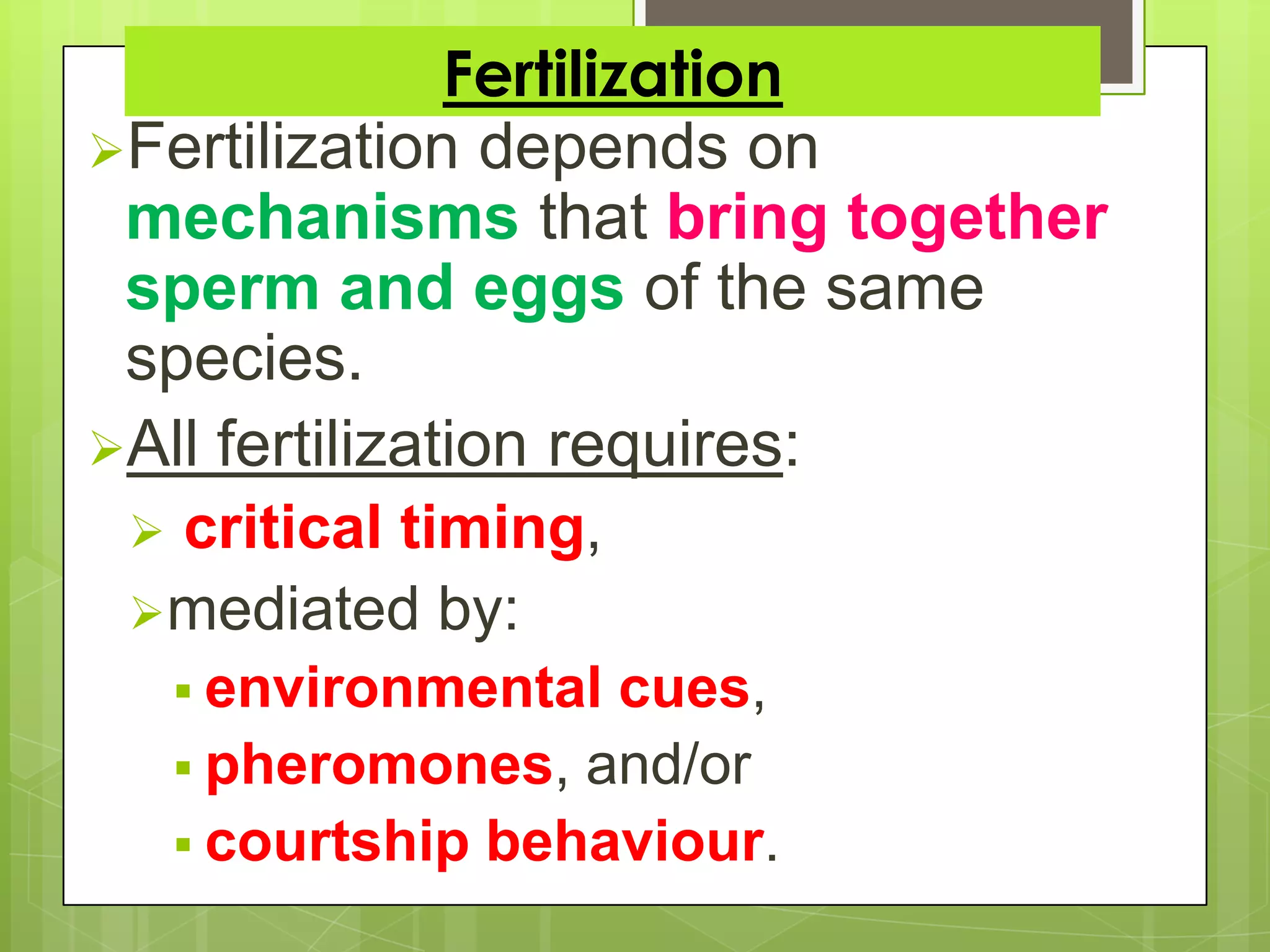
Fertilization
Fertilization depends on
mechanisms that bring together
sperm and eggs of the same
species.
All fertilization requires:
 critical timing,
mediated by:
 environmental cues,
 pheromones, and/or
 courtship behaviour.
Fertilization
Two types of fertilizations:
 External fertilization
 Internal fertilization
External Fertilization
In external fertilization,
eggs shed by the female
are fertilized by sperm of male
in the external environment.
Internal Fertilization
In internal fertilization,
sperm are deposited in or near the
female reproductive tract,
and fertilization occurs within the
tract
Internal Fertilization
Internal fertilization requires:
 behavioural interactions and
 compatible copulatory organs.
MALE
COPULATORY
ORGANS
PROCESS OF FERTILIZATION
Fertilization brings the haploid nuclei
of sperm and egg together, forming a
diploid zygote.
The sperm’s contact with the egg’s
surface initiates metabolic reactions
in the egg that trigger the onset of
embryonic development.
Metabolic reactions:
Acrosomal reaction
Cortical reaction
ACROSOMAL REACTION
Triggered when the sperm meets
the egg.
The acrosome, at the tip of the
sperm releases hydrolytic enzymes
that digest material surrounding the
egg.
Gamete contact depolarizes the
egg cell membrane and sets up a
fast block to polyspermy.
Sperm contacts egg
Acrosome releases
hydrolytic enzymes –
digest egg jelly coat
Actin filaments of acrosomal process
binds to the sperm binding receptors.
Plasma membranes of sperm
and egg fuses
Sperm releases haploid nucleus in egg cytoplasm
– fast block prevent polyspermy.
The Cortical Reaction
Initiated by the fusion of egg and
sperm.
It causes a rise in Ca2+.
This stimulates cortical granules to
release their contents outside the
egg.
Cause formation of a fertilization
envelope (functions as a slow
block to polyspermy.)
Rise of calcium in egg and
formation of fertilization envelope
Activation of the Egg
The sharp rise in Ca2+ in the egg’s
cytosol increases the rates of
cellular respiration and protein
synthesis by the egg cell.
Now the egg is said to be activated.
The sperm nucleus merges with the
egg nucleus to form a diploid
zygote and cell division begins.
EMBRYONIC DEVELOPMENT AFTER
FERTILIZATION
3 PROCESSES OCCURE IN AN EMBRYO
AFTER FERTILIZATION:
1.Cleavage
2.Gastrulation
3.Organogenesis
1. CLEAVAGE
A period of rapid cell division
without growth.
This creates a hollow ball of cells
called a blastula.
The blastula consists of many
smaller cells called blastomeres
The hollow part of the blastula is
filled with fluid and called a
blastocoel.
CELL DIVISION OF A FERTILIZED
EGG FORMING A BLASTULA
Two types of cleavage
Meroblastic cleavage, incomplete
division of the egg, occurs in species
with yolk-rich eggs, such as reptiles
and birds.
Holoblastic cleavage, complete
division of the egg, occurs in species
whose eggs have little or moderate
amounts of yolk, such as sea urchins
and frogs
2. Gastrulation
Gastrulation –
rearranges the cells of a
blastula into a three-layered
embryo, called a gastrula,
which has a primitive gut
(archenteron)and opens in a
blastopore.
Three embryonic germ layers
of the gastrula
The ectoderm forms the outer
layer
The endoderm lines the
digestive tract.
The mesoderm partly fills the
space between the endoderm
and ectoderm.
GASTRULA OF A FROG
3. ORGANOGENESIS
During organogenesis, various
regions of the germ layers
develop into organs.
Early in vertebrate
organogenesis, the notochord
forms from mesoderm, and the
neural plate forms from
ectoderm.
ORGANOGENESIS
OF A FROG
The neural plate soon curves
inward, forming the neural tube
The neural tube will become
the central nervous system
(brain and spinal cord).
THE FATE OF THE 3 GERM
LAYERS
Fig. 47-14
ECTODERM MESODERM ENDODERM
Epidermis of skin and its
derivatives (including sweat
glands, hair follicles)
Epithelial lining of mouth
and anus
Cornea and lens of eye
Nervous system
Sensory receptors in
epidermis
Adrenal medulla
Tooth enamel
Epithelium of pineal and
pituitary glands
Notochord
Skeletal system
Muscular system
Muscular layer of
stomach and intestine
Excretory system
Circulatory and lymphatic
systems
Reproductive system
(except germ cells)
Dermis of skin
Lining of body cavity
Adrenal cortex
Epithelial lining of
digestive tract
Epithelial lining of
respiratory system
Lining of urethra, urinary
bladder, and reproductive
system
Liver
Pancreas
Thymus
Thyroid and parathyroid
glands
AMNIOTES
Developmental Adaptations of
Amniotes
Embryos of birds, other reptiles,
and mammals develop in a fluid-
filled sac in a shell or the uterus
Organisms with these adaptations
are called amniotes.
During amniote development, four
extraembryonic membranes form around
the embryo:
The chorion functions in gas exchange
The amnion encloses the amniotic fluid
The yolk sac encloses the yolk
The allantois disposes of waste products
and contributes to gas exchange.
EXTRAEMBRYONIC LAYERS OF BIRDS
PRECOCIAL
AND ALTRICIAL
DEVELOPMENT
PRECOCIAL YOUNG
ALTRICIAL YOUNG
At birth the young may be well-developed
and able to move about at once, this is
called precocial development.
If at birth the young are maybe blind,
hairless, and essentially helpless, it is
called altricial development.
In general, precocial young are born after
a relatively long gestation period and in a
small litter.
Hares and many large grazing mammals
bear precocial offspring.
Rabbits, carnivores, and most rodents
bear altricial young.

Unit 5 animal reproduction and development

  • 1.
  • 2.
    INTRODUCTION  Animal reproductiontakes many forms  Animal form and function can be viewed broadly as adaptations contributing to reproductive success.  Both asexual and sexual reproduction occur in the animal kingdom.
  • 3.
    Sexual reproduction Is thecreation of an offspring by fusion of a male gamete (sperm) and female gamete (egg) to form a zygote
  • 4.
    Asexual reproduction Is creationof offspring without the fusion of egg and sperm.
  • 5.
  • 6.
    Mechanisms of Asexual Reproduction Manyinvertebrates reproduce asexually. One of these is by the process of fission. FISSION: Is the separation of a parent into two or more individuals of about the same size. FISSION OF AN AMOEBA
  • 7.
    Fission of asea anemone to producer two daughter organisms
  • 8.
    Second method: BUDDING Inbudding, new individuals arise from outgrowths of existing ones BUDDING OF A HYDRA
  • 9.
    Third method: FRAGMENTATION Isbreaking of the body into pieces,  some or all of which develop into adults. Fragmentation must be accompanied by regeneration - regrowth of lost body parts FRAGMENTATION AND REGENERATION OF SEA STARS
  • 10.
     Fourth method:Parthenogenesis  Is the development of a new individual from an unfertilized egg
  • 11.
  • 12.
    Introduction to sexual Reproductionin animals Almost all eukaryotic species reproduce sexually. Sexual reproduction results in genetic recombination – variation within species.
  • 13.
    Genetic recombination provides potentialadvantages: 1. An increase in variation in offspring, 2. An increase in the reproductive success of parents in changing environments. 3. An increase in the rate of adaptation. 4. Elimination of harmful genes from a population.
  • 14.
  • 15.
    REPRODUCTION CYCLES AND PATTERNS Ovulationis the release of mature eggs at the midpoint of a female cycle. Most animals exhibit reproductive cycles related to changing seasons. Reproductive cycles are controlled by hormones and environmental cues
  • 16.
    Animals may reproduceasexually or sexually, or they may alternate these methods. Lizards reproduce only by a complex form of parthenogenesis that involves the doubling of chromosomes after meiosis Asexual whiptail lizards are descended from a sexual species, and females still exhibit mating behaviours.
  • 17.
  • 18.
    Sexual reproduction isa special problem for organisms that seldom encounter a mate. One solution is hermaphroditism, in which each individual has male and female reproductive systems Some hermaphrodites can self- fertilize. C. elegans makes both sperm and eggs and can reproduce by self-fertilization.
  • 19.
    Individuals of somespecies undergo sex reversals Some species exhibit male to female reversal (for example, certain oysters), while others exhibit female to male reversal (for example, a coral reef fish)
  • 20.
  • 21.
    Ensuring the Survivalof Offspring All species produce more offspring than the environment can handle. The proportion that survives is small. Species with external fertilization produce more gametes than species with internal fertilization.
  • 22.
    Species with internalfertilization provide greater protection of the embryos and more parental care. The embryos of some terrestrial animals develop in amniote eggs with protective layers. Other animals retain the embryo, which develops inside the female. In many animals, parental care helps ensure survival of offspring.
  • 23.
     AMNIOTIC EGGOF A CHICKEN
  • 24.
     PARENTAL CAREOF AN INVERTEBRATE
  • 25.
  • 26.
    Gamete Production andDelivery Sexually reproducing animals have systems producing gametes. These individuals have gonads - organs producing gametes. Male gonads : Testis Female gonads: Ovaries Some gametes form from undifferentiated tissue.
  • 27.
    GONADS: MALE –TESTIS AND FEMALE - OVARIES
  • 28.
    Complex systems containmany sets of:  accessory tubes  and glands that carry nourish, and protect gametes and developing embryos.
  • 29.
    Some organisms havea cloaca: is a common opening between the external environment and the digestive, excretory, and reproductive systems Common in non-mammalian vertebrates; Mammals usually have a separate opening to the digestive tract.
  • 30.
  • 31.
    Monogamy is relativelyrare among animals. Males and/or females which have mechanisms to decrease the chance of their mate mating with another individual.
  • 32.
    COURTSHIP BEHAVIOUR Courtship, in animals – behaviourthat results in mating and eventual reproduction
  • 33.
    Courtship behaviours can include: specialcalls, postures, and movements, special plumage, bright colours or other ornamentation
  • 34.
    EXAMPLES The 'dancing' doneby male birds of paradise.
  • 36.
    Method of reproduction in whicheggs are laid and embryos develop
  • 37.
    Three Methods ofreproduction in which eggs are laid and embryos develop Ovipary Ovovivipary Vivipary
  • 38.
    OVIPARYOUS ORGANISMS Reproduction inwhich eggs are laid and embryos develop outside the mother's body. Each egg eventually hatching into a young animal. Little or no development occurs within the mother's body. Most invertebrates and many vertebrates reproduce in this way.
  • 39.
    Ovoviviparous: Animals produce eggs,but instead of laying the eggs, the eggs develop within the mother's body. The young eat unfertilized eggs in the womb for nourishment The young are born alive without placental attachment (umbilical cord), as certain reptiles, fishes, sharks, insects.
  • 40.
    VIVIPAROUS Where the embryodevelops within the uterus. and is nourished through a yolk sac placenta from the mother’s blood. Young are born alive.  most mammals and some reptiles and fishes.
  • 42.
  • 43.
  • 44.
    Introduction to animaldevelopment The question of how a zygote becomes an animal? The first step is cell division (mitosis) Second step: Cell differentiation (Is the specialization of cells in structure and function) Third step: Morphogenesis (Is the process by which an animal takes shape.)
  • 45.
  • 46.
    Fertilization Fertilization depends on mechanismsthat bring together sperm and eggs of the same species. All fertilization requires:  critical timing, mediated by:  environmental cues,  pheromones, and/or  courtship behaviour.
  • 47.
    Fertilization Two types offertilizations:  External fertilization  Internal fertilization
  • 48.
    External Fertilization In externalfertilization, eggs shed by the female are fertilized by sperm of male in the external environment.
  • 49.
    Internal Fertilization In internalfertilization, sperm are deposited in or near the female reproductive tract, and fertilization occurs within the tract
  • 50.
    Internal Fertilization Internal fertilizationrequires:  behavioural interactions and  compatible copulatory organs. MALE COPULATORY ORGANS
  • 51.
    PROCESS OF FERTILIZATION Fertilizationbrings the haploid nuclei of sperm and egg together, forming a diploid zygote. The sperm’s contact with the egg’s surface initiates metabolic reactions in the egg that trigger the onset of embryonic development. Metabolic reactions: Acrosomal reaction Cortical reaction
  • 52.
    ACROSOMAL REACTION Triggered whenthe sperm meets the egg. The acrosome, at the tip of the sperm releases hydrolytic enzymes that digest material surrounding the egg. Gamete contact depolarizes the egg cell membrane and sets up a fast block to polyspermy.
  • 53.
  • 54.
    Acrosome releases hydrolytic enzymes– digest egg jelly coat
  • 55.
    Actin filaments ofacrosomal process binds to the sperm binding receptors.
  • 56.
    Plasma membranes ofsperm and egg fuses
  • 57.
    Sperm releases haploidnucleus in egg cytoplasm – fast block prevent polyspermy.
  • 58.
    The Cortical Reaction Initiatedby the fusion of egg and sperm. It causes a rise in Ca2+. This stimulates cortical granules to release their contents outside the egg. Cause formation of a fertilization envelope (functions as a slow block to polyspermy.)
  • 59.
    Rise of calciumin egg and formation of fertilization envelope
  • 60.
    Activation of theEgg The sharp rise in Ca2+ in the egg’s cytosol increases the rates of cellular respiration and protein synthesis by the egg cell. Now the egg is said to be activated. The sperm nucleus merges with the egg nucleus to form a diploid zygote and cell division begins.
  • 61.
    EMBRYONIC DEVELOPMENT AFTER FERTILIZATION 3PROCESSES OCCURE IN AN EMBRYO AFTER FERTILIZATION: 1.Cleavage 2.Gastrulation 3.Organogenesis
  • 62.
    1. CLEAVAGE A periodof rapid cell division without growth. This creates a hollow ball of cells called a blastula. The blastula consists of many smaller cells called blastomeres The hollow part of the blastula is filled with fluid and called a blastocoel.
  • 63.
    CELL DIVISION OFA FERTILIZED EGG FORMING A BLASTULA
  • 64.
    Two types ofcleavage Meroblastic cleavage, incomplete division of the egg, occurs in species with yolk-rich eggs, such as reptiles and birds. Holoblastic cleavage, complete division of the egg, occurs in species whose eggs have little or moderate amounts of yolk, such as sea urchins and frogs
  • 65.
    2. Gastrulation Gastrulation – rearrangesthe cells of a blastula into a three-layered embryo, called a gastrula, which has a primitive gut (archenteron)and opens in a blastopore.
  • 66.
    Three embryonic germlayers of the gastrula The ectoderm forms the outer layer The endoderm lines the digestive tract. The mesoderm partly fills the space between the endoderm and ectoderm.
  • 67.
  • 68.
    3. ORGANOGENESIS During organogenesis,various regions of the germ layers develop into organs. Early in vertebrate organogenesis, the notochord forms from mesoderm, and the neural plate forms from ectoderm.
  • 69.
  • 70.
    The neural platesoon curves inward, forming the neural tube The neural tube will become the central nervous system (brain and spinal cord).
  • 71.
    THE FATE OFTHE 3 GERM LAYERS Fig. 47-14 ECTODERM MESODERM ENDODERM Epidermis of skin and its derivatives (including sweat glands, hair follicles) Epithelial lining of mouth and anus Cornea and lens of eye Nervous system Sensory receptors in epidermis Adrenal medulla Tooth enamel Epithelium of pineal and pituitary glands Notochord Skeletal system Muscular system Muscular layer of stomach and intestine Excretory system Circulatory and lymphatic systems Reproductive system (except germ cells) Dermis of skin Lining of body cavity Adrenal cortex Epithelial lining of digestive tract Epithelial lining of respiratory system Lining of urethra, urinary bladder, and reproductive system Liver Pancreas Thymus Thyroid and parathyroid glands
  • 72.
  • 73.
    Developmental Adaptations of Amniotes Embryosof birds, other reptiles, and mammals develop in a fluid- filled sac in a shell or the uterus Organisms with these adaptations are called amniotes.
  • 74.
    During amniote development,four extraembryonic membranes form around the embryo: The chorion functions in gas exchange The amnion encloses the amniotic fluid The yolk sac encloses the yolk The allantois disposes of waste products and contributes to gas exchange.
  • 75.
  • 76.
  • 77.
    At birth theyoung may be well-developed and able to move about at once, this is called precocial development. If at birth the young are maybe blind, hairless, and essentially helpless, it is called altricial development. In general, precocial young are born after a relatively long gestation period and in a small litter. Hares and many large grazing mammals bear precocial offspring. Rabbits, carnivores, and most rodents bear altricial young.